

We use cookies to ensure our website works properly and to personalise your experience. Cookies policy
Siddhant College of Pharmacy, Sudumbre, Maharashtra 410501
The present study focused on the formulation and evaluation of herbal antispasmodic effervescent tablets containing thymol extracted from Trachyspermum ammi (Ajwain). Thymol is a naturally occurring monoterpene phenol known for its antispasmodic, antimicrobial, antioxidant, and anti-inflammatory activities. The objective of the study was to develop a stable, effective, and patient-friendly effervescent dosage form that provides rapid relief from gastrointestinal spasmodic conditions. Thymol was extracted from crushed ajwain seeds by reflux extraction using ethanol and water as solvents. The extracted thymol was incorporated into effervescent tablets using citric acid and sodium bicarbonate as effervescent agents, along with excipients such as HPMC, sucrose, starch, and sodium starch glycolate. The prepared tablets were evaluated for preformulation and post-formulation parameters, including bulk density, tapped density, angle of repose, hardness, thickness, friability, pH, and effervescence time. The formulated tablets showed satisfactory evaluation results with a bulk density of 1.60 g/cc, tapped density of 1.50 g/cm³, angle of repose of 38°, hardness of 4 kg/cm², friability of 0.067%, and effervescence time of 53.9 seconds. The formulation demonstrated acceptable physicochemical properties and rapid effervescence, indicating good patient compliance and therapeutic potential. The study concludes that thymol extracted from ajwain can be successfully formulated into stable herbal antispasmodic effervescent tablets.
Gastrointestinal spasms are commonly associated with abdominal pain, indigestion, irritable bowel syndrome, intestinal colic, and other digestive disorders. These conditions arise due to the involuntary contraction of smooth muscles in the gastrointestinal tract, resulting in discomfort and pain. Antispasmodic agents are widely used to relieve such conditions by relaxing smooth muscle contractions.
Herbal medicines have gained significant importance in recent years because of their safety, affordability, and reduced adverse effects compared to synthetic drugs. Among various herbal constituents, thymol has attracted considerable attention because of its potent pharmacological activities. Thymol is a monoterpene phenolic compound primarily obtained from Trachyspermum ammi (Ajwain) and Thymus vulgaris (Thyme). It possesses antimicrobial, antifungal, antioxidant, anti-inflammatory, and antispasmodic properties.
Ajwain belongs to the family Apiaceae and is commonly used in traditional Indian medicine for the treatment of digestive disorders, cough, indigestion, and flatulence. The major active constituent present in ajwain is thymol, which contributes to its therapeutic effects. Thymol exerts antispasmodic action mainly by relaxing gastrointestinal smooth muscles through calcium channel modulation and inhibition of acetylcholine-induced contractions.
Effervescent tablets are specialized oral dosage forms that rapidly disintegrate in water and release carbon dioxide gas due to the reaction between acids and bicarbonates. These formulations improve patient compliance, provide a rapid onset of action, and are especially suitable for geriatric and pediatric patients who experience difficulty swallowing conventional tablets.
The present study was aimed at developing and evaluating herbal antispasmodic effervescent tablets containing thymol extracted from ajwain seeds.
2. AIM AND OBJECTIVES
Aim
To formulate and evaluate herbal antispasmodic effervescent tablets containing thymol extracted from Trachyspermum ammi.
Objectives
3. LITERATURE REVIEW
Several studies have reported the pharmacological importance of ajwain and thymol.
1. Gurdip Singh et al. reported that ajwain essential oil contains thymol as the major constituent along with p-cymene and γ-terpinene. The study demonstrated significant antioxidant and antimicrobial activity of ajwain oil.
2. Boskabady et al. reviewed the pharmacological effects of Carum copticum and reported its bronchodilator, antihypertensive, antispasmodic, and antimicrobial properties.
3. Begrow et al. studied the impact of thymol on antispasmodic activity and ciliary clearance and confirmed its smooth muscle relaxant activity.
4. Gujar and Wagh demonstrated microwave-assisted extraction methods for the isolation of thymol from Trachyspermum ammi seeds and reported improved extraction efficiency.
5. Recent reviews on effervescent tablets highlighted advantages such as rapid drug release, improved patient compliance, enhanced palatability, and ease of administration.
Previous studies on herbal effervescent formulations suggest that herbal active compounds can be effectively incorporated into modern pharmaceutical dosage forms to improve therapeutic efficacy and patient acceptability.
4. MATERIALS AND METHODS
4.1 Materials
The materials used in the study included:
1. Carom seeds –
Biological name: Trachyspermum ammi (L) Sprague
Family: Apiaceae (formerly Umbelliferae)
Biological Source: Dried Seed
Extract – Thymol Chemical
formula: C10H14O
Molecular weight: 150.22g/mol
Chemical nature: Monoterpene phenol
2. Citric acid Chemical nature:
It is a weak organic acid
Source: lemon juice
Biological name: Citrus limon
Family: Rutaceae
Molecular weight: 192.14g/mol Chemical formula: C6H8O7
3. Sodium bicarbonate
Molecular weight: 84.01g/mol
Chemical formula: NaHCO3
Chemical nature: It is a weak base (mildly alkaline salt)
|
Sr. No. |
Ingredient |
Quantity |
|
1 |
Thymol Extract |
50 mL |
|
2 |
Citric Acid |
30 g |
|
3 |
Sodium Bicarbonate |
30 g |
|
4 |
Sucrose |
25 g |
|
5 |
Salt |
5 g |
|
6 |
HPMC |
5 g |
|
7 |
Sodium Starch Glycolate |
115 g |
4.2 Extraction of Thymol
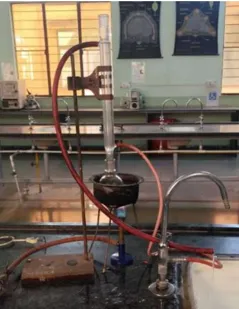
Fig no 1
4.3 Formulation of Thymol Granules
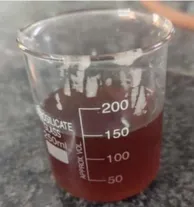
Fig no 2
4.4 Preparation of Sodium Bicarbonate Granules
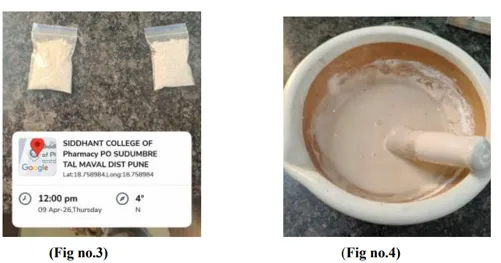
4.5 Tablet Compression
Equal quantities of thymol granules and sodium bicarbonate granules were blended and compressed into tablets using a tablet compression machine. Each tablet weighed approximately 1 g.
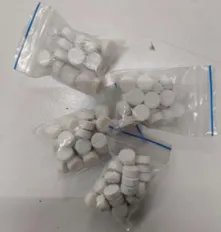
Fig no 5
5. EVALUATION PARAMETERS
5.1 Preformulation Studies
A. Bulk Density
Bulk density was determined as the ratio of the mass of powder to the bulk volume occupied.
B. Tapped Density
Tapped density was measured after mechanically tapping the powder for a fixed number of times.
C. Angle of Repose
Angle of repose was determined to evaluate the flow properties of granules.
D. Carr’s Compressibility Index
Carr’s index was used to assess powder flowability and compressibility.
5.2 Evaluation of Tablets
A. Effervescence Time
The time required for complete disintegration and release of carbon dioxide in water was measured.
B. PH Determination
pH of tablet solution after dissolution was determined.
C. Hardness
Tablet hardness was measured using a hardness tester.

fig no 6
D. Thickness
The thickness of tablets was measured using vernier calipers.
E. Friability
The friability test was performed to evaluate mechanical strength.
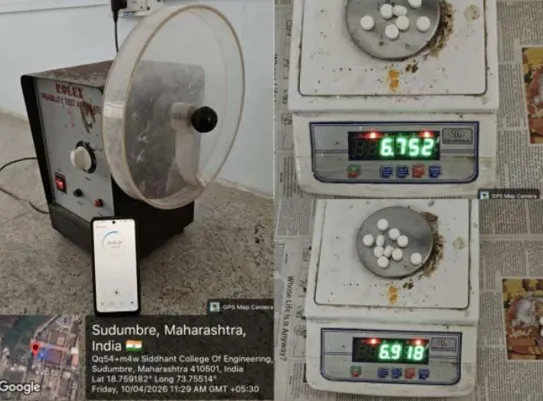
Fig no 7
6. RESULTS AND DISCUSSION
6.1 Preformulation Studies
|
Parameter |
Result |
Standard |
|
Bulk Density |
1.60 g/cc |
1.6–1.75 g/cc |
|
Tapped Density |
1.50 g/cm³ |
1.10–1.60 g/cm³ |
|
Angle of Repose |
38° |
Acceptable |
The obtained bulk density and tapped density values indicated satisfactory packing properties of granules. The angle of repose showed acceptable flow behavior necessary for tablet compression.
6.2 Tablet Evaluation
|
Parameter |
Result |
|
Effervescence Time |
53.9 sec |
|
pH |
Neutral |
|
Shape |
Round |
|
Colour |
White with slight brown tint |
|
Hardness |
4 kg/cm² |
|
Thickness |
7 mm |
|
Friability |
0.067% |
The prepared tablets exhibited rapid effervescence and acceptable mechanical strength. Friability values were below the pharmacopoeial limit of 1%, indicating good tablet integrity. Neutral pH suggests suitability for oral administration without gastric irritation.
The rapid disintegration of tablets may enhance drug release and therapeutic efficacy. Effervescent formulations improve patient compliance due to pleasant taste and ease of administration.
7. CONCLUSION
The present study successfully formulated and evaluated herbal antispasmodic effervescent tablets containing thymol extracted from Trachyspermum ammi. The extraction process effectively isolated thymol from ajwain seeds, and the prepared tablets exhibited satisfactory physicochemical characteristics.
The formulation demonstrated acceptable hardness, low friability, rapid effervescence, and suitable pH, indicating good stability and patient acceptability. The developed herbal effervescent tablets may serve as a promising alternative to conventional synthetic antispasmodic formulations for the management of gastrointestinal spasmodic disorders.
Further pharmacological and clinical studies are recommended to establish therapeutic efficacy and long-term stability.
REFERENCES

Sunita Shewalkar, Shriyog Suroshi, Arshahmad Shikalgar, Bharat Jagtap, Pratik Aghav, Pooja Prajapati, Formulation and Evaluation of Antispasmodic Effervescent Tablets from Extracted Thymol, Int. J. of Pharm. Sci., 2026, Vol 4, Issue 6, 320-326. https://doi.org/10.5281/zenodo.20491928
 10.5281/zenodo.20491928