

We use cookies to ensure our website works properly and to personalise your experience. Cookies policy
1.Research Scholer, Department of Pharmaceutics, Smt. Tarawati Institute of Bio-Medical & Allied Sciences, Roorkee, Uttarakhand.
2.Associate professor, Department of Pharmaceutics, Smt. Tarawati Institute of Bio-Medical & Allied Sciences, Roorkee, Uttarakhand.
3.Associate professor, Department of Pharmaceutics, Smt. Tarawati Institute of Bio-Medical & Allied Sciences, Roorkee, Uttarakhand
Introduction: Bi-layer tablets, which combine two or more Active Pharmaceutical Ingredients (API) in a single dosage form to promote patient convenience and compliance. Bi-layer tablets may be the best solution to prevent chemical incompatibilities between APIS by physical separation and to enable the development of various medication release profiles (Immediate release with prolonged release) Objective : The main objective of this study to Formulation and evaluation of Bilayer Tablet of Diltiazem & Benazepril Hydrochloride containing solid dispersion technique. Identification studies of drug, Selection of suitable analytical methods for Diltiazem and BZ, Formulation of solid dispersion (complex) for solubility enhancement of BZ, Evaluation of solid dispersion. Preparation of bilayer tablet, Evaluation of tablet, Simultaneous estimation of Diltiazem and BZ. Method : firstly blend the all ingredients and API of both formulation was found to be satisfactory after being evaluated for several precompression parameters, including as Hausner's ratio, bulk density, tapped density, compressibility index, and angle of repose. Prepare the Diltiazem tablet as a first layer Using the Direct Compression technique then prepare The benazepril hydrochloride tablet and both prepare tablet compressed each other. The tablets were evaluated for a number of attributes, such as weight variation, thickness, hardness, friability, wetting time, water absorption ratio, disintegration time, content homogeneity, and in vitro drug release . Result: The API formulations in the study, were created utilizing super disintegration agents solubility enhancing agents and other excipients like Sodium starch glycolate 6%. Resulting this talet have 186±1 melting point. Hardness 3.2-5kg/cm2 , Thickness 2.7±12mm Friability 10%, weight variation 0.5% and disintegration tine in min Diltiazem is 3 min and BZ is 15 min. Simultaneous the Diltiazem concentration was present in the binary mixture 1.44. cy was the concentration of BZ was present in the binary mixture was 3.91. and drug releasing 78.7% in 30 min. Conclusion: One of the most difficult areas of drug research is still improving the oral bioavailability of poorly water soluble medications. In recent years, the availability of surface active carriers has made it possible to successfully construct SD systems for preclinical clinical and commercial usage
Bilayer tablet
The pharmaceutical industry has grown more interested in recent years in creating bi-layer tablets, which combine two or more Active Pharmaceutical Ingredients (API) in a single dosage form to promote patient convenience and compliance. Bi-layer tablets may be the best solution to prevent chemical incompatibilities between APIS by physical separation and to enable the development of various medication release profiles (immediate release with prolonged release)[1].
Combination therapy has a number of benefits over monotherapy, such as the problem of dose-dependent side effects is minimized, a low dose combination of two different agents reduces the dose-related risk, the addition of one agent may counteract some detrimental effects of another, and a low dose combination of two different agents minimizes the clinical and metabolic effects that occur with a maximal dosage of each individual component of a combined table[2].
The goal of any drug delivery system is to provide a therapeutic amount of drug to the proper site in the body to achieve and maintain desired drug concentration. Combination products are two or more active drug substances in a single dosage form, which provide the advantages of combination therapy in patients with chronic conditions like hypertension, while reducing the number of prescriptions and the attendant administrative costs with improving patient compliance. Clinically, combination therapy in hypertension treatment involves two or more drugs from different classes can result in better drug efficacy and is recommended for initial stage of hypertension treatment.
Advantages of bilayer tablet
Disadvantages of bilayer
Solubility
Most drugs exhibit a low and variable in vivo bioavailability due to poor water solubility. This is true for different routes of administration. Enhancement of their solubility and dissolution rates is required for increasing their in vivo bioavailability. Poor drug solubility also makes it very hard to perform high-through put screening of compounds for potential drug effects. Therefore, there is an urgent need for intelligent drug formulations with improved bioavailability. Many different strategies have been developed to overcome the problem of poor solubility of drugs. These include micellar solubilization, using inclusion compounds and complexation. An alternative means that has been developed is the use of submicron carriers. The main advantage of submicron particles (SMPs) formation is an increase in the surface area and the concentration gradient of these poorly soluble compounds, followed by an increase in the rate of dissolution of the compounds according to the Noyes– Whitney equation[6,7].
Class I
High solubility High permeability
Class II
Low solubility High permeability
ClassIII
High solubility Low permeability
Class Ⅳ
Low solubility High permeability
Preparation of bilayer tablets
Bilayer tablet means combination of 2 drugs, in which 1st-layer intended for immediate release with the 2nd layer meant for sustained release. First layer of drug is released first and second one is in extended-release form. Two incompatible drugs may be compressed into two different layers and minimizes the area of contact between the two layers. Figure 2 shows the preparation of bilayer tablets.[8]
Compaction
Adequate mechanical strength and desired release summary are required for the formulation of tablets. Drugs having poor flow and compatibility problems will result in capping and/or lamination. Compressibility and consolidation, both are involved in compaction.
Compression
In compression, bulk volume may be reduced and the particles come closer to each other.
Consolidation
In consolidation, the mechanical strength of the material is increased due to inter-particle interaction (bonding)
Material and method
|
S.no. |
Chemicals |
Supplier |
|
1. |
BENAZEPRIL HYDEROCHLORIDE |
Cris Pharma India Limited |
|
2. |
DILTIAZEM |
Cris Pharma India Limited |
|
3. |
AEROSIL 200 |
Cris Pharma India Limited |
|
4. |
CROSSPOVIDONE |
Cris Pharma India Limited |
|
5. |
LACTOSE MONOHYDRATE |
Loba chemie |
|
6. |
MICROCRYSTALLINE CELLULOSE (MCC)PH 102 |
Cris Pharma India Limited |
|
7. |
MAGNESIUM STEARATE PRECIPITATED |
Cris Pharma India Limited |
|
8. |
STARCH -1500 |
Yarrow chem |
|
9. |
D-SORBITOL |
Loba chemie |
|
10. |
SUCROSE |
Loba chemie |
|
11. |
HYDROCHLORIC ACID 0.1 MOLl/L (0.1N) FOR 500 ML SOLUTION |
Cris Pharma India Limited |
|
12 |
SODIUM STARCH GLYCOLATE |
Loba Chemie |
|
13 |
2-HP-β-CYCLODEXTRINE |
Himedia |
|
14 |
METHANOL |
|
Determination of melting point
Melting point determination The drug Diltiazem and BZ will be filled in one end fused Capillary tube and was kept into digital melting point apparatus. The temperature at which drug was start melting will be noted as melting point[9,10]
Calibration curve of Diltiazem in 0.01N HCl
Standard stock solution will be prepared by adding 10 mg Diltiazem was dissolved in 100 ml of 0.01N HCl to volumetric flask to prepare (100μg/ml). Several dilutions will be made to prepare solution concentration ranging between (3μg/ml-24μg/ml) and volume made unto mark.The solutions prepared will further be analyzed and a standard plot will be made and lambda max (λmax) will be determined.[11,12]
Calibration curve of Benazepril hydrochloride in 0.01N HCl
Standard stock solution will be prepared by adding 10 mg BZ was dissolved in 100 ml of 0.01N HCl to volumetric flask to prepare (100μg/ml). Several dilutions will be made to prepare solution concentration ranging between (3μg/ml-24μg/ml) and volume made upto mark.The solutions prepared will further be analyzed and a standard plot will be made and lambda max (λmax) will be determined[13]
Calibration curve of Binary mixture in 0.01 N HCl
Standard stock solution will be prepared by adding 10 mg Diltiazem, 10 mg BZ was dissolved in 100 ml of 0.01N HCl to volumetric flask to prepare (200μg/ml). Several dilutions will be made to prepare solution concentration ranging between (3μg/ml-24μg/ml) and volume made upto mark.The solutions prepared will further be analyzed and a standard plot will be made and lambda max (λmax) will be determined[14,15]
Preparation of Diltiazem (Blend -1)
Sift the weighed quantity of Amlodipine besylate, microcrystalline cellulose used as diluent, sodium starch glycolate used as super disintegration, aerosil used as glidant , magnesium stearate used as lubricant, sunset yellow is used as colouring agent, sifted material into blender and blends it for 10 min. Weigh accurately for each tablet. The punch used for the compression was 12 mm diameter (punch number 9).The total weight of each blend 1 tablet was 150 mg[16]
Prepration of Benazepril hydrochloride(Blend -2)
Sift the weighed quantities of benazepril hydrochloride-CD, microcrystalline cellulose used as diluent, crosspovidone used as disintegration, aerosil used as glidant, magnesium stearate used as lubricant, sifted material into the blender and blend it for 10 minutes. Weigh accurately of Benazepril hydrochloride(solid dispersion ) layer for each layer. Compression was made by using 12 mm punches (punch number 9). The total weight of each blend 2 tablet was adjusted to 250 mg[17,18]
Preparation of bilayer tablet
Weigh accurately layer 1 placed in the die cavity and punched by direct compression method by (16 station tablet punching machine) with low compression force.The total weight of each layer 1 tablet was 150 mg. Weigh accurately layer 2 Benazeoril hydrochloride then placed in die cavity and allowed for punched by direct compression method by (16 station tablet punching machine) (punch number 9) [19]
Post compression studies
Thickness and diameter
Physical dimensions the controlled parameter for preparation of formulation. Thickness and diameter are prominent parameter in market place and also for formulated tablet uniformity. These dimensions were checked through “Digital vernier caliper” in mm.
The thickness of the tablets was determined using a Vernier caliper. 30 tablets from formulation were used and average values were calculated[20,21].
Hardness
The resistance of tablets to shipping, breakage, under conditions of storage, transportation and handling before usage depends on its hardness. For each formulation, the hardness of 6 tablets was determined using the Monsanto hardness tester. The tablet was held along its oblong axis in between the two jaws of the tester. At this point, reading should be zero kg/cm2 . Then constant force was applied by rotating the knob until the tablet fractured. The value at this point was noted[22,23].
Friability
Friability is a measure of tablet strength. Friability was tested using a Roche Friabilator with the following procedure. In this test, a series of tablets are subjected to the combined effects of impact abrasion using a plastic chamber rotating at a speed of 25 rpm, dropping tablets from a distance of 6 inches with each rotation. pre-weighed samples of 6 tablets were placed in the Roche Friabilator and rotated 100 revolutions, or 100 revolutions. Four minutes, operated. The tablets were then dusted and weighed again. A weight loss of less than 1.% is generally considered acceptable. Fracture rate (% F) was calculated[24,25].
Weight of variation
To investigate weight variability, 20 tablets of formulation type were individually weighed using an electronic balance, the average weight was calculated, and then the individual tablet weights of were compared to the average. , found weight variations[26,27]
Disintegration test
The disintegration test is carried out in an apparatus (Electro lab, Mumbai) containing a basket rack assembly with six glass tubes of 7.75 cm in length and 2.15 mm in diameter, the bottom of which consists of a #10 mesh sieve. The basket is raised and lowered 28–32 times per minute in a medium of 900 mL medium which is 0.01N HCL (pH 2 maintained at 37 ± 2∘ C. Six tablets were placed in each of the tubes and the time required for complete passage of tablet fragments through the mesh (#10) was considered as the disintegration time of the tablet.[28,29]
Drug content
Weigh 5 tablets of formulation, grind in a mortar, weigh powder corresponding to 25 mg dissolve in 100 ml 0.01 N HCl (pH 2) Did. This is a stock solution where a 0.2 mL sample is taken and diluted to 10 mL with 0.01 N HCl. Absorbance was measured at wavelengths 364 nm, 239 nm and 237nm using a double-beam UV-Vis spectrophotometer. The drug content should be within the range between 90 and 110% of standard amount[30,32].
In-vitro Dissolution
Dissolution testing was performed using a USP Type II (paddle type) dissolution apparatus. Analysis was performed in 900 mL of 0.01N HCl (pH 2) maintained at 37°C and 100 rpm. A 10 ml aliquot of the sample was taken after 5 minutes. Time intervals were replaced with equivalents of fresh 0.01N HCl (pH 2) maintained at 37°C. Collected samples were analyzed with a UV spectrophotometer at 364 nm 239, 237nm using 0.01N HCl as a blank. A standard curve was used to determine drug content in eluted samples. The collected samples were filtered and observed in UV spectrophotometer.[32,33]
Result & Discussion
Table 1: Determination of melting point
|
Drug |
Observed MP ºC |
Mean ±SD |
Reported |
||
|
|
MP1 |
MP2 |
MP3 |
|
|
|
BZ |
179 |
178 |
179 |
178.6±0.577 |
183 |
|
Diltiazem |
185 |
187 |
186 |
186±1 |
195 |
Calibration curve of Diltiazem in 0.01N HCL at 364, 239, 237 λmax
Method is described in section 4.2.2.1 the standard plot of AM in 0.01N HCL indicates that the standard curve of Diltiazem followed Beer’s law. Linearity between 1-10 µg/ ml and R2 value was found to be at 364nm 0.9987, 239 nm 0.9981,237nm 0.9986.
Table 2: Calibration curve of Diltiazem
|
Concentration |
Absorbance±SD |
||
|
(µg/ml) |
λmax 364 |
λmax 239 |
λmax 237 |
|
3 |
0.039±0.0182 |
0.097±0.053 |
0.095±0.038 |
|
6 |
0.0763±0.0314 |
0.198±0.094 |
0.195±0.076 |
|
9 |
0.128±0.0213 |
0.340±0.058 |
0.335±0.044 |
|
12 |
0.187±0.0066 |
0.494±0.011 |
0.488±0.009 |
|
15 |
0.234±0.0075 |
0.621±0.0007 |
0.616±0.019 |
|
18 |
0.287±0.005 |
0.76±0.0091 |
0.751±0.0068 |
|
21 |
0.335±0.008 |
0.867±0.033 |
0.877±0.025 |
|
24 |
0.382±0.011 |
0.991±0.022 |
0.992±0.043 |
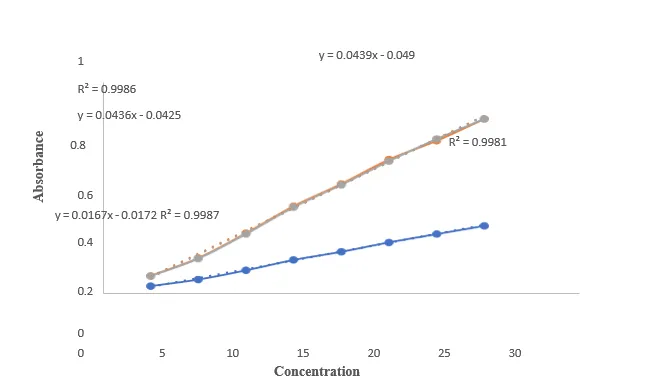
Figure;1 Standard plot of Diltiazem at 364nm,239nm,237nm in 0.01 N HCL.
Calibration curve of Benazepril Hydrochloride in 0.01N HCL at 364, 239, 236λmax
Method is described in section 4.2.2.2 the standard plot of BZ in 0.01 N HCL indicates that the standard curve of BZ followed Beer’s law. Linearity between 1-10 µg/ ml and R2 was found to be at 364nm 0.085, 239 nm 0.9993,236nm 0.9992. BZ was not show linearity at 364 nm.
Table:3 Absorbance of BZ in 0.01 N HCL.
|
Concentration |
Absorbance±SD |
||
|
(µg/ml) |
364 λmax |
239 λmax |
237 λmax |
|
3 |
0.0033±0.0040 |
0.057±0.001 |
0.056±0.0005 |
|
6 |
0.0046±0.0063 |
0.109±0.008 |
0.109±0.0087 |
|
9 |
0.0046±0.0045 |
0.175±0.0058 |
0.174±0.0055 |
|
12 |
0.005±0.0043 |
0.228±0.0045 |
0.229±0.0040 |
|
15 |
0.0026±0.0015 |
0.285±0.021 |
0.282±0.017 |
|
18 |
0.005±0.0045 |
0.34±10.0085 |
0.342±0.0085 |
|
21 |
0.003±0.0017 |
0.41±0.009 |
0.41±0.0095 |
|
24 |
0.0033±0.0015 |
0.464±0.018 |
0.465±0.0190 |
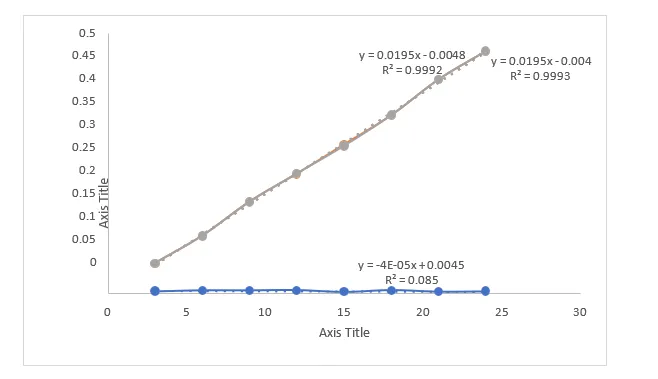
Figure 2 Standard plot of BZ at 364nm,239nm,237nm in 0.01 N HCL.
Calibration curve of Binary Mixture in 0.01N HCL at 364, 239, 236λmax
Method is described in section 4.2.2.3 the standard plot of Binary Mixture in 0.01 N HCL indicates that the standard curve of Binary mixture followed Beer’s law. Linearity between 1-10 µg/ ml and R2 was found to be at 364nm 0.9991, 239 nm 0.9985,237nm 0.9987.
Table: 4 Absorbance of Binary Mixture in 0.01 N HCL.
|
Concentration |
Absorbance±SD |
||
|
(µg/ml) |
364λmax |
239λmax |
237λmax |
|
0 |
0 |
0 |
0 |
|
3 |
0.053±0.001 |
0.207±0.005 |
0.206±0.0052 |
|
6 |
0.097±0.004 |
0.370±0.006 |
0.368±0.0068 |
|
9 |
0.14±0.004 |
0.564±0.015 |
0.562±0.015 |
|
12 |
0.19±0.006 |
0.752±0.0191 |
0.746±0.022 |
|
15 |
0.24±0.006 |
0.974±0.0046 |
0.963±0.0126 |
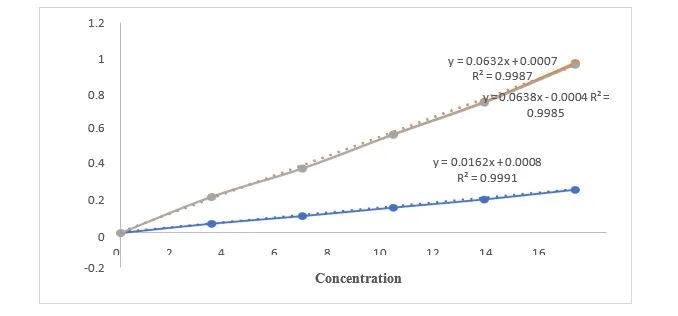
Figure: 3 Standard plot of Binary Mixture at 364nm,239nm,237nm in 0.01 N HCl
PREPARATION OF SOLID DISPERSION
Kneading Method
The calculated amounts of BZ and CD (molar ratio 1:1) were accurately weighed, transferred to a glass mortar, and triturated with a small volume of ethanol (70% v/v). The slurry obtained was kneaded for 30 min and then dried under vacuum at room temperature in the presence of calcium chloride as a dehydrating agent.
PREPARATION OF TABLET
Preparation of Diltiazem (Blend -1)
Sift the weighed quantity of Diltiazem, microcrystalline cellulose used as diluent, sodium starch glycolate used as super disintegration, aerosil used as glidant , magnesium stearate used as lubricant, sunset yellow is used as colouring agent, sifted material into blender and blends it for 10 min. Weigh accurately for each tablet. The punch used for the compression was 12 mm diameter (punch number 9).The total weight of each blend 1 tablet was 150 mg.
Table: 5 Formulation table of layer 1.
|
S.NO. |
INGREDIENTS |
QTY(mg) |
QTY(%) |
|
1 |
Diltiazem |
10 |
7% |
|
2 |
(MCC)PH102 |
125 |
85% |
|
3 |
Sodium starch glycolate |
6 |
4% |
|
4 |
Aerosil 200 |
0.75 |
0.5% |
|
5 |
Magnecium stearate |
6 |
4% |
|
6 |
Sunset yellow |
0.15 |
0.1% |
|
7 |
Total weight |
150mg |
100% |
Preparation of Benazepril Hydrochlorie (Blend 2)
Sift the weighed quantities of Benazepril hydrochloride-CD, microcrystalline cellulose used as diluent, crosspovidone used as disintegration, erosil used as glidant, magnesium stearate used as lubricant, sifted material into the blender and blend it for 10 minutes. Weigh accurately of Benazepril hydrochloride(solid dispersion ) layer for each layer. Compression was made by using 12 mm punches (punch number 9). The total weight of each blend 2 tablet was adjusted to 250 mg.
Table: 6 Formulation table of layer 2.
|
S.NO. |
INGREDIENTS |
QTY(mg) |
QTY(%) |
|
1 |
Benazepril hydrochloride-β-CD 1:1 |
122 |
49% |
|
2 |
Microcrystalline cellulose(MCC)PH102 |
105 |
42% |
|
3 |
Crosspovidone |
10 |
4% |
|
4 |
Aerosil 200 |
1.25 |
0.5% |
|
5 |
Magnesium stearate |
10 |
4% |
|
6 |
Total weight |
250 |
100% |
Preparation of bilayer tablet
Weigh accurately layer 1 placed in the die cavity and punched by direct compression method by (16 station tablet punching machine) with low compression force. The total weight of each layer 1 tablet was 150 mg. Weigh accurately layer 2 Benazepril hydrochloride (solid dispersion ) then placed in the die cavity and allowed for punched by direct compression method by (16 station tablet punching machine) (punch number 9) with maintain the optimum hardness of 6–8 kg/cm2 to form bilayer tablets
POST COMPRESSION STUDIES
Table: 7 Evaluation parameter of tablet
|
Thickness ±diameter (mm) |
Hardne ss (kg/cm2) |
Friability |
Weight variation |
Disintegration time (minutes) |
|
2.7±12mm |
3.2-5kg/cm2 |
10% |
0.5% |
Diltiazem -3 BZ-15 |
In vitro Dissolution
In vitro drugs release studies of the bilayer tablets were performed. We have performed the release study at 100 rpm to provide. Release of drug at λ max 364nm release 94% in 10 minutes that is λ max of Diltiazem, Release 66 % in 30 minutes at λ max 237 that was λmax of Diltiazem and BZ , 78 % release in 30 minutes at 239 λ max that was BZ.
Table:8 Drug release.
|
Time |
%CDR |
||
|
|
364 λ max |
239 λ max |
237 λ max |
|
0 |
0 |
0 |
0 |
|
5 |
25.55 |
18.19 |
17.23 |
|
10 |
94.58 |
49.61 |
46.66 |
|
15 |
80.66 |
55.25 |
56.46 |
|
20 |
66.66 |
57.38 |
62.32 |
|
25 |
57.03 |
63.64 |
68.08 |
|
30 |
52.89 |
66.51 |
78.7 |
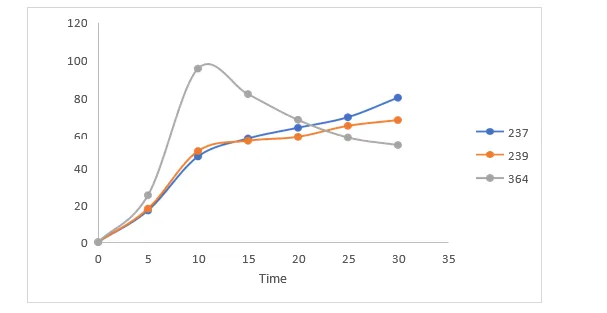
Figure:4 Drug release profile of bilayer tablet at different λ max
CONCLUSION AND FUTURE DIRECTION
The enhancement of oral bioavailability of poorly water soluble drugs remain one of the most challenging aspects of drug development, Successful development of SD system for preclinical clinical and commercial use has been feasible in recent years due to the availability of surface active carriers. The solubility enhancement by 2Hp-β-CD it show good results because of solubility enhanced the bioavailability of drug will be enhanced solid dispersion method used for the solubility enhancement.
Improve the aqueous solubility of poorly water soluble drugs for BSC class ll drugs increasing their solubility and dissolution rate would be a promising approach to enhance the bioavailability.The most frequent concern with SD have been the ability to scaleup the manufacturing method, the physical stability of the dispersion and the amount of carrier needed to facilitate the required increase in the release rate. When a high carrier/drug ratio must be used, the amount of dispersion required to administer the usual dose of the drug may be too high to produce a tablet or capsule that can be easily swallowed. The drawbacks associated to SD of CD with BZ it get moisture at room temperature have to store with dehydrating agent to absorb the moisture.
REFERENCES



Manisha Yadav, Sunita Rani, Deepak Saini, Formulation and Evaluation of Bilayer Tablet Containing Diltiazem and Benazepril Hydrochloride, Int. J. of Pharm. Sci., 2026, Vol 4, Issue 6, 7355-7368. https://doi.org/ 10.5281/zenodo.21042909
 10.5281/zenodo.21042909