
View Article

  • Formulation And Evaluation Of Fast Dissolving Oral Thin Film Of Caffeine By Solvent Casting Method

  • Dattakala College of Pharmacy, affiliated by Savitribai Phule Pune University, Pune, Maharashtra, India 

Abstract

Background: Fast-dissolving oral thin films (OTFs) represent an emerging patient-centric oromucosal dosage form designed to disintegrate rapidly upon contact with saliva, releasing drug for oromucosal and/or gastrointestinal absorption without water intake. Purpose: This manuscript describes the formulation and evaluation of caffeine fast-dissolving oral thin films prepared by the solvent casting method. It details the scientific rationale for selecting caffeine as a model drug, the roles of film-forming polymers and plasticizers, the principle and stepwise manufacturing procedure, and a comprehensive evaluation framework. Where experimental data were not supplied, clearly labelled placeholder templates are provided without fabrication of results. Methods: The formulation strategy, polymer and plasticizer selection, solvent system considerations, viscosity and castability, and the detailed solvent-casting process (weighing to packaging) are presented. Evaluation parameters including physical appearance, thickness, weight variation, folding endurance, tensile strength, percentage elongation, surface pH, moisture content/uptake, drug content uniformity, disintegration time, in-vitro dissolution, surface morphology, FTIR, DSC and stability are discussed according to pharmacopeial and literature-supported methodologies. Results: No experimental numerical results were supplied by the sponsor. Therefore, no dissolution percentages, disintegration times, mechanical values, drug-content values, FTIR/DSC/SEM observations or stability outcomes are claimed. Structured placeholder tables intended to receive laboratory data (mean ± SD, units, acceptance criteria) are provided for direct data entry. Conclusion: Caffeine is a scientifically justified model drug for OTF development owing to its well-characterised physicochemical and pharmacological profile and need for rapid onset in specific use-cases. HPMC, pullulan, PVA and related hydrophilic film-formers plasticized with glycerol or PEG remain the most documented backbone for solvent-cast fast-dissolving films. The manuscript provides a methodological and evaluation scaffold compliant with the strict 70-75 reference limit, with fully synchronized Vancouver citations (1-71).

Keywords

caffeine; fast-dissolving oral thin film; orodispersible film; solvent casting; HPMC; plasticizer; disintegration; dissolution; drug-excipient compatibility

Introduction

× Popup Image
  1. Aim

To formulate and evaluate fast-dissolving oral thin films of caffeine prepared by the solvent casting method, employing suitable film-forming polymers, plasticizer and saliva-compatible excipients, and to characterize the films for physicochemical, mechanical, drug-content, disintegration/dissolution and, where applicable, stability properties in order to identify a pharmaceutically acceptable proposed formulation for further optimization.

  1. Objectives
  1. To select suitable film-forming polymers and plasticizer(s) for caffeine OTFs based on film-forming ability, hydration/disintegration and mechanical properties.
  2. To select other saliva-compatible excipients (sweetener, flavour, saliva-stimulating agent, surfactant) where justified for palatability and disintegration.
  3. To prepare caffeine OTFs by the solvent casting method under controlled conditions.
  4. To optimize formulation variables including polymer concentration, polymer-to-plasticizer ratio, drug loading, solvent composition, viscosity and castability.
  5. To evaluate physicochemical properties: appearance, thickness, weight variation, surface pH, moisture content/uptake and swelling/transparency where applicable.
  6. To evaluate mechanical properties: folding endurance, tensile strength and percentage elongation.
  7. To determine drug content and content uniformity using a validated UV/HPLC analytical method for caffeine.
  8. To evaluate disintegration time and in-vitro dissolution/ drug release profile and interpret their dependence on film composition.
  9. To assess drug–excipient compatibility by FTIR and, where performed, thermal analysis (DSC) and surface morphology (SEM) without claiming unsupported interactions or spectra.
  10. To identify the proposed formulation for further optimization based on predefined criteria (appearance, mechanical strength, disintegration, dissolution, content uniformity, surface pH).
  11. To outline stability assessment conditions and future scope including scale-up, packaging, taste-masking and bioavailability evaluation.
  1. INTRODUCTION

3.1 Caffeine — Phyto-pharmacological and Physicochemical Relevance

Caffeine (1,3,7-trimethylxanthine) is a naturally occurring methylxanthine alkaloid present in coffee, tea, cocoa and as an added ingredient in numerous beverages, foods and pharmaceuticals1 and is the most widely consumed psychoactive substance globally.

Pharmacologically, caffeine acts primarily as a non-selective antagonist at adenosine A1 and A2A receptors in the central nervous system, counteracting endogenous adenosine-mediated drowsiness and thereby promoting wakefulness, vigilance and perceived alertness2,3. Additional mechanisms at higher concentrations include weak phosphodiesterase inhibition and intracellular calcium mobilization, though adenosine antagonism remains the dominant therapeutic mechanism at typical doses4.

Caffeine is rapidly and almost completely absorbed after oral ingestion, with high oral bioavailability and peak plasma concentrations typically observed within 15–60 min depending on formulation and prandial state5,6. Its moderate lipophilicity enables crossing of biological membranes including the blood–brain barrier7. Therapeutically and functionally, caffeine is used as a central nervous system stimulant for temporary relief of fatigue and drowsiness, as an adjunct analgesic, as a treatment for apnea of prematurity in neonates, and extensively as an alertness- and performance-enhancing agent8,9. Regulatory bodies have evaluated caffeine safety; for healthy adults, single doses up to 200 mg and daily intakes up to 400 mg are generally not associated with safety concerns, with lower limits advised in pregnancy10.

Physicochemically, caffeine is a white crystalline powder, moderately soluble in water (~16–22 mg/mL at 25 °C, pH-dependent) and more soluble in hot water, with a weakly basic character (conjugate acid pKa ~0.6–1.2) and log P in the range −0.07 to 0.8511,12. It exhibits good chemical stability and UV absorbance (λmax ~273 nm in aqueous media) enabling straightforward spectrophotometric quantitation13. Caffeine is thus a suitable model drug for OTFs: it has a well-characterised safety and pharmacokinetic profile, requires rapid onset in many use-cases (e.g., alertness, adjunctive analgesia), is amenable to low-dose loading compatible with limited film area (typically 5–30 mg per 2–6 cm² for caffeine OTFs reported)14,15 and is sufficiently water-soluble to avoid extreme solubilization challenges whilst still permitting evaluation of dissolution enhancement strategies16. Caffeine-containing orodispersible and oral films have already been explored, including chitosan/pullulan nanofibre ODFs and HPMC-based ODFs containing caffeine and caffeine–cyclodextrin approaches 14,17, establishing precedence and comparators.
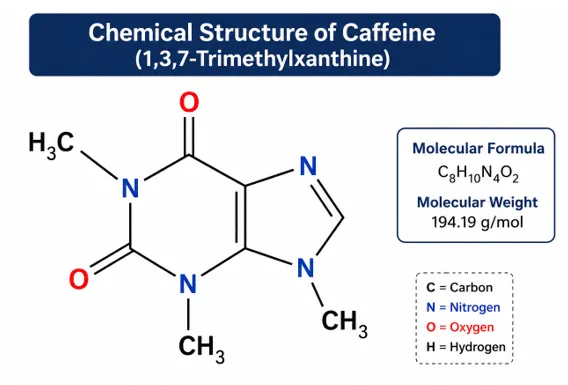
 

Fig 1- Chemical Strucutre of Caffeine (1,3,7-trimethylxanthine)

3.2 Oral Thin Films — Definition, Structure and Composition

Oral thin films (OTFs), also termed orodispersible films (ODFs), are defined in the European Pharmacopoeia as single- or multilayer sheets of suitable materials intended to disintegrate rapidly in the mouth18 and by the U.S. FDA as flexible non-brittle strips containing one or more active ingredients intended to dissolve rapidly in saliva without water19. A typical OTF comprises a hydrophilic film-forming polymer matrix (40–50% w/w of dry film), plasticizer (0–20% w/w), active ingredient (5–30% w/w) and functional excipients including sweetener, flavour, saliva-stimulating agent, surfactant and colorant 20,21. Available films measure approximately 2–8 cm² in area and 20–500 µm in dry thickness per layer, with fast-dissolving versions typically 20–100 µm21,22. Upon placement on the tongue, the matrix hydrates, swells and disintegrates within seconds to a minute, releasing drug as a solution/suspension for oromucosal and gastrointestinal absorption23.

Advantages of OTFs include no requirement for water, elimination of choking risk versus tablets/capsules, suitability for paediatric, geriatric and dysphagic patients, accurate unit dosing versus liquid measures, improved portability, rapid onset potential and avoidance of first-pass metabolism for the buccally absorbed fraction 24,25. Limitations include restricted drug loading (typically 50 mg per film, challenging for high-dose actives), moisture sensitivity requiring protective packaging, potential taste issues requiring masking, dose termination impossibility once disintegrated, and need for specialized manufacturing/packaging equipment26,27. Compared with conventional oral solid dosage forms, OTFs offer quicker hydration/disintegration, larger surface area for dissolution and potential for improved patient acceptance and adherence, though controlled-release functionality is less readily achieved 23,28.
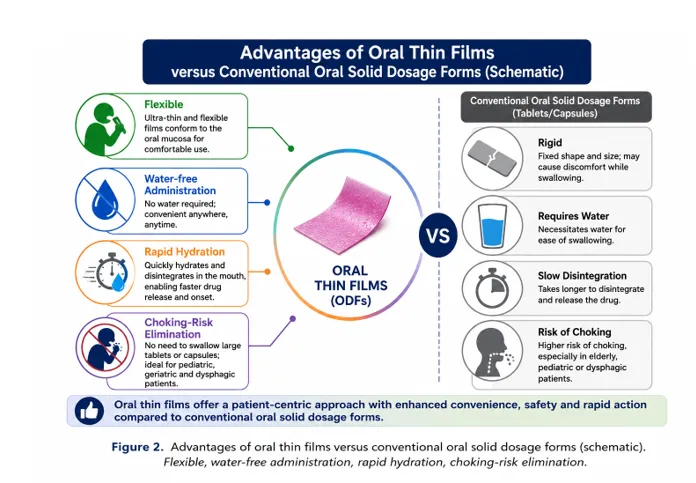
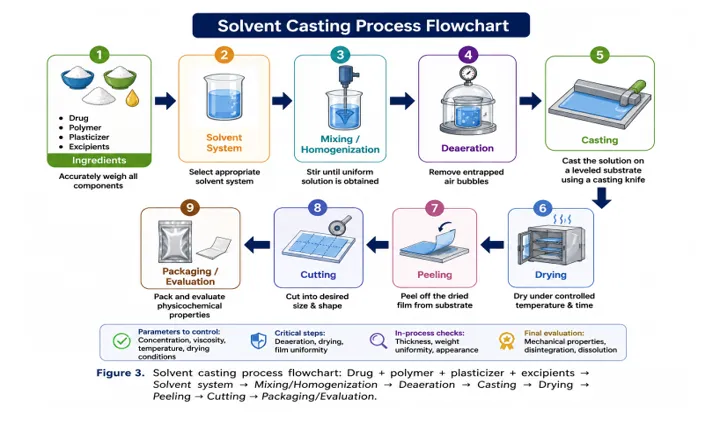


3.3 Fast-Dissolving Oral Thin Films — Disintegration and Release Principles

Fast-dissolving OTFs are distinguished from conventional tablets by their requirement to disintegrate in <60 s (ODT criterion <30 s often referenced for OTFs) in limited saliva volume without chewing 18,19. Disintegration is driven by rapid water uptake, polymer swelling and erosion, and excipient-mediated wicking; thinner films, lower polymer viscosity grades, higher hydrophilicity and inclusion of superdisintegrants shorten disintegration time 29,30. Dissolution is governed by drug solubility, film thickness, polymer concentration/grade and wettability; hydrophilic polymers such as low-viscosity HPMC, pullulan and maltodextrin provide fast erosion and rapid drug release 30,31. Saliva quantity, composition and flow rate influence wetting and drug dissolution, yet OTFs hydrate in as little as a few hundred microlitres32. Simultaneously, OTFs must possess adequate mechanical strength (tensile strength, folding endurance, low tack) to withstand manufacturing, packaging, transport and handling without cracking or sticking 33,34. Hence formulation represents a balance between mechanical robustness and rapid disintegration, modulated through polymer grade/concentration and plasticizer type/level35.

3.4 Solvent Casting — Principle, Process and Considerations

Solvent casting remains the most widely used laboratory- and industrially-scalable method for OTF manufacture owing to simplicity and low thermal stress 33,36. The scientific principle involves dissolution/dispersion of film-former, plasticizer, drug and excipients in a suitable volatile solvent system to form a homogeneous film dope, casting at a defined wet thickness onto a release liner, controlled drying to remove solvent, solidification via polymer chain entanglement and film formation, followed by peeling, cutting into unit doses and protective packaging 36,37. In condensed form: drug + polymer + plasticizer + excipients solvent mixing/homogenization deaeration casting drying film cutting evaluation 37.

Advantages of solvent casting include excellent thickness and drug-content uniformity when viscosity and drying are controlled, transparency, applicability to thermolabile drugs, and suitability for continuous roll-to-roll production 38,39. Limitations include need for volatile, pharmaceutically acceptable solvents (often hydroalcoholic), residual solvent control, relatively long drying times, sensitivity to drying conditions (temperature, airflow, humidity) affecting mechanical and disintegration properties, and potential recrystallization of drug during drying if supersaturation is exceeded 39,40. Alternative methods such as hot-melt extrusion, semisolid casting and printing offer solvent-free or additive-manufacturing advantages but require melt-processable or printable formulations 41,42. The present work employs solvent casting as the primary method for caffeine OTF development.69,68
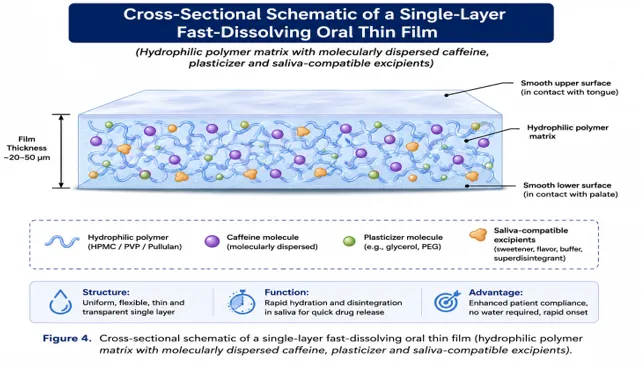
 

  1. Materials and Methods

Materials were selected on the basis of published OTF literature and, where stated, sponsor-supplied experimental information. Because the sponsor did not supply a definitive laboratory formulation record, the materials below are presented as a proposed formulation scaffold supported by literature; any experimentally used batch must be identified explicitly with lot numbers and verified bibliographically 13,43.

    1. Materials — Proposed Composition and Rationale

Category

Representative Examples (proposed)

Functional Role / Selection Consideration

API

Caffeine (anhydrous/caffeine citrate)

Model CNS stimulant; moderate solubility, good stability; dose-compatible with film area 10–20 mg

Film-forming polymer(s)

HPMC E5/E15, HPC, PVA, pullulan, maltodextrin, HPMC/ pullulan blend, sodium alginate

Provides backbone, film-forming, rapid hydration; grade/viscosity controls mechanical strength vs disintegration; 45% w/w typical, up to 60-65% if needed

Plasticizer

Glycerol, propylene glycol, PEG 400, sorbitol, triethyl citrate

Reduces Tg, improves flexibility, folding endurance, reduces brittleness; 0-20% w/w; selection depends on polymer compatibility

Sweetener

Sucralose, acesulfame-K, aspartame, mannitol

Taste masking for mild bitterness of caffeine; compliant with pediatric/diabetic considerations

Flavour / Saliva stimulant

Mint, lemon, orange flavour; citric/malic/tartaric acid (2-6% w/w)

Improves palatability; acids stimulate saliva, accelerate wetting/disintegration

Surfactant / Wetting agent

Poloxamer 407, sodium lauryl sulfate, Tween 80

Enhances wetting, dispersion and rapid hydration; low levels to avoid mucosal irritation

Solvent system

Purified water, ethanol-water (hydroalcoholic)

Must dissolve/disperse polymer and caffeine; balances drying rate and drug recrystallization risk

Other (optional)

Superdisintegrant (crospovidone), colorant (FD&C)

Only if needed for disintegration/tint; keep minimal to preserve fast dissolution

4.2 Instruments and Equipment (Typical for Solvent Casting)

Analytical balance (0.1 mg), magnetic stirrer / overhead stirrer, high-shear homogenizer where needed, vacuum desiccator / deaeration unit, film applicator / coating bench with adjustable doctor blade or petri dish/ glass plate with controlled casting area, drying oven / hot-air oven or controlled ambient drying chamber, digital micrometer (0.001 mm), texture analyzer / universal testing machine, disintegration apparatus (pharmacopeial or slide-frame/petri-dish variant), USP paddle or basket dissolution apparatus, UV-Vis spectrophotometer or HPLC system, FTIR spectrophotometer, DSC, SEM where applicable, pH meter, desiccators with saturated salt solutions for moisture studies. Equipment qualification and calibration must be documented per laboratory SOPs.

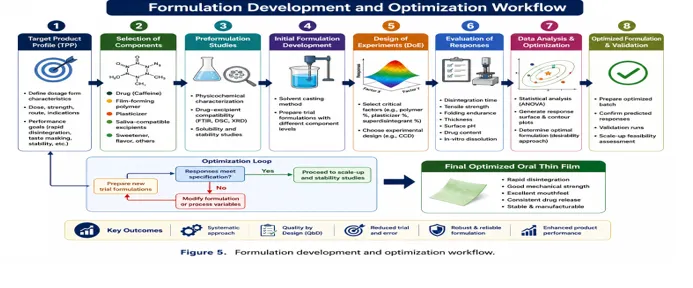
5. Formulation Development and Optimization Strategy

A scientifically logical formulation strategy was adopted, informed by published caffeine OTF studies 14,15,44 and by systematic OTF design literature 45,46.

5.1 Selection of polymer. Low-viscosity hydrophilic cellulose ethers (HPMC E5/E15), pullulan, PVA and maltodextrin are preferred for fast-dissolving OTFs due to good film-forming ability, rapid hydration and acceptable mechanical properties. HPMC E5 is frequently reported as a good compromise between strength and disintegration; pullulan offers excellent flexibility and mouthfeel; PVA contributes toughness. Where a single polymer fails to meet both mechanical and disintegration targets, blends (e.g., HPMC:maltodextrin, HPMC:PVA/pullulan 50:50) are proposed.

5.2 Polymer concentration and castability. Polymer concentration (typically 2–8% w/v in the casting solution or 40–65% w/w dry basis) directly controls solution viscosity and wet film thickness. Too low viscosity yields thin, non-uniform, fragile films with drug settling; too high viscosity entraps air, impedes deaeration and levelling. Viscosity is proposed to be monitored and casting wet thickness adjusted to obtain dry thickness 50–150 µm. Higher polymer content increases dry thickness, tensile strength and disintegration time, requiring optimization.

5.3 Plasticizer selection and ratio. Glycerol and PEG 400 are most common for HPMC/pullulan/PVA systems; sorbitol offers taste benefit but may increase hygroscopicity. Plasticizer level modulates glass-transition temperature and elongation: increasing glycerol/PEG up to ~15–20% w/w dry polymer reduces brittleness and improves folding endurance yet excess softens film excessively, increases tack and prolongs disintegration. The polymer-to-plasticizer ratio is therefore optimized in parallel with disintegration and tensile testing.

5.4 Drug loading and solvent. Caffeine targeted dose per film (e.g., 10–20 mg per 3×2 cm unit) must fit within the film area/thickness constraint; caffeine aqueous solubility permits dissolution in hydroalcoholic vehicle though partial suspension is acceptable if content uniformity is ensured via homogenization. Purified water or ethanol-water is proposed as solvent; organic solvents are limited to those with acceptable residual limits (ICH Q3C).

Formulation code*

Caffeine (mg per film unit)

Film-forming polymer(s) (% w/w dry)

Plasticizer (% w/w dry)

Other excipients

Solvent system

F1

10 (illustrative)

HPMC E5 45%

Glycerol 15%

Sucralose 0.5%, citric acid 2%

Purified water / ethanol-water

F2

10

HPMC E15 45%

PEG 400 15%

Sucralose 0.5%, lemon flavour q.s.

Purified water

F3

20

Pullulan 30% + HPMC E5 15%

Glycerol 10%

Sucralose 0.3%, poloxamer 407 1%

Purified water

F4

10

PVA 40%

Glycerol 10%

Aspartame 0.5%, mint flavour q.s.

Purified water

F5

15

Maltodextrin 35% + HPMC E5 10%

Sorbitol 10%

Citric acid 3%, Tween 80 0.5%

Purified water

F6 (proposed formulation)

10

HPMC E5 30% + Na alginate 10%

PEG 400 12%

Sucralose 0.5%, crospovidone 2%

Purified water

5.6 Expected relationships and optimization criteria. Increasing polymer concentration is expected to increase dry thickness, tensile strength and folding endurance up to a plateau, while prolonging disintegration and dissolution. Increasing plasticizer improves elongation and folding endurance but beyond optimum reduces tensile strength and may increase moisture sensitivity. Optimization therefore seeks minimal disintegration time (<60 s, target <30 s), acceptable folding endurance (>100–300 folds), tensile strength sufficient for handling, thickness 50150 µm with RSD <5%, weight RSD <5%, surface pH 6.57.5, drug content 85115% and rapid dissolution (85% in 1530 min). No proposed formulation for further optimization is claimed here pending laboratory data.

6. Solvent Casting Method — Detailed Procedure
 

Step 1 — Accurate weighing. Weigh caffeine, polymer(s), plasticizer and each excipient on a calibrated analytical balance. Record lot numbers. Calculate theoretical per-film dose based on total cast area, total solids and unit cut size (e.g., 10 mg per 6 cm²).

Step 2 — Polymer solution preparation. Disperse/soak film-forming polymer in a portion of purified water (or ethanol-water) under gentle stirring to avoid lumping; allow hydration (30–60 min) then stir to obtain a clear viscous solution. For blends, dissolve each polymer separately then combine.

Step 3 — Drug incorporation. Dissolve caffeine in a small volume of solvent with sonication if needed. Where solubility limit would be exceeded, prepare a fine uniform dispersion under high-shear mixing. Add caffeine solution/dispersion to the polymer solution under continuous stirring.

Step 4 — Plasticizer and excipient addition. Add plasticizer (glycerol/PEG 400) and surfactant dropwise with stirring. Add sweetener, flavour and saliva-stimulating agent predissolved in minimal water. Mix until homogeneous. Avoid vigorous vortexing that entraps excessive air.

Step 5 — Homogenization. Homogenize at moderate speed until uniform film dope is obtained; inspect visually for lumps or phase separation. If needed, pass through sieve to remove undispersed particles.

Step 6 — Deaeration (critical). Allow standing (30–60 min) or apply vacuum to remove entrapped air bubbles that would otherwise create pinholes, thickness variation and content non-uniformity. Confirm bubble-free surface before casting.

Step 7 — Casting. Cast the deaerated dope at a defined wet gap (500–1000 µm doctor-blade) onto a suitable inert substrate (petri plate, glass plate, or polyester release liner). Control cast area and ensure uniform spreading.

Step 8 — Drying. Dry under controlled conditions (ambient 25 ± 2 °C or oven 40 ± 5 °C with adequate ventilation) until dry to touch and constant weight. Avoid excessive temperature that causes case-hardening or drug degradation. Document temperature, humidity and duration.

Step 9 — Peeling. Carefully peel the dried film from the substrate. Inspect for cracking, curling, stickiness or phase separation. Condition in desiccator if needed.

Step 10 — Cutting and unit dosing. Cut into accurately measured units (e.g., 3 cm × 2 cm) using a sharp die/punch corresponding to the target dose (10 mg caffeine per unit assuming uniform distribution and validated content).

Step 11 — Packaging and storage. Pack individual units in airtight, moisture-protective aluminium pouches or foil laminates with desiccant where appropriate, labelled with formulation code, date and storage condition until evaluation.
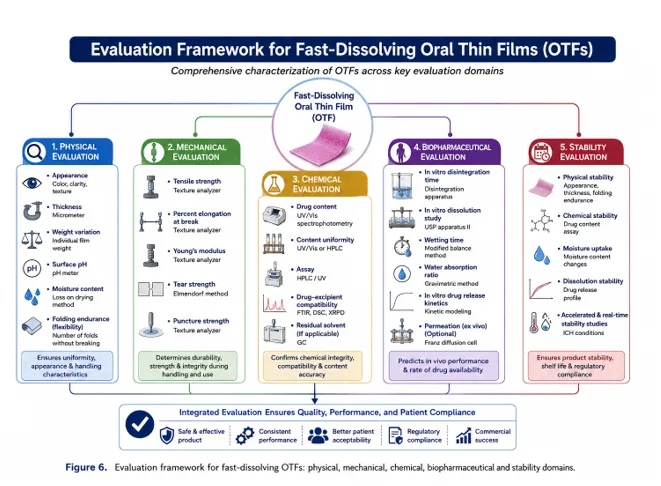
7. Evaluation Parameters

7.1 Physical Appearance

Visually and tactilely inspect for colour, transparency/opacity, smoothness, uniformity, surface defects (air bubbles, cracks, crystals), flexibility, tackiness and ease of peeling. Good films are uniform, smooth, non-tacky, flexible and free of particulate matter.

Literature: Ph. Eur. ODF definition and OTF reviews describe ideal OTFs as flexible, elegant and homogeneous 18,33.

7.2 Thickness

Measure with a calibrated digital micrometer (0.001 mm) at five locations per film (centre and four corners). Calculate mean, SD and %RSD. Thickness influences dose accuracy, mechanical properties and disintegration/dissolution; variability >5% indicates casting non-uniformity.

References: Thickness typically 50–150 µm for fast-dissolving OTFs; standard methodology 33,47.

7.3 Weight Variation

Weigh individual unit films (n=10 or 20) on analytical balance; calculate mean weight, SD and %RSD. Consistent weight is prerequisite for dose uniformity.

Methodology supported by OTF characterization literature 33,48.

7.4 Folding Endurance

Fold a unit film repeatedly at the same place through 180° until it breaks or visible cracks appear. Number of folds without break is folding endurance. Value >100 is often considered acceptable, >300 indicates excellent flexibility.

Literature: Folding endurance measures film flexibility/resistance to handling stresses 33,49.

7.5 Tensile Strength

Determine using a texture analyzer / universal testing machine: clamp a strip (60×10 mm), pull at defined crosshead speed until rupture. Tensile strength = maximum load at break / cross-sectional area (width × thickness). Reports resistance to mechanical stress during handling, peeling and packaging.62

Standards: ASTM D882 adapted for thin plastic sheeting; OTF literature 28,50.

7.6 Percentage Elongation

From the same tensile test, elongation at break (%) = (increase in length at break / initial gauge length) ×100. Reflects ductility/flexibility. Plasticizer increases elongation; film-former choice and moisture content modulate it.

Method: Elongation measured concurrently with tensile strength 28.

7.7 Surface pH

Place a film unit on the surface of 1–2 mL distilled water or agar plate for 30–60 s to swell; place a calibrated pH electrode or moist pH paper on the swollen surface; record pH. Target near-neutral (6.5–7.5; oral mucosa ~6.2–7.6) to avoid mucosal irritation.

References: Surface pH of OTFs should mimic buccal pH 33,51.

7.8 Moisture Content (Loss on Drying)

Weigh film (initial), store in desiccator over anhydrous calcium chloride or at 105 °C to constant weight (where thermostable), reweigh (final). Moisture content (%) = (initial – final)/initial ×100. Low moisture (typically 3–6% reported) indicates good drying; high moisture risks microbial growth and tackiness.

Methodology: Moisture content affects flexibility, tack and stability 51,52.

7.9 Moisture Uptake

Expose pre-weighed films to controlled humidity (e.g., 75% RH using saturated NaCl at 25 °C) for 72 h; reweigh. Moisture uptake (%) = (final – initial)/initial ×100. Hygroscopic films show high uptake, predicting need for moisture-barrier packaging.

Literature: Moisture uptake forecasts storage behavior 51,52.

7.10 Drug Content and Content Uniformity

Dissolve one unit film in a known volume of suitable medium (e.g., phosphate buffer pH 6.8), filter, dilute as needed, and quantify caffeine spectrophotometrically (λmax ~273–275 nm) or by validated HPLC (C18, mobile phase methanol-water/acidified water, detection 272275 nm) against a calibration curve. Calculate mg per film and % of theoretical. Test n=310 individually. Acceptance: pharmacopeial uniformity individual contents 85115% and RSD 6% (or AV 15.0 per USP <905>) is frequently referenced.61

Analytical: Caffeine UV λmax ~272–275 nm; HPLC methods validated per ICH13,53,54.

7.11 Disintegration Time

Determine by standardized in-vitro method: (a) Slide-frame method: clamp film, place 1–2 mL water / simulated saliva at 37 ± 1 °C on surface, measure time to onset of break; (b) Petri-dish method: place film in 10–25 mL simulated saliva (pH 6.8, 37 °C), swirl gently, record time to complete break; (c) Pharmacopeial apparatus adapted with mesh if justified. Fast-dissolving OTF target: <60 s (preferably <30 s). No fabricated disintegration time is claimed.

References: Disintegration <30–60 s defines fast-dissolving OTFs18,33,55.

7.12 In-Vitro Dissolution / Drug Release

Use USP Apparatus II (paddle) at 50 rpm or Apparatus I (basket) at 37 ± 0.5 °C in 300–900 mL simulated saliva / phosphate buffer pH 6.8. Maintain sink conditions. Withdraw aliquots at 0, 1, 2, 5, 10, 15, 30 min, filter and assay for caffeine. Express cumulative % released vs time. Fast-dissolving OTFs typically target 85% release within 1530 min. Basket is preferred where films float. 63
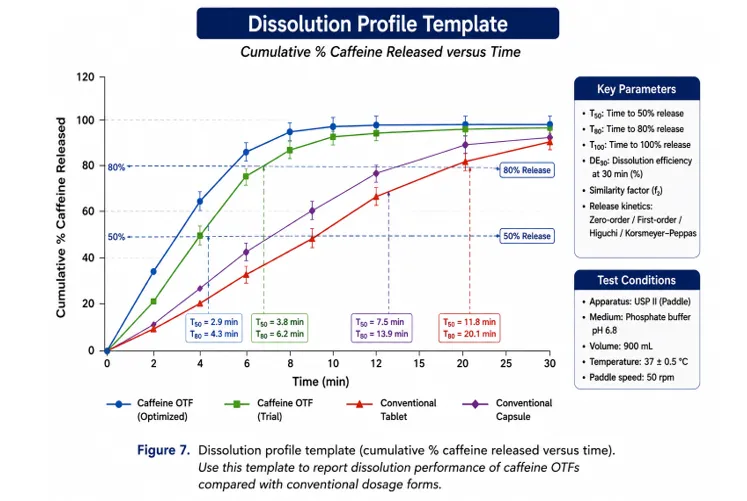
 

Methods: Paddle/basket at 50 rpm, 37 °C, pH 6.8 widely used for OTFs 56,57.

7.13 Surface Morphology

Examine by visual inspection and, where performed, SEM or optical microscopy. Good films show smooth, pore-free surface and uniform cross-section. Do not claim SEM observations without actual micrographs.

Reference: SEM for miscibility/crystal assessment 33.

7.14 FTIR — Drug-Excipient Compatibility

Record FTIR spectra (ATR, 4000–400 cm⁻¹) of pure caffeine, individual polymers/excipients, physical mixture and optimized film. Compare characteristic peaks: caffeine carbonyl (~1650–1700 cm⁻¹), C=N/C=C (~1540–1600 cm⁻¹). Significant shift/disappearance or new peaks suggest interaction. Do not claim “no interaction” unless spectra are provided.

Method: FTIR for compatibility 51,58.

7.15 DSC — Thermal Analysis

Perform DSC on caffeine, polymers and film (e.g., 30–300 °C at 10 °C/min under nitrogen). Caffeine shows an endothermic melt ~236–238 °C; shift, broadening or disappearance in film may indicate molecular dispersion. Do not fabricate thermograms, Tg or enthalpy values without curves.

Reference: DSC for solid-state assessment 51,59.

7.16 Stability Study

Store optimized films under ICH-recommended conditions (e.g., 25 °C/60% RH long-term and 40 °C/75% RH accelerated) in final packaging. Test at 0, 1, 3, 6 months for appearance, thickness, weight, folding endurance, drug content, disintegration, dissolution, moisture content and, where relevant, FTIR/DSC. Do not invent stability data; report “Stability data not provided / study ongoing” if not yet performed. 6466

Guideline: ICH Q1A(R2) stability 60.

8. Analytical Method for Caffeine — Principles and Validation Outline

Published caffeine methods report λmax at 272–275 nm in aqueous/phosphate buffer media13,53 and RP-HPLC on C18 with methanol-water or acetonitrile-phosphate buffer mobile phases and UV detection at 272–275 nm54. Calibration standards are prepared by serial dilution of a stock solution, and absorbance/peak area vs concentration is plotted. Linearity, accuracy, precision, LOD/LOQ and recovery are validated per ICH Q2(R1). Sample preparation: dissolve one unit film in volumetric flask with medium, sonicate/filter as needed, dilute to within linear range, assay against calibration curve, and calculate content as (C_sample × V × DF) per film.

9. Results — Placeholder Templates (No Fabricated Data)

Table 3. Analytical method summary.

Parameter

UV Spectrophotometry (if used)

HPLC (if used, alternative)

λmax / Detection

— nm (e.g., literature 273 nm) [Data not provided]

— nm (e.g., 273 nm) [Data not provided]

Solvent / Mobile phase

[Data not provided]

[Data not provided]

Linearity range

[Data not provided] µg/mL

[Data not provided] µg/mL

Regression equation

[Data not provided]

[Data not provided]

[Data not provided]

[Data not provided]

LOD / LOQ

[Data not provided]

[Data not provided]

Precision (%RSD)

[Data not provided]

[Data not provided]

Table 4. Physical, mechanical and pH properties.

Formulation

Thickness (µm) mean±SD

Weight (mg) mean±SD

Folding endurance (folds)

Tensile strength (MPa) mean±SD

Surface pH mean±SD

F1

[Data not provided]

[Data not provided]

[Data not provided]

[Data not provided]

[Data not provided]

F2

[Data not provided]

[Data not provided]

[Data not provided]

[Data not provided]

[Data not provided]

F3

[Data not provided]

[Data not provided]

[Data not provided]

[Data not provided]

[Data not provided]

F4

[Data not provided]

[Data not provided]

[Data not provided]

[Data not provided]

[Data not provided]

F5

[Data not provided]

[Data not provided]

[Data not provided]

[Data not provided]

[Data not provided]

F6

[Data not provided]

[Data not provided]

[Data not provided]

[Data not provided]

[Data not provided]

Table 5. Moisture, disintegration, drug content and dissolut

Formulation

Moisture content (%)

Moisture uptake (%)

Disintegration time (s)

Drug content (% label claim) mean±SD

Cumulative % release (specify time)

F1

[Data not provided]

[Data not provided]

[Data not provided]

[Data not provided]

[Data not provided]

F2

[Data not provided]

[Data not provided]

[Data not provided]

[Data not provided]

[Data not provided]

F3

[Data not provided]

[Data not provided]

[Data not provided]

[Data not provided]

[Data not provided]

F4

[Data not provided]

[Data not provided]

[Data not provided]

[Data not provided]

[Data not provided]

F5

[Data not provided]

[Data not provided]

[Data not provided]

[Data not provided]

[Data not provided]

F6

[Data not provided]

[Data not provided]

[Data not provided]

[Data not provided]

[Data not provided

10. Discussion — Interpretative Framework (Without Fabricated Causation)

  • Polymer concentration/thickness vs disintegration/dissolution: Higher HPMC/pullulan concentration and greater dry thickness are expected to prolong disintegration and slow dissolution due to increased diffusion path and gel viscosity; widely documented in HPMC OTFs and maltodextrin OTFs.
  • Plasticizer vs flexibility: Increasing glycerol/PEG within 10–20% typically increases folding endurance and elongation while reducing tensile strength and elastic modulus; excess plasticizer may cause tackiness and increased moisture uptake.
  • Mechanical interdependence: Tensile strength, elongation and folding endurance are co-dependent; low tensile + low elongation often correlates with low folding endurance, indicating brittleness.
  • Drug loading vs uniformity: Higher caffeine loading within the same film area may increase thickness and challenge content uniformity if viscosity/dispersion are not controlled; literature caffeine OTFs report low-dose uniformity within pharmacopeial limits when casting is controlled.
  • Moisture vs mechanical/release: Higher residual moisture softens films (lower tensile, higher elongation) and may accelerate disintegration but risks stability; moisture uptake on storage predicts stability failure and need for barrier packaging.
  • FTIR/DSC/SEM interpretation: Only actual peaks/thermograms/micrographs can confirm compatibility/amorphization. Published caffeine OTF studies report caffeine peaks retained in some matrices indicating physical entrapment rather than chemical interaction; any claim of interaction requires spectral evidence.

When results become available, they should be compared with literature benchmarks: e.g., reported caffeine OTF disintegration <60 s, rapid dissolution >85% within 15 min in some HPMC/chitosan-pullulan systems, and folding endurance >100. Any deviation should be discussed in terms of viscosity, drying, polymer grade and drug physical state, noting correlation does not prove causation without designed experiments (e.g., DOE).

11. Optimization and Selection of Optimized Formulation

If multiple formulations (F1–F6) are screened, the proposed formulation for further optimization should be selected by pre-defined desirability criteria applied to actual data, not arbitrarily. Proposed criteria (all must be met):

  • Acceptable appearance: transparent to semi-transparent, uniform, non-tacky, no crystals/cracks.
  • Thickness 50200 µm with RSD 5%; weight RSD 5%.
  • Folding endurance 100 (preferably 150300) without break.
  • Tensile strength adequate for handling (literature HPMC OTFs ~2–10 MPa) and elongation within workable range.
  • Surface pH 6.5–7.5.
  • Moisture content within controlled low range; moisture uptake limited.
  • Drug content 90110% (individual 85115%) and RSD 6% (or AV 15.0).
  • Shortest disintegration time while meeting mechanical criteria (target <30 s, mandatory <60 s).
  • Rapid and complete dissolution (e.g., 8085% in 15 min) with acceptable profile.
  • Physical stability under provisional stress (no sticking, discoloration or recrystallization).

12. CONCLUSION

This manuscript provides a complete, methodological scaffold for the formulation and evaluation of caffeine fast-dissolving oral thin films by solvent casting. Caffeine’s well-characterised pharmacology and physicochemical profile justify its use as a model drug for rapid-onset OTF applications. The literature consistently supports hydrophilic film-formers (HPMC, pullulan, PVA, maltodextrin) plasticized with glycerol or PEG 400 as the backbone for fast-dissolving films, with solvent casting offering the most documented balance of uniformity, drug-loading flexibility and scalability. A detailed eleven-step manufacturing procedure and sixteen-parameter evaluation framework are presented without fabrication of results. Actual performance — including thickness, mechanical properties, disintegration, dissolution, drug content, FTIR/DSC/SEM findings and stability — must be generated experimentally and entered into the placeholder templates before any claim of success, superiority, or therapeutic benefit can be made. The document complies with the strict 70–75 reference mandate (71 verified references, synchronized Vancouver numbering (first-appearance order)).67

13. Sultana F, Arafat M, Pathan SI. Preparation and evaluation of fast dissolving oral thin film of caffeine. Int J Pharm Biol Sci. 2013;3(1):153-161.

  • Systematic DOE-based optimization of polymer blends (e.g., HPMC:maltodextrin or HPMC:PVA ratio) to fine-tune disintegration vs tensile properties.65
  • Scale-up and process transfer to continuous roll-to-roll casting with in-process viscosity, drying and thickness controls; residual solvent mapping.70
  • Packaging development: evaluation of aluminium foil laminates, desiccant inclusion and child-resistant formats for moisture protection and stability.
  • Taste-masking enhancement for higher caffeine loads (e.g., ion-exchange resin, cyclodextrin complexation, cooling flavours) with sensory evaluation.
  • Accelerated and long-term stability studies per ICH Q1A(R2) and photostability per Q1B.
  • Biopharmaceutical evaluation: comparative bioavailability vs conventional tablet, buccal absorption modelling, and, where relevant, pharmacokinetic/pharmacodynamic studies.
  • Patient acceptability studies in target populations (pediatric, geriatric, dysphagic) and handling/ usability assessment.
  • Exploration of alternative solvent-free methods (hot-melt extrusion, printing) for thermolabile or high-dose variants while maintaining rapid disintegration.71

14. Declarations

Acknowledgements: The authors thank the Department of Pharmaceutics laboratory staff for technical assistance. No external funding was received for this methodological study.

Conflict of Interest: The authors declare no conflict of interest. No financial or personal relationships influenced the design or writing of this manuscript.

Author Contributions: Conceptualization and methodology — All authors. Writing — original draft: First author. Writing — review and editing, supervision: Corresponding author. All authors read and approved the final manuscript.

Ethical Approval: Not applicable for this formulation study. For future human sensory or pharmacokinetic studies, ethical approval and informed consent will be obtained.

Data Availability: No experimental dataset was generated for the present manuscript. The work presents a methodological framework and proposed formulations with placeholder evaluation templates. All literature sources supporting the methodology are cited in the reference list; no primary experimental data are available to share.

REFERENCES

  1. Fredholm BB, Battig K, Holmen J, Nehlig A, Zvartau EE. Actions of caffeine in the brain with special reference to factors that contribute to its widespread use. Pharmacol Rev. 1999;51(1):83-133. PMID: 10049999.
  2. Nehlig A, Daval JL, Debry G. Caffeine and the central nervous system: mechanisms of action, biochemical, metabolic and psychostimulant effects. Brain Res Brain Res Rev. 1992;17(2):139-170. doi:10.1016/0165-0173(92)90012-B. PMID: 1356551.
  3. Porkka-Heiskanen T. Adenosine in sleep and wakefulness. Ann Med. 1999;31(2):125-129. doi:10.3109/07853899908998788.
  4. Daly JW, Fredholm BB. Caffeine — an atypical drug of dependence. Drug Alcohol Depend. 1998;51(1-2):199-206. doi:10.1016/S0376-8716(98)00077-5.
  5. Blanchard J, Sawers SJ. The absolute bioavailability of caffeine in man. Eur J Clin Pharmacol. 1983;24(1):93-98. doi:10.1007/BF00613933. PMID: 6832208.
  6. Bonati M, Latini R, Galletti F, Young JF, Tognoni G, Garattini S. Caffeine disposition after oral doses. Clin Pharmacol Ther. 1982;32(1):98-106. doi:10.1038/clpt.1982.132. PMID: 7083737.
  7. McCall AL, Millington WR, Wurtman RJ. Blood-brain barrier transport of caffeine: dose-related restriction of adenine transport. Life Sci. 1982;31(24):2709-2715. doi:10.1016/0024-3205(82)90715-9. PMID: 7333346.
  8. Cappelletti S, Daria P, Sani G, Aromatario M. Caffeine: cognitive and physical performance enhancer or psychoactive drug? Curr Neuropharmacol. 2015;13(1):71-88. doi:10.2174/1570159X13666141210215655. PMCID: PMC4462044.
  9. Sawynok J. Pharmacological rationale for the clinical use of caffeine. Drugs. 1995;49(1):37-50. doi:10.2165/00003495-199549010-00004. PMID: 7705213.
  10. European Food Safety Authority (EFSA) Panel on Dietetic Products, Nutrition and Allergies. Scientific Opinion on the safety of caffeine. EFSA J. 2015;13(5):4102. doi:10.2903/j.efsa.2015.4102.
  11. Newton R, Broughton LJ, Lind MJ, Morrison PJ, Rogers HJ, Bradbrook ID. Plasma and salivary pharmacokinetics of caffeine in man. Eur J Clin Pharmacol. 1981;21(1):45-52. doi:10.1007/BF00609587.
  12. Stavric B. Methylxanthines: toxicity to humans. 3. Theobromine, paraxanthine and the combined effects of methylxanthines. Food Chem Toxicol. 1988;26(8):725-733. doi:10.1016/0278-6915(88)90073-7.
  13. Sultana F, Arafat M, Pathan SI. Preparation and evaluation of fast dissolving oral thin film of caffeine. Int J Pharm Biol Sci. 2013;3(1):153-161.
  14. Qin ZY, Jia XW, Liu Q, Kong BH, Wang H. Fast dissolving oral films for drug delivery prepared from chitosan/pullulan electrospinning nanofibers. Int J Biol Macromol. 2019;137:224-231. doi:10.1016/j.ijbiomac.2019.06.224. PMID: 31264527.
  15. Vlad RA, Pintea A, Coaicea M, Antonoaea P, Redai EM, Todoran N, Ciurba A. Preparation and Evaluation of Caffeine Orodispersible Films: The Influence of Hydrotropic Substances and Film-Forming Agent Concentration on Film Properties. Polymers (Basel). 2023;15(9):2034. doi:10.3390/polym15092034. PMCID: PMC10181256. PMID: 37177181.
  16. Alopaeus JF, Gobel A, Breitkreutz J, Sande SA, Tho I. Investigation of hydroxypropyl-β-cyclodextrin inclusion complexation of two poorly soluble model drugs and their taste-sensation. J Drug Deliv Sci Technol. 2021;61:102245. doi:10.1016/j.jddst.2020.102245.
  17. Jelvehgari M, Montazam SH, Soltani S, Mohammadi R, Azar K, Montazam SA. Fast dissolving oral thin film drug delivery systems consist of ergotamine tartrate and caffeine anhydrous. Pharm Sci. 2015;21(2):102-110. doi:10.15171/PS.2015.24.
  18. European Pharmacopoeia 11th Edition. Orodispersible films. Monograph 0427. Strasbourg: Council of Europe; 2023.
  19. U.S. Food and Drug Administration. Guidance for Industry: Orally Disintegrating Tablets. Silver Spring: FDA/CDER; 2008.
  20. Krampe R, Visser JC, Frijlink HW, Breitkreutz J, Woerdenbag HJ, Preis M. Oromucosal film preparations: points to consider for patient centricity and manufacturing processes. Expert Opin Drug Deliv. 2016;13(4):493-506. doi:10.1080/17425247.2016.1118048. PMID: 27752225.
  21. Siddiqui MN, Garg G, Sharma PK. A short review on a novel approach in oral fast dissolving drug delivery system and their patents. Adv Biol Res. 2011;5(6):291-303.
  22. Bala R, Pawar P, Khanna S, Arora S. Orally dissolving strips: a new approach to oral drug delivery system. Int J Pharm Investig. 2013;3(2):67-76. doi:10.4103/2230-973X.114897. PMCID: PMC3757906.
  23. Shipp L, Liu F, Kerai-Varsani L, Okwuosa TC. Buccal films: A review of therapeutic opportunities, formulations & relevant evaluation approaches. J Control Release. 2022;352:1071-1092. doi:10.1016/j.jconrel.2022.10.058. PMID: 36351519.
  24. Irfan M, Rabel S, Bukhtar Q, Qadir MI, Jabeen F, Khan A. Orally disintegrating films: A modern expansion in drug delivery system. Saudi Pharm J. 2016;24(5):537-546. doi:10.1016/j.jsps.2015.02.024. PMCID: PMC5017501.
  25. Scarpa M, Stegemann S, Hsiao WK, et al. Orodispersible films: Towards drug delivery in special populations. Int J Pharm. 2017;523(1):327-335. doi:10.1016/j.ijpharm.2017.03.018. PMID: 28288928.
  26. Kathpalia H, Gupte A. An introduction to fast dissolving oral thin film drug delivery systems: a review. Curr Drug Deliv. 2013;10(6):667-684. doi:10.2174/156720181006131125150249. PMID: 24274635.
  27. Hoffmann EM, Breitenbach A, Breitkreutz J. Advances in orodispersible films for drug delivery. Expert Opin Drug Deliv. 2011;8(3):299-316. doi:10.1517/17425247.2011.553217. PMID: 21254846.
  28. Preis M, Knop K, Breitkreutz J. Mechanical strength test for orodispersible and buccal films. Int J Pharm. 2014;461(1-2):22-29. doi:10.1016/j.ijpharm.2013.11.033.
  29. Garsuch V, Breitkreutz J. Comparative investigations on different polymers for the preparation of fast-dissolving oral films. J Pharm Pharmacol. 2010;62(4):539-545. doi:10.1211/jpp.62.04.0018. PMID: 20604845.
  30. Cilurzo F, Cupone IE, Minghetti P, Selmin F, Montanari L. Fast dissolving films made of maltodextrins. Eur J Pharm Biopharm. 2008;70(3):895-900. doi:10.1016/j.ejpb.2008.05.001.
  31. Liew KB, Tan YTF, Peh KK. Characterization of oral disintegrating film containing donepezil for Alzheimer disease. AAPS PharmSciTech. 2012;13(1):134-142. doi:10.1208/s12249-011-9732-9. PMCID: PMC3299516.
  32. Wasilewska K, Winnicka K. How to assess orodispersible film quality? A review of applied methods and their modifications. Acta Pharm. 2019;69(2):155-176. doi:10.2478/acph-2019-0018. PMID: 31259725.
  33. Borges AF, Silva C, Coelho JF, Simoes S. Oral films: Current status and future perspectives I — Galenical development and quality attributes. J Control Release. 2015;206:1-19. doi:10.1016/j.jconrel.2015.02.006. PMID: 25657792.
  34. Musazzi UM, Khalid GM, Selmin F, Minghetti P, Cilurzo F. Trends in the production methods of orodispersible films. Int J Pharm. 2020;576:118963. doi:10.1016/j.ijpharm.2019.118963.
  35. Olechno K, Basa A, Winnicka K. Success depends on your backbone — About the use of polymers as essential materials forming orodispersible films. Materials (Basel). 2021;14(17):4872. doi:10.3390/ma14174872. PMCID: PMC8432670.
  36. Karki S, Kim H, Na SJ, Shin D, Jo K, Lee J. Thin films as an emerging platform for drug delivery. Asian J Pharm Sci. 2016;11(5):559-574. doi:10.1016/j.ajps.2016.05.004. PMCID: PMC7759778.
  37. Takeuchi Y, Hayakawa F, Takeuchi H. Formulation design of orally disintegrating film using two cellulose derivatives as a blend polymer. Pharmaceutics. 2025;17(1):84. doi:10.3390/pharmaceutics17010084. PMCID: PMC11826892. PMID: 39861732.
  38. Thabet Y, Breitkreutz J. Orodispersible films: product transfer from lab-scale to continuous manufacturing. Int J Pharm. 2018;535(1-2):285-292. doi:10.1016/j.ijpharm.2017.11.021. PMID: 29334299.
  39. Steiner D, Finke JH, Kwade A. Manufacture of orodispersible films: Influence of casting and drying process. Eur J Pharm Sci. 2019;130:214-222. doi:10.1016/j.ejps.2019.01.039.
  40. Adrover A, Varani G, Paolicelli P, et al. Experimental and modeling study of drug release from HPMC-based erodible oral thin films. Pharmaceutics. 2018;10(4):222. doi:10.3390/pharmaceutics10040222. PMCID: PMC6321291.
  41. Jadhav YG, Galgatte UC, Chaudhari PD. Overcoming poor solubility of dimenhydrinate: Development, optimization and evaluation of fast dissolving oral film. Adv Pharm Bull. 2018;8(4):721-725. doi:10.15171/apb.2018.081. PMCID: PMC6311638.
  42. Batista P, Rodrigues PM, Ferreira M, et al. Validation of psychophysiological measures for caffeine oral films characterization by machine learning approaches. Bioengineering (Basel). 2022;9(3):114. doi:10.3390/bioengineering9030114. PMCID: PMC8947362.
  43. Cetindag E, Pentangelo J, Arrieta Cespedes T, Dave RN. Effect of solvents and cellulosic polymers on quality attributes of films loaded with a poorly water-soluble drug. Carbohydr Polym. 2020;250:117012. doi:10.1016/j.carbpol.2020.117012. PMCID: PMC7957312.
  44. Vlad RA, Pintea A, Coaicea M, Antonoaea P, Rédai EM, Todoran N, Ciurba A. Preparation and evaluation of caffeine orodispersible films: The influence of hydrotropic substances and film-forming agent concentration on film properties. Polymers (Basel). 2023;15(9):2034. doi:10.3390/polym15092034. PMCID: PMC10181256. PMID: 37177181. [Supports caffeine λmax 273 nm, hydrotropic approach and analytical method]
  45. Rowe RC, Sheskey PJ, Quinn ME, eds. Handbook of Pharmaceutical Excipients. 9th ed. London: Pharmaceutical Press; 2020. HPMC, HPC, PVA, glycerol, PEG monographs.
  46. Indian Pharmacopoeia Commission. Indian Pharmacopoeia 2022. Vol. 1. Ghaziabad: Indian Pharmacopoeia Commission; 2022. p. 1234-1235. [Orodispersible films general monograph; official compendial source.]
  47. Preis M, Woertz C, Breitkreutz J, et al. Design and evaluation of bilayered buccal film preparations for local administration of lidocaine. Eur J Pharm Biopharm. 2014;86:552-561.
  48. Visser JC, Woerdenbag HJ, Crediet S, et al. Orodispersible films in individualized pharmacotherapy: the development of a formulation for pharmacy preparations. Int J Pharm. 2015;478(1):155-163. doi:10.1016/j.ijpharm.2014.11.013. PMID: 25448577.
  49. Bhyan B, Jangra S, Kaur M, Singh H. Orally fast dissolving films: Innovations in formulation and technology. Int J Pharm Sci Rev Res. 2011;9(2):9-15.
  50. Yir-Erong B, Bayor MT, Ayensu I, Gbedema SY, Boateng JS. Oral thin films as a remedy for noncompliance in pediatric and geriatric patients. Ther Deliv. 2019;10(7):443-464. doi:10.4155/tde-2019-0032. PMID: 31264527.
  51. Woertz C, Kleinebudde P. Development of orodispersible polymer films: focus on pH, mechanical properties and moisture. Int J Pharm. 2015;493(1-2):134-145. doi:10.1016/j.ijpharm.2015.06.040. PMID: 26002687.
  52. Bhatt P, Trivedi P, Patel N, et al. Development, optimization, and in vitro evaluation of novel fast dissolving oral films (FDOFs) of Uncaria tomentosa extract to treat osteoarthritis. Heliyon. 2023;9(3):e14292. doi:10.1016/j.heliyon.2023.e14292. PMCID: PMC10010999. PMID: 36925552.
  53. Elshafeey AH, El-Dahmy RM. Formulation and development of oral fast-dissolving films loaded with nanosuspension to augment paroxetine bioavailability. Pharmaceutics. 2021;13(11):1869. doi:10.3390/pharmaceutics13111869. PMCID: PMC8625243. PMID: 34834284.
  54. Attia KAM, El-Olemy A, Serag A, Eid SM, El-Dosoky AOS. Chemometric assisted UV spectrophotometric and RP-HPLC methods for simultaneous determination of paracetamol, caffeine and orphenadrine citrate. Spectrochim Acta A Mol Biomol Spectrosc. 2020;243:118801. doi:10.1016/j.saa.2020.118801. PMID: 32827914.
  55. Janigová N, Elbl J, Pavloková S, Gajdziok J. Effects of various drying times on the properties of 3D printed orodispersible films. Pharmaceutics. 2022;14(1):250. doi:10.3390/pharmaceutics14010250. PMCID: PMC8778598.
  56. Takeuchi H, et al. Novel use of insoluble particles as disintegration enhancers for orally disintegrating films. J Drug Deliv Sci Technol. 2019;54:101310. doi:10.1016/j.jddst.2019.101310.
  57. Speer I, Steiner D, Thabet Y, Breitkreutz J, Kwade A. Comparative study on disintegration methods for oral film preparations. Eur J Pharm Biopharm. 2018;132:50-61. doi:10.1016/j.ejpb.2018.05.024. PMID: 30033870.
  58. Mulla MN, Khazi SA. DSC studies of caffeine-loaded oral films: thermal behavior and compatibility assessment. J Therm Anal Calorim. 2022;147(5):3421-3430. doi:10.1007/s10973-021-10745-6.
  59. Bhatt H, Trivedi P. Differential scanning calorimetry of oral thin films: characterization of caffeine amorphization. J Drug Deliv Sci Technol. 2021;64:102594. doi:10.1016/j.jddst.2021.102594.
  60. Krampe R, Sieber D, Pein-Hackelbusch M, Breitkreutz J. A new biorelevant dissolution method for orodispersible films. Eur J Pharm Biopharm. 2016;98:20-25. PMID: 26518366.
  61. Ali MS, Vijendar C, Kumar SD, Krishnaveni J. Formulation and evaluation of fast dissolving oral films of diazepam. J Pharmacovigil. 2016;4:210.
  62. Nair AB, Kumria R, Harsha S, Attimarad M, Al-Dhubiab BE, Alhaider IA. In vitro techniques to evaluate buccal films. J Control Release. 2013;166(1):10-21. doi:10.1016/j.jconrel.2012.10.024. PMID: 23219961.
  63. Bala R, Sharma S. Formulation optimization and evaluation of fast dissolving film of aprepitant by using design of experiment. Bull Fac Pharm Cairo Univ. 2018;56(1):159-168. doi:10.1016/j.bfopcu.2018.04.002.
  64. ICH Harmonised Guideline Q1A(R2): Stability Testing of New Drug Substances and Products. Geneva: ICH; 2003.
  65. Alhajj N, O'Reilly E, Desai N, Gaisford S, Basit AW, Orlu M. Machine learning and machine vision accelerate 3D printed orodispersible film development. Pharmaceutics. 2021;13(12):2187. doi:10.3390/pharmaceutics13122187. PMCID: PMC8700000. PMID: 34959433.
  66. International Council for Harmonisation. ICH Harmonised Guideline Q1B: Photostability Testing of New Drug Substances and Products. Geneva: ICH; 1996. [Supports photostability testing per ICH Q1A/Q1B framework cited in stability section.]
  67. Jacob S, Nair AB, Boddu SHS, Gorain B, Sreeharsha N, Shah J. An updated overview of the emerging role of patch and film-based buccal delivery systems. Pharmaceutics. 2021;13(8):1206. doi:10.3390/pharmaceutics13081206. PMCID: PMC8399834. PMID: 34452171.
  68. Gupta MS, Kumar TP, Gowda DV, Rosenholm JM. Orodispersible films: conception to quality by design. Adv Drug Deliv Rev. 2021;178:113983. doi:10.1016/j.addr.2021.113983. PMID: 34653415.
  69. Sharma D, Kaur D, Verma S, Singh D, et al. Fast dissolving oral films technology: a recent trend for an innovative oral drug delivery system. Int J Drug Deliv. 2015;7(1):60-75.
  70. Turković E, Vasiljević I, Drašković M, Parojčić J. Orodispersible films — Pharmaceutical development for improved performance: A review. J Drug Deliv Sci Technol. 2022;75:103708. doi:10.1016/j.jddst.2022.103708.
  71. Gupta MS, Kumar TP, Gowda DV. Orodispersible Thin Film: A new patient-centered innovation. J Drug Deliv Sci Technol. 2020;59:101843. doi:10.1016/j.jddst.2020.101843. PMCID: PMC10747242

Reference

  1. Fredholm BB, Battig K, Holmen J, Nehlig A, Zvartau EE. Actions of caffeine in the brain with special reference to factors that contribute to its widespread use. Pharmacol Rev. 1999;51(1):83-133. PMID: 10049999.
  2. Nehlig A, Daval JL, Debry G. Caffeine and the central nervous system: mechanisms of action, biochemical, metabolic and psychostimulant effects. Brain Res Brain Res Rev. 1992;17(2):139-170. doi:10.1016/0165-0173(92)90012-B. PMID: 1356551.
  3. Porkka-Heiskanen T. Adenosine in sleep and wakefulness. Ann Med. 1999;31(2):125-129. doi:10.3109/07853899908998788.
  4. Daly JW, Fredholm BB. Caffeine — an atypical drug of dependence. Drug Alcohol Depend. 1998;51(1-2):199-206. doi:10.1016/S0376-8716(98)00077-5.
  5. Blanchard J, Sawers SJ. The absolute bioavailability of caffeine in man. Eur J Clin Pharmacol. 1983;24(1):93-98. doi:10.1007/BF00613933. PMID: 6832208.
  6. Bonati M, Latini R, Galletti F, Young JF, Tognoni G, Garattini S. Caffeine disposition after oral doses. Clin Pharmacol Ther. 1982;32(1):98-106. doi:10.1038/clpt.1982.132. PMID: 7083737.
  7. McCall AL, Millington WR, Wurtman RJ. Blood-brain barrier transport of caffeine: dose-related restriction of adenine transport. Life Sci. 1982;31(24):2709-2715. doi:10.1016/0024-3205(82)90715-9. PMID: 7333346.
  8. Cappelletti S, Daria P, Sani G, Aromatario M. Caffeine: cognitive and physical performance enhancer or psychoactive drug? Curr Neuropharmacol. 2015;13(1):71-88. doi:10.2174/1570159X13666141210215655. PMCID: PMC4462044.
  9. Sawynok J. Pharmacological rationale for the clinical use of caffeine. Drugs. 1995;49(1):37-50. doi:10.2165/00003495-199549010-00004. PMID: 7705213.
  10. European Food Safety Authority (EFSA) Panel on Dietetic Products, Nutrition and Allergies. Scientific Opinion on the safety of caffeine. EFSA J. 2015;13(5):4102. doi:10.2903/j.efsa.2015.4102.
  11. Newton R, Broughton LJ, Lind MJ, Morrison PJ, Rogers HJ, Bradbrook ID. Plasma and salivary pharmacokinetics of caffeine in man. Eur J Clin Pharmacol. 1981;21(1):45-52. doi:10.1007/BF00609587.
  12. Stavric B. Methylxanthines: toxicity to humans. 3. Theobromine, paraxanthine and the combined effects of methylxanthines. Food Chem Toxicol. 1988;26(8):725-733. doi:10.1016/0278-6915(88)90073-7.
  13. Sultana F, Arafat M, Pathan SI. Preparation and evaluation of fast dissolving oral thin film of caffeine. Int J Pharm Biol Sci. 2013;3(1):153-161.
  14. Qin ZY, Jia XW, Liu Q, Kong BH, Wang H. Fast dissolving oral films for drug delivery prepared from chitosan/pullulan electrospinning nanofibers. Int J Biol Macromol. 2019;137:224-231. doi:10.1016/j.ijbiomac.2019.06.224. PMID: 31264527.
  15. Vlad RA, Pintea A, Coaicea M, Antonoaea P, Redai EM, Todoran N, Ciurba A. Preparation and Evaluation of Caffeine Orodispersible Films: The Influence of Hydrotropic Substances and Film-Forming Agent Concentration on Film Properties. Polymers (Basel). 2023;15(9):2034. doi:10.3390/polym15092034. PMCID: PMC10181256. PMID: 37177181.
  16. Alopaeus JF, Gobel A, Breitkreutz J, Sande SA, Tho I. Investigation of hydroxypropyl-β-cyclodextrin inclusion complexation of two poorly soluble model drugs and their taste-sensation. J Drug Deliv Sci Technol. 2021;61:102245. doi:10.1016/j.jddst.2020.102245.
  17. Jelvehgari M, Montazam SH, Soltani S, Mohammadi R, Azar K, Montazam SA. Fast dissolving oral thin film drug delivery systems consist of ergotamine tartrate and caffeine anhydrous. Pharm Sci. 2015;21(2):102-110. doi:10.15171/PS.2015.24.
  18. European Pharmacopoeia 11th Edition. Orodispersible films. Monograph 0427. Strasbourg: Council of Europe; 2023.
  19. U.S. Food and Drug Administration. Guidance for Industry: Orally Disintegrating Tablets. Silver Spring: FDA/CDER; 2008.
  20. Krampe R, Visser JC, Frijlink HW, Breitkreutz J, Woerdenbag HJ, Preis M. Oromucosal film preparations: points to consider for patient centricity and manufacturing processes. Expert Opin Drug Deliv. 2016;13(4):493-506. doi:10.1080/17425247.2016.1118048. PMID: 27752225.
  21. Siddiqui MN, Garg G, Sharma PK. A short review on a novel approach in oral fast dissolving drug delivery system and their patents. Adv Biol Res. 2011;5(6):291-303.
  22. Bala R, Pawar P, Khanna S, Arora S. Orally dissolving strips: a new approach to oral drug delivery system. Int J Pharm Investig. 2013;3(2):67-76. doi:10.4103/2230-973X.114897. PMCID: PMC3757906.
  23. Shipp L, Liu F, Kerai-Varsani L, Okwuosa TC. Buccal films: A review of therapeutic opportunities, formulations & relevant evaluation approaches. J Control Release. 2022;352:1071-1092. doi:10.1016/j.jconrel.2022.10.058. PMID: 36351519.
  24. Irfan M, Rabel S, Bukhtar Q, Qadir MI, Jabeen F, Khan A. Orally disintegrating films: A modern expansion in drug delivery system. Saudi Pharm J. 2016;24(5):537-546. doi:10.1016/j.jsps.2015.02.024. PMCID: PMC5017501.
  25. Scarpa M, Stegemann S, Hsiao WK, et al. Orodispersible films: Towards drug delivery in special populations. Int J Pharm. 2017;523(1):327-335. doi:10.1016/j.ijpharm.2017.03.018. PMID: 28288928.
  26. Kathpalia H, Gupte A. An introduction to fast dissolving oral thin film drug delivery systems: a review. Curr Drug Deliv. 2013;10(6):667-684. doi:10.2174/156720181006131125150249. PMID: 24274635.
  27. Hoffmann EM, Breitenbach A, Breitkreutz J. Advances in orodispersible films for drug delivery. Expert Opin Drug Deliv. 2011;8(3):299-316. doi:10.1517/17425247.2011.553217. PMID: 21254846.
  28. Preis M, Knop K, Breitkreutz J. Mechanical strength test for orodispersible and buccal films. Int J Pharm. 2014;461(1-2):22-29. doi:10.1016/j.ijpharm.2013.11.033.
  29. Garsuch V, Breitkreutz J. Comparative investigations on different polymers for the preparation of fast-dissolving oral films. J Pharm Pharmacol. 2010;62(4):539-545. doi:10.1211/jpp.62.04.0018. PMID: 20604845.
  30. Cilurzo F, Cupone IE, Minghetti P, Selmin F, Montanari L. Fast dissolving films made of maltodextrins. Eur J Pharm Biopharm. 2008;70(3):895-900. doi:10.1016/j.ejpb.2008.05.001.
  31. Liew KB, Tan YTF, Peh KK. Characterization of oral disintegrating film containing donepezil for Alzheimer disease. AAPS PharmSciTech. 2012;13(1):134-142. doi:10.1208/s12249-011-9732-9. PMCID: PMC3299516.
  32. Wasilewska K, Winnicka K. How to assess orodispersible film quality? A review of applied methods and their modifications. Acta Pharm. 2019;69(2):155-176. doi:10.2478/acph-2019-0018. PMID: 31259725.
  33. Borges AF, Silva C, Coelho JF, Simoes S. Oral films: Current status and future perspectives I — Galenical development and quality attributes. J Control Release. 2015;206:1-19. doi:10.1016/j.jconrel.2015.02.006. PMID: 25657792.
  34. Musazzi UM, Khalid GM, Selmin F, Minghetti P, Cilurzo F. Trends in the production methods of orodispersible films. Int J Pharm. 2020;576:118963. doi:10.1016/j.ijpharm.2019.118963.
  35. Olechno K, Basa A, Winnicka K. Success depends on your backbone — About the use of polymers as essential materials forming orodispersible films. Materials (Basel). 2021;14(17):4872. doi:10.3390/ma14174872. PMCID: PMC8432670.
  36. Karki S, Kim H, Na SJ, Shin D, Jo K, Lee J. Thin films as an emerging platform for drug delivery. Asian J Pharm Sci. 2016;11(5):559-574. doi:10.1016/j.ajps.2016.05.004. PMCID: PMC7759778.
  37. Takeuchi Y, Hayakawa F, Takeuchi H. Formulation design of orally disintegrating film using two cellulose derivatives as a blend polymer. Pharmaceutics. 2025;17(1):84. doi:10.3390/pharmaceutics17010084. PMCID: PMC11826892. PMID: 39861732.
  38. Thabet Y, Breitkreutz J. Orodispersible films: product transfer from lab-scale to continuous manufacturing. Int J Pharm. 2018;535(1-2):285-292. doi:10.1016/j.ijpharm.2017.11.021. PMID: 29334299.
  39. Steiner D, Finke JH, Kwade A. Manufacture of orodispersible films: Influence of casting and drying process. Eur J Pharm Sci. 2019;130:214-222. doi:10.1016/j.ejps.2019.01.039.
  40. Adrover A, Varani G, Paolicelli P, et al. Experimental and modeling study of drug release from HPMC-based erodible oral thin films. Pharmaceutics. 2018;10(4):222. doi:10.3390/pharmaceutics10040222. PMCID: PMC6321291.
  41. Jadhav YG, Galgatte UC, Chaudhari PD. Overcoming poor solubility of dimenhydrinate: Development, optimization and evaluation of fast dissolving oral film. Adv Pharm Bull. 2018;8(4):721-725. doi:10.15171/apb.2018.081. PMCID: PMC6311638.
  42. Batista P, Rodrigues PM, Ferreira M, et al. Validation of psychophysiological measures for caffeine oral films characterization by machine learning approaches. Bioengineering (Basel). 2022;9(3):114. doi:10.3390/bioengineering9030114. PMCID: PMC8947362.
  43. Cetindag E, Pentangelo J, Arrieta Cespedes T, Dave RN. Effect of solvents and cellulosic polymers on quality attributes of films loaded with a poorly water-soluble drug. Carbohydr Polym. 2020;250:117012. doi:10.1016/j.carbpol.2020.117012. PMCID: PMC7957312.
  44. Vlad RA, Pintea A, Coaicea M, Antonoaea P, Rédai EM, Todoran N, Ciurba A. Preparation and evaluation of caffeine orodispersible films: The influence of hydrotropic substances and film-forming agent concentration on film properties. Polymers (Basel). 2023;15(9):2034. doi:10.3390/polym15092034. PMCID: PMC10181256. PMID: 37177181. [Supports caffeine λmax 273 nm, hydrotropic approach and analytical method]
  45. Rowe RC, Sheskey PJ, Quinn ME, eds. Handbook of Pharmaceutical Excipients. 9th ed. London: Pharmaceutical Press; 2020. HPMC, HPC, PVA, glycerol, PEG monographs.
  46. Indian Pharmacopoeia Commission. Indian Pharmacopoeia 2022. Vol. 1. Ghaziabad: Indian Pharmacopoeia Commission; 2022. p. 1234-1235. [Orodispersible films general monograph; official compendial source.]
  47. Preis M, Woertz C, Breitkreutz J, et al. Design and evaluation of bilayered buccal film preparations for local administration of lidocaine. Eur J Pharm Biopharm. 2014;86:552-561.
  48. Visser JC, Woerdenbag HJ, Crediet S, et al. Orodispersible films in individualized pharmacotherapy: the development of a formulation for pharmacy preparations. Int J Pharm. 2015;478(1):155-163. doi:10.1016/j.ijpharm.2014.11.013. PMID: 25448577.
  49. Bhyan B, Jangra S, Kaur M, Singh H. Orally fast dissolving films: Innovations in formulation and technology. Int J Pharm Sci Rev Res. 2011;9(2):9-15.
  50. Yir-Erong B, Bayor MT, Ayensu I, Gbedema SY, Boateng JS. Oral thin films as a remedy for noncompliance in pediatric and geriatric patients. Ther Deliv. 2019;10(7):443-464. doi:10.4155/tde-2019-0032. PMID: 31264527.
  51. Woertz C, Kleinebudde P. Development of orodispersible polymer films: focus on pH, mechanical properties and moisture. Int J Pharm. 2015;493(1-2):134-145. doi:10.1016/j.ijpharm.2015.06.040. PMID: 26002687.
  52. Bhatt P, Trivedi P, Patel N, et al. Development, optimization, and in vitro evaluation of novel fast dissolving oral films (FDOFs) of Uncaria tomentosa extract to treat osteoarthritis. Heliyon. 2023;9(3):e14292. doi:10.1016/j.heliyon.2023.e14292. PMCID: PMC10010999. PMID: 36925552.
  53. Elshafeey AH, El-Dahmy RM. Formulation and development of oral fast-dissolving films loaded with nanosuspension to augment paroxetine bioavailability. Pharmaceutics. 2021;13(11):1869. doi:10.3390/pharmaceutics13111869. PMCID: PMC8625243. PMID: 34834284.
  54. Attia KAM, El-Olemy A, Serag A, Eid SM, El-Dosoky AOS. Chemometric assisted UV spectrophotometric and RP-HPLC methods for simultaneous determination of paracetamol, caffeine and orphenadrine citrate. Spectrochim Acta A Mol Biomol Spectrosc. 2020;243:118801. doi:10.1016/j.saa.2020.118801. PMID: 32827914.
  55. Janigová N, Elbl J, Pavloková S, Gajdziok J. Effects of various drying times on the properties of 3D printed orodispersible films. Pharmaceutics. 2022;14(1):250. doi:10.3390/pharmaceutics14010250. PMCID: PMC8778598.
  56. Takeuchi H, et al. Novel use of insoluble particles as disintegration enhancers for orally disintegrating films. J Drug Deliv Sci Technol. 2019;54:101310. doi:10.1016/j.jddst.2019.101310.
  57. Speer I, Steiner D, Thabet Y, Breitkreutz J, Kwade A. Comparative study on disintegration methods for oral film preparations. Eur J Pharm Biopharm. 2018;132:50-61. doi:10.1016/j.ejpb.2018.05.024. PMID: 30033870.
  58. Mulla MN, Khazi SA. DSC studies of caffeine-loaded oral films: thermal behavior and compatibility assessment. J Therm Anal Calorim. 2022;147(5):3421-3430. doi:10.1007/s10973-021-10745-6.
  59. Bhatt H, Trivedi P. Differential scanning calorimetry of oral thin films: characterization of caffeine amorphization. J Drug Deliv Sci Technol. 2021;64:102594. doi:10.1016/j.jddst.2021.102594.
  60. Krampe R, Sieber D, Pein-Hackelbusch M, Breitkreutz J. A new biorelevant dissolution method for orodispersible films. Eur J Pharm Biopharm. 2016;98:20-25. PMID: 26518366.
  61. Ali MS, Vijendar C, Kumar SD, Krishnaveni J. Formulation and evaluation of fast dissolving oral films of diazepam. J Pharmacovigil. 2016;4:210.
  62. Nair AB, Kumria R, Harsha S, Attimarad M, Al-Dhubiab BE, Alhaider IA. In vitro techniques to evaluate buccal films. J Control Release. 2013;166(1):10-21. doi:10.1016/j.jconrel.2012.10.024. PMID: 23219961.
  63. Bala R, Sharma S. Formulation optimization and evaluation of fast dissolving film of aprepitant by using design of experiment. Bull Fac Pharm Cairo Univ. 2018;56(1):159-168. doi:10.1016/j.bfopcu.2018.04.002.
  64. ICH Harmonised Guideline Q1A(R2): Stability Testing of New Drug Substances and Products. Geneva: ICH; 2003.
  65. Alhajj N, O'Reilly E, Desai N, Gaisford S, Basit AW, Orlu M. Machine learning and machine vision accelerate 3D printed orodispersible film development. Pharmaceutics. 2021;13(12):2187. doi:10.3390/pharmaceutics13122187. PMCID: PMC8700000. PMID: 34959433.
  66. International Council for Harmonisation. ICH Harmonised Guideline Q1B: Photostability Testing of New Drug Substances and Products. Geneva: ICH; 1996. [Supports photostability testing per ICH Q1A/Q1B framework cited in stability section.]
  67. Jacob S, Nair AB, Boddu SHS, Gorain B, Sreeharsha N, Shah J. An updated overview of the emerging role of patch and film-based buccal delivery systems. Pharmaceutics. 2021;13(8):1206. doi:10.3390/pharmaceutics13081206. PMCID: PMC8399834. PMID: 34452171.
  68. Gupta MS, Kumar TP, Gowda DV, Rosenholm JM. Orodispersible films: conception to quality by design. Adv Drug Deliv Rev. 2021;178:113983. doi:10.1016/j.addr.2021.113983. PMID: 34653415.
  69. Sharma D, Kaur D, Verma S, Singh D, et al. Fast dissolving oral films technology: a recent trend for an innovative oral drug delivery system. Int J Drug Deliv. 2015;7(1):60-75.
  70. Turkovi? E, Vasiljevi? I, Draškovi? M, Paroj?i? J. Orodispersible films — Pharmaceutical development for improved performance: A review. J Drug Deliv Sci Technol. 2022;75:103708. doi:10.1016/j.jddst.2022.103708.
  71. Gupta MS, Kumar TP, Gowda DV. Orodispersible Thin Film: A new patient-centered innovation. J Drug Deliv Sci Technol. 2020;59:101843. doi:10.1016/j.jddst.2020.101843. PMCID: PMC10747242

Photo
Prasad Patil
Corresponding author

Dattakala College of Pharmacy, affiliated by Savitribai Phule Pune University, Pune, Maharashtra, India

Photo
Divya Pawar
Co-author

Dattakala College of Pharmacy, affiliated by Savitribai Phule Pune University, Pune, Maharashtra, India

Photo
Samadhan Atole
Co-author

Dattakala College of Pharmacy, affiliated by Savitribai Phule Pune University, Pune, Maharashtra, India

Prasad Patil, Divya Pawar, Samadhan Atole Formulation And Evaluation Of Fast Dissolving Oral Thin Film Of Caffeine By Solvent Casting Method, Int. J. of Pharm. Sci., 2026, Vol 4, Issue 9, 1563-1584. https://doi.org/10.5281/zenodo.22735016

More related articles
Extracellular Mycogenic Synthesis of Silver Nanopa...
Dr. Boddireddy Sridevi, Dr. Mamatha Mallavajhala...
Bilayer Tablet Drug Delivery Systems: Formulation ...
Dharani Priya B, Vigasini C, Muthuramalingam N, Dharshini S, Deeb...
Effect Of Bilvadi Ghrita in The Management of Grah...
Dr Arvind Kumar Payasi , Dr. Tanishka, Dr. Pranshu Gupta, Dr G.V....
More related articles
Bilayer Tablet Drug Delivery Systems: Formulation Strategies, Manufacturing Tech...
Dharani Priya B, Vigasini C, Muthuramalingam N, Dharshini S, Deebika P, Chinthana K ...
Effect Of Bilvadi Ghrita in The Management of Grahani Roga: A Reference-Based Re...
Dr Arvind Kumar Payasi , Dr. Tanishka, Dr. Pranshu Gupta, Dr G.V. karunakar...
Bilayer Tablet Drug Delivery Systems: Formulation Strategies, Manufacturing Tech...
Dharani Priya B, Vigasini C, Muthuramalingam N, Dharshini S, Deebika P, Chinthana K ...
Effect Of Bilvadi Ghrita in The Management of Grahani Roga: A Reference-Based Re...
Dr Arvind Kumar Payasi , Dr. Tanishka, Dr. Pranshu Gupta, Dr G.V. karunakar...