

We use cookies to ensure our website works properly and to personalise your experience. Cookies policy
1,3,4,5 Department of Pharmaceutics Shri Pandit Baburao Chaughule College of Pharmacy Bhiwandi, Maharashtra 421308. India.
2 Department of Pharmaceutics, SMBT College of Pharmacy, Dhamangaon, Nashik, Maharastra 422403. India
Inflammatory skin disorders are frequent ailments that can cause physical discomfort and have a detrimental impact on the quality of life for those affected. Although corticosteroids are commonly used to treat skin irritation, extended use may be associated with negative side effects, sparking interest in safe and natural treatment alternatives. The current work aims to create and test a herbal anti-inflammatory cream combining Pomegranate Seed Oil (PSO) and pomegranate-derived bioactive ingredients. Pomegranate contains bioactive substances such as punicic acid, polyphenols, flavonoids, punicalagins, and ellagic acid, which have antioxidant and anti-inflammatory activities. Five cream formulations (F1-F5) were created with an oil-in-water emulsion process and tested for physical appearance, pH, washability, thermal stability, viscosity, spreadability, and stability. The skin irritation potential was determined utilizing the hen’ egg test -Chorioallantoic Membrane (HET-CAM) technique. All formulations exhibited acceptable physical properties, including good washability, thermal stability, and skin-friendly pH. The pH ranged from 6.2 ± 0.65 to 6.9 ± 0.53, spreadability was 3.0 ± 0.42 to 3.6 ± 0.30 cm/sec, and viscosity was 3820 to 3900 cps. F5 had the highest overall performance, with a pH of 6.2 ± 0.65, spreadability of 3.6 ± 0.30 cm/sec, and viscosity of 3900 cps. The HET-CAM trial found no significant irritation from the cream, with a total irritation score of 4 vs 21 for the positive control. Overall, the proposed pomegranate seed oil-based cream displayed remarkable physicochemical properties, stability, and topical safety, indicating its promise as a natural anti-inflammatory topical formulation
People with inflammatory skin conditions face several difficulties. In addition to causing physical discomfort and health issues, these diseases are often visible and can have a substantial effect on a person's mental and social well-being. Because the skin is the largest and most apparent organ in our body, we look and feel a lot like ourselves. Nowadays, the most used medications for treating skin irritation are corticosteroids. They are usually applied to the skin as creams, ointments, gels, or lotions. When used as directed, these medications often have little adverse effects and are very effective due to their potent anti-inflammatory properties. However, interest in natural treatment options has increased due to worries about the dangers of long-term usage. Whether this is true or not, a lot of individuals nowadays think that natural pharmaceuticals are safer and more beneficial to the body than synthetic ones. This notion has increased interest in the use of medicinal plants as potential therapies for skin conditions among both the scientific community and the general population [1]. Medicinal plants can have quite different effects on different animals, humans, and even the same group of people. This variation makes it difficult to create a single therapy that works for everyone. However, technology also allows for a re-examination and validation of the efficacy of therapies used by traditional Eastern and indigenous civilizations. Recently, scientists have been increasingly interested in these tried-and-true techniques in their search for new and powerful drugs. Pomegranates (Punica granatum) are among the most ancient and esteemed medicinal fruits. Pomegranates have lately become more popular in the skincare, cosmetics, and health supplement sectors due to their well-known nutritional and medicinal properties [2].
Because they are rich in bioactive compounds including flavonoids and polyphenols, they have antibacterial, anti-inflammatory, and antioxidant properties. Pomegranate juice and Pomegranate Rind Extract (PRE) have been shown to reduce inflammation when taken orally, but their topical use is still relatively unknown. This project investigates the creation of a skin cream containing PRE to treat inflammatory skin diseases, motivated by encouraging outcomes from topical PRE-investigations in animals. The precise objective is to incorporate PRE-into the water-based (aqueous) portion of a cream and Pomegranate Seed Oil (PSO) into the oil-based (lipid) portion. Because PSO contains punicic acid and other healthy fats that may reduce inflammation, it is a helpful ingredient in skincare and dermatological treatments [3]. A wide range of tests will be carried out to assess the safety and effectiveness of this new cream. To determine how well the cream permeates into the skin, Franz Diffusion Cells (FDC) are employed in laboratory experiments. The anti-inflammatory qualities of the cream will also be investigated, with an emphasis on how it influences prostaglandin E2 (PGE2) and COX-2, two important indicators of inflammation. User feedback will also be collected to determine how the cream feels on the skin and whether it is comfortable to use in order to ensure that it is both pleasant and effective. The goal of the study is to provide a safe, natural treatment for skin irritation by combining the proven benefits of ancient remedies with modern pharmaceutical techniques [4].
The pomegranate (Punica granatum) has been utilized as a medicinal fruit since ancient times due to its powerful healing and protecting characteristics. It contains several bioactive components, including punicalagins, ellagic acid, flavonoids, anthocyanins, and punicic acid, which have potent antioxidant, anti-inflammatory, and anticancer properties[1]. The peel, seeds, bark, flowers, and juice all have medicinal properties. The peel is particularly high in polyphenols and tannins, whilst the seed oil includes punicic acid and other beneficial fatty acids that promote skin, heart, and metabolic health. Pomegranate has traditionally been used to treat digestive issues, respiratory illnesses, infections, and inflammatory problems[5]. Pomegranate's significant antioxidant activity has also been shown in recent research to reduce oxidative stress, prevent cancer cell proliferation, and protect tissues from harm [3], [4]
The skin is the biggest organ in the human body, serving as a barrier against toxic chemicals, diseases, and water loss. It consists of three layers: the epidermis, dermis, and hypodermis. The epidermis contains specialized cells like keratinocytes, melanocytes, and Langerhans cells, which aid in protection, pigmentation, and immune defense [6], [7]. Inflammation is the body's natural defensive reaction to injury, illness, and stress; nevertheless, continuous inflammation can lead to chronic disorders. Arachidonic acid activates the cyclooxygenase (COX) and lipoxygenase (LOX) pathways, which create important inflammatory mediators such as prostaglandins and leukotrienes[8]. Pomegranate has anti-inflammatory properties via inhibiting COX and LOX enzymes, lowering inflammatory cytokines like TNF-α and IL-1β, and decreasing pathways including NF-κB and p38-MAPK[9]. Pomegranate seed oil contains compounds that stimulate peroxisome proliferator-activated receptors (PPARs), which affect lipid metabolism and immunological responses. These combined activities make pomegranate a viable natural treatment for skin inflammation and associated illnesses [10], [11]
The goal of the study is to combine the established advantages of natural medicines with contemporary pharmaceutical procedures in order to discover a safe, natural remedy for skin inflammation.
MATERIAL AND METHOD
Material to used prepare Anti-inflamatory cream
Product and preparation of anti-inflammatory cream
Product: We purchased pomegranate seed oil from Organic Zinc. The college laboratory procured and used all other excipients and supplies.
Table 1. Formulation of Anti-inflamatory cream[12]
|
Ingredients |
F1 |
F2 |
F3 |
F4 |
F5 |
|
Pomegranate seed oil (ml) |
3 ml |
3 ml |
3 ml |
3 ml |
3 ml |
|
Stearic acid |
9gm |
1 gm |
6gm |
4 gm |
5 gm |
|
Cetyl alcohol |
1 gm |
9 gm |
4 gm |
6 gm |
5 gm |
|
Petroleum jelly |
2.5 gm |
2.5 gm |
2.5 gm |
2.5 gm |
2.5 gm |
|
Glycerine (ml) |
3 ml |
3 ml |
3 ml |
3 ml |
3 ml |
|
Potassium hydroxide |
0.5 gm |
0.5 gm |
0.5 gm |
0.5 gm |
0.5 gm |
|
Methylparaben |
0.1 gm |
0.1 gm |
0.1 gm |
0.1 gm |
0.1 gm |
|
Water |
Q.S |
Q.S |
Q.S |
Q.S |
Q.S |
Preparation method
Petroleum jelly, pomegranate seed oil, cetyl alcohol, and stearic acid were melted together at 75°C in a beaker.
Milli-Q water was heated to 75°C. Glycerine, potassium hydroxide, and methylparaben were added with continuous stirring.
The hot aqueous phase was slowly added to the oil phase with high-speed homogenization. Stirring continued for 2 hours until a uniform cream formed.
Heating was stopped, and the cream was cooled to room temperature. The slap technique was used to enhance smoothness and consistency [12].
EVALUATION OF ANTI-INFLAMATORY CREAM
A visual assessment was performed to assess the appearance, colour, and odour of the formulation. In addition to aesthetic considerations, a thorough evaluation of these characteristics is required to ensure the formulation's overall quality. Table 2 to show result of physical appearance [13].
The pH meter was calibrated using a standard buffer solution. 0.5 gram of cream was weighed, dissolved in forty-five millilitres of purified water, and then distributed throughout a 100-millilitre beaker. With a pH meter the cream's pH was found to be in range of 6.2 to 6.9 shows in table [13].
The washability of the formulation was evaluated by applying gel to the skin and then personally examining the results to ascertain how readily and completely it could be removed with distilled water.
Thermal stability: The produced cream was kept in Petri dishes at 45°C in the incubator for 48 hours. After being taken out of the incubator, the sample passes the test if it shows table 2 signs of oil separation or any other phase separation [14].
A Brookfield viscometer with cylinder spindle #64 was used to determine the cream's viscosity, or thickness. The measurements were taken in line with the device's normal working procedures. The test samples were stored at 37 ± 1°C and placed in cleaned and dried 250 ml beakers. Centipoises (Cps) were used to record measurements taken at 100% torque. The anti-inflammatory cream exhibited a viscosity similar to a standard marketed cream, ranging from 3260 to 3900 Cps. This indicates that the water and oil phase amounts used in the formulation were enough. Table 2. displays the result [12].
The spreadability of a cream, or how easily it can be applied to the skin, is an important aspect in determining its utility. To investigate this, a simple gadget was developed in the lab using previously published designs. The setup consisted of two glass slides measuring 7.5 × 2.5 centimetres. While one slide was fixed to a wooden basis, the other remained movable, tied to a string that travelled through a weight-bearing pulley system in the table 2. provides a summary of this evaluation's findings[12]
Formula- 𝑆 = 𝑀×𝐿 S = T M×L
Where:
The mass that pulls the upper slide (g) is M.
L is the slide's displacement (in centimetres).
T is the amount of time (s) needed to travel that distance.
Table 2. provides a summary of this evaluation's findings.
The final formulations, including active components, were kept in plastic containers at 2-4˚C, 25˚C, and 40˚C. After week four, all formulations' physiochemical characteristics were assessed to verify physical stability. The improved formulation was tested in an airtight container at the specified temperature. The cream is the consistency of pomegranate seeds in oil. The presence of a steady water phase implies that the anti-aging cream containing pomegranate seed oil was manufactured properly. Organoleptic properties, pH, and viscosity were all measured to determine stability. Samples of pomegranate seed oil cream were collected at zero, one, two, and three-month intervals and analysed using a variety of parameters. The durability research findings are given in Table 2 [12], [15].
The Hen's Egg Test Chorioallantois Membrane (HET-CAM) was utilized as an alternative to traditional animal-based testing to evaluate the formulation's potential to cause skin irritation. Because it doesn't require animal sacrifice, this method is a morally sound and efficient in vitro model.[16], [17]
Goal
The test measures how irritating a drug is by tracking its detrimental effects on the chorioallantois membrane of fertilized hen eggs. The degree of irritation is determined by how long it takes to provoke the following reactions:
1 bleeding (haemorrhage),
2 coagulation (protein denaturation)
3 blood vessel lysis (destruction of blood vessels).
These effects are evaluated independently and combined to create a cumulative score that is used to classify the irritation potential of the test sample.
A) Reagents Employed:
A) 0.9% sodium chloride (NaCl) in deionized/distilled water
1% sodium dodecyl sulfate (SDS) in deionized or distilled water
0.1 N sodium hydroxide (NaOH) in deionized or distilled water
B) Control Samples
A 0.9% NaCl solution is used as the negative control to ensure that the test conditions do not unintentionally result in an unpleasant reaction.
C) The Positive Control
0.1 N NaOH solution, which is known to cause irritation, is used to confirm test sensitivity.
D) Getting Test Substances Ready:
The cream tablet was dissolved in ten milliliters of a 0.9% NaCl solution to serve as the test sample for the assay.
B) The HET-CAM Test Procedure:
Test Groups:
Each of the test drug, positive control, and negative control groups consisted of three eggs. Eggs from the same hen were randomly assigned to each group wherever possible.
C) How to Get an Egg Ready:
D) Exposure to CAM
E) Observational criteria
F) Results Evaluation
A cumulative irritation score was computed using the timeframes reported for each endpoint (coagulation, lysis, and bleeding). The greatest score that may be reached is 21, which is equivalent to an exceedingly unpleasant chemical. Comparing test samples quantitatively is made possible by the scoring system.
Table No. 3 provides a summary of the study's findings [18].
RESULT AND DISCUSSION
The created cream formulations (F1-F5) were tested for heat stability, pH, spreadability, viscosity, skin irritation, appearance, and washability. All formulations demonstrated high thermal stability at 45°C ± 1°C with no phase separation. The pH values varied from 6.2 ± 0.65 to 6.9 ± 0.53, suggesting compatibility with skin pH and topical application. The spreadability values varied from 3.0 ± 0.42 to 3.6 ± 0.30 cm/sec, indicating ease of application. Viscosity measurements indicated values ranging from 3820 to 3900 cps, suggesting appropriate rheological behavior and consistency similar to commercial creams. There were no symptoms of skin irritation in any formulation, indicating their safety for topical usage. All formulations had a pleasing appearance, smooth texture, homogeneity, and simple washability. According to the comparative examination, formulation F5 performed the best overall due to its optimal spreadability, greatest viscosity, and strong stability properties.
Table 2. evaluation results of cream formulation F1 to F5
|
Formulation |
Thermal Stability |
pH |
Spreadability (cm/sec) |
Viscosity (cps) |
Appearance and Washability |
|
F1 |
Stable at 45°C ± 1°C |
6.9 ± 0.53 |
3.0 ± 0.42 |
3820 |
Good |
|
F2 |
Stable at 45°C ± 1°C |
6.5 ± 0.57 |
3.5 ± 0.40 |
3845 |
Good |
|
F3 |
Stable at 45°C ± 1°C |
6.8 ± 0.65 |
3.2 ± 0.55 |
3875 |
Good |
|
F4 |
Stable at 45°C ± 1°C |
6.3 ± 0.53 |
3.4 ± 0.48 |
3890 |
Good |
|
F5 |
Stable at 45°C ± 1°C |
6.2 ± 0.65 |
3.6 ± 0.30 |
3900 |
Good |
Skin irritation test :-
Table 3: Skin irritation test
Schoring Scheme for Evaluation of Test Results
|
Effect |
Score |
||
|
0.5 min. |
2 min. |
5 min. |
|
|
Lysis |
5 |
3 |
1 |
|
Haemorrhage |
7 |
5 |
3 |
|
Coagulation |
8 |
7 |
5 |
Result mentioned in TABLE and skin irritation reaction shows in Figs No 1
Skin Irritation Test (HET-CAM Test)
|
Effect |
Positive control (Score) 0.1 N NaOH |
Negative control (Score) 0.9 % NaCl |
Test Substance (Score) Cream |
|
Coagulation |
9 |
0 |
0 |
|
Haemorrhage |
7 |
0 |
1 |
|
Lysis |
5 |
0 |
1 |
|
Total Score |
21 |
0 |
4 |
A careful study of the mixture revealed no evidence of skin irritation, including:
• Blood vessel bleeding (hemorrhage).
• Blood vessel disintegration, also known as vascular lysis.
Coagulation refers to the denaturation of proteins in and around blood vessels.
• The positive control demonstrated membrane surface coagulation.
The regions where the formulation was administered, however, stayed clean and translucent, suggesting that there was no discomfort there. Consequently, it can be said that the tested mixture is safe to apply to the skin and does not irritate it. The findings of the irritation test are shown in Figure 1.
Set Ι
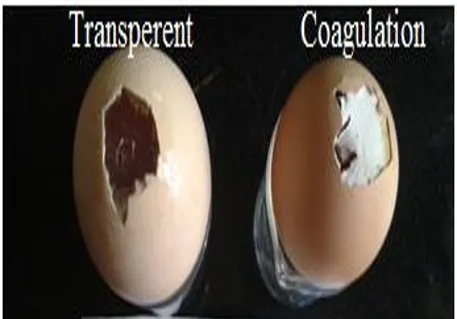
Irritation Reaction of Cream(set Ι): For optimized batch ( +) ve control of pomegranate Seed oil based For optimized batch ( +) ve control cream
Set ΙΙ
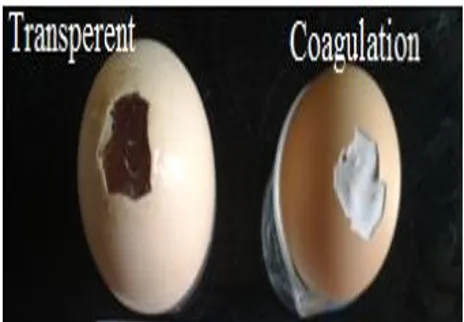
Irritation Reaction of cream (set ΙΙ): For optimized batch ( +) ve control of pomegranate Seed oil based For optimized batch ( +) ve control cream
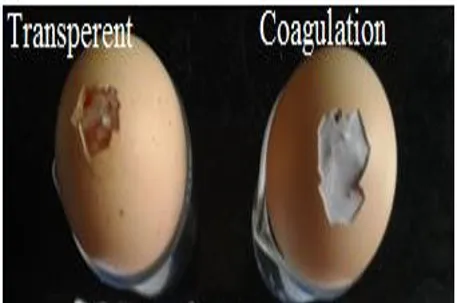
Irritation Reaction of cream (set ΙIΙ): For optimized batch ( +) ve control of pomegranate Seed oil based For optimized batch ( +) ve control cream
Fig.No.1: Irritation Reaction of cream
CONCLUSION
The current study effectively developed and tested pomegranate seed oil-based herbal cream formulations for topical treatment of inflammatory skin diseases. All five formulations had acceptable physicochemical qualities, including a skin-friendly pH, decent spreadability, adequate viscosity, washability, and thermal stability. F5 was found to be the optimal formulation, with the highest spreadability (3.6 ± 0.30 cm/sec), viscosity (3900 cps), and pH of 6.2 ± 0.65.
The HET-CAM evaluation also revealed that the optimized cream caused less irritation than the positive control, confirming its preliminary topical safety. The beneficial phytoconstituents of pomegranate, including punicic acid, polyphenols, flavonoids, and punicalagins, give scientific support for its possible anti-inflammatory and antioxidant properties.
As a result, the created formulation, notably F5, could be a potential natural topical formulation for future research in inflammatory skin disorders. However, more in-vivo research, mechanistic investigations, and clinical trials are needed to determine its therapeutic efficacy and long-term safety.
PROSPECTIVE STUDIES
Further studies, such as in vivo anti-inflammatory activity, stability tests, and clinical trials on human volunteers, may be conducted to establish the formulation's safety and therapeutic efficacy. Future study may concentrate on sophisticated herbal topical administration technologies to improve skin penetration and efficacy.
ACKNOWLEDGEMENT
We are sincerely thankful to the Principal, teaching staff, and laboratory faculty of Shri Pandit Baburao Choughule College of Pharmacy for providing the necessary facilities, guidance, and support to carry out this research work successfully. We also express our gratitude to our colleagues and friends for their valuable cooperation and encouragement throughout the study.
REFERENCES



Mayur Partole, Dipak Thorat, Harsh Khare, Somnath Lature, Priyanka Sadgir Formulation and Evaluation of Herbal Anti-Inflammatory Cream by using Pomegranate Seed Oil, Int. J. of Pharm. Sci., 2026, Vol 4, Issue 8, 4094-4104, https://doi.org/10.5281/zenodo.22095170
 10.5281/zenodo.22095170