

We use cookies to ensure our website works properly and to personalise your experience. Cookies policy
P. Wadhwani College of Pharmacy, Yavatmal
This research explores the formulation and evaluation of a Herbal soap designed to promote enhanced skin health by leveraging the therapeutic benefits of natural plant ingredient. The soap was prepared using a blend of coconut oil, castor oil, olive oil, glycerin, and selected herbal ingredients such as neem, ashwagandha, vetiver, reetha, oats, chosen for their established antibacterial, anti-inflammatory, and moisturizing properties. The formulation process involved precise saponification, careful incorporation of herbal powders, and the addition of essential oils for fragrance and added skin benefits. Comprehensive physicochemical analyses including pH, foaming index were conducted to assess the quality and efficacy of the final product. Results indicated that the herbal soap exhibited satisfactory cleansing, lathering activity, making it suitable for daily use and various skin types. The study underscores the potential of single- layer herbal soaps as a natural, eco-friendly alternative to conventional synthetic products, offering both skin protection and environmental sustainability. Vary depending on the ingredients used, here are some commonly claimed advantages.
The skin is the largest organ of the body. It is made up of water, protein, fats and minerals with a total area of about 20 square feet. Skin protects the body from germs and the elements. Skin helps to feel sensation like hot and cold, and also regulates the temperature of the body. The epidermis is the outer-most layer of the skin, provides a water-resistant and creates our skin tone. The dermis is the second layer of the skin, contains tough connective tissue, hair follicles, and sweat glands. The hypodermis is the deeper layer of the skin and known as subcutaneous tissue. It is made up of fat and connective tissue. [1]
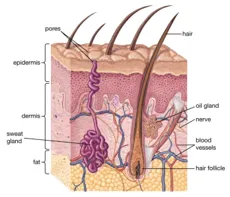
Fig. no. 1: Structure of skin
The word cosmetic was derived from the Greek word "kosm tikos" meaning having the power, arrange, skill in decorating1. The origin of cosmetics forms a continuous narrative throughout the history of man as they developed. The man in prehistoric times 3000BC used colors for decoration toattract the animals that he wished to hunt and also the man survived attack from the enemy by coloring his skin and adorned his body for protection to provoke fear in an enemy (whether man or animal). The cosmetics, according to the Drugs and Cosmetics Act is defined as articles intended to be rubbed, poured, sprinkled or sprayed on, introduced into or otherwise applied to the human body or any part there of for cleansing, beautifying, promoting attractiveness or altering the appearance.
The cosmetic does not come under the preview of drug license. The herbal cosmetics are the preparations containing phytochemical from a variety of botanical sources, which influences the functions of skin and provide nutrients necessary for the healthy skin or hair. The natural herbs and their products when used for their aromatic value in cosmetic preparation are termed as herbal cosmetics. The Drug and Cosmetics Act specify that herbs and essential oils used in cosmetics must not claim to penetrate beyond the surface layers of the skin nor should have any therapeutic effect. Herbal soap preparation is a medicine or drugs it contain Antibacterial and antifungal agents which mainly uses of part of plants such as like leaves, stem, roots andfruits to treatment for a injury or disease or to achieve good health.[2]
This preparation possess antimicrobial property are administered topically and available to apply in various forms like creams, lotion gel, soap, solvent extract or ointment. The variety of creams and soap properties have been used to treat various skin disorders. Mostly skin infection are caused by fungi, staphylococcus aureus and streptococcus species Ethnomedically, juiceand extract from leaves of the plants are topically applied as antimicrobial and antiinflammatory agents in treatment of skin disease including eczemas, ringworm and pruritus.
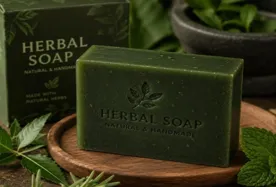
Fig.no. 2: Herbal Soap
Soap is a emulsifying and cleansing agent that is usually made by treating fat (vegetables or animal oil) or fatty acid with an alkali such as sodium or potassium hydroxide, This process is called as saponification. Soap are the substance that when dissolved in water posses the ability to remove the dirt from surfaces such as human skin, textiles and other solids. Soap is a salt of fatty acid. Herbal soap refers to a type of soap formulated with natural ingredients derived from herbs, botanical extracts, and essential oils.
Herbal soap is made using natural herbs and ingredients that are healthier and beneficial for the skin and are less likely to cause any damaging effect. The use of plant extracts in soap making has been practiced for centuries, and it is still prevalent today. Unlike conventional soaps that may contain synthetic fragrances and harsh chemicals, these variants prioritize natural and plant-based ingredients known for their beneficial properties. They are valued for their potential to soothe, nourish, and rejuvenate the skin, making them popular choices in natural skincare routines. These are gentle on skin and likely to have any side effects.
Mostly skin infections are caused by fungi, staphylococcus aureus and streptococcus species. Herbal soap has been used traditionally for treating several epidermal dysfunctions such as eczema, psoriasis and acne and helps to boost immune response in tissue affected areas. Herbal soaps are gaining popularity among consumers due to their natural and gentle properties. It is free from harsh chemicals and synthetic fragrances, making it suitable for sensitive skin types. The anti-inflammatory and antioxidants properties of herbal soap aid in soothing irritation, healing wounds and combating skin conditions. Additionally, it contains aroma therapeutic benefits, promoting relaxation and stress relief during bathing.
Benefits of Herbal Soap:
Herbal Detain Soap is typically marketed as a natural skin care product that combines herbal extracts with cleansing agents and tan removing and skin whiting While the exact benefits may vary depending on the ingredients used, here are some commonly claimed advantages.
Herbal soaps usually contain natural oils and fewer harsh chemicals, making them suitable for sensitive skin. They help maintain the skin's natural moisture.
Ingredients like olive oil, glycerin, aloe vera, and coconut oil help keep the skin soft and hydrated, preventing dryness.
Many herbs such as neem, turmeric, tea tree oil, and lavender possess antibacterial and antifungal activities that help protect the skin from infections.
Herbal ingredients contain antioxidants that help protect the skin from damage caused by free radicals and environmental pollution.
Herbs like neem, tulsi, and tea tree oil help reduce acne, pimples, and excess oil production due to their antimicrobial properties.
Essential oils provide a pleasant natural fragrance without the use of synthetic perfumes, which may irritate the skin.
Since herbal soaps contain fewer artificial colors and chemicals, they are less likely to cause skin irritation, allergies, or itching.
Regular use of herbal soap can help make the skin smoother, healthier, and refreshed.
Herbal soaps are generally biodegradable and environmentally friendly because they are prepared from natural ingredients.
AIM AND OBJECTIVES
AIM:-
To formulate and evaluate a herbal soap containing natural herbal ingredients for effective cleansing, antimicrobial activity, skin nourishment, and improved skin compatibility.
OBJECTIVES:-
PLAN OF WORK
1. Collection of Materials
Collection of herbal ingredients, oils and other required chemicals.
2. Preparation of Herbal
Processing of selected herbal ingredients for soap formulation.
3. Formulation of Herbal Soap
Preparation of herbal soap by Hot Process Method.
4. Molding and Drying
Pouring the prepared soap into molds and allowing proper drying & curing.
5. Evaluation of Herbal Soap Evaluation using parameters such as:
6. Stability Study
Observation of soap stability under suitable storage conditions.
7. Result and Conclusion
Analysis of evaluation results and conclusion of the study.
INGREDIENTS
Common Name: Coconut oil
Family: Arecaceae
Biological Source: Endosperm of dried Coconut (copra)
Part Used: Kernel
Chemical Constituents: Lauric acid, caprylic acid, capric acid, myristic acid
Properties: Emollient, antimicrobial, Moisturizing
Importance: Coconut oil contributes to a rich and creamy lather in soap. Its lauric acid content aids in skin barrier repair and hydration. It penetrates the skin, keeping it supple, smooth, and free of microbial colonization
Common Name: Olive oil
Family: Oleaceae
Biological Source: Obtained from the ripe fruits of olive tree
Part Used: Fruit pulp
Chemical Constituents: Oleic acid, palmitic acid, linoleic acid, squalene, polyphenols
Properties: Emollient, moisturizing, antioxidant, soothing
Importance: Olive oil provides mild cleansing and excellent moisturizing properties in soap. It helps maintain skin softness, improves skin elasticity and protects against dryness and irritation. Its antioxidant components support skin nourishment and repair.
Common Name: Castor oil
Family: Euphorbiaceae
Biological Source: Fixed oil obtained from seeds of Ricinus communis
Part Used: Seeds
Chemical Constituents: Ricinoleic acid, oleic acid, linoleic acid, stearic acid
Properties: Humectant, emollient, antimicrobial, conditioning
Importance: Castor oil enhances creamy and stable lather in soap formulations. It attracts moisture to the skin, improving hydration and softness. It also contributes to conditioning and smooth texture of the soap.
Common Name: Neem
Family: Meliaceae
Biological Source: Leaves and seeds of Azadirachta indica
Part Used: Leaves / Seed oil
Chemical Constituents: Nimbin, azadirachtin, nimbidin, quercetin
Properties: Antibacterial, antifungal, anti-inflammatory, antiseptic
Importance: Neem is widely used in herbal soaps for its antimicrobial and skin-protective effects. It helps reduce acne, itching and microbial infections while soothing irritated skin and promoting healthy skin condition.
Common Name: Oats
Family: Poaceae
Biological Source: Dried seeds of Avena sativa
Part Used: Seeds
Chemical Constituents: Beta-glucan, avenanthramides, proteins, lipids, saponins
Properties: Soothing, exfoliating, moisturizing, anti-inflammatory
Importance: Oats are used in herbal soaps for gentle exfoliation and skin soothing effects. They help relieve dryness, itching and irritation while improving skin hydration and smoothness. Oats also enhance the mildness of the soap formulation.
Common Name: Ashwagandha
Family: Solanaceae
Biological Source: Dried roots of Withania somnifera
Part Used: Root
Chemical Constituents: Withanolides, alkaloids, sitoindosides, flavonoids
Properties: Antioxidant, rejuvenating, anti-inflammatory, soothing
Importance: Ashwagandha helps protect the skin from oxidative stress and environmental damage. In soap formulations, it supports skin rejuvenation, improves skin texture, and provides calming effects on sensitive skin.
Common Name: Vetiver Family: Poaceae
Biological Source: Roots of Vetiveria zizanioides
Part Used: Roots
Chemical Constituents: Vetiverol, vetivone, khusimol, essential oils
Properties: Cooling, antimicrobial, antioxidant, aromatic
Importance: Vetiver provides refreshing and cooling properties in herbal soaps. It helps cleanse and calm the skin while imparting a pleasant natural fragrance. Its antimicrobial activity supports healthy skin hygiene.
Common Name: Reetha / Soapnut
Family: Sapindaceae
Biological Source: Dried fruits of Sapindus mukorossi
Part Used: Fruit pericarp
Chemical Constituents: Saponins, sugars, flavonoids, fatty acids
Properties: Natural cleanser, foaming agent, antimicrobial, gentle cleansing
Importance: Reetha acts as a natural cleansing and foaming agent in herbal soaps. Its saponin content helps remove dirt and excess oil without excessive dryness, making the soap mild and skin friendly.
Common Name: Lavender oil
Family: Lamiaceae
Biological Source: Essential oil obtained from flowering tops of Lavandula angustifolia
Part Used: Flowers
Chemical Constituents: Linalool, linalyl acetate, camphor, terpinen-4-ol
Properties: Aromatic, calming, antimicrobial, anti-inflammatory
Importance: Lavender oil gives herbal soap a pleasant fragrance and relaxing effect. It helps soothe irritated skin, reduces redness and provides mild antimicrobial protection while improving the sensory appeal of the soap.
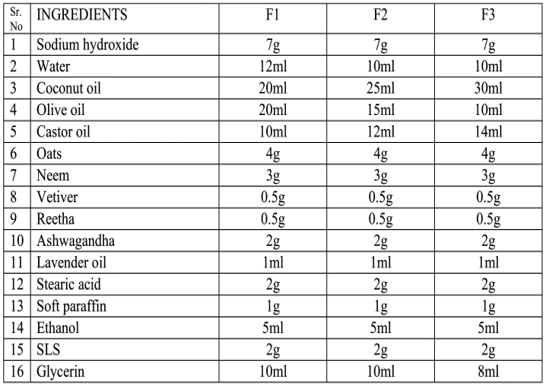
FORMULATION TABLE:
Table no. 1
METHOD OF PREPARATION:
Step 1: Take distilled water in a beaker. Slowly add NaOH little by little. Stir carefully until it fully dissolved. The solution becomes hot automatically. Keep aside and cool to about 35-40°C.
Step 2: Take coconut oil, olive oil and castrol oil in a 500 ml beaker. Heat the beaker at 60–70°C. Stir carefully until it is fully mixed. Keep aside and cool upto about 35-40°C.
Step 3: Heat the oils mixture at 35-45°C on the heating mantel. Slowly add lye solution into oil solution.
Step 4: Then add glycerin with continuous stirring.
Step 5: At the end of the process add SLS with continuous stirring,
Step 6: Add herbal powder neem, ashwagandha, vetiver, reetha, oats into the solution stir it slowly.
Step 7: Add 1ml of lavender oil & mix gently.
Step 8: Then add stearic acid, followed by soft paraffin & ethanol with continuous stirring.
Step 9: Then the mixture poured into the soap mould and freeze the soap containing mould up to 2-3 hours.
Step 10: After 2-3 hours remove the soap mould from the freeze allow to few minutes then soap will be formed.
EVALUATION PARAMETERS
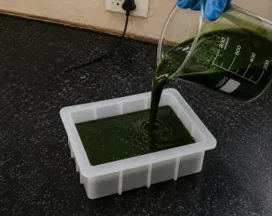
Fig. no. 14: POURING LAYER
Color and clarity were checked against a white background by naked eyes and odor was checked by smell.
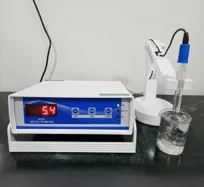
Fig. no. 15: pH Meter
The pH of the prepared soap was assessed by touching a pH strip to the freshly formulated soap and conjointly by dissolving 1 g in 10 ml water with the help of digital pH meter.
About 5 g of sample was added to 50 ml of neutralized alcohol and was boiled for 30 min under reflux on a water bath, then cooled and to it 1 ml of phenolphthalein solution was added. It was then titrated immediately with 0.1 N HCL
5gm of soap s taken in a conical flask. Added it to 50ml of warm ethanol and shaken vigorously to dissolve the solution was filtered through a tarred filter paper with 20ml warm ethanol and dried it at 105°C for one hour. The weight of dried paper was taken.
%Alcohol insoluble matte = weight of the residue X 100 / wt of sample
About 10g of the sample under study were accurately weighed and transferred to a tarred china dish of know weight and kept in a hot air oven at 100-105°C for an hour. Then, the sample was weighed along with the china dish The weight of the content was noted to calculate the percentage moisture content.
Moisture content = [final weight initial weight] X 100
TFM was estimated by reacting soap with acid in the presence of hot water and calculated the fatty acids obtained. 10g of the formulated soap was dissolved in 150ml distilled water and heated. To this 20ml of 15%H2SO4 added while heating until a clean solution was obtained. Fatty acids that are present on the surface of the resting solution are solidified by adding 7g beeswax and heated again. Then, it was allowed to cake. Cake removed and boiled to dry and weighed to obtain the TFM using the formula
%TFM = [Weight of the cake Weight of the wax] in gm / weight of the soap in gms X100
Accelerated stability testing of prepared poly herbal formulation was at room temperature, studied for one week at 50°C ± 1° C for 3 months. The poly herbal formulation was kept on water bath at room and elevated. temperature and observed on 0th,15th,20th, 30th, 40th, 50th, 60th, 70th, 80th and 90th day.
0.5 g of sample of soap was dispersed in 25 ml of distilled water. Then, transferred it into a 100 ml measuring cylinder and the volume was made up to 50 ml with water. Twenty-five strokes were given and allowed to stand till aqueous volume measured up to 50 ml and the foam height above the aqueous volume was measured.
About 1% soap solution was prepared and from this, 25 ml was taken in a 100 ml measuring cylinder. The cylinder was covered with hand and shaken for 10 min. The volume of foam at 1 min intervals for 4 min was recorded.
The Irritation test can be used to determine if a material or chemical will cause local irritation in the skin, mucosal, or ocular tissues. In this test, 3 volunteers were taken and they were allowed to apply formulated soap on skin to determine irritation action.
The soap solution is prepared and applied to the specific body area. This area is then kept under observation for a few hours to conduct an irritancy test. [19]
RESULTS & DISCUSSION
The evaluation of herbal soap was performed successfully and tabulated in table no. 1. The prepared herbal soap was shown in figure. The physicochemical parameters for herbal soap formulations F1, F2 and F3 such as colour, appearance, pH are determined. The formulations have a dark green colour with an aromatic pleasant lavender fragrance and had a good appearance as well as the pH was found to be in the range of 5.4. Healthy skin has a pH of 4.7 to 5.9 and the prepared formulations pH was found to be neutral in nature and doesn't cause any irritation or sensitization to the skin. Other parameters like foam height and foam retention are also performed and showed good results. The prepared soaps produced good lather i.e. 2.3-3.0 cm and retained on the skin for 3 minutes.
|
Sr. no. |
TEST |
|
Result |
|
|
F1 |
F2 |
F3 |
||
|
1 |
Colour |
Light green |
Dark green |
Dark green |
|
2 |
Odour |
Unpleasent |
Pleasant and lavender fragrance |
Pleasant and lavender fragrance |
|
3 |
Appearance |
Nonuniform |
Good |
Good |
|
4 |
Shape |
Round |
Rectangular |
Round |
|
5 |
Texture |
Hard |
Smooth |
Smooth |
|
6 |
pH |
5.25 |
5.4 |
5.6 |
|
7 |
Foam height |
2cm |
4cm |
3cm |
|
8 |
Foam |
2min |
3min |
2min |
CONCLUSION
The present study successfully formulated and evaluated a herbal soap using natural ingredients such as neem, oats, lavender oil, olive oil, castor oil, glycerin, and other herbal components. The prepared soap showed satisfactory physicochemical properties including acceptable pH, good hardness, proper foam formation, smooth appearance, and good cleansing ability. The formulation was found to be stable and skin friendly due to the presence of herbal ingredients possessing antimicrobial, moisturizing, soothing, and nourishing properties.
The herbal soap demonstrated advantages over synthetic soaps by containing natural ingredients with fewer harmful chemicals, making it safer for regular skin use. The study concludes that the formulated herbal soap can be considered an effective and economical alternative to commercial synthetic soaps. Further studies on long-term stability and antimicrobial activity can enhance the quality and therapeutic value of the formulation.
REFERENCES

Manthan Surjagade, Shubham Mishra, Dr. M. D. Kitukale, D. S. Deshmukh, Formulation and Evaluation of Herbal Soap, Int. J. of Pharm. Sci., 2026, Vol 4, Issue 6, 2047-2057. https://doi.org/10.5281/zenodo.20595215
 10.5281/zenodo.20595215