

We use cookies to ensure our website works properly and to personalise your experience. Cookies policy
Delonix Society’s Baramati College of Pharmacy, Barhanpur, Baramati
Dengue fever is a viral disease transmitted by arthropods that commonly leads to thrombocytopenia, which is a condition characterized by a low platelet count and can result in severe bleeding. This study developed and tested an herbal syrup made from the extract of Carica papaya leaves as a supportive treatment for thrombocytopenia caused by dengue. The leaves were collected, identified, dried in air, ground, and then extracted using an aqueous decoction method. The extract was found to contain several bioactive compounds, including alkaloids, flavonoids, tannins, phenolic acids, saponins, and glycosides. Four syrup formulations (F1–F4) were created with different concentrations of the papaya leaf extract, using standard pharmaceutical ingredients like glycerin, xanthan gum, citric acid, sodium benzoate, and peppermint oil. These syrups were evaluated for organoleptic properties, pH, viscosity, density, homogeneity, and physical stability. The syrups had a clear appearance, consistent texture, acceptable pH levels (5.8–6.4), moderate viscosity (2200–3450 cP), and appropriate density (1.18–1.27 g/mL). No signs of phase separation, precipitation, crystallization, or discoloration were observed during the study. The inclusion of peppermint oil greatly improved the taste by reducing the bitterness of the syrup. The results suggest that the developed herbal syrup from Carica papaya leaf is stable, safe, and easy to use, and may help in increasing platelet levels in dengue patients. Further preclinical and clinical research is needed to confirm its effectiveness and safety.
Dengue fever is a viral illness spread by mosquitoes and is a major public health concern in tropical and subtropical regions around the world. One of the serious complications of dengue infection is thrombocytopenia, which refers to a low number of platelets in the blood. This condition can lead to severe bleeding, shock, and damage to vital organs. Currently, the treatment for dengue is mainly supportive care, as there is no effective antiviral medication available. Papaya leaf extract contains several bioactive substances such as papain, chymopapain, carpaine, flavonoids, tannins, and polyphenols. These compounds have been found to support platelet production, lower oxidative stress, reduce inflammation, and prevent the spread of the virus. Despite these benefits, the natural bitter taste of papaya leaf juice makes it difficult for people to consume directly. To address this issue, a more pleasant herbal syrup can be developed to improve patient acceptance and the effectiveness of treatment. By incorporating other herbs like kiwi, basil, and mint into the syrup, additional nutritional and immune-boosting properties can be added. In this article, we will explore the creation and assessment of a polyherbal syrup made from papaya leaf extract as a potential supportive treatment for dengue-related thrombocytopenia 1,3.
BOTANY AND TAXONOMIC CLASSIFICATION
Carica papaya L. is a long-living plant that grows as a herb and belongs to the family Caricaceae and the order Brassicales. It is commonly grown in tropical and subtropical regions and is considered an important crop because of its nutritional and health benefits. This plant contains active chemicals such as papain and chymopapain in its milky sap and can have male, female, or both male and female reproductive parts. Because of its high content of plant-based chemicals and wide range of potential health benefits, Carica papaya has been studied for its medicinal uses and is used to help with various health issues 11.
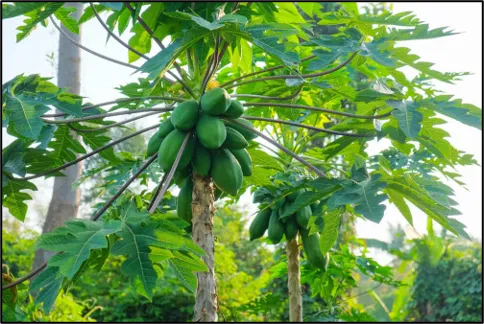
Figure no. 1: Carica Papaya tree.
GEOGRAPHICAL DISTRIBUTION
Carica papaya L. is native to tropical America, particularly southern Mexico and Central America. Today, it is grown in many tropical and subtropical areas around the world. Because of its health benefits and nutritional value, papaya has become a significant commercial fruit crop in Asia, Africa, Oceania, and the Americas. India is the top producer of papaya globally, followed by Brazil, Mexico, Indonesia, and Nigeria 1,3.
MORPHOLOGY
Papaya leaves are large and have a shape that branches out like a hand, with several deep segments. They are attached to the stem by long, hollow stalks and grow in a spiral pattern at the top of the stem. Typically, these leaves have between 7 to 13 distinct lobes, and they have clear veins that help the leaf perform photosynthesis more effectively and exchange gases efficiently 1,2.
CHEMICAL CONSTITUENTS
Papaya leaves are rich in bioactive plant compounds and nutrients that contribute to their therapeutic effects. Key components include alkaloids such as carpaine, pseudocarpaine, and carpamic acid, along with phenols, flavonoids like quercetin, rutin, and anthocyanins, saponins, tannins, and glycosides. They also contain proteolytic enzymes such as papain and chymopapain, and antioxidants like vitamin E and squalene. Additionally, papaya leaves are high in protein, dietary fiber, and essential minerals including potassium, calcium, magnesium, iron, zinc, and manganese. These plant compounds and nutrients provide papaya leaves with antioxidant, anti-inflammatory, immunomodulatory, and overall therapeutic properties 1,2.
MEDICINAL USES
Carica papaya leaves have various medicinal properties and have been traditionally used to treat several health conditions, including malaria, typhoid, diabetes, high blood pressure, gastrointestinal issues, and infectious diseases. The extract from these leaves has gained attention for its potential in managing dengue-related low platelet counts, as it may help increase platelet production, reduce the destruction of platelets, and influence immune responses. Papaya leaves are known for their antioxidant, anti-inflammatory, pain-relieving, antimicrobial, liver-protecting, and immune-regulating effects. Research also suggests that they might have anticancer properties, potentially effective against cancers of the breast, cervix, lungs, pancreas, and liver. Because of its wide range of health benefits and rich chemical composition, Carica papaya leaves remain a subject of ongoing pharmaceutical and medical research 1,3,6,11.
PHARMACOLOGICAL ACTIVITY
The extract from Carica papaya leaves contains various substances that have medicinal benefits, such as carpaine, quercetin, and other flavonoids. Because of these active components, the extract has been shown to help increase platelet production, support the recovery of blood cells, and protect platelets from being destroyed. This makes it especially helpful in cases where dengue virus causes a low platelet count. The extract also has the ability to fight the dengue virus by stopping it from replicating and assembling. It can also help regulate the immune system, which may reduce inflammation and keep blood vessels healthy during serious infections. The anti-inflammatory and antioxidant effects of the extract come from enzymes, flavonoids, and polyphenols, which help lower levels of oxidative stress, inflammation, and tissue damage. Additionally, the extract has been found to kill the larvae of Aedes aegypti mosquitoes, indicating its potential as a tool for controlling the spread of dengue 1,3,11.
AIM AND OBJECTIVES
This study aims to create and analyze an effective herbal syrup made from Carica papaya leaf extract to help treat thrombocytopenia linked to dengue. The goals involve extracting and standardizing the active components from papaya leaves, and then developing a strong and easy-to-take syrup that includes natural flavours like kiwi and basil to improve taste and offer extra antioxidant benefits. The study will also examine the physical and chemical properties of the syrup, such as pH, viscosity, appearance, and how uniform the product is. Testing will be done under different storage conditions to check stability. The research will also cover safety, quality control, and cost-effectiveness to ensure the herbal syrup is a practical and reliable option for helping patients recover platelets and follow treatment plans for dengue 2,5,7,10.
LITERATURE REVIEW
MATERIALS AND METHODS
Plant Material: The Carica Papaya leaves were used for experimental process.
Chemicals:
Table no. 1: List of chemicals used for work
|
Chemicals |
Company/Source |
|
Sucrose |
Standard Pharmaceutical Source |
|
Sodium Benzoate |
Standard Pharmaceutical Source |
|
Citric Acid |
Standard Pharmaceutical Source |
|
Peppermint oil |
Standard Pharmaceutical Source |
|
Xanthum gum |
Standard Pharmaceutical Source |
|
Glycerin |
Laboratory prepared |
|
Distilled water |
Laboratory Prepared |
Equipments:
Table no. 2: List of equipments used for work
|
Equipment |
Company/Source |
|
Weighing Balance |
Wenser |
|
Magnetic Stirrer |
Borosil |
|
Ostwald Viscometer |
Avantor |
|
pH Meter |
Labpro |
|
Density Bottle |
Standard Lab Supplier |
|
Beakers and Glassware |
Borosil |
Collection, Authentication and Cleaning of raw materials.
The leaves of Carica papaya were used to extract bioactive compounds through the decoction method. A specific amount of dried leaf powder was boiled in distilled water at 100°C until the volume was reduced to one-quarter or one-half of the original. After boiling, the decoction was allowed to cool to room temperature. It was then filtered using a muslin cloth and Whatman No.1 filter paper. The filtered liquid was further concentrated under reduced pressure using a rotary evaporator and stored for future use. This aqueous extract, which contains various bioactive components such as papain, carpaine, flavonoids, and polyphenols, was utilized in the preparation of the herbal syrup.4,5
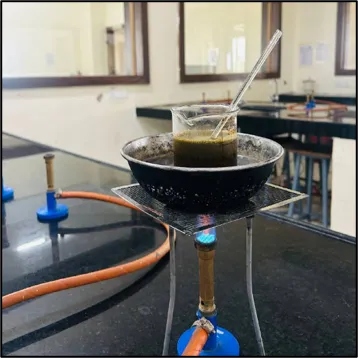
Figure no. 2: Decoction Extraction.
Phytochemical Screening of Extract:
|
Test Name |
Observation |
Inference |
|
Alkaline reagent test |
Yellow colour was observed |
Presence of Flavonoids |
|
Lead acetate test |
Yellow precipitate was observed |
Presence of Flavonoids |
|
Test Name |
Observation |
Inference |
|
Dragendroff’s test |
Orange precipitate observed |
Presence of Alkaloids |
|
Wagner’s test |
Reddish-brown precipitate observed |
Presence of Alkaloids |
|
Test Name |
Observation |
Inference |
|
Ferric chloride test |
Green-black colour was observed |
Presence of Tannins |
d) Test for Saponins
|
Test Name |
Observation |
Inference |
|
Foam test |
Foam formation for several minutes was observed |
Presence of Saponins |
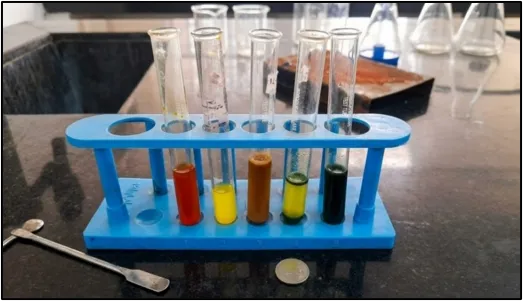
Figure no. 3: Phytochemical Screening Results
Formulation Composition:
Table no. 3: Formulation Composition
|
Ingredient |
F1 (g) |
F2 (g) |
F3 (g) |
F4 (g) |
|
Papaya leaves extract |
1.0 |
1.5 |
2.0 |
2.5 |
|
Simple syrup |
2.0 |
2.5 |
3.0 |
3.5 |
|
glycerine |
1.0 |
1.5 |
2.0 |
2.5 |
|
Sodium benzoate |
0.20 |
0.20 |
0.20 |
0.20 |
|
Citric acid |
0.50 |
0.50 |
0.50 |
0.50 |
|
Xanthum gum |
0.25 |
0.35 |
0.45 |
0.55 |
|
Peppermint oil |
0.20 |
0.20 |
0.20 |
0.20 |
|
Distilled Water |
q.s |
q.s |
q.s |
q.s |
Preparation of Syrup:
The therapeutic oral syrup was prepared using standard pharmaceutical compounding methods. A simple syrup base was made by dissolving sucrose in purified water, with gentle heating. Xanthan gum was then dispersed in water, acting as a stabilizer and increasing the viscosity. The aqueous Carica papaya leaf extract was combined with glycerine, sodium benzoate, and citric acid to ensure proper texture, preservation, and pH balance. The prepared extract was slowly added to the syrup base while continuously stirring to achieve a uniform mixture. To mask the bitter taste of the extract, a small amount of peppermint oil was included. The final volume was adjusted with distilled water, the mixture was filtered, and then packed into airtight amber-coloured bottles for further physicochemical testing and stability analysis 9,10.
RESULTS AND DISCUSSION
The Carica papaya leaf extract syrup had a clear and uniform appearance and showed good homogeneity. No signs of phase separation, sedimentation, crystallization, or colour change were observed during the study period, indicating that the syrup maintained good physical stability. The herbal extract was well distributed within the formulation, ensuring consistent uniformity. The syrup exhibited an acceptable level of viscosity and had a pleasant appearance. The flavours in the syrup effectively masked the bitter taste of the extract.
Phytochemical Tests.
|
Phytochemical Test |
Result |
|
Alkaloids |
+ (Present) |
|
Flavonoids |
+ (Present) |
|
Tannins and Phenolics |
+ (Present) |
|
Saponins |
+ (Present) |
|
Glycosides |
+ (Present) |
Organoleptic Parameters.
|
Parameters |
Result |
|
Colour |
Brownish |
|
Odour |
Minty |
|
Taste |
Bitter |
|
Appearance |
Clear |
pH ,Viscosity and Density results:
|
Formulation |
pH (Mean ± SD) |
Viscosity (cP) |
Density (g/mL) |
|
F1 (5%) |
5.8±0.1 |
2200±40 |
1.18±0.01 |
|
F2 (10%) |
6.0±0.1 |
2610±45 |
1.22±0.01 |
|
F3 (15%) |
6.2±0.1 |
3080±50 |
1.24±0.02 |
|
F4 (20%) |
6.4±0.1 |
3450±55 |
1.27±0.02 |
CONCLUSION
This study successfully created and tested an herbal syrup made with Carica papaya leaf extract (CPL) as a possible supportive treatment for dengue-related low platelet count A chemical analysis showed that the extract contains important active substances like alkaloids, flavonoids, tannins, phenolic compounds, saponins, and glycosides. These compounds are known for their antioxidant, anti-inflammatory, immune-modulating, and ability to boost platelet production. The syrup had good physical characteristics such as a suitable pH, consistent viscosity, proper density, uniform texture, and remained stable over time. No separation of layers, settling of particles, formation of crystals, or change in colour was noticed during storage, showing that the formulation is physically stable. The inclusion of peppermint oil helped improve the taste by reducing the bitter flavour of the papaya leaf extract, making it more acceptable to patients. As the concentration of CPL increased, the syrup's viscosity and density also increased, but the pH stayed within a safe range for oral use. Therefore, the developed papaya leaf extract syrup was found to be stable, safe, and easy to take, making it a useful supportive therapy for raising platelet counts in dengue patients. Further research, including preclinical and clinical trials, will be necessary to confirm its effectiveness, safety, and the way it works in treating dengue-induced low platelet count.
ACKNOWLEDGEMENT
I sincerely thank the Delonix Society’s Baramati College of Pharmacy, Baramati, for providing the facilities to complete this research work successfully. I express my heartfelt gratitude to Rajendra N. Patil, Abhijit Shitole for their valuable guidance, encouragement, and continuous support throughout the project. I also thank all teaching and non-teaching staff members for their cooperation and assistance during the research work.
REFERENCES








Pratik Kokane, Siddhant Maske, Prasad Khude, Aklesh Kori, Omkar Lambhate, Priya Kudale, Sakshi Kodalkar, Pratiksha Madane, Abhijit Shitole, Rajendra Patil, Formulation and Evaluation of Papaya Leaf Extract Syrup for Dengue Treatment, Int. J. of Pharm. Sci., 2026, Vol 4, Issue 6, 5737-5743. https://doi.org/10.5281/zenodo.20801214
 10.5281/zenodo.20801214