

We use cookies to ensure our website works properly and to personalise your experience. Cookies policy
Loknete Shri Dadapatil Pharate College of Pharmacy, Mandavgan Pharata, Shirur, Pune
Due to many lifestyle changes such as fatigue, stress, poor diet and different hair coloring techniques young generation is facing serious hair problems. Dandruff, a common scalp condition, is often associated with itching, flaking, and irritation, while rough and frizzy hair texture diminishes aesthetic appeal. The formulation process involves selecting botanical ingredients known for their anti-dandruff and hair-smoothing properties, followed by optimization to ensure efficacy and safety. Various herbal extracts, essential oils, and natural additives will be combined to create a synergistic blend targeting dandruff-causing microbes and improving hair texture This research project aims to develop a novel polyherbal hair mask formulated specifically for combating dandruff and enhancing hair smoothness. Strengthening hair follicles is important for improving hair growth and preventing hair loss. Pollutants, weather, use of heat appliances such as hair dryers, straighteners, and curling irons exposure to UV rays, use of strong shampoos, use of medical treatments, too much styling, and some other causes are responsible for hair damage. Therefore, the hair will be dry and dull. Split ends, rough texture, and itchy scalp are also signs of damaged hair. Hair is the most fragile part of the body. Healthy hair improves the appearance of the individual. Hair Mask is a hair treatment for men and women that leaves hair shinier, smoother, nourished and moisturized. The purpose of using herbal hair mask is to remove dirt and dandruff, strengthen the hair and darken the hair colour. The hair mask containing only the natural ingredients from plant source will treat hair problems without damaging hairs and with no adverse effects as of synthetic preparations. The formulated hair mask will undergo comprehensive evaluation, including physicochemical analysis, microbial assessment, and sensory evaluation, to determine its stability. The mask is completely chemical free. The combination of several such ingredient of herbal origin has made it possible to secure highly effective dry powder hair mask. The formulation at laboratory scale was done and evaluated for number of parameters to ensure its safety and efficacy.
Hair is an important part of the human body that significantly contributes to an individual's appearance, personality, and self-confidence. Healthy hair reflects good scalp health and proper nutrition, whereas factors such as stress, pollution, unhealthy lifestyle, poor diet, excessive use of chemical-based products, and environmental changes can lead to various hair problems including dandruff, hair fall, dryness, roughness, and loss of shine.
Dandruff is one of the most common scalp disorders characterized by itching, flaking, and irritation of the scalp. It is often associated with microbial growth, excessive sebum production, poor hygiene, and environmental factors. In addition to dandruff, rough and frizzy hair has become a major concern among both men and women due to frequent exposure to heat treatments, chemical styling products, and environmental pollutants.
Herbal cosmetics have gained considerable attention in recent years because of their safety, effectiveness, and minimal side effects compared to synthetic products. Herbal hair masks are natural formulations prepared from medicinal plants that nourish the scalp, strengthen hair follicles, improve hair texture, and promote healthy hair growth. These formulations provide a holistic approach to hair care by utilizing the therapeutic properties of various herbs.
The present research focuses on the formulation and evaluation of a polyherbal anti-dandruff hair mask and hair smoothener containing natural ingredients such as cucumber, hibiscus, shikakai, shatavari, curry leaves, peppermint, aloe vera, fenugreek seeds, lemon juice, and lavender oil. These ingredients are selected based on their traditional use and scientifically proven benefits in dandruff control, scalp nourishment, hair strengthening, moisturizing, and hair smoothing.
The formulated polyherbal hair mask is intended to provide a natural, safe, and effective solution for controlling dandruff while enhancing hair smoothness, shine, and overall hair health. The formulation is further evaluated for its physicochemical properties, phytochemical constituents, stability, safety, and effectiveness to ensure product quality and efficacy.
Disease Profile
Dandruff is a common scalp disorder characterized by the shedding of dead skin cells from the scalp. It causes itching, irritation, and visible white flakes on the hair and shoulders. The condition is mainly associated with excessive oil production, fungal growth (Malassezia), poor hygiene, stress, and dry scalp. Dandruff can be classified into dry dandruff and oily dandruff. Dry and rough hair occurs when hair lacks adequate moisture and nourishment. Environmental pollution, excessive heat styling, chemical treatments, and improper hair care practices can damage the hair shaft, resulting in dullness, frizziness, split ends, and hair breakage.The use of a polyherbal anti-dandruff hair mask helps control dandruff, nourishes the scalp, strengthens hair follicles, improves hair texture, and restores smoothness and shine naturally.
LITERATURE SURVEY
1. Arpitha G. et al. (2023)
The authors developed and evaluated a polyherbal hair mask containing natural ingredients for dandruff control and hair nourishment. The study reported that herbal formulations effectively reduce dandruff, strengthen hair follicles, and improve hair texture without causing adverse effects associated with synthetic products.
2. Poornima Mishra et al. (2022)
This review highlighted the importance of herbal hair masks in maintaining healthy hair and scalp. The study emphasized that herbal ingredients can effectively remove dirt and dandruff, improve hair growth, and provide conditioning effects while being safe for long-term use.
3. Rahane R.K. et al. (2023)
The researchers formulated and evaluated an anti-dandruff herbal hair mask containing Amla, Neem, Shikakai, Hibiscus, and other medicinal herbs. Their findings demonstrated significant reduction in dandruff and improvement in scalp health due to the antifungal and nourishing properties of herbal ingredients.
4. Shukla M.K. et al. (2023)
The study focused on the development of an anti-dandruff herbal hair mask for managing flaky scalp conditions. The authors concluded that herbal formulations provide effective dandruff control, improve hair strength, and minimize hair damage caused by chemical-based products.
5. Akshata D. Katmande et al. (2022)
This research described the preparation and evaluation of a herbal hair mask containing natural plant materials. The formulation was found to improve hair smoothness, reduce hair fall, and maintain scalp hygiene while being free from harmful chemicals.
6. Ankita P. Jadhav et al. (2022)
The authors formulated a herbal anti-dandruff hair mask using traditional medicinal plants. Evaluation results indicated improved hair texture, reduced dandruff, and enhanced scalp nourishment, confirming the effectiveness of herbal ingredients in hair care.
NEED OF STUDY
Hair-related problems such as dandruff, hair fall, dryness, roughness, and loss of shine have become increasingly common due to modern lifestyle changes, environmental pollution, stress, unhealthy dietary habits, and excessive use of chemical-based hair care products. Among these conditions, dandruff is one of the most prevalent scalp disorders, causing itching, irritation, flaking, and discomfort, which may adversely affect an individual's appearance and confidence.Although numerous anti-dandruff products are available in the market, most contain synthetic chemicals that may produce undesirable side effects such as scalp irritation, dryness, allergic reactions, and hair damage after prolonged use. Therefore, there is a growing demand for safer, natural, and effective alternatives for hair care.
Herbal formulations have gained considerable importance because they are rich in bioactive constituents, possess antimicrobial and anti-inflammatory properties, and are generally free from harmful side effects. Medicinal plants such as cucumber, hibiscus, shikakai, shatavari, curry leaves, peppermint, aloe vera, fenugreek, lemon, and lavender oil have traditionally been used for promoting scalp health, controlling dandruff, strengthening hair follicles, and improving hair texture.The present study was undertaken to formulate and evaluate a polyherbal anti-dandruff hair mask and hair smoothener using natural ingredients. The study aims to provide an effective herbal formulation that not only controls dandruff but also nourishes the scalp, reduces hair fall, improves hair smoothness, and enhances the overall appearance of hair. Furthermore, the research evaluates the physicochemical properties, stability, safety, and efficacy of the formulation to ensure its suitability as a natural hair care product.Hence, this study is necessary to develop a safe, economical, eco-friendly, and effective herbal hair mask that can serve as an alternative to conventional chemical-based hair care products.
DRUG AND EXCIPIENTS PROFILE
Ingredients:
Table No. 1: Ingredients and its pharmacognosy
|
Sr. No. |
Ingredient name |
Biological source |
Family |
Uses |
|
1 |
Cucumber powder |
Dried fruit of Cucumis sativus |
Cucurbitaceae |
Regulates sebum production, natural oil on scalp, Humectant Repair damaged hair Silky and shiny hair |
|
2 |
Hibiscus powder |
Dried flower of Hibiscus rosa Sinesis |
Malvaceae |
Anti-dandruff property. Source of vit A, vit C, amino acid |
|
3 |
Shatavari powder |
Dried tuberous root of Asparagus racemosus Willd |
Liliaceae |
Hair growth promotion. Hair root strengthening |
|
4 |
Shikakai powder |
Dried pods of Acacia concinna |
Mimosaceae |
Cleansing of scalp. Anti-dandruff property |
|
5 |
Curry leaves powder |
Dried leaves of Murraya koenigii (L.) Spreng |
Rutaceae |
Reduce dullness. Hair thickening Maintain hair health |
|
6 |
Peppermint powder |
Extracted from leaves of Mentha piperita L. |
Lamiaceae |
Moisturizing property. Itching relief Cooling effect |
|
7 |
Aloe vera powder |
Dried leaves of Aloe barbadensis miller |
Liliaceae |
Hydrates hair. Stop hair fall |
|
8 |
Fenugreek seed powder |
Dried seeds of Trigonella foenum graecum |
Leguminosae |
Reduce hair loss |
|
9 |
Lemon juice |
Fresh fruit of Citrus limonis Burm |
Rutaceae |
Helps to revive dull, dry hair Healthy and silky hair |
|
10 |
Lavender oil |
Flower of Lavandula angustifolia |
Lamiaceae |
Perfume and preservative Improve blood circulation |
MATERIAL AND METHODOLOGY:
Collection of herbal ingredients
Table No. 2: Parts of plant used and grade
|
Sr. No. |
Ingredients name |
Parts of plant used |
Grade |
|
1 |
Cucumber |
Fruit |
Local market |
|
2 |
Hibiscus |
Flower |
Local market |
|
3 |
Shatavari |
Roots |
Local market |
|
4 |
Shikakai |
pods |
Local market |
|
5 |
Curry leaves |
Leaves |
Local market |
|
6 |
Peppermint |
Leaves |
Local market |
|
7 |
Aloe vera |
Leaves |
Local market |
|
8 |
Fenugreek |
Seed |
Local market |
|
9 |
Lemon juice |
Fruit |
Local market |
|
10 |
Lavender oil |
flower |
Local market |
Apparatus used:
Table No. 3: Glassware’s and company
|
Sr. No. |
Glassware’s Names |
Company Name |
|
1 |
Beaker |
AGARWAL borosilicate glass |
|
2 |
Test tubes |
AGARWAL borosilicate glass |
|
3 |
Measuring cylinder |
AGARWAL borosilicate glass |
|
4 |
Stirrer |
AGARWAL borosilicate glass |
|
. 5 |
Funnel |
AGARWAL borosilicate glass |
|
6 |
Porcelain dish |
AGARWAL borosilicate glass |
|
7 |
Silica crucible |
- |
Chemicals used:
Table No. 4: Chemicals Used
|
Sr. No. |
Chemicals name |
|
1 |
Alpha Naphthol solution |
|
2 |
Alcohol |
|
3 |
Conc. H2SO4 |
|
4 |
Fehling A solution |
|
5 |
Fehling B solution |
|
6 |
Hager’s reagent |
|
7 |
Mayer’s reagent |
|
8 |
Sudan red III |
|
9 |
NaOH |
|
10 |
CuSO4 solution |
|
11 |
Dilute HCl |
|
12 |
Distilled water |
Composition of polyherbal hair mask:
Table No. 5: Composition of polyherbal hair mask
|
Sr. No. |
Ingredients Name |
Batch 1 (10 gm) |
Batch 2 (15 gm) |
|
1 |
Cucumber powder |
1.8 gm |
3.0 gm |
|
2 |
Hibiscus powder |
1.3 gm |
2.5 gm |
|
3 |
Shatavari powder |
1.5 gm |
2.6 gm |
|
4 |
Shikakai powder |
1.3 gm |
2.6 gm |
|
5 |
Curry leaves powder |
1.1 gm |
1.5 gm |
|
6 |
Peppermint powder |
0.8 gm |
1.0 gm |
|
7 |
Aloe vera powder |
1.5 gm |
1.0 gm |
|
8 |
Fenugreek seed powder |
0.7 gm |
0.8 gm |
|
9 |
Lemon juice |
Q.S. |
Q.S. |
|
10 |
Lavender oil |
Q.S. |
Q.S. |
Methodology and Experimental work:
Method of preparation:
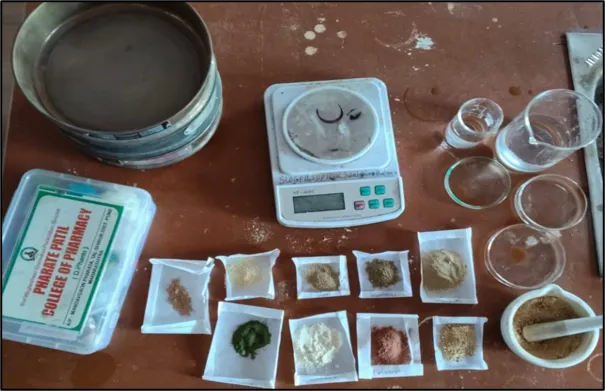
Figure No. 01 Collection and Weighing all Materials
The cucumber powder is the main ingredient of hair mask as it regulates the sebum production, and natural oil on scalp. The cucumber also acts as the humectant and makes our hair silky and shiny. It also repairs the damaged hair. So, the quantity of cucumber powder in hair mask composition is more as compared to others. The Shikakai and hibiscus both has the anti-dandruff property so below cucumber powder they both are taken approximately in same quantity. Shatavari promotes the hair growth and strengthen the hair roots hence it also taken in same amount as shatavari. Curry leaves help to maintain hair health and reduce dullness. It also helps to thickening of hair. As peppermint is potent it is taken in small quantity. The aloe vera and fenugreek seed helps to reduce hair fall as they both has same property so they are taken in approximately same amount. Aloe vera also helps to take our hair silky and shiny. The lemon juice revives dull and dry hair which helps to make our hair healthy and shiny. The lavender oil improves the blood circulation and act as preservative. It also gives perfume to mask the raw odour of herbal powders. By this way all the ingredients play a very important role in hair mask function. Hence, they are taken according to their use, property and potency.
Batch 1:
Composition of batch 1 is not as our expectations that it does not properly clean the hair dandruff and smoothen the hair. It works near about our expectations and does not make our hair properly so to overcome this problem second batch was prepared.
Batch 2:
Batch 2 is properly meets to our expectations as we increase the quantity of cucumber powder, hibiscus powder, Shikakai powder, shatavari powder and curry leaves powder. Batch 2 passes the all-evaluation tests and works as our expectations.
Evaluation of herbal hair mask
The prepared herbal anti-dandruff and hair smoothener hair mask was evaluated by following parameters:
By utilizing sensory organs like eyes or nose, the examination of the formulation is performed under this evaluation, and it includes macroscopic characteristics of the drug or product, such as colour, odour, texture and appearance.
Ash content- Take about 2 or 3 gm accurately weighed, of the ground drag in a tarred silica dish previously ignited and weighed. Scatter the ground drug in a fine even layer on the bottom of the dish. Incarnated by gradually increasing the heat-not exceeding dull red heat-until free from carbon, cool and weigh. If a carbon free ash cannot be obtained in this way, exhaust the charred mass with hot water, collect the residue on an ash less filter paper, increate the residue and filter paper, add the filtrate, evaporate to dryness and ignite at low temperature. Calculate the percentage of ash.
Various tests were performed, to identify the phytoconstituents present in the products and their effect is shown on the body. Every plant exhibits certain phytochemical properties, which show a number of beneficial effects.
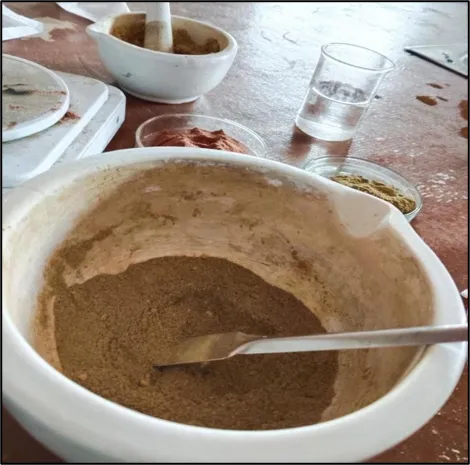
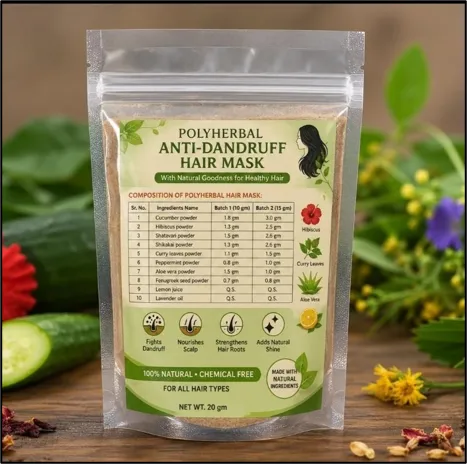
Figure No.02 Procedure carries in Laboratory and Final Product prepared pohyherbal Anti-dandruff Hair Mask
RESULTS AND DISCUSSION
The prepared polyherbal anti-dandruff hair mask and hair smoothener was successfully formulated and evaluated using various organoleptic, physicochemical, phytochemical, rheological, patch test, and stability study parameters.
Organoleptic Evaluation
The formulation exhibited acceptable organoleptic characteristics. The prepared hair mask was brown in color with a characteristic pleasant odor due to the presence of herbal ingredients and lavender oil. The texture of the formulation was smooth, and the appearance was amorphous in nature. These characteristics indicate the suitability of the formulation for cosmetic application and consumer acceptance.
Physicochemical Evaluation
The physicochemical analysis showed that the formulation possessed desirable properties. The pH of the hair mask was found to be 5.4, which is within the acceptable range for scalp and hair application. The Loss on Drying (LOD) value was 11.33%, indicating an appropriate moisture content in the formulation. The total ash value was found to be 12%, while acid-insoluble ash, water-insoluble ash, and water-soluble ash values were 4%, 10.5%, and 1.5%, respectively. These results confirm the purity and quality of the herbal ingredients used in the formulation.
Phytochemical Evaluation
Phytochemical screening revealed the presence of several important bioactive constituents. Molisch’s and Fehling’s tests confirmed the presence of carbohydrates. Hager’s and Mayer’s tests indicated the presence of alkaloids. The volatile oil test confirmed the presence of essential oils, while the Biuret test showed the presence of proteins. The foam test indicated the presence of saponins. These phytoconstituents contribute to the anti-dandruff, nourishing, moisturizing, and hair-strengthening activities of the formulation.
Rheological Evaluation
The rheological evaluation demonstrated good powder flow properties. The bulk density and tapped density were found to be 0.36 gm/ml and 0.56 gm/ml, respectively. The angle of repose was 23.77°, indicating excellent flowability of the powder. The Hausner’s ratio was 1.56, and Carr’s index was 35.71%, suggesting acceptable powder handling and packaging characteristics. The formulation was found to be free-flowing with slight stickiness due to the natural herbal constituents.
Patch Test Evaluation
The patch test was performed to assess the safety of the formulation. No signs of redness, swelling, irritation, or itching were observed after application. These findings indicate that the prepared herbal hair mask is safe for topical use and does not produce any adverse skin reactions.
Stability Studies
The formulation was subjected to stability studies under different temperature and humidity conditions. No significant changes in color, odor, texture, or appearance were observed during the study period. This confirms that the formulation remained physically stable and retained its quality characteristics throughout storage.
Overall Result
Among the two formulations prepared, Batch 2 showed superior performance compared to Batch 1. Batch 2 effectively controlled dandruff, improved hair smoothness, enhanced hair texture, and met all evaluation criteria. The increased quantities of cucumber powder, hibiscus powder, shikakai powder, shatavari powder, and curry leaves powder contributed significantly to its improved efficacy. The overall results demonstrate that the developed polyherbal hair mask is a stable, safe, and effective herbal formulation for dandruff control and hair smoothing.
CONCLUSION
The present study successfully formulated and evaluated a polyherbal anti-dandruff hair mask and hair smoothener using natural herbal ingredients such as cucumber, hibiscus, shatavari, shikakai, curry leaves, peppermint, aloe vera, fenugreek, lemon juice, and lavender oil. The selected ingredients were incorporated based on their traditional use and scientifically reported benefits for hair and scalp health.The prepared formulation showed satisfactory organoleptic, physicochemical, phytochemical, rheological, safety, and stability characteristics. The phytochemical evaluation confirmed the presence of beneficial constituents such as carbohydrates, proteins, alkaloids, volatile oils, and saponins, which contribute to the therapeutic activity of the formulation. The patch test revealed no signs of irritation, redness, or swelling, indicating that the formulation is safe for topical application. Stability studies demonstrated that the formulation remained stable without any significant changes in color, odor, texture, or appearance. Among the prepared formulations, Batch 2 exhibited superior performance and effectively met the desired objectives of dandruff control and hair smoothing. The formulation helped nourish the scalp, reduce dandruff, improve hair texture, enhance hair smoothness, and promote overall hair health. Therefore, it can be concluded that the developed polyherbal hair mask is a safe, effective, economical, and natural alternative to conventional chemical-based hair care products. The study supports the potential use of herbal formulations in the management of dandruff and maintenance of healthy, smooth, and attractive hair.
ACKNOWLEDGEMENT
I express my sincere gratitude to our Principal, faculty members, and project guide for their valuable guidance, constant encouragement, and support throughout the completion of this research work. I am also thankful to the management and staff of the college for providing the necessary facilities and resources required for this study. Finally, I extend my heartfelt thanks to my classmates, friends, and family members for their motivation, cooperation, and support during the successful completion of this project.
CONFLICT OF INTEREST
The authors declare that there is no conflict of interest regarding the publication of this research work. The study was conducted solely for academic and research purposes without any financial or commercial influence.
REFERENCES




Shivanjali Khedkar, Pradnya Gawali, Sandhya Bhandwlkar, Madhura Jagtap, Vishal Chavan, Formulation and Evaluation of Polyherbal Anti-Dandruff Hair Mask and Hair Smoothener: A Research, Int. J. of Pharm. Sci., 2026, Vol 4, Issue 6, 6492-6502. https://doi.org/10.5281/zenodo.20848151
 10.5281/zenodo.20848151