

We use cookies to ensure our website works properly and to personalise your experience. Cookies policy
Lokanete.Dr. J.D. Pawar College of Pharmacy, Manur, Tal-Kalwan, Dist.-Nashik.
Background: Domperidone Maleate, a dopamine D? receptor antagonist used in the treatment of nausea, vomiting, and gastrointestinal disorders, has a short biological half-life and is primarily absorbed in the upper gastrointestinal tract. Its oral bioavailability is limited due to rapid gastric emptying. A gastroretentive floating drug delivery system (GRDDS) can prolong gastric residence time, improve drug absorption, and provide sustained drug release, thereby enhancing its therapeutic efficacy. Objective: The present study aims to formulate and optimize gastroretentive floating tablets of Domperidone Maleate using various grades of hydroxypropyl methylcellulose (HPMC K4M) and natural polymer to achieve sustained drug release.Methods: Floating tablets were prepared by direct compression using HPMC K4M, and Tamarind Seed Polysaccharide (TSP):in varying ratios. The tablets were evaluated for pre-compression (bulk density, tapped density, Carr’s index, Hausner ratio) and post-compression (thickness, hardness, friability, drug content, buoyancy) parameters. In vitro dissolution studies were conducted for 12 hours, and the data were fitted into kinetic models to determine the release mechanism.Results: All formulations exhibited acceptable physicochemical characteristics. The optimized batch (F7) demonstrated more than 12 hours of buoyancy, high drug content (99.23%), and sustained release of 99.45% over 12 hours. Drug release followed first-order kinetics with Higuchi diffusion and non-Fickian transport mechanisms.Conclusion: Floating tablets of Domperidone Maleate prepared with HPMC K4M, and TSP can effectively sustain drug release over 12 hours and improve gastric retention. This system holds potential for enhanced therapeutic efficiency in Anti emetic and prokinetic treatment.
Domperidone Maleate is a dopamine D₂ receptor antagonist widely used for the treatment of nausea, vomiting, and gastrointestinal disorders. It has a short biological half-life and is mainly absorbed in the upper gastrointestinal tract, which limits its oral bioavailability. Gastroretentive floating drug delivery systems are designed to prolong gastric residence time, thereby improving drug absorption and providing sustained drug release. Floating tablets remain buoyant in gastric fluid for an extended period, resulting in enhanced therapeutic efficacy and reduced dosing frequency. Therefore, the present study focuses on the formulation and evaluation of floating tablets containing Domperidone Maleate using suitable polymers and gas-generating agents to achieve prolonged gastric retention and controlled drug release.
2. Pre-formulation Studies Preformulation
studies are critical to understand the physical and chemical characteristics of the drug and excipients, ensuring stability and compatibility prior to formulation development.
2.1.Organoleptic Properties:
The physical appearance of Domperidone Maleate was observed visually for color, texture, and odor.
2.2 Melting Point Determination:
Melting point was determined using a digital melting point apparatus by the capillary tube method. The observed value was compared with standard reference.
2.3 Solubility Studies:
Solubility was tested in various solvents including distilled water, ethanol, methanol, 0.1N HCl, and phosphate buffer (pH 6.8). Approximately 1–2 mg of drug was added to 5 mL of solvent in a test tube, shaken, and observed for solubility.
2.4 Calibration Curve:
A stock solution of Domperidone Maleate (1000 µg/mL) was prepared in Methanol. Serial dilutions (5, 10, 15, 20, 25 µg/mL) were scanned in UV spectrophotometer at λmax = 284 nm to generate a standard curve.
3. Formulation Development
Floating tablets were formulated using the direct compression method. A total of eight formulations (F1to F8) were prepared using varying concentrations of HPMC K4M, and TSP
3.1 Role of Key Ingredients:
• HPMC K4M : Serve as matrix-forming agents to control drug release.
• TSP : Natural polymer added for additional swelling and gel-forming capacity.
• Sodium Bicarbonate + Citric Acid: Gas-generating agents to achieve buoyancy
• Lactose: Used as a diluent to maintain tablet weight and compressibility.
• Magnesium Stearate and Talc: Used as lubricant and glidant respectively.
3.2 Method:
1. All excipients and the API were passed through a 40mesh sieve.
2. The weighed quantities were transferred into a polyethylene bag and mixed thoroughly.
3. Magnesium stearate and talc were added last to ensure uniform distribution.
4. The blend was compressed into tablets using a rotary tablet press with 8 mm flat-faced punches
3.3 Formulation Composition:
Each tablet contained 10 mg Domperidone Maleate with varying polymer ratios (see table in Results section for full composition)
Table 1: Formulation Composition of Domperidone Maleate with varying polymer ratios
|
Ingredient |
F1 |
F2 |
F3 |
F4 |
F5 |
F6 |
F7 |
F8 |
|
Domperidone Maleate |
10 |
10 |
10 |
10 |
10 |
10 |
10 |
10 |
|
TSP |
5 |
10 |
5 |
5 |
5 |
10 |
10 |
10 |
|
HPMC K4M |
120 |
60 |
120 |
60 |
60 |
120 |
120 |
60 |
|
Sodium Bicarbonate |
20 |
20 |
40 |
40 |
20 |
20 |
40 |
40 |
|
Citric Acid |
6 |
6 |
6 |
6 |
6 |
6 |
6 |
6 |
|
Mg. Stearate |
2 |
2 |
2 |
2 |
2 |
2 |
2 |
2 |
|
Talc |
4 |
4 |
4 |
4 |
4 |
4 |
4 |
4 |
|
MCC |
Q. S |
Q. S |
Q. S |
Q. S |
Q. S |
Q. S |
Q. S |
Q. S |
|
Total Weight |
200 |
200 |
200 |
200 |
200 |
200 |
200 |
200 |
3.4 Pre-compression Evaluation
The powder blend for each formulation was evaluated for:
• Bulk Density and Tapped Density: Measured using a 100 mL graduated cylinder.
• Carr’s Index and Hausner Ratio: Calculated from bulk and tapped density to assess flowability.
• Angle of Repose: Determined by funnel method to evaluate the flow properties.
3.5 Post-compression Evaluation After tablet compression, tablets were tested for:
• General Appearance: Visual inspection of colour, shape, and defects.
• Tablet Thickness and Diameter: Measured using Vernier callipers.
• Hardness: Tested using Monsanto hardness tester.
• Friability: 10 tablets were rotated at 25 rpm for 4 minutes using Roche friabilator.
• Weight Variation: 20 tablets weighed individually; average and % deviation calculated.
• Drug Content Uniformity: 10 tablets crushed, dissolved in 0.1N HCl, filtered, and analyzed spectrophotometrically at 284 nm
3.6 In Vitro Buoyancy Test
Floating lag time (time to float) and total floating duration were determined by placing one tablet in 100 mL of 0.1N HCl (pH 1.2) maintained at 37 ± 0.5°C. Time was recorded until the tablet rose to the surface (lag time) and remained floating (duration).
3.7 In Vitro Drug Release Study
Dissolution testing was performed using a USP Type II (paddle) apparatus at:
• Medium: 900 mL of 0.1N HCl
• Speed: 75 rpm
• Temperature: 37 ± 0.5°C
At specific intervals (0.5, 1, 1.5, 2, 3, 4, 6, 8, 12 hours), 5 mL samples were withdrawn and replaced with fresh medium. The samples were filtered and analyzed at 284 nm using a UV spectrophotometer. Drug release profiles were plotted.
3.8 Drug Release Kinetics
The dissolution data of the optimized formulation were fitted to the following kinetic models: • Zero-order kinetics: Drug release vs. time
• First-order kinetics: Log % drug remaining vs. time
• Higuchi model: % drug release vs. square root of time
• Korsmeyer-Peppas model: Log % drug released vs. log time The regression coefficient (r²) values were calculated to determine the best-fit model and drug release mechanism
4. RESULTS
4.1 Pre-compression Parameters
The powder blends of all nine formulations (F1–F8) were evaluated for flow properties. The results indicate acceptable compressibility and flow, suitable for direct compression.
Table 2: Pre-compression properties of Domperidone Maleate Gastroretentive tablet blends
|
|
Formulation Code |
Bulk Density (gm/ml) |
Tapped Density (gm/ml) |
Carr’s Index (%) |
Hausner’s Ratio |
Angle of Repose (Θ) |
||||||
|
|
F1 |
0.453 ± 0.01 |
0.538 ± 0.01 |
15.79 |
1.18 |
29.4 ± 0.5 |
||||||
|
|
F2 |
0.461 ± 0.01 |
0.548 ± 0.01 |
15.87 |
1.18 |
29.2 ± 0.5 |
||||||
|
|
F3 |
0.472 ± 0.01 |
0.531 ± 0.01 |
11.11 |
1.12 |
26.8 ± 0.5 |
||||||
|
F4 |
0.458 ± 0.01 |
0.552 ± 0.01 |
17.02 |
1.20 |
30.1 ± 0.5 |
|
||||||
|
F5 |
0.469 ± 0.01 |
0.525 ± 0.01 |
10.66 |
1.11 |
25.9 ± 0.5 |
|
||||||
|
F6 |
0.447 ± 0.01 |
0.528 ± 0.01 |
15.34 |
1.18 |
29.7 ± 0.5 |
|
||||||
|
F7 |
0.475 ± 0.01 |
0.526 ± 0.01 |
9.69 |
1.10 |
24.8 ± 0.5 |
|
||||||
|
F8 |
0.455 ± 0.01 |
0.545 ± 0.01 |
16.51 |
1.19 |
29.8 ± 0.5 |
|
||||||
4.2 Post-compression Parameters
All formulations passed pharmacopeial specifications for general appearance, weight variation, friability, and hardness.
Table 3: Post-compression evaluation of Domperidone Maleate floating tablets
|
|
Formulation code |
Weight variation (mg) |
Hardness (kg/cm2) |
Thickness (mm) |
Friability (%) |
Assay |
||||||
|
|
F1 |
198 ± 2.1 |
4.8 ± 0.2 |
3.18 ± 0.02 |
0.32 |
98.12 |
||||||
|
F2 |
201 ± 1.8 |
4.9 ± 0.1 |
3.20 ± 0.03 |
0.30 |
98.36 |
|
||||||
|
F3 |
199 ± 2.0 |
5.0 ± 0.2 |
3.19 ± 0.02 |
0.28 |
98.74 |
|
||||||
|
F4 |
202 ± 1.9 |
5.1 ± 0.1 |
3.22 ± 0.03 |
0.27 |
99.02 |
|
||||||
|
F5 |
200 ± 1.7 |
5.2 ± 0.2 |
3.21±0.02 |
0.25 |
99.18 |
|
||||||
|
F6 |
197 ± 2.2 |
5.0 ± 0.1 |
3.20 ± 0.03 |
0.29 |
98.85 |
|
||||||
|
F7 |
203 ± 1.6 |
5.1±0.2 |
3.21 ± 0.02 |
0.22 |
99.76 |
|
||||||
|
F8 |
198 ± 2.0 |
4.9 ± 0.1 |
3.19 ± 0.03 |
0.31 |
98.41 |
|
||||||
4.3 In Vitro Buoyancy Study
Table 4: Vitro Buoyancy Study
|
Formulation Code |
Floating Lag time (sec) |
Total floating time (hrs) |
|
F1 |
89 |
> 12 |
|
F2 |
99 |
> 12 |
|
F3 |
101 |
> 12 |
|
F4 |
79 |
> 12 |
|
F5 |
94 |
> 12 |
|
F6 |
79 |
> 12 |
|
F7 |
74 |
> 12 |
|
F8 |
84 |
> 12 |
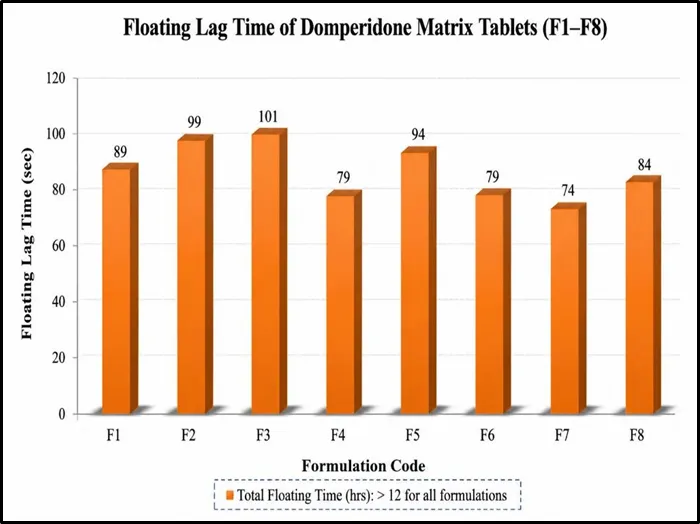
Fig. 1: Floating Lag Time F1- F8 Batch
4.4 SWELLING INDEX
Table No. 5 Domperidone Maleate the swelling index for all batches F1 – F8
|
Time (Hrs) |
F1 |
F2 |
F3 |
F4 |
F5 |
F6 |
F7 |
F8 |
|
0 |
0.00 |
0.00 |
0.00 |
0.00 |
0.00 |
0.00 |
0.00 |
0.00 |
|
1 |
14.20 ± 0.11 |
12.39 ± 0.24 |
20.12 ± 0.10 |
15.65 ± 0.20 |
13.45 ± 0.19 |
11.78 ± 0.14 |
24.10 ± 0.15 |
16.68 ± 0.12 |
|
2 |
28.45 ± 0.21 |
24.86 ± 0.18 |
35.60 ± 0.15 |
30.78 ± 0.30 |
26.92 ± 0.22 |
22.13 ± 0.20 |
40.33 ± 0.25 |
24.32 ± 0.16 |
|
4 |
36.20 ± 0.20 |
35.78 ± 0.19 |
48.05 ± 0.21 |
45.40 ± 0.25 |
40.88 ± 0.18 |
33.87 ± 0.18 |
55.67 ± 0.20 |
32.24 ± 0.14 |
|
6 |
39.55 ± 0.29 |
36.14 ± 0.32 |
48.65 ± 0.30 |
48.43 ± 0.25 |
42.89 ± 0.27 |
34.97 ± 0.27 |
56.78 ± 0.25 |
46.12 ± 0.15 |
|
8 |
40.32 ± 0.18 |
38.95 ± 0.22 |
51.26 ± 0.29 |
50.76 ± 0.21 |
45.21 ± 0.30 |
36.42 ± 0.22 |
60.11 ± 0.28 |
50.28± 0.22 |
|
10 |
42.80 ± 0.25 |
40.67 ± 0.24 |
53.98 ± 0.33 |
56.66 ± 0.38 |
47.32 ± 0.27 |
39.12 ± 0.24 |
62.45 ± 0.33 |
58.11 ± 0.16 |
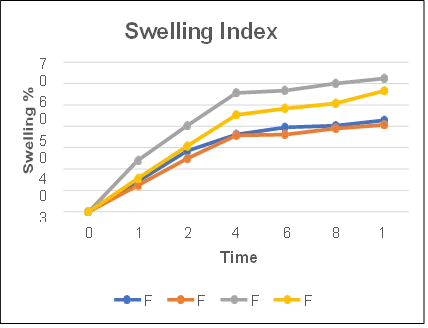
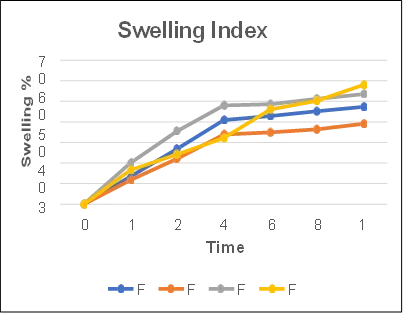
Fig 2 Swelling Index of F1-F4 Fig 3 Swelling Index of F5-F8
4.5 Drug Content
Table 6: Drug Content of F1-F8 Batch
|
Formulation Code |
Drug Content (%) |
|
F1 |
98.12 |
|
F2 |
98.36 |
|
F3 |
98.74 |
|
F4 |
99.02 |
|
F5 |
99.18 |
|
F6 |
98.85 |
|
F7 |
99.76 |
|
F8 |
98.41 |
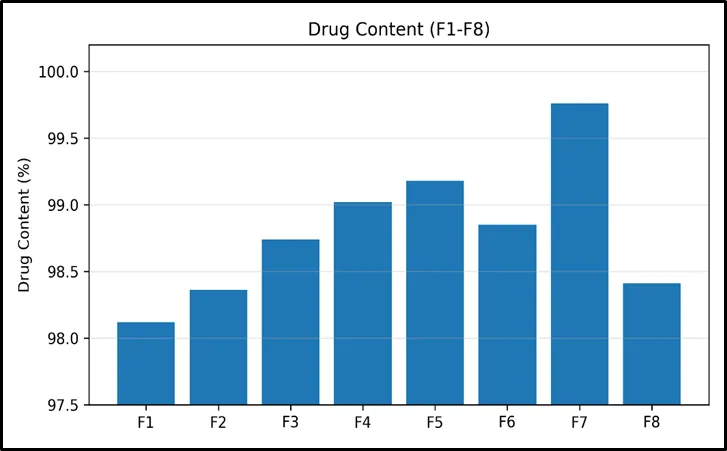
Fig.4Formulation Drug Content (F1 – F8)
4.6 IN- VITRO DRUG RELEASE PROFILES
Table 7: Cumulative percentage of drug release of formulations with HPMC K4M and TSP
|
Time points (hr) |
F1 |
F2 |
F3 |
F4 |
|
0 |
0 |
0 |
0 |
0 |
|
0.5 |
12.45±1.42 |
14.82±1.38 |
16.25±1.56 |
17.41±1.48 |
|
1 |
18.72±1.58 |
21.64±1.47 |
23.82±1.61 |
25.34±1.72 |
|
2 |
29.65±1.86 |
32.74±1.74 |
35.91±1.83 |
38.42±1.95 |
|
4 |
41.82±2.11 |
44.93±2.06 |
48.76±2.18 |
50.91±2.24 |
|
6 |
53.64±2.24 |
56.81±2.15 |
60.42±2.31 |
63.75±2.28 |
|
8 |
67.52±1.96 |
70.85±1.88 |
73.94±2.04 |
75.82±1.92 |
|
10 |
81.43±1.72 |
84.26±1.81 |
87.15±1.95 |
89.63±1.84 |
|
12 |
92.74±1.61 |
95.12±1.56 |
97.46±1.72 |
99.28±1.68 |
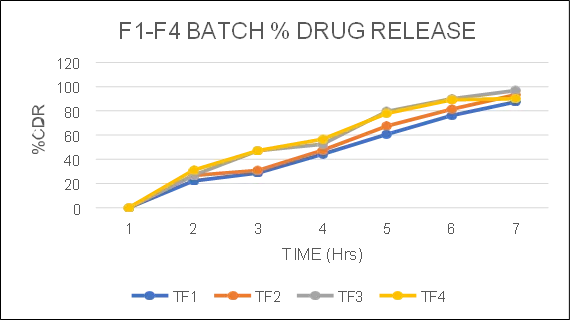
Fig 5 Drug Release Batch F5 to F8
Table 8 : Cumulative percentage of drug release of formulations with HPMC K4M and TSP
|
Time points (hr) |
F5 |
F6 |
F7 |
F8 |
|
0 |
0 |
0 |
0 |
0 |
|
0.5 |
17.88±2.32 |
22.89±2.91 |
13.67±1.54 |
22.82±1.73 |
|
1 |
25.55±2.63 |
31.51±1.63 |
17.67±1.87 |
32.83±1.46 |
|
2 |
36.60±2.81 |
42.22±1.26 |
25.72±1.90 |
43.65±2.06 |
|
4 |
46.30±2.80 |
53.33±3.96 |
45.29±4.56 |
64.94±1.15 |
|
6 |
57.91±2.57 |
61.22±2.32 |
53.81±2.89 |
72.53±2.18 |
|
8 |
62.52±1.43 |
75.24±1.28 |
76.80±2.28 |
88.52±2.66 |
|
10 |
76.93±1.00 |
87.74±1.24 |
93.30±2.05 |
97.42±7.18 |
|
12 |
90.80±1.54 |
93.14±1.37 |
103.46±1.82 |
99.14±1.37 |
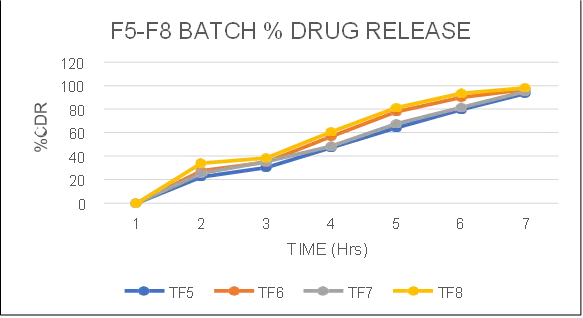
Fig 6 Drug Release Batch F5 to F8
4.7 Data Analysis
Design of Experiments
A. Full and reduced model assessment for the dependent variables
Table: 9. Factors and levels for Box-Behnken design
|
Sr.No. |
Independent Factor |
Unit |
Low (-1) |
High (+1) |
|
1. |
HPMC K4 M |
mg |
60 |
120 |
|
2. |
Tamarind seed Polysaccharide |
mg |
5 |
10 |
|
3. |
Sodium Bicarbonate |
mg |
20 |
40 |
Table No. 10 Summary of results of regression analysis for responses Y1,Y2& Y3
|
Models |
R2 |
Adjusted R2 |
Predicted R2 |
SD |
% CV |
|
Response(Y1) Quadratic |
0.8278 |
0.7234 |
0.3814 |
1.96 |
2.04 |
|
Response(Y2) Quadratic |
0.9486 |
0.9250 |
0.8642 |
0.064 |
12.22 |
|
Response(Y3) Quadratic |
0.768 |
0.8373 |
0.932 |
0.032 |
13.20 |
a) Full model for Y1 (% drug release)
Table No. 11 Analysis of variance for response Y1 (% CDR)
|
Source |
Sum of Squares |
Df |
Mean Square |
F Value |
P Value Prof > F |
Significance |
|
Model |
94.78 |
7 |
13.54 |
45.13 |
0.0021 |
Significant |
|
TSP |
1.73 |
1 |
46.46 |
154.97 |
0.0001 |
|
|
HPMC K4M |
46.46 |
1 |
1.73 |
5.77 |
0.0480 |
|
|
Sodium Bicarbonate |
21.91 |
1 |
21.91 |
73.19 |
0.0007 |
|
|
Residual |
4.78 |
4 |
3.95 |
|
|
|
|
Cor Total |
94.78 |
7 |
|
|
|
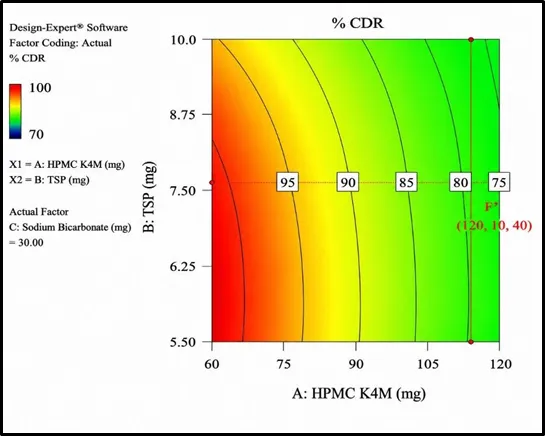
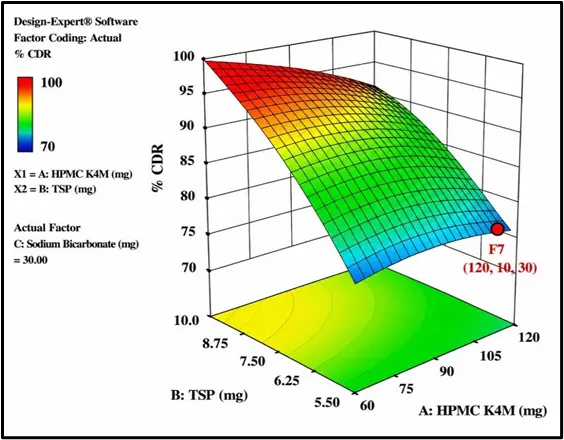
Figure No.7: Contour plot for Y1 (% CDR) Fig NO 8 3D surface plot for Y1
Table 12. Full Model for Y2 (Floating Lag Time)
|
Source |
Sum Of Squares |
Df |
Mean Square |
F Value |
P Value Prof > F |
Significance |
|
Model |
9850.45 |
7 |
1407.21 |
13.43 |
0.0040 |
Significant |
|
A – TSP |
4250.20 |
1 |
4250.20 |
10.00 |
0.0095 |
|
|
B – HPMC K4M |
3125.15 |
1 |
3125.15 |
8.10 |
0.0410 |
|
|
C – Sodium Bicarbonate |
890.40 |
1 |
890.40 |
14.40 |
0.0062 |
|
|
Residual |
638.25 |
5 |
127.65 |
_ |
_ |
|
|
Cor Total |
10488.70 |
7 |
_ |
_ |
_ |
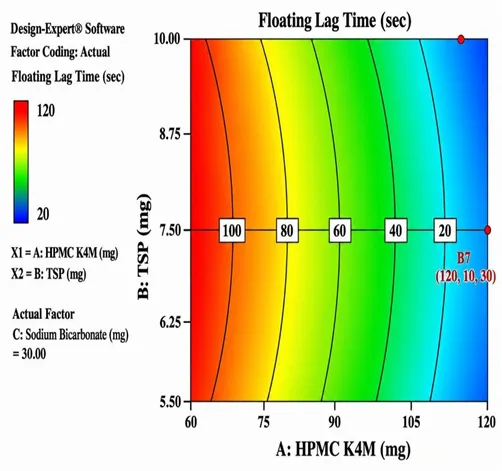
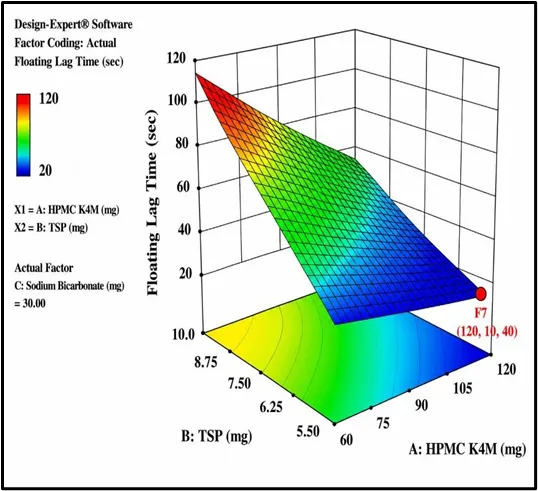
FIG NO 9 Contour plot for Y2 Fig NO 10 3D surface plot for Y2
Table No 13 Full Model for Y3 (Total Floating Time)
|
|
Sum Of Squares |
Df |
Mean Square |
F Value |
P Value Prof > F |
Significance |
|
Model |
4.85 |
7 |
0.693 |
15.40 |
0.0032 |
Significant |
|
A – TSP |
0.92 |
1 |
0.950 |
21.11 |
0.0058 |
|
|
B – HPMC K4M |
0.62 |
1 |
0.620 |
13.78 |
0.0138 |
|
|
C – Sodium Bicarbonate |
1.18 |
1 |
1.180 |
26.22 |
0.0037 |
|
|
Residual |
0.225 |
5 |
0.045 |
_ |
_ |
|
|
Cor Total |
5.075 |
7 |
_ |
_ |
_ |
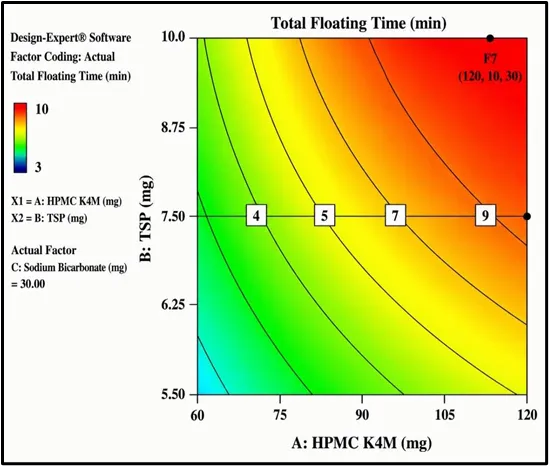
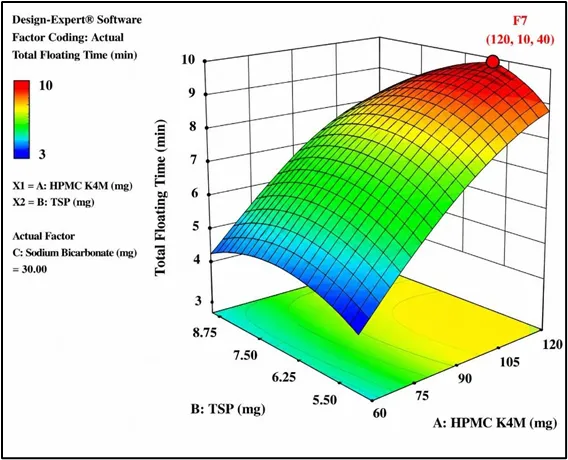
FIG NO 11 Contour plot for Y3 Fig NO 12 3D surface plot for Y3
4.8 MATHEMATICAL MODELING OF DISSOLUTION PROFILES
Table 14 Regression coefficient (R2) value of floating matrix tablet for different kinetic models
|
Formulation |
R2 |
||||
|
Zero- Order |
First Order |
Higuchi |
Korsmeyer- Pappes |
n value |
|
|
F1 |
0.9300 |
0.9800 |
0.9803 |
0.9776 |
0.620 |
|
F2 |
0.9400 |
0.8100 |
0.9939 |
0.9937 |
0.580 |
|
F3 |
0.9080 |
0.9490 |
0.9960 |
0.9930 |
0.502 |
|
F4 |
0.9840 |
0.9730 |
0.9690 |
0.9890 |
0.700 |
|
F5 |
0.9370 |
0.9370 |
0.9981 |
0.9980 |
0.540 |
|
F6 |
0.9920 |
0.8750 |
0.9590 |
0.9890 |
0.763 |
|
F7 |
0.9918 |
0.9470 |
0.9570 |
0.9911 |
0.746 |
|
F8 |
0.9080 |
0.9490 |
0.9960 |
0.9930 |
0.502 |
4.9 STABILITY STUDY OF DOMPERIDONE MALEATE TABLET
Table 15: Results of Physical Evaluation of Tablet at 37 °C ± 2 °C / 60 % RH ± 5 % RH
|
|
Parameters |
Initial |
1st month |
|||||||||||
|
|
I |
II |
III |
I |
II |
III |
||||||||
|
Weight variation (mg) |
203.2 |
204.8 |
202.6 |
203.6 |
203.6 |
204.2 |
|
|||||||
|
Thickness (mm) |
3.4 |
3.4 |
3.2 |
3.2 |
3.1 |
3.2 |
|
|||||||
|
Hardness kg/cm2 |
5.1 |
5.0 |
5.2 |
5.0 |
5.1 |
5.0 |
|
|||||||
|
Drug release (%) |
99.90 |
99.85 |
99.95 |
99.38 |
95.35 |
99. 40
|
|
|||||||
|
Floating lag time (sec) |
74 |
70 |
72 |
75 |
79 |
75 |
|
|||||||
|
Friability (%) |
0.25 |
0.24 |
0.25 |
0.23 |
0.22 |
0.23 |
|
|||||||
Table 16: Result of Physical Evaluation of Tablet at 42 °C ± 2 °C / 75 % RH ± 5 % RH
|
|
Parameters |
Initial |
1st month |
|
||||||||||||||
|
|
I |
II |
III |
I |
II |
II III |
|
|
||||||||||
|
|
Weight variation (mg) |
202.6
|
202.8 |
203.3 |
203.9
|
209.9
|
202. 5
|
|
||||||||||
|
|
Thickness (mm) |
3.4 |
3.4 |
3.3 |
3.2 |
3.3 |
3.2 |
|
||||||||||
|
|
Hardness kg/cm2 |
5.3 |
5.2 |
5.0 |
5.0 |
5.1 |
5.2 |
|
||||||||||
|
|
Drug release (%) |
99.90
|
99.85 |
99.95 |
99. 0
|
95.35 |
99. 0
|
|
||||||||||
|
Floating lag time (sec) |
79 |
77 |
79 |
7 |
79 |
75 |
|
|||||||||||
|
Friability (%) |
0.25 |
0.24 |
0.25 |
0.23
|
0.22 |
0.23 |
|
|||||||||||
DISCUSSION
The present investigation focused on the formulation and optimization of Gastroretentive floating tablets of Domperidone Maleate, a BCS Class II drug with limited bioavailability due to extensive first-pass metabolism and low aqueous solubility. Developing a floating drug delivery system allowed for prolonged gastric retention, facilitating localized drug release in the upper gastrointestinal tract (GIT) — a region where Domperidone Maleate demonstrates optimal absorption.
5.1 Pre-compression and Blend Properties
The pre-compression parameters of all formulations (F1–F8) were within acceptable limits, indicating good flowability and compressibility of the powder blend. Carr's Index, Hausner's ratio, and angle of repose confirmed satisfactory flow properties suitable for direct compression. Among all formulations, F7 showed the best flow characteristics with the lowest Carr's Index (9.69%), Hausner's ratio (1.10), and angle of repose (24.8°).
5.2 Physicochemical Evaluation
The post-compression evaluation of all formulations (F1–F8) complied with the acceptable pharmacopeial limits for weight variation, hardness, thickness, friability, and assay, indicating satisfactory tablet quality. Among all formulations, F7 showed the best performance with the lowest friability (0.22%) and the highest assay (99.76%).
5.3 In Vitro Buoyancy Study
The in vitro buoyancy study showed that all formulations floated for more than 12 hours, indicating excellent floating ability. Among all formulations, F7 exhibited the shortest floating lag time (74 sec), demonstrating rapid buoyancy and better gastroretentive performance.
5.4 Swelling Index
The swelling index of all formulations increased progressively with time, indicating effective hydration and swelling of the polymer matrix. Among all formulations, F7 exhibited the highest swelling index (62.45 ± 0.33% at 10 h), suggesting superior swelling behavior and sustained drug release potential.
5.6 Drug content
The drug content of all formulations (F1–F8) was within the acceptable pharmacopeial limit, indicating uniform drug distribution in the tablets. Among all formulations, F7 showed the highest drug content (99.76%), demonstrating excellent content uniformity and formulation accuracy.
5.7 IN- VITRO DRUG RELEASE
The in vitro drug release study showed a sustained release pattern for all formulations over 12 hours, confirming the effectiveness of the gastroretentive matrix system. Among all formulations, F7 exhibited the highest cumulative drug release (103.46%), indicating optimum polymer concentration and superior drug release performance.
5.8 Design Of Experiment
The Box–Behnken design and regression analysis demonstrated that HPMC K4M, Tamarind Seed Polysaccharide (TSP), and Sodium Bicarbonate significantly influenced % drug release, floating lag time, and total floating time (p < 0.05). The quadratic models showed good agreement between experimental and predicted responses, confirming the suitability of the optimization model.
5.9 MATHEMATICAL MODELING OF DISSOLUTION PROFILES
The drug release data showed a good fit to the Higuchi and Korsmeyer–Peppas kinetic models, indicating diffusion-controlled drug release from the floating matrix tablets. The n values (0.502–0.763) suggested that the drug release followed non-Fickian (anomalous) diffusion, involving both diffusion and polymer relaxation mechanisms.
5.10 STABILITY STUDY OF DOMPERIDONE MALEATE TABLET
The stability study demonstrated that the optimized Domperidone Maleate floating tablets remained physically and chemically stable under both storage conditions, with no significant changes in tablet properties after one month. The results confirmed that the formulation maintained acceptable weight variation, hardness, friability, floating behavior, and drug release, indicating good stability.
CONCLUSION
The present study successfully formulated and evaluated gastroretentive floating tablets of Domperidone Maleate using HPMC K4M, Tamarind Seed Polysaccharide (TSP), and Sodium Bicarbonate by the direct compression method. All formulations exhibited satisfactory pre-compression and post-compression characteristics within acceptable pharmacopeial limits. Among the prepared formulations, F7 was identified as the optimized formulation, showing excellent floating behavior with a floating lag time of 74 seconds and a total floating time of more than 12 hours. It also demonstrated the highest swelling index, uniform drug content (99.76%), and sustained drug release (103.46%) over 12 hours.
The Box–Behnken Design confirmed that the selected formulation variables significantly influenced the critical quality attributes, while kinetic modeling indicated that drug release followed the Higuchi and Korsmeyer–Peppas models with a non-Fickian diffusion mechanism. Furthermore, the optimized formulation remained stable under accelerated stability conditions without significant changes in its physicochemical properties. Therefore, the developed floating tablet of Domperidone Maleate has the potential to improve gastric retention, provide sustained drug release, and enhance therapeutic efficacy and patient compliance.
Acknowledgements: The authors gratefully acknowledge Loknete Dr. J.D Pawar College of Pharmacy, Manur, for providing necessary research facilities and infrastructure support. We also extend our appreciation to the laboratory staff for their technical assistance during the formulation and evaluation processes.
REFERENCES

Akanksha Khairnar, Rajendra Surwase, Formulation Development and Evaluation of Floating Tablet Containing Domperidone Maleate, Int. J. of Pharm. Sci., 2026, Vol 4, Issue 8, 327-340, https://doi.org/10.5281/zenodo.21772956
 10.5281/zenodo.21772956