

We use cookies to ensure our website works properly and to personalise your experience. Cookies policy
1,2,3,4Prerna Institute of Pharmacy, Parbhani
A polyherbal anti-acne cream was prepared using extracts of the plants Tulsi and aloe vera along with base materials. The plants have been reported in the literature as having good antimicrobial, antioxidant, and anti-inflammatory activity. Formulations of the cream were prepared by varying the proportions of polymers and evaluated for their physicochemical properties like pH, spreadability, viscosity, homogeneity, appearance, afterfeel, and spreadability-like tests. The present study was to develop, evaluate, and compare the hydrating, erythema, and sun protection of the herbal w/o cream that comprises extracts of natural products from aloe vera and turmeric given in appropriate concentrations. The different types of formulations in cream of water in oil were formulated by the different concentrations of the natural drug.
Many people prefer the herbal product over the synthetic one. Produce several harmful side effects Compare to the herbal product they have Minimal side effect. Acne becomes the major problem now a day’s in adults, it Affect Both the gender (male, female). There are two types of acne disorder which affect The individual. i.e Acne rosacea And Acne vulgaris. Acne rosacea is a typical, Constant, and medically treatable skin disorder that resembles adult acne. Acne Rosacea Typically affects the middle third of the face, particularly the nose, causing Temporary aggravation and temporary relief. The signs may appear and disappear, And the skin may remain clear for several weeks, months, or even years before They Reappear. Symptoms and indications of rosacea are: Redness of the face, tiny red Pimples and fine red lines on the Facial skin. An enormous, bulbous red nose, Eye Problems, include puffy, red eyelids and conjunctivitis. Acne vulgaris, often known as Acne, is a common skin ailment brought on by changes in the pilosebaceous units, Which Are skin structures made up of a hair follicle and the sebaceous gland that lies Adjacent to it.[1] Acne symptoms can be Divided into three categories: mild, Moderate, and severe. Open comedons, also known as blackheads, and closed Comedons, sometimes known as white heads, are two types of non-inflammatory Lesions. Papules, pustules, cysts, and Nodules are all examples of inflammatory Lesions. Seborrhea, comedones, inflammatory lesions, the presence of bacteria In The follicular canal, and sebum production are the main characteristics of acne Vulgaris.
We have used three herbal ingredients in our preparation which are Aloe Vera gel, Neem, Tulsi. Aloe Vera gel is used as a moisturizer, to reduce pimples and acne and Also used for treatment of burn wounds. Neem is used as an antifungal and anti-Inflammatory and it is also used to reduce scar, pigmentation, redness and itching of The skin. Tulsi is used to add glow to the skin and to promote wound healing and Remove acne.
Cream is defined as semisolid which are oil in water (o/w) or water in oil (w/o) type And these semisolid emulsions are Intended for the external application. Cream is Classified as oil in water and water in oil emulsion. It is applied on outer part or Superficial part of the skin and its main ability is to remain for a longer period of time At the site of application. The function of the Cream is to protect the skin against Different environmental condition and give soothing effect to skin and treat any Infection as well As tan and acne. There are differ#in vient types of the creams like Cleansing, cold, foundation, vanishing, massage, hand and body cream. The main Aim of our work is to develop herbal cream which can give effect like reduce acne And skin irritation, wrinkles and also Adding glow to the skin. Acne is a disturbing Issue especially for teenagers and adolescence according to global statistics Approximately 85% of Population will suffer this skin issue at age around 12-25 Years, nearly 8% adult at age 23-24 years old and only 3% of adult having Acne at Age 35-44 years old. Propionibacterium acne and staphylococcus aureus were Responsible for acne since the presence of This bacterium in the sample isolated From acne patient at the same time, the increasing number of resistance of acne Inducing bacteria Towards the antibiotic is a worrisome problem. The interest of Consumer towards the natural bioactive compound has a functional Ingredient in the Cosmetic product has arisen due to their various health beneficial effect. Beside their Nutritional and sensorial Properties also their potential effect in improving skin ihealth Has been recognized has acting as protective agent. Although, some skin issue can Categorized as self- limiting but it also can give negative psychosocial consequences To individual by having low social withdrawal due to embarrassment and at the worst Scenario it can leads to suicidal ideation. We have used to herbal ingredient in our Preparation which are Aloe Vera extract and Tulsi extract. Aloe Vera is used as Moisturizer and anti-acne. Also used for treatment of burn wound. Aloe Vera is first Active ingredient and Tulsi is second active ingredient in it. And last one is neem.
Skin
Human facial skin is a soft, flexible, and multilayered tissue that covers the face and protects underlying structures while maintaining moisture, detecting stimuli, and contributing to facial expression.
Types of skin Disease
1. Acne and Scars
Acne is one of the most common skin problems, affecting teenagers and adults alike.
It occurs due to clogged pores, excess oil production, and bacterial growth. If left
untreated, acne often leaves marks or scars on the skin.
Symptoms: Pimples, blackheads, whiteheads, inflamed red bumps, and scarring.
2. Eczema
Eczema is a chronic skin disease that causes inflammation, dryness, and itching.
Symptoms: Red, itchy, dry, or cracked skin, often found on elbows, knees, and face.
3. Psoriasis
Psoriasis is an autoimmune disease that accelerates the skin cell cycle, resulting in a
rapid buildup of cells on the surface.
Symptoms: Thick, scaly patches of
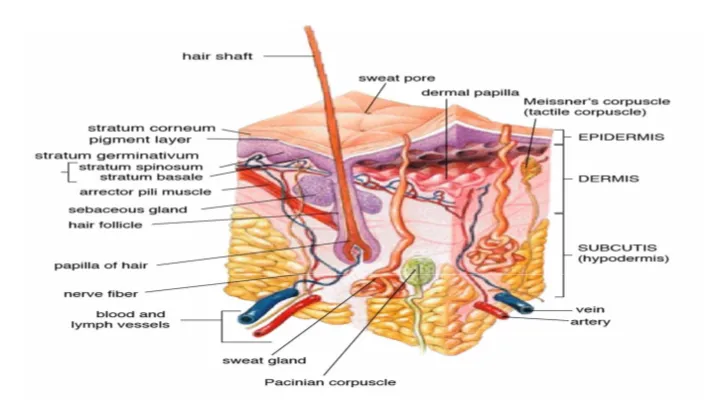
Structure of Skin
Aim
To formulate and evaluate a polyherbal anti-acne cream using Aloe vera, Neem, Tulsi, and Turmeric extracts, focusing on their antimicrobial, anti-inflammatory, antioxidant, and skin-protective properties.
Objectives
4. MATERIALS AND METHODS
A. Plant Profile
1. NEEM
Synonyms : Azadirachta indica, Indian Lilac, Margosa Tree, Nim (Hindi), Kadunimb (Marathi)
Biological source : Neem consists of dried leaves, bark, seeds, and oil Obtained from Azadirachta indica, belonging to the
belonging to the
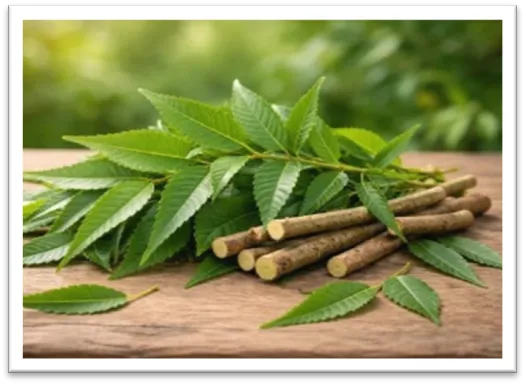
Family : Meliaceae.
Chemical Constituents :
Neem (Azadirachta indica) contains over 140 active phytochemicals, Primarily terpenoids (limonoids), flavonoids, and steroids, found Throughout its leaves, bark, seeds, and fruit. Key compounds include Azadirachtin (insect repellent), nimbin (anti-inflammatory), nimbidin (antibacterial), and gedunin (antifungal), making it highly effective for Medicinal and agricultural uses.
Uses :
2.ALOEVERA
Synonyms : Aloe Barbadensis, Aloe, Aloe Indica
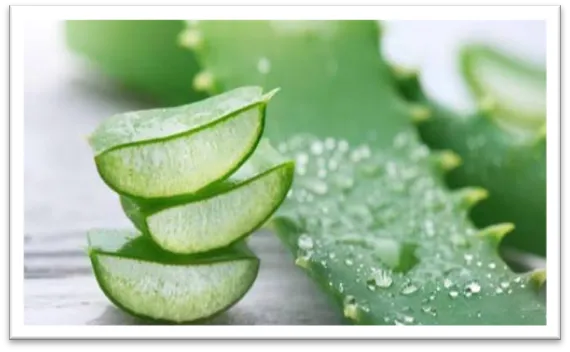
Biological Source : Dried Juice of the leaves of Aloe Barbadensis Miller
(curacao aloes), Aloe perryi Baker (socotrine aloes).
Family: Liliaceae
Chemical Constituents : There are seventy-five potentially active Ingredients in aloe vera, including vitamins, enzymes, minerals, Carbohydrates, lignin, saponins, amino acids, and salicylic acids
Uses :
3. TURMERIC
Synonyms : Curcuma domestica Valeton, Turmeric, Haldi
Scientific name : Curcuma Longa
Biological Source : Turmeric consists of the dried rhizomes (underground stems) of the plant Curcuma longa,
Family : Zingiberaceae
Chemical Constituents :
Contains curcuminoids: curcumin, demethoxycurcumin, Bisdemethoxycurcumin Contains volatile oil: turmerone, atlantone, zingiberene Also contains proteins, carbohydrates, resins, and starch Main active constituent: Curcumin
Uses :
4.Tulsi
Synonym: Tulsi, Holy Basil
Biological Source: Tulsi consists of the fresh and dried leaves (and Sometimes flowering tops) of Ocimum sanctum Linn. Ocimum sanctum / Ocimum tenuiflorum
Family: Lamiaceae
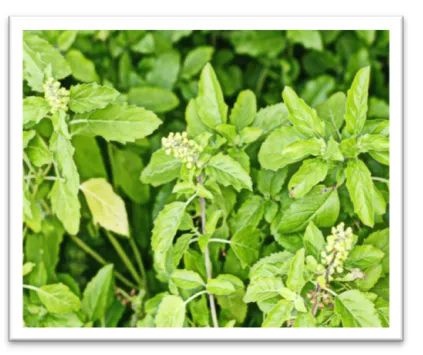
Tulsi contains various important chemical compounds, such as:
Uses :
Collection of plant material Neem extract , Turmeric extract , Aloe vera gel , Tulsi extract, Stearic acid , Cetyl Alcohol , Beeswax , Liquid paraffin , Glycerin g, Distilled water ,Methyl & Propyl Paraben + Rose water, Fragrance (optional).
Extraction processes
1.Extraction of Neem leaves
Neem leaves were collected and washed with distilled water and Dried in hot air oven.
After proper drying, leaves were powdered.
Then 10g Neem leaves powder in 100ml water watch taken in a Valumetric flask and shaken.
Then the solution was heated on a water bath 80 to 100 degree Celsius in 30 minutes.
Then the filtrate or filter product obtained, which is a clear solution
or clear extract of Neem leaves, was used in the preparation.
2.Extraction of Turmeric Powder
Extraction of turmeric powder from Curcuma longa is a simple
Process. First, fresh turmeric rhizomes are collected and washed
Properly to remove dirt.
Then 5g Turmeric powder in 100ml water watch taken in a
Valumetric flask and shaken
The solution was heated on water bath 80 to 100 degree Celsius in 30 minutes
Then the filtrate or filter product obtained, which is a clear solution
Or clear extract of Neem leaves, was used in the preparation.
Extraction of Tulsi Leaves
Formulation of Cream
Preperation of Oil Phase
2.Preperation of Aqueous Phase
Development of Cream Formulation
Aqueous phase is slowly added into oily phase at 65°c to 75°c mixed for
10 to 15 minutes. The prepared herbal extract is added into the above
Part slowly when temperature reached to 40°c and mixed until it get cold.
The pH of Cream is kept between 5 to 7.
Formulation table:
|
Sr.no. |
Ingredient |
Quality |
|
1 |
Neem Extract |
3 ml |
|
2 |
Turmeric extract |
2.5 ml |
|
3 |
Aloe vera gel |
2.5 g |
|
4 |
Tulsi extract |
2.5 ml |
|
5 |
Bees wax |
3 g |
|
6 |
Liquid paraffin |
43 ml |
|
7 |
Hard paraffin |
6.5 g |
|
8 |
Borax |
1 g |
|
9 |
Rose water |
2 ml |
|
10 |
Distilled water |
30 ml |
Evaluation parameters
A. Physical Evaluation
1.Irritancy:
Mark the area (1 cm2) on the left-hand dorsal surface. Then the cream Was applied to that area and the time was noted. Then it is checked for Irritancy, erythema, and endemic any for an interval up to 24 h and Reported.
pH measurement:
0.5 g cream was taken and dispersed in 50 ml distilled water and then PH was measured by using digital PH meter. Using a pH meter; should be skin-friendly (pH ~5.5–6.5).
3.Viscosity:
Using a viscometer; ensures good spreadability.
4.Spreadability:
Measured by the time required to spread a fixed amount of cream Between glass slides.
5.Greasiness:
Here the cream was applied on the skin surface in the form of smear And checked if the smear was oily or grease-like.
Physical Evaluation
RESULT :
The formulated polyherbal anti-acne cream showed good consistency, smooth texture, acceptable pH (skin-friendly), and good spreadability. It was stable, non-irritant, and showed promising anti-acne activity due to herbal extracts with antibacterial and anti-inflammatory properties.
CONCLUSION:
The study investigated the antiacne, antibacterial, antioxidant, Anti-Inflammatory Properties of Aloe veral, rose oil, Tulsi in herbal antiacne Cream formulation. Aloe vera and Neem together offer a holistic Approach to treating acne by treating inflammation, Microbial Overgrowth, sebum management, and skin repair in an anti-acne cream. The literature study highlighted the considerable number of research that Supports the use of aloe vera and Neem, tusli extract in skincare Products because of its antibacterial, anti-inflammatory, antioxidant, and Anti-acne properties. Overall, the results highlight the importance of Adding Tulsi, rose oil, aloe vera, and Neem to anti-acne cream Formulations to offer a natural, safe, effective way to treat acne. Phytochemical
REFERENCES
1. Saini, P.K. et al. (2025). Formulation and Evaluation of an Oil?in?Water Herbal Cream Containing Aloe Vera, Neem and Turmeric Extracts – This study reports the formulation of an O/W herbal cream With Aloe vera, Neem, Turmeric and evaluates stability, pH, viscosity, Spreadability and antimicrobial in vitro activity.
2. Sharma, N., Shrivastava, P., & Tiwari, S.P. (2025). Formulation and Characterization of Herbal Cream for the Management of Acne Vulgaris This article focuses on a herbal cream including Neem, Aloe vera, Turmeric with characterization of physicochemical properties and Antimicrobial testing.
3. Ansong, J.A. et al. (2023). Formulation and Evaluation of Herbal?Based Antiacne Gel Preparations – Though this is a gel (not Cream), it describes phytochemical evaluation, antimicrobial assays, and Gel performance, which can support methodology and discussion of Herbal anti?acne products.
4. Dhyani, A., & Singh, V. (2017). Formulation and Evaluation of Multipurpose Herbal Cream – Includes Aloe vera, Neem, Turmeric Among other herbs and discusses basic evaluation such as spreadability And stability
5. Sharma N, Sharma C, Mishra CP. Formulation and Evaluation of an Oil?in?Water Herbal Cream Containing Aloe Vera, Neem and Turmeric Extracts. Journal of Drug Discovery and Therapeutics. 2025;13(6).
6. Sharma N, Shrivastava P, Tiwari SP. Formulation and Characterization Of Herbal Cream for the Management of Acne Vulgaris. Journal of Neonatal Surgery. 2025;14(25S).
7. Ansong JA, Asante E, Johnson R, et al. Formulation and Evaluation of Herbal?Based Antiacne cream Preparations. Biomed Research International. 2023; Article ID 7838299.
8. Dhyani A, Uttarakhand Council of Science and Technology, Singh N. Formulation and evaluation of multipurpose herbal cream. Journal of Drug Delivery and Therapeutics. 2017;9(2).
9. Ali, B. M. M., Ghoname, N. F., Hodeib, A. A., & Elbadawy, M. A. (2015). Significance of topical propolis in the treatment of facial acne vulgaris. Egyptian Journal of Dermatology and Venerology, 35(1), 29-36.
10. Rathore S, Gupta S, Gupta V. A Comprehensive Review on Formulation and Evaluation of Herbal Anti?acne Cream. Journal of Cardiovascular Disease Research. 2023.
11. Akash E Formulation and Evaluation of Anti?Acne Herbal Cream Incorporating Aloe vera, Turmeric, Neem and Honey. International Journal of Allied Medical Sciences and Clinical Research. 2025.
12. Shinde SC, Kumbhar S. Polyherbal Formulation of Anti?acne Cream. Indian Pharmacy Research Journal. (Year not specified)
13. Rathore, S., Gupta, S., & Gupta, V. (2023).A comprehensive review On formulation and evaluation of herbal anti-acne cream. Journal of Cardiovascular Disease Research, 14(2), 102–110.
14. Akash, E., Sharma, R., & Patel, D. (2025).Formulation and evaluation Of anti-acne herbal cream. International Journal of Allied Medical Sciences and Clinical Research, 13(1), 45–52.
15. Karande, S. M., Patil, P. R., & Jadhav, A. B. (2024).Formulation and Evaluation of poly-herbal anti-acne cream. Journal of Propulsion Technology, 45(3), 220–228.
16. Sucharitha, P. A. M., Reddy, K. S., & Kumar, M. (2024).Preparation And evaluation of poly herbal anti-acne cream. International Journal of Pharmacognosy and Chemistry, 6(2), 90–97.
17. Cui, H., Li, Y., & Zhang, L. (2022).Development of novel topical anti-Acne cream containing postbiotics. Indian Journal of Dermatology, 67(5), 512–518.
18. Sharma, P., & Singh, R. (2020).Formulation and evaluation of anti-Acne cream using clove oil. Materials Today: Proceedings, 33, 1234–1238.
19. Gupta, A., & Verma, S. (2025).Evaluation of anti-acne potential of Herbal and fruit extracts. Journal of Herbal Medicine, 28, 100450.
20. Kaur, H., & Kaur, G. (2021).Herbal treatment for acne vulgaris: A Review. International Journal of Pharmaceutical Sciences Review and Research, 68(1), 150–156.
21. Dhyani A, Chander V, Singh N. Formulation and evaluation of multi-Purpose herbal cream. J drug deliv ther. 2019; 9(2): 341-343.
22. Bhowmik D, Chiranjib YJ, Tripathi KK, Kumar KS. Herbal remedies of Azadirachta indica and its medicinal application. J Chem Pharm Res. 2010; 2(1): 62-72.
23. Sah AK, Vijaysimha M, Mahamood M. The tulsi, queen of green Medicines: Biochemistry and pathophysiology-a review. Int J Pharm sci Rev Res. 2018; 50(2): 106-114.
24. Viswanathan MV, Unnikrishnan PM, Komatsu K, Fushimi H, Basnet P. A brief introduction to Ayurvedic system of medicine and some of its Problems. Indian J Tradit Knowl. 2003; 2(2): 159-169.
25. Imhof A, Pine DJ. Stability of nonaqueous emulsions. J Colloid Inter-Face Sci. 1997; 192(2): 368-374.
26. Mohamed MI. Optimization of chlorphenesin emulgel formulation. The AAPS J. 2004; 6(3): 81-87.
27. Bleckmann A, Kropke R, Schneider G, Beiersdorf AG. Preparation of The w/o emulsion type with an increased water content, additionally Comprising one or more alkylmethicone copolyols and/or alkyldime-Thicone copolyols, and cationic polymers. US patent application. 2021.
28. Kapoor S, Saraf S. Formulation and evaluation of moisturizer con-Taining herbal extracts for the management of dry skin. Pharmacog J. 2010; 2(11): 409-417.
29. Ashara K, Soniwala MM, Paun J, Chawda J. Importance of tritura-Tion technique on preparation and evaluation of cold cream. Inventi rapid Pharm Tech. 2013: 1-2.
30. Navindgikar N, Kamalapurkar KA, Chavan PS. Formulation and Evaluation of multipurpose herbal cream. Int J Curr Pharm Res. 2020; 12(3): 25-30.
31. Gupta N, Dubey A, Prasad P, Roy A. Formulation and evaluation of Herbal fairness cream comprising hydroalcoholic extracts of Pleuro-tus Ostreatus, Glycyrrhiza glabra and Camellia sinensis. Pharma Bio Sci J. 2015: 40-45


Pavan Jadhav, Saurabh kshirsagar, Omkar mane, Suryavanshi V.S, Formulation of polyherbal Antiacne Cream, Int. J. of Pharm. Sci., 2026, Vol 4, Issue 5, 7439-7450. https://doi.org/10.5281/zenodo.20415065
 10.5281/zenodo.20415065