

We use cookies to ensure our website works properly and to personalise your experience. Cookies policy
Department of Pharmaceutics, Dr. Bapuji Salunkhe Institute of Pharmacy, Miraj, Maharashtra, India.
This Topic investigates the formulation development, optimization, and evaluation of Metronidazole oral solid dosage forms utilizing sustainable, plant-derived natural polymers as alternatives to conventional synthetic binding agents. While modern pharmaceutical manufacturing heavily relies on synthetic binders, these excipients frequently present challenges related to high production costs, industrial toxicity, and environmental non biodegradability. To address these limitations, this study systematically explores the structural, mechanical, and matrix-forming behaviours of Acacia and Tragacanth gums under standardized compression forces. Initial pre-formulation studies were conducted to characterize the active pharmaceutical ingredient (API), confirming a crystalline powder state with an observed melting point of 160°C and high solubility in both methanol and 0.1N HCl. Analytical standardization via a UV-Vis spectrophotometer established an absorption maximum lambda max at 277 nm in 0.1N HCl, yielding a highly linear calibration curve R2 = 0.9971 across a concentration range of 2–10 ug/ml. To achieve systematic optimization by 22 full factorial Design of Experiments (DOE) was implemented. The independent variables investigated were binder concentration X1, evaluated at (2% and 4% w/v) and (natural binder type X2, Acacia versus Tragacanth), while tablet Hardness Y1 and Disintegration time Y2 were selected as batch. Experimental batches (coded F1 - F4) were prepared via the wet granulation method, incorporating microcrystalline cellulose as a diluent, sodium starch glycolate as a superdisintegrant, and a combination of magnesium stearate and talc as lubricants. Comprehensive pre-compression evaluations of the processed granules encompassing the angle of repose, bulk density, tap density, Carr’s compressibility index, and Hausner’s ratio demonstrated excellent-to-good flow ability and favorable packing characteristics across all formulations, confirming their suitability for high-speed tablet compression.
Tablets are solid forms of medication that can include active ingredients along with other substances, formed through compression or moulding. Effective drugs can be taken in various formats like pills, capsules, powders, tablets, or cachets. Solid unit dose forms, especially in sustained release formulations, offer a precise quantity of the drug in a single unit.1 According to the Indian pharmacopoeia, pharmaceutical tablets are generally solid shapes, either concave or biconvex, produced by compacting drugs alone or with fillers, and sometimes additives, using compression or moulding methods. 2
Binders play a vital role in tablet compositions, impacting the physical strength and effectiveness of the medication. They are used to provide cohesion to the powdered material during tablet production. Binders enhance powder flow and ensure tablet integrity post- compression.3 The choice of binder depends on its binding force and compatibility with other ingredients, especially active pharmaceutical ingredients. Natural gums are frequently utilized as binding agents in tablet
compositions because of their cost-effective, secure, and readily accessible characteristics. Binding agents strengthen tablets during processing, handling, and packaging, while also improving granule flow.4
Tablets are a widely used form of medication that is favoured for its convenience, precision, simplicity of use, compact size, and efficient production. They are the most commonly manufactured type of medication worldwide. Tablets consist of active pharmaceutical ingredients and various additives such as binders, fillers, disintegrants, lubricants, glidants, and coatings.5 Binders play a crucial role in maintaining the structure and effectiveness of tablets, affecting drug release, strength, and patient adherence. Acacia, sourced from acacia trees like acacia Senegal or acacia Seyal, is a natural binder that is recognized for its sticky properties and capacity to improve granule flow.6
The selection of a specific binder on the mechanical strength and performance of a tablet, directly impacting crucial quality parameters such as hardness, friability, disintegration time, and dissolution rate. There is a significant lack of comprehensive, comparative data regarding how different natural binders behave under identical compression forces, creating a need to systematically evaluate and standardise their binding efficiencies.7Investigating various concentrations of natural binders is essential to understand their specific swelling and matrix-forming behaviour, which ultimately control how effectively the active pharmaceutical ingredient is released in the body. This work is necessary to evaluate the structural and mechanical effects of natural binders in solid dosage formulations, providing the empirical data required to validate them as regulatory-compliant replacements for synthetic binders.8
MATERIALS AND METODS
Materials:
Metronidazole obtained as Gift Sample from Arti Labs Mumbai and All Excipients used were of analytical grade.
Methods:
1.Pre-formulation study:
1.1 Organoleptic properties:
The specimens were analysed for colour, odour and texture.
1.2 Melting Point Determination:
A small quantity of the drug was placed in a capillary tube, which was then secured alongside a thermometer and immersed in liquid paraffin within the Thiele’s tube. Controlled heating was applied using a burner, and the temperature of fusion was recorded. To ensure accuracy and reduce potential mistakes, the procedure was repeated three times.9
1.3 Solubility:
Testing solubility in various solvents with the sample drug in a sodium fusion tube.
1.4 Absorption maxima of metronidazole in 0.1N HCL:
10 mg of metronidazole was dissolved in 100 ml of 0.1 N HCL, resulting in a final stock solution concentration of 100 µg/ml. Take 2.5 ml from the above stock solution and dilute it to 25 ml with 0.1 N HCL to achieve a concentration of 10 µg/ml. This solution was scanned at range 200-400 nm.10
1.5 Calibration curve metronidazole in 0.1N HCL:
A solution containing metronidazole at a concentration of 100ug/ml was prepared by dissolving 10 mg of metronidazole in 100 ml of 0.1 N hydrochloric acid. Different volumes (0.5 ml, 1 ml, 1.5 ml, 2 ml, and 2.5 ml) were then taken from this solution and diluted to 25 ml with 0.1 N HCl, resulting in dilutions ranging from 2 µg/ml to 10 µg/ml. The absorbance values for metronidazole were measured at 277 nm. A calibration curve was created by plotting absorbance against concentration.11
1.6 Drug excipient compatibility:
The FT-IR spectrophotometer (BRUKER ALPHA II) was utilized to capture the infrared spectrum of Metronidazole. A small amount of the powder was placed on the sample holder for the FTIR assessment, and the device was set to scan within the range of 4000 to 400 cm⁻¹. Following the scan, the obtained spectrum was compared with reference information to confirm the sample's identity and purity.12
1.7 Design of Experiment:
Design of Experiments within the Quality by Design (QBD) framework, researchers can enhance the efficiency of optimizing formulation and process variables. This method enhances product quality, performance, and stability while reducing the need for extensive experimentation and resource consumption. Consistent with this approach, this study utilized a 22 full factorial design. Two parameters, binder concentration, and different types of natural binders were evaluated at three distinct levels within this design.13
Identifying independent variables (Factor):
X1 = Concentration of binder, X2 = Type of binder (natural binder)
Levels:(-1 denotes low)
(+1 denotes high)
Identifying dependent variables (Response):
Y1 = Hardness, Y2 = Disintegration time
2.Granulation:
The tablets were prepared using the wet granulation technique. Initially, Metronidazole Powder was mixed with other components in a specific order by grinding them together in a mortar and pestle. Each binder was then combined with a portion of water to create a mucilage. This mucilage was added to the powder mixture to form a moist mass. Afterward, the moist mass was sieved and dried in a hot oven. The resulting dried granules were sieved again to separate the fine granules from the coarse ones. Magnesium stearate and talc was blended with both types of granules and thoroughly mixed.14
2.1 Evaluation of granules:
2.1.1 Measurement of Angle of Repose:
The angle of repose, labelled as a, was determined by employing the fixed funnel and free-standing cone technique. A funnel was fixed with its pointed end placed 2cm above a sheet of graph paper on a flat surface. The powders were poured through the funnel cautiously until the peak of the cone touched the funnel's tip. The average base widths (r) of the powder cones were gauged, and the tangent of the angle of repose (Tan Ө) was computed using the specified formula:
Angle of repose Ө = tan -1 h/ r
Here, h represents the height from the base to the apex of the powder cone.15
2.1.2 Bulk Density: Bulk density is the measurement of the density of a collection of granules. To calculate the bulk density, a specific quantity of granules is poured into a measuring cylinder, and the volume taken up by the granules from different batches with different binders is gauged. The bulk density is subsequently computed using a specific formula.16
Bulk density = Total mass of granules / Total volume of granules
2.1.3 Tap Density:
Tap density refers to the density of granules once they have undergone 100 taps from a specific height, and the resulting volume is measured. The tap densities of four different concentrations are determined using the following equation17
Tap density = Mass of tapped granules / Volume of tapped granules
2.1.4 Compressibility Index (Carr's Index %): Compressibility is a simple method to measure the powder's free-flowing property, indicating how easily a material can flow. The percentage compressibility, known as Carr's index (%), is calculated as follows18
Carr's index (%) = Tap density - Bulk density / Tap density * 100.
2.1.5 Hausner's ratio: Hausner's ratio is a measure of how easily powder flows, determined by the formula19
Hausner's ratio = Tapped density / Bulk density.
3. Formulation of tablets:
Tablets of metronidazole were prepared as stated in table below using Rotary Punch compression machine.
|
Sr no |
Ingredients |
F1 |
F2 |
F3 |
F4 |
|
1 |
Metronidazole |
100 mg |
100 mg |
100 mg |
100 mg |
|
2 |
Microcrystalline cellulose |
125 mg |
130 mg |
130 mg |
125 mg |
|
3 |
Tragacanth |
- |
- |
5 mg |
10 mg |
|
4 |
Acacia |
10 mg |
5 mg |
- |
- |
|
5 |
Sodium starch glycolate |
10 mg |
10 mg |
10 mg |
10 mg |
|
6 |
Magnesium stearate |
2.5 mg |
2.5 mg |
2.5 mg |
2.5 mg |
|
7 |
Talc |
2.5 mg |
2.5 mg |
2.5 mg |
2.5 mg |
4.Evaluation of Tablets:
4.1 Weight variation: Choose 20 tablets randomly from optimize batch and weigh each one separately. Then, calculate the average weight. Weight variation can be calculated using the formula below20
Weight variation= (Individual weight - Average weight) / Average weight x 100
4.2 Hardness test: Three tablets were select from optimize batch, and their average hardness was measured employing a Monsanto Hardness tester.21
4.3 Friability test: Twenty tablets where selected form optimize batch and collectively weighed. Subsequently, they were placed in a Roche friabilator and run for 4 minutes at a speed of 25 revolutions per minute. After dusting, the tablets were reweighed, and the percentage of friability was computed using the formula22
Friability = (Initial weight - final weight) / Initial weight *100
4.4 In-vitro Dissolution Test:
During this assessment, a USP dissolution device was employed. Six tablets from optimize batch was placed into containers, which held 900 ml of 0.1 M hydrochloric acid (HCl) as the dissolution medium, kept at a constant temperature of 37 ± 0.5 °C. The device rotated continuously at a speed of 100 rpm. Every 10 minutes, a 1 ml sample was taken out and promptly substituted with fresh testing liquid of the same amount. The sample was filtered, and 1 ml of the filtered substance was mixed with 0.1 N HCL. The optical density of the thinned filtrate was gauged spectrophotometrically at a frequency of 277 nm, with 0.1 M HCl as the reference. The drug release percentage was then computed. 23
4.5 Disintegration Time: The disintegration process of the tablets was carried out using a disintegration apparatus filled with 0.1 M HCl, containing 900 ml, and maintained at a controlled temperature of 37 ± 1°C. Six tablets from a optimize batch were simultaneously tested, each placed in a separate tube.24 The time taken for each of the six tablets to disintegrate and pass through the mesh was recorded. Subsequently, the average disintegration time for optimize batch was determined.25
5. RESULT AND DISCUSSION:
5.1 Organoleptic properties:
|
Properties |
Observation |
|
BCS class |
Class I |
|
Colour |
White powder |
|
Texture |
Crystalline powder |
5.2 Melting point determination:
The melting point of metronidazole was found to be 1600

5.3 Solubility:
|
Sample |
Solubility |
|
Water |
Slightly soluble |
|
Acetone |
Sparingly soluble |
|
Methanol |
Soluble |
|
0.1N HCL |
Soluble |
|
Ethanol |
Sparingly soluble |
5.4 Absorption maxima of metronidazole in 0.1N HCL
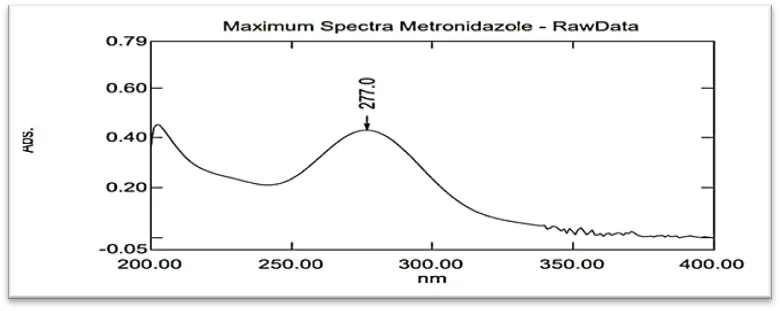
The absorption maxima of metronidazole was found to be at 277 nm.
5.5 Calibration curve metronidazole in 0.1N HCL
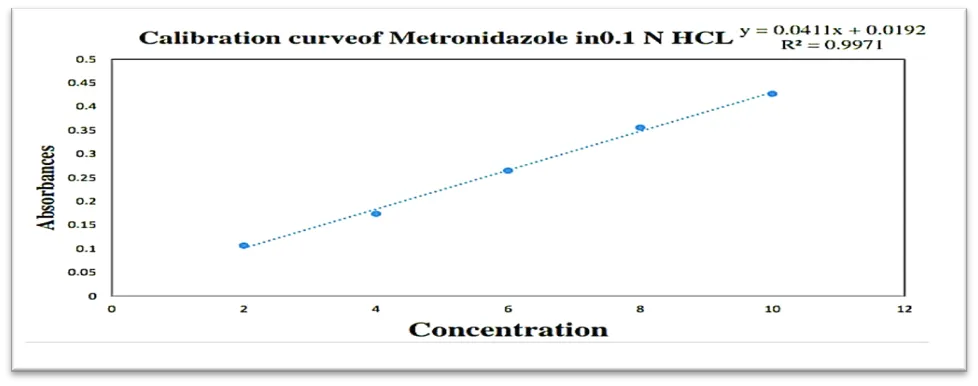
The calibration curve of metronidazole in 0.1 N HCL was found to be linear against the concentration vs absorbances ranging from 2 -10 ug /ml with R2

5.6 Authentication of API (Metronidazole) by using FTIR:
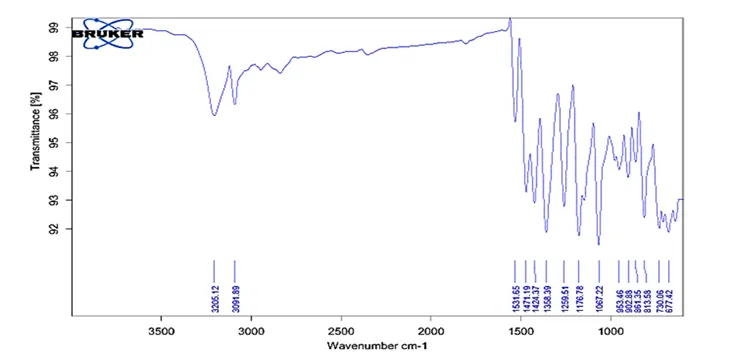
The FTIR spectroscopy study of Metronidazole was performed to verify its identity, identify its functional groups, by detecting characteristic absorption peaks. The characteristic peaks that were obtained, are depicted in below figure and explained in below table these findings confirmed the authenticity of sample.
|
Sr. No. |
Theoretical Wave Number (cm⁻¹) |
Peak Position Wave Number (cm⁻¹) |
Peak Intensity |
Stretching Vibration |
Probable Functional Group |
|
1. |
3200–3400 |
3205.12 |
Strong |
O–H Stretching |
Hydroxyl Group |
|
2. |
1500–1550 |
1531.65 |
Strong |
N–O Asymmetric Stretch |
Nitro Group |
|
3. |
1340–1370 |
1358.39 |
Strong |
N–O Symmetric Stretch |
Nitro Group |
|
4. |
1200–1300 |
1259.51 |
Medium |
C–N Stretching |
C–N Group |
|
5. |
1450–1500 |
1471.19 |
Medium |
C=C Stretching |
Aromatic/Heterocyclic Ring |
|
6. |
1150–1200 |
1176.78 |
Medium |
C–O Stretching |
Ether Linkage |
|
7. |
1400–1450 |
1424.37 |
Medium |
CH₂ Bending |
Alkyl Group |
5.7 Drug Excipient Compatibility Study by using FTIR:
A] Binder- Tragacanth
Blue Colour Peak Indicate Pure Metronidazole
Red Colour Peak Indicate Physical Mixture containing Binder Tragacanth
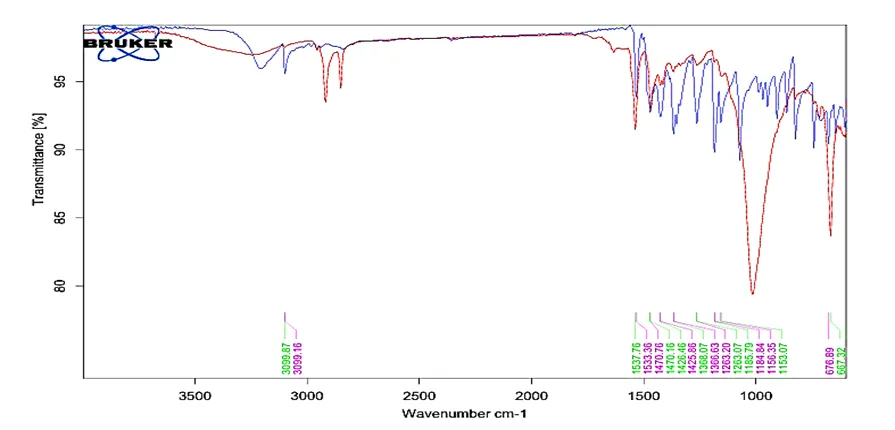
B] Binder- Acacia
Blue Colour Peak Indicate Pure Metronidazole
Red Colour Peak Indicate Physical Mixture containing Binder Acacia
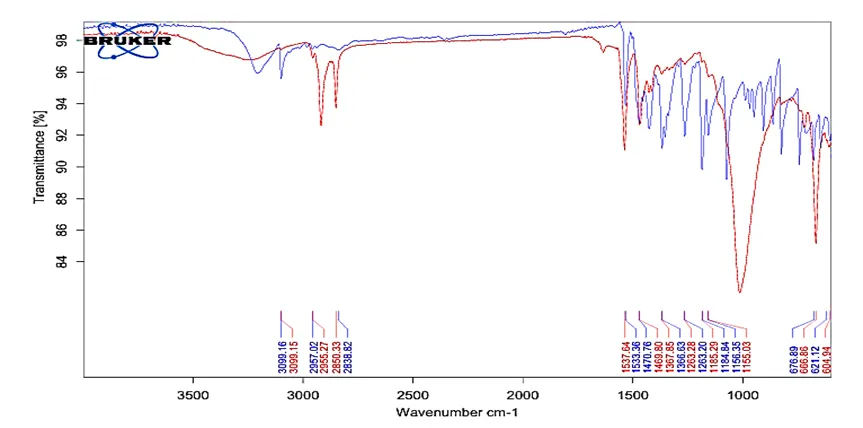
FTIR analysis was used to investigate potential drug-excipient interaction. When Metronidazole was coupled with excipients, the results showed no noticeable alteration in its infrared peaks when compared to the medication in its pure form. The drug was therefore compatible with the specified excipients, according to the FTIR spectroscopy findings.
5.8 Evaluation of batch obtain from 22 factorial design:
|
Run obtain form DOE |
Batch code |
Factor A Binder concentration % (X1) |
Factor B Binder types (X2) |
Response1 Hardness Kg/cm2 (Y1) |
Response 2 Disintegration time(min) (Y2) |
|
1 |
F1 |
4 |
Acacia |
6.3 Kg /cm2 |
14.1 min |
|
2 |
F2 |
2 |
Acacia |
8 Kg /cm2 |
11.5 min |
|
3 |
F3 |
2 |
Tragacanth |
5.4 Kg/cm2 |
7.38 min |
|
4 |
F4 |
4 |
Tragacanth |
7 Kg /cm2 |
9.58 min |
Applying Anova to the above batches of 22 Factorial Design the Batch F3 is obtained as Optimized batch with Hardness in-range and Minimized Disintegration time.
6.Evaluation of F3 (Optimized Batch) Granules:
|
Optimize batch |
Angle of repose |
Bulk density |
Tap density |
Carr’s index |
Hausner's ratio |
Flow property |
|
F3 |
17.51 |
0.40 g / ml |
0.44 g / ml |
9% |
1.1 |
Excellent |
The optimize batch (F3) granules for 2% tragacanth show excellent flow property.
7. Tablet Evaluation of Optimized batch F3 :
7.1 Weight Variation Test
All the tablets show percentage deviation Less than 5 % as specified range in IP for 250mg tablet and complies weight variation test.
7.2 Hardness Test
The Hardness of optimize batch tablet was found to be 5.6 Kg /cm2
7.3 Friability Test:
The friability of optimize batch tablet was found to be 0.89%. and accepts according to Pharmacopeial Standards.
7.4 In-vitro Dissolution Test:
|
Sr.no
|
Time |
% Drug release |
|
1 |
10 |
14.40 |
|
2 |
20 |
24.05 |
|
3 |
30 |
38.97 |
|
4 |
40 |
58.29 |
|
5 |
50 |
70.83 |
|
6 |
60 |
81.86 |
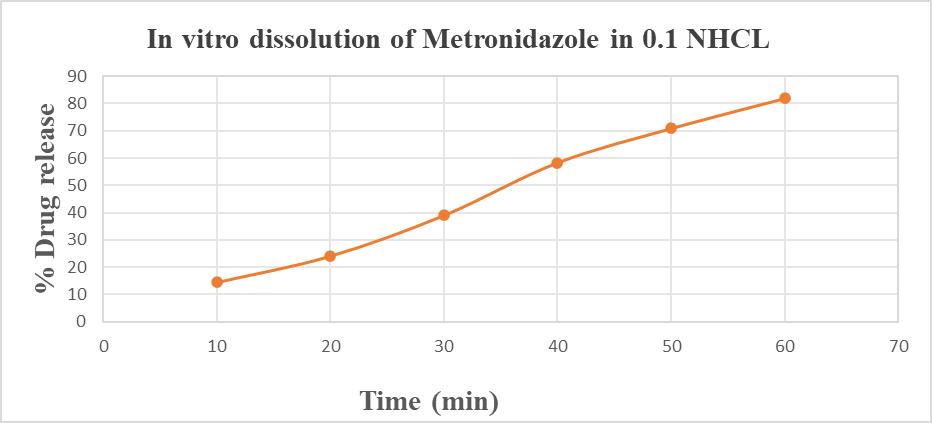
The optimize batch of metronidazole tablet show 81% drug release after 1hour.
7.5 Disintegration time:
The Disintegration time of the tablets (Optimized Batch F3) was found to be 7min50sec meet.
CONCLUSION
In conclusion, the systematic optimization of metronidazole tablets successfully yielded a stable immediate-release formulation that complies with official pharmacopoeial standards. The optimized batch (F3) demonstrated excellent pre-compression flow characteristics, including an angle of repose of 17.51° and a Carr’s index of 9%. Post-compression evaluations confirmed that the tablets satisfied the IP weight variation criteria, achieved a robust mechanical hardness of 5.6 K /cm2, and maintained a low friability of 0.89%, safely below the standard 1% limit. Furthermore, the tablets exhibited a prompt disintegration time between 7 minutes 50 seconds alongside an in-vitro drug release profile of 81% after one hour, satisfying official dissolution criteria. These findings validate that utilizing 2% tragacanth as a natural binder provides an effective, high-quality, and robust matrix suitable for wet granulation manufacturing of metronidazole tablets
REFERENCES

Misba Mujawar, Dineshbabu Naidu, Ashwini Aldar, Ujma Belif, Formulation Of Tablet Using Different Natural Binder and Evaluation of Their Effect on Tablet Quality Parameters, Int. J. of Pharm. Sci., 2026, Vol 4, Issue 6, 7263-7273, https://doi.org/10.5281/zenodo.21033416
 10.5281/zenodo.21033416