

We use cookies to ensure our website works properly and to personalise your experience. Cookies policy
Department Of Pharmaceutics, Karmayogi Tatyasaheb Bondre Institute Of Pharmacy,Chikhli Dist. Buldhana, Maharashtra (India) – 443201.
The present study focuses on the formulation and evaluation of mucoadhesive buccal films of Tramadol hydrochloride for effective pain management. The objective was to develop an alternative drug delivery system that overcomes the limitations of conventional oral dosage forms such as first-pass metabolism, delayed onset of action, and fluctuating plasma drug levels. Buccal films were prepared using the solvent casting method with polymers like HPMC, PVA, and Carbopol 934 in different concentrations.The prepared formulations (F1–F6) were evaluated for physicochemical properties, mechanical strength, mucoadhesion, swelling behavior, and in-vitro drug release. All formulations showed satisfactory results with uniform thickness, good flexibility, and acceptable surface pH. Drug content uniformity was within limits, confirming proper drug distribution. Mucoadhesive strength and swelling index increased with higher polymer concentration, improving residence time at the buccal site.In-vitro drug release studies demonstrated that polymer concentration significantly influenced drug release behavior. Among all formulations, F5 was found to be the optimized formulation, showing a balanced profile of sustained drug release, adequate mucoadhesion, and good mechanical properties. Stability studies confirmed that F5 remained stable under accelerated conditions without significant changes in key parameters. The study concludes that mucoadhesive buccal films of Tramadol hydrochloride are a promising alternative for improved drug delivery and patient compliance
The development of novel drug delivery systems for existing drug molecules improves drug
performance in terms of efficacy, safety, patient compliance, and overall therapeutic benefit. Buccal drug delivery is a method in which the drug is administered through the buccal mucosa, thereby bypassing the gastrointestinal tract and first-pass hepatic metabolism. This route enables the therapeutic agent to directly enter systemic circulation and provide rapid drug action. Among the different drug delivery systems, the buccal delivery system is considered highly promising because the buccal mucosa provides a protective barrier against toxins and microorganisms while allowing efficient drug absorption [1].
Mucoadhesive Buccal Films
Various mucoadhesive dosage forms have been developed, including tablets, patches, strips, ointments, gels, disks, and films. Among these, buccal films have gained significant attention because they overcome the limitations associated with oral gels, such as short residence time and easy removal by saliva. An ideal buccal film should be soft, flexible, strong, and expandable to withstand mechanical stress in the oral cavity. Additionally, it should possess adequate mucoadhesive strength to remain attached to the buccal mucosa for the desired period and ensure controlled drug release [2].
Manufacturing Methods of Buccal Films
The following methods are commonly used for the preparation of mouth dissolving and buccal films:
1. Solvent Casting Method
In the solvent casting method, water-soluble polymers are dissolved in water. The drug and other excipients are dissolved separately in a suitable solvent. Both solutions are then mixed thoroughly to obtain a uniform solution, which is subsequently cast into a petri plate or mold and dried to form a thin film.[3]
2. Semisolid Casting Method
In this method, a solution of water-soluble film-forming polymer is first prepared. This solution is then added to a solution containing acid-insoluble polymers such as cellulose acetate phthalate or cellulose acetate butyrate prepared in ammonium or sodium hydroxide. A suitable plasticizer is added to obtain a gel mass. The gel mass is cast into films or ribbons using heat-controlled drums. The thickness of the prepared film ranges from 0.015 to 0.05 inches. Generally, the ratio of acid-insoluble polymer to film-forming polymer should be 1:4.[4]
3. Hot Melt Extrusion Method
In the hot melt extrusion method, the drug is mixed with solid carriers, and the mixture is introduced into an extruder. The heaters present in the extruder melt the mixture, and the molten mass is then shaped into films using dies. This method offers several advantages, including fewer processing steps, improved content uniformity, and an anhydrous manufacturing process.[5]
4. Solid Dispersion Extrusion Method
In this technique, immiscible components are mixed with the drug and extruded to prepare solid dispersions. The prepared solid dispersions are then shaped into films with the help of dies.[6]
5. Rolling Method
In the rolling method, a drug-containing solution or suspension is rolled onto a carrier surface. Water and alcohol are commonly used as solvents. The formed film is dried using rollers and cut into the desired shape and size. Other ingredients, including active pharmaceutical agents, are dissolved in a small quantity of aqueous solvent using a high-shear processor to obtain a homogeneous viscous solution before film formation [7].
MATERIALS AND METHODS
Materials
The materials used in the preparation of mucoadhesive buccal films included Tramadol Hydrochloride, which was obtained from Lupin Limited, Mumbai. Hydroxypropyl methylcellulose (HPMC) was procured from Colorcon Asia Pvt Ltd, Goa, while polyvinyl alcohol (PVA) and citric acid were obtained from Merck Life Science / Rankem. Carbopol 934, glycerol/PEG 400, and sodium saccharin were purchased from S. D. Fine Chemicals. All chemicals and reagents used in the study were of analytical grade and used without further purification.
Table Composition of Formulations (F1–F6)
|
Ingredient |
F1 |
F2 |
F3 |
F4 |
F5 |
F6 |
|
Tramadol Hydrochloride (mg) |
50 |
50 |
50 |
50 |
50 |
50 |
|
PVA (mg) |
50 |
75 |
100 |
100 |
150 |
100 |
|
Carbopol 934 (mg) |
50 |
50 |
60 |
60 |
75 |
75 |
|
Glycerol (mL) |
0.5 |
0.5 |
0.5 |
0.5 |
0.5 |
0.5 |
|
Sodium Saccharin (mg) |
10 |
10 |
10 |
10 |
10 |
10 |
|
Citric Acid (mg) |
5 |
5 |
5 |
5 |
5 |
5 |
|
Distilled Water (mL) |
q.s |
q.s |
q.s |
q.s |
q.s |
q.s |
Experimental Method
Selection and Procurement of Materials
Tramadol Hydrochloride was selected as the model drug due to its effectiveness in the management of moderate to severe pain, short half-life, and extensive first-pass metabolism, making it suitable for buccal drug delivery. Polyvinyl alcohol (PVA) was selected as the film-forming polymer because of its good mechanical strength, flexibility, and excellent film-forming properties. PEG 400 was used as a plasticizer to improve flexibility and prevent brittleness of the films. Sodium saccharin was incorporated as a sweetening agent to mask the bitter taste of the drug, while citric acid was used as a saliva-stimulating agent to enhance film disintegration and drug release. Distilled water was used as the solvent system due to its safety and compatibility with the selected excipients.All materials and chemicals used in the formulation were of analytical or pharmaceutical grade and procured from reliable and certified suppliers to ensure purity, consistency, and reproducibility in the preparation of mucoadhesive buccal films.[8]
Preformulation Studies[9-12]
Preformulation studies were performed to evaluate the physicochemical properties of Tramadol Hydrochloride and its suitability for mucoadhesive buccal film formulation.
|
Sr. No. |
Parameter |
Purpose |
|
1 |
Organoleptic Properties |
To evaluate colour, appearance, odour, and taste of Tramadol Hydrochloride |
|
2 |
Solubility Study |
To determine solubility of the drug in different solvents |
|
3 |
Melting Point Determination |
To assess purity and identity of the drug |
|
4 |
pH Study |
To evaluate compatibility with buccal mucosa |
|
5 |
UV Spectroscopy (λmax) |
To determine maximum absorbance wavelength of the drug |
|
6 |
Standard Calibration Curve |
To establish linearity between concentration and absorbance |
|
7 |
FTIR Studies |
To identify drug–excipient compatibility and interactions |
Preparation of Tramadol HCl Mucoadhesive Buccal Films
Mucoadhesive buccal films of Tramadol Hydrochloride were prepared by the solvent casting method. PVA was dissolved in distilled water, followed by the addition of Carbopol 934 with continuous stirring. Tramadol HCl was dissolved separately and mixed with the polymeric solution. Sodium saccharin, citric acid, and glycerol/PEG 400 were added as sweetener, saliva-stimulating agent, and plasticizer, respectively. The final solution was poured into a Petri dish, dried at room temperature or in a hot air oven, and cut into 2 × 2 cm² films for evaluation.[13]
Calculation for Buccal Film
The total area of a 9 cm Petri dish was calculated using:
A=πr2=3.14×(4.5)2=63.6 cm2

Approximately 16 films of size 2 × 2 cm² were prepared from one Petri dish. Each film contained 50 mg of Tramadol HCl.
Optimization of Formulation
Different batches (F1–F6) were prepared by varying polymer concentrations to study their effect on film properties. The optimized formulation was selected based on mechanical strength, mucoadhesive properties, flexibility, uniform drug distribution, and controlled drug release. F6 was considered the optimized batch due to its suitable film characteristics and satisfactory drug release profile.
Table : Evaluation Parameters of Mucoadhesive Buccal Films [14-20]
|
Sr. No. |
Evaluation Parameter |
Purpose/Significance |
|
1 |
Physical Evaluation |
To evaluate appearance, texture, and transparency of films |
|
2 |
Thickness |
To ensure uniform film thickness and dose distribution |
|
3 |
Weight Variation |
To check uniformity of film weight and drug loading |
|
4 |
Folding Endurance |
To determine flexibility and mechanical strength of films |
|
5 |
Surface pH |
To ensure compatibility with buccal mucosa and avoid irritation |
|
6 |
Drug Content Uniformity |
To confirm uniform distribution of Tramadol Hydrochloride in films |
|
7 |
Swelling Index |
To determine water uptake and swelling behavior of films |
|
8 |
Mucoadhesive Strength |
To evaluate adhesive strength of films on buccal mucosa |
|
9 |
In Vitro Drug Release Study |
To determine rate and extent of drug release from films |
|
10 |
Stability Studies |
To evaluate stability of films under accelerated storage conditions |
RESULTS & DISCUSSION
Preformulation Studies
Organoleptic Properties
|
Property |
Observation |
Interpretation |
|
Appearance |
White to off-white crystalline powder |
Indicates typical physical nature of Tramadol Hydrochloride |
|
Odour |
Odourless or slightly characteristic |
Suitable for buccal formulation |
|
Taste |
Bitter |
Taste masking is required |
Tramadol Hydrochloride was found to be a white crystalline, odourless, and bitter powder.
Solubility Study
|
Solvent |
Observation |
Interpretation |
|
Water |
Freely soluble |
Supports rapid drug release |
|
Methanol |
Soluble |
Good solubility in polar solvent |
|
Ethanol |
Slightly soluble |
Moderate solubility |
|
Chloroform/Ether |
Practically insoluble |
Poor solubility in non-polar solvents |
Good aqueous solubility indicates suitability for buccal drug delivery.
Melting Point Determination
|
Parameter |
Observation |
Interpretation |
|
Melting Point |
180–184°C |
Confirms purity and identity of drug |
The observed melting point confirmed the purity of the drug sample.
pH Study
|
Parameter |
Observation |
Interpretation |
|
pH (1% solution) |
5.5–6.5 |
Suitable for buccal application |
The pH range indicates minimal risk of mucosal irritation.
UV Spectroscopy (Determination of λmax)
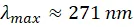
The UV spectrum of Tramadol Hydrochloride showed maximum absorbance at:
λmax≈271 nm
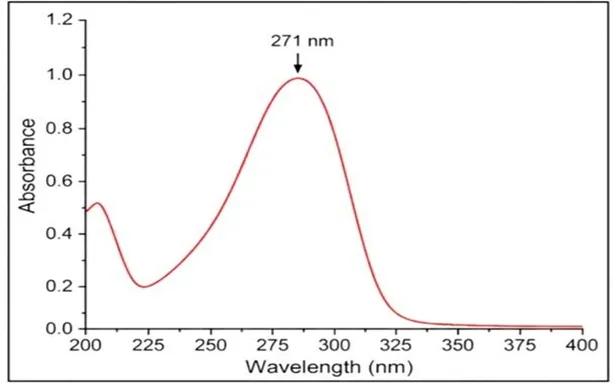
The λmax value was used for calibration curve preparation and further drug analysis.
Standard Calibration Curve of Tramadol HCl
A standard calibration curve of Tramadol Hydrochloride was prepared in phosphate buffer pH 6.8 within the concentration range of 2–12 µg/mL. The absorbance increased linearly with concentration, confirming Beer–Lambert’s law.
Table Standard Calibration Curve of Tramadol HCl in Phosphate Buffer pH 6.8
|
Concentration (µg/mL) |
Absorbance |
|
2 |
0.113 |
|
4 |
0.221 |
|
6 |
0.335 |
|
8 |
0.448 |
|
10 |
0.545 |
|
12 |
0.675 |
The regression equation obtained was:
y=0.1099x+0.0058

The correlation coefficient was found to be:
R2=0.9991
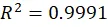
The developed UV spectrophotometric method showed excellent linearity, accuracy, and suitability for quantitative estimation of Tramadol HCl.
Drug–Excipient Compatibility Study (FTIR Analysis)
FTIR analysis of Tramadol Hydrochloride showed characteristic peaks at 3445 cm⁻¹ (O–H stretching), 3350 cm⁻¹ (N–H stretching), 1512 cm⁻¹ (aromatic C=C stretching), and 1110 cm⁻¹ (C–O–C stretching). Similar peaks with slight shifts were observed in the drug–excipient mixture, indicating absence of significant chemical interaction between the drug and excipients.
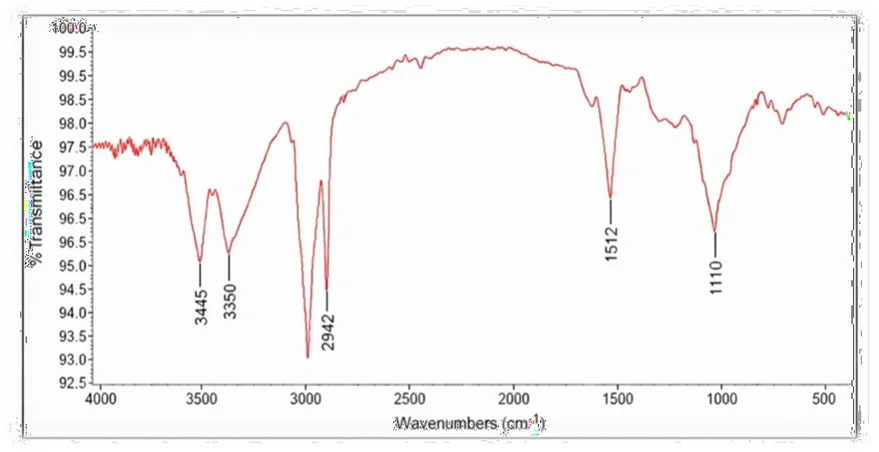
FTIR studies confirmed good compatibility of Tramadol HCl with the selected formulation excipients.
Table : Physicochemical Characteristics and Evaluation of Prepared Mucoadhesive Buccal Films of Tramadol Hydrochloride
|
Formulation |
Appearance |
Texture |
Transparency |
Thickness (mm) |
Weight (mg) |
Folding Endurance |
Surface pH |
Swelling Index (%) |
Mucoadhesive Strength (g) |
Drug Content (%) |
Drug Release at 12 hr (%) |
|
F1 |
Smooth |
Slightly soft |
Transparent |
0.21 ± 0.02 |
45 ± 2 |
210 ± 5 |
6.2 ± 0.1 |
45 ± 3 |
18 ± 2 |
96.5 ± 1.2 |
81.68 ± 1.8 |
|
F2 |
Smooth |
Flexible |
Transparent |
0.25 ± 0.01 |
52 ± 3 |
265 ± 7 |
6.4 ± 0.1 |
58 ± 2 |
24 ± 2 |
98.2 ± 1.0 |
85.42 ± 1.9 |
|
F3 |
Smooth |
Slightly soft |
Translucent |
0.30 ± 0.02 |
60 ± 2 |
290 ± 6 |
6.5 ± 0.2 |
62 ± 4 |
25 ± 3 |
99.1 ± 0.8 |
88.24 ± 1.7 |
|
F4 |
Smooth |
Flexible |
Transparent |
0.27 ± 0.01 |
55 ± 2 |
275 ± 5 |
6.3 ± 0.1 |
75 ± 3 |
27 ± 2 |
98.7 ± 0.9 |
91.85 ± 1.8 |
|
F5 |
Smooth |
Slightly rigid |
Transparent |
0.32 ± 0.02 |
63 ± 3 |
300 ± 6 |
6.6 ± 0.1 |
82 ± 2 |
32 ± 3 |
99.5 ± 0.7 |
94.25 ± 1.5 |
|
F6 |
Smooth |
Flexible |
Transparent |
0.29 ± 0.01 |
48 ± 2 |
285 ± 5 |
6.4 ± 0.2 |
80 ± 3 |
30 ± 2 |
98.9 ± 0.8 |
92.21 ± 1.7 |
DISCUSSION
All formulations showed satisfactory physicochemical properties, acceptable surface pH, good mechanical strength, uniform drug content, and controlled drug release. Increase in polymer concentration enhanced swelling index, folding endurance, mucoadhesive strength, and sustained drug release. Among all formulations, F5 showed the best overall performance with optimum swelling behavior, maximum folding endurance, high mucoadhesive strength, and maximum cumulative drug release over 12 hours, indicating its suitability as the optimized buccal film formulation.
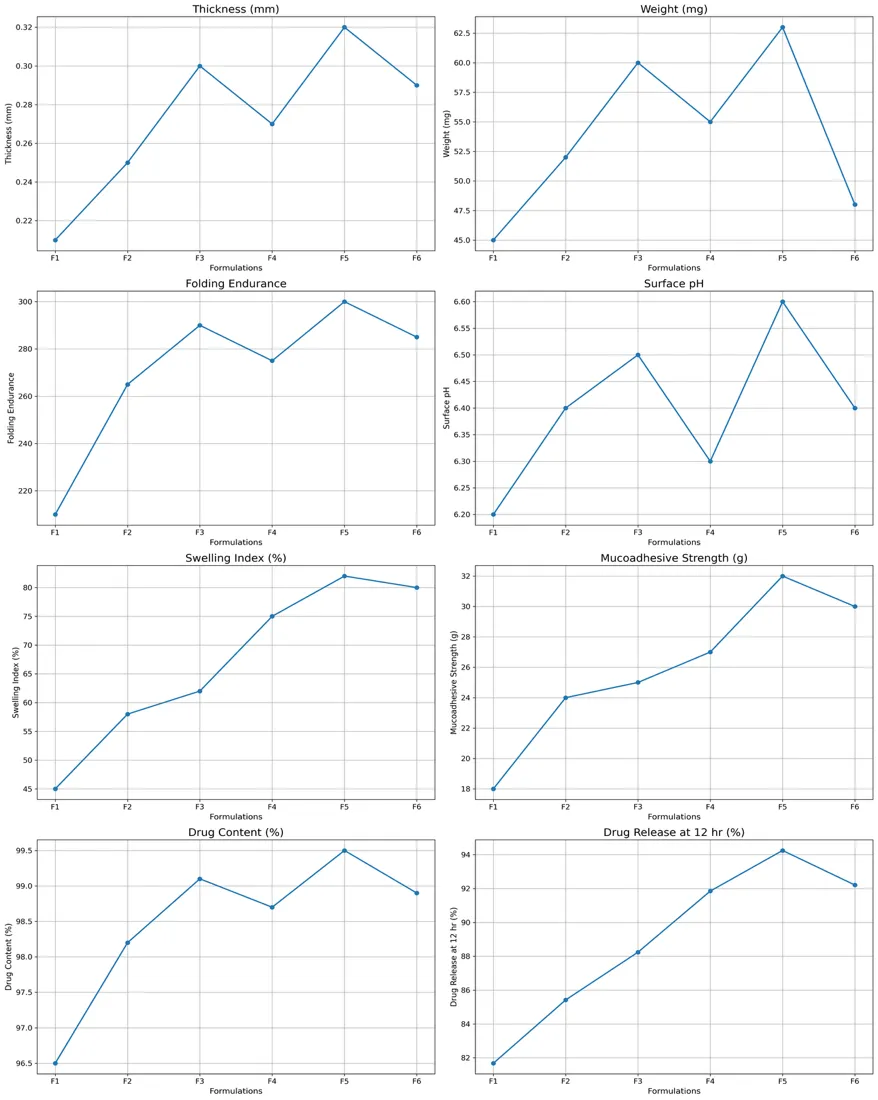
Figure: Combined graphical representation of physicochemical evaluation parameters of prepared mucoadhesive buccal films of Tramadol Hydrochloride including thickness, weight variation, folding endurance, surface pH, swelling index, mucoadhesive strength, drug content uniformity, and cumulative drug release.
Stability Studies
The optimized buccal film formulation (F5) of Tramadol hydrochloride was subjected to accelerated stability conditions at 40 ± 2°C and 75 ± 5% RH for 3 months. After storage, the formulation showed no significant changes in physical appearance, drug content, folding endurance, or drug release, indicating good stability.
Table Stability Study of Optimized Buccal Film (F5)
|
Parameter |
0 Days |
90 Days |
|
Appearance |
Clear, smooth |
No change |
|
Drug Content (%) |
99.05 |
99.02 |
|
Folding Endurance |
300 ± 5 |
290 ± 25 |
|
Drug Release (%) |
94.25 |
94.02 |
Formulation F5 showed stable physicochemical properties under accelerated conditions, confirming good formulation stability.
CONCLUSION
The present study successfully developed and evaluated mucoadhesive buccal films of Tramadol hydrochloride to improve pain management by overcoming limitations of conventional oral dosage forms such as first-pass metabolism and delayed action. The buccal films were prepared using polymers like HPMC, PVA, and Carbopol 934 by the solvent casting method.All formulations (F1–F6) showed good physicochemical and mechanical properties, including uniform thickness, acceptable surface pH, and proper drug content uniformity. Mucoadhesive strength and swelling behavior increased with higher polymer concentration, especially Carbopol 934, which improved residence time and drug absorption.
In-vitro drug release studies showed that drug release was influenced by polymer concentration, with F1 showing faster release and F3 showing sustained release. The optimized formulation F5 provided the best balance of controlled drug release, mucoadhesion, and mechanical strength.Stability studies of F5 confirmed no significant changes in key parameters, indicating good formulation stability. Overall, the study concludes that mucoadhesive buccal films of Tramadol hydrochloride are a promising alternative drug delivery system, with further in-vivo and clinical studies recommended for future development.
REFERENCES

Ganesh Tale, Dr Rahul Radke, Dr Ramesh Pagore, Formultion And Evaluation Of Mucoadhesive Buccal Films, Int. J. of Pharm. Sci., 2026, Vol 4, Issue 7, 2423-2431, https://doi.org/10.5281/zenodo.21324341
 10.5281/zenodo.21324341