

We use cookies to ensure our website works properly and to personalise your experience. Cookies policy
1, 2 *Centre for Biotechnology, Siksha ‘O’ Anusandhan deemed to be University, Bhubaneswar, Odisha, India-751003
3National Institute of Pharmaceutical Education and Research (NIPER), Ahmedabad-382355, Gujarat, India
Culture media form the foundation of medical microbiology and play a critical role in the isolation, cultivation, and characterization of microorganisms under controlled laboratory conditions. These media are composed of essential nutrients such as carbon, nitrogen, vitamins, and minerals that support microbial growth and metabolic activities. Due to the diversity of microbial physiology, various types of culture media including basal, enriched, selective, differential, enrichment, transport, and specialized media have been developed to meet specific research and clinical needs. In medical microbiology, culture media are indispensable for diagnosing infectious diseases, studying pathogen biology, and evaluating antimicrobial susceptibility. Furthermore, they serve as key platforms in drug discovery for screening bioactive compounds, assessing antibiotic efficacy, and supporting fermentation processes. Recent advancements integrating culture techniques with omics technologies, artificial intelligence, and microfluidics are enhancing the efficiency and precision of microbial studies. Despite these advancements, challenges such as contamination risks, limited cultivation of certain microorganisms, and variability in media composition persist. Overall, culture media remain essential tools bridging clinical diagnostics and pharmaceutical research, with evolving innovations promising improved therapeutic discovery and disease management
Culture media constitute a cornerstone of medical microbiology, enabling the isolation, cultivation, and characterization of pathogenic microorganisms under controlled laboratory conditions (Cappuccino and Welsh, 2019). These media are formulated with essential nutrients such as carbon, nitrogen, vitamins, and minerals to mimic the natural environment of microbes (Atlas, 2010) and support their in vitro growth. Owing to the vast diversity in microbial physiology and nutritional requirements, a wide range of specialized media such as selective, differential, enriched, and transport media have been developed to facilitate accurate identification and study of clinically relevant microorganisms (Madigan et al., 2021; Tortora et al., 2021).
In clinical settings, culture media play a pivotal role in diagnosing infectious diseases, determining antimicrobial susceptibility (Jorgensen and Ferraro, 2009), and monitoring microbial contamination. Techniques such as isolation of pure cultures, colony morphology analysis, and biochemical characterization rely heavily on optimized media formulations. Moreover, culture-based methods remain essential for validating molecular diagnostics and for studying pathogen virulence, host microbe interactions, and resistance mechanisms. These applications are particularly significant in the era of increasing antimicrobial resistance (AMR), where precise identification of pathogens is critical for targeted therapy and effective disease management (Ventola, 2015; WHO, 2023).
From a drug discovery perspective, culture media serve as platforms for screening bioactive compounds, evaluating antibiotic efficacy (Lewis, 2013; Berdy, 2012), and supporting fermentation processes for the production of therapeutic agents. Advances in media design, including defined and synthetic media, are enabling reproducible and high-throughput screening of novel drug candidates.
Looking forward, integration of culture-based techniques with omics technologies, artificial intelligence, and microfluidics is expected to revolutionize microbiological research. Innovative approaches such as organoid cultures, co-culture systems, and personalized microbiome-based media hold promise for precision medicine, accelerating the discovery of next-generation antimicrobials and improving global healthcare outcomes.
Culture media
Culture media are nutrient-rich substances, available in liquid (broth) or solid (agar-based) forms that support the in vitro growth and maintenance of microorganisms. Since microbes differ widely in their physiology (Lagier et al., 2015; Nichols et al., 2010), habitat, and nutritional requirements, no single medium can support all species, and specialized media are often required, while obligate parasites cannot be cultured on artificial media. Culture media are essential in microbiology for isolating pure cultures, identifying pathogens, diagnosing infectious diseases, studying biochemical and genetic characteristics, and testing antimicrobial sensitivity (Prescott et al., 2020). Solid media, typically prepared using agar derived from red algae, allow the formation of discrete colonies for morphological study, whereas liquid media support large-scale microbial growth. Overall, culture media play a critical role in microbial cultivation, enumeration, and experimental analysis in laboratory settings (Baltz, 2008; Demain, 2000).
Ingredients
Culture media are specially formulated nutrient systems that support the in vitro growth (Atlas, 2010), maintenance, and enumeration of microorganisms under controlled laboratory conditions. These media may be prepared in liquid or solid (gel-based) forms and are essential for microbial isolation, selection, and survival studies. A typical culture medium comprises several key components that collectively fulfill microbial nutritional requirements (Prescott et al., 2020). Peptone functions as a primary source of carbon and nitrogen, facilitating cellular metabolism and growth. Beef extract supplies essential amino acids, vitamins, and minerals (Brown, 2018), while yeast extract enhances the medium by providing additional growth factors, including vitamins and organic nitrogen compounds (CLSI, 2023). Distilled water serves as the solvent, ensuring proper dissolution of nutrients and maintaining osmotic balance (Murray et al., 2020; Forbes et al., 2017). In solid media, agar an inert polysaccharide derived from marine algae is incorporated as a solidifying agent due to its stability and resistance to microbial degradation (Cappuccino and Welsh, 2019). Together, these components create an optimal environment for microbial cultivation (Jorgensen and Ferraro, 2009), making culture media indispensable in microbiological research, diagnostics, and biotechnological applications.
Key Factors in Culture Media Selection
The selection of an appropriate culture medium is a critical step in microbiological research and clinical diagnostics, as it directly influences microbial growth, identification, and experimental accuracy (Atlas, 2010; Madigan et al., 2021). The diagram illustrates several key factors that govern the effectiveness of culture media.

Fig 1: Key factors influencing the selection of culture media in microbiology, highlighting critical parameters such as consistency, composition, selectivity, oxygen content, indicative properties, convenience, and safekeeping that collectively determine the suitability, performance, and reliability of media for microbial growth, identification, and experimental applications (Atlas, 2010; Madigan et al., 2021)
Consistency of the medium ensures reproducibility and reliability of results by maintaining appropriate physical properties required for microbial growth (Cappuccino and Welsh, 2019). Composition is equally important, as it determines the availability of essential nutrients such as carbon, nitrogen, vitamins, and minerals necessary for cellular metabolism (Prescott et al., 2020).
Selectivity enables the targeted growth of specific microorganisms by incorporating inhibitory substances that suppress unwanted microbes, which is particularly valuable in clinical microbiology (Forbes et al., 2017). Additionally, oxygen content significantly affects microbial growth, as different organisms require aerobic or anaerobic conditions (Madigan et al., 2021).
The indicative (differential) properties of media allow differentiation of microorganisms based on biochemical reactions, often through visible color changes (Collee et al., 2014). Convenience in preparation and handling ensures efficiency and reproducibility in laboratory procedures (Brown, 2018). Lastly, safekeeping of media is essential to maintain sterility, stability, and shelf-life, preventing contamination and degradation (Atlas, 2010).Finally these factors collectively determine the suitability of culture media for specific microbiological applications, ensuring accurate diagnostics and effective research outcomes.
Culture media are classified based on multiple criteria including physical state, composition (Madigan et al., 2021), functional application, oxygen requirement, and specialized uses (Ventola, 2015; WHO, 2023). Each category serves a distinct role: solid media enable isolation, liquid media support bulk growth, selective and differential media aid identification (MacConkey, 1905), and specialized media facilitate transport, storage, and industrial applications. This multifaceted classification ensures precise microbial cultivation and analysis across clinical, research, and biotechnological fields (Rappaport and Vassiliadis, 1951).
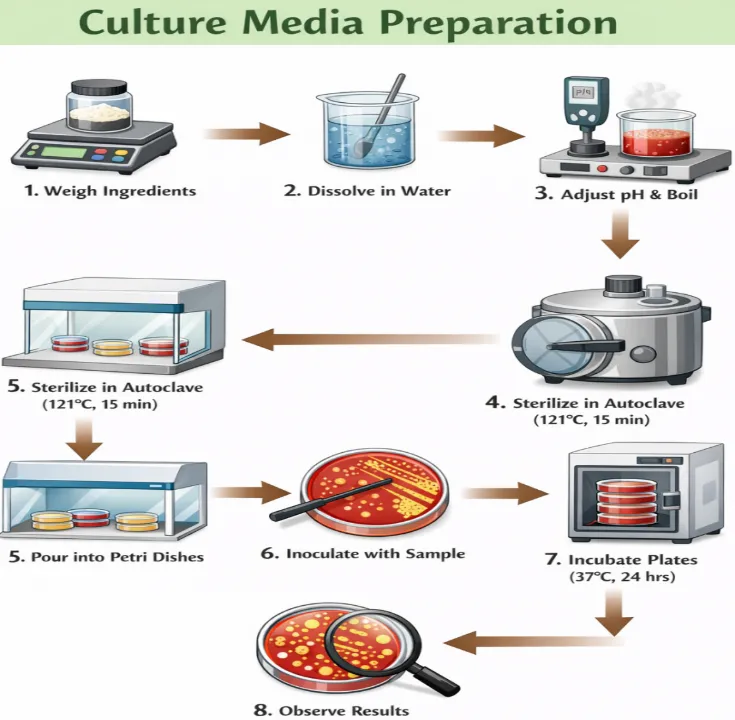
Structural presentation of culture media preparation:
Scope and Research Focus:
This review aims to provide a comprehensive overview of culture media and their significance in microbiology, medical diagnostics, and drug discovery. It focuses on the composition and classification of various culture media used for microbial cultivation and analysis. The study further examines the critical role of culture media in pathogen isolation, clinical diagnostics, and microbial identification. Special emphasis is given to their application in antimicrobial susceptibility testing and drug discovery, highlighting their importance in evaluating therapeutic agents. Additionally, this review summarizes the different types of culture media and their specific functions across diverse microbiological applications. Finally, recent advancements and future perspectives in culture media development are discussed, particularly in relation to improving microbial cultivation, diagnostic accuracy, and innovative drug discovery approaches.
Applications of Culture Media:
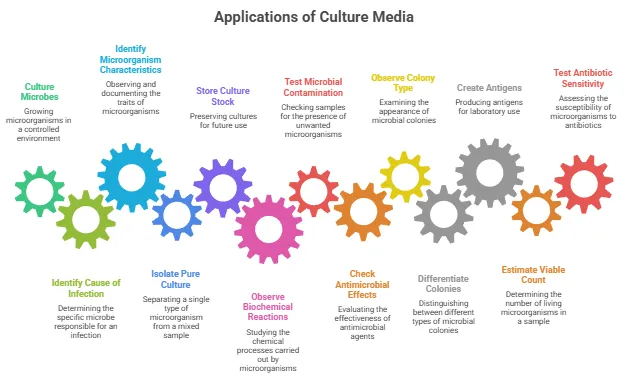
Figure 2: Applications of culture media in microbiology, illustrating their roles in microbial cultivation, isolation of pure cultures, identification of pathogens, observation of colony morphology and biochemical reactions, detection of contamination, antimicrobial susceptibility testing, antigen production, and estimation of viable microbial counts in laboratory and clinical settings (Madigan et al., 2021; Forbes et al., 2017).
The figure illustrates the diverse applications of culture media in microbiology, emphasizing their central role in both research and clinical diagnostics. Culture media provide a controlled environment that supports the growth and cultivation of microorganisms, enabling scientists to study their characteristics and behavior (Madigan et al., 2021).
One of the primary applications is the isolation of pure cultures, which allows separation of a single microbial species from a mixed population for accurate identification (Cappuccino and Welsh, 2019). Culture media are also essential for identifying the causative agents of infections and understanding microbial traits through morphological and biochemical analysis (Forbes et al., 2017).
Additionally, culture media facilitate the observation of colony characteristics and biochemical reactions, which are crucial for distinguishing between different microorganisms (Collee et al., 2014). They are widely used to test microbial contamination, ensuring the safety of food, pharmaceuticals, and clinical samples.
In medical microbiology and drug discovery, culture media play a vital role in antibiotic sensitivity testing and evaluation of antimicrobial effects, helping determine effective treatment strategies (CLSI, 2023). They are also used to estimate viable cell counts, differentiate colonies, and produce antigens for laboratory and vaccine-related applications. Furthermore, culture media enable the storage and preservation of microbial cultures for future research. Overall, culture media serve as indispensable tools that support microbial identification, analysis, and therapeutic development.
Microbial culture media represent a highly diverse and functionally specialized group of formulations tailored to meet the nutritional and environmental demands of different microorganisms (Demain, 2000). Their classification into basal, enriched, selective, differential, enrichment, transport, anaerobic, and specialized media highlights their critical roles in microbial isolation (Andrews, 2001), identification, preservation, and experimental analysis (Lagier et al., 2015; Nichols et al., 2010). Such comprehensive categorization not only enhances diagnostic accuracy but also supports advanced applications in clinical microbiology, biotechnology, and drug discovery research (Lewis, 2013; Berdy, 2012).
Criteria for differentiation of culture media
Culture media are classified based on multiple criteria including physical state, composition, functional application, oxygen requirement, and specialized uses. Each category serves a distinct role: solid media enable isolation, liquid media support bulk growth, selective and differential media aid identification, and specialized media facilitate transport, storage, and industrial applications. This multifaceted classification ensures precise microbial cultivation and analysis across clinical, research, and biotechnological fields.
Table 1: Classification and Differentiation of Culture Media Based on Multiple Criteria
|
Criteria |
Type of Media |
Key Characteristics |
Principle / Function |
Applications |
Examples |
|
Physical State (Consistency)
|
Solid |
Contains 1.5–2% agar; firm surface |
Supports discrete colony formation |
Isolation, morphology study |
Nutrient agar, Blood agar |
|
Semi-solid |
0.2–0.5% agar; soft gel |
Allows limited bacterial movement |
Motility testing, microaerophiles |
Stuart’s medium, OF medium |
|
|
Liquid (Broth) |
No agar; fluid medium |
Uniform growth with turbidity |
Mass culture, biochemical tests |
Nutrient broth, TSB |
|
|
Nutritional Composition |
Simple (Basal) |
Basic nutrients (C, N, salts) |
Supports non-fastidious organisms |
Routine culture |
Peptone water, Nutrient agar |
|
Complex |
Composition not precisely known |
Supports wide range of microbes |
General microbiology studies |
Blood agar, TSB |
|
|
Defined (Synthetic) |
Exact chemical composition known |
Used for metabolic studies |
Research, physiology studies |
Czapek Dox medium |
|
|
Functional Application
|
Enriched |
Added blood/serum/egg |
Supports fastidious organisms |
Clinical diagnostics |
Blood agar, Chocolate agar |
|
Selective |
Contains inhibitors (salts, dyes, antibiotics) |
Suppresses unwanted microbes |
Isolation of specific bacteria |
MacConkey agar, Mannitol salt agar |
|
|
Differential |
Contains indicators |
Differentiates organisms by color/biochemical traits |
Identification of species |
MacConkey agar, Blood agar |
|
|
Enrichment |
Liquid medium favoring target microbes |
Increases desired organism population |
Sample processing |
Selenite F broth |
|
|
Oxygen Requirement |
Aerobic |
Supports growth in presence of oxygen |
Standard cultivation |
Routine microbiology |
Nutrient agar |
|
Anaerobic |
Reduced oxygen conditions (reducing agents) |
Supports obligate anaerobes |
Anaerobic culture studies |
Thioglycollate broth, RCM |
|
|
Special Purpose Media |
Assay media |
Standardized composition |
Evaluates antibiotics/ vitamins |
Drug testing |
Mueller-Hinton agar |
|
Fermentation media |
High nutrient content |
Promotes metabolite production |
Industrial microbiology |
YPD medium |
|
|
Minimal media |
Limited nutrients |
Selects wild-type organisms |
Genetic studies |
Minimal salts medium |
|
|
Transport & Storage |
Transport media |
Maintains viability without growth |
Prevents overgrowth/ drying |
Sample transport |
Cary-Blair medium, Stuart’s medium |
|
Storage media |
Preserves cultures long-term |
Maintains viability |
Culture preservation |
Egg saline, glycerol stocks |
|
|
Physical Form Variants |
Biphasic media |
Combination of liquid and solid |
Enhances growth of fastidious organisms |
Diagnostic use |
Lowenstein–Jensen medium |
|
Dehydrated media |
Powder/granule form |
Long shelf life, reconstituted before use |
Laboratory convenience |
Commercial media powders |
|
|
Ready-to-use media |
Pre-prepared sterile media |
Direct usage without preparation |
Clinical and research labs |
Pre-poured agar plates |
Classification of media for medical microbiology and drug discovery, emphasizing antimicrobial screening, pathogen isolation, and therapeutic relevance
In medical microbiology and drug discovery, culture media serve as indispensable platforms for isolating clinically relevant pathogens, studying their physiology, and evaluating antimicrobial agents. Selective and differential media enhance accurate identification of pathogens, while enrichment media improve detection sensitivity in complex samples. Media such as Mueller-Hinton agar play a central role in antimicrobial susceptibility testing, forming the foundation for antibiotic screening and resistance profiling. Furthermore, specialized media support the cultivation of fastidious and anaerobic organisms, enabling the discovery of novel drug targets (Table 2). Collectively, these media systems bridge clinical diagnostics (Murray et al., 2020) and pharmaceutical research (Ventola, 2015), facilitating the development of next-generation therapeutics against emerging and drug-resistant pathogens.
Table 2: Culture Media in Medical Microbiology and Drug Discovery
A. Primary Isolation & Clinical Diagnostic Media
|
Name of Media |
Uses |
Importance in Medical Microbiology / Drug Discovery |
|
Blood Agar |
Isolation & hemolysis detection |
Identifies pathogenic bacteria and virulence (hemolysins), crucial for infection diagnosis |
|
MacConkey Agar |
Gram-negative isolation |
Differentiates enteric pathogens; essential for clinical screening |
|
Chocolate Agar |
Fastidious pathogens (Neisseria, Haemophilus) |
Supports clinically important bacteria for disease diagnosis |
|
CLED Agar |
Urinary pathogens |
Prevents swarming; useful in UTI diagnostics |
|
Mannitol Salt Agar |
Staphylococcus aureus detection |
Identifies salt-tolerant pathogens relevant in hospital infections |
|
XLD Agar |
Enteric pathogens |
Differentiates Salmonella/Shigella in clinical samples |
|
TCBS Agar |
Vibrio cholerae |
Critical for cholera detection and epidemiological studies |
B. Selective & Differential Media for Pathogen Identification
|
Name of Media |
Uses |
Importance in Drug Discovery |
|
EMB Agar |
Coliform detection |
Differentiates lactose fermenters; useful in contamination studies |
|
CHROMagar |
Rapid pathogen identification |
Chromogenic detection enhances diagnostic accuracy |
|
Bile Esculin Agar |
Enterococci identification |
Detects drug-resistant strains (e.g., VRE) |
|
Hektoen Enteric Agar |
Enteric pathogens |
Differentiates pathogens in mixed infections |
|
Cetrimide Agar |
Pseudomonas aeruginosa |
Identifies opportunistic, drug-resistant pathogen |
|
Bismuth Sulfite Agar |
Salmonella typhi |
Selective detection of typhoid-causing bacteria |
C. Enrichment Media for Low-Abundance Pathogens
|
Name of Media |
Uses |
Importance |
|
Selenite F Broth |
Salmonella enrichment |
Enhances detection of pathogens in low numbers |
|
Tetrathionate Broth |
Enteric pathogens |
Suppresses normal flora for targeted isolation |
|
Alkaline Peptone Water |
Vibrio spp. |
Critical for waterborne disease surveillance |
|
GN Broth |
Gram-negative bacteria |
Improves recovery from clinical samples |
D. Media for Antimicrobial Susceptibility Testing (AST)
|
Name of Media |
Uses |
Importance in Drug Discovery |
|
Mueller-Hinton Agar |
Antibiotic susceptibility testing |
Gold standard for evaluating antimicrobial activity (Kirby–Bauer method) |
|
Mueller-Hinton Broth |
MIC determination |
Determines minimum inhibitory concentration (MIC) |
|
Iso-Sensitest Agar |
Drug testing |
Alternative standardized medium for AST |
|
Diagnostic Sensitivity Agar |
Antibiotic assays |
Used in pharmacological screening |
E. Media for Anaerobic & Fastidious Pathogens
|
Name of Media |
Uses |
Importance |
|
Thioglycolate Broth |
Anaerobic bacteria |
Supports growth of oxygen-sensitive pathogens |
|
Robertson Cooked Meat Medium |
Clostridium spp. |
Important for toxin-producing bacteria |
|
Brucella Agar |
Fastidious pathogens |
Used in zoonotic disease research |
|
Campylobacter Agar |
Campylobacter spp. |
Microaerophilic pathogen isolation |
|
Lowenstein–Jensen Medium |
Mycobacterium tuberculosis |
Essential for TB diagnosis and drug resistance studies |
|
BCYE Agar |
Legionella spp. |
Supports intracellular pathogens |
F. Specialized Media for Drug Discovery & Industrial Screening
|
Name of Media |
Uses |
Importance |
|
Minimal Media |
Genetic & metabolic studies |
Identifies biosynthetic pathways and drug targets |
|
Fermentation Media |
Metabolite production |
Used in antibiotic and bioactive compound production |
|
Assay Media |
Antibiotic/vitamin testing |
Measures potency and bioactivity of compounds |
|
Tryptic Soy Broth (TSB) |
Biomass production |
Used for large-scale microbial growth |
|
Brain Heart Infusion Broth |
Fastidious organisms |
Supports drug testing on pathogenic strains |
G. Transport & Preservation Media
|
Name of Media |
Uses |
Importance |
|
Cary-Blair Medium |
Stool sample transport |
Maintains pathogen viability |
|
Stuart’s Medium |
Clinical samples |
Prevents overgrowth during transport |
|
Amies Medium |
Transport medium |
Improved recovery of pathogens |
|
Glycerol Stocks |
Long-term storage |
Preserves strains for future drug testing |
|
Cooked Meat Broth |
Anaerobe preservation |
Maintains viability of strict anaerobes |
RESEARCH GAPS / FUTURE PERSPECTIVES
Current challenges in microbial culture systems include the inability to culture certain microorganisms, such as obligate parasites and unculturable microbes, variability in media composition that affects reproducibility, and risks of contamination requiring skilled handling. Additionally, there is a growing need for standardized high-throughput media for efficient drug screening, improved integration of conventional culture techniques with omics and AI-based approaches, and the development of personalized, microbiome-specific culture systems to support precision medicine applications.
CONCLUSION:
Culture media are indispensable in microbiology, providing essential support for microbial growth, identification, and analysis. Their diverse classifications enable targeted applications in clinical diagnostics, research, and pharmaceutical development. In drug discovery, culture media facilitate antimicrobial screening and pathogen characterization, playing a crucial role in combating antimicrobial resistance. Advances in technology are further enhancing the precision and efficiency of culture-based studies. However, continuous improvements in media formulation and integration with modern techniques are necessary to overcome existing limitations and expand their applications.
ACKNOWLEDGEMENT
The authors express their gratitude to the management of the Siksha 'O' Anusandhan Deemed to be University, Bhubaneswar for providing the essential resources and scope for this publication.
Conflicts of interest
The authors declare that there are no competing interests to declare in this work.
Funding
No funding source applicable.
REFERENCES:


Krishna Kumar Das, Suprava Sahoo, Santosh Kumar Behera, Basudeba Kar*, From Microbial Cultivation to Drug Discovery: A Comprehensive Review of Culture Media and Their Biomedical Applications, Int. J. of Pharm. Sci., 2026, Vol 4, Issue 6, 7385-7397. https://doi.org/ 10.5281/zenodo.21044777
 10.5281/zenodo.21044777