

We use cookies to ensure our website works properly and to personalise your experience. Cookies policy
*1Associate Professor and Department of Pharmaceutical Analysis, Arunai College Of Pharmacy , Tiruvannamalai – 606803 Tamil Nadu.
2M.Pharm.,Ph.D., Principal and Professor, Arunai College Of Pharmacy, Tiruvannamalai – 606803
3,4,5,6,7Arunai College Of Pharmacy, Tiruvannamalai – 606803
The present study aimed to develop and validate a simple, accurate, precise, robust and green reverse-phase high-performance liquid chromatographic (RP-HPLC) method for the simultaneous estimation of Amoxicillin and Cloxacillin in bulk drug and capsule dosage form. The chromatographic conditions were optimized to achieve satisfactory separation of both drugs, followed by validation of the developed method for linearity, accuracy, precision, robustness and ruggedness. The method demonstrated excellent linearity with a correlation coefficient of 0.9998 for both Amoxicillin and Cloxacillin. The assay results were found to be 98.93% for Amoxicillin and 100.78% for Cloxacillin, with satisfactory precision and low percentage relative standard deviation. Robustness and ruggedness studies confirmed the reliability and reproducibility of the method under small deliberate changes in analytical conditions and between different analysts. The environmental performance of the method was evaluated using the Greenness Evaluation Metric of Analytical Methods (GEMAM) and Analytical GREEnness (AGREE) approaches. The developed method showed acceptable green analytical characteristics by minimizing solvent consumption, waste generation and potential environmental impact while maintaining analytical performance. Hence, the proposed green RP-HPLC method can be considered suitable for routine simultaneous estimation of Amoxicillin and Cloxacillin in pharmaceutical dosage forms.
Antibiotics play an important role in the treatment and prevention of bacterial infections. Amoxicillin and Cloxacillin are penicillin-class antibacterial agents used in pharmaceutical preparations. Reliable analytical methods are required for the quantitative determination of active pharmaceutical ingredients in bulk drugs and pharmaceutical dosage forms.
High-performance liquid chromatography (HPLC) is widely used in pharmaceutical analysis because of its sensitivity, selectivity and reproducibility. However, conventional chromatographic procedures may involve considerable quantities of organic solvents and generate chemical waste. Therefore, the development of analytical procedures that incorporate the principles of Green Analytical Chemistry is important for reducing environmental and occupational hazards.
Green analytical chemistry aims to minimize the use of hazardous substances, reduce waste and energy consumption, and improve laboratory safety without compromising analytical quality. In the present study, a green RP-HPLC method was developed for the simultaneous estimation of Amoxicillin and Cloxacillin. The developed method was subsequently validated and its environmental performance was assessed using GEMAM and AGREE. The study objectives included reducing solvent consumption and waste generation while maintaining accuracy, precision, sensitivity and robustness.
DRUG PROFILE:
Drug name : Amoxicillin
Category :Antibiotic drug
Background : Amoxicillin is a broad-spectrum β-lactam antibiotic belonging to the aminopenicillin class.
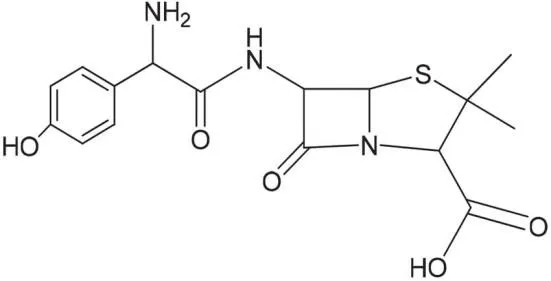
Chemical structure:
Chemical name : (2S,5R,6R)-6-[[(2R)-2-amino-2-(4-hydroxyphenyl)acetyl]amino]-3,3-dimethyl-7-oxo-4-thia-1-azabicyclo[3.2.0]heptane-2-carboxylic acid
Molecular formula : C16H19N3O5S
Molecular weight : 365.408 g/mol
Appearance : Off-white solid, Crystals from, Penicillin-type odour, Bitter taste
Melting point :194 °C
Route of administration : Amoxicillin is administered orally and is available in various forms, including immediate-release or extended-release tablets, chewable tablets, and suspension.
Storage : Store tablets and capsules at room temperature, away from moisture, heat, and light.
Approval date : 18 January 1974.
Mechanism of action : Amoxicillin belongs to the class of beta-lactam antimicrobials. Beta-lactams bind to penicillin-binding proteins, inhibiting transpeptidation — a crucial step in cell wall synthesis involving cross-linking. This action activates autolytic enzymes in the bacterial cell wall, resulting in cell wall lysis and bacterial cell destruction.
Drug name : Cloxacillin
Category :Antibiotic drug
Background : Cloxacillin is a β-lactam, penicillinase-resistant (anti-staphylococcal) penicillin developed to treat infections caused by penicillinase-producing staphylococci. It belongs to the isoxazolyl penicillin group and is stable against destruction by many bacterial β-lactamase enzymes.
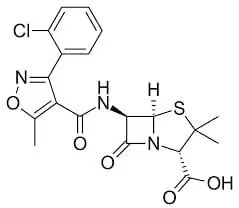
Chemical structure:
Chemical name : sodium (2S,5R,6R)-6-[[3-(2-chlorophenyl)-5-methyl-1,2-oxazole-4-carbonyl]amino]-3,3-dimethyl-7-oxo-4-thia-1-azabicyclo[3.2.0]heptane-2-carboxylate.
Molecular formula : C19H17ClN3NaO5S
Molecular weight : 457.9 g/mol
Appearance : white or almost white, odorless crystalline powder.
Melting point :168-172 °C
Route of administration : Cloxacillin is administered by oral, intravenous, intramuscular and is available in various forms, including capsule, oral suspension.
Storage : Store tablets and capsules at room temperature, away from moisture, heat, and light.
Approval date : August 1965.
Mechanism of action : Beta-lactam antibiotic. Inhibits bacterial cell wall synthesis by binding to penicillin-binding proteins.
MATERIALS AND METHODS:
Reagent and chemical used:
Instrumentation
PROCEDURE:
Preparation of buffer solution:
0.77gm of ammonium acetate were dissolved in 800ml of milli-Q-water and adjust the PH for 3.5 by using glacial acetic acid make upto 1000ml
preparation of standard stock solution:
50mg of amoxicillin and 50mg of cloxacillin were dissolved in Milli-Q-water and made upto 100ml volumetric flask with solvent.
1ml stock solution was pipetted out and made upto the 10 ml volumetric flask with solvent. (50µg of amoxicillin & 50µg of cloxacillin\ml)
preparation of sample stock solution:
The average weight of 10 capsules was calculated as 112. 2mg.Then112.2mg of powder were dissolved in Milli-Q-water and made upto 100ml volumetric flask with solvent.
1ml stock solution was pipetted out and made upto the 10 ml volumetric flask with solvent. (50µg\ml)
METHOD DEVELOPMENT:
The developed method was fully validated for the parameters as per ICH guidelines.
Linearity
Weigh accurately and transfer about 50mg of brivaracetam into 100ml of volumetric flask dissolve and make up with solvent. Take 0.5ml, 0.75ml,1ml,1.25ml,1.5ml of stock solution is transfer into 10ml of volumetric flask and make up with solvent upto the volume. To make the linearity concentration of 50%, 75%,100%,125%,150%.
Accuracy
Weigh accurately tablet average weight of sample and transfer into 100ml of volumetric flask dissolve and makeup to the volume with the solvent. Take 0.8ml,1ml,1.2ml of stock solution was transferred into 10ml of volumetric flask and makeup with solvent upto the volume. To make the concentration of 80%, 100%,120%.
Precision
Weigh accurately tablet average weight of sample and transfer into 100ml of volumetric flask dissolve and makeup to the volume with the solvent.1ml of stock solution was transferred into 10ml of volumetric flask and makeup with the solvent upto the volume. Six-time replicate of injection to produce the similar of the result no maximum deviation.
Robustness
Small deliberate changes in method like flow rate, wavelength, mobile phase and ratio were made but there was no recognized change in the result and were within range as per ICH guidelines. Robustness conditions like flow minus, flow rate, wavelength decreasing, wavelength increasing, mobile phase decreasing, mobile phase increasing, ratio increasing and ratio decreasing was maintained and sample were injected in duplicated manner system suitability parameters were not much effected and all the parameters were passed. % RSD was within the limit.
Ruggedness
Ruggedness is a measure of reproducibility of test results under normal, expected operational conditions from laboratory to laboratory and from analyst to analyst. The method was fully validated for the parameters as per ICH guidelines.
RESULTS AND DISCUSSION:
The optimized chromatographic method provided satisfactory separation of Amoxicillin and Cloxacillin. The method demonstrated excellent linearity, with a correlation coefficient of 0.9998 for both analytes. The assay results were 98.93% for Amoxicillin and 100.78% for Cloxacillin. Accuracy and precision studies showed satisfactory recovery and low percentage relative standard deviation (%RSD). Robustness studies demonstrated that small deliberate changes in chromatographic conditions did not significantly affect the analytical performance. Ruggedness studies also showed reproducible results between analysts.
Method development:
Optimized chromatographic condition:
Mode of operation : Gradiant
Stationary phase : C18 Column (250 mm×5,4.5µ)
Mobile phase : Buffer: Ethanol (65:35)
Detection wavelength: 276 nm
Flow rate : 0.8ml/min
Column Temperature : 30℃
Retention time:
Amoxicillin :7.712minut
Cloxacillin :16.970minutes
Run time :15minutes
Injection volume : 50 mcg
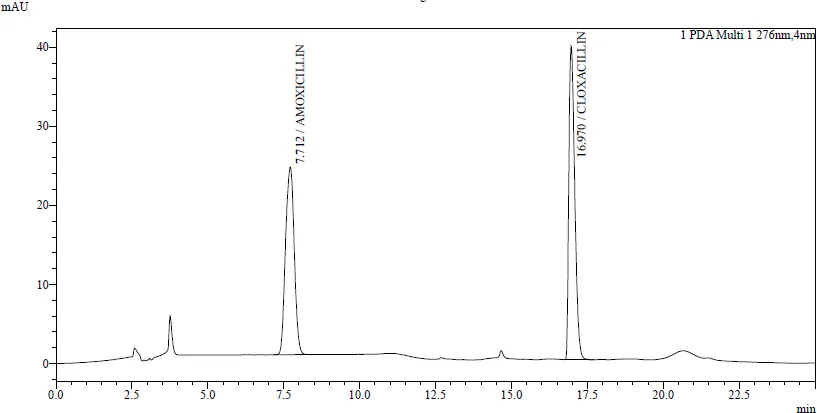
Figure 1: Optimized chromatogram
Peak table:
|
Peak |
Drug name |
Retention time |
Area |
Tailing factor |
Theoretical plate |
|
1 |
Amoxicillin |
7.712 |
473298 |
1.023 |
3069 |
|
2 |
Cloxacillin |
16.970 |
536140 |
1.438 |
31063 |
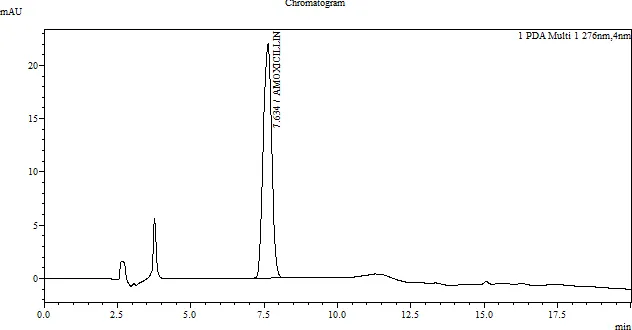
Figure 2: Optimized chromatogram of amoxicillin
|
Drug name |
Retention time |
Area |
Theoretical plate |
Tailing factor |
|
Amoxicillin |
7.634 |
470625 |
3186 |
1.042 |
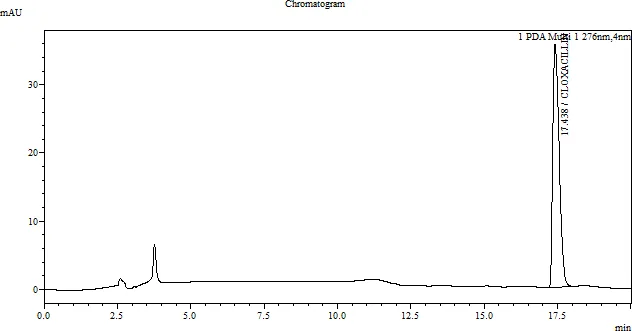
Figure 3: Optimized chromatogram of cloxacillin
|
Drug name |
Retention time |
Area |
Theoretical plate |
Tailing factor |
|
Cloxacillin |
17.438 |
624150 |
29981 |
1.425 |
Assay:
Table 1: Assay data for amoxicillin
|
Amoxicillin |
||||
|
Injection |
Retention time |
Area |
Theoretical plate |
Tailing factor |
|
Standard 1 |
7.712 |
473298 |
3069 |
1.023 |
|
Standard 2 |
7.724 |
473920 |
3133 |
1.028 |
|
Standard 3 |
7.721 |
473590 |
3128 |
1.028 |
|
Standard 4 |
7.721 |
475105 |
3137 |
1.035 |
|
Standard 5 |
7.723 |
475207 |
3163 |
1.036 |
|
Bracketing std |
7.721 |
473704 |
3134 |
1.036 |
|
Sample 1 |
7.728 |
470625 |
3186 |
1.042 |
|
Sample 2 |
7.729 |
467515 |
3171 |
1.040 |
|
Average standard area |
Percentage average |
SD |
%RSD |
|
474137 |
98.93% |
814.2918396 |
0.171741889 |
Table 2: Assay data for cloxacillin
|
Cloxacillin |
||||
|
Injection |
Retention time |
Area |
Theoretical plate |
Tailing factor |
|
Standard 1 |
16.970 |
536140 |
31063 |
1.438 |
|
Standard 2 |
16.988 |
538904 |
32392 |
1.398 |
|
Standard 3 |
17.010 |
538901 |
32491 |
1.402 |
|
Standard 4 |
17.022 |
540080 |
32531 |
1.428 |
|
Standard 5 |
17.034 |
541914 |
30873 |
1.460 |
|
Bracketing std |
17.083 |
540051 |
32029 |
1.408 |
|
Sample 1 |
17.042 |
607966 |
28562 |
1.484 |
|
Sample 2 |
17.064 |
604150 |
29981 |
1.425 |
|
Average standard area |
Percentage average |
SD |
%RSD |
|
539331.6667 |
100.78% |
1913.164748 |
0.374728805 |
Linearity:
Table 3: linearity data for amoxicillin
|
Amoxicillin |
||||
|
Concentration |
Retention time |
Area |
Theoretical plate |
Tailing factor |
|
50% |
7.444 |
235551 |
3256 |
1.042 |
|
75% |
7.559 |
362487 |
2943 |
1.025 |
|
100% |
7.576 |
471667 |
3081 |
1.048 |
|
125% |
7.581 |
583864 |
3077 |
1.053 |
|
150% |
7.585 |
709012 |
3075 |
1.060 |
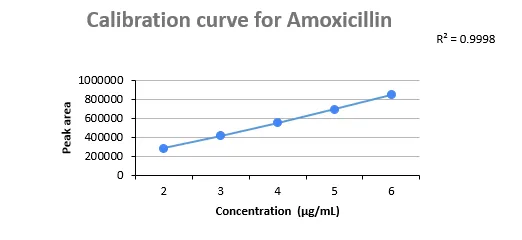
Figure 4: calibration curve for amoxicillin
Table 4: linearity data for cloxacillin
|
Cloxacillin |
||||
|
Concentration |
Retention time |
Area |
Theoretical plate |
Tailing factor |
|
50% |
17.016 |
284981 |
37207 |
1.360 |
|
75% |
17.025 |
415799 |
32429 |
1.398 |
|
100% |
16.999 |
549245 |
29988 |
1.382 |
|
125% |
16.963 |
694983 |
25862 |
1.467 |
|
150% |
16.927 |
847574 |
23350 |
1.432 |
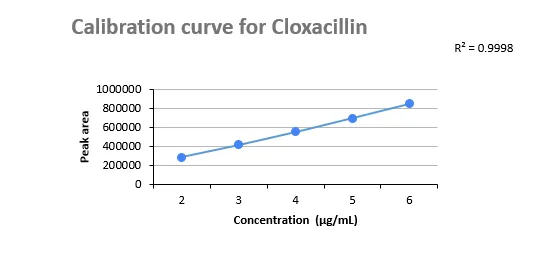
Figure 5: calibration curve for cloxacillin
Table 5: Linearity data
|
Parameters |
Amoxicillin |
Cloxacillin |
|
Correlation coefficient R2 
|
0.9998 |
0.9998 |
|
Slope |
116831.9 |
140135.4 |
|
Y intercept |
-0.04154238 |
0.014632922 |
Accuracy
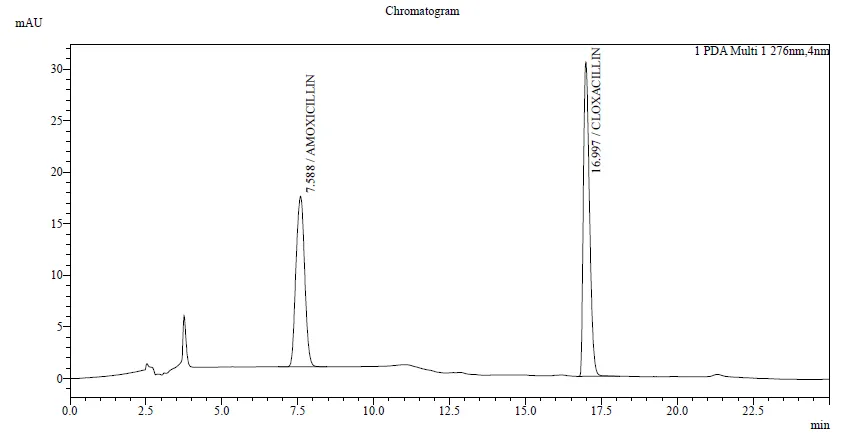
Figure 6: Accuracy-80%
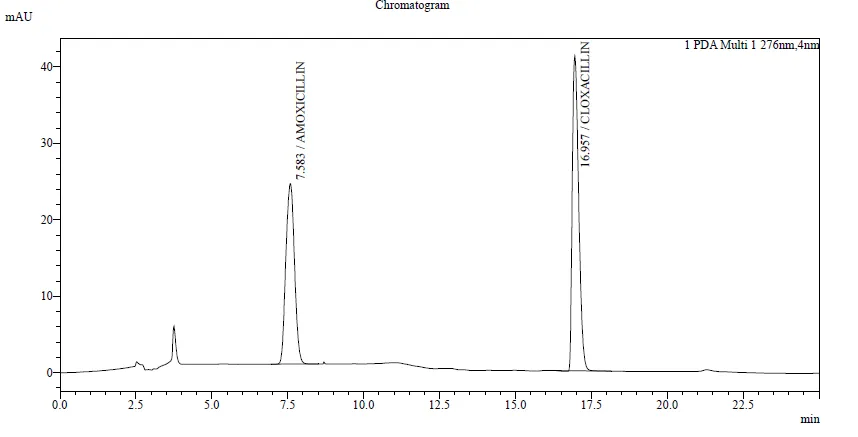
Figure 7: Accuracy-100%
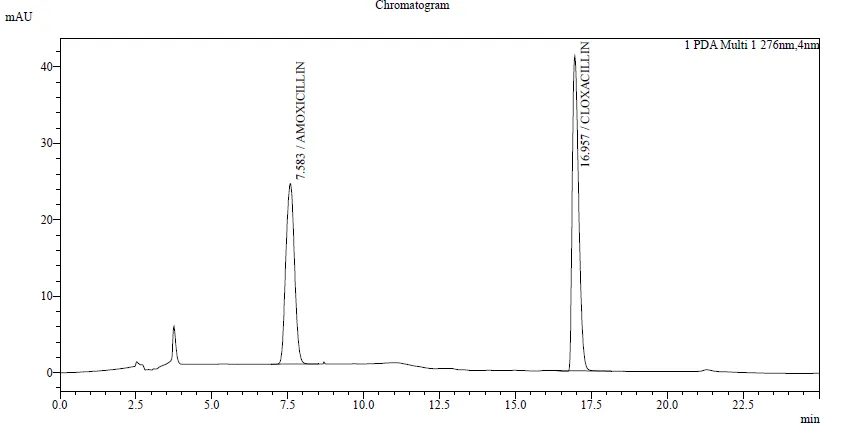
Figure 8: Accuracy-120%
Table 6: amoxicillin Data for accuracy
|
Amoxicillin |
||||
|
Percentage concentration |
Percentage recovery |
Mean recovey |
SD |
%RSD |
|
80% |
100.12% |
101.243% |
1.2414 |
1.233
|
|
100% |
101.00% |
|||
|
120% |
102.61% |
|||
Table 7: cloxacillin Data for accuracy
|
Cloxacillin |
||||
|
Percentage concentration |
Percentage recovery |
Mean recovey |
SD |
%RSD |
|
80% |
99.70% |
% |
|
|
|
100% |
100.66% |
|||
|
120% |
101.202% |
|||
Precision:
Table 8: Data for precision
|
Amoxicillin
|
|||||
|
Interday precision |
Intraday precision |
||||
|
Injection |
Retention time |
Area |
Injection |
Retention time |
Area |
|
1 |
7.571 |
475349 |
1 |
7.491 |
469800 |
|
2 |
7.576 |
474159 |
2 |
7.589 |
474516 |
|
3 |
7.576 |
474811 |
3 |
7.571 |
467498 |
|
4 |
7.704 |
472222 |
4 |
7.568 |
467657 |
|
5 |
7.710 |
470569 |
5 |
7.569 |
469775 |
|
6 |
7.720 |
471559 |
6 |
7.567 |
467855 |
|
|
Average |
SD |
%RSD |
|
Interday precision |
473111.5 |
1931.72 |
0.408301485 |
|
Intraday precision |
469516.33 |
2662.14 |
0.566994941 |
Table 9: Data for precision
|
Cloxacillin
|
|||||
|
Interday precision |
Intraday precision |
||||
|
Injection |
Retention time |
Area |
Injection |
Retention time |
Area |
|
1 |
16.952 |
558576 |
1 |
16.987 |
550192 |
|
2 |
16.965 |
550893 |
2 |
17.002 |
554120 |
|
3 |
16.972 |
557510 |
3 |
17.002 |
543788 |
|
4 |
`7.080 |
550110 |
4 |
16.995 |
544371 |
|
5 |
17.082 |
548748 |
5 |
16.997 |
546329 |
|
6 |
17.087 |
550877 |
6 |
16.992 |
544641 |
|
|
Average |
SD |
%RSD |
|
Interday precision |
552786.5 |
4159.76 |
0.75249665 |
|
Intraday precision |
547240.11 |
4093.19 |
0.748013642 |
Robustness
Table 10: amoxicillin Data of robustness (change in flow rate)
|
Amoxicillin
|
||||
|
Flow rate |
Retention time |
Area |
Theoretical plate |
Tailing factor |
|
0.9ml |
8.545 |
545838 |
3166 |
1.058 |
|
1.1ml |
7.706 |
485259 |
2891 |
1.067 |
Table 11: cloxacillin Data of robustness (change in flow rate)
|
Cloxacillin
|
||||
|
Flow rate |
Retention time |
Area |
Theoretical plate |
Tailing factor |
|
0.9ml |
18.7612 |
626371 |
11639 |
1.630 |
|
1.1ml |
17.831 |
560881 |
12722 |
1.563 |
Ruggedness
Table 12: amoxicillin Data for ruggedness
|
Amoxicillin
|
||||
|
Analyst |
Average percentage |
Average standard area |
SD |
%RSD |
|
Analyst-1 |
99.259 |
47413.333 |
814.81670 |
0.171852468 |
|
Analyst-2 |
98.560 |
475441.1667 |
917.54267 |
0.192987638 |
Table 13: cloxacillin Data for ruggedness
|
Cloxacillin
|
||||
|
Analyst |
Average percentage |
Average standard area |
SD |
%RSD |
|
Analyst-1 |
101.600 |
546061 |
2694.0768 |
0..4933655 |
|
Analyst-2 |
100.480 |
546220 |
3836.7613 |
0.70242056 |
Established method greenness analysis:
Green assessment can be defined as the absence or minimal usage of hazardous chemicals, the elimination of waste, and the decrease of energy consumption the suggested method’s greenness has been investigated by assigning penalty points to all of the specified parameter for the approach by applying a “Greenness evaluation metric of analytical methods (GEMAM)”, after that given a score for every of the twelve green analytical chemistry elements as shown below in “Analytical GREEnness (AGREE)”.
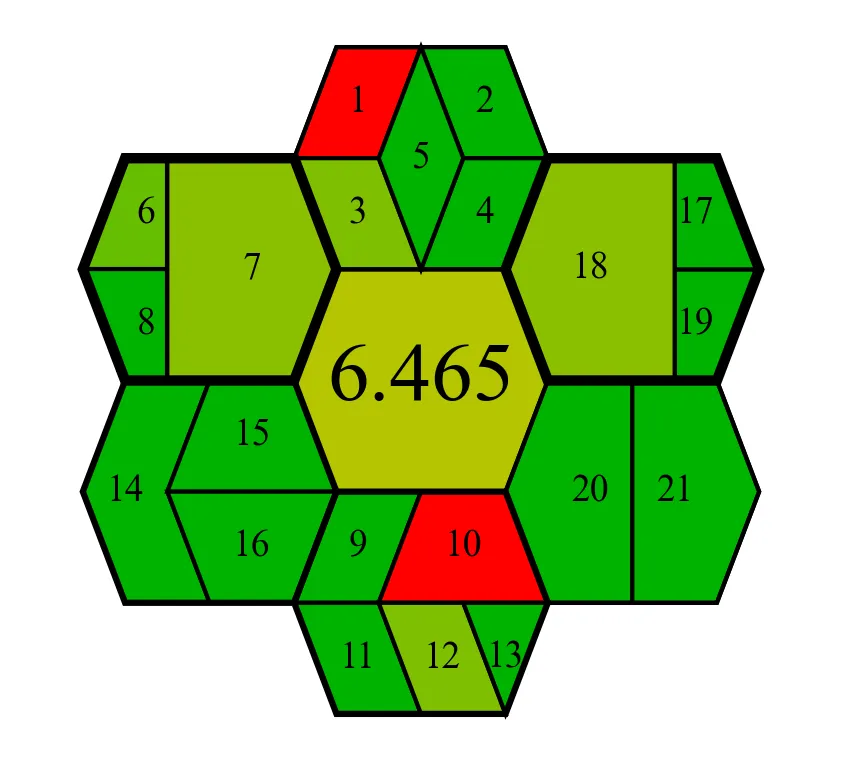
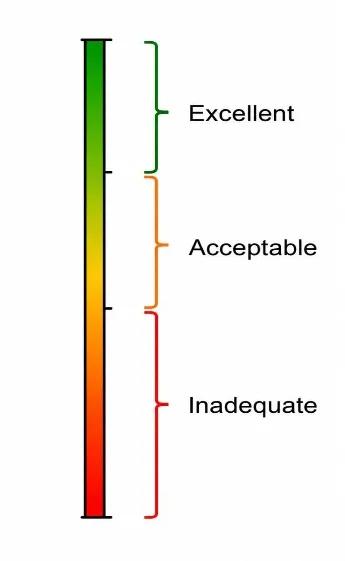
Figure 9: The general result of the greenness evaluation metric of analytical methods (GEMAM) assessment (left) and the corresponding colour scale for reference (right)
Table 14: Different sections & different criteria of GEMAM
|
Sections |
Criteria |
|
sample |
1. Sample preparation site |
|
2. Whether the sample is damaged during sample preparation |
|
|
3. Range of extraction when sample preparation |
|
|
4. The size of sample |
|
|
5. Storage of sample |
|
|
Reagent |
6. Description of the ideal green derivation |
|
7. The amounts of reagents |
|
|
8. The score of reagents |
|
|
Methods |
9. Number of analytes determined in a single run (or analysis parameter) |
|
10. Sample throughput (per hour) |
|
|
11. Number of main steps in the analysis process |
|
|
12.Ratio of the mass of sustainable and renewable materials to the total mass of materials used |
|
|
13. Economic benefits of the methods |
|
|
Instruments |
14. The energy consumption per analysis should be minimized |
|
15. Automatic of instruments |
|
|
16. Miniaturization of instruments |
|
|
17. Waste treatment |
|
|
Waste |
18. The amounts of wastes |
|
19. The score of wastes |
|
|
Operation |
20. Hermetic sealing of analytical process |
|
21. Noise generation of analytical process |
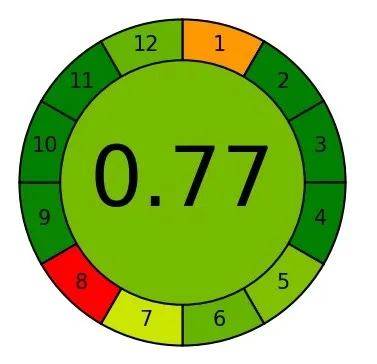
Figure 10: The general result of Analytical GREEnness (AGREE)
CONCULUSION
The present study successfully developed and validated a simple, accurate, precise, robust and rugged green RP-HPLC method for the simultaneous estimation of Amoxicillin and Cloxacillin in bulk drug and capsule dosage form. The optimized chromatographic conditions provided satisfactory separation of both drugs with good retention characteristics.
The developed method exhibited excellent linearity with a correlation coefficient of 0.9998 for both Amoxicillin and Cloxacillin. The assay results were satisfactory, with 98.93% for Amoxicillin and 100.78% for Cloxacillin, accompanied by low %RSD values. The accuracy studies demonstrated satisfactory percentage recovery, while precision studies showed good reproducibility with low %RSD values.
The robustness and ruggedness studies confirmed that the method can withstand small deliberate changes in chromatographic conditions and variations between analysts without significant changes in the results. Therefore, the developed method is suitable for routine quantitative analysis of Amoxicillin and Cloxacillin in pharmaceutical dosage forms.
Furthermore, the method was evaluated using green analytical assessment approaches, including GEMAM and AGREE, to assess its environmental impact. The method aims to minimize solvent consumption, waste generation, energy consumption and exposure to hazardous chemicals while maintaining analytical performance. Thus produce the acceptable and excellent green analytical values.
Hence, the developed green RP-HPLC method can be considered a reliable, efficient and environmentally conscious analytical method for the simultaneous estimation of Amoxicillin and Cloxacillin in bulk and capsule dosage forms.
REFERENCES







R. Tamilselvan*, Dr.S.k.Senthil Kumar, C. Lakshmi, P.S.Lokesh, K. Loshni, P. Mahathi, K. Mathivanan, Green Analytical Rp-Hplc Method Development And Validation For Simultaneous Estimation Of Anti Biotic Drug In Bulk &Capsule Dosage Form, Int. J. of Pharm. Sci., 2026, Vol 4, Issue 8, 5233-5248. https://doi.org/ 10.5281/zenodo.22208555
 10.5281/zenodo.22208555