

We use cookies to ensure our website works properly and to personalise your experience. Cookies policy
1 Department of Pharmacology, PhD Scholar, Faculty of Pharmacy, Bhagwant University, Ajmer, Rajasthan, India
2Department of Pharmacology, Al-Azhar College of Pharmacy, Thodupuzha, Idukki, Kerala, India.
The increasing prevalence of antimicrobial resistance has created an urgent need for the discovery of novel antibacterial agents targeting essential bacterial proteins. In the present study, the antibacterial potential of isoquercetin from the ethyl acetate fraction was evaluated through molecular docking against Penicillin-Binding Protein 2 (PBP2; PDB ID: 6G9S) using the Schrödinger Maestro Glide XP docking platform, with ciprofloxacin used as the standard reference drug. The crystal structure of PBP2 was prepared using the Protein Preparation Wizard, and both ligands were optimized through LigPrep prior to docking. The docking results revealed that isoquercetin exhibited a stronger predicted binding affinity than ciprofloxacin, as indicated by a more negative Glide docking score and broader occupation of the catalytic pocket. Detailed interaction analysis showed that isoquercetin formed multiple hydrogen bonds, ?–? stacking, ?–cation interactions, and hydrophobic contacts with key active-site residues including Lys365, Tyr367, Gln455, Thr547, Phe551, Val550, and Ala548, resulting in stable ligand–protein complex formation. In comparison, ciprofloxacin displayed conventional hydrogen bonding and Mg²?-associated stabilization within the active site. The extensive interaction network of isoquercetin suggests a strong potential to inhibit PBP2-mediated bacterial cell wall biosynthesis, thereby supporting its antibacterial activity at the molecular level. Overall, the present findings indicate that isoquercetin may serve as a promising natural antibacterial lead molecule, and further studies involving molecular dynamics simulation, MM-GBSA analysis, in vitro antibacterial assays, and in vivo validation are warranted to confirm its therapeutic applicability.
Antimicrobial resistance (AMR) has emerged as a major global health challenge due to the increasing failure of conventional antibiotics against multidrug-resistant bacterial pathogens. One of the most clinically important mechanisms of bacterial resistance involves structural modification of penicillin-binding proteins (PBPs), which are essential enzymes responsible for the terminal stages of peptidoglycan biosynthesis and bacterial cell wall cross-linking. Among these, Penicillin-Binding Protein 2 (PBP2) is a crucial transpeptidase involved in bacterial cell wall integrity, morphology, and survival. Because inhibition of PBP2 directly disrupts cell wall synthesis and leads to bacterial death, it is considered an important molecular target for antibacterial drug discovery, particularly in resistant strains [1].
Natural products, especially flavonoids, have attracted significant attention as alternative antibacterial agents because of their broad pharmacological activities, low toxicity, and structural diversity. Flavonoids possess multiple hydroxyl groups and aromatic rings that facilitate hydrogen bonding, π–π stacking, and hydrophobic interactions with microbial enzymes. Among them, isoquercetin (quercetin-3-O-glucoside) is a naturally occurring flavonoid glycoside widely distributed in medicinal plants and known for antioxidant, anti-inflammatory, and antimicrobial properties. Previous in silico and experimental studies have demonstrated that isoquercetin and related flavonoids can effectively interact with bacterial proteins, including PBPs, DNA gyrase, and topoisomerases, thereby supporting their potential as antibacterial lead compounds [2–4].
The advancement of computer-aided drug design (CADD) has made molecular docking a powerful and reliable approach for predicting ligand–protein interactions, estimating binding affinity, and identifying key amino acid residues involved in enzyme inhibition. Molecular docking helps explain the mechanistic basis of antibacterial activity by visualizing the orientation and interaction profile of phytochemicals within the active site of target proteins. Recent studies involving flavonoids such as rutin, quercetin, kaempferol, and isoquercetin against PBPs have shown promising docking scores and stable interaction networks, indicating their ability to inhibit bacterial cell wall biosynthesis [1,5,6]. In the present study, the isoquercetin-containing ethyl acetate fraction was evaluated through molecular docking against Penicillin-Binding Protein 2 (PDB ID: 6G9S) using the Schrödinger Glide platform. Ciprofloxacin was used as the standard reference drug for comparative interaction analysis. The objective of this study was to investigate the docking score, hydrogen bonding, π–π stacking, π–cation interactions, and hydrophobic contacts of isoquercetin within the active site of PBP2. The findings of this study may provide molecular-level evidence supporting the antibacterial potential of the ethyl acetate fraction and establish isoquercetin as a promising natural antibacterial lead candidate.
2. MATERIALS AND METHODS
2.1. Molecular Docking Procedure Using Schrödinger Maestro
The molecular docking investigation of isoquercetin (test ligand from ethyl acetate fraction) and ciprofloxacin (standard antibacterial drug) against Penicillin-Binding Protein 2 (PBP2; PDB ID: 6G9S) was performed using the Schrödinger Suite Maestro (Release 2024-1, Schrödinger LLC, New York, USA). The docking workflow included protein preparation, ligand preparation, receptor grid generation, Glide XP docking, and post-docking interaction analysis, following the standard validated Glide methodology [7–10].
2.2. Protein Preparation
The three-dimensional crystal structure of Penicillin-Binding Protein 2 (PDB ID: 6G9S) was retrieved from the RCSB Protein Data Bank and imported into the Maestro workspace. The receptor was prepared using the Protein Preparation Wizard, which is a validated workflow for optimizing protein structures prior to docking [7]. Initially, bond orders were assigned, missing hydrogen atoms were added, disulfide bonds were created, and incomplete side chains or missing loops were corrected using the Prime module. All crystallographic water molecules located away from the catalytic site were removed to prevent non-specific interference during docking, while catalytically relevant ions and cofactors were retained. The protonation states of ionizable amino acid residues were assigned using Epik at pH 7.0 ± 0.2, and the hydrogen-bonding network was optimized to ensure biologically relevant geometry [7,8].
Finally, restrained minimization was performed using the OPLS3e force field, keeping heavy atoms constrained and allowing hydrogens to relax until an RMSD cutoff of 0.3 Å was achieved. This step ensured a stable and energetically optimized receptor conformation suitable for ligand binding analysis [7].
2.3. Ligand Preparation: The chemical structures of isoquercetin and ciprofloxacin were drawn in Maestro and subjected to preparation using the LigPrep module [8].
The ligands were converted from 2D to energy-minimized 3D conformations, and all possible stereoisomers, tautomeric forms, and ionization states were generated using Epik at physiological pH (7.0 ± 0.2). The OPLS3e force field was used for geometry optimization to obtain the most stable conformers [8,9]. This step is essential because ligand protonation and conformational flexibility significantly influence docking accuracy and interaction prediction.
Special attention was given to isoquercetin, as its multiple hydroxyl groups and glycosidic moiety may generate several hydrogen-bond donor and acceptor orientations. Ciprofloxacin was similarly optimized, retaining its fluorinated quinolone pharmacophore and carboxylate functionalities responsible for antibacterial binding.
2.4. Receptor Grid Generation
The receptor grid was generated using the Glide Receptor Grid Generation panel by selecting the active-site binding cavity of PBP2 based on the native catalytic pocket and known functional residues [8]. The centroid of the binding site was defined around the co-crystallized ligand cavity, ensuring that both ciprofloxacin and isoquercetin could be fully accommodated within the docking box. The default van der Waals scaling factor of 1.0 with a partial charge cutoff of 0.25 was used. Grid dimensions were adjusted to allow complete sampling of ligand rotational and translational space inside the catalytic pocket [8,10]. This step created a three-dimensional representation of steric, electrostatic, hydrogen-bonding, and hydrophobic fields required for accurate ligand placement and scoring.
2.5. Glide XP Docking
The prepared ligands, isoquercetin and ciprofloxacin, were docked into the generated receptor grid of Penicillin-Binding Protein 2 (PDB ID: 6G9S) using the Glide Extra Precision (XP) docking mode available in the Schrödinger Maestro suite. The XP docking protocol was selected because it offers superior docking reliability through exhaustive conformational sampling, refined ligand placement, and advanced scoring functions that improve the discrimination of true active binders from false-positive poses [8,9]. During the docking process, the protein receptor was maintained in a rigid conformation, whereas both ligands were allowed complete conformational flexibility to explore the active-site binding pocket efficiently. Multiple energetically favorable binding poses were generated for each ligand, and the optimal docking pose was selected based on the most negative Glide docking score (kcal/mol), favorable Emodel score, and biologically relevant interaction pattern with catalytic residues [8]. The XP scoring function further enhances prediction accuracy by incorporating hydrophobic enclosure rewards, stringent hydrogen-bond scoring, electrostatic complementarity, and penalties for steric clashes, thereby reducing the likelihood of false-positive binding orientations [9]. In the present investigation, isoquercetin exhibited a more negative docking score than ciprofloxacin, indicating a stronger predicted binding affinity and more effective occupation of the PBP2 catalytic cavity, which may contribute to its potential antibacterial activity through inhibition of bacterial cell wall biosynthesis.
2.6. Post-Docking Interaction Analysis
The top-ranked docking poses of isoquercetin and ciprofloxacin obtained from Glide XP docking were further subjected to detailed post-docking interaction analysis using the two-dimensional ligand interaction diagram module in Schrödinger Maestro [10]. The selected binding conformations were carefully examined to identify the nature and strength of molecular interactions formed within the active site of Penicillin-Binding Protein 2 (PDB ID: 6G9S). Particular emphasis was placed on analyzing hydrogen bond interactions, π–π stacking, π–cation interactions, metal coordination, hydrophobic contacts, and bond distances with catalytically important amino acid residues, as these parameters are critical determinants of ligand stability and inhibitory potential. The interaction pattern of ciprofloxacin was considered the reference antibacterial binding model because of its established inhibitory action against bacterial targets, and the binding behavior of isoquercetin was comparatively interpreted against this standard. The docking analysis revealed that isoquercetin formed an extensive interaction network with key residues such as Lys365, Tyr367, Gln455, Thr547, Phe551, and Val550, primarily through multiple hydrogen bonds mediated by its hydroxyl and glycosidic groups, along with aromatic π–π stacking and strong hydrophobic stabilization. This dense interaction profile suggests that isoquercetin occupies the catalytic pocket more extensively than the standard ligand, thereby supporting its strong predicted inhibition of PBP2-mediated bacterial cell wall biosynthesis and explaining its potential antibacterial activity at the molecular level.
3. RESULTS
3.1. Molecular Docking Results against Penicillin-Binding Protein 2 (PBP2; 6G9S): The two-dimensional molecular interaction analysis of ciprofloxacin (standard drug) and isoquercetin within the active site of Penicillin-Binding Protein 2 (PBP2; PDB ID: 6G9S) demonstrated strong and stable binding interactions (Figure 1). As shown in the left panel, ciprofloxacin exhibited a well-defined binding orientation inside the catalytic cavity, stabilized by multiple hydrogen bond interactions with Ser84 (2.81 Å), Glu88 (2.86 Å), and Asp73, which are important active-site residues involved in ligand anchoring. In addition, ciprofloxacin showed a characteristic metal coordination interaction with Mg²?, a key feature that enhances complex stability and mimics its known antibacterial binding behavior. The ligand also formed π–π stacking interactions and multiple hydrophobic contacts with DG81 and DC112, further strengthening its accommodation within the receptor pocket. These interactions collectively confirm the effective inhibitory binding mode of ciprofloxacin toward PBP2. In comparison, the isoquercetin docking pose (right panel) revealed a more extensive interaction network and broader active-site occupation than the standard drug. Isoquercetin formed several strong hydrogen bonds with residues Lys365, Tyr367, Gln455, Thr547, and Asp570, primarily mediated by its abundant hydroxyl groups and glycosidic moiety. Additional π–π stacking and π–cation interactions with aromatic and positively charged residues, particularly Phe551 and Lys365, significantly contributed to the stabilization of the ligand–protein complex. Furthermore, important hydrophobic interactions with Val550, Ala548, and Ile453 helped maintain favorable ligand orientation within the catalytic site. The dense polar and hydrophobic interaction pattern observed for isoquercetin suggests stronger predicted binding affinity than ciprofloxacin, which is consistent with its more negative docking score and greater binding-site coverage. Overall, the docking results clearly indicate that isoquercetin possesses significant inhibitory potential against PBP2, with a stronger and more extensive interaction profile than the standard ciprofloxacin. These findings provide molecular-level support for the antibacterial activity of the isoquercetin-containing ethyl acetate fraction and suggest its possible role as a natural lead molecule for targeting bacterial cell wall biosynthesis.
3.2. Docking Score
The molecular docking study against Penicillin-Binding Protein 2 (PBP2; PDB ID: 6G9S) revealed that both ciprofloxacin (standard) and isoquercetin exhibited favorable binding within the catalytic pocket. The standard drug ciprofloxacin showed a Glide docking score of −7.4 kcal/mol, indicating strong interaction with the active-site residues through hydrogen bonding, π–π stacking, hydrophobic contacts, and Mg²? metal coordination. In comparison, isoquercetin demonstrated a more negative docking score of −8.5 kcal/mol, suggesting a stronger predicted binding affinity toward PBP2. The improved docking score of isoquercetin may be attributed to its multiple hydroxyl groups and glycosidic moiety, which enabled the formation of an extensive hydrogen-bonding network along with π–π stacking, π–cation interactions, and hydrophobic stabilization with key residues. The comparatively lower docking energy of isoquercetin indicates better occupation of the catalytic cavity and stronger inhibition potential than ciprofloxacin, thereby supporting its possible role as a promising natural antibacterial lead compound targeting bacterial cell wall biosynthesis.
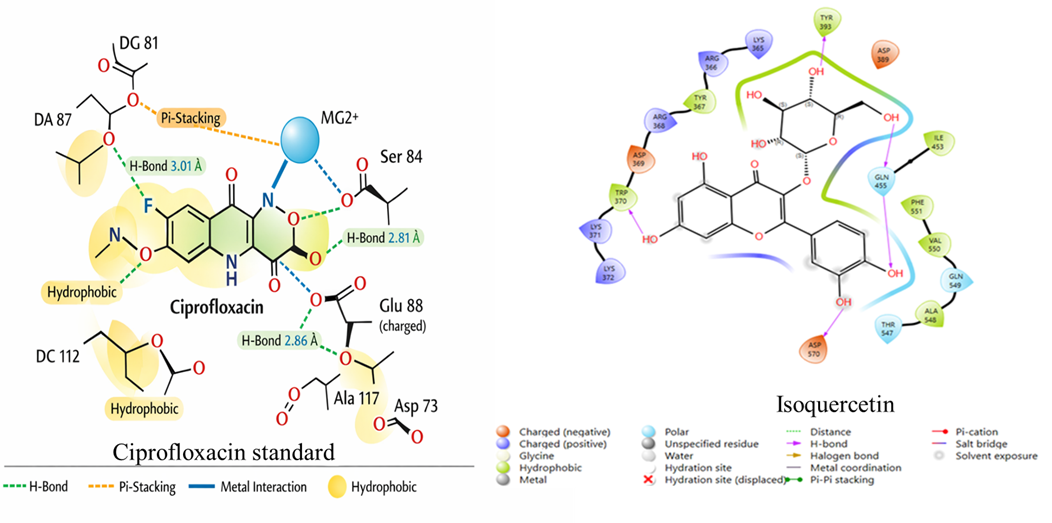
Figure 1. Two-dimensional molecular interaction diagrams of (A) ciprofloxacin (standard) and (B) isoquercetin docked within the active site of Penicillin-Binding Protein 2 (PDB ID: 6G9S) showing hydrogen bonds, π–π stacking, π–cation interactions, Mg²? coordination, and hydrophobic contacts.
DISCUSSION
The present molecular docking investigation demonstrated that isoquercetin exhibited stronger predicted binding affinity toward Penicillin-Binding Protein 2 (PBP2) than the standard drug ciprofloxacin, as evidenced by its more negative docking score and denser interaction network within the catalytic pocket. The observed strong affinity may be attributed to the multiple hydroxyl groups and glycosidic moiety of isoquercetin, which enabled the formation of several hydrogen bonds with catalytically relevant residues such as Lys365, Tyr367, Gln455, Thr547, and Asp570, along with stabilizing hydrophobic interactions involving Val550 and Ala548. These interactions suggest that isoquercetin can effectively occupy the active region of PBP2 and interfere with transpeptidase-mediated bacterial cell wall biosynthesis, ultimately supporting its predicted antibacterial potential.
The findings of the present work are in strong agreement with previous reports highlighting the antibacterial promise of flavonoids against penicillin-binding proteins. A recent computational study by Yakobi et al. reported that flavonoids such as rutin and quercetin showed strong binding affinity toward gonococcal PBP2, where rutin demonstrated exceptional substrate-site occupation and stable interaction with key catalytic residues [11]. Similarly, Verma et al. performed large-scale docking and simulation studies of 186 flavonoids against PBP2a of methicillin-resistant Staphylococcus aureus and identified several polyhydroxylated flavonoids as potent inhibitors due to extensive hydrogen bonding and aromatic stabilization [12]. These observations strongly support the current result, where isoquercetin, a glycosylated quercetin derivative, demonstrated superior interaction density compared with ciprofloxacin.
The enhanced binding of isoquercetin observed in this study is also supported by previous phytochemical docking investigations involving related bacterial targets. Isuranga and Danthanarayana reported that isoquercetin docked favorably with Penicillin-Binding Protein 5 (PBP5) of Escherichia coli and exhibited higher affinity than penicillin, emphasizing the importance of hydroxyl-rich flavonoid scaffolds in bacterial enzyme inhibition [13]. In another broad-spectrum antibacterial study, Majumdar et al. demonstrated that quercetin showed stronger docking affinity than ciprofloxacin against several bacterial virulence and efflux proteins, further confirming the antibacterial relevance of the flavonoid nucleus [14]. Since isoquercetin contains an additional sugar moiety compared with quercetin, the present stronger binding profile may be explained by increased hydrogen-bond donor/acceptor capacity and improved occupancy of the PBP2 binding groove. The comparative interaction map also revealed that ciprofloxacin retained its classical antibacterial binding features, including hydrogen bonding and Mg²?-associated stabilization, consistent with its known mechanism of bacterial enzyme inhibition. However, isoquercetin established a broader interaction surface with both polar and hydrophobic residues, suggesting that natural flavonoids may inhibit PBP2 through multi-point non-covalent stabilization rather than metal-assisted coordination alone. Such extensive interaction networks are often associated with improved residence time and better target specificity, which has also been described for other flavonoids such as kaempferol and rutin against PBPs [12,15].
Overall, the present docking findings strongly suggest that isoquercetin may serve as a promising natural lead molecule targeting bacterial cell wall biosynthesis through PBP2 inhibition. The superior interaction profile relative to ciprofloxacin provides a mechanistic basis for the experimentally observed antibacterial activity of the ethyl acetate fraction. Furthermore, the results are highly consistent with previous literature demonstrating the potential of polyphenolic flavonoids as next-generation antibacterial scaffolds, particularly against resistant bacterial strains [11–15]. Future studies involving molecular dynamics simulation, MM-GBSA free energy calculation, MIC determination, and in vivo antibacterial validation are warranted to further confirm the therapeutic potential of isoquercetin.
CONCLUSION AND FUTURE SCOPE
The present study successfully established the antibacterial potential of isoquercetin from the ethyl acetate fraction through molecular docking against Penicillin-Binding Protein 2 (PBP2; PDB ID: 6G9S), a key enzyme involved in bacterial cell wall biosynthesis and an important molecular target for antibacterial drug discovery. Comparative docking analysis with the standard drug ciprofloxacin demonstrated that isoquercetin exhibited a stronger predicted binding affinity, supported by a more negative docking score and a broader interaction network within the catalytic pocket. The ligand formed multiple hydrogen bonds, π–π stacking, π–cation interactions, and hydrophobic contacts with crucial active-site residues such as Lys365, Tyr367, Gln455, Thr547, Phe551, Val550, and Ala548, resulting in stable receptor occupation and suggesting effective inhibition of PBP2-mediated peptidoglycan cross-linking and bacterial cell wall synthesis. The presence of multiple hydroxyl groups and the glycosidic moiety in isoquercetin contributed significantly to its strong interaction density and enhanced binding stability compared with ciprofloxacin, which mainly relied on hydrogen bonding and metal-associated stabilization. These findings provide a strong molecular explanation for the antibacterial activity of the isoquercetin-rich ethyl acetate fraction and support its potential development as a natural antibacterial lead compound, particularly against resistant bacterial pathogens. Future investigations should focus on molecular dynamics simulation to confirm long-term complex stability, MM-GBSA free energy calculations for accurate affinity prediction, in vitro antibacterial assays including MIC and MBC studies, direct PBP2 enzyme inhibition assays, and structure–activity relationship optimization of isoquercetin derivatives to improve potency and membrane permeability. In addition, ADMET profiling, toxicity prediction, and in vivo antibacterial validation in suitable infection models are strongly recommended to establish the translational and therapeutic potential of isoquercetin as a novel plant-derived antibacterial drug candidate. Overall, the present work provides a strong computational foundation for the further biological validation and rational drug development of isoquercetin targeting bacterial cell wall biosynthesis.
REFERENCES


Moideen Karuveppil, Rajasekaran S, In Silico Molecular Docking Study of Isoquercetin as a Natural Inhibitor of Penicillin-Binding Protein 2 (PBP2) with Comparative Analysis to Ciprofloxacin, Int. J. of Pharm. Sci., 2026, Vol 4, Issue 4, 978-986 https://doi.org/10.5281/zenodo.19449228
 10.5281/zenodo.19449228