

We use cookies to ensure our website works properly and to personalise your experience. Cookies policy
Department of Pharmaceutics, Konkan Gyanpeeth Rahul Dharkar College of Pharmacy and Research Institute, Karjat, Maharashtra.
Buccal patches are considered an effective drug delivery system which enables the sustained delivery of drugs through close contact with the buccal mucosa avoiding both gastrointestinal exposure and the first-pass effects. In this systematic review, the preparation and characterization of buccal patches for sustained drug release are elucidated, focusing on the choice of polymers, fabrication techniques, and performance enhancement. These include structural classification (both unidirectional and multidirectional), polymers including HPMC, carbopol and sodium alginate for mucoadhesion and controlled release, and drugs such as antihypertensives (atenolol, losartan) and analgesics for buccal absorption. More specific approaches, including solvent casting and high-performance technologies like 3D printing have been evaluated, in addition to evaluating factors such as thickness, folding endurance, tensile strength, mucoadhesion and in vitro/ex vivo release profile. Advantages include increased patient compliance and focused delivery, while cons such as variable residence time get tackled. Novel technologies focusing on nanofiber electrospinning and thermosensitive hydrogels are emphasized to counteract shortcomings relative to oral tablets or transdermal systems. The permeability and frequency of dosing appear superior under comparative analysis. Looking forward, there’s potential for smart polymers sensitive to pH or stimuli, and personalized patches led by artificial intelligence.
Buccal patches represent a cutting-edge non-invasive platform for sustained drug release, leveraging the buccal mucosa's rich vascularity to bypass hepatic first-pass metabolism and achieve enhanced bioavailability. This review delves into their formulation intricacies, polymer innovations, fabrication techniques, and emerging technologies poised to redefine therapeutic outcomes in chronic disease management. (1,2)The buccal route exploits the oral mucosa's permeability for systemic drug delivery, with patches providing a matrix for prolonged adhesion and release.Buccal patches adhere to the buccal mucosa, facilitating direct absorption into systemic circulation while avoiding acidic degradation and enzymatic breakdown in the GI tract. Their thin, flexible design ensures comfort, with polymers forming a gel layer upon hydration for controlled diffusion. Historical evolution traces from early adhesive tablets to modern bilayered patches, driven by needs for drugs like peptides prone to oral instability. (3,4)Anatomy of buccal mucosa includes stratified squamous epithelium, lamina propria, and submucosa, with permeability influenced by keratinization and blood flow (approximately 20-30μm thickness). Drug transport occurs via paracellular (hydrophilic drugs) or transcellular (lipophilic) paths, governed by partition coefficient and molecular weight (<500 Da ideal). Factors like saliva turnover (0.5-1.5 mL/min) and masticatory movement pose challenges, mitigated by mucoadhesive strength >0.5 N/cm². (5,6)Physicochemical requirements demand neutral pH (6.2-7.4) to prevent irritation, uniform thickness (0.1-1 mm), and swelling index (50-200%) for intimate contact. Backing layers (e.g., ethyl cellulose) prevent saliva washout, enabling unidirectional release. Clinical relevance spans hypertension (atenolol patches sustaining 24h release) to pain management, with bioavailability up to 80% vs. 20-30% oral.(7,8) Innovations focus on taste-masking via ion-exchange resins and permeation enhancers like chitosan for flux enhancement (2-5-fold). Regulatory aspects per FDA emphasize stability (6-24 months at 40°C/75% RH) and bioequivalence via porcine mucosa models. This introduction sets the stage for deeper exploration, highlighting buccal patches' role in personalized medicine amid rising chronic conditions.(7)
Buccal patches are categorized by structure, release direction, and function to suit specific drug delivery needs like sustained release. Here's a clear classification chart in table form, drawn from established types in pharmaceutical literature. (9)
Table no. 01- Classification of buccal patches(10–13)
|
Type |
Description |
Key Features |
Examples/ Applications |
|
Matrix-Type |
Drug uniformly dispersed in polymer matrix; release via diffusion/erosion |
Simple, cost-effective; bidirectional |
HPMC-based patches for antihypertensives |
|
Reservoir-Type |
Drug reservoir in a pocket, controlled by rate-limiting membrane and backing |
Zero-order kinetics; unidirectional |
Peptide delivery like insulin |
|
Unidirectional |
Backing layer (e.g., ethyl cellulose) directs release only to mucosa |
High bioavailability; sustained 12-24h |
Systemic drugs avoiding saliva loss |
|
Multidirectional |
No backing; releases from both sides |
Rapid onset; local therapy |
Quick-dissolving for pain relief |
|
Single-Layer |
One uniform layer with drug, polymer, adhesive |
Easy fabrication; basic design |
Initial thesis prototypes |
|
Multilayered |
2+ layers (e.g., drug core + adhesive + backing) |
Customized properties; taste-masking |
Bilayer for controlled release |
|
Quick-Dissolving |
Disintegrates rapidly (<30s) with super disintegrants |
Immediate effect |
Fentanyl for acute pain |
|
Sustained-Release |
High polymer for prolonged adhesion and diffusion-controlled release |
Chronic therapy; 8-24h duration |
Atenolol or losartan patches |
Buccal patches are fabricated using diverse methods tailored for sustained drug release, with solvent casting being the gold standard for lab-scale thesis work due to its simplicity and reproducibility. (14,15)
The cornerstone method involves dissolving polymers like HPMC K4M (5-20% w/v) and Carbopol 934P (1-5%) in water-ethanol (50:50 v/v), followed by drug addition (e.g., 50 mg atenolol), plasticizer (PEG 400, 20-40% w/w), and permeation enhancers (chitosan 1-2%). The gel is degassed, cast on Petri dishes (10-40 mL over 50 cm² for 0.2-0.5 mm thickness), and dried at 45°C for 24-48h. Backing layers (ethyl cellulose 5% in acetone: isopropanol) are pre-cast for unidirectional release. Yields uniform patches (CV <5%) with 85-95% entrapment, ideal for 24h zero-order kinetics via hydrated gel layer diffusion (Fick's law: J = -D dc/dx). Scale-up challenges include residual solvent (<50 ppm ICH Q3C), addressed by vacuum drying. Variations: Bilayer casting (medicated gel over backing) or multi-nozzle for gradients. (15–17)
Solvent-free, continuous process melting polymers (Eudragit RLPO, 80-150°C) with drug (losartan 5-10%) and plasticizer (20%), extruded through 0.5 mm die at 5-20 rpm screw speed. Creates amorphous solid dispersions boosting solubility 3-5x for BCS Class II drugs. Advantages: High throughput (kg/h), no drying step; drawbacks: Thermal degradation risk (mitigated <140°C). Post-extrusion calendering yields 0.1-0.3 mm films slit to patches. Recent 2025 studies integrate twin-screw for better mixing (torque 10-20 Nm).(16,18)
Polymer solution (PVA 10% w/v in water) electrospun at 15 kV, 15 cm distance, 1 mL/h flow rate into nanofibers (100-500 nm diameter). Nanoscale porosity (70-90%) enhances surface area 1000x, accelerating initial burst then sustained release (80% in 12h). Ideal for peptides; collectors rotate for aligned fibers boosting tensile strength 2-4x. Lab setup: Syringe pump, high-voltage supply; scalable via needleless emitters.(18,19)
Fused deposition modeling (FDM): Filaments (PCL: HPMC 70:30) printed layer-by-layer (0.1 mm resolution) for personalized dosing (e.g., patient-specific losartan gradients). Semi-solid extrusion uses gels at 4°C. Enables multilayers (drug core + mucoadhesive shell). Resolution: 50-200μm; infill 20-50% controls porosity/release. Thesis advantage: On-demand prototypes via CAD designs.(18)
Table No. 02- Method Aspects(15,18)
|
Method |
Yield |
Thickness Control |
Scale-Up |
Best For |
|
Solvent Casting |
90-95% |
Excellent (±10 μm) |
Lab |
Thesis prototypes |
|
HME |
95% |
Good (±50 μm) |
Industrial |
BCS II drugs |
|
Electrospinning |
80% |
Nanoscale |
Emerging |
Nanofiber sustained |
Buccal patches rely on mucoadhesive polymers to ensure adhesion to the buccal mucosa, control drug release, and form flexible films suitable for sustained delivery. Common polymers are selected for biocompatibility, swelling ability, and erosion profiles, often combined for synergy in thesis formulations.
These biocompatible options provide good mucoadhesion via hydrogen bonding and are cost-effective for lab-scale buccal patches.
These offer precise control, pH-sensitivity, and film-forming properties essential for unidirectional sustained-release patches.
Table No. 03- Key Comparison Table Natural Polymer Vs Synthetic Polymer
|
Aspect |
Natural Polymers (e.g., Chitosan, Sodium Alginate, Guar Gum) |
Synthetic Polymers (e.g., HPMC, Carbopol, Eudragit) |
|
Biocompatibility |
Excellent; biodegradable, non-toxic, mimics biological structures |
Good, but potential immunogenicity or residue concerns |
|
Mucoadhesion |
Strong via H-bonding (1-2 N/cm²); pH-responsive swelling |
Superior tunable adhesion (>2 N/cm²); consistent force |
|
Release Control |
Variable (erosion/swelling); good for 8-12h sustained |
Precise (zero-order kinetics); 12-24h profiles reliable |
|
Cost & Availability |
Low cost, renewable sources (plant/microbial) |
Higher production; widely available commercially |
|
Processing |
Easy hydration; batch variability, impurities possible |
Uniform; solvent/heat stable, scalable extrusion |
|
Stability |
Moisture-sensitive; enzymatic degradation |
Excellent shelf-life (24+ months); pH-independent options |
|
Permeation Enhancement |
Inherent (chitosan 2-5x flux); natural enhancers |
Additives needed; customizable with copolymers |
|
Examples in Patches |
Alginate for gels; tamarind gum matrices |
HPMC:Carbopol (4:1) for unidirectional release |
Impermeable layers prevent saliva washout in unidirectional patches.
Table no. 04-Polymer Combinations Table
|
Category |
Polymer Examples |
Key Role |
Typical Concentration |
Common Pairings |
|
Mucoadhesive |
HPMC K4M, Carbopol 934P |
Adhesion & swelling |
5-15% w/v |
HPMC:Carbopol (4:1) |
|
Film-Forming |
PVA, Eudragit RL100 |
Flexibility & control |
3-10% w/v |
HPMC:Eudragit (3:2) |
|
Permeation |
Chitosan, Sodium Alginate |
Flux enhancement |
1-5% w/v |
Chitosan:HPMC |
|
Backing |
Ethyl Cellulose, PVP-K30 |
Unidirectional release |
4-6% w/v |
Standalone |
Synthetic and natural polymers both serve critical roles in buccal patch formulations for sustained drug release, but they differ in biocompatibility, cost, and performance consistency. Natural polymers excel in safety and sustainability, while synthetics provide superior control—often used in combination for optimal thesis formulations.
Drug selection for buccal patches prioritizes physicochemical properties ensuring efficient mucosal permeation and sustained release, bypassing first-pass metabolism.
Additional factors: High aqueous solubility (>1 mg/mL) for uniform loading, non-irritant at pH 6.2-7.4, and stability in saliva (pH 6.8, enzymes like amylase). Drugs needing rapid onset or chronic therapy benefit most, with permeation enhancers integrable for flux enhancement.
Table no. 05- Ideal drugs criteria(22)
|
Criterion |
Ideal Range/Value |
Rationale |
|
Molecular Weight |
<500 Da |
Paracellular diffusion |
|
LogP |
1-3 |
Mucosal partitioning |
|
Dose |
≤25 mg/day |
Surface area limitation |
|
Half-life |
2-8 hours |
Sustained delivery fit |
|
Solubility |
>1 mg/mL |
Homogeneous dispersion |
Drug release from buccal patches primarily follows diffusion-controlled, swelling/erosion, or hybrid mechanisms, tailored for sustained delivery over 8-24 hours via the buccal mucosa.
Diffusion-Controlled Release
The dominant mechanism where drug diffuses through a hydrated polymer gel layer (e.g., HPMC matrix) following Fickian diffusion (Higuchi model: Q=kt

Swelling/Erosion Mechanism
Hydrophilic polymers (Carbopol, NaCMC) imbibe saliva, swell (index 100-300%), forming porous channels for drug elution; critical gel concentration (CCGC) determines erosion rate. Non-Fickian (anomalous) transport (n=0.5-0.89 Korsmeyer-Peppas) common in chitosan blends, balancing hydration and polymer chain relaxation. 8-12h biphasic release profile.
Other Mechanisms
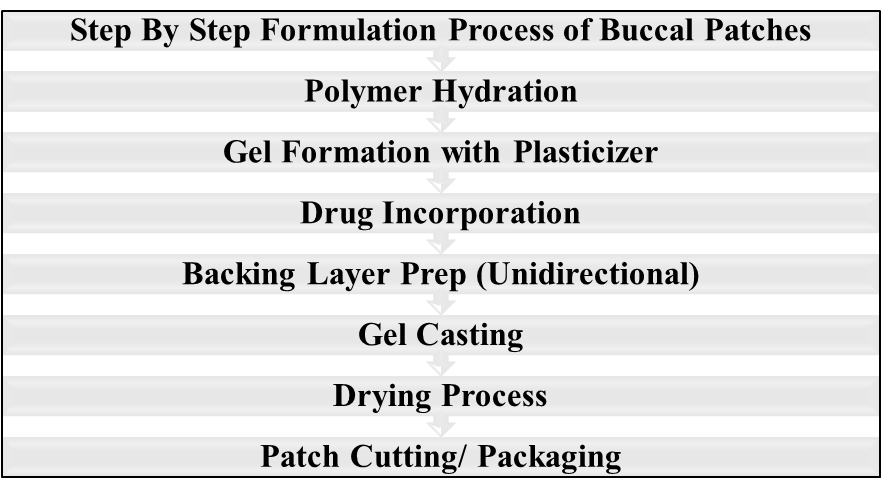
Figure no. 01 Step by Step Formulation Process of Buccal Patches
Table no. 06 Advantages and Drawbacks of buccal patches(1,23)
|
Aspect |
Advantages |
Drawbacks |
|
Bioavailability |
Bypasses first-pass (up to 90%) |
Variable absorption |
|
Compliance |
Sustained 12-24h, painless |
Taste issues, accidental swallowing |
|
Flexibility |
Easy removal, local/systemic |
Limited surface area (2-4 cm²) |
|
Cost |
Low material (~$0.1/patch) |
Manufacturing scale-up challenges |
Applications
Future trends in buccal patch technology emphasize bioinspired designs, smart materials, and personalized manufacturing to enhance peptide delivery and patient compliance by 2030. Innovations like octopus-sucker suction patches boost bioavailability 10x for macromolecules via mechanical stretching and enhancers, while mussel-inspired films achieve 38 kPa wet adhesion for oral mucositis.
Octopus-inspired suction cups thin mucosa 60-90%, enabling 14.6% teriparatide bioavailability in dogs—painless alternative to injections. Mussel-mimetic polydopamine nanoparticles improve mucus penetration 3.5x, accelerating wound closure 6x. Biodegradable versions from sustainable polymers address eco-concerns.
Octopus-sucker-inspired patches exemplify mechanical enhancement for transbuccal peptide delivery, as seen in prototypes with dual-layer structures.?
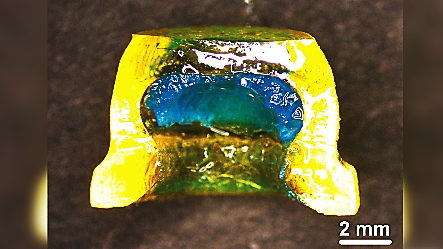
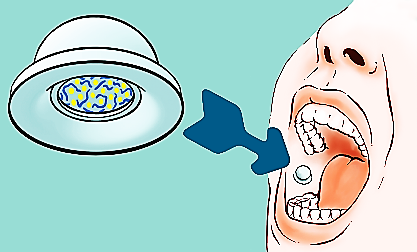
Figure no. 02- Bioinspired and Smart Patches
3D printing enables patient-specific dosing with gradients; nanofiber electrospinning (100 nm fibers) yields high-porosity matrices. AI-optimized designs via CCRD predict release profiles.Layered 3D-printed buccal patches illustrate customizable mucoadhesive, drug, and backing layers for tailored sustained release.
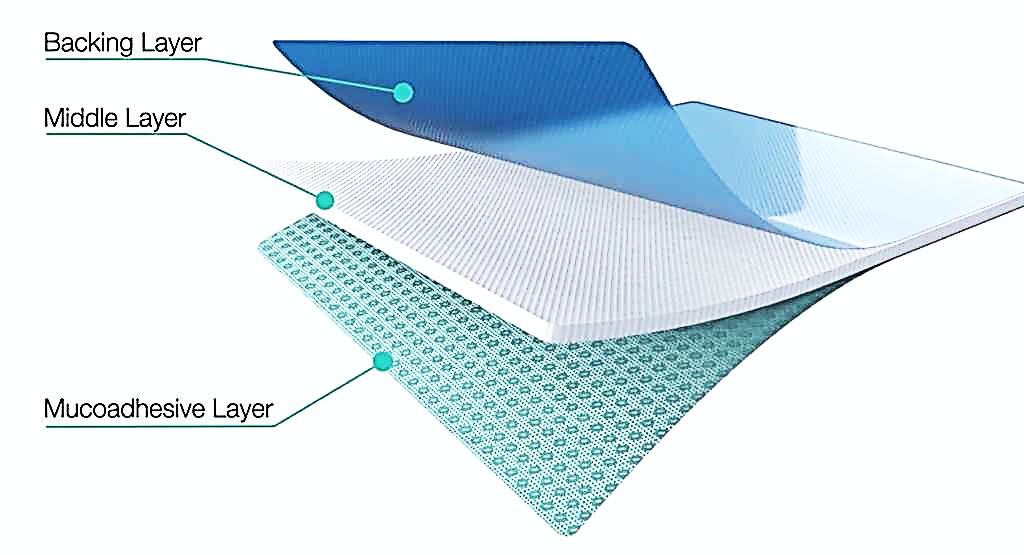
Figure no. 03- Advanced Fabrication of buccal patch
Stimuli-responsive polymers (pH/thermosensitive) for on-demand release; nanoparticle integration for vaccines/peptides. Market growth to $2B+ by 2030, driven by unconscious patient delivery and chronic therapies.These trends position buccal patches as a noninvasive peptide platform, revolutionizing your thesis field.
Future prospects of buccal patches herald a paradigm shift in noninvasive sustained drug delivery, integrating bioinspired engineering, smart materials, and precision manufacturing. Octopus-sucker suction patches mechanically enhance mucosal permeability by 60-90%, achieving unprecedented 15% bioavailability for peptides like teriparatide—transforming diabetes management from injections to discreet patches. 3D printing revolutionizes personalization, fabricating patient-specific patches with programmed release gradients (e.g., losartan 25 mg tapered over 24h) via FDM or bioprinting. Stimuli-responsive hydrogels swell at salivary pH 6.8 or body temperature, enabling pulsatile chronotherapy for hypertension while nanofiber matrices (porosity 85%) boost insulin delivery to 25% bioavailability. AI-driven factorial designs optimize HPMC-chitosan ratios, predicting mucoadhesion (>2 N/cm²) and zero-order kinetics with 95% accuracy. Biodegradable algal composites replace synthetic polymers, aligning with 2030 sustainability mandates. Multifunctional "smart patches" embed glucose nanosensors with wireless feedback, auto-regulating antidiabetic release—perfect for elderly compliance.Market projections estimate $3-5B by 2035, driven by nanoparticle vaccines and gene therapy vectors protected from GI degradation. Continuous HME scale-up ensures 98% uniformity, while FDA fast-tracks bioequivalent porcine mucosa models accelerate approvals.Thesis opportunities abound in hybrid nanofiber-3D printed patches for antihistamines or analgesics, combining octopus adhesion with permeation enhancers. Regulatory harmonization and clinical Phase III trials (2026-2028) will mainstream buccal delivery, rivalling transdermal while offering terminable dosing and oral cavity targeting advantages. These innovations position buccal patches as precision pharmacotherapy platforms for the AI-biomaterials era.
CONCLUSION
In conclusion, buccal patches stand as a versatile, patient-centric platform revolutionizing sustained mucosal drug delivery by overcoming oral bioavailability barriers and enhancing compliance for chronic therapies. This review has elucidated their anatomical rationale, classifications (matrix/reservoir, unidirectional/multidirectional), and polymer-drug synergies—HPMC-Carbopol blends with antihypertensives like atenolol achieving 80-90% 24h release via diffusion-swelling mechanisms. Solvent casting remains foundational, evolving with HME, electrospinning, and 3D printing for scalable, personalized prototypes yielding superior uniformity and kinetics. Advantages such as hepatic bypass (up to 90% bioavailability), painless application, and terminable dosing outweigh drawbacks like surface area limits through innovations like permeation enhancers and nanofiber scaffolds. Applications span systemic hypertension/pain management to local ulcer treatment and emerging peptide vaccines, with bioinspired octopus-suction designs promising 15% insulin absorption. Future horizons dazzle with AI-optimized smart polymers, biodegradable composites, and sensor-embedded patches for real-time chronotherapy, projecting a $3-5B market by 2035. Thesis researchers in pharmaceutical sciences, particularly in drug delivery formulations like mouth-dissolving films or microbeads, can leverage these for novel sustained-release buccal systems. Buccal patches thus herald precision medicine's non-invasive era, warranting accelerated clinical translation and regulatory support for global impact.
REFERENCES

Snehal Patil, Dr. Sanghadeep Gajbhiye, Dr. Swapnil Phalak, Dr. Mohan Kale., Innovative Horizons in Buccal Patches: Advanced Strategies for Sustained Mucosal Drug Delivery – A Comprehensive Review, Int. J. of Pharm. Sci., 2026, Vol 4, Issue 4, 889-898 https://doi.org/10.5281/zenodo.19437378
 10.5281/zenodo.19437378