

We use cookies to ensure our website works properly and to personalise your experience. Cookies policy
Surabhi Dayakar Rao College of Pharmacy, Rimmanaguda, Telangana, India, 502312
This review explores recent trends and breakthroughs in nanorobotics for cancer therapy. These minuscule robots or devices offer a powerful approach to cancer management by precisely targeting and eliminating malignant cells. Beyond treatment, nanotechnology also excels in early detection and management of diverse illnesses.A key advantage lies in nanorobotics' enhanced precision and effectiveness at destroying tumours, all while minimizing harm to normal tissues. The article covers its applications in cancer alongside other conditions, such as cardiovascular issues, diabetes, and renal disorders. Capable of intricate functions like navigation, precise drug release, cellular communication, and data handling, nanorobots exhibit remarkable nanoscale smarts.The review assesses the landscape of cancer therapies, delves into nanorobots' core elements and operations, and evaluates their potential in diagnostics and treatment.
Cancer remains one of the world's deadliest diseases. According to the latest Global Cancer Statistics, an estimated 19.3 million new cases and nearly 10 million deaths occurred worldwide1 in 2020.Demographic shifts, environmental pollution, and rising lifestyle-related risk factors are projected to drive rapid growth in global cancer incidence over the next two decades2.Effective interventions are urgently needed to curb overall mortality. Conventional therapies like surgery, chemotherapy, and radiotherapy have improved survival for many patients. Yet they show limited efficacy against advanced metastatic cancers3.Immunotherapies mark a breakthrough in managing these cases, but low response rates temper their success4.Critically, both chemotherapy and immunotherapies are non-targeted, often killing tumour cells alongside healthy ones and causing severe, sometimes fatal, side effects5. The past three decades have witnessed a great expansion of research in the field of cancer nanomedicine6showed in Fig.1.
The central promise of nanorobotics is to move cancer therapy away from non-specific treatment and toward molecularly guided intervention. Instead of exposing the whole body to toxic doses, nanorobots can be engineered to bind to cancer-associated markers, deliver payloads only where needed, and support real-time imaging or monitoring.
Natural nanorobots existing in biological systems:
Over the past decades, nanotechnology has advanced dramatically, with novel nanotechnologies applied across diverse fields. Yet living organisms feature even more remarkable natural nanomachines—often called "bio nanorobots" 7.
These structures rotate and transport chemical loads along predetermined tracks with sonometer precision and high efficiency, enabling essential cellular functions. Many natural biological nanorobots harness energy, converting it into mechanical work within living systems8.
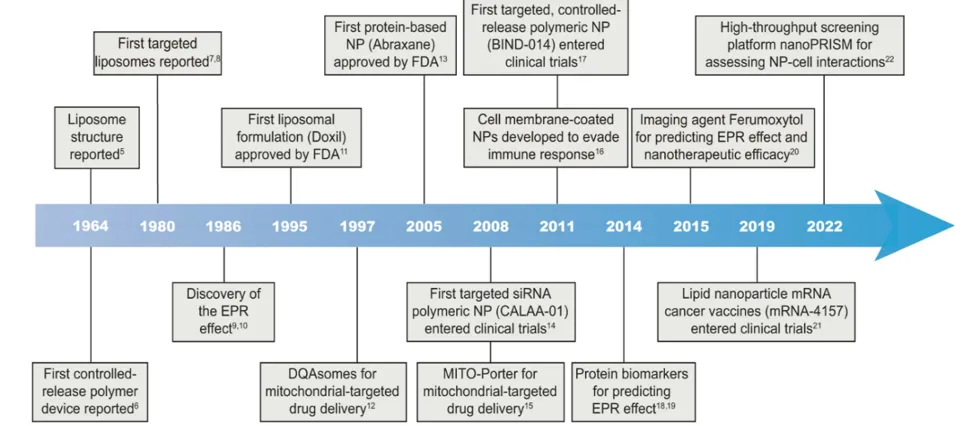
Fig.1: Historical timeline of major development in the field of cancer nanomedicine.
Most protein-based molecular nanorobots transform chemical energy from ATP (adenosine triphosphate) into mechanical motion9. ATP synthase, one of Earth's most abundant proteins, resides in chloroplast thylakoid membranes, mitochondrial cristae, and bacterial plasma membranes. As the final enzyme in oxidative phosphorylation, this nanomachine uses electrochemical gradients and proton flow to drive ATP synthesis from ADP and phosphate—powering its own rotation. Vital to human health, ATP synthase holds promise for treating cancer, bacterial infections, and obesity10.
P-glycoprotein (P-pg.), an ATP-binding cassette transporter, confers multidrug resistance to chemo drugs, particularly anticancer agents11.As an efflux pump that has ATPase-like function to export chemo drugs out of cells, p-gp is overexpressed in tumour cells, and drugs can be delivered to the extracellular matrix with these pumpsP-gp, a 170-kD protein containing two amino acid chains, has a flexible structure capable of maintaining its rotational and translational motion in the efflux mechanism. Inhibition of this efflux activity has been one of the many aims in the exploitation of p-glycoprotein inhibitors. Many studies reported the p-gp inhibitors based on the information on the function and structure of p-glycoprotein11.
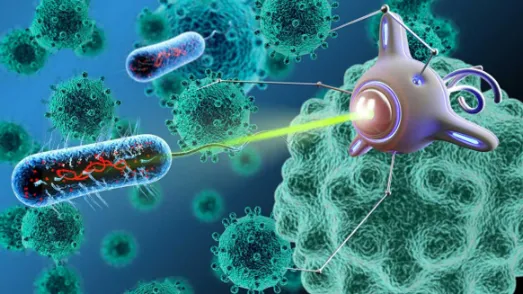
Fig.2: Cancer tumours killed by nanorobots
Types of Nanorobots:
Nanorobotics can be classified in several ways depending on their design, function and application. Here are the main types explained clearly.
|
Sr. No. |
Nanorobots types |
Characteristics |
|
01. |
Pharmacyte12
|
A medical nanorobot with a diameter of 1–2 mm. Molecular indicators or chemotactic sensors are used to ensure the precision of the targeting system. They can be eliminated or recuperated through centrifuge nana pheresis after finishing the tasks. 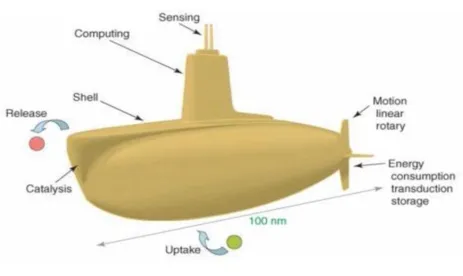
|
|
02. |
Microchips13 |
Nanorobots possess microchips which can conduct current signals once the molecules detect a disease. The benefits are the small charge to yield and simple to operate. 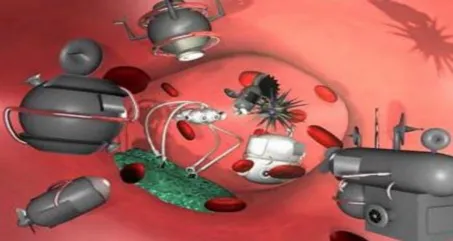
|
|
03. |
Respirocyte14 |
A type of nanorobot that carries oxygen like an artificial red blood cell.The power is achieved through endogenous serum glucose 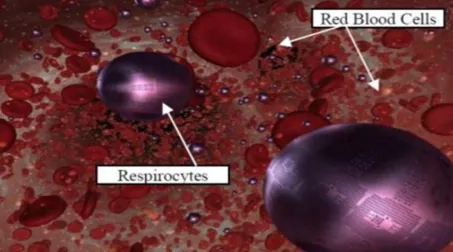
|
|
04. |
Microbivores15 |
The nanorobot is flat and spheroidal in shape for nanomedical usesWith a diameter of 3.4 μm along its main axis and a diameter of 2.0 μm on the minor axis. It has the phagocytic capability which is almost 80-fold higher proficient than other macrophages 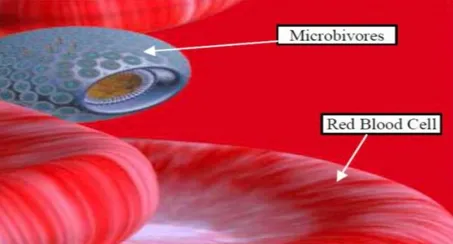
|
|
05. |
Clottocytes16 |
They have the ‘instant’ hemostasis biological activity which is called artificial mechanical platelets.They also transport substances that assist in the coagulation process. |
|
06. |
Chromallocyte17 |
The renovation machine will first assess the condition by inspecting the cellular substances, actions, and works.These repair machines are capable of overhauling the complete cell. 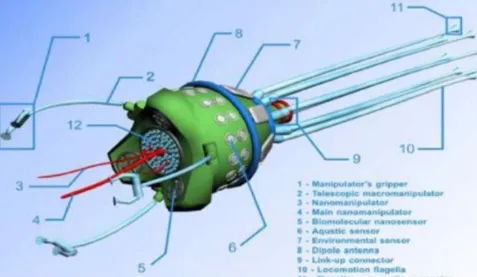
|
Historical perspective:
In his prescient 1959 talk "There's Plenty of Room at the Bottom," Nobel physicist Richard P. Feynman envisioned using machine tools to fabricate smaller ones—iteratively scaling down to the atomic level18.
Feynman recognized the technology's medical potential. As he noted, a colleague (Albert R. Hibbs) proposed "swallow[ing] the surgeon": tiny machines could enter blood vessels, navigate to the heart, diagnose faulty valves, and repair them with micro-knives. Others might permanently augment underperforming organs19.He says that, although it is a very wild idea, it would be interesting in surgery if you could swallow the surgeon.
You put the mechanical surgeon inside the blood vessel and it goes into the heart and looks around (of course the information has to be fed out). It finds out which valve is the faulty one and takes a little knife and slices it out. Other small machines might be permanently incorporated in the body to assist some inadequately functioning organ.
Construction of nanorobots:
Nanorobots designed for targeted cancer therapy detect and destroy cancerous cells upon injection20.Researchers use the open-source Cadnano software to precisely design their structures, employing DNA origami—a method that folds long DNA strands with short staples into nanoscale objects21,22. These robots resemble open-ended nanoscale barrels with two clamshell-like sections connected by molecular hinges. Upon recognizing tumour-specific markers, the hinges activate, enabling controlled opening.
With twelve internal attachment sites, the nanorobots can load drugs in multiple configurations. Two external aptamer-binding sites ensure high-affinity recognition of surface proteins on target cancer cells. Molecular anchors secure the payload, preventing premature release. Detection of target cell proteins shifts the bot to the "on" state, opening it for precise drug delivery; it remains closed ("off") in healthy tissue, minimizing off-target toxicity23.
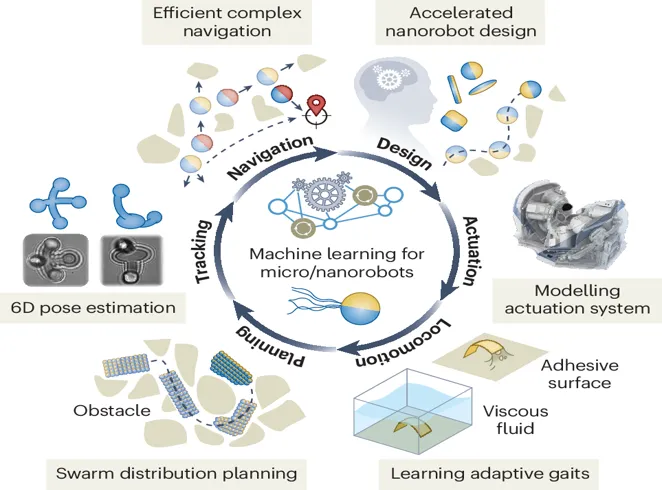
Fig.3: Construction of Nanorobots
RECENT ADVANCES IN NANOROBOTICS FOR CANCER THERAPY:
Recent year (especially 2024 -2026) have seen rapid progress in nanorobotics, moving from basic drug delivery systems toward intelligent responsive and multifunctional nanomachines
1.DNAOrigami Based Smart Nanorobots24
One of the most important breakthroughs is the development of DNA-BASED nanorobots.These nanorobots are built using DNA folding technique (DNA origami).They remain inactive in normal tissue and activate only in tumour environments.
Key Advancements:
2. Stimuli- responsive nanorobots25 (smart activation system):
Modern nanobots respond to specific tumour microenvironment signals such as:
Key Innovations:
3. AI-Integration and Autonomous Nanorobots26
Artificial intelligence is now being integrated with nanorobotics.
Capabilities:
4. Biohybrid Nanorobots27 (Living+Artifical Systems):
A cutting-edge innovation involves combining biological organisms with nanotechnology.
These systems mimics natural biological processes improving targeting efficiency.
Advantages of nanorobotics28:
Applications of nanorobots in cancer treatment29,30:
Early diagnosis significantly increases a patient’s chances of successful cancer treatment. Nanorobots equipped with chemical biosensors (nanosensors) can be used to detect tumour cells at an early stage of cancer development. These nanosensors are capable of identifying the presence of malignant cells within the body with high sensitivity.Most anticancer drugs have a narrow therapeutic index, which often leads to toxicity in normal cells, especially stem cells. This can result in adverse effects such as hematological toxicity and gastrointestinal complications. Conventional chemotherapeutic agents act by destroying rapidly dividing cells, a characteristic feature of cancer (neoplastic) cells. However, this mechanism also affects healthy rapidly dividing cells. Drugs such as Doxorubicin are widely used in the treatment of various cancers, including Hodgkin’s disease. These drugs are often administered in combination with other anticancer agents to enhance therapeutic efficacy and reduce toxicity.
Nanorobots, due to their ability to function as blood-borne devices, can play a crucial role in improving cancer therapy. Nanorobots integrated with chemical biosensors can detect tumor cells in the early stages within the patient’s body. Advanced nanosensors can also measure the intensity of specific biomarkers, such as E-cadherin signals, which are important in cancer detection and progression. This has led to the development of hardware architectures based on nano-bioelectronics for the application of nanorobots in cancer diagnosis and therapy.
In addition, scientists have developed biohybrid systems using genetically modified Salmonella bacteria that are naturally attracted to tumor environments due to chemicals secreted by cancer cells. These bacteria carry microscopic robots, approximately 3 micrometers in size, which can automatically release drug-filled capsules upon reaching the tumor site. This system, often referred to as a bacteriobot, enables targeted drug delivery directly to the tumor, thereby destroying cancer cells while minimizing damage to healthy tissues and reducing the side effects associated with conventional chemotherapy.
CONCLUSION
Nanorobotics has emerged as a revolutionary approach in precision cancer therapy by offering targeted, efficient and minimally invasive treatment strategies. This review article highlighted the fundamental concepts of nanorobotics including its introduction, historical perspective, various types, construction, advanced technologies, and wide-ranging applications in cancer diagnosis and treatment. The integration of nanotechnology, artificial intelligence, biosensors, and drug delivery systems has significantly improved the ability of nanorobots to detect cancer cells at an early stage and deliver therapeutic agents directly to tumour tissues greater accuracy and reduced side effects.
Furthermore, advanced developments in molecular engineering and biomedical sciences have expanded the potential of nanorobotics in personalised medicine, controlled drug release, imaging and real-time monitoring of caner progression. Although several challenges such as biocompatibility, safety, manufacturing complexity, ethical concerns, and high cost still remain, continuous research and technological advancements are expected to overcome these limitations in the future.
Overall, nanorobotics represents a promising and futuristic platform for precision oncology, with the potential to transform conventional cancer therapy into a more effective, safer, and patient-specific treatment approach. Continued interdisciplinary research and clinical investigations will play a vital role in bringing nanorobotic cancer therapy from experimental stages to routine clinical practice.
ACKNOWLEDGEMENT:
We would like to express my sincere gratitude to our Principal Dr. M. Venkataramana, for providing all the necessary facilities and continuous encouragement for the successful completion of our work.
We are deeply thankful to Vice Principal and our guide “Dr. A.Ganesh" for his valuable guidance, continuous encouragement, and constant support throughout the preparation of this article.
We also extend our heartfelt thanks to all the faculty members and our friends for their cooperation, motivation, and assistance during the completion of this work.
Finally, we thank everyone who directly or indirectly contributed to the successful completion of our article.
REFERENCES

Ganesh Akula, Konda Pradeep, Afreen Sulthana, Chikkudu Srija, Nayini Shravya, Kesari Miranjipally Indu, Nanobots: Revolutionizing Cancer Annihilation at the Molecular Frontier, Int. J. of Pharm. Sci., 2026, Vol 4, Issue 6, 1936-1944. https://doi.org/10.5281/zenodo.20594212
 10.5281/zenodo.20594212