

We use cookies to ensure our website works properly and to personalise your experience. Cookies policy
Sri Venkateswara Dental College and Hospital, Chennai, Tamil Nadu, India
Periodontitis is a multifactorial, host microbial interaction whose onset and progression are governed by the interaction of environmental, genetic/epigenetic, microbial, and lifestyle factors.9,10 Traditional periodontal therapy follows a uniform protocol aimed at eliminating deep pockets, reducing bleeding, and achieving plaque control, yet nearly one-fifth of patients respond inadequately to this conventional therapy.2,7 This has driven a paradigm shift toward personalized (precision) periodontics, an approach in which patients are grouped into distinct groups so that diagnosis, prevention, and treatment can be tailored to the particular individual.3,4 This review covers the P4 framework of personalized periodontics (Personalization, Prediction, Prevention, Participation), its precision-medicine ecosystem, its diagnostic toolkit — salivary, GCF, plaque-based point-of-care tests, spectroscopic methods, and bone-loss imaging.5,15,17 The role of the periodontal microbiome (keystone-pathogen hypothesis), host genetics and epigenetic regulation, and major systemic and behavioral risk factors — smoking, diabetes mellitus, cardiovascular disease, obesity, psychological stress, and rheumatoid arthritis — in shaping individualized risk and treatment planning is discussed in detail, along with practical management protocols for each.18,20,24,32,35 This narrative review going to deal with Personalized periodontics.
Periodontal disease (gingivitis and periodontitis) begins with subclinical inflammation within 2 to 4 days of its early stages.9 This stage typically produces no perceptible symptoms, so a large proportion of affected individuals remain unaware of the disease until significant damage has occurred.8 Left untreated, it progresses to gingival bleeding, tooth mobility, bone loss and tooth loss, which increases the systemic morbidity, and considerable financial burden on both the patient and the healthcare system.9,10 Periodontitis is now recognized as a complex disease in which multiple causal risk factors act simultaneously to drive its onset and progression.1,9 Environmental exposures, genetic and epigenetic predisposition, lifestyle behaviors, and coexisting systemic diseases interact continuously, together shaping an individual's susceptibility to, and trajectory of, periodontal breakdown1,8,9,10
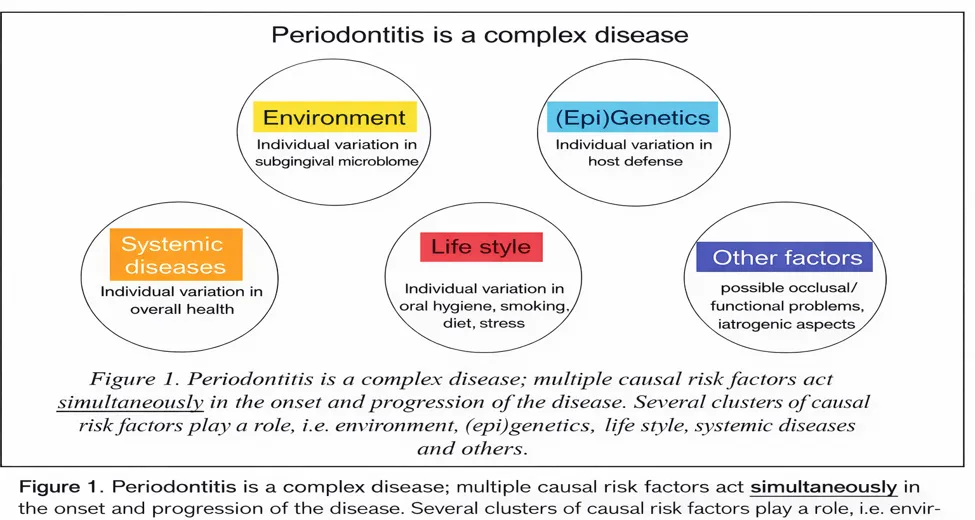
Adapted from, Loos BG, Van Dyke TE. The role of inflammation and genetics in periodontal disease. Periodontology 2000. 2020;83(1).
2. From Traditional to Contemporary Periodontal Therapy
2.1 Goals of Traditional Periodontal Therapy
The goals of traditional periodontal therapy are the reduction of gingival bleeding, elimination of deep pockets and achievement of adequate plaque control.2 This is conventionally achieved by treating periodontal disease as an opportunistic infection modified by the host's inflammatory response, controlling infection and inflammation, reducing predisposing and modifying factors, and providing continuous assessment through supportive periodontal care.7 However, clinical evidence indicates that nearly 20% of patients do not respond adequately to this standardized regimen, exposing the limitations of a uniform treatment.2,7
2.2 The Shift Toward Contemporary, Individualized Care
Modern periodontics recognizes that disease progression varies according to genetic background, host immune response, and environmental influence.3 Traditional therapy follows a one-size-fits-all model, but because of this individual variation a subset of patients remain non-responders.4 Personalized treatment has therefore become a clinical necessity rather than an option.3,4
3. Defining Personalized Periodontics
Personalized periodontics has been defined, in Periodontology 2000 (2018), as the separation of patients into different groups, with clinical decisions, practices, and treatments customized according to the individual patient.2 The overarching purposes of personalized periodontal therapy are to select the optimal therapy for a given patient, improve treatment outcomes, and predict disease susceptibility before overt clinical presentation.2,6
4. The P4 Model of Periodontics
P4 periodontics represents an integrative framework for periodontal care built around four interlinked components: Personalization, Prediction, Prevention, and Participation. 13
Personalization involves identifying the specific disease pathway operating in a given patient, understanding their individual pattern of disease progression, and tailoring treatment accordingly.3 It draws on the patient's genetic profile, microbial composition, inflammatory response, and systemic health status to move away from the traditional "one-size-fits-all" protocol toward a stratified model of care, in which patients with similar disease phenotypes and risk profiles are grouped together and managed with regimens suited to that group.4 In practice, this translates into individualized decisions on the choice of non-surgical versus adjunctive antimicrobial or regenerative therapy, the frequency of supportive periodontal maintenance, and the selection of implant versus conventional prosthetic rehabilitation based on a patient's specific healing capacity and risk profile. 3,4
Prediction emphasizes assessing risk before symptoms appear, using genetic markers and biomarkers to detect susceptible individuals at an early, pre-clinical stage.13 This is achieved through host-genetic testing (for example, Interleukin-1 [IL-1] gene polymorphisms), salivary and gingival crevicular fluid (GCF) biomarker panels, subgingival microbial profiling, and, increasingly, Artificial Intelligence (AI)-assisted risk-calculators that combine clinical, microbial, and genetic data into a single susceptibility score.4,37 By identifying at-risk individuals before clinically detectable attachment loss occurs, prediction allows clinicians to intervene during the subclinical phase of disease, when treatment is simplest and most cost-effective. 4,13
Prevention focuses on early diagnosis, effective plaque control, and lifestyle modification to reduce disease occurrence altogether.13 Rather than a single generic recall schedule, prevention under the P4 model is risk-stratified: patients identified as high-risk through the prediction pillar receive more frequent supportive periodontal therapy, targeted oral-hygiene instruction, and closer monitoring, while low-risk patients follow a standard maintenance interval.3,4 Prevention also extends to modifying shared systemic and behavioral risk factors — such as smoking cessation counselling and glycaemic control in patients with diabetes mellitus — thereby addressing periodontal risk and general health simultaneously. 3,13,20,27
Participation underscores the importance of active patient involvement — maintaining good oral hygiene, adopting healthier lifestyle behaviors, and attending regular periodontal recall visits.13 It reframes the patient from a passive recipient of care into an informed partner in decision-making, achieved through patient education about their individual risk profile, shared goal-setting, motivational interviewing to support behaviour change, and the use of digital tools such as mobile reminders and tele-monitoring to reinforce compliance between visits.13 Sustained participation is essential for the long-term success of the other three P's, since even an accurately predicted and personalized treatment plan will fail without consistent patient adherence. 13
Collectively, the P4 model works by modifying modifiable risk factors and embedding a comprehensive, patient-centered strategy into everyday periodontal care.3
5. Conceptual Framework of Precision Periodontics
5.1 The Diagnostic-to-Treatment Flow
The process begins with comprehensive patient examination — clinical parameters (probing depth, attachment loss, bleeding on probing, mobility), radiographs, biomarkers, genetics, microbial profiling, and lifestyle factors — combined with medical history and biospecimens (blood, saliva, plaque, tissue). This data is digitized into structured databases.5
Multi-omics layers (genomics, epigenomics, transcriptomics, metabolomics, metagenomics) are integrated and analyzed using Artificial Intelligence (AI)-driven computational tools, guided by informatics specialists. This enables patient stratification and generates individualized treatment plans.5
Decision-support and visualization tools then help clinicians select therapy — regenerative procedures, systemic disease management, lifestyle modification, or laser treatment. Outcomes are monitored continuously, with feedback looped back into the system — closing the loop toward truly personalized, precise periodontal care.5
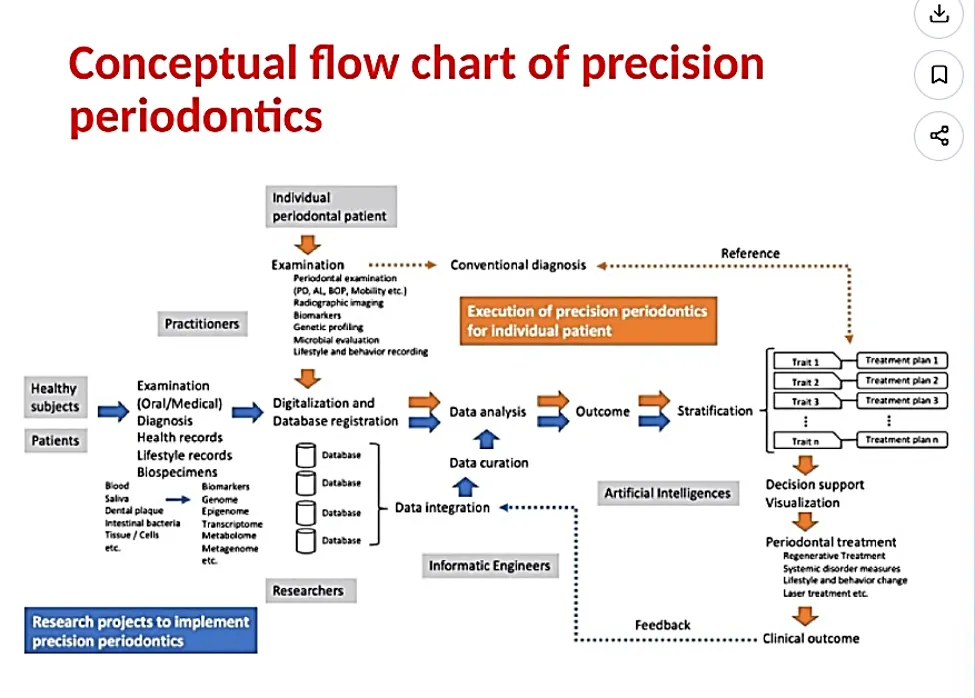
Adapted from - Kikuchi T, Hayashi J, Mitani A. Next-Generation Examination, Diagnosis, and Personalized Medicine in Periodontal Disease. J Pers Med. 2022 (5)
5.2 The Precision Medicine Ecosystem
The precision medicine ecosystem begins with the patient, whose information — family history, environmental exposures, genotype, phenotype, and clinical outcomes — is recorded within electronic health records.14 In parallel, biospecimens such as blood, saliva, or tissue are collected and analyzed by researchers to generate research data.16 Clinicians interact with these electronic records to guide diagnosis and treatment, while clinical laboratories contribute additional diagnostic information.14 All of this data is organized into a curated, continuously refined database that supports both clinicians and researchers, enabling data-driven decision-making.16 A dynamic feedback loop results: research findings improve clinical practice, and clinical outcomes, in turn, enrich the research dataset, together advancing personalized and precision-based patient care.14,16
6. Diagnostic Approaches in Precision Periodontics
Examination and diagnosis in precision periodontics increasingly rely on biomarkers for both the diagnosis and prognosis of periodontal disease.15 Identifying biomarkers capable of accurately predicting disease progression is essential for early detection and effective disease control.17 Traditionally, proteomic analysis has used biological samples such as saliva, gingival crevicular fluid, pocket-associated tissue, and serum to comprehensively evaluate disease-related biomarkers.12 The diagnostic validity of any such biomarker rests on two key parameters — sensitivity, the ability to correctly identify individuals with disease, and specificity, the ability to correctly identify those without disease — which together determine its clinical usefulness in precision periodontal care.15,17
6.1 Periodontal Biomarkers
Biomarkers assist across the full continuum of care, from prediction and prevention to diagnosis, treatment, and maintenance of periodontal disease.12 They are broadly classified into two types: static biomarkers, which are genetic and do not change over time, reflecting inherited susceptibility; and dynamic biomarkers, which are biochemical or microbiological in nature and reflect current disease activity and progression.11,12,15
6.2 Point-of-Care Diagnostic Tests
6.2.1 Saliva-Based Tests
|
Test Kit |
Principle |
What It Detects |
Output |
|
Oral Fluid Nanosensor Test |
Nanotechnology-based biosensor detecting biomarkers in saliva |
Proteins, enzymes, inflammatory markers, bacterial products |
Electronic/digital signal (usually no visible color change) |
|
Electronic Taste Chip |
Microelectromechanical sensor analyzing salivary composition |
Oral pathogens, metabolites, volatile sulfur compounds (VSCs) |
Digital/electronic readout |
|
OraQuick |
Immunochromatographic lateral flow assay |
Human Immunodeficiency Virus (HIV) antibodies in oral fluid |
Colored test line (similar to a pregnancy strip) |
|
Integrated Microfluidic Platform |
Lab-on-chip microfluidic analysis |
Deoxyribonucleic acid (DNA), Ribonucleic acid (RNA), proteins, inflammatory biomarkers in saliva |
Usually fluorescent/ electronic signal |
|
My PerioPath |
Polymerase Chain Reaction (PCR)-based microbiological assay |
Major periodontal pathogens in saliva |
Lab-generated report (no direct color change) |
|
Omnigene |
DNA probe / molecular diagnostic test |
Specific periodontal bacteria |
No color change; molecular report |
|
IAI Pado Test |
RNA/DNA probe technology |
Periodontal pathogens such as Porphyromonas gingivalis (P. gingivalis), Aggregati bacter actinomycetem comitans (A. actinomycetem comitans) |
No visible color change |
|
MyPerioID |
Genetic susceptibility test |
Interleukin-1 (IL-1) gene polymorphism associated with periodontitis risk |
Genetic report; no color change |
6.2.2 Gingival Crevicular Fluid (GCF)-Based Tests
|
Test Kit |
Principle |
What It Detects |
Color Change / Output |
|
Periogard |
Enzyme-based assay (AST activity) |
Aspartate aminotransferase (AST) released from damaged cells, indicating tissue destruction |
Colorless → Purple/Violet |
|
Pocket Watch |
Enzymatic detection of proteolytic activity |
Neutral proteases from periodontal pathogens |
Colorless → Blue |
|
Periocheck |
Hydrolysis of a synthetic substrate by enzymes |
Neutral proteases, especially from Treponema denticola (T. denticola) and P. gingivalis |
Colorless → Blue |
|
Prognostik |
Enzyme–substrate reaction |
Elastase enzyme from neutrophils, a marker of inflammation |
Colorless → Red/Pink |
|
MMP Dipstick Test |
Immunochromatographic assay |
Matrix metalloproteinase-8 (MMP-8), a collagen breakdown marker |
Visible test line (similar to a pregnancy strip) |
6.2.3 Plaque-Based Diagnostic Tests
|
Test Kit |
Principle |
What It Detects |
Color Change / Output |
|
Perioscan (Benzoyl-DL-arginine-naphthylamide [BANA] test) |
Hydrolysis of the BANA substrate by bacterial enzymes |
'Red complex' bacteria (P. gingivalis, T. denticola, Tannerella forsythia [T. forsythia]) |
Colorless → Blue/blue-black |
|
Evalusite |
Immunoassay using monoclonal antibodies |
Specific pathogens: P. gingivalis, A. actinomycetemcomitans, Prevotella intermedia (P. intermedia) |
Appearance of colored dots (pink/purple) |
|
Perio 2000 |
Enzymatic activity assay |
Bacterial proteolytic enzymes in plaque |
Colorless → Blue |
|
TOPAS (Toxicity Prescreening Assay) |
Measures bacterial toxin activity |
Toxic metabolites from periodontal pathogens |
Color change (yellow → orange/brown) indicating toxicity level |
|
Genetic test kits |
DNA probe / PCR-based detection |
Specific periodontal pathogens at the genetic level |
No color change (lab-based readout/report) |
6.3 Physical and Spectroscopic Methods
Physical methods are increasingly applied in periodontal diagnostics to analyze salivary biomarkers and identify disease activity.17 Broad-spectrum Fluorescence Resonance Energy Transfer (FRET) measures total protease activity in saliva and helps assess periodontal tissue destruction.17 Infrared Attenuated Total Reflection (IR-ATR) spectroscopy differentiates healthy individuals from periodontitis patients based on salivary spectral patterns.17 Secondary Electrospray Ionization (SESI) identifies salivary metabolites produced by periodontal pathogens, aiding disease detection.17 Collectively, these physical diagnostic methods offer rapid, non-invasive, and sensitive approaches to the early diagnosis and monitoring of periodontitis.17
6.4 Diagnostic Imaging
Diagnostic imaging plays an important role in periodontal assessment, particularly in evaluating alveolar bone loss.38 Lin et al. developed a radiographic analysis method for localizing alveolar bone-loss areas in periodontitis using threshold segmentation combined with hybrid features of intensity and the H-value of the fractional Brownian motion model. This technique effectively identifies and segments bone-loss areas on periodontal radiographs, helping clinicians accurately assess the severity and extent of periodontal destruction, and may assist in treatment planning and monitoring of disease progression.38
6.5 Limitations of Conventional Diagnostic Imaging
6.6 Benefits of Precision Medicine over Conventional Diagnostic Techniques
12. Limitations of Personalized Periodontics
Despite its considerable promise, personalized periodontics faces several practical barriers to widespread clinical adoption.4,7
CONCLUSION
A thorough understanding of disease pathways, genomic interactions, and novel biomarkers — established before overt disease occurrence — can meaningfully aid in disease prevention and, to some extent, guide treatment planning.3 Prompt diagnosis allows patients to benefit from targeted therapies suited to their individual risk profile.4 However, personalized periodontics remains an evolving field, and further longitudinal studies are needed to validate its diagnostic and therapeutic tools and to better understand its role within routine periodontal practice.3,4 Despite its promise, personalized periodontics faces barriers including the need for specialized clinician training, the multifactorial complexity of periodontal disease, limited long-term clinical validation, high cost, and workflow-integration challenges. Continued longitudinal research and biomarker validation will be essential to translate precision periodontics from concept to routine clinical practice3,4
REFERENCES





Nowfiya M, Deepa S, Jenifer Cynthia R A, Shanmuga priya R, Arunmozhi U, Personalized Periodontics: Review, Int. J. of Pharm. Sci., 2026, Vol 4, Issue 9, 2206-2215. https://doi.org/10.5281/zenodo.22842324
 10.5281/zenodo.22842324