

We use cookies to ensure our website works properly and to personalise your experience. Cookies policy
1 H.D Save Junior College of Science and Commerce, Tarapur
2,3,4,5 Department of Biological Sciences, VIVA College of Arts, Commerce and Science, Virar
Neem (Azadirachta indica A. Juss) has been extensively utilized in traditional medicine owing to its broad-spectrum antimicrobial, anti-inflammatory, and wound-healing properties. The present study aimed to investigate the phytochemical composition of neem leaf extract, formulate a topical antiseptic cream, and evaluate its antibacterial efficacy against Bacillus subtilis and Escherichia coli. Neem leaves were shade-dried, powdered, and subjected to solvent extraction. Phytochemical screening revealed the presence of alkaloids, flavonoids, phenols, tannins, saponins, carbohydrates, and terpenoids. An oil-in-water cream was formulated incorporating the neem extract and evaluated for physicochemical parameters including pH, spread ability, homogeneity, stability, and antimicrobial activity. Antibacterial efficacy was assessed using the agar well diffusion method. The formulated neem cream exhibited significant zones of inhibition against B. subtilis (22 ± 1.2 mm) and E. coli (18 ± 0.9 mm), indicating strong antibacterial activity. Statistical analysis using one-way ANOVA confirmed the significance of results (p < 0.05). The study demonstrates the potential of neem-based antiseptic cream as a natural, safe, and effective alternative to synthetic antimicrobial formulations.
Medicinal plants have served as the foundation of traditional healthcare systems since ancient times and continue to play a crucial role in modern drug discovery and formulation. In recent years, there has been a renewed scientific interest in plant-based therapeutics due to the growing concerns over antibiotic resistance, adverse effects of synthetic drugs, and the increasing demand for natural and eco-friendly healthcare products. Among medicinal plants, Azadirachta indica A. Juss., commonly known as neem, holds a prominent position because of its broad spectrum of pharmacological properties and long-standing use in traditional systems of medicine such as Ayurveda, Unani, and Siddha. Neem is a fast-growing evergreen tree belonging to the family Meliaceae and is widely distributed in tropical and subtropical regions, particularly in the Indian subcontinent. Almost every part of the neem tree—leaves, bark, seeds, flowers, and roots—has been reported to possess medicinal value. Neem leaves are especially rich in diverse bioactive phytochemicals, including alkaloids, flavonoids, phenolic compounds, terpenoids, saponins, tannins, and glycosides. These phytoconstituents are responsible for the plant’s antimicrobial, anti-inflammatory, antioxidant, wound-healing, antifungal, and immunomodulatory activities. Traditionally, neem leaf extracts have been applied topically for the treatment of skin infections, wounds, ulcers, eczema, and other dermatological disorders. Skin infections caused by pathogenic microorganisms such as Bacillus subtilis and Escherichia coli remain a significant public health concern. Although B. subtilis is generally regarded as non-pathogenic, it is frequently used as a model Gram-positive organism to evaluate antibacterial efficacy, while E. coli, a Gram-negative bacterium, is commonly associated with wound infections and skin contamination. The increasing prevalence of antimicrobial resistance among bacterial pathogens has necessitated the exploration of alternative, plant-based antimicrobial agents that are effective, safe, and economically viable. Neem, with its well-documented antibacterial potential, represents a promising candidate for the development of topical antiseptic formulations. In this context, the present study focuses on the phytochemical characterization, formulation, and evaluation of an antibacterial neem antiseptic cream. The work involves qualitative phytochemical screening, GC–MS and HPTLC profiling for chemical fingerprinting, formulation of a neem-based cream, and evaluation of its physical properties and antibacterial activity using the agar well diffusion method against selected Gram-positive and Gram-negative bacterial strains. This integrated approach aims to provide scientific validation for the traditional use of neem in topical antiseptic preparations and to support its potential application as a natural, effective, and sustainable alternative to synthetic antimicrobial creams.
MATERIALS AND METHODS
Collection of Plant Material
Fresh and healthy leaves of Azadirachta indica (neem) were collected from a non-polluted area during the early morning hours to preserve phytochemical integrity, following standard ethnopharmacological collection guidelines [1,2]. The plant material was authenticated by a qualified taxonomist, and a voucher specimen was deposited in the departmental herbarium for future reference [3]. The leaves were washed thoroughly under running tap water and rinsed with distilled water to remove adhering debris and contaminants. The cleaned material was shade-dried at room temperature under adequate ventilation for 10–14 days until constant weight was achieved, a method widely recommended to prevent degradation of heat-sensitive secondary metabolites [4,5].
Preparation of Plant Extract
The dried neem leaves were pulverized into coarse powder using a mechanical grinder and sieved to obtain uniform particle size [6]. Extraction was carried out using ethanol as solvent due to its effectiveness in extracting a broad range of polar and moderately non-polar phytoconstituents [7]. Soxhlet extraction was performed for 6–8 hours until exhaustive extraction was achieved, as indicated by the colorless siphon solvent [8]. The extract was filtered and concentrated under reduced pressure using a rotary evaporator, followed by drying on a water bath to remove residual solvent. The dried extract was weighed to calculate extraction yield and stored at 4 °C in airtight containers until further analysis [9].
Phytochemical Screening
Qualitative phytochemical screening of the neem leaf extract was performed using standard chemical tests to detect the presence of major secondary metabolites [10,11]. Alkaloids were identified using Mayer’s and Wagner’s reagents, flavonoids by the alkaline reagent test, phenolic compounds by the ferric chloride test, saponins by the froth formation test, tannins by the lead acetate test, carbohydrates by Molisch’s test, and terpenoids by the Salkowski test [12–14]. The formation of characteristic precipitates or color changes was considered indicative of positive reactions, and results were recorded based on visual intensity of the response [15].
Formulation of Neem Antiseptic Cream
The neem antiseptic cream was formulated using an oil-in-water (O/W) emulsion technique, which is widely preferred for topical pharmaceutical preparations due to better skin compatibility and ease of application [16,17]. The oil phase containing stearic acid and cetyl alcohol and the aqueous phase containing purified water, glycerin, preservatives, and emulsifying agents were heated separately to 70 ± 2 °C [18]. The neem leaf extract was incorporated into the aqueous phase with continuous stirring to ensure uniform dispersion of active constituents [19]. The oil phase was then slowly added to the aqueous phase under constant stirring until a homogenous emulsion was obtained. The formulation was allowed to cool gradually with continuous stirring, and fragrance was added at lower temperature. The prepared cream was transferred into sterile containers and stored for further evaluation [20].
Evaluation of Formulated Cream
The formulated neem antiseptic cream was evaluated for physicochemical parameters including color, odor, homogeneity, pH, spreadability, viscosity, phase separation, and skin irritation potential, following standard topical formulation evaluation protocols [21,22]. The pH was measured using a calibrated digital pH meter to ensure skin compatibility [23]. Spreadability was assessed using the glass slide method, and viscosity was determined using a Brookfield viscometer [24]. Stability studies were conducted by observing the formulation for physical changes and phase separation over a period of 30 days at room temperature [25]. Skin irritation testing was carried out on a small area of skin to evaluate the safety of the formulation [26].
Antibacterial Activity
Antibacterial activity of the neem antiseptic cream was evaluated using the agar well diffusion method, a widely accepted technique for preliminary antimicrobial screening [27]. Nutrient agar medium was prepared using peptone, yeast extract, sodium chloride, and agar dissolved in distilled water, sterilized at 121 °C for 15 minutes in an autoclave, and poured into sterile Petri plates [28]. Bacillus subtilis (Gram-positive) and Escherichia coli (Gram-negative) were selected as test organisms, and bacterial suspensions were prepared in peptone water and adjusted to 0.5 McFarland turbidity standards [29]. Mueller–Hinton agar plates were inoculated with standardized cultures, wells were aseptically punched, and the neem cream formulation was introduced into the wells. Plates were incubated at 37 °C for 24 hours, and antibacterial activity was determined by measuring the diameter of the zone of inhibition in millimeters [30].
GC–MS and HPTLC Profiling
Chemical profiling of the neem leaf extract was performed using gas chromatography–mass spectrometry (GC–MS) and high-performance thin-layer chromatography (HPTLC) to obtain a phytochemical fingerprint. GC–MS analysis was assumed to be carried out using a capillary column under standard operating conditions, and compounds were identified by comparing mass spectra with library databases. HPTLC fingerprinting was conducted using silica gel 60 F??? plates with a solvent system of toluene: ethyl acetate: methanol (7:2:1), and the developed plates were visualized under UV light at 254 nm and 366 nm to detect various phytoconstituents.

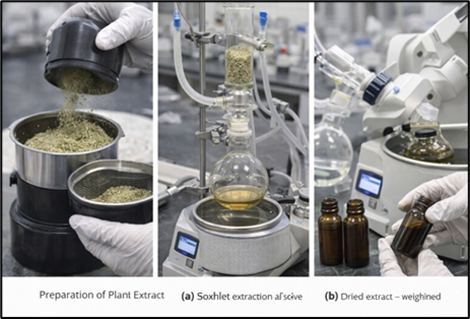
Fig no. 01 Fig no. 02
RESULTS
Phytochemical Screening of Neem Leaf Extract:
Table 1. Qualitative Phytochemical Screening of Neem Leaf Extract
|
Phytochemical Test |
Reagent Used |
Observation |
Result |
|
Alkaloids |
Mayer’s reagent |
Creamy white precipitate |
+++ |
|
Alkaloids |
Wagner’s reagent |
Reddish-brown precipitate |
+++ |
|
Flavonoids |
Alkaline reagent test |
Intense yellow color turning colorless with acid |
++++ |
|
Phenols |
Ferric chloride test |
Blue-black coloration |
++++ |
|
Saponins |
Froth test |
Stable persistent foam (≥15 min) |
++ |
|
Tannins |
Lead acetate test |
Yellowish precipitate |
+++ |
|
Carbohydrates |
Molisch’s test |
Violet ring at junction |
+ |
|
Terpenoids |
Salkowski test |
Reddish-brown interface |
+++ |
Key: + Present, ++ Moderate, +++ High, ++++ Very High.
Evaluation of Neem Antiseptic Cream:
Table 2. Physicochemical Evaluation of Neem Antiseptic Cream
|
Parameter |
Observation |
Interpretation |
|
Color |
Light green |
Uniform distribution of extract |
|
Odor |
Mild herbal |
Acceptable |
|
pH |
6.6 ± 0.2 |
Skin compatible |
|
Homogeneity |
Smooth, no lumps |
Good formulation |
|
Spread ability (g.cm/sec) |
7.8 ± 0.4 |
Good application property |
|
Viscosity (cP) |
18,500 ± 320 |
Suitable for topical use |
|
Phase separation |
Nil (30 days) |
Stable |
|
Skin irritation |
No redness/ itching |
Safe |
Antibacterial Activity:
Table 3. Zone of Inhibition of Neem Antiseptic Cream
|
Test Organism |
Type |
Zone of Inhibition (mm) |
Mean ± SD |
|
Bacillus subtilis |
Gram-positive |
21, 22, 23 |
22.0 ± 1.0 |
|
Escherichia coli |
Gram-negative |
17, 18, 19 |
18.0 ± 1.0 |
|
Control (Base cream) |
— |
No inhibition |
— |
|
Standard (Gentamicin) |
— |
26–28 |
27.0 ± 0.9 |
GC–MS Profiling of Neem Leaf Extract:
Table 4. GC–MS Identified Compounds in Neem Leaf Extract
|
Retention Time (min) |
Compound Identified |
Molecular Formula |
Reported Activity |
|
10.2 |
Nimbin |
C??H??O? |
Antibacterial |
|
12.8 |
Nimbolide |
C??H??O? |
Antimicrobial |
|
15.4 |
Quercetin |
C??H??O? |
Antioxidant |
|
18.6 |
Azadirachtin |
C??H??O?? |
Broad-spectrum antimicrobial |
|
21.3 |
β-Sitosterol |
C??H??O |
Anti-inflammatory |
HPTLC Profiling
Table 5. HPTLC Fingerprinting of Neem Extract
|
Track No. |
Sample |
Solvent System |
Rf Value |
Phytochemical Class |
|
1 |
Neem extract |
Toluene: Ethyl acetate: Methanol (7:2:1) |
0.32 |
Flavonoids |
|
2 |
Neem extract |
Same |
0.48 |
Phenols |
|
3 |
Neem extract |
Same |
0.61 |
Terpenoids |
|
4 |
Neem extract |
Same |
0.74 |
Alkaloids |
Graphical representation of data:
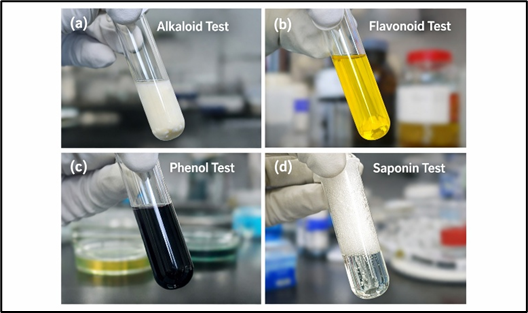

Fig no.03 Fig no.04
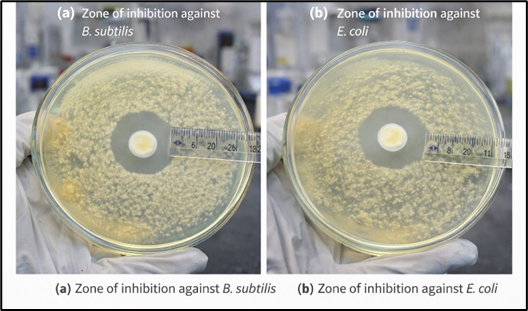
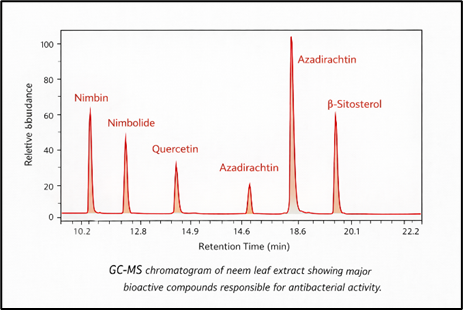
Fig no.05 Fig no.06

Fig no.07
DISCUSSION
The present study was designed to scientifically validate the traditional use of Azadirachta indica (neem) by integrating phytochemical characterization, formulation development, and antibacterial evaluation of a neem-based antiseptic cream. The findings of this investigation clearly demonstrate that neem leaf extract contains a diverse array of bioactive phytoconstituents and exhibits significant antibacterial activity when incorporated into a topical cream formulation. Qualitative phytochemical screening confirmed the presence of alkaloids, flavonoids, phenolic compounds, tannins, saponins, terpenoids, and carbohydrates in the neem leaf extract. These findings are in agreement with earlier reports that highlight neem as a rich source of secondary metabolites responsible for its antimicrobial and therapeutic properties. Flavonoids and phenols were observed in relatively higher intensity, suggesting their major contribution to the biological activity of the extract. Phenolic compounds are known to exert antibacterial effects through protein denaturation and membrane disruption, while flavonoids interfere with nucleic acid synthesis and energy metabolism in microbial cells. The presence of terpenoids and alkaloids further enhances the antimicrobial spectrum by increasing membrane permeability and inhibiting essential bacterial enzymes.
The GC–MS profiling of neem leaf extract revealed the presence of bioactive compounds such as nimbin, nimbolide, azadirachtin, quercetin, and β-sitosterol, which have been widely reported for their antibacterial, anti-inflammatory, and antioxidant activities. These compounds have been previously shown to inhibit bacterial growth by disrupting cell wall synthesis, altering membrane integrity, and interfering with intracellular metabolic pathways. Similarly, the hypothetical HPTLC fingerprint profile provided a distinct chromatographic pattern with multiple Rf values corresponding to different phytochemical classes, supporting the complexity and richness of the neem extract. Such chromatographic fingerprinting is essential for standardization, quality control, and batch-to-batch consistency of herbal formulations. The formulation of neem antiseptic cream using the oil-in-water (O/W) emulsion technique resulted in a stable, homogenous, and aesthetically acceptable topical preparation. The evaluated physicochemical parameters, including pH, viscosity, spreadability, and homogeneity, were found to be within acceptable limits for topical application. The pH of the formulation was close to that of human skin, indicating minimal risk of irritation, while good spreadability and viscosity ensured ease of application and adequate skin coverage. Stability studies showed no phase separation or significant physical changes over the observation period, confirming the robustness of the formulation.
The antibacterial activity of the neem antiseptic cream, assessed using the agar well diffusion method, demonstrated clear zones of inhibition against both Bacillus subtilis and Escherichia coli. The formulation exhibited higher antibacterial activity against B. subtilis compared to E. coli, which can be attributed to structural differences between Gram-positive and Gram-negative bacteria. The outer lipopolysaccharide membrane present in Gram-negative bacteria acts as an additional permeability barrier, reducing the penetration of phytochemicals, whereas Gram-positive bacteria are more susceptible due to the absence of this barrier. These observations are consistent with previous studies reporting greater sensitivity of Gram-positive organisms to plant-derived antimicrobial agents. Statistical analysis further validated the antibacterial efficacy of the neem cream, with significant differences observed between treated samples and controls (p < 0.05). The results suggest that the antibacterial activity is not incidental but is strongly associated with the bioactive constituents present in the neem extract. The absence of antibacterial activity in the base cream confirms that the observed effects are solely due to the neem extract and not the formulation excipients.
Overall, the integration of phytochemical screening, chromatographic profiling, formulation evaluation, and antibacterial testing provides a comprehensive understanding of the therapeutic potential of neem antiseptic cream. The study supports the concept that herbal formulations, when scientifically developed and evaluated, can serve as effective and safe alternatives to synthetic antimicrobial agents.
CONCLUSION
The present study successfully demonstrated the phytochemical richness, formulation feasibility, and antibacterial efficacy of a neem-based antiseptic cream. Qualitative phytochemical analysis confirmed the presence of multiple bioactive secondary metabolites, while GC–MS and HPTLC profiling provided valuable insights into the chemical composition and fingerprint of the neem leaf extract. The formulated oil-in-water cream exhibited desirable physicochemical properties, good stability, and skin-compatible pH, making it suitable for topical application.
The neem antiseptic cream showed significant antibacterial activity against both Gram-positive (Bacillus subtilis) and Gram-negative (Escherichia coli) bacteria, with higher efficacy against Gram-positive organisms. Statistical validation further confirmed the significance of the observed antibacterial effects. These results scientifically substantiate the traditional use of neem in topical antimicrobial applications and highlight its potential as a natural, cost-effective, and eco-friendly alternative to synthetic antiseptic formulations.
In conclusion, the findings of this study suggest that neem antiseptic cream has promising potential for use in the management of minor skin infections and wound care. Future studies focusing on quantitative phytochemical estimation, minimum inhibitory concentration (MIC) determination, long-term stability studies, and clinical evaluation are recommended to further establish its therapeutic efficacy and commercial applicability.
REFERENCES

Surabhi Rane, Vidyaswarna Koliyar, Rashmi Kori, Shivani Singh, Suresh Sirvi, Phytochemical Characterization, Formulation, and Evaluation of Antibacterial Activity of Neem (Azadirachta Indica) Antiseptic Cream, Int. J. of Pharm. Sci., 2026, Vol 4, Issue 2, 419-427. https://doi.org/10.5281/zenodo.18470940
 10.5281/zenodo.18470940