

We use cookies to ensure our website works properly and to personalise your experience. Cookies policy
Godavari institute of Pharmacy Kolpa
Quality by Design (QbD) has become the dominant framework for developing stability-indicating analytical methods for pharmaceutical dosage forms, replacing empirical one-factor-at-a-time optimization with a structured, risk-based sequence: Analytical Target Profile definition, risk assessment of critical method parameters, Design of Experiments-based optimization, Method Operable Design Region mapping, and a defined control strategy validated per ICH Q2(R2), incorporating forced-degradation stability-indication per ICH Q1A(R2). This review synthesizes the 2023-2025 literature applying QbD/AQbD principles to stability-indicating method development across tablet, injectable, and bioanalytical dosage forms, spanning drugs including favipiravir, terlipressin, eltrombopag olamine, treprostinil, hexoprenaline, and multi-drug combinations. Two original schematic figures are presented: a consolidated AQbD workflow diagram mapping the development sequence against ICH Q14, and an Ishikawa risk-assessment diagram illustrating representative critical-method-parameter categories preceding Design of Experiments screening. Persistent gaps are identified in standardized forced-degradation reporting and consistent linkage between AQbD design-space documentation and the final control strategy.
A stability-indicating analytical method is one capable of accurately quantifying the intact drug in the presence of its degradation products, process impurities, and excipient interference — a requirement mandated by ICH Q1A(R2) for any method used to support stability studies of a new drug substance or product. Historically, such methods were developed empirically, with forced-degradation stress conditions (acid, base, oxidative, thermal, photolytic hydrolysis) applied only after a nominal separation had already been achieved, often necessitating repeated re-optimization when degradation products co-eluted with the analyte or with each other.
Quality by Design (QbD), and its analytical-method-specific form Analytical Quality by Design (AQbD), addresses this inefficiency by building stability-indicating capability into the method design from the outset: critical method parameters are risk-ranked and screened before optimization begins, and resolution from degradation products is defined as a Critical Analytical Attribute (CAA) to be optimized for directly via Design of Experiments, rather than checked only after the fact.
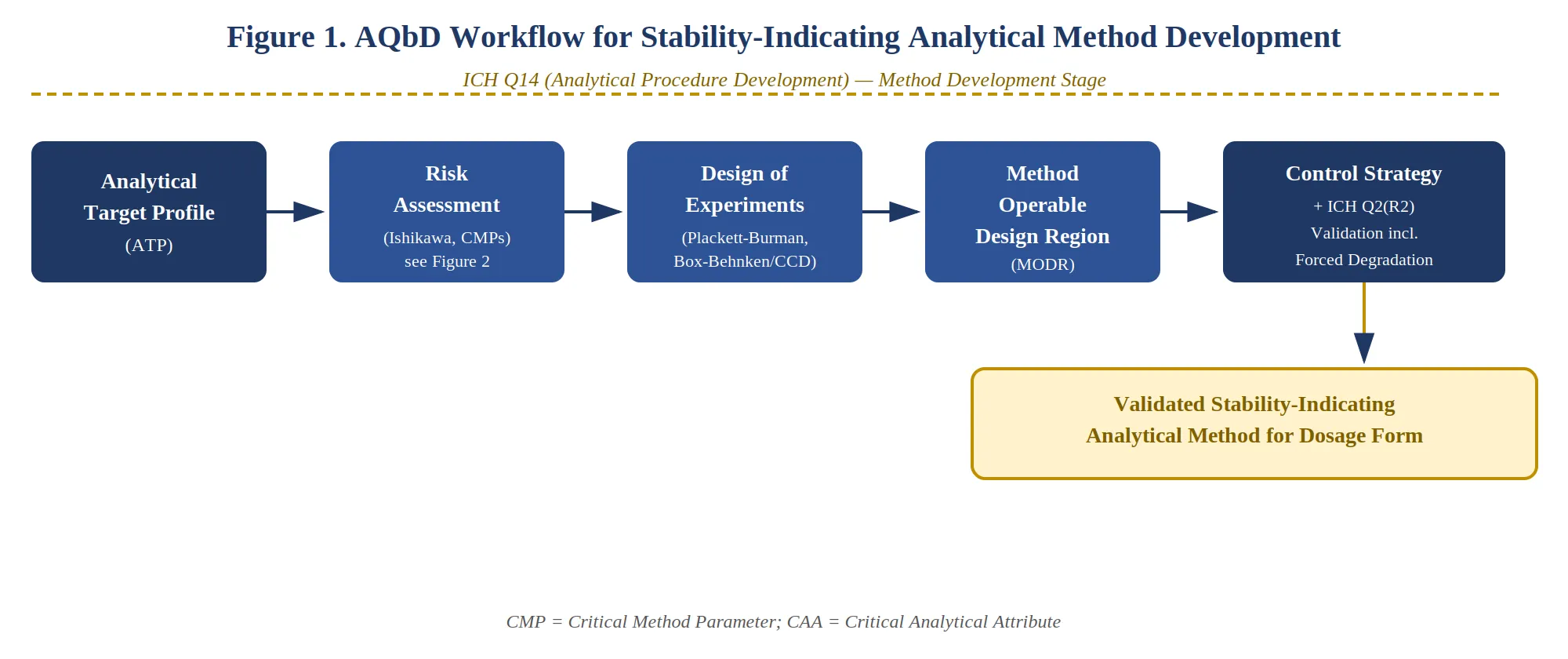
Figure 1. Consolidated AQbD workflow for stability-indicating analytical method development, from Analytical Target Profile definition through ICH Q2(R2) validation. (Original diagram prepared for this review.)
2. Risk Assessment: Identifying Critical Method Parameters
The risk-assessment stage of AQbD typically uses an Ishikawa (fishbone) diagram or failure-mode-and-effects analysis to systematically enumerate candidate critical method parameters (CMPs) across categories such as mobile phase composition, column characteristics, instrument settings, sample preparation, and — specifically for stability-indicating methods — the forced-degradation stress conditions themselves. Figure 2 illustrates a representative risk-assessment structure of the type applied across the stability-indicating AQbD literature reviewed in Section 3, prior to Plackett-Burman screening and subsequent Box-Behnken or central composite design optimization.
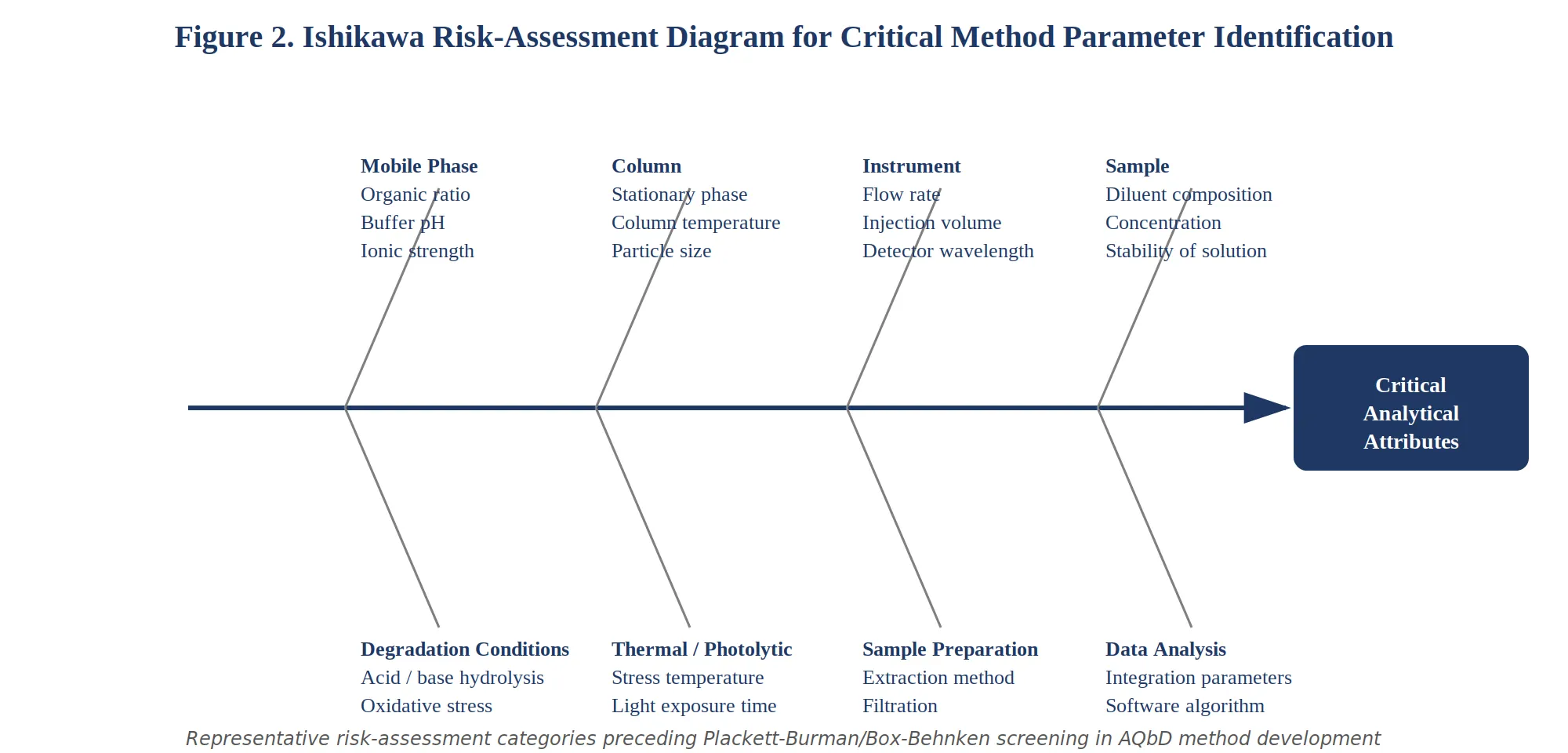
Figure 2. Ishikawa risk-assessment diagram showing representative critical-method-parameter categories evaluated prior to Design of Experiments screening in stability-indicating AQbD method development. (Original diagram prepared for this review.)
3. Literature Review: QbD-Driven Stability-Indicating Methods Across Dosage Forms
An AQbD-based stability-indicating RP-HPLC-PDA method was developed and validated for favipiravir — an oral antiviral repurposed for pandemic influenza and, more recently, COVID-19 — subjecting the method to acid, alkali, peroxide, and photolytic forced-degradation conditions and framing the work explicitly as an eco-friendly (green-chemistry-integrated) AQbD approach (Siri Chandana et al., J AOAC Int, 2024;107(3):377-386. doi:10.1093/jaoacint/qsae009).
A QbD-driven stability-indicating RP-HPLC-PDA method for terlipressin, a peptide vasopressin analogue used in an injectable dosage form, was developed and validated for the injectable route specifically, illustrating AQbD application beyond oral solid dosage forms (Salva & Galla, Chromatographia, 2024;87:567-579. doi:10.1007/s10337-024-04352-w).
QbD principles were applied to develop and validate a stability-indicating HPLC method for eltrombopag olamine in tablet dosage forms, using a three-level factorial design to optimize primary contributing factors and performing forced-degradation studies under multiple stress conditions per ICH guidelines, achieving a validated linear range of 10-70 microgram/mL with percent recovery of 98-100% (Chromatographia, 2024. doi:10.1007/s10337-024-04356-6).
The QbD approach was implemented for a stability-indicating RP-HPLC method for treprostinil in an injectable dosage form, explicitly motivated by the tedium and robustness limitations of conventional (non-QbD) methods for this drug, and incorporated green-technology assessment alongside the forced-degradation and validation package (ACS Omega, 2025. doi:10.1021/acsomega.5c00373).
A stability-indicating UPLC method for hexoprenaline in an injectable dosage form was developed and validated using AQbD principles, with forced degradation performed under hydrolytic (acid and base), oxidative, and thermal stress conditions, and standard solution stability additionally assessed — the authors noting that AQbD-generated methods carry reduced regulatory risk and lower long-term operational cost (PMC8587854).
An AQbD-based UPLC method was developed for the concurrent quantification of four antidiabetic actives — metformin, vildagliptin, dapagliflozin, and sitagliptin — in bulk and tablets, applying response-surface methodology to a multi-analyte separation problem (Narikimalli & Galla, Anal Chem Lett, 2024;14:528-548. doi:10.1080/22297928.2024.2376118).
A comprehensive review of QbD-driven analytical procedures across multiple drug classes catalogued a broad range of applications — including stability-indicating methods for pseudoephedrine sulfate and related organic impurities, bioanalytical QbD-based methods for dapagliflozin with preclinical pharmacokinetic application, and multiple Box-Behnken/central-composite-optimized methods — providing a useful secondary confirmation of the breadth of dosage forms and analyte classes now addressed by QbD-driven method development (J Liq Chromatogr Relat Technol, 2023;46(1-5). doi:10.1080/10826076.2023.2204238).
4. Identified Gaps and Novelty Statement
Three gaps recur across the QbD stability-indicating method literature surveyed. First, forced-degradation reporting is inconsistent in depth: some papers report only percentage degradation achieved under each stress condition, while others additionally report degradation kinetics or propose degradation pathways, limiting cross-study comparability of 'stability-indicating' claims. Second, formal linkage between the AQbD-derived Method Operable Design Region and the final control strategy specified in the validation report is not always made explicit, even though ICH Q14 treats this linkage as central to the framework. Third, application of QbD-driven stability-indicating method development to injectable and biologic-adjacent dosage forms (peptides, complex parenterals) remains less extensively represented in the literature than tablet dosage forms, despite the terlipressin and treprostinil examples above showing feasibility.
5. CONCLUSION
Quality by Design has become the structurally preferred route to stability-indicating analytical method development across tablet, injectable, and multi-analyte dosage forms, replacing empirical degradation-product resolution with risk-based, DoE-optimized method design from the outset. The literature reviewed here, spanning favipiravir, terlipressin, eltrombopag olamine, treprostinil, hexoprenaline, and multi-drug antidiabetic combinations, confirms consistent uptake of the ATP-to-control-strategy AQbD sequence illustrated in Figure 1, built on risk assessments of the type shown in Figure 2. Standardizing forced-degradation reporting depth and making the MODR-to-control-strategy linkage explicit represent the principal opportunities for strengthening stability-indicating AQbD method development going forward.
Conflict of Interest
The authors declare no conflict of interest.
REFERENCES

Dr. Rahul Solunke*, More jyotiraditya, Quality by Design (QbD) in Analytical Method Development for Dosage Forms: A Critical Review of Stability-Indicating Method Development Approaches, Int. J. of Pharm. Sci., 2026, Vol 4, Issue 7, 2368-2372. https://doi.org/10.5281/zenodo.21318565
 10.5281/zenodo.21318565