

We use cookies to ensure our website works properly and to personalise your experience. Cookies policy
Department of Pharmaceutics, Bharathi College of Pharmacy, Bharathinagara, Mandya, Karnataka-571422, India.
Exagamglogene autotemcel (exa-cel, Casgevy) and lovotibeglogene autotemcel (lovo-cel, Lyfgenia) were approved by the US FDA in December 2023, and they were essentially the first cell-based gene therapies approved for sickle cell disease and transfusion-dependent beta-thalassemia, with exa-cel being the first CRISPR-Cas9-based therapy to reach approval at all. The pivotal trial data showed strong efficacy, where nearly all evaluable patients achieved freedom from severe vaso-occlusive crises, but the real-world safety picture is still fairly limited, since the follow-up is short, the number of commercially treated patients is small, and the evidence base is still dominated by sponsor-reported data rather than independent sources. This review pulls together the currently available regulatory, trial, and post-marketing information on both therapies, with particular attention to the known safety signals that is, hematologic malignancy associated with lovo-cel, theoretical off-target editing risk associated with exa-cel, and busulfan conditioning toxicity common to both. It also looks at access and cost barriers and points out specific gaps in independent, real-world pharmacovigilance that need attention now that these therapies are reaching a wider and more diverse patient population, including children following the 2026 pediatric label expansion.
Sickle cell disease (SCD) and transfusion-dependent beta-thalassemia (TDT) are inherited haemoglobinopathies that cause chronic haemolysis, recurrent vaso-occlusive crises, progressive organ damage, and reduced life expectancy.(1,2) Standard management has generally relied on supportive care, hydroxyurea, chronic transfusion, and, in eligible patients, allogeneic haematopoietic stem cell transplantation, which carries its own risks of graft failure and graft versus host disease and is limited by donor availability.
In December 2023, the FDA approved two autologous cell-based gene therapies for these conditions, exa-cel (Casgevy) and lovo-cel (Lyfgenia). Exa-cel was notable as being the first FDA-approved therapy to use CRISPR-Cas9 gene-editing technology, which distinguishes it mechanistically from lovo-cel, since lovo-cel uses lentiviral vector-mediated gene addition rather than direct genome editing. (1,3,4)
Both therapies, though, were approved on the basis of trials that still had maturing follow-up, so regulatory authorities required continued post-marketing evaluation at the time of approval.(5–7) Now that more than two years have passed since commercial launch, an emerging but still limited body of post-marketing evidence allows an early look at how these therapies are actually performing outside the controlled trial setting. This review aims to bring together the current regulatory, trial and real-world evidence on the safety of exa-cel and lovo-cel, to characterize the access and cost barriers relevant to their real-world uptake, and to identify specific gaps in independent pharmacovigilance that should guide future monitoring, particularly as the pediatric indication expands the eligible population.(8)
CRISPR-CAS9 MECHANISM: A BRIEF OVERVIEW
CRISPR-Cas9 is basically a genome-editing technology adapted from an adaptive immune mechanism seen naturally in bacteria, where a guide RNA directs the Cas9 nuclease to a specific DNA sequence, producing a targeted double-strand break which the cell then repairs. Exa-cel is manufactured by collecting the patient’s own haemopoietic stem and progenitor cells, which are edited ex vivo using CRISPR-Cas9 to disrupt the erythroid-specific enhancer region of BCL11A, and then these edited cells are reinfused following conditioning. In general, BCL11A suppresses the production of fetal haemoglobin after birth, so disrupting its erythroid enhancer allows fetal haemoglobin to be produced again, which can functionally compensate for the defective adult haemoglobin in SCD and TDT.(3)
Lovo-cel, in contrast, is a lentiviral vector-based gene addition therapy rather than a gene-editing therapy. It introduces a modified beta-globin gene giving rise to HbAT87Q into the patient’s own stem cells, rather than editing the existing genomic sequence.(4) This distinction matters clinically, since both therapies carry theoretically distinct risks, where exa-cel’s risk relates to potential CRISPR off-target editing and lovo-cel’s risk relates to semi-random lentiviral vector integration and the resulting insertional mutagenesis.(4,9) Both, however, require myeloablative conditioning, typically with busulfan, before the modified cells can be infused, and this step carries a significant toxicity that is independent of the gene-modification technology used.(10) [Fig. 1]
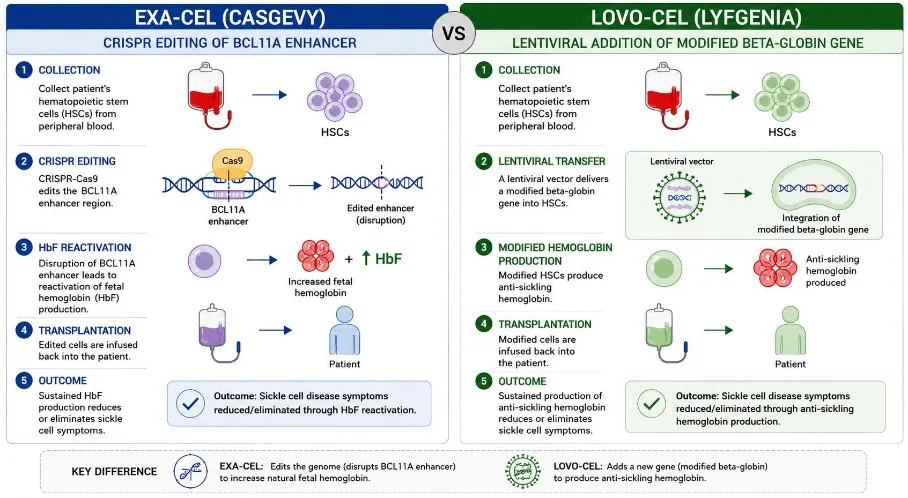
[Fig.1]
FROM TRIAL TO APPROVAL
Exa-cel’s approval was supported by two related open-label, single-arm trials, CLIMB-121 (severe SCD) and its long-term extension CLIMB-131, along with CLIMB-111 in TDT. (1,5) In the pivotal SCD analysis, 29 of 30 evaluable patients (96.7%) achieved the primary endpoint of freedom from severe vaso-occlusive crises for at least 12 consecutive months.(5) Updated follow-up data presented in December 2025 reported that all 45 evaluable SCD patients across CLIMB-121 and CLIMB-131 had achieved this outcome, with a mean vaso-occlusive-crisis-free duration of 35.3 months.(11)
Lovo-cel’s approval was supported by a similarly sized trial population; the Biologics License Application safety dataset included 50 patients, of which six had at least six years of follow-up at the time of review.(4) In both cases, approval proceeded essentially on surrogate and intermediate-term efficacy outcomes rather than long-term, population-representative safety data, and this made regulators differ somewhat in their approach, where the FDA granted standard approval while requiring post-marketing studies, while the European Medicines Agency granted Casgevy conditional marketing authorization, openly acknowledging a less comprehensive evidence base and requiring annual submission of additional post-approval data. (5,7)
An independent Canadian health technology assessment of exa-cel raised specific concerns about how well the trial results would generalize to broader real-world populations, and about the adequacy of how long-term response was defined and measured in the available dataset.(6) Most recently, in July 2026, the FDA expanded the exa-cel indication to include children as young as two years old, which meaningfully broadens the population for whom real-world evidence is only now starting to accumulate.(8)
KNOWN AND THEORETICAL SAFETY CONCERNS
Off-Target CRISPR Editing (Exa-cel)
A theoretical concern that is specific to CRISPR-based editing is off-target activity, where the Cas9 nuclease cuts DNA at unintended genomic locations, which could potentially disrupt tumor-suppressor genes or activate oncogenes. Detection strategies generally include careful guide-RNA design, preclinical off-target prediction algorithms, and clinical monitoring through integration and variant analysis.(12,13) So far, no confirmed clinical case of off-target-editing-related malignancy has been reported for exa-cel, but the available follow-up period is still short relative to the latency typically associated with treatment-related malignancies, and that is really the main reason behind the mandated extended post-marketing surveillance. (5,13)
Insertional Mutagenesis and Hematologic Malignancy (Lovo-cel)
Lovo-cel carries an FDA boxed warning for hematologic malignancy. (14) Within the Biologics License Application safety dataset of 50 patients, two developed leukemia, and three patients died in total, two from leukemia and one from sudden cardiac death.(4) The FDA-mandated post-marketing monitoring plan for lovo-cel recipients requires complete blood counts at minimum every six months and integration site analysis at months six and twelve, and as clinically warranted after that. (14) Expert commentary attributes this signal mainly to the lentiviral vector’s semi-random pattern of genomic integration rather than to any CRISPR-related mechanism; since lovo-cel doesn’t use gene editing at all, this distinction should be made explicit when discussing comparative safety between the two therapies. (9)
Busulfan Conditioning Toxicity (Both Therapies)
Both exa-cel and lovo-cel require myeloablative conditioning, typically with busulfan, before the modified cell product can be infused, which exposes patients to risks including infertility, hepatic veno-occlusive disease, and other organ toxicities that are independent of the gene-therapy component itself.(10) Clinicians in the transplant field have described busulfan conditioning as one of the most significant remaining barriers to broader use of autologous gene therapy for sickle cell disease, and non-genotoxic conditioning alternatives, including agents such as briquilimab, are under early investigation but are not yet part of standard practice for either approved product.(10) [Fig. 2]
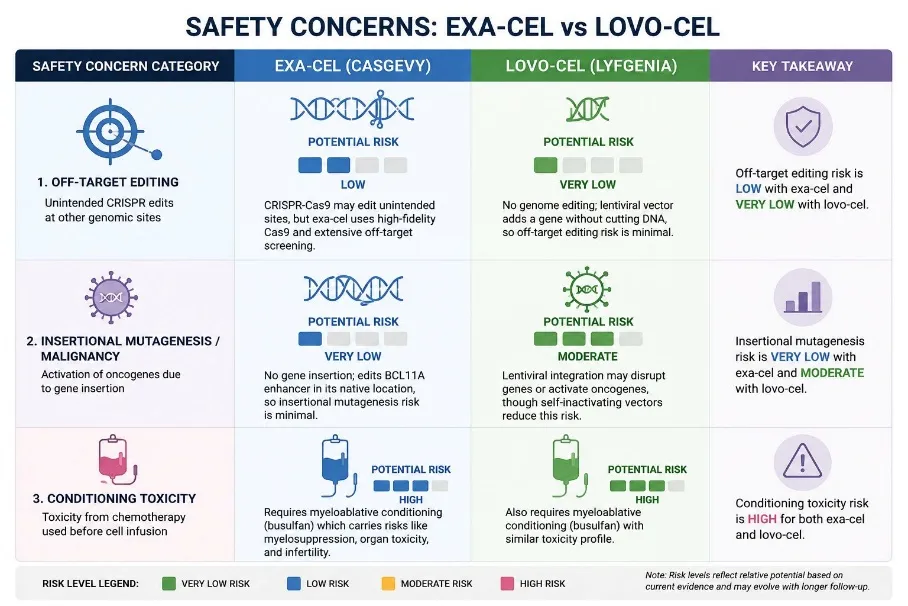
[Fig. 2]
REAL-WORLD EVIDENCE AND POST-MARKETING DATA
As of May 2026, more than 500 patient initiations had occurred since Casgevy’s commercial launch, but the actual infusion numbers remain considerably smaller than the initiation numbers. In 2025 alone, 301 patients began the treatment process, 147 completed first cell collection, and only 64 were ultimately infused.(15) Separately, CRISPR Therapeutics reported that of approximately 300 patients referred to Authorized Treatment Centers, roughly 165 had completed first cell collection and only 39 had received infusion.(16) [Fig.3]
This referral-to-infusion pattern, which shows up in both independent reporting sources, basically indicates that only a minority of patients who begin the treatment pathway have, within the reporting period, actually reached the point of therapeutic exposure. This has two important implications for a pharmacovigilance-focused review: first, the population currently generating real-world safety experience is still small and may not represent the full eligible population; second, the current real-world safety data comes almost entirely from company-reported figures rather than from independent registries, published case series, or spontaneous-report database analyses.(11,15,16) No independent, peer-reviewed, registry-based, or FDA Adverse Event Reporting System (FAERS)/VigiBase-derived pharmacovigilance study specific to exa-cel or lovo-cel was found in this literature search, and that in itself is a notable finding rather than just a limitation of the search strategy.
By comparison, disproportionality-based pharmacovigilance methodology has already been applied to other advanced cell and gene therapies; a 2024 analysis of cardiovascular adverse events associated with tisagenlecleucel, a chimeric antigen receptor T-cell therapy, using FAERS data, shows an analytic approach that could reasonably be applied to exa-cel and lovo-cel once enough real-world exposure has accumulated to support meaningful signal detection.(17)
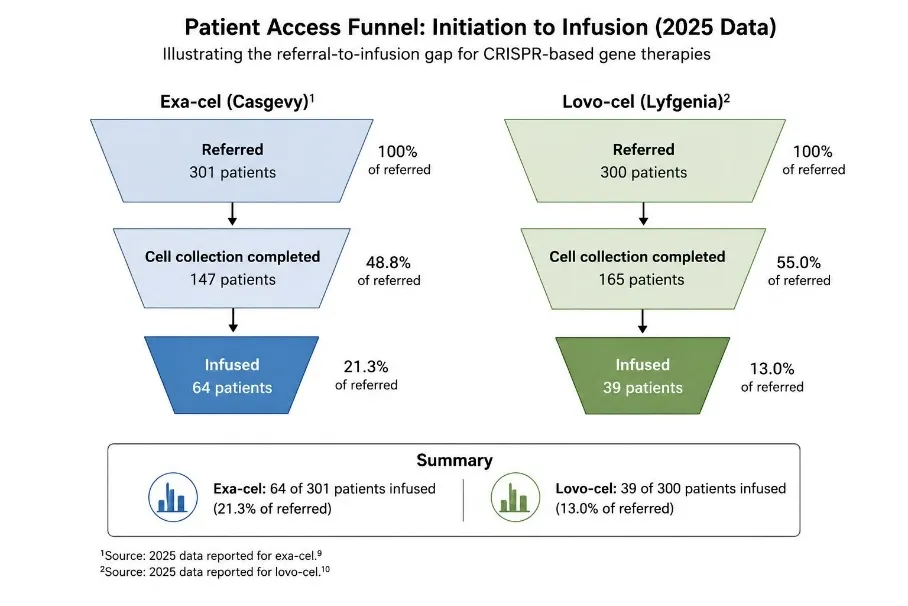
[Fig. 3]
ACCESS, COST, AND HEALTH-SYSTEM CHALLENGES
The list prices of both therapies are substantial: exa-cel is priced at approximately $2.2 million, and lovo-cel at approximately $3.1 million on a wholesale acquisition cost basis. (18) Before launch, the Institute for Clinical and Economic Review had recommended a value-based price range of $1.35 to $2.05 million for these therapies, meaning both launched at or above the upper bound of that independently estimated range. (19) [Fig. 4] A later cost-effectiveness analysis found that exa-cel’s price exceeded commonly applied cost-effectiveness thresholds by approximately $200,000, with lovo-cel assessed as considerably less cost-effective given its substantially higher price. (18)
The Congressional Budget Office, a non-industry government source, has noted explicitly that while future healthcare costs might in principle be offset by successful treatment, information about these therapies' long-term effects on health, longevity, and total healthcare spending is still unavailable, which limits the ability to model true long-term value.(20) Beyond price, both therapies require administration at specialized Authorized Treatment Centers with hematopoietic stem cell transplantation capability, and this is a substantial geographic and logistical access barrier given the limited number of such centers relative to the eligible patient population.(21) In response to affordability concerns, new payment models have come up, including the Centers for Medicare & Medicaid Services Cell and Gene Therapy Access Model and outcomes-based Medicaid payment agreements that tie reimbursement to demonstrated patient response rather than a fixed upfront payment regardless of outcome.(22)
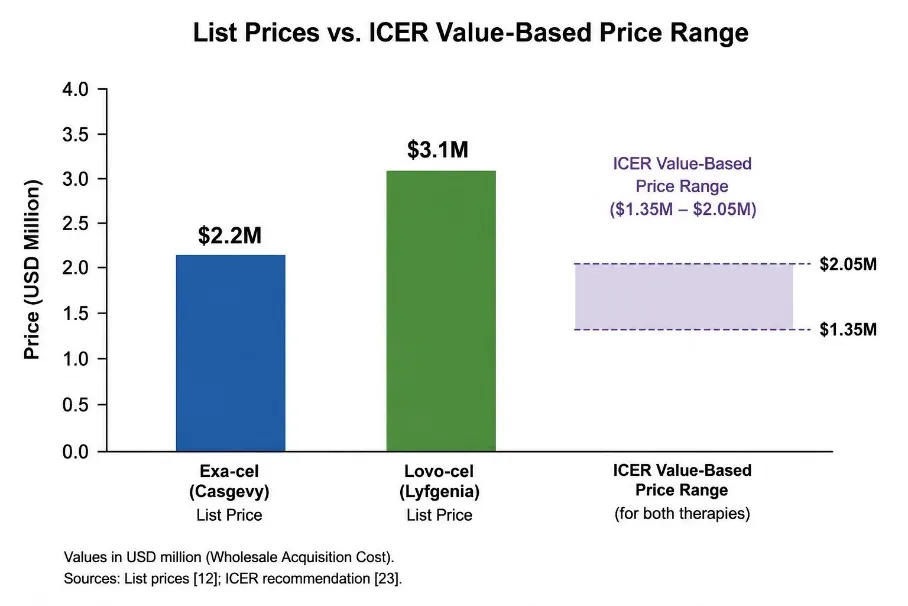
[Fig. 4]
GAPS AND FUTURE PHARMACOVIGILANCE NEEDS
Several specific gaps come out of the evidence put together above. First, there is a follow-up duration mismatch between the relatively short observation periods reported so far even the longest cohort, with roughly six years of follow-up for a small subset of lovo-cel recipients and the latency period typically needed to detect treatment-related malignancy.(4) Second, the small number of patients who have actually reached commercial infusion by 2025-2026 limits the statistical power of any real-world safety signal that might currently be detectable.(15,16) Third, the near-total reliance on company-reported data, rather than independent registries or spontaneous-report database analyses, is an evidence-quality limitation that should be explicitly acknowledged rather than treated as equivalent to independently verified post-marketing surveillance.(11,15,16)
There is, though, a concrete methodological path forward: the disproportionality-analysis approach already applied to FAERS data for other cell and gene therapies, such as tisagenlecleucel, could be extended to exa-cel and lovo-cel as reporting volume builds up.(17) Access-related selection bias also needs attention as a pharmacovigilance consideration in its own right, since the patients treated so far are disproportionately those with proximity to an Authorized Treatment Center and adequate insurance and logistical support, meaning early real-world safety data may not generalize once broader access is achieved.(15,16,21) Finally, the pediatric population is a distinct and only recently opened area of real-world evidence generation following the July 2026 label expansion, and will need dedicated, age-specific safety tracking going forward.(8)
CONCLUSION
Exa-cel and lovo-cel represent a genuine milestone in the treatment of sickle cell disease and transfusion-dependent beta-thalassemia, with exa-cel standing as the first CRISPR-Cas9-based therapy to reach regulatory approval. Trial data through 2025 show strong efficacy, and one clear safety signal hematologic malignancy associated with lovo-cel’s lentiviral vector has already led to a boxed warning and structured post-marketing monitoring requirement, while exa-cel’s CRISPR-specific off-target risk remains, so far, a theoretical rather than confirmed concern. But the real-world evidence base for both therapies is still limited in volume, short in follow-up duration, and disproportionately drawn from company-reported rather than independent sources, and a substantial referral-to-infusion access gap suggests that the current safety experience may not yet represent the full eligible patient population. As commercial uptake expands, including into the pediatric population, sustained investment in independent, registry and pharmacovigilance-database-driven safety monitoring will be essential to make sure that the promise shown in clinical trials translates into a well-characterized real-world safety profile.
FUNDING
No external funding was received for the preparation of this review article.
CONFLICT OF INTEREST
The authors declare that there are no conflicts of interest related to this work.
AUTHOR CONTRIBUTIONS
Prasad Cheepurupalli, Durga Chandra Kanth Samayam, and Satish Kumar Matta, made substantial contributions to the conception and design of the review, literature search, data analysis and interpretation, drafting and critical revision of the manuscript, and approved the final version for publication.
REFERENCES
FIGURE LEGENDS
Fig. 1. Mechanism comparison diagram: exa-cel (CRISPR editing of BCL11A enhancer) vs. lovo-cel (lentiviral gene addition of modified beta-globin).
Fig. 2. Safety concern comparison table/infographic: exa-cel vs. lovo-cel across off-target editing, insertional mutagenesis/malignancy, and busulfan conditioning toxicity
Fig. 3. Real-world funnel diagram: Referred → Cell Collection Completed → Infused, using 2025 data (301→147→64 and 300→165→39)
Fig. 4. simple bar chart comparing list prices of exa-cel ($2.2M) and lovo-cel ($3.1M) against the ICER value-based price range ($1.35M-$2.05M).



Prasad Cheepurupalli, Durga Chandra Kanth Samayam, Satish Kumar Matta, Real-World Safety and Pharmacovigilance of CRISPR/Cas9-Based Gene Therapies:A Review of Exagamglogene Autotemcel (Casgevy) and Lovotibeglogene Autotemcel (Lyfgenia), Int. J. of Pharm. Sci., 2026, Vol 4, Issue 8, 446-454, https://doi.org/10.5281/zenodo.21785550
 10.5281/zenodo.21785550