

We use cookies to ensure our website works properly and to personalise your experience. Cookies policy
Dr. R. N. Lahoti Institute of Pharmaceutical Education and Research Center, Sultanpur.
The therapeutic efficacy and drug bioavailability of oral dosage forms have been the subject of numerous attempts in recent years. In this regard, a variety of gastroretentive drug delivery systems (GRDDS) have been employed to enhance the therapeutic efficacy of medications that are active locally in the stomach, have a limited absorption window, are unstable at alkaline pH, and are soluble in acidic conditions. In order to create GRDDS, biocompatible polymers and excipients that can tolerate the stomach's acidity must be chosen. environment while delivering the medication in a sustained and regulated way. These devices can lower dosage. frequency, improve patient adherence, and deliver steady plasma drug levels while reducing adverse effects. GRDDS are especially helpful in the treatment of long-term conditions like diabetes, high blood pressure, gastrointestinal infections, and peptic ulcers.
Because it's convenient, oral administration is still the most popular method of drug delivery. both patient acceptance and safety. Tablets and capsules are the most common solid oral dosage forms. pharmaceutical market, which supplies nearly 60% of all prescription drugs. They provide accurate dosage, stability, and cost-effective manufacturing. However, the conventional oral method has certain drawbacks. drugs that are poorly soluble in water, unstable in intestinal fluid, or Substances that are only absorbed in the upper gastrointestinal tract often have low and variable bioavailability. Additionally, drugs with short biological half-lives need to be taken often, which reduces compliance and increases the likelihood of different plasma concentrations. Innovative drug delivery methods have been created to overcome these constraints.¹ Among them, GRDDS, or gastroretentive drug delivery systems, have garnered a lot of interest. GRDDS are intended to keep a dosage form in the stomach by extending its gastric residence time. and upper small intestine for prolonged This ensures that drugs with a narrow absorption window or local action in the stomach achieve enhanced bioavailability and improved therapeutic effect.⁶
To accomplish gastroretention, a number of strategies have been developed. Among them are high-density systems that stay at the stomach's bottom; mucoadhesive or bioadhesive systems that cling to the stomach lining; swelling and expandable systems, which grow larger to avoid floating systems, which stay buoyant in gastric fluid, and passage through the pylorus. Among Due to their simplicity, these floating drug delivery systems have been studied the most. efficient and patient-friendly.⁴
There are two types of floating systems: effervescent and non-effervescent. Bubbly When systems come into contact with gastric fluid, they react with an acid to produce gas. Like sodium bicarbonate, and a base like citric acid.⁷
The carbon dioxide produced is trapped in the polymer matrix, making the dosage form less dense and enabling it to float. Non-Effervescent systems depend on hydrophilic polymers like Carbopol, HPMC, or xanthan gum, which creates a buoyant gel layer by trapping air. One of the most effective gastroretentive techniques is the use of floating matrix tablets. They are created using hydrophilic polymers that regulate drug release, hydrate, and swell. When They guarantee both sustained release and floatation when paired with effervescent agents.²
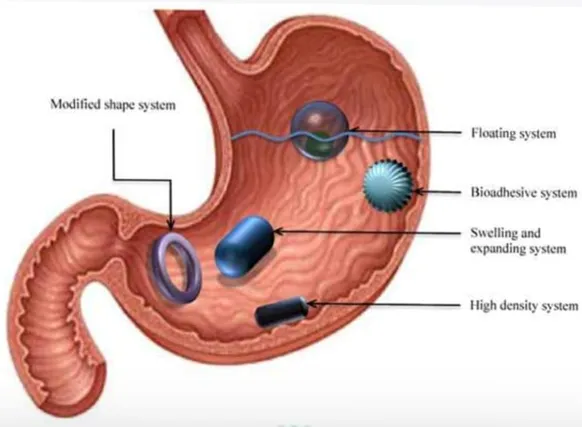
Fig.1 Gastro retentive Drug Delivery System
The system lowers dosage and keeps drug concentrations within the therapeutic window for extended periods of time. frequency and enhances patient compliance A perfect option for gastroretentive delivery is nifedipine. It is a calcium channel blocker. In the treatment of angina pectoris and hypertension. But it has serious disadvantages:extensive first-pass metabolism, a brief half-life of roughly two hours, and low water solubility. Due to these characteristics, bioavailability is low and inconsistent, requiring several daily doses.¹¹
A Nifedipine's gastroretentive floating matrix system can solve these issues by extending improving bioavailability, maintaining release, and gastric residence. Thus, the present study proposes the formulation, optimization, and evaluation of a floating matrix system for Nifedipine. By employing hydrophilic polymers such as HPMC and Carbopol in combination with effervescent agents, the formulation aims to achieve prolonged gastric retention, sustained release, and enhanced therapeutic efficacy.⁹
Classification of Floating Tablet Drug Delivery Systems
Floating tablet drug delivery systems are categorized based on the formulation design and the mechanism through which buoyancy is achieved in the gastric environment. The primary objective of these systems is to prolong gastric residence time by maintaining the dosage form in a floating state over gastric fluids. Depending on the materials used and the floating principle involved, floating tablets can be classified into several types, each with distinct formulation characteristics and applications.
Effervescence-Based Floating Tablet Systems
Effervescence-based floating tablets utilize gas-forming agents to achieve buoyancy. These formulations commonly contain sodium bicarbonate, calcium carbonate, or similar alkaline compounds along with organic acids such as citric or tartaric acid. When the tablet comes into contact with gastric fluid, an acid–base reaction occurs, resulting in the release of carbon dioxide gas.
Polymer Swelling-Induced Floating Tablets
Polymer swelling-induced floating tablets are non-effervescent systems that depend on the hydration and swelling behavior of hydrophilic polymers. These tablets are formulated using swellable polymers such as HPMC, carbopol, sodium carboxymethyl cellulose, xanthan gum, or other natural polymers. Upon exposure to gastric fluid, the polymers absorb water and swell, forming a viscous gel layer around the tablet.
Low-Density Hollow Floating Tablets
Low-density hollow floating tablets are designed with an internal cavity or porous structure that significantly reduces the overall density of the dosage form. The hollow space may be created using sublimation techniques, incorporation of volatile substances, or compression of porous materials that generate air pockets within the tablet.
Floating Drug Delivery System and It’s Mechanism
Bulk is a feature of floating drug delivery systems (FDDS). density is lower than that of gastric fluids, so they stay buoyant in the abdomen without having an impact on the rate of gastric emptying for an extended duration of time. As the system floats on the stomach contents, the medication is gradually released at the intended rate obtained from the system But aside from the minimal amount of gastric content required. But aside from the minimal amount of gastric content required to enable the appropriate attainment of buoyancy principle of retention, a minimal degree of floating additionally, force (F) is needed to maintain the dosage form. Consistently buoyant on the meal’s surface. For measure the kinetics of the floating force, a novel equipment for calculating the final weight has been documented in the literature. The device functions by continuously measuring the force equivalent to F, which is a function of time. Necessary to keep the submerged object intact. The if F is on the higher positive, the object floats better. Side as depicted in Figure 2. This apparatus helps in optimizing FDDS with respect to stability and durability of floating forces produced in order to prevent the drawbacks of unforeseeable intragastric buoyancy capability variations.¹⁹
F = F buoyancy – F gravity
= (Df – Ds) gv
Where,
F= total vertical force, Df = fluid density, Ds= object density, v = volume and g = acceleration due to gravity
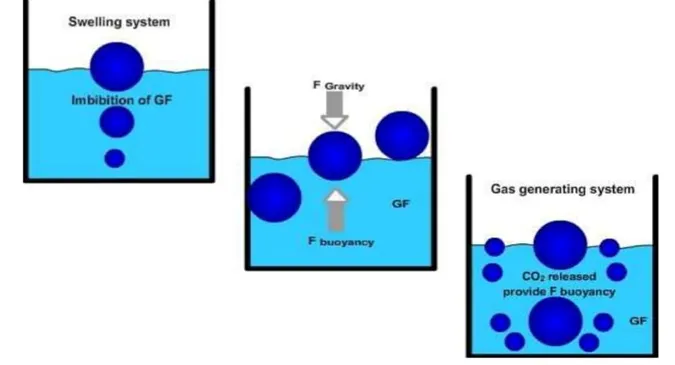
Fig. 2 Mechanism of floating system, GF= Gastric Fluid
Factors affecting of GRDDS
Pharmaceutical Factors:
Physiological Factors:
Feeding Frequency
Patient Related Factors:
CHEMICAL IDENTITIES
Nifedipine is a dihydropyridine derivative chemically known as 3,5-pyridinedicarboxylic acid, 1,4-dihydro-2,6-dimethyl-4-(2-nitrophenyl)-, dimethyl ester. It has the molecular formula C17H18N2O6 and a molecular weight of 346.34 g/mol. It appears as a light-sensitive yellow crystalline powder.⁵
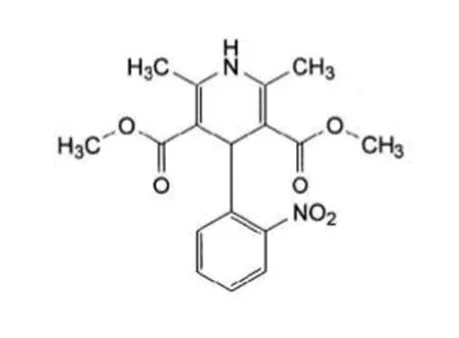
Fig 3.Chemical Structure of Nefedipine
Classification
The drug belongs to the class of calcium channel blockers, specifically the dihydropyridine subgroup. According to the Biopharmaceutical Classification System (BCS), Nifedipine is categorized as a Class II drug because of its poor water solubility but high membrane permeability.⁶
Physicochemical Properties
Nifedipine is practically insoluble in water but soluble in organic solvents such as ethanol, methanol, and chloroform. It is highly sensitive to light and requires protective packaging. Its short elimination half-life of around 2 hours makes frequent dosing necessary.⁸
Pharmacokinetics
After oral administration, Nifedipine is rapidly absorbed from the gastrointestinal tract. However, it undergoes extensive first-pass metabolism in the liver through the cytochrome P450 enzyme system, particularly CYP3A4. The drug exhibits 40–60% oral bioavailability, high plasma protein binding (92–98%), and urinary excretion of inactive metabolites.⁷
Mechanism of Action
Nifedipine selectively blocks L-type calcium channels in vascular smooth muscle, inhibiting calcium influx. This action leads to relaxation of vascular smooth muscle, dilation of coronary and peripheral arteries, decreased vascular resistance, and reduced myocardial oxygen demand, thereby lowering blood pressure and relieving angina.⁸
Therapeutic Uses
Clinically, Nifedipine is indicated in the treatment of hypertension, stable and variant angina pectoris, and Raynaud’s phenomenon. It is also used in certain vascular disorders where vasodilation provides therapeutic benefits. Its effectiveness in cardiovascular diseases makes it a widely prescribed drug.¹⁰
Adverse Effects
Common side effects of Nifedipine include headache, dizziness, flushing, hypotension, peripheral edema, and reflex tachycardia. These effects are often dose-dependent and occur due to excessive vasodilation. Long-term therapy requires monitoring of cardiovascular parameters to prevent complications.⁹
ADVANTAGE OF GRDDS
DISADVANTAGE OF GRDDS
METHODOLOGY
Preformulation Studies
The study begins with solubility testing of Nifedipine in water and 0.1 N HCl, melting point determination, and preparation of calibration curves using UV–Visible spectrophotometry at 216 nm. These investigations establish the basic physicochemical properties of the drug.11
Compatibility Studies
Drug–excipient compatibility is assessed using FTIR spectroscopy. Pure Nifedipine and mixtures with excipients are analyzed between 4000–400 cm⁻¹. The absence of significant peak shifts confirms chemical compatibility and suitability of excipients for tablet formulation.12
Materials
The following materials are used in the formulation:
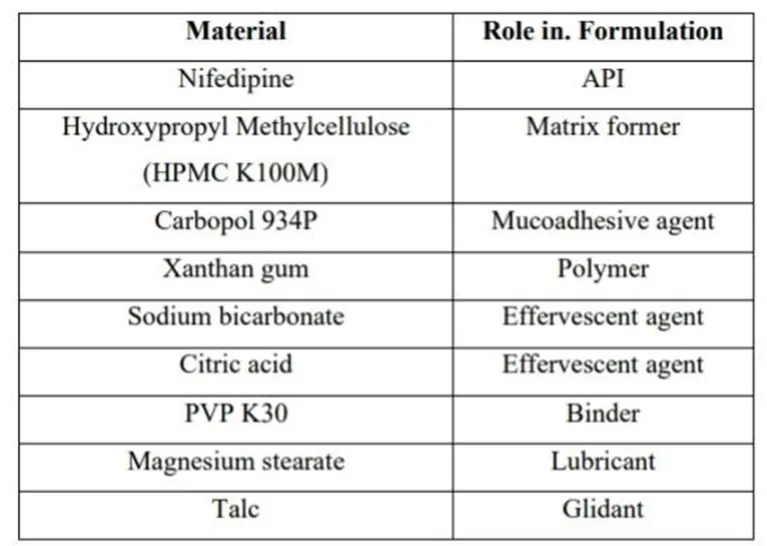
Formulation of Floating Tablets
Floating matrix tablets are prepared by direct compression. Nifedipine, polymers, and effervescent agents are accurately weighed, blended by geometric dilution, lubricated with magnesium stearate and talc, and compressed into tablets using a rotary press.17
Pre-compression Evaluation
Powder blends are evaluated for bulk density, tapped density, Carr’s index, Hausner’s ratio, and angle of repose. These parameters provide assurance of good flow properties and compressibility before compression.
Post-compression Evaluation
The compressed tablets are tested for general appearance, thickness, hardness, friability, weight variation, and drug content uniformity. These tests confirm compliance with pharmacopeial standards and product reproducibility.18
IN VITRO EVOLUTION
To establish the in vivo efficacy of gastro-retentive drug delivery systems (GRDDS), it is essential to conduct a well-planned study using either animal models or human subjects. Such in vivo investigations offer crucial insights into parameters like gastric retention time (GRT) and drug bioavailability. The first step in ensuring a successful study is the careful selection of an appropriate animal model. However, smaller animals such as mice, rats, rabbits, and guinea pigs can pose challenges in handling, particularly when evaluating larger dosage forms, which makes accurate measurement of GRT and bioavailability difficult. Among these, gamma scintigraphy has been widely used to track the movement, position, and extent of GRDDS throughout the gastrointestinal tract. In this method, a stable isotope is incorporated into the dosage form during preparation, which is later converted into a γ-emitting material through neutron irradiation. The emitted gamma rays are detected and processed to produce images that also help determine dissolution and disintegration behavior. The technique is favored because it provides reliable data while maintaining a good safety profile and exposing subjects to relatively low radiation levels.¹⁴
REFERENCES


Dhiraj Chavan, Ananta Gite, Nandu Kayande, Review on Innovative Gastroretentive Floating Matrix System for Sustained Release of Nifedipine: Formulation, Optimization and Evolution, Int. J. of Pharm. Sci., 2026, Vol 4, Issue 5, 6618-6625. https://doi.org/10.5281/zenodo.20389880
 10.5281/zenodo.20389880