

We use cookies to ensure our website works properly and to personalise your experience. Cookies policy
Sant Gajanan Maharaj College of Pharmacy, Mahagaon, Chinchewadi, Maharashtra 416503, India.
Wound healing is a complex biological process that requires effective therapeutic agents with minimal adverse effects. Herbal formulations have gained considerable attention due to their safety, affordability, and therapeutic potential. The present study aimed to formulate and evaluate a herbal wound healing ointment containing Bryophyllum pinnatum leaf extract and to investigate its physicochemical characteristics and antimicrobial activity. The leaf extract was prepared using the Soxhlet extraction method with 70% hydroalcoholic solvent. The ointment was formulated using suitable excipients, including white soft paraffin, hard paraffin, cetostearyl alcohol, white beeswax, and phenol. The prepared formulations were evaluated for various physicochemical parameters such as appearance, homogeneity, pH, viscosity, spreadability, washability, and stability. Antimicrobial activity was assessed using the agar well diffusion method against selected microbial strains and compared with a marketed standard formulation. The optimized formulation exhibited satisfactory physicochemical properties, good consistency, acceptable spreadability and viscosity, and demonstrated appreciable antimicrobial activity, indicating its potential for topical wound management. The findings suggest that the formulated herbal ointment containing Bryophyllum pinnatum leaf extract may serve as a safe and effective alternative to conventional wound healing preparations. However, further in vivo and clinical studies are required to establish its therapeutic efficacy and safety for clinical applications.
Wounds are one of the most common health problems affecting individuals of all age groups and may result from physical injury, burns, surgical procedures, or microbial infections. The wound healing process is a complex biological phenomenon involving a series of overlapping phases, including hemostasis, inflammation, proliferation, and tissue remodeling. Delayed or impaired wound healing may lead to infection, prolonged hospitalization, and reduced quality of life. Therefore, the development of safe and effective wound healing agents remains an important area of pharmaceutical research.
The growing interest in herbal medicine has encouraged researchers to explore plant-based formulations for the management of wounds and other skin disorders. Herbal products are widely accepted because they are generally considered safe, cost-effective, and associated with fewer adverse effects than many synthetic drugs. Medicinal plants contain a variety of bioactive phytochemicals, including flavonoids, tannins, alkaloids, saponins, and phenolic compounds, which possess antimicrobial, anti-inflammatory, antioxidant, and tissue regenerative properties. These pharmacological activities contribute significantly to the wound healing process by preventing microbial infection, reducing inflammation, promoting collagen synthesis, and accelerating tissue repair. Consequently, herbal formulations have emerged as promising alternatives for the treatment of wounds.
Bryophyllum pinnatum (Family: Crassulaceae) is a well-known medicinal plant that has been widely used in traditional systems of medicine for the treatment of wounds, burns, ulcers, skin infections, and inflammatory conditions. The plant is rich in biologically active constituents such as flavonoids, alkaloids, tannins, glycosides, triterpenoids, and phenolic compounds, which are responsible for its diverse pharmacological activities. Previous studies have reported that Bryophyllum pinnatum possesses significant antimicrobial, anti-inflammatory, antioxidant, analgesic, and wound healing properties. These therapeutic activities support its potential as a natural agent for the development of topical wound healing formulations. Previous studies have demonstrated that Bryophyllum pinnatum possesses significant antimicrobial, anti-inflammatory, antioxidant, analgesic, and supporting its use in topical wound healing formulations.
Topical drug delivery systems, particularly ointments, are widely preferred for wound management because they provide prolonged contact of the drug with the affected area, maintain adequate moisture, and protect the wound from external contaminants. Ointments also enhance the penetration of active constituents into the skin, thereby improving therapeutic efficacy and promoting faster tissue regeneration. Herbal ointments prepared with suitable base materials offer additional advantages, such as ease of application, patient compliance, and reduced systemic side effects. Therefore, incorporating Bryophyllum pinnatum leaf extract into an ointment dosage form may provide an effective and convenient approach for the management of wounds.
Based on the reported pharmacological properties of Bryophyllum pinnatum, the present study was undertaken to formulate and evaluate a herbal wound healing ointment containing Bryophyllum pinnatum leaf extract. The prepared formulation was evaluated for its physicochemical characteristics and antimicrobial activity to assess its potential as an effective topical wound healing preparation.
MATERIALS AND METHODS
Plant Material
Fresh leaves of Bryophyllum pinnatum were collected from the residential premises at Badyachiwadi, Gadhinglaj, Kolhapur, Maharashtra, India, during the study period. The collected leaves were carefully examined to ensure that they were healthy and free from disease or physical damage. The leaves were washed thoroughly with distilled water to remove dust and adhering impurities and were shade dried at room temperature for 10–15 days. The dried leaves were then powdered using a domestic mixer grinder to obtain a coarse powder. The powdered material was stored in an airtight container in a cool and dry place until further use for extraction and formulation studies.
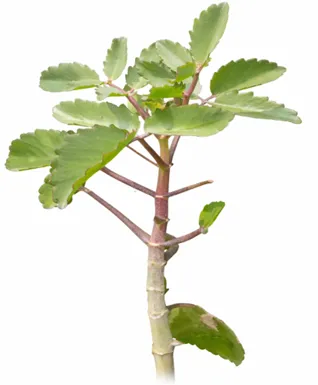
Figure No.1 Bryophyllum pinnatum plant
Authentication of Plant Material
The collected plant material was authenticated by a qualified botanist from Shivraj College of Arts, Commerce and D. S. Kadam Science College, Gadhinglaj, Maharashtra, India. The plant was identified as Bryophyllum pinnatum belonging to the family Crassulaceae. An authentication certificate was obtained prior to the commencement of the experimental work.
Chemicals and Reagents
Bryophyllum pinnatum leaf extract was used as the active ingredient in the formulation of the herbal wound healing ointment. White beeswax, hard paraffin, cetostearyl alcohol, white soft paraffin, and phenol were used as excipients for the preparation of the ointment base. Ethanol and distilled water were used during the extraction process. All chemicals and reagents used in the study were of analytical reagent (AR) grades.
Preparation of Hydroalcoholic Extract
About 50 g of the dried powdered leaves of Bryophyllum pinnatum were packed in a cellulose thimble and placed in a Soxhlet apparatus. The extraction was carried out using 70% hydroalcoholic solvent (ethanol: water, 70:30 v/v). The extraction process was performed for three consecutive days, with the apparatus operated for several hours each day to ensure efficient extraction of the phytoconstituents. After completion of extraction, the extract was filtered and concentrated using a water bath to remove the solvent. The concentrated extract was collected in a clean container and stored in an airtight container until further use for formulation studies.
Preliminary Phytochemical Screening
The hydroalcoholic extract of Bryophyllum pinnatum leaves was subjected to preliminary phytochemical screening using standard qualitative chemical tests to identify the presence of major phytoconstituents.
Table 1. Preliminary phytochemical screening of the hydroalcoholic extract of Bryophyllum pinnatum leaves.
|
Phytoconstituent |
Test Performed |
Observation |
|
Alkaloids |
Dragendorff's test |
Orange/reddish-brown precipitate |
|
Alkaloids |
Mayer's test |
Cream-colored precipitate |
|
Flavonoids |
Shinoda test |
Pink/red coloration |
|
Flavonoids |
Alkaline reagent test |
Intense yellow colour |
|
Tannins |
Ferric chloride test |
Greenish black colour |
|
Saponins |
Foam test |
Stable persistent froth |
|
Glycosides |
Keller–Killiani test |
Brown ring at interface |
The preliminary phytochemical screening of the hydroalcoholic extract of Bryophyllum pinnatum revealed the presence of alkaloids, flavonoids, tannins, saponins, and glycosides. These phytoconstituents are known to possess antimicrobial, antioxidant, anti-inflammatory, and wound healing activities, which may contribute to the therapeutic efficacy of the formulated herbal ointment.
Experimental Design
A two-factor, two-level (2²) full factorial design was employed to optimize the formulation of the herbal wound healing ointment. White beeswax (X₁) and cetostearyl alcohol (X₂) were selected as the independent variables, while viscosity and spreadability were considered as the dependent responses. Four experimental formulations (F1–F4) were prepared according to the experimental design.
Table 2. Independent variables used in the experimental design.
|
Factor |
Independent Variable |
Low (-1) |
High (+1) |
|
X₁ |
White beeswax (g) |
1.25 |
3.75 |
|
X₂ |
Cetostearyl alcohol (g) |
0.50 |
1.50 |
White beeswax and cetostearyl alcohol were selected as formulation variables to optimize the physicochemical properties of the ointment.
Table 3. Experimental batch combinations according to 2² factorial design.
|
Batch |
White Beeswax (X₁) |
Cetostearyl Alcohol (X₂) |
|
F1 |
1.25 |
0.50 |
|
F2 |
1.25 |
1.50 |
|
F3 |
3.75 |
0.50 |
|
F4 |
3.75 |
1.50 |
Four experimental batches (F1–F4) were prepared according to the factorial design by varying the concentrations of white beeswax and cetostearyl alcohol at two different levels.
Formulation of Herbal Wound Healing Ointment
Table 4. Formulation Composition of Experimental Herbal Ointment Batches (F1–F4).
|
Sr. No. |
Ingredients |
Quantity in Batch F1 (g) |
Quantity in Batch F2 (g) |
Quantity in Batch F3 (g) |
Quantity in Batch F4 (g) |
Role |
|
1 |
Bryophyllum pinnatum leaf extract |
2.40 |
2.40 |
2.40 |
2.40 |
Active Pharmaceutical Ingredient |
|
2 |
White Beeswax |
1.25 |
1.25 |
3.75 |
3.75 |
Stiffening agent |
|
3 |
Hard Paraffin |
1.00 |
1.00 |
1.00 |
1.00 |
Hardening agent |
|
4 |
Cetostearyl Alcohol |
0.50 |
1.50 |
0.50 |
1.50 |
Emulsifier / Emollient |
|
5 |
Phenol |
0.10 |
0.10 |
0.10 |
0.10 |
Preservative |
|
6 |
White Soft Paraffin |
19.75 |
18.75 |
17.25 |
16.25 |
Base / Vehicle |
Procedure for Preparation of Ointment
The formulated herbal wound healing ointment containing the hydroalcoholic extract of Bryophyllum pinnatum was prepared using the standard fusion method. Initially, all the structural excipients and ingredients were accurately weighed according to the design matrix. The ointment base was prepared by melting hard paraffin, white beeswax, and cetostearyl alcohol together in a water bath, with the ingredients being added sequentially in descending order of their respective melting points. Upon complete liquefaction, white soft paraffin was incorporated into the molten mixture and stirred thoroughly to achieve a uniform, homogeneous ointment base matrix.
Concurrently, the powdered plant extract of Bryophyllum pinnatum was measured in the required quantity. This active extract was then gradually incorporated into the molten ointment base under continuous and uniform mechanical stirring to ensure absolute and homogeneous distribution of the phytoconstituents throughout the vehicle. Phenol was subsequently introduced into the formulation in a suitable concentration to serve as a preservative, followed by thorough mixing. The entire formulation was subjected to continuous, uninterrupted stirring during the cooling phase to prevent any unwanted granule formation and to ensure a smooth, elegant final texture. The resulting optimized herbal ointment was then successfully transferred into clean, dry, ointment containers and stored under controlled conditions for further physical and biological evaluation profiles.
Physicochemical Evaluation of the Formulated Ointment
1.Appearance: The formulated ointment was evaluated for its organoleptic characteristics, including colour, odour, texture, and consistency. The appearance was examined visually under normal daylight conditions. The colour and odour were observed manually, while the texture and consistency were assessed by gently rubbing a small quantity of the ointment between the fingers to evaluate its smoothness, uniformity, and ease of application.
2. Homogeneity: The developed ointment formulations were visually inspected for color, appearance, and structural uniformity. The homogeneity was further tested by pressing a small quantity of ointment between the thumb and index finger to check for the presence of any coarse particles or lumps.
3. Viscosity: The dynamic viscosity of all the designed herbal ointment batches (F₁–F₄) was determined using a Brookfield Viscometer at room temperature to evaluate the rheological behavior and structural thickness.
4. Spreadability: The mechanical spreadability was evaluated using the slide-separation method. A predefined quantity of the ointment was placed between two horizontal glass slides, and a standard weight was applied over the upper slide. The time (t) taken for the complete separation of the slides was recorded. The spreadability (S) was calculated using the following standard formula
S = (m × l) / t
Where,
5. Washability: A small amount of the formulated ointment was applied directly onto the skin surface, and its ease of removal or washability was evaluated qualitatively under a continuous stream of running tap water.
6. pH Determination: The pH of the formulated ointment was determined using a calibrated digital pH meter. One gram of ointment was dispersed in 10 mL of distilled water and allowed to stand for 2 hours. The pH of the dispersion was then measured at room temperature. The measurements were performed in triplicate, and the average value was recorded.
7. Antimicrobial Activity:The antimicrobial activity of the formulated herbal ointments was evaluated by the agar well diffusion method against Staphylococcus aureus. Sterile nutrient agar plates were inoculated with the test microorganism using a sterile cotton swab. Wells were prepared using a sterile cork borer, and equal quantities of the formulated ointments (F1–F4) were introduced into the respective wells. Cipladine ointment was used as the standard reference. The plates were incubated at 37 ± 2°C for 24 hours, and the antimicrobial activity was determined by measuring the diameter of the zone of inhibition (mm).
RESULT AND DISCUSSION
1. Preliminary Phytochemical Screening
Table 5. Preliminary Phytochemical Screening of Bryophyllum pinnatum Extract.
|
Phytoconstituent |
Test Performed |
Result |
|
Alkaloids |
Dragendorff's test |
Positive (+) |
|
Alkaloids |
Mayer's test |
Positive (+) |
|
Flavonoids |
Shinoda test |
Positive (+) |
|
Flavonoids |
Alkaline reagent test |
Positive (+) |
|
Tannins |
Ferric chloride test |
Positive (+) |
|
Saponins |
Foam test |
Positive (+) |
|
Glycosides |
Keller–Killiani test |
Positive (+) |
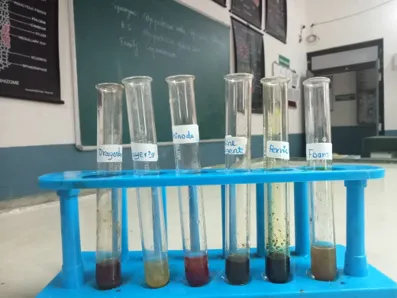
Figure No. 2 Chemical Test
2. Appearance
Table 6. Organoleptic Characteristics (Appearance).
|
Batch |
Colour |
Odour |
Texture |
Consistency |
|
F1 |
Light green |
Characteristic herbal odour |
Smooth |
Semisolid |
|
F2 |
Light green |
Characteristic herbal odour |
Smooth and uniform |
Semisolid |
|
F3 |
Green |
Characteristic herbal odour |
Smooth, uniform and non-gritty |
Semisolid |
|
F4 |
Dark green |
Characteristic herbal odour |
Smooth, homogeneous and non-gritty |
Semisolid |
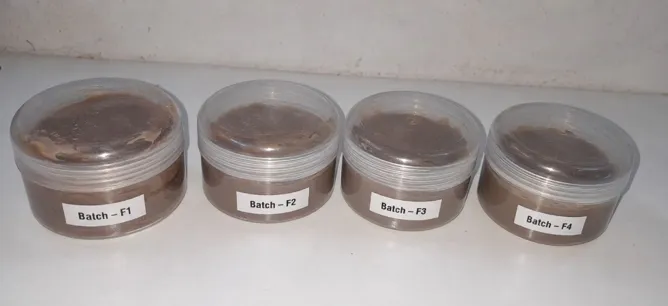
Figure No.3 Formulated Herbal Ointment
The organoleptic characteristics of all formulated ointment batches (F1–F4) were evaluated in terms of colour, odour, texture, and consistency. All formulations exhibited a characteristic herbal odor due to the presence of Bryophyllum pinnatum extract. The ointments were semisolid in nature and showed smooth texture without any signs of grittiness or phase separation. Among all the formulations, F4 exhibited the best organoleptic properties, with a homogeneous, smooth, and non-gritty texture, indicating uniform distribution of the herbal extract throughout the ointment base. The acceptable appearance and consistency of F4 suggested its suitability for topical application and better patient acceptability.
3.Homogeneity
Table 7. Homogeneity of the Formulated Ointment.
|
Batch |
Observation |
|
F1 |
Homogeneous |
|
F2 |
Homogeneous |
|
F3 |
Homogeneous |
|
F4 |
Highly homogeneous, no phase separation |
4. Viscosity
Table 8. Viscosity of the Formulated Ointment.
|
Batch |
Viscosity (cP) |
|
F1 |
13,200 |
|
F2 |
15,800 |
|
F3 |
20,000 |
|
F4 |
21,800 |
5. Spreadability:
Table 9. Spreadability of the Formulated Ointment.
|
Batch |
Spreadability (g·cm/s) |
|
F1 |
26 |
|
F2 |
23 |
|
F3 |
19 |
|
F4 |
17 |
6. Washability:
Table 10. Washability of the Formulated Ointment.
|
Batch |
Observation |
|
F1 |
Moderately washable; slight residue remained after washing. |
|
F2 |
Good washability; a small amount of residue remained. |
|
F3 |
Good washability; easily removed with water and left minimal residue. |
|
F4 |
Excellent washability; easily removed with water without leaving any visible residue. |
7. pH Determination:
Table 11. pH Determination of the Formulated Ointment
|
Batch |
PH (Mean ± SD) |
|
F1 |
6.2 ± 0.1 |
|
F2 |
6.4 ± 0.1 |
|
F3 |
6.5 ± 0.1 |
|
F4 |
6.7 ± 0.1 |
8. Antimicrobial Activity of the Formulated Herbal Ointment:
Table 12. Antimicrobial Activity of the Formulated Herbal Ointment.
|
Sr. No. |
Formulation |
Zone of Inhibition (mm) |
|
1 |
F1 |
12 ± 0.2 |
|
2 |
F2 |
15 ± 0.3 |
|
3 |
F3 |
18 ± 0.2 |
|
4 |
F4 |
21 ± 0.3 |
|
5 |
Standard (Cipladine) |
24 ± 0.2 |
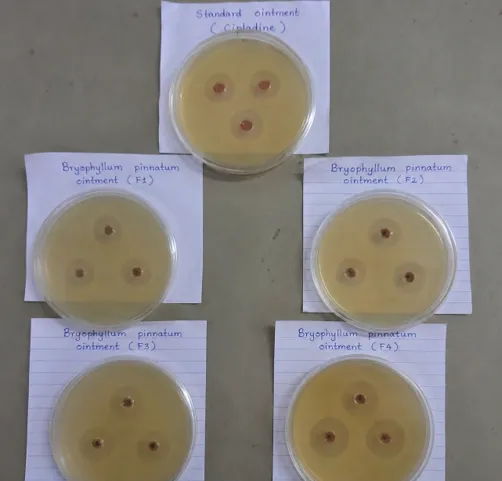
Figure 4. Antimicrobial activity of the formulated herbal ointments (F1–F4) and the marketed formulation (Cipladine) against Staphylococcus aureus using the agar well diffusion method.
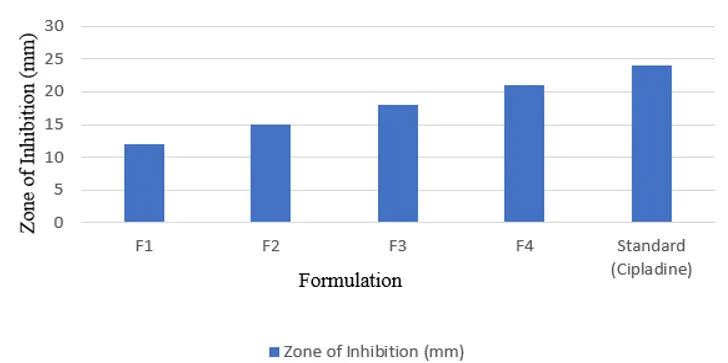
Figure 5. Bar graph showing the zone of inhibition (mm) of the formulated herbal ointments (F1–F4) and the marketed formulation (Cipladine) against Staphylococcus aureus.
The antimicrobial activity of the formulated herbal ointments was evaluated against Staphylococcus aureus using the agar well diffusion method. As shown in Table 12 and Figure 3, all the formulations exhibited antibacterial activity with measurable zones of inhibition. The antimicrobial activity increased progressively from F1 to F4. Among all the formulations, F4 showed the highest zone of inhibition (21 ± 0.3 mm), indicating superior antibacterial activity. The marketed formulation (Cipladine) exhibited the maximum zone of inhibition (24 ± 0.2 mm). The enhanced antimicrobial activity of F4 may be attributed to the presence of bioactive phytoconstituents in Bryophyllum pinnatum extract and the optimized composition of the ointment base, making it a promising formulation for topical wound healing applications.
CONCLUSION
The present study successfully formulated and evaluated a herbal wound healing ointment containing Bryophyllum pinnatum extract. Four different formulations (F1–F4) were prepared by varying the concentrations of the ointment base components and were systematically evaluated for their physicochemical characteristics, phytochemical constituents and antimicrobial activity. All the formulated batches exhibited satisfactory appearance, homogeneity and stability, indicating the suitability of the selected formulation components for topical application.
Among the prepared formulations, F4 was identified as the optimized formulation based on its superior physicochemical properties. It exhibited a smooth and uniform appearance, excellent homogeneity, skin-compatible pH, optimum viscosity, satisfactory spreadability and good washability, making it suitable for easy topical application. Phytochemical screening confirmed the presence of important bioactive constituents such as flavonoids, tannins, alkaloids, glycosides and phenolic compounds, which are known to contribute to wound healing and antimicrobial activities.
The antimicrobial study demonstrated that all formulations exhibited inhibitory activity against Staphylococcus aureus; however, the optimized formulation F4 showed the highest antibacterial activity among the prepared batches and produced a zone of inhibition comparable to the marketed formulation (Cipladine). These findings indicate that the optimized herbal ointment possesses promising pharmaceutical properties and significant antimicrobial potential, supporting its possible use in topical wound management.
Overall, the results suggest that the developed Bryophyllum pinnatum herbal ointment is a promising natural formulation for wound healing applications. Nevertheless, further in vivo pharmacological studies, stability studies and clinical investigations are recommended to confirm its long-term safety, efficacy and therapeutic potential before large-scale clinical use.
REFERENCES

Pooja Pote, Sayali Kotekar, Aarti Injal, Shweta Mali, Samiksha More, Formulation, Physicochemical Evaluation, and Antimicrobial Activity of Herbal Wound Healing Ointment Containing Bryophyllum pinnatum Leaf Extract, Int. J. of Pharm. Sci., 2026, Vol 4, Issue 7, 5932-5941. https://doi.org/10.5281/zenodo.21713081
 10.5281/zenodo.21713081