

We use cookies to ensure our website works properly and to personalise your experience. Cookies policy
Department Of Pharmacy Practice, Hindu College Of Pharmacy, Guntur.
Chemotherapy-induced nausea and vomiting (CINV) is a common and distressing adverse effect of cancer chemotherapy that can reduce patients' quality of life and interfere with treatment adherence. Aprepitant, a neurokinin-1 (NK1) receptor antagonist, has become an important component of antiemetic therapy for the prevention of both acute and delayed CINV. This review summarizes the mechanism of action, clinical efficacy, safety, and current guideline recommendations for aprepitant in the management of CINV. Evidence from clinical studies indicates that aprepitant, when combined with a 5-HT3 receptor antagonist and dexamethasone, significantly improves the prevention of nausea and vomiting in patients receiving highly and moderately emetogenic chemotherapy. Overall, aprepitant is an effective and well-tolerated antiemetic that plays a key role in improving patient comfort, treatment adherence, and quality of life during chemotherapy.
Chemotherapy-induced nausea and vomiting (CINV) is one of the most common and distressing adverse effects experienced by patients undergoing cancer chemotherapy. Despite significant advances in antiemetic therapy, CINV continues to impair patients' quality of life, nutritional status, and adherence to cancer treatment. Effective prevention of CINV is therefore an essential component of supportive cancer care.[1]
CINV is classified into acute, delayed, anticipatory, breakthrough, and refractory types based on the timing of onset and response to treatment. While 5-hydroxytryptamine-3 (5-HT3) receptor antagonists effectively control acute CINV, delayed CINV remains a major clinical challenge.[1]
Aprepitant is a selective neurokinin-1 (NK1) receptor antagonist that inhibits the binding of substance P to NK1 receptors in the central nervous system, thereby suppressing the emetic reflex. When administered in combination with a 5-HT3 receptor antagonist and dexamethasone, aprepitant has demonstrated superior efficacy in preventing both acute and delayed CINV, particularly in patients receiving highly emetogenic chemotherapy.[2,3].Current international guidelines, including those from the American Society of Clinical Oncology (ASCO), the National Comprehensive Cancer Network (NCCN), and the Multinational Association of Supportive Care in Cancer/European Society for Medical Oncology (MASCC/ESMO), recommend NK1 receptor antagonist-based regimens as standard prophylaxis for patients receiving highly emetogenic chemotherapy and selected moderately emetogenic chemotherapy regimens.[3,4]
Overview of Chemotherapy - Induced Nausea and Vomiting:
Definition:
Chemotherapy-induced nausea and vomiting (CINV) refers to nausea and/or vomiting that occurs as an adverse effect of anticancer chemotherapy. It is one of the most common and distressing toxicities of cancer treatment and can significantly impair patients' quality of life, nutritional status, treatment adherence, and overall clinical outcomes. The incidence and severity of CINV depend on the emetogenic potential of the chemotherapy regimen, patient-related risk factors, and the use of appropriate antiemetic prophylaxis.[1]
Epidemiology:
CINV affects a substantial proportion of patients receiving chemotherapy. In the absence of effective antiemetic prophylaxis, approximately 70–80% of patients treated with highly emetogenic chemotherapy experience nausea and vomiting. Although the introduction of 5-hydroxytryptamine-3 (5-HT3) receptor antagonists, neurokinin-1 (NK1) receptor antagonists, and corticosteroids has significantly reduced its incidence, delayed nausea remains a major clinical challenge. Risk factors associated with an increased likelihood of CINV include younger age, female sex, low alcohol consumption, a history of motion sickness or pregnancy-related nausea, anxiety, and previous episodes of CINV. Effective prevention of CINV improves treatment adherence and quality of life in patients undergoing cancer chemotherapy.[1-3]
Pathophysiology:
The pathophysiology of CINV involves complex interactions between the gastrointestinal tract and the central nervous system. Chemotherapy damages enterochromaffin cells in the gastrointestinal mucosa, leading to the release of serotonin (5-hydroxytryptamine, 5-HT). Serotonin activates 5-HT3 receptors on vagal afferent nerves, transmitting signals to the chemoreceptor trigger zone (CTZ) and the vomiting center in the medulla, resulting in acute nausea and vomiting. Delayed CINV is primarily mediated by substance P, which binds to neurokinin-1 (NK1) receptors in the brainstem. Additional modulation by higher cortical centers contributes to anticipatory nausea and vomiting. The combined activation of these pathways initiates the emetic reflex, making dual blockade of 5-HT3 and NK1 receptors an effective strategy for preventing both acute and delayed CINV.[2-4]
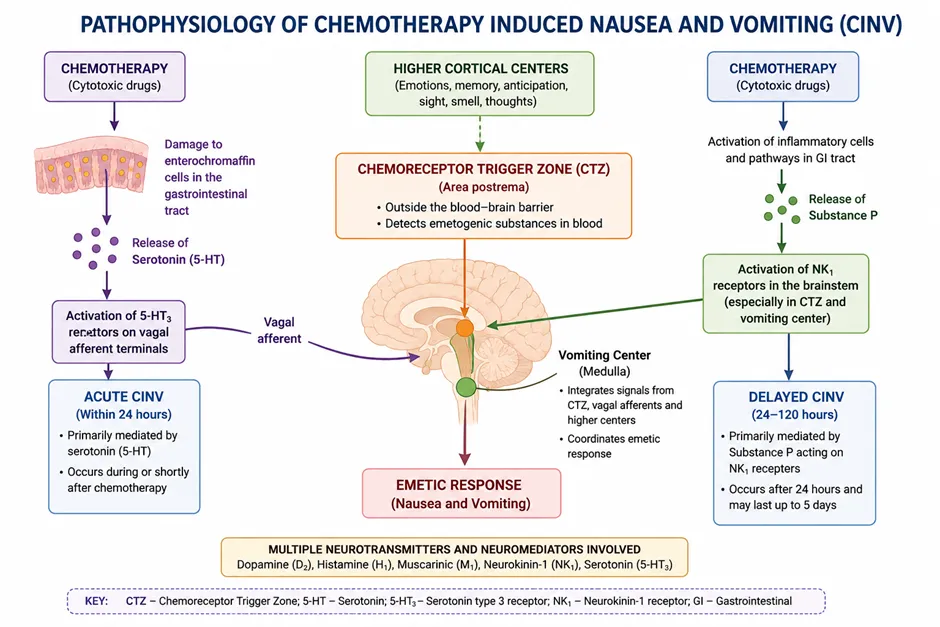
Fig: 1- Pathophysiology of CINV
Classification of CINV:
Table: 1- Classification of CINV
|
Type of CINV |
Time of Onset |
Duration |
Characteristics |
Mechanism |
References |
|
Acute CINV |
Within 24 hours after chemotherapy(usually 1-2 hours after administration) |
Up to 24 hours |
Most common during the first day of chemotherapy;vomiting is more prominent than nausea |
Primarily medicated by serotonin (5-HT) released from enterochromaffin cells, activating 5-HT3 receptors |
[1,2,3] |
|
Delayed CINV |
More than 24 hours after chemotherapy |
Up to 5-7 days |
Common after highly emetogenic chemotherapy,especially cisplatin;nausea is more common than vomiting |
Mainly mediated by substance P acting on neurokinin-1(NK1) receptors in the central nervous system |
[1,2,3] |
|
Anticipatory CINV |
Before chemotherapy administration |
Variable |
Triggered by previous unpleasant chemotherapy experiences;often associated with anxiety and conditioned responses |
Mediated by higher cortical centers through psychological conditioning |
[1,2,3] |
|
Breakthrough CINV |
Occurs despite appropriate prophylactic antiemetic therapy |
Variable |
Nausea and/or vomiting that occur despite preventive treatment and requires rescue antiemetic medication |
May result from inadequate control of multiple emetic pathways or highly emetogenic chemotherapy |
[1,2,3] |
|
Refractory CINV |
Occurs during subsequent chemotherapy cycles after failure of previous antiemetic therapy |
Persistent |
Symptoms continue despite optimal prophylactic and rescue antiemetic treatment |
Due to resistance to standard antiemetic regimens and persistent activation of emetic pathways |
[1,2,3] |
Aprepitant:
Introduction:
Aprepitant is the first orally active neurokinin-1 (NK1) receptor antagonist approved for the prevention of chemotherapy-induced nausea and vomiting (CINV). It is primarily used in combination with a 5-hydroxytryptamine-3 (5-HT3) receptor antagonist and dexamethasone to prevent both acute and delayed CINV in patients receiving highly emetogenic and selected moderately emetogenic chemotherapy. It has significantly improved the management of CINV and enhanced patients' quality of life.[1,2]
Chemical Classification:
Mechanism of Action (MOA):
Aprepitant selectively blocks neurokinin-1 (NK1) receptors in the central nervous system by preventing the binding of substance P, a neurotransmitter involved in the vomiting reflex. This inhibition suppresses both acute and delayed phases of chemotherapy-induced nausea and vomiting. When used with a 5-HT3 receptor antagonist and dexamethasone, it provides superior antiemetic efficacy compared with conventional therapy alone.[2,3]
Pharmacokinetics:
Pharmacodynamics:
Aprepitant competitively antagonizes NK1 receptors, thereby inhibiting substance P-mediated emetic signaling in the brain. It has minimal affinity for serotonin (5-HT3), dopamine, or corticosteroid receptors. Its clinical effect is enhanced when combined with other antiemetics targeting different emetic pathways.[2]
Available Dosage Forms:
Recommended Dosage:
or highly emetogenic chemotherapy (Adults):
Aprepitant should be administered in combination with a 5-HT3 receptor antagonist and dexamethasone according to current antiemetic guidelines.[2,4]
Indications:
Aprepitant is indicated for:
Clinical role of Aprepitant in CINV:
Aprepitant plays a significant role in the prevention of chemotherapy-induced nausea and vomiting (CINV), particularly in patients receiving highly emetogenic chemotherapy (HEC) and selected moderately emetogenic chemotherapy (MEC). As a neurokinin-1 (NK1) receptor antagonist, aprepitant blocks the action of substance P in the central nervous system, thereby reducing both acute (within 24 hours) and delayed (24–120 hours) phases of CINV.[1]
Prevention of Acute CINV:
When used in combination with a 5-hydroxytryptamine-3 (5-HT3) receptor antagonist and dexamethasone, aprepitant significantly improves the prevention of acute nausea and vomiting compared with conventional dual therapy.[2]
Prevention of Delayed CINV:
Delayed CINV remains a major challenge in cancer patients. Aprepitant has demonstrated superior efficacy in preventing delayed nausea and vomiting by inhibiting NK1 receptor-mediated emetic pathways, making it an essential component of antiemetic therapy.[1,2]
Use in Highly Emetogenic Chemotherapy (HEC):
International guidelines recommend aprepitant as part of a standard three-drug antiemetic regimen consisting of an NK1 receptor antagonist, a 5-HT3 receptor antagonist, and dexamethasone for patients receiving highly emetogenic chemotherapy, including cisplatin-based regimens.[3]
Use in Moderately Emetogenic Chemotherapy (MEC):
Aprepitant is also recommended for selected patients receiving moderately emetogenic chemotherapy, particularly those with additional risk factors for CINV or those receiving carboplatin-based chemotherapy. Its addition to standard therapy improves complete response rates and decreases the need for rescue antiemetics.[3]
Combination Therapy:
Aprepitant is most effective when administered as part of combination antiemetic therapy. The combination of aprepitant, a 5-HT3 receptor antagonist (such as ondansetron or palonosetron), and dexamethasone provides comprehensive blockade of multiple emetic pathways, resulting in better control of both nausea and vomiting throughout the chemotherapy cycle.[2,4]
Overall, aprepitant has become a cornerstone of evidence-based supportive care in oncology. Its proven efficacy, favorable safety profile, and inclusion in international antiemetic guidelines have established it as a key agent for improving patient comfort, treatment adherence, and quality of life during chemotherapy.
Safety Profile of Aprepitant:
Table:2 - Safety Profile of Aprepitant
|
Parameter |
Details |
References |
|
Common Adverse Effects |
Fatigue, hiccups, headache, dizziness, constipation, diarrhea, dyspepsia, abdominal pain, decreased appetite, elevated liver enzymes(ALT/AST), and mild infusion-site reactions (with intravenous fosaprepitant). These adverse effects are generally mild to moderate in severity and self-limiting. |
[1,2,3,4] |
|
Serious Adverse Effects |
Severe hypersensitivity reactions (including anaphylaxis), stevens-johnson syndrome(rare), angioedema, severe skin reactions, clinically significant liver dysfunction, and serious drug-drug interactions due to CYP3A4 inhibition or induction. |
[1,2,3,4] |
|
Contraindications |
Hypersensitivity to aprepitant or any of its excipients; concomitant use with pimozide, terfenadine, astemizole, or cisapride, as increased plasma concentrations of these drugs may result in serious or life-threatening cardiac arrhythmias |
[1,2,3,4] |
|
Precautions |
Use cautiously in patients with moderate or severe hepatic impairment; monitor for significant drug interactions with CYP3A4 substrates (e.g.,dexamethasone, warfarin, certain anticancer agents). Monitor INR in patients receiving warfarin.Advise patients that the effectiveness of hormonal contraceptives may be reduced during treatment and for up to 28 days after the last dose; use an alternative or additional non-hormonal contraceptive method. Safety during pregnancy and breastfeeding should be considered only if the potential benefit outweighs the potential risk. |
[1,2,3,4] |
Drug-Drug Interactions of Aprepitant:
Aprepitant is extensively metabolized by the cytochrome P450 (CYP) enzyme system, primarily CYP3A4. It acts as a moderate inhibitor of CYP3A4, a weak inducer of CYP3A4, and an inducer of CYP2C9, making it susceptible to several clinically important drug–drug interactions. Careful monitoring and dose adjustments may be required when aprepitant is administered with drugs metabolized through these pathways.
Table:3 - Important Drug-Drug Interactions of Aprepitant
|
Interacting Drug |
Mechanism of Interaction |
Clinical Effect |
Recommendation |
References |
|
Dexamethasone |
CYP3A4 inhibition by aprepitant increases dexamethasone plasma concentration |
Increased corticosteroid exposure and adverse effects |
Reduce dexamethasone dose by approximately 50% when co-administered |
[1,2,3,4] |
|
Warfarin |
Induction of CYP2C9 increases warfarin metabolism |
Decreased INR and reduced anticoagulant effect |
Monitor INR closely during and after aprepitant therapy |
[1,2,3,4] |
|
Oral hormonal contraceptives |
CYP3A4 induction increases contraceptive metabolism |
Reduced contraceptive efficacy |
Use an additional non-hormonal contraceptive method during treatment and for 28 days after the last dose |
[1,2,3,4] |
|
Midazolam |
CYP3A4 inhibition decreases midazolam metabolism |
Increased sedation and prolonged effect |
Use cautiously and monitor for excessive sedation |
[1,2,3,4] |
|
Vincristine, Vinblastine, Docetaxel, Paclitaxel |
CYP3A4 inhibition may increase plasma concentrations |
Increased risk of chemotherapy-related toxicity |
Monitor patients for adverse effects; dose adjustment may be necessary |
[1,2,3,4] |
|
Ketoconazole |
Strong CYP3A4 inhibitor |
Increases aprepitant plasma concentration |
Use with caution and monitor for adverse effects |
[1,2,3,4] |
|
Rifampicin |
Strong CYP3A4 inducer |
Markedly decreases aprepitant plasma concentration, reducing efficacy |
Avoid concomitant use whenever possible |
[1,2,3,4] |
|
Pimozide, Terfenadine, Astemizole, Cisapride |
CYP3A4 inhibition increase plasma concentrations of these drugs |
Risk of serious ventricular arrhythmias and QT prolongation |
Concomitant use is contraindicated |
[1,2,3,4] |
|
Phenytoin and Carbamazepine |
Strong CYP3A4 inducers |
Decreased aprepitant exposure and reduced antiemetic efficacy |
Avoid concomitant use or monitor clinical response |
[1,2,3,4] |
A thorough review of the patient's medication profile should be performed before initiating aprepitant to minimize the risk of clinically significant drug interactions. Appropriate dose modifications, laboratory monitoring, and patient counseling are essential to ensure the safe and effective use of aprepitant in patients receiving chemotherapy.
Guideline Recommendations:
Several international oncology organizations recommend aprepitant, a neurokinin-1 (NK1) receptor antagonist, as part of standard antiemetic prophylaxis for the prevention of chemotherapy-induced nausea and vomiting (CINV). These recommendations are based on strong clinical evidence demonstrating improved control of both acute and delayed CINV, particularly in patients receiving highly emetogenic chemotherapy.
Table:4 - Guideline Recommendations for Aprepitant in CINV
|
Guideline |
Recommendation |
References |
|
American Society of Clinical Oncology(ASCO) |
Recommends an NK1 receptor antagonist (aprepitant or fosaprepitant) in combination with a 5-HT3 receptor antagonist and dexamethasone for patients receiving highly emetogenic chemotherapy (HEC). It is also recommended for selected moderately emetogenic chemotherapy (MEC) regimens, particularly carboplatin-based chemotherapy. |
[1,2,3,4] |
|
National Comprehensive Cancer Network (NCCN) |
Recommends aprepitant-containing regimens as first-line prophylaxis for HEC and selected MEC regimens. The preferred regimen includes an NK1 receptor antagonist, a 5-HT3 receptor antagonist, dexamethasone, and, in some regimens, olanzapine. |
[1,2,3,4] |
|
Multinational Association of Supportive Care in Cancer/European Society for Medical Oncology (MASCC/ESMO) |
Recommends aprepitant or fosaprepitant in combination with a 5-HT3 receptor antagonist and dexamethasone for preventing acute and delayed CINV associated with highly emetogenic chemotherapy. For selected MEC regimens, NK1 receptor antagonists are recommended based on the emetogenic risk of the chemotherapy. |
[1,2,3,4] |
|
National Institute for Health and Care Excellence (NICE) |
Recommends aprepitant as part of combination antiemetic therapy for adults receiving highly emetogenic chemotherapy and selected moderately emetogenic chemotherapy according to individual patient risk and treatment regimen. |
[1,2,3,4] |
Summary
All major international guidelines consistently recommend aprepitant as an essential component of combination antiemetic therapy for the prevention of CINV. When used with a 5-hydroxytryptamine-3 (5-HT3) receptor antagonist and dexamethasone, aprepitant significantly reduces the incidence of acute and delayed nausea and vomiting, improves treatment adherence, and enhances patients' quality of life.
Advantages and Limitations of Aprepitant
Advantages:
Aprepitant is an effective neurokinin-1 (NK1) receptor antagonist that significantly improves the prevention of both acute and delayed chemotherapy-induced nausea and vomiting (CINV), particularly in patients receiving highly emetogenic chemotherapy. When used in combination with a 5-hydroxytryptamine-3 (5-HT3) receptor antagonist and dexamethasone, it enhances the complete response rate by reducing episodes of vomiting and the need for rescue antiemetic medication. Aprepitant is generally well tolerated and has a favorable safety profile, with most adverse effects being mild and self-limiting. It improves patients' quality of life, promotes adherence to chemotherapy, and is recommended by major international guidelines, including ASCO, NCCN, and MASCC/ESMO, as a key component of standard antiemetic therapy.[1-4]
Limitations:
Despite its clinical benefits, aprepitant has certain limitations. It is relatively expensive compared with conventional antiemetic agents, which may limit its accessibility in some healthcare settings. Aprepitant is extensively metabolized by the CYP3A4 enzyme system and may interact with several medications, including dexamethasone, warfarin, and hormonal contraceptives, requiring careful monitoring and dose adjustments. It should be used with caution in patients with moderate to severe hepatic impairment. Although highly effective in preventing vomiting, aprepitant may not completely eliminate nausea in all patients, especially delayed nausea. Furthermore, it is most effective when used as part of combination antiemetic therapy rather than as a single agent.[1-4]
FUTURE PERSPECTIVES:
Although aprepitant has significantly improved the prevention of chemotherapy-induced nausea and vomiting (CINV), further research is needed to optimize its clinical use and improve patient outcomes. Future studies should focus on developing personalized antiemetic strategies based on individual patient risk factors, genetic variability, and the emetogenic potential of chemotherapy regimens.[1]
The development of newer neurokinin-1 (NK1) receptor antagonists with improved pharmacokinetic properties, longer duration of action, and fewer drug–drug interactions may further enhance the management of CINV. Comparative studies evaluating aprepitant with newer agents such as netupitant and rolapitant are also needed to determine the most effective and cost-efficient treatment strategies.[2]
Future research should assess the long-term safety, cost-effectiveness, and real-world effectiveness of aprepitant across diverse patient populations, including pediatric patients, older adults, and patients with hepatic impairment. In addition, the integration of aprepitant into multimodal antiemetic regimens and adherence to evidence-based clinical guidelines may further improve symptom control, treatment adherence, and quality of life in patients undergoing chemotherapy.[3]
Overall, continued advances in antiemetic therapy and supportive oncology care are expected to further reduce the burden of CINV and optimize cancer treatment outcomes.
CONCLUSION
Chemotherapy-induced nausea and vomiting (CINV) remains one of the most challenging adverse effects of cancer chemotherapy, with a significant impact on patients' quality of life, nutritional status, and adherence to treatment. Aprepitant, a selective neurokinin-1 (NK1) receptor antagonist, has emerged as an important component of modern antiemetic therapy due to its proven efficacy in preventing both acute and delayed CINV. When used in combination with a 5-hydroxytryptamine-3 (5-HT3) receptor antagonist and dexamethasone, aprepitant provides superior control of nausea and vomiting compared with conventional antiemetic regimens.
Evidence from randomized clinical trials and international guidelines consistently supports the use of aprepitant in patients receiving highly emetogenic chemotherapy and selected moderately emetogenic chemotherapy regimens. In addition to its favorable safety profile, aprepitant improves treatment adherence, reduces the need for rescue antiemetic therapy, and enhances patients' overall quality of life. Although challenges such as drug–drug interactions and treatment costs remain, the clinical benefits of aprepitant outweigh these limitations when used appropriately.
In conclusion, aprepitant represents a cornerstone of evidence-based supportive care in oncology and continues to play a vital role in the effective management of chemotherapy-induced nausea and vomiting. Ongoing research and the development of personalized antiemetic strategies are expected to further optimize its clinical use and improve outcomes for patients undergoing chemotherapy.[1-4]
Abbreviations:
Abbreviation| Full Form
CINV| Chemotherapy-Induced Nausea and Vomiting
NK1| Neurokinin-1
5-HT3| 5-Hydroxytryptamine Type-3
HEC| Highly Emetogenic Chemotherapy
MEC| Moderately Emetogenic Chemotherapy
CTZ| Chemoreceptor Trigger Zone
CNS| Central Nervous System
GI| Gastrointestinal
CYP3A4| Cytochrome P450 3A4
CYP2C9| Cytochrome P450 2C9
ASCO| American Society of Clinical Oncology
NCCN| National Comprehensive Cancer Network
MASCC| Multinational Association of Supportive Care in Cancer
ESMO| European Society for Medical Oncology
NICE| National Institute for Health and Care Excellence
FDA| Food and Drug Administration
ALT| Alanine Aminotransferase
AST| Aspartate Aminotransferase
INR| International Normalized Ratio
IV| Intravenous
PO| Per Oral (By Mouth)
RCT| Randomized Controlled Trial
Conflict of Interest:
The authors declare that there are no conflicts of interest regarding the publication of this review article. The authors have no financial, commercial, institutional, or personal relationships that could have influenced the preparation, interpretation, or presentation of the information presented in this manuscript.
ACKNOWLEDGEMENT
The authors express their sincere gratitude to the Department of Pharmacy Practice, Hindu College of Pharmacy, Guntur, for providing the academic support and resources required for the preparation of this review article. The authors also thank the faculty members and mentors for their valuable guidance, encouragement, and constructive suggestions throughout the development of this manuscript. Finally, the authors acknowledge all researchers whose published work contributed to this review.
REFERENCES

Dr. Sk. Shakeela, M. Prathyusha, M. Manogna, K. Usha Kiranmai, Role Of Aprepitant in The Management of Chemotherapy - Induced Nausea and Vomiting: A Review, Int. J. of Pharm. Sci., 2026, Vol 4, Issue 7, 3876-3888, https://doi.org/10.5281/zenodo.21451192
 10.5281/zenodo.21451192