

We use cookies to ensure our website works properly and to personalise your experience. Cookies policy
1Bhalchandra Institute of Pharmacy,pune
2R R College of Pharmacy, Bengaluru
3Government Polytechnic for Women, Srikakulam
4Siddharth Institute of Pharmacy, Mitimita
5Ghausia College of Pharmacy, Bakewar, Fatehpur
6Department of Pharmaceutical Sciences, Mohanlal Sukhadia University, Udaipur.
Artificial intelligence has completely changed the game in biotechnology and drug discovery. Instead of sticking to the old, slow ways of doing research, scientists now use machine learning, deep learning, and natural language processing to speed things up and get more out of the data. These tools help researchers sift through massive, complicated datasets—genomics, proteomics, metabolomics, you name it—and pull out insights that really matter.Traditionally, finding new drugs has been a painfully slow, expensive process. It can take over ten years and cost billions, with most candidates failing before they ever reach the market. But AI makes this whole thing way more efficient. It handles high-speed virtual screenings, builds brand-new drug models from scratch, and predicts how well molecules will work together—all without relying so much on trial-and-error. By looking at molecular interactions, protein–ligand binding, and structure–activity relationships, AI cuts out a ton of wasted effort.AI’s impact doesn’t stop there. It also helps identify and validate drug targets by merging data from different fields, leading to new biomarkers and understanding disease pathways better. In clinical trials, AI can sort and select patients faster, improve recruitment, and track results in real time, which really bumps up the chances of successfully developing new treatments. Drug repurposing powered by AI has also taken off, letting researchers find new uses for existing medications—something especially useful when new diseases pop up.Of course, it’s not all smooth sailing. Data comes in all shapes and sizes, making standardization tough. Many AI models are hard to interpret, which creates “black box” problems. Regulatory rules are still catching up, and ethical issues can be tricky. Still, progress in explainable AI and standards is helping tackle some of these hurdles.In short, AI is changing how we approach biotech and pharma, making drug development faster, cheaper, smarter, and a lot more personalized. This review takes a deep dive into everything AI brings to the table—what works, what still needs fixing, and where things might head next.
The field of biotechnology has undergone rapid evolution over the past few decades, largely driven by advancements in computational tools and data science. The integration of computational methodologies into biological research has enabled scientists to analyze complex biological systems with greater precision and efficiency. Despite these advancements, traditional drug discovery remains a lengthy, expensive, and high-risk process, typically requiring 10–15 years and investments exceeding billions of dollars. Moreover, the high attrition rate—particularly during clinical trial phases—poses a significant challenge to the pharmaceutical industry.(1)
In this context, Artificial Intelligence (AI) has emerged as a disruptive and transformative technology, introducing a paradigm shift in biotechnology research and drug discovery. AI enables automation of repetitive tasks, enhances predictive modeling capabilities, and facilitates data-driven decision-making, thereby significantly reducing time and cost associated with drug development. By leveraging advanced algorithms, AI can process and interpret vast volumes of structured and unstructured biological data far more efficiently than conventional methods.(2)
AI encompasses a broad range of computational techniques that simulate human cognitive functions, including learning, reasoning, and problem-solving. Key subsets of AI include machine learning (ML), which allows systems to learn from data and improve performance without explicit programming; deep learning (DL), which utilizes multilayered neural networks to model complex patterns and relationships; and natural language processing (NLP), which enables machines to understand and extract meaningful information from textual data such as scientific literature and clinical records.
These AI-driven technologies are increasingly being applied across multiple domains of biotechnology, including genomics, proteomics, metabolomics, and pharmacology. In genomics, AI facilitates gene sequencing analysis, mutation detection, and biomarker discovery. In proteomics, it aids in protein structure prediction and interaction analysis, while in pharmacology, it supports drug design, toxicity prediction, and therapeutic optimization. The convergence of AI with biotechnology has thus opened new avenues for innovation, improving the accuracy, efficiency, and scalability of research processes.
Furthermore, the growing availability of big data from high-throughput technologies, electronic health records, and biomedical databases has created a favorable environment for AI applications. The synergy between AI and biotechnology is not only accelerating drug discovery but also advancing the development of personalized medicine, where treatments are tailored based on individual genetic and physiological profiles.(3)
2. OVERVIEW OF ARTIFICIAL INTELLIGENCE IN BIOTECHNOLOGY
Artificial Intelligence (AI) in biotechnology refers to the application of computational algorithms and data-driven models to analyze complex biological systems and generate actionable insights. With the rapid growth of high-throughput technologies such as next-generation sequencing, mass spectrometry, and bioinformatics platforms, the volume of biological data has increased exponentially. AI provides powerful tools to process, interpret, and integrate these large-scale datasets, enabling researchers to uncover hidden patterns, predict biological outcomes, and accelerate scientific discovery.(4)
AI techniques are particularly valuable in handling multi-omics data (genomics, proteomics, metabolomics) and in bridging the gap between experimental biology and computational analysis. By improving data accuracy, reducing manual intervention, and enabling predictive analytics, AI enhances the efficiency and scalability of biotechnology research.
2.1 Machine Learning (ML)
Machine Learning (ML) is a core subset of AI that focuses on developing algorithms capable of learning from data and making predictions or decisions without being explicitly programmed. In biotechnology, ML models are trained on large datasets to identify patterns and relationships between biological variables.
ML techniques such as supervised learning, unsupervised learning, and reinforcement learning are widely used in drug discovery and biomedical research. Supervised learning models are applied to predict drug-target interactions, classify disease states, and estimate toxicity profiles based on labeled datasets. Unsupervised learning methods, such as clustering and dimensionality reduction, are used to identify novel biomarkers, group similar biological samples, and analyze gene expression patterns.(5)
Additionally, ML plays a crucial role in quantitative structure–activity relationship (QSAR) modeling, where it predicts the biological activity of chemical compounds based on their structural features. These capabilities significantly reduce the need for extensive experimental screening and accelerate the identification of potential drug candidates.
2.2 Deep Learning (DL)
Deep Learning (DL) is an advanced branch of machine learning that utilizes artificial neural networks with multiple layers (deep neural networks) to model complex, nonlinear relationships in data. DL has shown remarkable success in analyzing high-dimensional biological data due to its ability to automatically extract relevant features.
In biotechnology, DL is extensively used in areas such as protein structure prediction, genomics, and medical imaging. For instance, deep learning models can predict three-dimensional protein structures from amino acid sequences, which is critical for understanding protein function and drug binding mechanisms. DL is also applied in analyzing genomic sequences to detect mutations, regulatory elements, and gene expression patterns.
Convolutional neural networks (CNNs) and recurrent neural networks (RNNs) are commonly used DL architectures in biological research. CNNs are effective for image-based data such as histopathological images, while RNNs are useful for sequential data such as DNA and RNA sequences. The ability of DL to handle complex datasets makes it a powerful tool in advancing biotechnology research.(6)
2.3 Natural Language Processing (NLP)
Natural Language Processing (NLP) is a branch of AI that enables computers to understand, interpret, and generate human language. In biotechnology and drug discovery, NLP is primarily used to extract meaningful information from vast amounts of unstructured textual data, including scientific publications, clinical trial reports, patents, and electronic health records.
NLP techniques such as text mining, named entity recognition (NER), and sentiment analysis allow researchers to identify relationships between genes, proteins, diseases, and drugs. For example, NLP can be used to automatically extract drug–drug interactions, adverse drug reactions, and therapeutic indications from literature databases.(7)
Furthermore, NLP facilitates knowledge integration by organizing and summarizing large volumes of biomedical information, enabling faster decision-making and hypothesis generation. It also supports drug repurposing efforts by identifying previously unrecognized connections between existing drugs and new therapeutic targets.
3. APPLICATIONS OF AI IN DRUG DISCOVERY
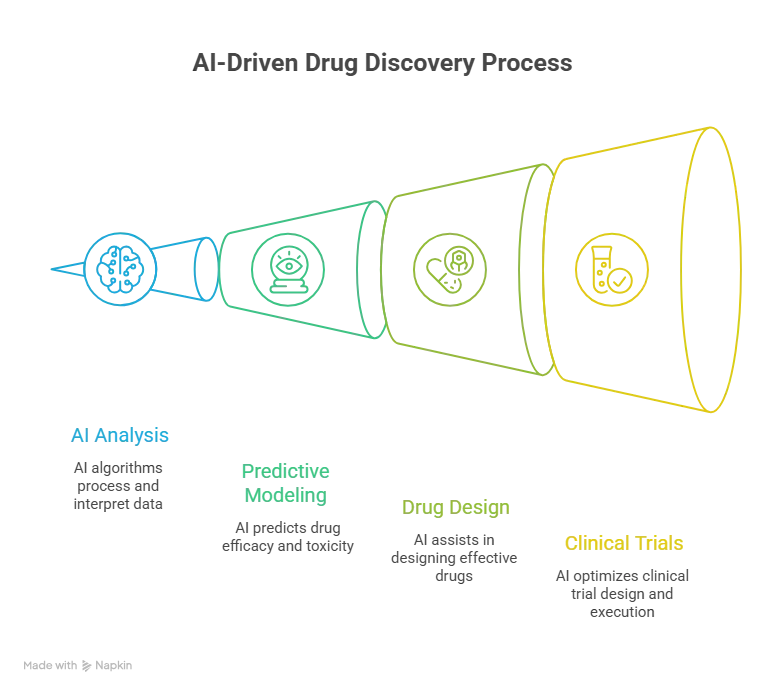
Artificial Intelligence (AI) has significantly transformed the drug discovery pipeline by improving efficiency, accuracy, and decision-making at every stage. From early target identification to late-stage clinical trials, AI-driven approaches enable faster and more cost-effective development of therapeutic agents. By leveraging large-scale biological and chemical datasets, AI minimizes reliance on traditional trial-and-error methods and enhances the probability of success.(8)
3.1 Target Identification and Validation
Target identification is a critical first step in drug discovery, involving the selection of biological molecules such as proteins, genes, or pathways associated with a disease. AI facilitates this process by analyzing complex genomic, transcriptomic, and proteomic datasets to identify potential therapeutic targets.(47)
Machine learning models can integrate multi-omics data to uncover disease-associated biomarkers and signaling pathways. Network-based approaches and systems biology models further help in understanding gene–protein interactions and disease mechanisms. AI also aids in target validation by predicting the functional relevance and druggability of identified targets, thereby reducing experimental workload and improving accuracy.(9)
3.2 Drug Design and Optimization
AI-driven drug design focuses on predicting and optimizing the physicochemical and biological properties of compounds. Advanced algorithms can model structure–activity relationships (SAR) and quantitatively predict how modifications in chemical structure influence biological activity.
Deep learning techniques enable de novo drug design, where entirely new molecular structures are generated with desired properties. AI also predicts ligand–protein binding affinity, helping researchers design molecules with high specificity and efficacy. Additionally, optimization of pharmacokinetic and pharmacodynamic properties—such as solubility, stability, and bioavailability—is achieved through iterative AI-based simulations.(10)
3.3 Virtual Screening
Virtual screening is a computational technique used to evaluate large libraries of chemical compounds and identify potential drug candidates. AI significantly enhances this process by enabling rapid and accurate screening of millions of molecules.(46)
Compared to traditional high-throughput screening (HTS), AI-based virtual screening reduces time, cost, and resource consumption. Machine learning models prioritize compounds based on predicted activity, binding affinity, and drug-likeness. Structure-based and ligand-based screening approaches are further improved using AI, increasing hit rates and reducing false positives.(11)
3.4 Prediction of ADMET Properties
Assessment of ADMET (Absorption, Distribution, Metabolism, Excretion, and Toxicity) properties is essential for determining the safety and efficacy of drug candidates. AI models are extensively used to predict these parameters early in the drug development process.
Machine learning algorithms analyze chemical structure data to estimate oral bioavailability, blood–brain barrier permeability, metabolic stability, and potential toxicity. Early prediction of adverse effects helps in eliminating unsuitable candidates, thereby reducing late-stage failures and improving overall success rates.(12)
3.5 Drug Repurposing
Drug repurposing, also known as drug repositioning, involves identifying new therapeutic uses for existing drugs. AI has emerged as a powerful tool in this area by analyzing clinical data, molecular pathways, and disease networks to uncover novel drug–disease associations.
This approach significantly reduces development time, cost, and regulatory hurdles, as repurposed drugs have already undergone safety evaluations. AI-driven drug repurposing has gained particular importance in addressing urgent health crises, such as emerging infectious diseases, where rapid therapeutic solutions are required.(45)
3.6 Clinical Trial Optimization
Clinical trials are one of the most time-consuming and expensive phases of drug development, often associated with high failure rates. AI improves clinical trial efficiency by optimizing study design, patient recruitment, and data analysis.(48)
AI algorithms analyze electronic health records and real-world data to identify suitable patient populations and predict treatment responses. This enhances patient stratification and reduces variability in trial outcomes. Additionally, AI enables real-time monitoring of clinical data, early detection of adverse events, and adaptive trial designs, ultimately increasing the probability of successful trial completion.(13)
.Here is an expanded and well-structured version with a comparative representation table for your review paper or thesis.
4. ROLE OF ARTIFICIAL INTELLIGENCE IN BIOTECHNOLOGY RESEARCH
Artificial Intelligence (AI) has emerged as a transformative technology in biotechnology research, significantly enhancing the ability to process, analyze, and interpret complex biological information. The advancement of high-throughput technologies such as next-generation sequencing, transcriptomics, metabolomics, and proteomics has generated enormous volumes of biological data. Traditional computational and statistical methods often struggle to manage such multidimensional datasets efficiently. AI provides advanced computational approaches capable of handling large-scale biological information with greater speed, precision, and scalability.(14)
AI integrates machine learning, deep learning, neural networks, natural language processing, and predictive analytics to identify hidden biological relationships, generate predictive models, and automate experimental workflows. These capabilities have accelerated innovation in disease diagnosis, drug discovery, biomarker identification, precision medicine, and synthetic biology. Furthermore, AI improves reproducibility, reduces research costs, minimizes experimental errors, and supports evidence-based scientific decision-making.(44)
The application of AI in biotechnology spans multiple domains, including genomics, proteomics, systems biology, synthetic biology, and personalized medicine. By combining computational intelligence with biological sciences, AI has become an indispensable tool for modern biotechnology research and translational medicine.(15)
4.1 Genomics and Proteomics
AI has revolutionized genomics and proteomics by enabling efficient analysis of highly complex and large-scale biological datasets. In genomics, AI-based algorithms are extensively used for genome sequencing, sequence alignment, variant calling, mutation detection, and identification of disease-associated genes. Machine learning models can analyze gene expression patterns and identify biomarkers associated with various diseases, including cancer, cardiovascular disorders, and neurological conditions.(49)
Deep learning techniques have significantly improved the prediction of genetic abnormalities and disease susceptibility. AI also facilitates the interpretation of epigenetic modifications and regulatory elements involved in gene expression. These advancements support personalized healthcare and targeted therapeutic development.(16)
In proteomics, AI contributes to protein structure prediction, protein–protein interaction analysis, peptide identification, and functional annotation of proteins. Advanced AI models such as deep neural networks can predict three-dimensional protein conformations from amino acid sequences with remarkable accuracy. This has immense importance in understanding protein functionality, molecular interactions, and drug-binding mechanisms.(43)
Additionally, AI assists in identifying post-translational modifications, protein folding abnormalities, and disease-associated protein biomarkers. Such applications are highly valuable in understanding complex pathological conditions and developing novel therapeutic interventions.(17)
4.2 Systems Biology
Systems biology aims to understand the interactions among genes, proteins, metabolites, and cellular pathways within biological systems. AI plays a critical role in integrating multi-omics datasets and constructing computational models that simulate biological processes and disease mechanisms.
AI-driven computational approaches help in the development of gene regulatory networks, signaling pathways, and metabolic interaction networks. These models allow researchers to analyze dynamic biological responses under different physiological and pathological conditions. Machine learning techniques can identify key regulatory genes, molecular targets, and biomarkers involved in disease progression.
By integrating genomic, transcriptomic, proteomic, and metabolomic data, AI enables a systems-level understanding of complex diseases such as cancer, diabetes, neurodegenerative disorders, and autoimmune diseases. AI-based predictive models also support the identification of therapeutic targets and prediction of treatment outcomes.(50)
Furthermore, AI facilitates simulation-based biological research, reducing dependency on costly and time-consuming laboratory experiments. These advancements enhance the efficiency of biomedical research and accelerate translational applications.(18)
4.3 Synthetic Biology
Synthetic biology involves the engineering and redesign of biological systems for useful applications such as pharmaceutical production, biofuel generation, environmental remediation, and industrial biotechnology. AI has substantially accelerated progress in synthetic biology by enabling rational design and optimization of engineered biological systems.
AI algorithms are used for designing genetic circuits, optimizing metabolic pathways, and predicting the behavior of engineered microorganisms. Machine learning models can simulate biological responses under varying environmental conditions, thereby reducing experimental trial-and-error approaches.(42)
AI also supports the discovery and engineering of novel enzymes, biomolecules, and biosynthetic pathways for industrial and therapeutic purposes. Predictive modeling helps researchers identify optimal gene combinations and metabolic configurations for enhanced productivity and stability.(19)
In industrial biotechnology, AI-driven synthetic biology applications contribute to the development of sustainable bioprocesses, improved fermentation technologies, and environmentally friendly manufacturing methods. These innovations have significant implications for healthcare, agriculture, energy production, and environmental sustainability.
4.4 Precision Medicine
Precision medicine focuses on delivering personalized healthcare by tailoring medical treatments according to an individual’s genetic profile, lifestyle, environmental exposure, and clinical history. AI serves as a key enabling technology for precision medicine by integrating and analyzing complex datasets from genomics, clinical records, imaging systems, and real-world patient data.
Machine learning algorithms can predict disease susceptibility, treatment response, drug toxicity, and patient prognosis with high accuracy. AI helps identify patient subgroups that are more likely to respond positively to specific therapies, thereby improving therapeutic efficacy and minimizing adverse drug reactions.(20)
In oncology, AI-driven precision medicine has enabled the development of targeted therapies based on tumor genetic mutations and molecular biomarkers. AI also supports early disease detection through advanced medical imaging analysis and predictive diagnostics.
Furthermore, AI enhances clinical decision-making by providing healthcare professionals with evidence-based recommendations and personalized treatment strategies. The integration of AI into healthcare systems improves patient outcomes, optimizes resource utilization, and promotes efficient healthcare delivery.(21)
Table 4.1: Applications of Artificial Intelligence in Biotechnology Research
|
Area of Biotechnology |
Role of AI |
Major Applications |
Benefits |
|
Genomics |
Analysis of genomic data using machine learning and deep learning |
Genome sequencing, mutation detection, biomarker identification, disease prediction |
Faster analysis, improved accuracy, personalized medicine |
|
Proteomics |
Prediction and analysis of protein structures and interactions |
Protein folding prediction, protein–protein interaction analysis, functional annotation |
Enhanced drug discovery and understanding of disease mechanisms |
|
Systems Biology |
Integration and modeling of biological networks |
Gene regulatory networks, metabolic pathway analysis, disease modeling |
Systems-level understanding of complex diseases |
|
Synthetic Biology |
Design and optimization of engineered biological systems |
Genetic circuit design, metabolic engineering, enzyme discovery |
Reduced experimental errors and improved productivity |
|
Precision Medicine |
Personalized analysis of patient-specific data |
Disease risk prediction, targeted therapy, clinical decision support |
Improved treatment efficacy and reduced adverse effects |
|
Drug Discovery |
AI-driven prediction and screening of drug candidates |
Virtual screening, target identification, lead optimization |
Reduced time and cost of drug development |
|
Healthcare Diagnostics |
AI-assisted medical analysis and diagnostics |
Medical imaging, disease classification, predictive diagnostics |
Early disease detection and improved patient care |
5. ADVANTAGES OF ARTIFICIAL INTELLIGENCE IN DRUG DISCOVERY
Artificial Intelligence (AI) has emerged as a revolutionary technology in the field of drug discovery and pharmaceutical research. Traditional drug development processes are often time-consuming, expensive, and associated with high failure rates. The integration of AI into pharmaceutical research has significantly improved the efficiency, speed, and accuracy of various stages involved in drug discovery. By utilizing machine learning, deep learning, neural networks, and predictive analytics, AI enables researchers to analyze complex biological and chemical datasets more effectively.(41)
AI facilitates rapid identification of drug targets, optimization of lead compounds, prediction of toxicity profiles, and enhancement of clinical trial success rates. Furthermore, AI-driven automation minimizes human error, improves reproducibility, and supports data-driven decision-making. The application of AI not only accelerates the development of novel therapeutics but also promotes personalized medicine and innovative treatment strategies.(22)
The major advantages of AI in drug discovery are discussed below.
5.1 Reduction in Time and Cost
One of the most important advantages of AI in drug discovery is the significant reduction in the time and financial investment required for the development of new drugs. Conventional drug discovery generally takes 10–15 years and involves billions of dollars in research and development costs. The lengthy process includes target identification, lead discovery, preclinical testing, clinical trials, and regulatory approval.(23)
AI accelerates early-stage drug discovery by performing rapid computational screening of millions of chemical compounds within a short period. Machine learning algorithms can identify promising drug candidates, predict their biological activity, and optimize lead compounds efficiently. Virtual screening and computer-aided drug design reduce dependency on labor-intensive laboratory experiments, thereby minimizing operational costs.
Additionally, AI enables faster analysis of experimental data and improves decision-making throughout the drug development pipeline. These advancements help pharmaceutical companies reduce research expenses and accelerate the availability of new therapies to patients.
5.2 Enhanced Accuracy in Prediction Models
AI-based predictive models offer improved accuracy in understanding biological and chemical interactions. Machine learning and deep learning algorithms can analyze large datasets containing molecular structures, biological pathways, pharmacological properties, and clinical outcomes.(24)
These AI models accurately predict drug–target interactions, binding affinities, toxicity profiles, pharmacokinetics, and pharmacodynamics. Early prediction of adverse effects and poor pharmacological properties reduces the likelihood of late-stage drug failure. Furthermore, AI assists in identifying biomarkers and therapeutic targets associated with specific diseases.
The enhanced predictive capability of AI increases the reliability of research findings and supports evidence-based drug development. As a result, pharmaceutical researchers can make more informed decisions during lead optimization and candidate selection.(25)
5.3 Improved Success Rate in Clinical Trials
Clinical trials represent one of the most challenging and expensive phases of drug development, with a large proportion of investigational drugs failing due to inadequate efficacy or unexpected safety concerns. AI significantly improves the efficiency and success rate of clinical trials by enabling better trial design and patient selection.
AI algorithms analyze patient demographics, genetic profiles, medical histories, and real-world clinical data to identify suitable participants for clinical studies. This process, known as patient stratification, ensures that therapies are tested on individuals who are more likely to respond positively.
Additionally, AI supports real-time monitoring of patient data, adverse events, and treatment responses during clinical trials. Predictive analytics help researchers identify potential risks early and optimize trial protocols accordingly. These improvements reduce trial attrition rates, lower development costs, and increase the probability of regulatory approval.(26)
5.4 Efficient Handling of Large and Complex Datasets
Modern biomedical research generates enormous amounts of data from genomics, proteomics, metabolomics, transcriptomics, and clinical studies. Traditional analytical methods often struggle to manage and interpret such multidimensional datasets efficiently.
AI systems are specifically designed to process, integrate, and analyze large-scale biological and clinical data rapidly and accurately. Machine learning algorithms can identify hidden correlations, patterns, and disease-associated biomarkers that may not be detectable through conventional statistical approaches.(27)
AI-driven big data analytics enables researchers to gain deeper insights into disease mechanisms, drug responses, and therapeutic targets. Efficient data handling also enhances collaboration among researchers and improves the reproducibility of scientific findings.(28)
5.5 Facilitation of Personalized Medicine
AI plays a central role in the advancement of personalized or precision medicine. Personalized medicine aims to develop therapeutic strategies tailored to an individual’s genetic profile, environmental exposure, lifestyle, and disease characteristics.
AI algorithms analyze patient-specific genomic and clinical data to predict disease susceptibility, treatment response, and risk of adverse drug reactions. This allows healthcare professionals to select the most effective therapy for each patient while minimizing unwanted side effects.(40)
In oncology, AI-driven precision medicine has enabled targeted cancer therapies based on tumor-specific genetic mutations. AI also supports individualized dosage optimization and treatment planning, thereby improving overall patient outcomes and quality of care.
The integration of AI into personalized medicine contributes to more accurate diagnoses, effective therapies, and improved healthcare delivery systems.(29)
5.6 Acceleration of Drug Repurposing and Innovation
Drug repurposing involves identifying new therapeutic applications for existing drugs. AI significantly accelerates this process by analyzing biological pathways, molecular interactions, disease networks, and clinical databases.
Machine learning models can rapidly identify existing drugs with potential efficacy against different diseases, thereby reducing development time and regulatory challenges. This approach became particularly important during global health emergencies such as the COVID-19 pandemic, where AI-assisted drug repurposing helped identify potential therapeutic candidates quickly.
Furthermore, AI supports innovation by discovering novel drug targets, designing new molecular entities, and predicting mechanisms of action. Advanced AI models can generate entirely new chemical structures with desirable pharmacological properties, opening new possibilities in pharmaceutical research and therapeutic development.(30)
5.7 Reduction in Human Error and Increased Reproducibility
Human errors in data analysis, experimental procedures, and interpretation can significantly affect the reliability of scientific research. AI-driven automation minimizes manual intervention and standardizes computational workflows, thereby reducing the chances of human error.
Automated AI systems improve the consistency, reproducibility, and reliability of research findings. Standardized analytical methods ensure that experimental results can be validated and reproduced across different laboratories and research settings.
In addition, AI enhances documentation, data management, and quality control processes, which are essential for regulatory compliance and scientific transparency. Improved reproducibility strengthens confidence in research outcomes and facilitates regulatory approval of pharmaceutical products.(31)
Table 5.1: Advantages of Artificial Intelligence in Drug Discovery
|
Advantage |
Role of AI |
Major Impact |
|
Reduction in Time and Cost |
Accelerates screening, target identification, and lead optimization |
Faster drug development and reduced research expenses |
|
Enhanced Predictive Accuracy |
Predicts drug interactions, toxicity, and pharmacokinetic properties |
Improved reliability and reduced late-stage failures |
|
Improved Clinical Trial Success |
Supports patient stratification and trial optimization |
Increased clinical success rates and lower attrition |
|
Efficient Data Handling |
Processes large-scale biological and clinical datasets |
Better identification of biomarkers and disease mechanisms |
|
Personalized Medicine |
Analyzes patient-specific genetic and clinical data |
Tailored therapies with improved treatment outcomes |
|
Drug Repurposing and Innovation |
Identifies new uses for existing drugs and novel compounds |
Faster therapeutic development and innovation |
|
Reduction in Human Error |
Automates workflows and standardizes data analysis |
Improved reproducibility and scientific reliability |
6. CHALLENGES AND LIMITATIONS
Despite its transformative potential, the application of Artificial Intelligence (AI) in biotechnology and drug discovery is associated with several challenges and limitations that must be addressed for its widespread adoption.
6.1 Data Quality and Availability Issues
AI models rely heavily on large volumes of high-quality data. However, biological and clinical datasets are often incomplete, noisy, or biased. Inconsistent data collection methods and missing values can significantly affect model performance and reliability. Additionally, access to proprietary pharmaceutical data is often restricted, limiting model training and validation.(32)
6.2 Lack of Standardized Datasets
The absence of standardized formats for biological and clinical data poses a major challenge. Data generated from different platforms, laboratories, and experimental conditions often lack uniformity, making integration and comparative analysis difficult. This heterogeneity reduces the reproducibility and generalizability of AI models.
6.3 Ethical and Regulatory Concerns
AI applications in healthcare raise important ethical issues, including data privacy, patient consent, and algorithmic bias. The use of sensitive patient data requires strict compliance with regulatory frameworks. Furthermore, the “black-box” nature of many AI models limits transparency and interpretability, which can hinder regulatory approval and clinical trust.(33)
6.4 High Implementation Cost
The adoption of AI technologies requires significant investment in computational infrastructure, software development, and data management systems. Small and mid-sized research organizations may face financial barriers in implementing AI-driven solutions. Additionally, maintaining and updating AI systems incurs ongoing costs.(34)
6.5 Need for Skilled Professionals
Effective utilization of AI in biotechnology requires interdisciplinary expertise in biology, pharmacology, data science, and computer programming. There is currently a shortage of professionals with such combined skill sets, which limits the integration of AI into research and industrial applications.
7. CASE STUDIES
7.1 AI-Based Identification of COVID-19 Drug Candidates
During the COVID-19 pandemic, AI played a crucial role in accelerating drug discovery and repurposing efforts. Machine learning models analyzed viral protein structures, host–virus interactions, and existing drug databases to identify potential therapeutic candidates. AI-enabled screening significantly reduced the time required to shortlist promising drugs for clinical evaluation.(35)
7.2 Protein Structure Prediction Using AlphaFold
One of the most significant breakthroughs in AI-driven biotechnology is the development of AlphaFold, an advanced deep learning system capable of predicting three-dimensional protein structures with high accuracy. This innovation has addressed a long-standing challenge in structural biology and has profound implications for drug discovery, as understanding protein structure is essential for designing effective therapeutics.
7.3 AI-Driven Oncology Drug Discovery
AI has been extensively applied in oncology for identifying novel drug targets, predicting tumor behavior, and designing targeted therapies. Machine learning models analyze genomic and clinical data to identify cancer-specific mutations and biomarkers. AI-driven platforms have successfully accelerated the discovery of small-molecule inhibitors and immunotherapies, improving treatment outcomes in cancer patients.(36)
FUTURE PERSPECTIVES
The future of AI in biotechnology and drug discovery is highly promising, with continued advancements expected to further enhance its capabilities and applications.
8.1 Integration with Big Data Analytics
The combination of AI with big data analytics will enable the processing of increasingly large and complex datasets, leading to more accurate predictions and deeper biological insights.
8.2 Cloud Computing
Cloud-based platforms will facilitate scalable storage and high-performance computing, allowing researchers worldwide to access AI tools and collaborate more effectively.(39)
8.3 Internet of Medical Things (IoMT)
Integration of AI with IoMT devices will enable real-time monitoring of patient health data, supporting personalized treatment strategies and improving clinical outcomes.(37)
8.4 Quantum Computing
Emerging technologies such as quantum computing have the potential to revolutionize drug discovery by solving complex molecular simulations and optimization problems beyond the capabilities of classical computers.
8.5 Development of Explainable AI and Regulatory Frameworks
Future efforts will focus on developing explainable AI models that provide transparent and interpretable results. Strengthening regulatory frameworks and ethical guidelines will be essential to ensure safe, reliable, and trustworthy AI applications in healthcare.(38)
CONCLUSION
Artificial Intelligence has significantly transformed modern biotechnology and drug discovery by enhancing efficiency, accuracy, and innovation across all stages of the development pipeline. From target identification to clinical trials, AI-driven approaches have reduced time, cost, and failure rates, while enabling the discovery of novel therapeutics and personalized treatment strategies.
Despite existing challenges such as data limitations, ethical concerns, and high implementation costs, ongoing advancements in AI technologies, data standardization, and regulatory frameworks are expected to overcome these barriers. The integration of AI with emerging technologies such as big data analytics, cloud computing, and quantum computing will further accelerate progress in this field.Overall, the synergy between AI and biotechnology holds immense potential to revolutionize healthcare by enabling the development of safer, more effective, and patient-specific therapeutic interventions, ultimately improving global health outcomes.
REFERENCES

Ankita pawar, Saurabh Kumar, Konda V V S Krishna, Yogita Suryavanshi, Sachin Kumar, Dr. Mukesh Kumar Meena, Role Of Artificial Intelligence in Modern Biotechnology Research and Drug Discovery, Int. J. of Pharm. Sci., 2026, Vol 4, Issue 6, 6265-6279-51, https://doi.org/10.5281/zenodo.20841089
 10.5281/zenodo.20841089