

We use cookies to ensure our website works properly and to personalise your experience. Cookies policy
Department of pharmacology, Bharathi College of Pharmacy, Bharathinagara, Maddur taluk , Mandya district , Karnataka , India- 571422
Schizophyllum commune is a widely distributed edible and medicinal mushroom belonging to the family Schizophyllaceae. It has attracted significant scientific interest due to its rich nutritional composition and diverse pharmacological properties. The mushroom contains various bioactive constituents, including polysaccharides, proteins, phenolic compounds, flavonoids, terpenoids, and essential minerals, which contribute to its therapeutic potential. Among these compounds, schizophyllan, a ?-glucan polysaccharide, has been extensively studied for its immunomodulatory, antitumor, antioxidant, and antimicrobial activities. Recent studies have demonstrated that extracts of S. commune possess anti-inflammatory, hepatoprotective, anticancer, and enzyme inhibitory effects, highlighting its potential application in the prevention and management of various diseases. In addition to its medicinal value, S. commune has gained importance in biotechnology, nutraceuticals, and pharmaceutical research due to its ability to produce biologically active metabolites. This review summarizes the taxonomy, distribution, nutritional composition, bioactive constituents, pharmacological activities, and therapeutic applications of S. commune. Furthermore, current research trends and future prospects for the development of mushroom-derived therapeutic agents are discussed. The available evidence suggests that S. commune represents a promising natural resource for the discovery of novel bioactive compounds and the development of functional foods and pharmaceutical products
Mushrooms are the fleshy, spore-producing fruiting bodies of basidiomycete fungi that typically grow above ground on soil or on their organic substrates. They have been consumed as food and used in traditional medicine for centuries due to their nutritional and therapeutic value. In recent years, mushrooms have gained increasing attention as functional foods because of their significant contributions to human health, nutrition, and disease prevention. The well-known concept that "food and medicine share a common origin" aptly reflects the role of edible mushrooms, which are rich sources of bioactive compounds with diverse medicinal properties. Numerous studies have demonstrated that dietary mushrooms possess antioxidant, immunomodulatory, antimicrobial, anti-inflammatory, and anticancer activities, making them promising natural agents for the prevention and management of several life-threatening diseases. [1]
2.0 Schizophyllum commune:
Schizophyllum commune is a globally distributed basidiomycete fungus that commonly colonizes dead and decomposing lignocellulosic materials, particularly decaying wood. It represents the teleomorphic (sexual) stage of the fungus and is recognized as one of the most widespread mushroom-forming species. Taxonomically, S. commune belongs to the phylum Basidiomycota, subphylum Agaricomycotina, and order Agaricales, a diverse group comprising the fungi commonly referred to as mushrooms. [2] The genus name Schizophyllum originates from the Greek-derived terms schizo, meaning "split," and phyllon, meaning "leaf" or "lamella," referring to the characteristic split gills that distinguish this fungus from other mushroom species. [3] The species epithet commune reflects its ubiquitous distribution and widespread occurrence across diverse habitats. Its efficient spore dispersal over long distances facilitates extensive colonization and contributes to considerable genetic diversity within and among populations through gene flow and genetic drift. [4]. Commonly referred to as the split-gill mushroom, Schizophyllum commune was first formally described in 1815. This edible mushroom is recognized for its rich nutritional composition, comprising carbohydrates, proteins, lipids, vitamins, minerals, and essential amino acids, including threonine, valine, methionine, isoleucine, leucine, phenylalanine, histidine, and tryptophan. The abundance of these nutrients, together with its diverse bioactive constituents, underpins its nutritional significance and broad spectrum of health-promoting and therapeutic properties[5]. Schizophyllum commune is a white-rot basidiomycete fungus capable of degrading lignocellulosic biomass through the production of a diverse array of metabolites, including lignocellulolytic enzymes, the extracellular polysaccharide schizophyllan, and ethanol. It is an edible mushroom characterized by a tough, leathery fruiting body that predominantly develops during the rainy season. This species commonly colonizes dead and decaying wood, where it plays a vital ecological role in lignin degradation and nutrient recycling. Under favorable environmental conditions, S. commune completes its life cycle within approximately 10 days, making it a valuable model organism for studies on fungal biology and lignocellulose degradation. [6]. Schizophyllan, a biologically active extracellular β-glucan produced by Schizophyllum commune, has attracted considerable attention because of its diverse pharmacological properties, including antitumor, anticancer, anti-inflammatory, and immunomodulatory activities. In addition to its therapeutic potential, schizophyllan possesses unique physicochemical characteristics that support a wide range of industrial applications, such as its use as a thickening and stabilizing agent in cosmetic formulations and as an oxygen-impermeable film-forming material for food packaging and preservation. [7] Schizophyllum commune has been extensively investigated for its diverse biological and pharmacological activities. Studies have demonstrated that this mushroom exhibits antidiabetic, anti-inflammatory, antimicrobial, antioxidant, antitumor, antityrosinase, immunomodulatory, neuroprotective, cytotoxic, genotoxic, antibacterial, antifungal, antiviral (including anti-dengue), hypoglycemic, immunostimulatory, and anticancer properties. These multifunctional bioactivities highlight the therapeutic potential of S. commune as a promising source of natural bioactive compounds for pharmaceutical, nutraceutical, and biomedical applications. [8]
2.1 Taxonomic Classification of Schizophyllum commune [9]:
Schizophyllum commune, commonly referred to as the split-gill mushroom or split-fold mushroom, is a widely distributed basidiomycete fungus belonging to the family Schizophyllaceae. Its taxonomic classification is presented below table 1.
Table 1: Taxonomic classification of S.commune
|
Taxonomic Rank |
Classification |
|
Kingdom |
Fungi |
|
Phylum |
Basidiomycota |
|
Class |
Agaricomycetes |
|
Subclass |
Agaricomycetidae |
|
Order |
Agaricales |
|
Family |
Schizophyllaceae |
|
Genus |
Schizophyllum |
|
Species |
Schizophyllum commune |
2.2 Common names: [10]
Table 2: Common names of S. commune.
|
Language |
Names |
|
Manipuri |
Kanglayen |
|
Mizoram |
Pasi |
|
Arunachal Pradesh |
Hubsi |
|
Indonesia |
Tanggidi |
|
Bengali |
Pakha chhatu |
|
Kannada |
Birukulli Anabe |
|
Urdu |
Kulat kodop |
2.3 Synonyms: [11]
Synonyms of Schizophyllum commune include:
2.4 Morphological characterization of Schizophyllum commune Fr.
Classification: [12]
Fungi, Dikarya, Basidiomycota, Agaricomycotina, Agaricomycetes, Agaricomycetidae, Agaricales, Schizophyllaceae, Schizophyllum Fr. 1815. Fruiting bodies become shrivelled in dry weather and appear light grey to brown; the hymenophore is confined to the lower side. The marginal proliferation is distinctly visible.
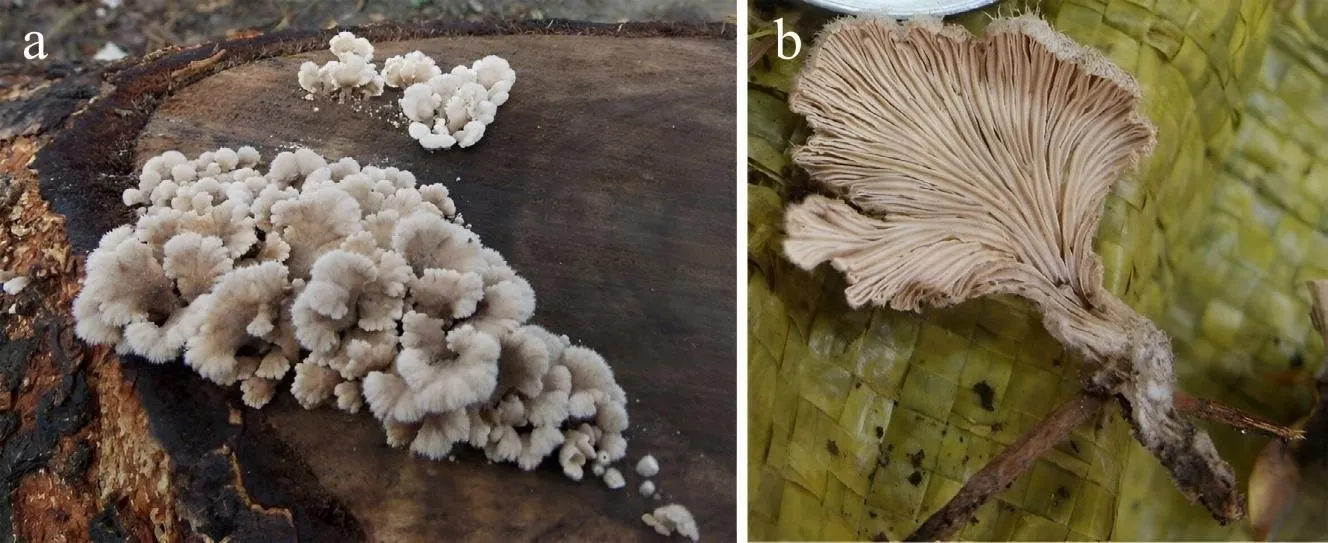
Figure 1: Photography of S.commune
(a): Habitat photographs of S. commune (split gill fungus); (b): Ventral surface of the fruiting body.
2.5 Origin and distribution: [13]
Schizophyllum commune exhibits a broad geographical distribution and has been reported from numerous countries across Asia, including Thailand, Taiwan, Malaysia, Vietnam, southern China, and Indonesia, particularly on Sumatra Island. The species has also been documented in Mexico. In India, S. commune is predominantly distributed in the northeastern region, with reports from Manipur and West Bengal.
2.6 Phytochemical constituents: [14,15]
Schizophyllum commune is a rich source of diverse bioactive compounds, contributing to its significance in both medicinal and culinary applications. The nutritional composition of S. commune varies depending on the cultivation substrate. Fruiting bodies cultivated on a substrate containing 94% grape residue, supplemented with 5% wheat bran and 1% calcium carbonate, and maintained at a moisture content of 60–70%, exhibited the following proximate composition: 8.40 ± 0.53% moisture, 6.36 ± 0.22% ash, 16.59 ± 0.12% protein, 2.95 ± 1.37% fat, 59.61 ± 0.36% dietary fiber, and 6.09 ± 0.01% carbohydrates.
Table 3. Bioactive Compounds of S. Commune
|
Bioactive compound (mg/100g) |
|
|
Alkaloids |
4.26 |
|
Flavonoids |
4.67 |
|
Phenolics |
10.8 |
|
Saponins |
23.83 |
|
Tannins |
1.24 |
2.7 Nutraceutical properties of S. Commune: [16]
Table 4. Nutraceutical Properties of S. commune
|
s.no |
Parameters |
s.commune |
|
|
Fresh mushroom |
Dried mushroom |
||
|
1. |
Carbohydrate (%) |
30.51 |
74.00 |
|
2. |
Protein (%) |
6.18 |
13.70 |
|
3. |
Crude fiber (%) |
1.20 |
3.08 |
|
4. |
Calorific value (kcal/100g) |
147.84 |
358.00 |
|
5. |
Total phenols (mg/100g) |
108.73 |
130.36 |
|
6. |
Total antioxidant activity |
1267.00 |
1090.76 |
|
7. |
Water activity (aw) |
0.993 |
0.531 |
|
8. |
Potassium (ppm) |
3306.32 |
7593.95 |
|
9. |
Sodium (ppm) |
571.75 |
677.23 |
|
10. |
Zinc (ppm) |
20.34 |
38.56 |
2.8 Pharmacological activities of Schizophyllum commune
1. Antioxidant Properties [17]:
Reactive oxygen species (ROS) and other free radicals are highly unstable molecules that induce oxidative damage to cellular biomolecules, including lipids, proteins, and nucleic acids, ultimately leading to cellular dysfunction or death. Persistent oxidative stress resulting from excessive free radical production has been implicated in the development of numerous degenerative disorders, such as aging, cancer, cardiovascular diseases, Alzheimer's disease, and other chronic conditions. Antioxidants play a vital role in maintaining redox balance by scavenging free radicals and minimizing oxidative damage. Several studies have evaluated the antioxidant properties of Schizophyllum commune using different in vitro assays. Among the various solvent extracts, the ethanolic extract demonstrated the greatest antioxidant potential. Chandrawanshi et al. reported that the ethanolic extract exhibited the highest DPPH radical scavenging activity (IC₅₀ = 18.56 μg/μl), followed by the hot water and methanolic extracts. The hot water extract also showed considerable DPPH scavenging activity (IC₅₀ = 20.00μg/μl), whereas the aqueous extract displayed the strongest reducing power at a concentration of 10 mg/ml. Furthermore, the ethanolic extract exhibited the highest hydrogen peroxide (H₂O₂) scavenging activity, with an IC₅₀ value of 19.24 μg/μl. The antioxidant capacity of S. commune is largely attributed to its phenolic constituents, including flavonoids and phenolic acids, which are recognized for their ability to neutralize reactive oxygen species and protect cellular components from oxidative injury. These compounds also contribute to the prevention of vascular disorders, certain types of cancer, and other oxidative stress-related diseases. The flavonoid content of S. commune has been reported as 29.80 ± 0.27 mg quercetin equivalents (QE)/g. Among different solvent extracts, the aqueous extract contained the highest total phenolic content (81.97%), followed by the methanolic extract (75.11%), whereas the ethanolic extract exhibited the lowest phenolic content (47.08%).
2.Antitumor Activity [18,19]:
The anticancer potential of natural polysaccharide–protein hybrids (PSHs) is challenging to compare directly with that of synthetic chemotherapeutic agents because of their diverse physicochemical characteristics and multifaceted mechanisms of action. The antitumor efficacy of fungal PSHs varies among species and is generally associated with their ability to modulate immune responses rather than exert direct cytotoxic effects [18]. Most investigations on the antitumor properties of Schizophyllum commune were conducted before 2017, with limited recent studies specifically addressing this biological activity. López Legarda et al. evaluated the submerged cultivation, extraction, and antitumor potential of PSHs obtained from Schizophyllum radiatum. The extracts were assessed against several cancer cell lines, including EL-4, MDA-MB-231, RAW 264.7, and U937, to determine both their antitumor and immunostimulatory activities. The findings indicated that these PSHs suppress tumor growth through both direct and indirect mechanisms, primarily by stimulating immune cells such as macrophages. Among the tested extracts, the intracellular polysaccharide (SIPS) fraction exhibited the greatest antitumor activity, whereas the extracellular polysaccharide (SEPS) fraction showed the strongest immunostimulatory effect. Although the PSHs did not demonstrate direct cytotoxicity comparable to conventional anticancer drugs, they significantly enhanced macrophage activation under in vitro conditions. The authors suggested that the antitumor efficacy of SIPS and SEPS may be more pronounced in vivo through synergistic interactions with the host immune system and gut microbiota.
3.Anti-Acetylcholinesterase Activity [20]:
An imbalance between free-radical production and scavenging can lead to various diseases, including neurodegenerative disorders such as Alzheimer’s disease. Since there is currently no cure or way to halt or reverse its progression, acetylcholinesterase (AChE) inhibitors have attracted significant research interest. Consequently, a range of organisms, including fungi, have been investigated as potential sources of physiologically active compounds that could serve as effective AChE inhibitors. To date, the anti-acetylcholinesterase activity of S. commune has been explored in only one study conducted in 2021. Mišković et al. demonstrated that PSH extracts of S. commune exhibited notable neuroprotective effects, establishing the species as a promising source of AChE inhibitors. In their study, the highest AChE inhibition was observed with the M28 SRB PSH extract (IC90 = 79.73 ± 26.34 μg/mL), while the IT extract showed greater activity in the F14 ethanol extracts (IC50 = 0.8 ± 0.6 μg/mL). Notably, the activity of the M28 SRB PSH extract was comparable to that of the commercially approved Alzheimer’s drug donepezil (IC90 = 87.92 μg/mL). The anti-AChE activity has been associated with phenolic compounds and flavonoids, and evidence from previous studies suggests a possible synergistic effect between primary metabolites (such as the polysaccharide fraction, likely SPG) and secondary metabolites (Phenolics).
4.Anti-diabetic properties [21]:
Diabetes mellitus is a chronic hyperglycaemic disorder, characterized by disturbances in lipid and carbohydrate me tabolism, as well as glucose homeostasis. Hydrolysis of α-1,4-glycosidic bond which is a major pathway for produc ing simple sugar in humans is inhibited by S. commune en zymes αglucosidase which results in delaying carbohydrate metabolism and rate of glucose absorption. Hence, decreasing postprandial plasma glucose levels and improving glucose tolerance in diabetes patients. The anti-diabetic properties of S. commune crude extracts were investigated through various assays and it was observed that the ethanolic extract exhibited the highest anti-diabetic rate of 23.74 ± 0.09, while the aque-ous extract showed the lowest rate of 21.49 ± 0.0. The meth-anolic extract demonstrated an anti-diabetic rate of 22.98 ± 0.06.
5.Hepatoprotective activity [22]:
The hepatoprotective effects of S. commune extracts against H2O2-induced cytotoxicity were evaluated in HepG2 cells. While herbal medicines are widely claimed to support liver health, scientific validation is often limited. Cytotoxicity of the extracts was assessed using the MTT assay. The results showed that hexane and methanol extracts had no significant effect (p > 0.01 and 0.001) on HepG2 cell viability at concentrations below 200 μg/mL, whereas chloroform and ethyl acetate extracts were non-toxic (p > 0.001) at concentrations below 400 μg/mL. The polysaccharide extract, at 100–1000 μg/mL, and schizophyllan, the primary active compound in the polysaccharide extract, also did not affect cell viability. Extracts showing more than 80% cell viability were selected for further evaluation of their hepatoprotective effects against H2O2-induced cytotoxicity in HepG2 cells.
6. Anti-inflammatory activity [23]:
Ultrasound treatment has been shown to be an effective method for producing polysaccharides from S. commune mycelial fermentation with a desired molecular weight, lower viscosity, and enhanced anti-inflammatory activity. A Box-Behnken response surface design combined with numerical optimization was used to optimize the process and investigate both the individual and interactive effects of key variables-initial concentration, ultrasonic power, and irradiation time on the polysaccharide’s anti-inflammatory activity.
7.Antiviral activity [24]:
A polysaccharide called sizofiran (SPG), isolated from Schizophyllum commune, has been shown to regulate both cellular and humoral immune responses to the nucleocapsid antigen in patients with chronic hepatitis B, enhancing antibody levels. Dengue virus (DENV) is an arbovirus primarily transmitted to humans by Aedes aegypti mosquitoes. Dengue fever poses a significant global public health threat, infecting 100 to 400 million people annually, with tropical and subtropical regions being the most affected. In a study, five medicinal fungi—Lignosus rhinocerotis, Pleurotus giganteus, Hericium erinaceus, Schizophyllum commune, and Ganoderma lucidum—were extracted sequentially using hot aqueous and ethanol methods, followed by n-hexane, ethyl acetate, and water extractions. Their anti-dengue virus activity was assessed using a plaque reduction assay. Results indicated that hot aqueous extracts and water-soluble extracts of L. rhinocerotis, P. giganteus, H. erinaceus, and S. commune exhibited minimal toxicity to Vero cells and demonstrated significant anti-DENV-2 activity. Further studies on dengue virus–induced inflammation showed that hot aqueous extracts of G. lucidum, S. commune, and P. giganteus, along with aqueous extracts of L. rhinocerotis, effectively inhibited cytokine production in dengue-infected monocytes. Additionally, human immunodeficiency virus type 1 (HIV-1), the retrovirus responsible for acquired immunodeficiency syndrome (AIDS), was shown to be inhibited by compounds isolated from S. commune. A 29 kDa hemolysin monomer and a 20 kDa ribonuclease purified from the fruiting bodies were found to inhibit HIV 1 reverse transcriptase, with IC50 values of 1.8 mM and 65 mM, respectively.
8.Immunomodulating effects [25]:
Schizophyllan interacts with immune cells such as polymorphonuclear cells (PMCs) and peripheral blood mononuclear (PBM) cells, stimulating the production of cytokines including interleukin-8 (IL-8). It activates macrophages, leading to systemic immunomodulatory effects. This process involves binding to two non complement receptor 3 (non-CR3) receptors on promonocytic U937 cells, resulting in macrophage activation both in vitro and in vivo. Consequently, T-cell activity is enhanced, and the responsiveness of cytotoxic lymphokineactivated killer (LAK) cells and natural killer (NK) cells to interleukin-2 (IL-2) is increased. Additionally, the schizophyllan complex is readily phagocytosed by macrophages, promoting the production of macrophage inhibitory factor, which plays a significant role in inflammatory bowel disease.
2.9 Utilization and applications of S. commune in food and non-food sector [26,27,28]:
Although S. commune is used in food preparation, it is also renowned for its therapeutic properties. S. commune can treat cancer and hence it is used as a drug for cancer. This ability is due to the presence of bioactive compounds like alkaloids, terpenoids, and flavonoids which inhibit the growth of cancer cells. S. commune essence is capable of being utilized as high value-added functional food rich in bioactive compounds with antioxidant properties which provide benefits to human health. In addition to its utilization in foods and drugs for cancer, it is also used in the non-food sector for instance several enzymes like celluloses, xylanases, pectinases, lipases, laccases, manganese peroxidase, and lignin peroxidase are produced by S. commune. These enzymes are utilized in various industrial processes, including wine and beer production, food processing, pulp and paper production, textile manufacturing, animal feed production, and biofuel production.
CONCLUSION
Schizophyllum commune is an important medicinal mushroom with significant nutritional, pharmacological, and biotechnological value. It is a rich source of bioactive compounds, including polysaccharides, proteins, phenolic compounds, flavonoids, terpenoids, and essential minerals, which contribute to its diverse biological activities. Numerous studies have demonstrated its antioxidant, anti-inflammatory, immunomodulatory, antitumor, hepatoprotective properties indicating its potential for the prevention and treatment of various diseases. Among its bioactive constituents, schizophyllan has received considerable attention because of its immunostimulatory and anticancer effects. In addition, the mushroom's nutritional profile supports its use as a functional food and nutraceutical ingredient. The increasing interest in natural products and mushroom-derived therapeutics has further highlighted the importance of S. commune in pharmaceutical and biomedical research. Despite promising findings, further investigations are required to isolate and characterize novel bioactive compounds, elucidate their mechanisms of action, and establish their safety and efficacy through preclinical and clinical studies. Future research should also focus on standardization, formulation development, and large-scale cultivation techniques to enhance its commercial and therapeutic applications. Overall, Schizophyllum commune represents a valuable natural resource with considerable potential for the development of innovative nutraceutical and pharmaceutical products.
Acknowledgement
I would like to express my sincere gratitude to Bharathi Education Trust, Bharathinagara, Mandya, Karnataka. For their invaluable support. I am also thankful to Ahalyadevi K H, DR Suresh B S, for their full support.
Finally, I express my sincere appreciation to everyone who directly or indirectly contributed to and supported me during the preparation of this review.
Conflicts of interest
The author declares no conflicts of interest.
REFERENCES




Ahalyadevi K H, Naveen kumar B M, Gowrisha M S, Shivani, Health & Schizophyllum commune: Bioactive Constituents, Pharmacological Activities, and Therapeutic Potential- A Comprehensive Review, Int. J. of Pharm. Sci., 2026, Vol 4, Issue 8, 4814-4823, https://doi.org/10.5281/zenodo.22154116
 10.5281/zenodo.22154116