

We use cookies to ensure our website works properly and to personalise your experience. Cookies policy
Dnyanvilas college of pharmacy, Dudulgaon, Alandi.
Smart and stimuli-responsive drug delivery systems (SRDDS) represent an innovative approach in pharmaceutical formulation development by enabling targeted and controlled drug release in response to specific internal or external stimuli. These systems employ advanced materials such as smart polymers, hydrogels, lipid-based carriers, and nanomaterials to enhance therapeutic efficacy, reduce systemic toxicity, and improve patient compliance. SRDDS respond to endogenous stimuli like pH, enzymes, temperature, and redox conditions, as well as exogenous triggers including light, ultrasound, and magnetic fields for precise drug delivery. Their mechanism involves physicochemical changes such as polymer swelling, bond cleavage, and sol-gel transition. These systems are widely applicable in oncology, neurology, ophthalmology, and regenerative medicine. Recent advances in nanotechnology, artificial intelligence, and computational modeling have accelerated the optimization of SRDDS. Despite challenges related to stability, scalability, and regulatory approval, SRDDS hold significant promise as future platforms for precision, adaptive, and patient-centered therapeutics.
Pharmaceutical technology is dynamically evolving in response to the need to surpass several limitations associated with conventional dosage forms, low bioavailability, burst release, poor solubility and non-specific drug distribution being among these (Alavi et al., 2024). Typical formulations depend on static passive diffusion or dissolution mechanism that cannot adjust according to the changes in physiological conditions. The continuous increase in the demand for precision medicine has consequently led to the development of SDDS that can respond to endogenous or exogenous signals. Smart or stimuli responsive systems or formulations are other synonyms of intelligent or bioresponsive systems which have been fabricated with functional polymers, lipids and hybrid nano-structures that change their physicochemical properties as they come in contact with a stimulant (Balcerak-Woźniak et al., 2024). As an example, a pH-sensitive hydrogel that can be activated or deactivated under ionic medium controls the release of encapsulated drugs. Also, temperature-responsive micelles can exhibit sol–gel transition close to body temperatures for localized drug retention.
The core of SRDDS is based on bio-mimetic inspiration: the imitation of biological feedback controls. Living systems, of course, respond to stimuli intrinsically via signal transduction pathways as insulin release in a response to glucose. The translation of these adaptability into de- novo synthetic formulation has been a turning point in controlled delivery especially en cancer, endocrinology and regenerative medicine (Neumann et al., 2023).
From the perspective of formulation science, stimuli-responsive DDS (SRDDS) are achieved by introducing stimuli-sensitive moieties (such as carboxyl, amine, disulfide, or azobenzene groups) into polymer backbones to impart reversible phase transitions or degradable linkages. These constructs provide programmable on-demand release kinetics, which are external tunable releases, and as a result spatiotemporal regulation of pharmacological effect. (thus enhancing the patient compliance and reduce both systems not only have better therapeutic efficacy, but also because of requiring fewer times administration it can long term treatment system in toxicity ( Gao et al., 2025).
The emergence of nanotechnology and modern polymer chemistry has also widened the scope of SRDDS. Hybrid nanocarriers (e.g., liposomes, micelles, dendrimers, and polymeric nanoparticles), which could yield flexible control over physicochemical stability, surface functionalization and stimuli-responsive properties. In addition, computational techniques and artificial intelligence can be used more and more often to predict stimuli-response behavior, which could speed up the design of formulation (Dai et al., 2024).
Objectives
1. To give an overview of stimuli -responsive systems for drug release, such as the classification, the mechanisms, and the materials.
2. Recent research, technology of SRDDS and their clinical use.
3. To assess the current limitations and challenges, including the stability, scalability and regulatory obstacles.
4. An overview on smart-designed for smart drug delivery in personalized medicine.
5. To compile a literature-derived evidence-base to aid formulation researchers and pharmaceutical scientists.
History
Stimuli-responsive drug delivery was first developed in the late 20th century with polymers that could undergo a physical or chemical change in response to an environmental stimulus. Initial systems were predominantly based on pH- and temperature-responsive hydrogels that enable controlled drug release in vitro. During 1990s, the use of biodegradable polymers (such as PLGA, chitosan) and liposomal carriers has developed and diversified for sophisticated delivery vehicles.
The 21st century saw the advent of nanotechnology-mediated SRDDS comprising nanoparticulates, micelles, dendrimers and polymeric micelles with multi-stimuli responsivity. Novel approaches such as enzyme-responsive and redox-sensitive systems further broadened the range of application to targeted tumour therapy, inflammatory disorders, and gene delivery. Recent integration with computational modeling, AI/ML has impelled the design process forward in recent years even further increasing polymer composition and its effect(s) on drug yield and release leading to a decrease in hands-on experimentation.
Key milestones:
1980s: First pH-sensitive hydrogels were developed.
1990s: Temperature-responsive polymers, such as PNIPAM, were introduced.
Early 2000s: Incorporation of liposomes and biodegradable nanoparticles
2010s: Emergence of enzyme- and redox-responsive nanocarriers
2020s: Multi-stimuli systems and AI-assisted smart formulation design
2.Classification of Smart and Stimuli-Responsive Drug Delivery Systems
Stimuli-responsive systems can be categorized broadly based on the origin of the triggering stimulus:
1. Internal (Endogenous) Stimuli-Responsive Systems
2. External (Exogenous) Stimuli-Responsive Systems
Each class offers unique advantages in terms of selectivity, control, and therapeutic application.
2.1 Internal (Endogenous) Stimuli-Responsive Systems
These systems take advantage of inherent differences in pH gradients, enzymatic concentration, redox potential, and ionic strength that exist in biological systems.
(a) pH-Responsive Systems
Among the most widely explored SRDDS are pH-sensitive formulations. The human body has different pH microenvironments, such as the stomach (pH 1.2-3.0), intestines (pH 6.8-7.4), tumor tissues (pH 6.5-6.8), and lysosomes (pH 4.5-5.0). By introducing ionizable moieties, such as carboxylic or amine groups, into the polymer chains, a reversible transition in solubility or swelling is achieved (Patroklou et al., 2025). Applications include colon-targeted delivery, oral insulin formulations, and tumor-selective nanocarriers.
(b) Redox-Responsive Systems
These systems utilize redox gradients between normal and pathological tissues. Tumor cells and inflamed tissues have higher levels of glutathione (GSH) and reactive oxygen species (ROS). Introduction of disulfide or thioketal linkages within the polymer matrix provides for selective cleavage and drug release under such reductive conditions (Ahmed et al., 2024).
(c) Enzyme-Responsive Systems
In specific disease states, enzymes such as matrix metalloproteinases, lipases, and esterases are over-expressed. Formulations containing enzyme-cleavable peptide linkers or biodegradable backbones will therefore degrade selectively at target sites.
For example, collagenase-responsive hydrogel scaffolds for wound healing or cancer therapy. (d) Temperature-Responsive Systems For instance, polymers like poly(N-isopropylacrylamide) (PNIPAAm) often show LCST at about 32 °C, which implies transition between hydrophilic and hydrophobic phases. These kinds of systems are really suitable for injectable depots and ocular gels (Singh et al., 2023).
2.2 External (Exogenous) Stimuli-Responsive Systems
Externally triggered systems respond to stimuli applied from outside the body and thus permit remote control over the drug release.
(a) Light-Responsive Systems
These involve photo-cleavable bonds such as azobenzene and o-nitrobenzyl, which undergo structural isomerization upon irradiation with light of the appropriate wavelength. Near infrared NIR light is of particular utility due to its deep penetration through tissue.
(b) Magnetic Field-Responsive Systems
Fe₃O₄ magnetic nanoparticles, incorporated into the polymer matrices, react to alternating magnetic fields and induce a local hyperthermia effect that enhances the diffusive process of drugs.
(c) Ultrasound-Responsive Systems
Cavitation and mechanical stress brought about by high-frequency sound waves disrupt the vesicles or micelles. (Wu et al., 2025)
d) Electric Field-Responsive Systems
Hydrogels that are electro-responsive swell or deswell upon electrical stimuli. This results in pulsatile release, making these systems ideal for transdermal or neural drug delivery.
2.3 Multi-Stimuli-Responsive Systems
Emerging research has integrated multiple stimuli-sensitive mechanisms into one platform, for instance, pH- and temperature-dual responsive or enzyme- and redox-dual responsive nanocarriers. These hybrid systems offer enhanced specificity and fail-safe release, especially useful in complex pathologies like cancers that are resistant to multiple drugs.
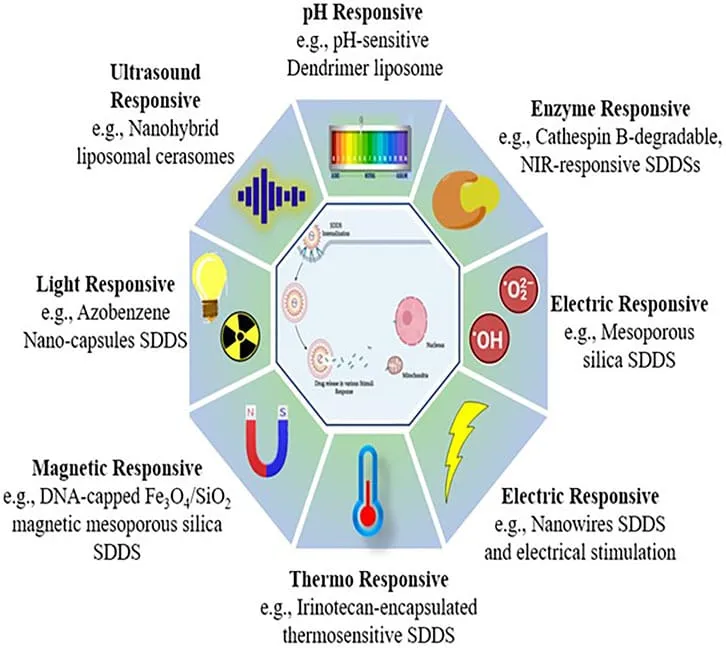
Fig. Mechanisms of Stimuli-Responsive Drug Delivery Systems
Stimuli-responsive drug delivery systems are specifically designed to release therapeutic agents against a particular internal or external stimulus. It may ensure site-specific and controlled release. The basic principle for this involves a structural or physicochemical change in a carrier material, such as swelling, degradation, change in solubility, or charge conversion, induced by environmental stimuli.
2.1 Internal Stimuli-Responsive Mechanisms
These systems exploit physiological variations inside the human body, including pH, temperature, redox potential, and enzyme activity.
2.1.1 pH-Responsive Systems
Tumor tissues, inflamed areas, and intracellular compartments (endosomes, lysosomes) have different pH gradients compared to normal tissues. pH-responsive polymers include poly(acrylic acid), chitosan, Eudragit®, and poly(L-histidine), which undergo protonation or deprotonation to show changes in solubility or swelling behavior, modulating drug release.
Example: Doxorubicin-loaded pH-sensitive liposomes have showed enhanced accumulation in acidic tumor environments with reduced systemic toxicity. (Li et al., 2023)
2.1.2 Redox-Responsive Systems
Such systems exploit redox gradients existing between the extracellular (oxidizing) and intracellular (reducing) compartments. Disulfide bonds are the most commonly used linkages in such systems, which are cleaved upon exposure to high intracellular glutathione (GSH) concentrations to effect drug release.
Example: Poly(ethylene glycol)-disulfide micelles showed improved intracellular drug release in cancer treatment .( Kumar et al., 2024 2.1.3)
2.1.3 Enzyme-Responsive Systems
Enzyme-sensitive linkages or substrates are incorporated into drug carriers for site-specific delivery, especially in cancer or inflammatory conditions where levels of such enzymes are upregulated. Example: MMP-responsive nanoparticles undergo selective degradation in tumor tissue to release encapsulated anticancer drugs at precise points. (Zhang et al., 2022 2.1.4)
2.1.4Temperature-Responsive Systems
Polymers that exhibit LCST, like poly(N-isopropylacrylamide) (PNIPAM), stay soluble below the LCST but insoluble above it due to a phase transition that can be utilized to trigger drug release. Example: Thermo-sensitive hydrogels loaded with insulin give a pulsatile release in response to physiological changes in temperature (Shen et al., 2024).
2.External Stimuli-Responsive Mechanisms
These systems are activated by externally applied triggers like magnetic fields, light, ultrasound, or electric stimuli.
2.2.1 Magnetic Field-Responsive Systems
Iron oxide or magnetite magnetic nanoparticles can be directed by means of external magnetic fields to the required site. Alternating magnetic fields can also induce heat, magnetic hyperthermia, which could stimulate controlled diffusion of drugs.
Example: Magnetite-based nanocarriers increased the localization of drugs within solid tumors, as indicated (Rao et al. 2023).
2.2.2 Light-Responsive Systems
These photosensitive polymers have the capability for photoisomerization or photothermal conversion upon light exposure, thus enabling spatiotemporal drug release. NIR light is preferred because it has deep tissue penetration and minimal photodamage.
Example: Doxorubicin-loaded NIR-triggered gold nanoshells showed increased efficacy in the treatment of breast cancer ( Patil et al., 2024)
2.2.3 Ultrasound-Responsive Systems
Ultrasound causes cavitation, leading to the generation of local heat that disrupts vesicular membranes and allows drug diffusion. Common ultrasound-responsive platforms are microbubbles and liposomes.
Example: Ultrasound-triggered liposomes containing paclitaxel exhibited enhanced tumor regression in animal models ( Singh et al., 2023).
3.Materials Used in Smart Stimuli-Responsive Systems
Material selection is vital to achieve the desired responsiveness, biocompatibility, and stability.
3.1 Polymers
The biodegradable and biocompatible natural polymers include chitosan, alginate, and hyaluronic acid.
Synthetic Polymers: Poly(NIPAAm), PEG, PLA, PLGA - with tunable response and mechanical strength.
Hybrid Polymers: Natural and synthetic polymers combined for performance.
3.2 Inorganic Nanomaterials
Magnetite (Fe₃O₄), silica nanoparticles, gold nanoparticles, and quantum dots provide magnetic, optical, or conductive stimuli responses.
3.3 Lipid-Based Carriers
Liposomes, niosomes, and solid lipid nanoparticles can be functionalized with pH or temperature-sensitive moieties for smart release.
4.Design and Formulation Strategies
To develop a stimuli-responsive DDS, it is very important to integrate the stimuli-sensitive components into the delivery matrix in a strategic manner.
4.1 Core-Shell Nanostructures
These designs provide dual responsiveness: an inner core for drug loading and an outer shell for environmental sensitivity, such as pH or redox.
4.2 Layer-by-Layer (LbL) Assembly
The layer thickness and release kinetics can be precisely adjusted by alternate depositions of polyelectrolytes or responsive polymers.
4.3 Prodrug-Based Systems
The drugs are chemically modified with stimuli-labile linkers, which, upon specific conditions, get cleaved, releasing the active drug.
4.4 Hydrogel-Based Systems
Hydrogels provide a 3D matrix that can swell up or shrink by exposing them to different stimuli. Their mechanical strength and porosity can be fine-tuned for sustained delivery.
4.5 Micellar and Vesicular Systems
Amphiphilic block copolymers self-assemble into micelles or vesicles that encapsulate hydrophobic drugs and respond to pH or temperature triggers.
5.Applications of Smart and Stimuli-Responsive Drug Delivery Systems
Smart and stimuli-responsive drug delivery systems have shown phenomenal promise in various therapeutic disciplines by allowing much better spatiotemporal control of the drug release and, correspondingly, improved patient outcomes.
5.1 Cancer Therapy
Amongst all the applications, cancer treatment has been one of the most explored domains for SRDDSs. The biochemical conditions within tumor microenvironments are distinct, exemplified by low pH, hypoxia, high levels of ROS, and overexpressed enzymes. These differences are exploited by stimuli-responsive carriers in achieving targeted delivery.
pH-Responsive Nanocarriers: Micelles loaded with doxorubicin, made from poly(L-histidine), and PEG present a selective release of the drug in an acidic environment of tumors, thus minimizing cardiotoxicity.
Redox-Responsive System: Glutathione-sensitive polymeric nanoparticles loaded with paclitaxel exhibited enhanced intracellular drug accumulation ( Zhao et al., 2024)
Multi-Variable Systems: pH- and temperature-sensitive hydrogels have been prepared for the localized treatment against breast cancer by reducing systemic exposure (Gupta et al., 2022).
5.2 Ocular Drug Delivery
The ocular route has significant obstacles in the form of tear turnover, blinking, and poor permeability. Thus, smart hydrogels that respond to changes in ocular pH and temperature have been designed for enhancing drug residence time.
Example: In-situ gelling formulations of timolol maleate based on PNIPAM and chitosan showed prolonged release and improved intraocular pressure control.
5.3 Transdermal Drug Delivery
Controlled transdermal release is provided by smart polymeric patches, which respond to heat, pH, or mechanical pressure.
Example: Thermo-responsive microneedle patches for insulin release resulted in outstanding glucose control without any risk of hypoglycemia (Liang et al., 2024).
5.4 Oral Controlled Delivery
Stimuli-responsive oral systems protect drugs from gastric degradation and release them selectively in the intestine.
Example: Eudragit-based pH-responsive capsules, for delivering mesalamine in ulcerative colitis, reduce dose frequency and side effects (Sharma et al. (2022)
5.5 Gene and Protein Delivery
SRDDSs enable the delivery of nucleic acids and proteins, which are highly sensitive to enzymatic degradation.
Example: Redox-sensitive polymeric nanoparticles carrying siRNA for gene silencing revealed higher efficiency of transfection compared to conventional systems (Kaur et al., 2023).
5.6 Ocular and Nasal Delivery
In addition, in-situ gels, responsive to pH and enzymes, administered via nasal or ocular routes improve drug absorption and result in controlled delivery of antivirals and antibiotics (Patel et al., 2024).
6.Evaluation Parameters of SRDDS
Evaluation of smart and stimuli-responsive systems needs to be done by both physicochemical and biological methods to ensure responsiveness, stability, and efficacy.
6.1 Physicochemical Characterization
Particle Size & Zeta Potential: The size and zeta potential were determined by DLS, assuming homogeneity and stability.
Morphology: The verification is carried out through SEM or TEM analyses to check the integrity of the structure.
Encapsulation Efficiency: Determined by UV or HPLC to assess loading capacity.
Stimuli Response Testing: Changes in swelling, degradation, or release profiles under simulated physiological conditions.
6.2 In Vitro Drug Release Studies
The drug release is studied under conditions of different pH, temperature, or enzyme concentration to mimic in-vivo conditions. Mathematical modeling using Higuchi, Korsmeyer–Peppas, and zero-order kinetics is used in interpreting release behavior.
6.3 In Vivo Studies
Animal models are used to study pharmacokinetics, biodistribution, and therapeutic efficacy; fluorescent or radiolabeled formulations are usually employed for tracking.
6.4 Stability Studies
Accelerated stability testing ensures material and formulation compatibility under different environmental conditions.
7.Recent Technological advancements
In the last few years, there has been rapid growth in intelligent drug delivery research driven by nanotechnology, polymer science, and AI-based formulation design.
7.1 Multi-Stimuli Responsive Systems
Recent research has focused on dual or even triple stimuli-responsive systems that combine multiple triggers such as pH, temperature, and light for greater precision.
Example: pH/Redox dual-responsive polymeric micelles of doxorubicin showed enhanced tumor penetration with minimum systemic toxicity (Tanaka et al., 2024)
7.2 AI and Computational Modeling in SRDDS
ML algorithms have now become common in optimizing polymer ratios, stimuli response predictions, and designing drug release kinetics.
Example: A series of ML-based predictive models have been developed to simulate hydrogel swelling and degradation patterns under varied pH conditions ( Zhou et al. 2023)
7.3 3D Printing of Responsive Systems
3D printing enables the fabrication of personalized, stimuli-sensitive implants or oral tablets with programmed release.
Example: 3D printed thermo-responsive patches for pain management displayed customizable drug delivery profiles (Jain et al., 2024).
7.4 Smart Polymers from Natural Sources
Biodegradable polymers are derived from chitosan, cellulose, and alginate, which are presently being modified for increased responsiveness either to pH or enzymes, enhancing safety and sustainability.
7.5 Nanocomposite and Hybrid Systems
The integration of polymers with metallic or inorganic nanoparticles enhances sensitivity and control.
Example: Gold–polymer hybrid nanocarriers showed NIR-driven on-demand release of drugs (Patel et al., 2023).
8.Challenges and Limitations in Smart and Stimuli-Responsive Drug Delivery Systems
Despite considerable advances, a number of technical, biological, and translational issues limit widespread clinical use of SRDDSs.
8.1 Complexity of Design and Manufacturing
In general, the development of multi-stimuli responsive systems requires complex polymer synthesis and nanofabrication processes. Industrial-scale reproducibility has remained challenging because materials are sensitive to conditions of synthesis.
8.2 Biocompatibility and Toxicity
While some synthetic polymers or metallic nanomaterials may lead to either immunogenicity, cytotoxicity, or vital organ accumulation, detailed biocompatibility and long-term toxicity studies are in need before clinical translation.
8.3 Stability and Storage
Maintaining responsiveness over time during storage and transport posses a significant challenge .Many formulations loose activity or structural integrity when exposed to humidity or temperature fluctuations.
8.4 Regulatory and Scale-up Challenges
There are no standardized regulatory frameworks for SRDDSs at present. Lack of harmonized guidelines on the evaluation of stimuli-responsiveness and in vivo efficacy complicates the process of commercialization.
8.5 Economic Constraints
The synthesis of high purity responsive polymers and advanced nanocarriers increases production cost. For large scale deployment , cost effective synthesis routes must be developed.
9.Current Trends
The field of SRDDS is significantly evolving, while there are some trends that influence the research directions and applications:
1. Stimulus Combination in Multi-Stimuli-Responsive Systems: Toward a multiplexed chemical programming.
2. Hybrid Nanomaterials: Polymeric nanoparticles combined with metallic, silica or lipid-based nanoparticles to improve sensitivity and stability.
3. Hydrogel Advances: Engineering gels with controlled swelling properties, self-healing abilities and bio-degradable natures for site specific delivery.
4. Machine learning and computational modeling:Al-assisted tuning of polymer design,drug loading, and release kinetics.
5. Personalized Medicine: A patient-targeting approach based on disease biomarkers or physiological states in the development of personalized formulations.
6. Noninvasive External Stimulation: NIR, magnetic field, and ultrasound for radio-controlled and on demand drug release.
7. Compartmentalization with Diagnosis Tools Theranostic platform that integrate drug delivery and diagnostic by real time imaging to follow therapeutic efficacy.
10.Future Prospects
AI is expected to revolutionize formulation design, from predicting polymer-drug compatibility to optimizing release profiles and simulating stimuli-responsive behaviors even before the synthesis.
10.1 Al and Machine Learning Integration
Al tools are believed to be capable of breaking the bottleneck of formulation design by expediting prediction on polymer-drug compatibility, release profile optimization and stimuli-responsiveness simulation prior to synthesis (Zhou et al., 2023); AIO generates automatically-optimized researcher relief spaces that shorten research time and enhance formulation efficiency tremendously.
10.2 Personalized and Precision Medicine
Through customization of stimuli-responsive formulations adapted to each individual’s physiological state, personalised therapy has been enabled. For example, glucose-imposed insulin behaviour specific to a subject is being developed (Li et al.,2024)
10.3 Smart Bio-Interfaces
Recent advances are towards bio-hybrid devices that integrate cells with smart material which also enable to deliver in feedback manners responding to a biochemical signal temporally (Kim et al., 2024).
10.4 Formulation Design (Green and Sustainable)
Future formulations will focus on biodegradable, renewable, and environment friendly materials to reduce toxicity, environmental consequences with increased efficiency.
10.5 Clinical Translation
The improvement of in vivo reproducibility, ease of preparation and long-term safety validation are essential steps to bring SRDDSs into clinics. A multi-stakeholder collaborative effort involving academia, industry and regulatory authorities will speed up clinical approval.
CONCLUSION
Smart and stimuli-responsive drug delivery systems represent a sea change in modern pharmaceutical formulation science. Through dynamic responsiveness to physiological or external cues, spatiotemporal precision is achieved with these systems, together with increased therapeutic efficiency and reduced side effects.
This is reflected in their versatility, which has seen their applications continually expand, from cancer and ocular therapy to transdermal and gene delivery. Integration of AI-driven design, multistimuli responsiveness, and sustainable materials holds tremendous promise for the future of personalised medicine.
Although challenges persist, especially in scalability, stability, and regulatory acceptance, progress over recent years underlines the inevitable clinical and commercial potential of these intelligent systems. As technology evolves, SRDDSs will redefine the paradigm of drug delivery toward safe, efficient, patient-centred solutions for global healthcare.
REFERENCES

Shubhangi Kandalkar, Sandhya Desai, Shruti Jorwar, Smart and Stimuli Responsive Drug Delivery Systems : A Horizon in Formulation Development, Int. J. of Pharm. Sci., 2026, Vol 4, Issue 6, 704-714, https://doi.org/10.5281/zenodo.20526125
 10.5281/zenodo.20526125