

We use cookies to ensure our website works properly and to personalise your experience. Cookies policy
Srinivas College of Pharmacy, Valachil, Farangipete post, Mangalore, 574143.
Neurological disorders such as Alzheimer’s disease, Parkinson’s disease, epilepsy, and brain tumors remain major global health challenges due to the difficulty of delivering drugs across the blood–brain barrier (BBB). Solid lipid nanoparticles (SLNs) have emerged as promising nanocarriers for brain-targeted drug delivery because of their biocompatibility, biodegradability, controlled drug release, and ability to enhance drug permeability across the BBB. SLNs are composed of solid lipids stabilized by surfactants and can encapsulate both hydrophilic and lipophilic drugs. Various preparation methods, including high-pressure homogenization, solvent injection, microemulsion, and double emulsion techniques, have been explored for optimized formulation development. Intranasal delivery of SLNs offers a direct nose-to-brain pathway, improving therapeutic efficacy while reducing systemic side effects. This review highlights the composition, mechanisms, preparation methods, physicochemical characterization, stability aspects, advantages, and limitations of SLNs in brain drug delivery. Furthermore, future perspectives such as targeted surface functionalization, gene delivery, personalized therapy, and large-scale manufacturing are also discussed, emphasizing the significant potential of SLNs in treating central nervous system disorders.
Many people globally suffer from numerous forms of neurological diseases, such as Alzheimer’s disease (AD), Parkinson’s disease (PD), brain tumor/cancer, Huntington’s disease (HD),
neuromuscular disorders, multiple sclerosis (MS), neurodegeneration, and epilepsy, causing immense suffering and loss of life1. Diseases affecting the central nervous system (CNS) are generally described by the disturbance of neurological functioning, causing neuronal cell death.[2]
The brain is a highly delicate organ that nature has protected effectively from harm. The fact that the blood-brain barrier (BBB) only permits certain molecules to pass through means that getting drugs to the brain area has always been difficult.[3]
To achieve effective drug levels within the brain, nanoparticulate drug carriers with adequate loading capacity and small sizes, which would effectively evade the reticuloendothelial system (RES), are currently being considered as ideal delivery systems.[4]
Most of the drugs do not get to the brain due to inefficiency in penetrating the BBB and efflux processes of the brain tissue. This problem has led many scientists to develop new colloidal delivery systems for drugs such as liposomes, microspheres, lipid microspheres, niosomes, polymeric nanoparticles, and solid lipid nanoparticles (SLNs).[5]
The solid lipid nanoparticles are spherical in shape and nanometer size range. They usually comprise of a solid core that comprises hydrophobic materials coated by phospholipids layer6. The core can hold the drug either dissolved or dispersed in the hydrophobic high melting fat matrix. The hydrophobic ends of the phospholipids remain embedded within the solid fat matrix. Thus, SLNs possess the capacity to encapsulate both lipophilic and hydrophilic drugs, and also for diagnostic purposes.[7]
Solid lipid nanoparticles (SLNs) can be administered through a wide range of routes depending on the therapeutic requirement, owing to their biocompatibility and versatility as drug carriers. The most commonly explored route is the parenteral route, particularly intravenous administration, which is highly suitable for targeted delivery and for drugs such as proteins and peptides that are prone to enzymatic degradation in the gastrointestinal tract. Oral administration of SLNs has also gained significant attention due to their ability to enhance bioavailability by protecting drugs from chemical and enzymatic degradation, although challenges such as gastric instability and particle aggregation remain. Transdermal delivery is another promising approach, as SLNs can interact with the lipid-rich stratum corneum, facilitating sustained and controlled drug release.[8] The nasal route offers a unique advantage for systemic and brain drug delivery due to its high vascularization and direct nose-to-brain pathway, bypassing the blood–brain barrier. Additionally, pulmonary delivery enables deep lung targeting using inhalable SLN formulations, while ocular administration benefits from improved drug retention and penetration in eye tissues. Overall, the multiple administration routes of SLNs highlight their potential as a flexible and efficient drug delivery system for both systemic and targeted therapies.[9]
The Solid Lipid Nanoparticles (SLNPs) can be regarded as one of the most safe and economical means for drug transport, which allows for the treatment of neurological diseases through the safe and effective passage of the BBB. In order to understand how the efficiency of solid lipid nanoparticles depends on the nature of its composition, size, construction, physical properties, as well as production techniques, it is crucial to examine advanced technologies for the production of solid lipid nanoparticles.[10]
Advantages of solid lipid nanoparticles [11]
• There is no bio-toxicity since the lipids that are used are biocompatible and biodegradable material.
• No organic solvent is required in making SLNs.
• Physical stability of SLNs is high.
• Targeted drug delivery and controlled release may be achieved using SLNs.
• Encapsulation of active ingredients in SLNs enhances its stability.
• Hydrophobic as well as hydrophilic drugs may be included within SLNs.
• Large-scale manufacture of SLNs is easy.
• SLNs may be sterilized.
Disadvantages [2,12]
• Low loading capacity due to less availability of space in the lipid matrix.
• Interaction of the drug with lipid matrix is very frequent, leading to failure in achieving desired SLNs formulation.
• Possibility of drug loss during storage of SLNs due to polymeric transition.
• High amount of water is undesirable for SLN formation.
Structure and Composition of SLN: [8]
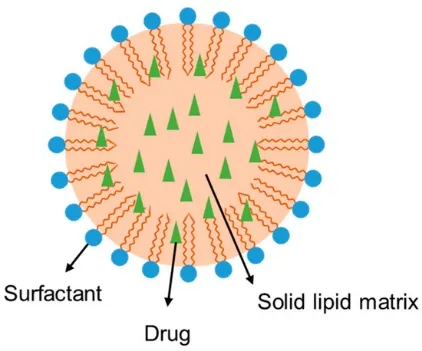
FIG NO:1 STRUCTURE OF SLN
1.Solid Lipid Matrix (Core Lipids) [13]
▪ Provides the solid internal phase where drug is encapsulated.
▪ Must be solid at room and physiological temperatures.
▪ Examples: stearic acid, cholesterol, triglycerides (e.g., glyceryl monostearate, glyceryl behenate, cetyl palmitate), waxes.
2.Surfactants (Stabilizers) [14]
▪ They stabilize the lipid particles in dispersion.
▪ Common surfactants: polysorbate 80 (Tween 80), phosphatidylcholine, poloxamers, poloxamines.
▪ Polysorbate 80 is particularly noted for enhancing BBB permeability of SLNs.
3.Cosurfactants/Charge Modifiers [15]
▪ Improve formulation stability and modify surface properties.
▪ sodium glycocholate, taurocholate salt, sodium oleate, stearylamine, dicetyl phosphate, dimyristoyl phosphatidyl glycerol.
4.Ligands / Targeting Moieties (optional for brain targeting) [16]
▪ Molecules attached to SLN surface to enhance BBB uptake via receptor-mediated transcytosis (RMT).
▪ Examples: transferrin, peptides (e.g., angiopep-2), RGD peptide, folic acid.
5. Hydrophilic Polymer Coatings [17]
▪ Coating with polymers like PEG or albumin reduces RES clearance and prolongs circulation, aiding brain exposure.
6.Cryoprotectants / Stabilizers (for storage) [14]
▪ Used during lyophilization to preserve particle integrity.
▪ Examples: mannitol, sorbitol, glucose, polyvinyl alcohol (PVA).
7.Water (Aqueous Phase) [18]
▪ Acts as the dispersion medium in the formulation process.
Mechanism of SLN Drug Delivery [19,20,21,22,23]
SLN nanoparticles help in the delivery of brain drugs by crossing the blood-brain barrier (BBB) via mechanisms such as clathrin-mediated endocytosis and transcellular transport. The lipophilicity and small size of SLN nanoparticles allow them to cross the BBB easily compared to traditional drug formulations, ensuring higher drug availability in the brain tissues. Targeting SLNs with ligands such as apolipoprotein E and lactoferrin increases the interaction between SLNs and brain endothelial cells, leading to enhanced specificity and efficiency via receptor-mediated endocytosis. Besides their targeting capability, SLN nanoparticles have properties such as controlled drug release, prolonged circulatory persistence, and low systemic toxicity, making them ideal carriers for CNS medications. In addition, nasal delivery of SLN nanoparticles exploits the nose-to-brain route (olfactory and trigeminal nerves) and does not require the crossing of the BBB for brain drug delivery.
Preparation Solid Lipid Nanoparticle
The drug, glyceryl monostearate, and span 80 were dissolved in dichloromethane at 85°C. At the same time, the aqueous phase with tween 80 was heated to 85°C. The organic phase was slowly added dropwise to one-third of the hot aqueous phase while ultrasonication was applied for 5 minutes to form a coarse pre-emulsion. This was then poured into the remaining cold aqueous phase (kept in an ice bath) and homogenized at 13,000 rpm for 7 minutes. Finally, the solvent was removed by stirring at 600 rpm for 12 hours.
High-pressure homogenization is a fast, scalable way to create tiny lipid nanoparticles without harmful solvents. It forces lipids through a small space at high pressure to break them down. Though it can cause drug damage or instability, tweaking temperature, pressure, and ingredients keeps the particles safe and stable.
Hot homogenization melts the lipid and mixes in the drug with a warm surfactant solution. It's great for fat-loving drugs but not ideal for water-loving ones since they can leak out, causing loss and fast release. Plus, the heat can sometimes harm sensitive drugs.
Cold homogenization avoids the heat-related issues of hot homogenization by mixing the drug with melted lipid, freezing it rapidly with liquid nitrogen, then crushing it into tiny particles. These are blended with a cold surfactant solution, protecting sensitive, water-loving drugs from breakdown and minimizing drug loss into water.
Hot melt extrusion with high-pressure homogenization lets us efficiently make uniform lipid nanoparticles in large amounts. By melting and mixing lipids and drugs, then homogenizing them, we gain precise control over size and shape. Key factors like lipid levels, screw speed, and temperature shape the final product.
Solvent injection technique create lipid nanoparticles by dissolving lipids and drugs in solvents like ethanol. This mixture is added to emulsifiers, causing nanoparticle formation as the solvent diffuses. Though energy-efficient, it requires solvent removal. Advances like microfluidics enhance size control and improve the methd’s precision.
The traditional microemulsion method creates solid lipid nanoparticles by mixing melted solid lipids with hot, surfactant-containing water to form a clear microemulsion. Rapid cooling then solidifies the lipid into nanoparticles. Drugs can be added before mixing. This simple, reliable process produces consistent, stable particles without using organic solvents.
Double emulsion (w/o/w) helps trap water-loving drugs inside solid lipid nanoparticles by first mixing the drug in water, then dispersing it in melted lipids, and finally combining it with another water phase. This method solidifies the lipid, keeping the drug securely inside and preventing leakage.
Supercritical fluid technology uses supercritical carbon dioxide to create solid lipid nanoparticles with precise control over size and drug content. It involves mixing lipid and drug, then using methods like RESS, SAS, or SFEE to form particles by changing pressure or removing solvents, resulting in clean, uniform nanoparticles.
Spray drying is one of the most common post-processing techniques for solid lipid nanoparticles (SLNs). Spray drying protects the integrity of SLNs in the aqueous suspension, while also promoting cost efficiency, ease of reconstitution, and transportability. Spray drying is also ideal for long-term storage.
CHARACTERIZATION:
The PCS technique measures the fluctuation in light scattering through the measurement of the movement of particles. This technique can measure from a few nanometers up to 3 microns in size. Several aspects determine the correlation between the diffraction angle and the particle diameter.
One of the major strengths of the laser diffraction method is its wide measurement range, which extends from nanometers to small millimeters. Increased polarization intensity differential scattering increases the sensitivity of the laser diffraction method for small particles.
2)Zeta Potential [8]
Zeta potential (ZP) is measured by DLS to predict nanodispersion stability. A high ZP creates strong repulsion between nanoparticles, preventing clumping and keeping the dispersion stable. Low ZP can cause aggregation. Typically, a ZP value above ±30 mV is considered sufficient to maintain stable nanodispersions and avoid particle clumping.
3)Determination of the Entrapment Efficiency (EE) [32]
Using Eppendorf’s high-speed cooling centrifuge, SLNs were spun at 5,000 rpm for 10 minutes, and kept at 4 ◦C. Supernatant and sediment were separated. The unentrapped drug concentration in the supernatant was determined by PerkinElmer’s UV spectrophotometer.
% EE = Total drug content − free drug/Total drug content × 100
4) Surface Morphology and Shape [33]
Scanning Electron Microscopy (SEM)
Scanning electron microscopy was used to analyze morphological characteristics of prepared SLNs. Formulations were poured on aluminum stubs in circular shape with the help of double adhesive tape. They were coated with gold under HUS-5 GB vacuum evaporator and observed under a Hitachi S-3000 N SEM under an accelerating voltage of 10Kv and magnification of 5000X [21].
5) Solid State Studies [34]
Thermograms were taken in the range of 30–300°C by means of DSC for AD, Dynasan 114, ADSLN, ANS and mixture of AD and Dynasan 114 at the heating rate of 10°C /min on differential scanning calorimeter (Mettler-Toledo, Switzerland).
The crystallinity of dug was analyzed using a Philips PW 1729 X-ray diffractometer with an online recorder. Using a Cu radiation source, diffractograms were captured at 40 kV, 40 mA, scanning from 10° to 80° at 0.02°C/min. Samples studied included ADS, Dynasan 114, their mixture, ADSLNs, and ANS
6. In vitro permeation study [35]
Permeability was studied using Franz diffusion cells with a 0.45 mm nylon membrane as an artificial barrier. Donor chambers were loaded with 400 μL of sample, and receptor chambers contained 7 mL buffer (pH 6.8) at 34°C with agitation at 400 rpm. Samples (3 mL) were withdrawn at intervals, replaced with fresh buffer. Flux and permeability constants were calculated from permeation data.
7)Viscosity [36]
Viscosity of in situ gel was determined at 60 rpm using the No. 3 rotor on the rotary viscometer, and readings were taken directly. Testing was done at 34°C in three runs.
8)Stability studies [37]
Stability studies are essential to ensure that solid lipid nanoparticles (SLNs) for brain drug delivery via the nose keep their properties over time. These formulations are stored at different temperature(refrigerated), room temperature, and accelerated conditions for up to six months. Regular checks are done to monitor key characteristics at set intervals.
9)pH measurement [38]
A precise amount of lyophilized or freshly made SLNs is gently stirred into distilled water or PBS (pH 7.4) to form a uniform suspension. After standing for 30–60 minutes at 25 ± 2 ºC, the suspension’s pH is measured with a calibrated digital pH meter to assess SLNs’ surface pH, crucial for their stability and brain compatibility.
10)Surface hydrophobicity[39]
Surface hydrophobicity of solid lipid nanoparticles (SLNs) for brain drug delivery is usually measured by how well hydrophobic fluorescent probes like ANS or Nile Red stick to their surface. Higher fluorescence means more hydrophobicity. Other ways include hydrophobic interaction chromatography and contact angle tests on dried nanoparticle films.
Stability Issues and Storage Conditions of Solid Lipid Nanoparticles (SLNs)
Solid lipid nanoparticles (SLNs) are known for their physical stability, often remaining stable for over three years under the right conditions. However, their long-term stability depends heavily on factors like the type of lipid, surfactant concentration, processing methods, and storage temperature. Careful optimization of these factors is essential to keep SLNs stable during storage.[40]
A key factor in SLN stability is the polymorphic behavior of the lipid matrix. Triglycerides in SLNs shift between α (alpha), β′ (beta prime), and β (beta) crystalline forms during preparation and storage. The speed of these transitions is influenced by the fatty acid chain length, with longer chains crystallizing more slowly. These changes affect the internal structure of SLNs, impacting drug loading and release.[41]
SLNs can also undergo gelation, especially linked to the β′ form. External stresses like light, temperature changes, and mechanical shear can accelerate this, causing particle size changes and reduced stability. Exposure to such conditions may also lower the zeta potential, indicating less colloidal stability.[42]
Drug degradation, especially hydrolysis in aqueous media, is another limitation. Drying methods like freeze-drying, spray drying, and electrospray help improve shelf life by producing stable dry powders suitable for solid dosage forms.[43]
Despite these benefits, SLNs face issues like particle growth from coagulation or agglomeration, which can cause unwanted rapid drug release.[44] The crystalline lipid matrix also tends to expel drugs over time due to polymorphic transitions, leading to drug loss and reduced effectiveness, limiting SLN use in drug delivery.[45]
FUTURE AND PROSPECTS:
1. Targeted Surface Functionalization
Ligand-modified SLNs can enhance receptor-mediated transport across the BBB. This improves brain-specific drug delivery and minimizes systemic toxicity.
2. Enhanced BBB Penetration Approaches
Innovative strategies like nose-to-brain delivery and transcytosis will improve SLN uptake. Overcoming BBB limitations remains the key research focus.
3. Delivery of Biologics and Gene Therapy
SLNs show promise for transporting siRNA, proteins, and peptides to the brain. This expands their role beyond conventional small-molecule drugs.
4. Personalized Brain Drug Delivery Systems
Future SLNs may be tailored based on patient genetics and disease profiles. This supports precision medicine in neurological disorders.
5. Scale-Up and Commercial Manufacturing
Challenges in large-scale production and stability must be addressed. Standardization is essential for industrial and clinical translation.
6. Clinical Validation and Safety Assessment
Extensive clinical trials and toxicity studies are required. This ensures long-term safety and regulatory approval of SLN-based therapies.
CONCLUSION
Solid lipid nanoparticles (SLNs) have emerged as a highly promising nanocarrier system for effective brain drug delivery due to their biocompatibility, biodegradability, controlled drug release, and ability to overcome the challenges posed by the blood–brain barrier (BBB). Their unique lipid-based structure enables the encapsulation of both hydrophilic and lipophilic drugs while improving drug stability, bioavailability, and targeted delivery to the central nervous system. Various formulation and preparation techniques, including high-pressure homogenization, solvent injection, and microemulsion methods, have further enhanced the versatility and efficiency of SLNs.
In particular, intranasal and ligand-mediated SLN systems have shown significant potential in improving nose-to-brain transport and receptor-mediated uptake, thereby enhancing therapeutic outcomes in neurological disorders such as Alzheimer’s disease, Parkinson’s disease, epilepsy, brain tumors, and other neurodegenerative conditions. Despite several advantages, challenges including limited drug loading, polymorphic transitions, storage instability, and large-scale manufacturing still require further investigation.
Overall, continuous advancements in surface modification, targeted delivery strategies, and large-scale production technologies are expected to expand the clinical applicability of SLNs. With further research and clinical validation, SLNs may become an effective and safer platform for future brain-targeted therapies.
REFERENCES
character
character



Hruthik, Vindhya V S, A R Shabaraya, Solid Lipid Nanoparticles as Promising Nanocarriers for Brain Drug Delivery: A Comprehensive Review, Int. J. of Pharm. Sci., 2026, Vol 4, Issue 7, 2413-2422, https://doi.org/10.5281/zenodo.21324292
 10.5281/zenodo.21324292