

We use cookies to ensure our website works properly and to personalise your experience. Cookies policy
Shiva Institute of Pharmacy, Bilaspur, Himachal Pradesh
Solubility, a critical parameter governing the bioavailability and therapeutic efficacy of pharmaceutical compounds, often poses a significant challenge in drug development. The discussion encompasses both conventional and emerging strategies, highlighting their mechanisms, advantages, and limitations. The study examines conventional methods such as particle size reduction, solid dispersion, and co-solvency, focusing on their historical importance and extensive use. An essential determinant in achieving optimal medication dosage absorption into the circulatory system is the demonstration of a pharmacological action is directly linked to the solubility of a substance. The primary challenge in formulating the new medicinal chemical is its limited water solubility. Medications with low solubility in water need large doses in order to achieve their highest effective concentration in the bloodstream when taken orally. The biopharmaceutical categorization system (BCS) classifies substances according to their solubility and permeability. Regulatory agencies and health organizations have used this categorization approach to validate bioequivalence for chemicals that are both highly soluble and very permeable by using dissolution as a form of confirmation. This review summarizes findings from multiple research articles to present comparative results of various techniques. Studies consistently show that nanotechnology-based approaches outperform conventional methods by achieving faster dissolution, stable amorphous states, and improved pharmacokinetic profiles. However, limitations such as scalability, cost, physical instability, and regulatory concerns are also addressed to give a balanced and comprehensive view of each technique’s applicability in real-world pharmaceutical development.
The term ’solubility’ is characterized as maximum amount of solute that can be dissolved in a given measure of solvent. Quantitatively it is characterized as the concentration of the solute in a soaked solution at a specific temperature.
The substance to be dissolved is called as solute and the dissolving liquid in which the solute dissolved is called as solvent.
Solubility does not also depend on any kind of particle size or other kinetic factors which are given enough time, even big particles will finally dissolve.
A large number of new drugs belong to BCS Class II and IV, which are poorly soluble in water. These drugs often require higher doses to achieve the desired effect, which may increase side effects. To overcome these issues, various solubility-enhancing techniques have been developed.
In recent years, nanotechnology-based techniques such as nanoparticles, nanosuspensions, nano emulsions, and lipid-based carriers have gained attention.
The solute must separate out from the bulk solute. This is enthalpically unfavorable as solute-solute interactions are breaking but are entropically favorable.
A cavity must be created in the solvent. The creation of the cavity will be entropically and enthalpically unfavorable as the ordered structure of the solvent decreases and there are fewer solvent-solvent interactions.
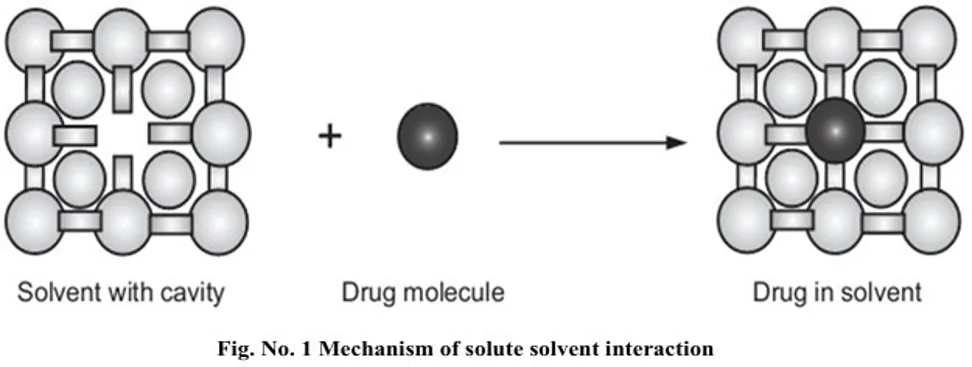
FACTORS AFFECTING SOLUBILITY
Solubility of a drug depends on several physical, chemical, and environmental factors. Understanding these factors helps in selecting the correct solubility enhancement method.

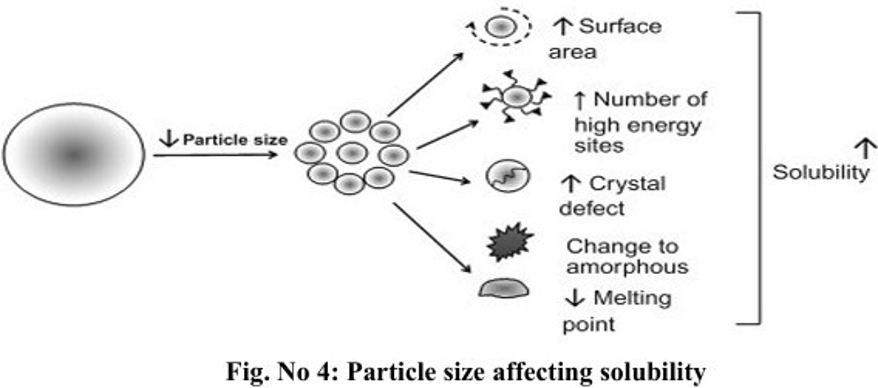
Particle size has a direct impact on solubility. Smaller particles have a larger surface area, which increases the contact with solvent.
b) Nature of solvent as well as solute:
Both the solvent's and the solute's properties depend on concentration and temperature. At room temperature, two hundred gram of zinc chloride may dissolve one gram of lead (II) chloride in one hundred gram of water.
c) The size of molecules:
As the molecular sizes of particles change, so does their solubility. Because the solvent molecules find it more difficult to fully encase molecules, a material becomes less soluble as its molecular weight and size grow.
d) Temperature:
Solubility is influenced by temperature. When the dissolution process absorbs energy (endothermic), solubility tends to increase with rising temperature.
e) Pressure:
While a gaseous solute's solubility increases with increasing pressure and decreases with decreasing pressure, the solubility of a solid or liquid solute remains constant when pressure changes.
2. CLASSIFICATION OF SOLUBILITY
2.1 As per USP
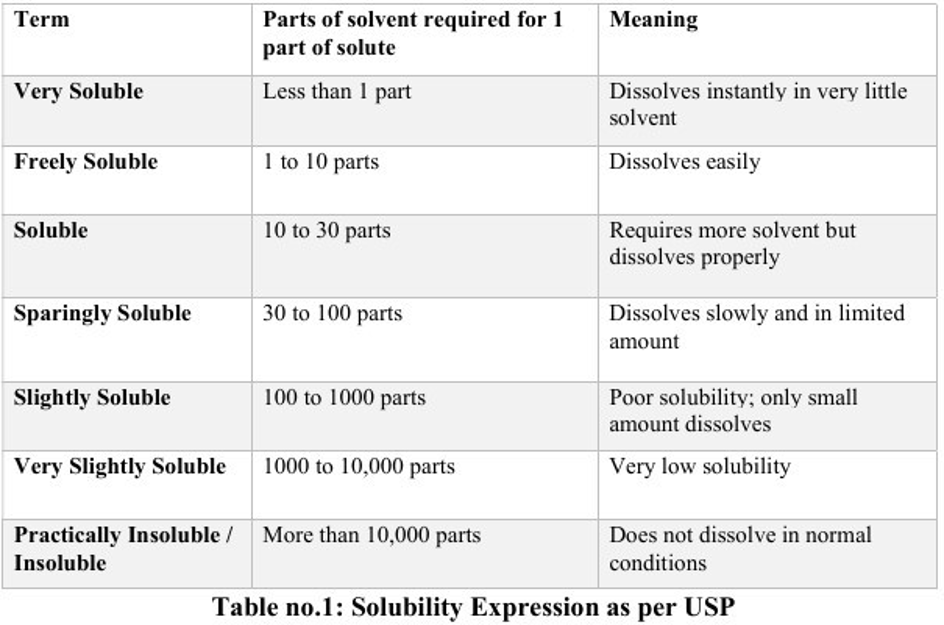
The United States Pharmacopoeia (USP) classifies solubility based on the parts of solvent required to dissolve one part of solute.
USP Solubility Categories
2.2 As per BCS
Biopharmaceutics classification system (BCS)
The US Food and Drug Administration (FDA) created the Biopharmaceutics Classification System (BCS). categorizes pharmaceuticals into four classes according on their solubility and permeability characteristics
3. IMPORTANCE OF SOLUBILITY
Oral bioavailability depends on factors like solubility, membrane permeability, dissolution rate, metabolism before reaching systemic circulation, and elimination. Among these, poor solubility and low permeability are the main reasons for reduced bioavailability.
Solubility is essential for achieving effective drug levels in the body and is important for both oral and parenteral formulations. Drugs with low solubility often require higher doses.
The low water solubility of many medications results in sluggish absorption, leading to insufficient and inconsistent bioavailability, as well as potential damage to the gastrointestinal mucosa.
1. To Improve Drug Absorption (Bioavailability)
For any drug to work, it must first dissolve in the gastrointestinal fluids. Low solubility = low dissolution = low absorption
Drugs remain undissolved and pass through the body without showing effect. When solubility is enhanced, the drug dissolves faster, leading to better absorption into the bloodstream.
2. To Reduce the Dose and Improve Patient Compliance
Poorly soluble drugs often require high doses to achieve therapeutic levels. High doses can result in increased side effects poor patient compliance more burden on the body.
3. To Improve the Onset of Action
A drug that dissolves slowly takes a longer time to show its effect. By improving solubility: the drug dissolves rapidly absorption becomes faster onset of action is quicker
4. To Achieve Consistent and Predictable Drug Action
Poor solubility causes unpredictable drug absorption, which leads to irregular plasma concentration inconsistent therapeutic effect dose-to-dose variation in patients Solubility enhancement ensures uniform dissolution and absorption, resulting in better therapeutic predictability.
5. To Improve Stability and Shelf-Life of Drug Products
Convert drugs into stable amorphous forms prevent crystallization increase overall stability of dosage forms.
5. TECHNIQUES FOR SOLUBILITY ENHANCEMENT
Low water solubility and poor bioavailability are major challenges in pharmaceutical development, especially for oral drugs. Improving solubility is essential for better absorption, but it is often difficult. Although various methods exist, their effectiveness depends on drug properties, excipients, and dosage form. Many techniques are complex and costly, and they do not always achieve optimal bioavailability.
The selection of procedures is based on specific factors like the characteristics of the medicine being considered, the qualities of the selection of excipients, and the type of the planned dosage form. Orally given medications achieve full absorption only when they have sufficient solubility in the stomach and exhibit excellent bioavailability.
In the process of developing new medications, it may be very difficult to increase a drug's solubility and, therefore, its oral bioavailability, especially for oral drug delivery systems. There are several methods documented in literature to improve the solubility of drugs that have low water solubility.
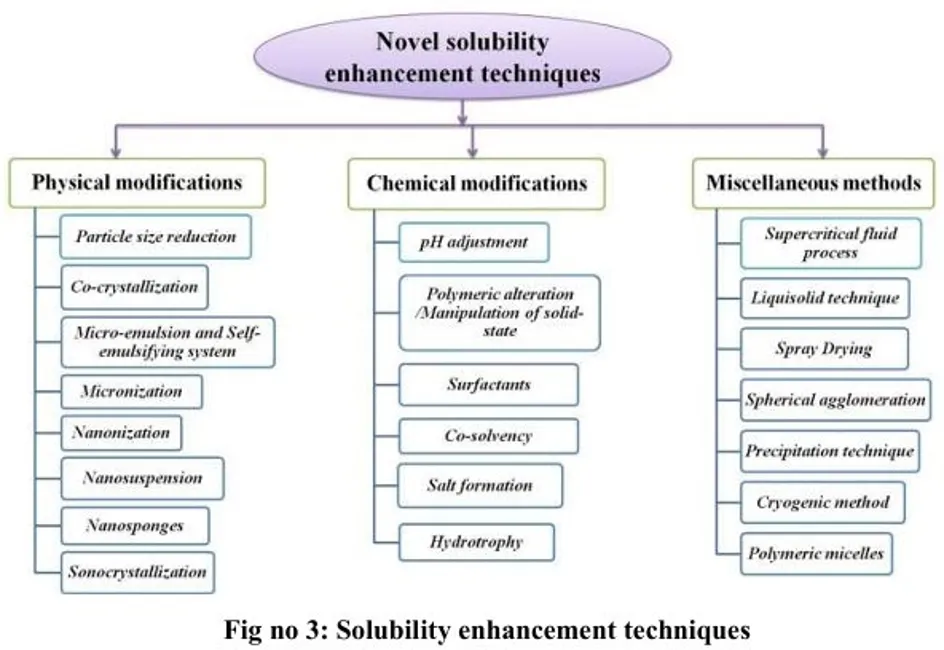
a) Particle Size Reduction:
Bioavailability is closely related to particle size, as reducing particle size increases surface area and improves drug dissolution. Techniques like milling (e.g., jet mills and colloid mills), micronization, and nanosuspension are used for particle size reduction. However, these methods do not increase the drug’s saturation solubility and are less suitable for high-dose drugs.
Advantages of particle size reduction:
Disadvantages of particle size reduction:
Nanonization:
Various nanonization strategies have emerged to increase the dissolution rates and bioavailability of numerous drugs that are poorly soluble in water. Nanonization broadly refers to the study and use of materials and structures at the nanoscale level of approximately 100 nm or less.
It is also known as “Solvent blending”. It enhances the solubility of a poorly water-soluble drug by the addition of water-miscible solvent in which drug has good solubility by reducing the interfacial tension.
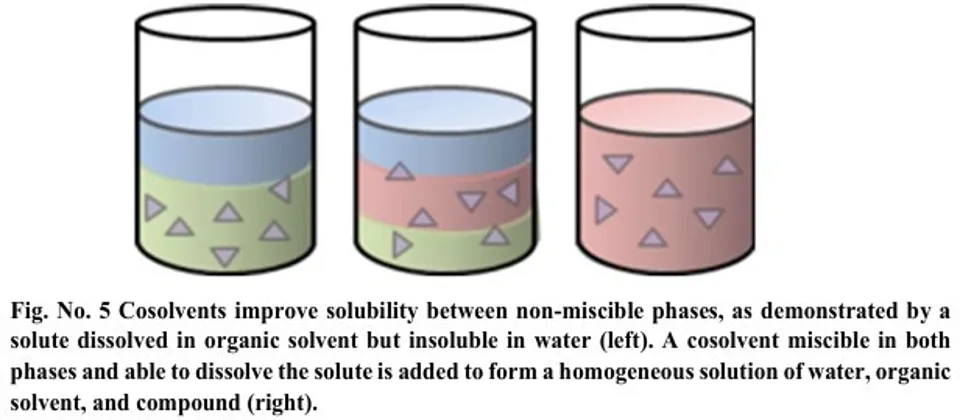
Advantages of co-solvency:
1. Has large solubilization capacity for poorly soluble drugs, simple and rapid to formulate, produce and evaluate.
Disadvantages of co-solvency:
1. Toxicity and tolerability related with the level of solvent administered has to be considered.
Hydrotrophy:
Hydrotrophy is a solubilization process whereby the addition of a large amount of the second solute increases the aqueous solubility of another solute. Solute consists of alkali metal salts of various organic acids. Hydrotropic agents are ionic organic salts.
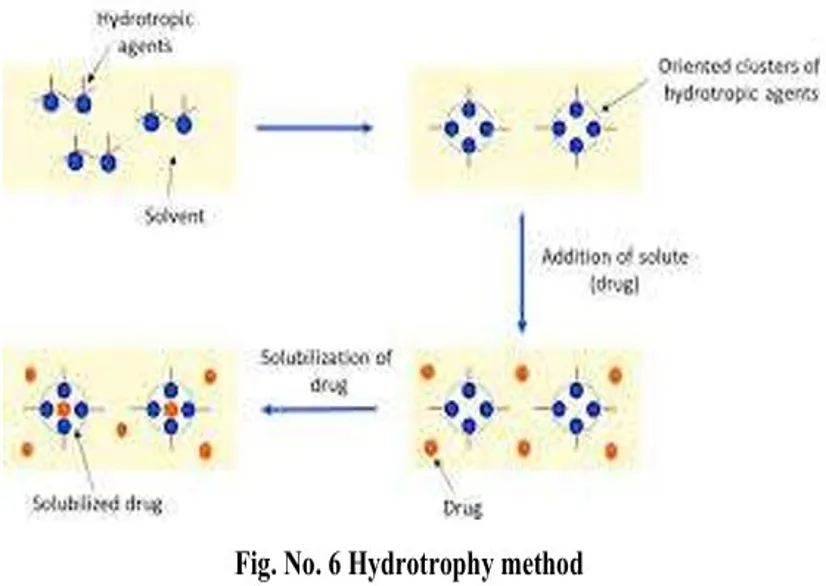
Poorly water-soluble drugs with parts of the molecule that can be base or acid may potentially be dissolved in water by applying a pH change. pH adjustment can in principle be used for both oral and parenteral administration. Upon intravenous administration, the poorly soluble drug may be precipitate because blood is a strong buffer with pH between 7.2 – 7.4.
Advantages of pH Adjustment:
Disadvantages of pH Adjustment:
Sono crystallization:
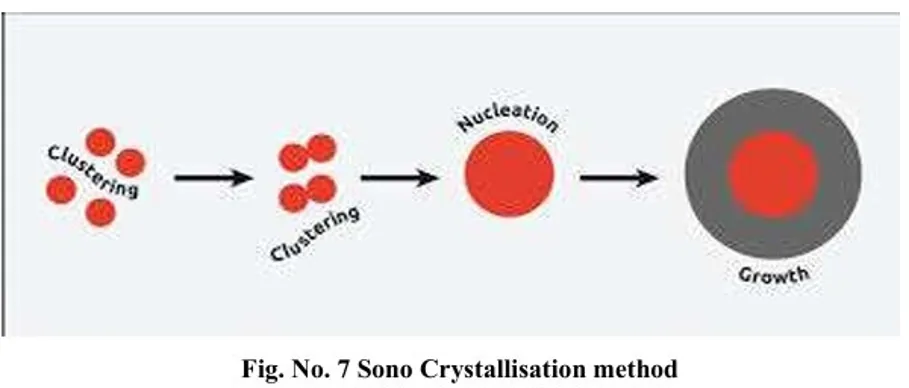
Recrystallization of poorly soluble materials using liquid solvents and antisolvents has also been employed successfully to reduce particle size. The novel approach for particle size reduction based on crystallization by using ultrasound is Sono crystallization.
Sono crystallization utilizes ultrasound power characterized by a frequency range of 20-100 kHz for inducing crystallization.
6. CONCLUSION
Poor aqueous solubility remains one of the biggest challenges in the formulation and development of modern drug molecules. Nearly 40–60% of newly developed drugs fall under BCS Class II or Class IV, where low solubility directly decreases dissolution, absorption, and oral bioavailability.
Various solubility enhancement techniques are available, and each method offers unique advantages depending on the physicochemical properties of the drug. Traditional approaches such as particle size reduction, salt formation, and pH adjustment are simple and widely used in industry.
From this review, it is clear that no single technique is universally applicable to all drugs. The selection of the appropriate method depends on drug properties such as pKa, log P, molecular weight, stability, and intended route of administration.
A rational and scientifically justified approach is essential to achieve optimal solubility, enhanced bioavailability, and better therapeutic outcomes.
Overall, solubility enhancement plays a crucial role in improving drug performance and remains a key focus in formulation development.
With the continuous growth of poorly soluble molecules, the use of advanced solubility enhancement techniques will continue to expand, providing safer, more effective, and patient- friendly drug products.
REFERENCES









Ayusha, Anshul, Arush, Mohit Dhiman, Nitesh, Arpit Sharma, Dr. Isha Rani, Neetu Sharma, Anshul Thakur, Solubility Enhancement Techniques for Poorly Water-Soluble Drugs, Int. J. of Pharm. Sci., 2026, Vol 4, Issue 6, 877-885. https://doi.org/10.5281/zenodo.20529986
 10.5281/zenodo.20529986