

We use cookies to ensure our website works properly and to personalise your experience. Cookies policy
1,2,3,4,5 Department of Quality Assurance, AISSMS’s College of Pharmacy, Kennedy Rd, near RTO Pune, Pune, Maharashtra 411001.
6 Department of Quality Assurance, Sitabai Thite College of Pharmacy, Shirur, Tal-Shirur, Dist- Pune, Maharashtra- 412210.
Pazopanib hydrochloride, a second-generation multitargeted tyrosine kinase inhibitor approved for advanced renal cell carcinoma and soft tissue sarcoma, exerts its therapeutic effect by inhibiting angiogenesis pathways essential for tumor growth. The present study aimed to develop a simple, rapid, and stability-indicating UV spectrophotometric method for the quantitative determination of pazopanib hydrochloride and validate it as per ICH guidelines. Forced degradation studies were conducted under acidic, alkaline, oxidative, photolytic, and thermal conditions in accordance with ICH Q1A(R2), with maximum absorbance detected at 242 nm in methanol, and validation was carried out per ICH Q2(R1) evaluating specificity, linearity, accuracy, precision, LOD, LOQ, and robustness. The method exhibited linearity over a concentration range of 10–50 µg/mL (R²=0.9911), with a mean recovery of 102.45%, precision %RSD values of 0.201 and 0.676 for intraday and interday studies respectively, and LOD and LOQ values of 6.67 and 20.22 µg/mL. Forced degradation studies confirmed that the drug degraded under acidic, alkaline, oxidative, and fluorescent light conditions while remaining stable under UV and thermal stress, establishing the stability-indicating nature of the method. The developed method was found to be simple, accurate, precise, and suitable for routine quality control and stability monitoring of pazopanib hydrochloride in pharmaceutical formulations.
Pazopanib is an antineoplastic agent used in the treatment of advanced renal cell cancer and advanced soft tissue sarcoma in patients with prior chemotherapy.[1] Pazopanib is a second-generation multitargeted tyrosine kinase inhibitor against vascular endothelial growth factor receptor-1, -2, and -3, platelet derived growth factor receptor alpha, platelet derived growth factor receptor-beta, and c-kit. These receptor targets are part of the angiogenesis pathway that facilitates the formation of tumor blood vessels for tumor survival and growth. It inhibits angiogenesis.[2] Metabolized by CYP3A4 and to a lesser extent by CYP1A2 and CYP2C8. Metabolites are less active than pazopanib (10 to 20-fold less active). Metabolized by CYP3A4 and to a lesser extent by CYP1A2 and CYP2C8. Metabolites are less active than pazopanib (10 to 20-fold less active).[2,3]
Pazopanib hydrochloride is a synthetic imidazolyl pyrimidine that is 5-[4-[2,3-dimethyl indazol-6-yl)-methylamino]pyrimidin-2-yl]amino]-2-methylbenzenesulfonamide; hydrochloride. This compound belongs to the class of organic compounds known as alkyl diarylamines. The structure of pazopanib hydrochloride includes a pyrimidine ring, an indazole ring, and a sulfonamide group. These are tertiary alkyl aryl amines having two aryl and one alkyl groups attached to the amino group.[1,2] Structure of Pazopanib hydrochloride is shown in Fig. 1. It is completely soluble in dimethyl sulfoxide, sparingly soluble in methanol and has extremely low solubility in aqueous solution at neutral pH and acetonitrile.

Fig.1. Structure of pazopanib hydrochloride
As per the literature survey for Pazopanib hydrochloride various methods like stability indicating method by HPLC-UV [4], UV spectroscopic methods[5-8], RP-HPLC [9,10], bio-analytical methods by LC-MS [11-12], LC-MS [13], Liquid Chromatography [14], HPTLC methods [15] were reported so far. Stress degradation study using UV spectroscopy has not been reported yet. Pazopanib hydrochloride is approved for use under some conditions by the numerous regulatory administrations worldwide, including the US Food and Drug Administration (FDA) (19 October 2009), the European Union's European Medicines Agency (EMA) (14 June 2010). Pazopanib hydrochloride is marketed by various companies like Novartis Pharmaceuticals Corp, Aark Pharmaceuticals, Dr. Reddy's Laboratories.
This present work describes the simple and rapid stability indicating method for determination of Pazopanib hydrochloride as per Q1A(R2) and Q1B ICH guidelines [16-18].
Ultraviolet spectroscopy is a sophisticated technique. It is easy to learn and operate. This work is done on UV- Visible spectrophotometer [JASCO (Model- V730)].
2. Experimental Work:
2.1 MATERIALS AND METHODS:
Pazopanib hydrochloride was received as a gift sample from NATCO Pharmaceuticals, Hyderabad. Other chemicals and reagents like Dimethyl Sulfoxide (AR grade), Methanol (AR grade), Hydrochloric acid (AR grade), Sodium Hydroxide (AR grade), Hydrogen Peroxide (AR grade) were procured from LOBA CHEMIE PVT. LTD., Mumbai.
2.2 Instrumentation:
Instruments which are used in this method are UV- Visible spectrophotometer [JASCO (Model- V730)], Electronic balance [Shimadzu (Model AY- 120)], Hot air oven [BIOMEDICA (24*24*24*)], Photo-stability chamber (Newtronic, Model- IC DAC version 1.2).
2.3 Preparation of Standard Stock Solution:
Accurately weighed 10 mg of Pazopanib hydrochloride, transferred into a 10 ml volumetric flask, about 1 ml DMSO was added and shaken well till it gets dissolved. After that made up the volume up to the mark with Methanol.
2.4 Detection wavelength:
The solution of Pazopanib hydrochloride (strength 20 µg/mL) was prepared using methanol and UV spectrum was recorded. It showed maximum absorbance at 242 nm. UV Spectrum is shown in Fig.2.

Fig.2. UV Spectrum of Pazopanib hydrochloride (20 μg/mL)
3. Forced Degradation Studies:
The deterioration circumstances were in accordance with ICH Q1A(R2)[16-17]. To achieve a 10-30% degradation, the reagent strength and exposure time were tuned. The following are the optimized stress conditions:
3.1 Acid Degradation:
2 ml of Pazopanib Hydrochloride working solution (100 µg/mL) was combined with 1 ml of 0.1 N HCl and methanol was added to make a volume of 10 ml. The resulting solution of strength 20 µg/mL was analyzed using a UV spectrophotometer. Reading obtained after 30 min from addition of acid was taken for calculations.
3.2 Base Degradation:
To obtain a final solution of 10 ml, 2 ml of 100 µg/mL Pazopanib Hydrochloride working solution was combined with 1 ml of 0.1 N NaOH and methanol. The resulting solution of strength 20 µg/mL was analyzed using a UV spectrophotometer and reading obtained after 30 min from addition of base, at room temperature was taken for calculations.
3.3 Oxidation Degradation:
2 ml of 100 µg/mL Pazopanib Hydrochloride working solution was combined with 1 ml of 30% w/v H2O2 and methanol to make a total volume of 10 ml. The resulting solution of 20 µg/mL was analyzed using a UV spectrophotometer and reading obtained after half an hour from addition of H2O2 at room temperature was taken for calculations.
3.4 Photolytic Degradation:
According to the ICH Q1B Guidelines, it was done in a photo stability chamber by exposing a solid-state powdered sample of Pazopanib Hydrochloride to UV light till exposure 200-watt hours per square meter and to cool white fluorescent light up to 1.2 million lux hours. Pazopanib Hydrochloride solution of 20 µg/mL was prepared in methanol. The resulting solution was examined using a UV spectrophotometer.
3.5 Thermal Degradation:
The bulk drug in solid state was thermally degraded by heating it in an oven at 80°C for 4 hours. A sample was removed from the oven, cooled at room temperature, weighed, and diluted using methanol to a final concentration of 20 µg/mL of Pazopanib Hydrochloride, which was then analyzed using a UV spectrophotometer.
4 Method Validation:
The method for Pazopanib Hydrochloride was validated as per the ICH guidelines ICH Q2(R1) in terms of specificity, linearity, range, accuracy, precision, limit of detection, limit of quantitation, and robustness [18].
4.1Linearity:
A standard solution of Pazopanib Hydrochloride (100 µg/mL) was diluted to volume 10, 20, 30, 40 and 50 µg/mL, thus leading to dilutions in the range of 10-50 µg/band.
4.2 Assay:
A blend of commonly used excipients was prepared. Accurately weighed amount of drug content and diluted appropriately to get 1000 µg/mL. 3 replicates of the sample solution (20µg/mL) were made by diluting 2 ml of working solution (100 µg/mL) in methanol. Each sample solution was examined using a UV spectrophotometer and scanned at 242 nm and the peak area was recorded.
4.3 Accuracy:
Recovery study was done by performing standard addition method at 80%, 100% and 120% level. The standard drug Pazopanib Hydrochloride was added to the pre analysed sample solution at three levels. The basic concentration of the sample chosen was 20µg/mL Pazopanib Hydrochloride. The peak areas obtained after examination using UV spectrophotometer were extrapolated from standard linearity to calculate the recovered amount.
4.4 Precision:
The precision method was established by interday and intraday precision studies. In interday precision, 3 replicates of standard solution (20 µg/mL) were examined using UV spectrophotometer on the same day after some time interval. In intraday precision, application of 3 replicates of standard solution (20 µg/mL) was examined using UV spectrophotometer on three consecutive days.
4.5 Limit of Detection and Limit of Quantitation:
The LOD and LOQ were calculated using equations,
LOD= 3.3 x σ/S
LOQ =10 x σ/S
Where, σ is the standard deviation of the y-intercepts and S is the slope of the calibration curve.
4.6 Robustness:
The developed method was tested for robustness by small but deliberate changes in the detection wavelength varied by 2 nm. The conc. of 20 µg/mL for Pazopanib was used to study the effect of factors on absorbance of drug.
5 RESULTS:
5.1 Forced Degradation Studies:
To evaluate the stability indicating property of the developed method, forced degradation studies were carried out in accordance with ICH guidelines Q1A (R2). The results are summarized in Table 1. The behaviors of Pazopanib in various conditions are given in Fig.3 to Fig.6.
Table 1. Forced degradation studies.
|
Sr. No. |
Degradation Conditions |
% Recovery ± SD |
|
1 |
Acidic Condition (0.1 N HCl for ½ hr. at RT) |
77.3% |
|
2 |
Alkali Condition (0.1 N NaOH for 20 mins at RT) |
86.65% |
|
3
|
Photo stability: 1) UV (200 Watt. Hrs./m2) |
100.1% |
|
2) Cool white fluorescent light (1.2 million Lux Hrs.) |
72.1% |
|
|
4 |
Oxidative Condition (30% H2O2 for 30 mins at RT) |
90.15% |
|
5 |
Thermal Condition (80oC for 4 hrs.) |
100.0% |

Fig.3. UV Spectrum of acid degradation (20 μg/mL)

Fig.4. UV Spectrum of base degradation (20 μg/mL)

Fig.5. UV Spectrum of oxidation degradation (20 μg/mL)

Fig.6. UV Spectrum of photolytic-fluorescence degradation (20 μg/mL)
5.2 Validation:
The validation parameters given in guideline ICH Q2(R1) are summarized in Table 4.
5.2.1 Specificity:
When compared to the working standard solution, the blend solution's results demonstrated that the excipients had no effect. As a result, the techniques were considered specific.
5.2.2 Linearity and Range:
Linearity range was found to be 10-50 µg/mL. The correlation coefficient was found 0.9911 with equation of y = 0.0304x + 0.1698. UV representation of Pazopanib linearity is shown in Fig.7. The Fig.8 shows no tendency behavior and thus linearity of the calibration curve. The calibration curve for residual plot and graph for residual plot is shown in Fig. 7 and Fig. 8, respectively.

Fig.7. UV representation of Pazopanib linearity (10-50 μg/mL)

Fig. 8. Calibration curve for linearity of Pazopanib (10-50 μg/mL)
5.2.3 Assay:
An assay of marketed tablet dosage form was performed, and the % drug content was found to be 105.93% ± 0.973 (SD). Assay was shown in Fig. 9.
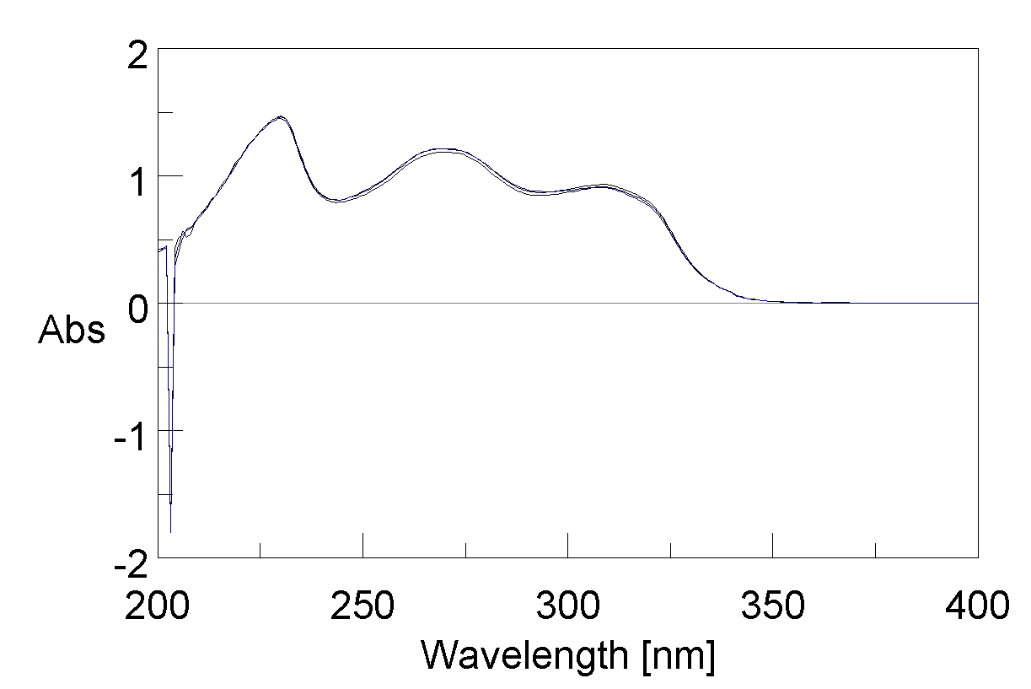
Fig. 9. Assay of Pazopanib
5.2.4 Accuracy:
The % mean recovery was found to be 102.45 % for Pazopanib Hydrochloride. As per ICH guidelines 80%, 100% and 120% levels were carried out. Recovery studies were shown in Fig. 10. These results indicate that the developed method is accurate for estimation of drug in tablet dosage form.

Fig. 10. Recovery studies of Pazopanib
5.2.5 Precision:
Repeatability and reproducibility precision were performed. The results of precision studies for Pazopanib Hydrochloride are shown in Table 2.
Table 2. Precision for Pazopanib Hydrochloride
|
Standard solution |
Condition |
% Relative Standard Deviation (% RSD) |
|
20 μg/mL |
Repeatability |
0.201 |
|
Reproducibility |
0.676 |
5.2.6 Limit of detection (LOD) and limit of quantitation (LOQ):
LOD and LOQ were calculated by formula method. The LOD and LOQ were 6.67 μg/mL and 20.22 μg/mL, respectively.
5.2.7 Robustness:
In robustness, detection wavelength was changed. It was observed that, %RSD for absorbance was found less than 2 % which confirmed that the method developed was robust. Results of robustness study are shown in Table 3.
Table 3. Robustness for Pazopanib Hydrochloride
|
Parameters |
Conditions |
% RSD |
|
Wavelength (± 2nm) |
240 nm |
1.44 |
|
244 nm |
1.10 |
Table 4. Validation parameters for Pazopanib Hydrochloride
|
Sr. No. |
Validation Parameter |
Result |
|
|
1 |
Linearity |
y = 0.0304x + 0.1698 R2= 0.9911 |
|
|
2 |
Range |
10-50 µg/mL |
|
|
3 |
Precision (% RSD) |
Repeatability |
0.201 |
|
Reproducibility |
0.676 |
||
|
4 |
% Assay |
105.93% ± 0.973 (SD) |
|
|
5 |
Accuracy (% recovery) |
|
102.45 % |
|
6 |
LOD |
6.67 μg/mL |
|
|
7 |
LOQ |
20.22 μg/mL |
|
|
8 |
Robustness |
Robust |
|
|
9 |
Specificity |
Specific |
|
CONCLUSION
This developed An Ultraviolet Visible Spectroscopy method which is simple, rapid and stability indicating for Pazopanib Hydrochloride drug. The developed method was validated as per ICH guidelines. Pazopanib Hydrochloride was found to be sensitive to acidic as well as alkaline, hydrolytic, fluorescent, and oxidative conditions. Pazopanib Hydrochloride was not found to degrade in the UV and thermal conditions. The degradation results were within limit. Thus, this method can be conveniently used for quantitative analysis of Pazopanib Hydrochloride as well as to monitor its stability.
DISCUSSION
As per reference number [14], drug was found stable at all stress conditions and within limits but in this method, we have found drug stable at only two conditions i.e. UV and thermal conditions and for other conditions the drug was found to be sensitive. As per reference number [15] the drug was overly sensitive to photolytic method but in our method, the drug was found stable at UV and thermal conditions, sensitive to other conditions and results were within limits.
ACKNOWLEDGMENT
Authors are thankful to NATCO Pharma, Hyderabad for providing API, to the principal and the management of the AISSMS’s College of Pharmacy, Pune, Maharashtra, India for providing required facilities for research work.
REFERENCES


P. Choudhary, T. Bhangdiya, D. Chotalia, S. Budruk, P. Choudhary, P. Lanke, Stability Indicating Method for Pazopanib Hydrochloride by UV Visible Spectroscopy, Int. J. of Pharm. Sci., 2026, Vol 4, Issue 6, 5644-5654, https://doi.org/10.5281/zenodo.20796992
 10.5281/zenodo.20796992