

We use cookies to ensure our website works properly and to personalise your experience. Cookies policy
University/College, State: - Pacific Academy of Higher education & research University Udaipur (Rajasthan) India.
A series of novel 1,2,4-triazole derivatives (NJ-01 to NJ-12) were synthesized and evaluated for their antimicrobial and anticonvulsant potential. Structural confirmation of synthesized compounds was achieved using IR, ^1H NMR, and mass spectroscopic techniques. The antimicrobial activity was assessed against Gram-positive bacteria (Staphylococcus aureus, Bacillus subtilis), Gram-negative bacteria (Escherichia coli, Pseudomonas aeruginosa), and fungus (Candida albicans). Anticonvulsant activity was evaluated using the maximal electroshock (MES) model in albino rats. Among all compounds, NJ-01, NJ-05, and NJ-09 exhibited significant biological activity in both models. A consistent relationship between antimicrobial and anticonvulsant activity was observed. Structural analysis revealed that electron-donating substituents and shorter alkyl chains contribute positively to biological efficacy. NJ-05 and NJ-09 were identified as lead candidates due to their dual pharmacological activity and favorable properties
Disease caused by bacteria, virus, fungi and other parasites and major caused of death,Disability, social and economical disruption for million of people.1 Infection deasese raise awrensee of our global vulnerabilit the need for strong health care system and potentially broad abd borderless impactof disease.2 According to world heath statics 2008 report published by world helath organisation (WHO), The induction will be one of the most serious problem in 2030.3 Thus developementof novel antimicrobial drug still in demand. Five member aromatic ring with three atom are called 1,2,4 Triazole is also pyrodiazole.
S-Triazole or 1, 2, 4-Triazole
Thus Copound carring Triazole compounds gained importance in medicinal and pharmacetyical field due to a broad range of buiological activity. such as antifungal4 , anticonvulsant5, antitubercular6, antiinflamatory7 and antimicribial8 activity.
Although many drugs are available, no drugs has fullfilled all the expectation in term of toxicity, resistance and cost factores. Thera are two types of approches to get new drugs for microbial infection treatments.
A. Synthesis of analogues, modifiaction of exicting compounds for improving microbial infection treatment.
B. Searching novel structure,which pathogen organism never seen before fore the treatment of bacterail and fungus infection.
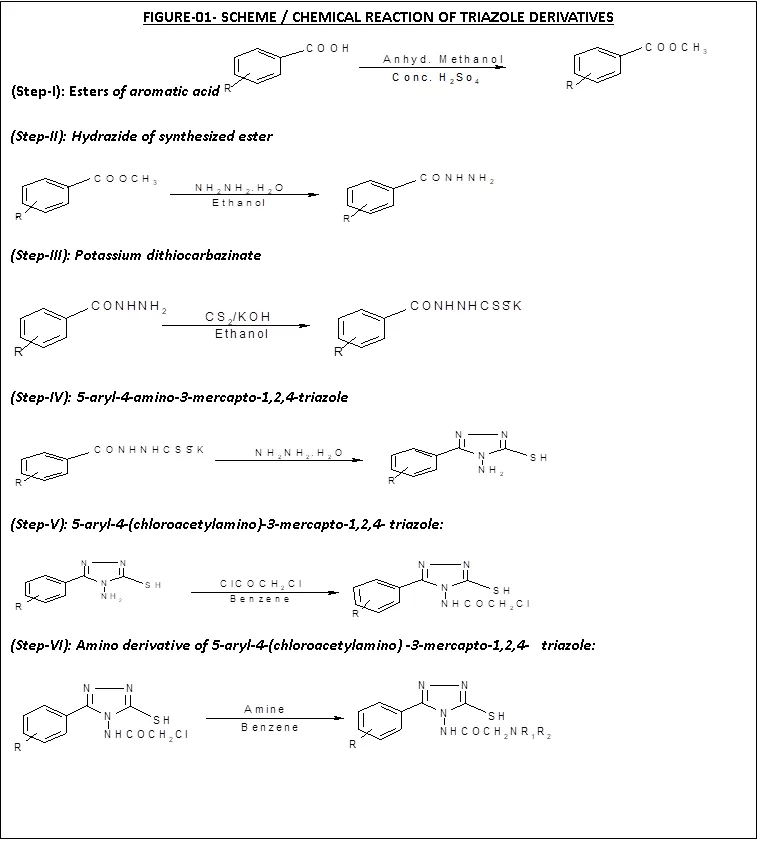
Various 1, 2, 4-triazole derivatives were synthesized by reacting aromatic acid esters with hydrazine hydrate followed by reaction with alcoholic potassium hydroxide and carbon disulphide. The obtained potassium dithiocarbazinates were cyclized with hydrazine to yield 1, 2, 4-triazole. And further reacted with chloro acetyl chloride and then with amines to give title compound.
All the synthesized compounds were recrystallized and their purity was checked by performing thin layer chromatography. The structure of the compounds was confirmed on the basis of IR, NMR &1H NMR spectral data.
All newly synthesized triazole derivatives were screened for their activity against fungi Candida albicans and compound were evaluated for antibacterial activity against staphylococcus aureus bacillus subtitis Escherichia coli and Pseudomonas aurugiosa.
MATERIAL AND METHODOLOGY
Melting points was determining by open capillary method and are uncorrected. The IR spectra (in KBr pellets) were recorded on IR spectrophotometer. 1HNMR spectra were recorded (DMSO-d6) on MHz spectrophotometer in CDCl3 using TMS as an internal standard. Chemical shift (δ) are expressed in part per million (ppm). Chemical shift values are given in d scales. Mass spectra were recorded by mass spectrophotometer by using electron ionization detector. The progress of reaction was monitored by thin layer chromatography using plate coated silica gel G of 0.25 mm thickness. Eluents used were hexane and ethyl acetate (6:4) as a solvent system and iodine vapors was used as a detecting agent. Spot were visualized through iodine chamber. Solubility of newly synthesized triazole derivative was determined in various organic solvents at room temperature. The reaction pathway summarized in figure 01.
Syntheses of compounds were carried out as per following scheme
Step-I: Synthesis of esters of aromatic acid
A mixture of substituted benzoic acid (0.3 mol), 130 mL of absolute alcohol and 3.3 mL of conc. H2SO4 was refluxed for 2 h on water bath. After completion of reaction, excess of ethanol was distilled off and content was transferred into separating funnel containing 310 mL distilled water. Carbon-tetrachloride (20 mL) was added, aqueous layer and ester layer were separated. Ester layer (lower layer) was taken in another separating funnel and shaked it with a strong solution of sodium bicarbonate until all free acid was removed and no further evolution of carbon dioxide occur. Washed once with water and dried by pouring into a small conical flask containing 7.5g magnesium sulphate. Cork the flask, shacked for 2 minutes then carbon tetrachloride was distilled off under reduced pressure. The resulting colourless liquid was collected and the completion of reaction was checked by TLC using hexane and ethyl acetate (6:4) and iodine vapour as a detecting reagent.
Step-II: Synthesis of hydrazide of synthesized ester
Produced aromatic esters (0.1 mol) and 80 % hydrazine hydrate (0.1 mol) was refluxed on a water bath for 15 min. enough absolute ethanol was added to obtain a clear solution. Again contents were refluxed for 2 h. Excess alcohol was evaporated and solution was cool down. The solid obtained was separated and recrystallised from ethanol to get the needle shaped crystals.
Step-III: Synthesis of potassium dithiocarbazinate
Substituted aromatic hydrazides (0.02 mol), KOH (0.012 mol) and CS2 (0.015 mol) in absolute ethanol (350 mL) were stirred for 10 h. After the completion of reaction ether (200 mL) was added. The obtained precipitate was filtered, washed and dried. The synthesized dithiocarbazinate was used for the next step without further purification.
Step-IV: Synthesis of 5-aryl-4-amino-3-mercapto-1,2,4-triazole
Substituted produced dithocarbazinate (0.1 mol), hydrazine hydrate (0.3 mol) and water (30 mL) was refluxed for 3 h, H2S was evolved during the reaction and clear solution resulted, enough cold water was added and cooled to 50c. Acidified the cooled solution with dil. HCl. Obtained precipitate was filtered, washed and recrystallized from 95% ethanol.
Step-V: Synthesis of 5-aryl-4-(chloroacetylamino)-3-mercapto-1,2,4- triazole:
In a two necked flask fitted with reflux condenser containing 100 mL benzene and obtained compound and separating funnel contained chloro acetyl chloride in 30 mL benzene. The mixture was refluxed and chloro acetyl chloride was added in small portions. After addition of chloro acetyl chloride, solution was again refluxed for 5-6 h, cooled and contents were poured on crushed ice. The obtained precipitate was filtered, washed and recrystallized from absolute ethanol.
Step-VI: Synthesis of amino derivative of 5-aryl-4-(chloroacetylamino) -3-mercapto-1,2,4- triazole:
Synthesized substituted 5-aryl-4-(chloroacetylamino)-3-mercapto-1, 2, 4- triazole (0.03 mol), respective amines (0.03 mol) and 75 mL benzene was taken in round bottom flask. The contents were refluxed for 5-6 h and cooled. Filtered the precipitate and washed with distilled water several times to remove traces of hydrochloride. Product obtained was recrystallized from appropriate solvent.
Characterization of synthesized compounds:-
01. 2-(Dimethylamino)-N-(3-mercapto-5-phenyl-4H-1,2,4-triazol-4-yl)-acetamide (NJ-01)
IR (KBr,cm-1):3310 (N-H stretching),3116.0 (aromatic C-H stereching), 2962.6 (C-H streching of methyl group), 2928.8 & 2858.7 (C-H streching of methylene group),2584.5 (S-H streching),1660.6 (C=O streching),1614.8(C=N streching),1580.0 (C=C streching), 760.8 (C-H out of plane bending), 670.0 (C-S streching)
MS(m/s): M+ Calculated – 277
1H-NMR (400 MHz,DMSO-d6) δ 8.0(s, 1H, -NH), 7.2-7.6(m, 5H, -C6H5), 3.25(s, 2H, -CH2), 3.1(s, 1H, -SH), 2.3(s, 6H, -CH3)
02. 2-(Diethyl amino)-N-(3-mercapto-5-phenyl-4H-1,2,4-triazol-4-yl)-acetamide (NJ-02)
IR (KBr,cm-1):3349.1 (N-H stretching),3116.0 (aromatic C-H stereching),2968.0 (C-H streching of methyl group), 2928.8 & 2848.9 (C-H streching of methylene group),2556.4 (S-H streching),1579.9 (C=N streching), 1664.0 (C=O streching),1579.9 (C=C streching), 786.7 (C-H out of plane bending), 661.5,623.1 (C-S streching)
MS(m/s): M+ Calculated – 305
1H-NMR (400 MHz,DMSO-d6) δ 8.0(s, 1H, -NH), 7.2-7.6(m, 5H, -C6H5), 3.25(s, 2H, -CH2), 3.1(s, 1H, -SH), 2.5(q, 6H, -CH3 ), 1.2(t,2H,CH2)
03. 2-(Dipropyl amino)-N-(3-mercapto-5-phenyl-4H-1,2,4-triazol-4-yl)-acetamide (NJ-03)
IR (KBr,cm-1):3355.1 (N-H stretching),3116.2 (aromatic C-H stereching),2968.0 (C-H streching of methyl group), 2928.8 & 2848.9 (C-H streching of methylene group),2556.4 (S-H streching),1416.1 (C=N streching),1662.0 (C=O streching),1579.9 (C=C streching), 823.0 (C-H out of plane bending), 661.5,623.1 (C-S streching)
MS(m/s): M+ Calculated – 333
1H-NMR (400 MHz,DMSO-d6) δ 8.0(s, 1H, -NH), 7.2-7.6(m, 5H, -C6H5), 3.25(s, 2H, -CH2), 3.1(s, 1H, -SH), 2.9(t,2H,-CH2), 1.7 (m,5H,-CH2CH3),1.1 (t,2H,-CH2)
04.2-(Diisopropyl amino)-N-(3-mercapto-5-phenyl-4H-1,2,4-triazol-4-yl)-acetamide (NJ-04)
IR (KBr,cm-1):3325.5 (N-H stretching),3102.5,3095.5 (aromatic C-H stereching),2580.1 (S-H streching),1662.7 (C=O streching), 1429.3 (C=N streching), 1575.6 (C=C streching),1380.8,1365.5 (C-H bendin due to isoprpyl group),819.1 (C-H out of plane bending), 684.0, 630.1 (C-S streching)
MS(m/s): M+ Calculated – 333
1H-NMR (400 MHz,DMSO-d6) δ 8.0(s, 1H, -NH), 7.2-7.6(m, 5H, -C6H5), 3.25(s, 2H, -CH2), 3.1(s, 1H, -SH), 2.3(s, 6H, -CH3),1.1(d,1H,-CH)
05. 2-(Dimethyl amino)-N-(3-mercapto-5-p-tolyl-4H-1, 2, 4-triazol-4-yl)-acetamide (NJ-05)
IR (KBr,cm-1):3226.6 (N-H stretching),3106.0 (aromatic C-H stereching),2958.0 (C-H streching of methyl group), 2928.8 & 2848.9 (C-H streching of methylene group),2564.4 (S-H streching),1662.6 (C=O streching),1611.4 (C=N streching), 787.8 (C-H out of plane bending). MS(m/s): M+ Calculated – 291
1H-NMR (400 MHz,DMSO-d6) δ 8.0(s, 1H, -NH), 7.0-7.2(m, 4H, -C6H5), 3.25(s, 2H, -CH2), 3.1(s, 1H, -SH), 2.3(s, 6H, -CH3 ),2.1 (s,3H,CH3)
06. 2-(Diethyl amino)-N-(3-mercapto-5-p-tolyl-4H-1,2,4-triazol-4-yl)-acetamide (NJ-06)
IR (KBr,cm-1):3266.6 (N-H stretching),3106.0 (aromatic C-H stereching),2958.0 (C-H streching of methyl group), 2928.8 & 2848.9 (C-H streching of methylene group),2556.4 (S-H streching),1662.6 (C=O streching),1573.8 (C=C streching), 684.9,631.3 (C-S streching)
MS(m/s): M+ Calculated – 319
1H-NMR (400 MHz,DMSO-d6) δ 8.0(s, 1H, -NH), 7.2-7.6(m, 5H, -C6H5), 3.25(s, 2H, -CH2), 3.1(s, 1H, -SH),2.5 (q,3H,-CH3,) 1.1 (t, 2H, -CH2 ).
07. 2-(Dipropyl amino)-N-(3-mercapto-5-p-tolyl-4H-1,2,4-triazol-4-yl)-acetamide (NJ-07)
IR (KBr,cm-1):3325.1 (N-H stretching),3116.2 (aromatic C-H stereching),2968.0 (C-H streching of methyl group), 2928.8 & 2848.9 (C-H streching of methylene group),2556.4 (S-H streching),1626.6 (C=O streching),1579.9 (C=C streching), 1416.1 (C=N streching), 823.0 (C-H out of plane bending), 661.5,623.1 (C-S streching)
MS(m/s): M+ Calculated – 347
1H-NMR (400 MHz,DMSO-d6) δ 8.0(s, 1H, -NH), 7.0-7.2(m, 4H, -C6H4), 3.25(s, 2H, -CH2), 3.1(s, 1H, -SH),2.9 (t,3H,-CH2),2.3 (s,3H,-CH3),1.7 (m,5H,-CH2CH3), 1.1 (t, 2H, -CH2 ).
08. 2-(Diisopropyl amino)-N-(3-mercapto-5-p-tolyl-4H-1,2,4-triazol-4-yl)-acetamide (NJ-08)
IR (KBr,cm-1):3292.5 (N-H stretching),3102.5,3045.5 (aromatic C-H stereching), 2582.0 (S-H streching),1429.3 (C=N streching),1575.6 (C=C streching),1662.7(C=O streching), 1380.8,1365.5 (C-H bending due to isopropyl group), 921.6 (C-H bending, rocking), 819.1 (C-H out of plane bending), 674.0,630.1 (C-S streching)
MS(m/s): M+ Calculated – 247
1H-NMR (400 MHz,DMSO-d6) δ 8.0(s, 1H, -NH), 7.0-7.2(m, 4H, -C6H4), 3.25(s, 2H, -CH2), 3.1(s, 1H, -SH), 2.9(m, 6H, -CH3 ), 2.3 (s, 3H, -CH3), 1.1(d, 1H, -CH).
09.2-(Dimethylamino)-N-(3-mercapto-5-(4-methoxyphenyl)-4H-1,2,4-triazol-4-yl)-acetamide (NJ-09)
IR (KBr,cm-1):3310 (N-H stretching), 2952.6 (C-H streching of methyl group), 2928.8 & 2858.7 (C-H streching of methylene group),2584.5 (S-H streching),1660.6 (C=O streching), 1614.8 (C=N streching),1585.0 (C=C streching), 773.4 (C-H out of plane bending), 614.5 (C-Sstreching)
MS(m/s): M+ Calculated – 307
1H-NMR (400 MHz,DMSO-d6) δ 8.0(s, 1H, -NH), 6.7-6.9 (m, 4H, -C6H4), 3.7(s, 3H, -OCH2), 3.25(s, 2H, -CH2), 3.1(s, 1H, -SH), 2.3(s, 5H, -CH3)
10.2-(Diethylamino)-N-(3-mercapto-5-(4-methoxyphenyl)-4H-1,2,4-triazol-4-yl)-acetamide (NJ-10)
IR (KBr,cm-1):3319.1 (N-H stretching),3116.2 (aromatic C-H stereching),2958.0 (C-H streching of methyl group), 2925.8 & 2848.9 (C-H streching of methylene group),2566.4 (S-H streching),1644.6 (C=O streching),1579.9 (C=C streching), 786.7 (C-H out of plane bending), 671.5,623.1 (C-Sstreching)
MS(m/s): M+ Calculated – 335
1H-NMR (400 MHz,DMSO-d6) δ 8.0(s, 1H, -NH), 6.7-6.9 (m, 4H, -C6H4), 3.7(s, 2H, -OCH3), 3.25(s, 2H, -CH2), 3.1(s, 1H, -SH), 2.5(q, 3H, -CH3), 1.1(s, 3H, -CH3),
11.2-(Dipropylamino)-N-(3-mercapto-5-(4-methoxyphenyl)-4H-1,2,4-triazol-4-yl)acetamide (NJ-11)
IR (KBr,cm-1):3310.9 (N-H stretching),3116.9,3032.1 (aromatic C-H stereching),2928.7 (C-H streching of methylene group),2562.8.5 (S-H streching),1660.0 (C=O streching),1562.9 (C=C streching), 1313.6 (C=N streching), 822.6 (C-H out of plane bending), 670.0,615.0 (C-S streching)
MS(m/s): M+ Calculated – 363
1H-NMR (400 MHz,DMSO-d6) δ 8.0(s, 1H, -NH), 6.7-6.9(m, 4H, -C6H4),3.7(s, 3H, -OCH3) 3.25(s, 2H, -CH2), 3.1(s, 1H, -SH), 2.9(s, 2H, -CH2), 1.7(m, 5H, -CH2CH3),1.1(t, 2H, -CH2).
12.2-(Diisopropylamino)-N-(3-mercapto-5-(4-methoxyphenyl)-4H-1,2,4-triazol-4-yl)acetamide (NJ-12)
IR (KBr,cm-1):3310 (N-H stretching),3116.9,3032.1 (aromatic C-H stereching), 2928.7 & 2851.3(C-H streching of methylene group),2562.8 (S-H streching),1660.0 (C=O streching),1562.9 (C=C streching), 1520.0 (C=N streching),1384.7,1373.7 (C-H Bending due to isopropyl group), 922.6 (C-H bending,rocking) 822.6 (C-H out of plane bending), 670.9,615.0 (C-S streching)
MS(m/s): M+ Calculated – 363
1H-NMR (400 MHz,DMSO-d6) δ 8.0(s, 1H, -NH), 6.7-6.9(m, 4H, -C6H4),3.7(s, 3H, -OCH3) 3.25(s, 2H, -CH2), 3.1(s, 1H, -SH), 2.9(m, 6H, -CH3), 1.1(d, 1H, -CH).
Antimicrobial studies:- All the test compounds were evaluated for the antibacterial activity against Staphylococcus aurous, Bacillus subtilis (gram positive) Escherichia coli and Pseudomonas aeruginosa (gram negative) and antifungal activity against Candida albicans. Nutrient broth was used for the preparation of inoculums of bacteria and Mueller Hinton’s agar was used for the screening method. The test bacteria and fungi were sub cultured using Mueller Hinton’s agar and dextrose medium respectively. The tube containing sterilized medium were inoculated with respective bacterial strain. After incubation at 37±1oC (bacteria) and 25±1oC (fungi) for 24 hours. They are stocked in refrigerator. The stock cultures were maintained. bacterial inoculums was prepared by transferring a loop full of stick culture to nutrient broth 100ml in conical flask the flask were incubated at 37±1oC (bacteria) and 25±1oC (fungi) for 24 hours before the experimentation.
Preparation of Antimicrobial Test solution: - Test solution of the compound were prepared by dissolving 10 mg of compound in 10 ml of giving solution with concentration of 1000 µg/ml. Standard solution of antibiotics and antifungal agent were prepared by dissolving 10 mg of compound in 10 ml of solution, for each tested strain, the growth condition and the stability of the medium were checked in negative controls.
Culture Medium:- Nutrient broth was used for the preparation of inoculums of the bacteria and Mueller Hinton agar was used for the screening method. The test bacteria and fungi were sub culture using Mueller Hinton agar and dextrose agar medium. The tube containing sterilized medium were inoculated with respective bacterial strain. After incubation at 37±1oC (bacteria) and 25±1oC (fungi) for 24 hours. They are stocked in refrigerator. The stock cultures were maintained. bacterial inoculums was prepared by transferring a loop full of stick culture to nutrient broth 100ml in conical flask the flask were incubated at 37±1oC (bacteria) and 25±1oC (fungi) for 24 hours before the experimentation.
Antibacterial Testing:-The Mueller Hinton agar medium, the Petri plates and flask plugged with cotton was sterilized was sterilized by autoclaving at 1210C. In each sterilized Petri plate (10 ml in diameter) about 30ml of molten nutrient agar medium inoculated with the respective strain of bacteria was transfer aseptically. The plate was left at room temperature to allow the solidification. In each plate, were placed on the medium in which solution of test compound were added and labeled accordingly. The plate was kept undisturbed for at least 20 min in refrigerator to allow diffusion of the solution properly in the nutrient agar medium. The plates were incubated at 37±1oC for 24 hours.
Antifungal Testing:-The Dextrose agar medium, the petri-plate and flask unplugged with cotton was sterilized by autoclaving at 1210C In each sterilized Petri plate (10 ml in diameter) about 30ml of molten nutrient agar medium inoculated with the respective strain of fungi was transfer aseptically. The plate was left at room temperature to allow the solidification. In each plate, were placed on the medium in which solution of test compound were added and labeled accordingly. The plate was kept undisturbed for at least 20 min in refrigerator to allow diffusion of the solution properly in the nutrient agar medium. The plates were incubated at 25±1oC for 24 hours.
Minimum Inhibitory Concentration Determination:-
The solution of newly synthesized compounds and standard drug was compared at 1000, 500, 250, 125, 62.5 and 31.5 µg/ml concentration in well of micro plate by diluting in liquid standard nutrient broth. The bacteria suspensions used for inoculation were prepared 106cells/ml by diluting fresh culture. The lowest concentration of the compound that inhibits macroscopic growth was determined and minimum inhibitory concentrations {MICs} were reported.
Anticonvulsant Activity Study:
Anticonvulsant activity was determined by Maximal Electro Shock (MES) induced method. Albino rats of either sex weighing 150-200 g were divided into different group for different synthesized compound, control and standard. The animals of all groups were treated with 100 mg/kg, 150mg/kg in suitable solvent by i.p. route. Except control group which received only solvent. Standard group received (Phenytoin) 25 mg/kg body weight by i.p. route. The effect of drug was observed after 30 min and 4h of the drug treatment. Seizures were produced in rats by 'Techno' convulsometer by delivering a current of 150 mA through the corneal electrodes for a period of 0.2 seconds. The animal was placed on the table and its head was fixed. The electrodes were dipped in normal saline and placed gently on the cornea. The shock was delivered by putting on the switch of the instrument. The animals were observed for the following parameters.
(a) Tonic phases - Flexor phase - Extensor phase
(b) Clonic phase (intermediate jerking of the limbs).
(c) Stupor (unconsciousness).
(d) Recovery/Death.
Time for each phase was noted by stop watch. Drug treated animals, were observed for presence or absence of extensor and flexor component of tonic phase during seizures.
RESULT AND DISCUSSION
All the Physiochemical properties such as their Melting point determination, TLC (determination of RF value) and percentage yield data of compounds summarized in Table No.01.
Anticonvulsant screening of synthesized compounds NJ1, NJ5 and NJ9 showed seizure protection at both 100 and 150 mg/kg dose after 30 min and 4 h showing quick onset of action. The synthesized compound NJ2, NJ6 and NJ10 were somewhat less active than NJ1, NJ5 and NJ9 reveals that their high concentration is required to cross blood brain barrier. Remaining compound (NJ3, NJ7, NJ11, NJ4, NJ8, and NJ12) was inactive as shown in Table No.02
Comparison of anticonvulsant activity:
1. Effect of substituents on benzene ring
NJ05>NJ01>NJ09
From present study it was found that methyl substituted ring was most active and unsubstituted ring was least active. Methoxy substituted compound was intermittent in activity. Study revealed that electron releasing\donating group generally exhibiting activity.
2. Effect of chain length
NJ01>NJ02>NJ03>NJ04>NJ05>NJ06>NJ07>NJ08>NJ09>NJ10>NJ11>NJ12
Study revealed that as chain length of compounds is increased from methyl to propyl or isopropyl, the activity of compounds decreases. It may be due to steric hindrance. Electron donating group of benzene ring exhibited better anticonvulsant activity as compared to unsubstitution.
Antimicrobial screening of synthesized compounds NJ1, NJ5 and NJ9 showed maximum growth inhibition activity against bacteria and fungi. The synthesized compound NJ2, NJ6, NJ7, NJ10 and NJ11 were somewhat less active than NJ1, NJ5 and NJ9. Remaining compounds (NJ3, NJ4, NJ8 and NJ12) were near to inactive, as shown in Table No.03 and 04.
Comparison of antimicrobial activity:
1. Effect of substituents on benzene ring
NJ09>NJ05>NJ1
From present study it was found that methoxy substituted ring was most active and unsubstituted ring was least active. Methyl substituted compound was intermittent in activity. Study revealed that electron releasing/electron donating group generally exhibited activity.
2. Effect of chain length
NJ09>NJ10>NJ05>NJ06>NJ01>NJ02>NJ11>NJ12>NJ07>NJ08>NJ03>NJ04
Study revealed that as chain length of compounds is increased from methyl to propyl or isopropyl, the activity of compounds decreases. It may be due to steric hindrance. Electron donating group of benzene ring exhibited better antimicrobial activity as compared to unsubstitution.
In-vivo and In-vitro Correlation Studies (IVIVC)
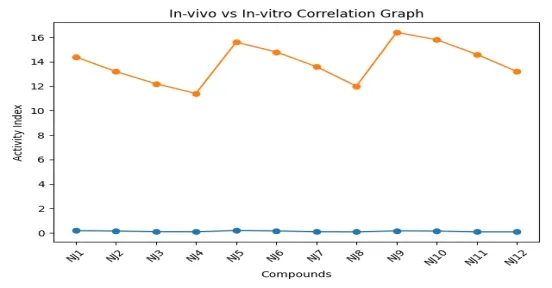
The correlation between in-vivo anticonvulsant activity and in-vitro antimicrobial activity of the synthesized 1, 2, 4-triazole derivatives was analyzed to understand the relationship between biological efficacy and structural features.
1. Correlation of Biological Activity
The results demonstrate a positive correlation between in-vivo and in-vitro activities:
This indicates that compounds effective in vitro are generally also effective in vivo, suggesting good pharmacological consistency.
2. Structure–Activity Relationship (SAR) Based Correlation
(a) Effect of Substituent’s on Benzene Ring
Slight variation suggests:
(b) Effect of Chain Length
Reason:
3. Pharmacokinetic–Pharmacodynamic Relationship
This supports a Level A type IVIVC trend (Qualitative Correlation) where:
Overall Correlation Conclusion
The study establishes that:
CONCLUSION
The synthesized compounds were then evaluated for their anticonvulsant studies. The anticonvulsant studies were performed on albino rats by Maximal Electro Shock (MES) induced method using Phenytoin as the reference drug. It was found that the compound NJ-1, NJ-5, NJ-9 showed better activity while compounds NJ-2, NJ-6, NJ-10 showed good activity and the remaining other compounds were inactive.
Electron donating group of benzene ring exhibited better anticonvulsant activity as compared to unsubstitution. Further work may be undertaken on this nucleus for the search of better anticonvulsant agents with less toxicity.
The synthesized compounds were then again subjected to biological evaluation. The activity was greatly influenced by ring substituents. Ampicillin and Griseofulvin were used as reference drugs, Ampicillin as antibacterial and Griseofulvin as antifungal drug. It was found that the compound NJ-1, NJ -5, NJ -9 showed better activity while compounds NJ-2, NJ-6, NJ-7, NJ-10 and NJ-11 showed good activity and the remaining other compounds were near to inactive.
Electron donating group of benzene ring exhibited better antimicrobial activity as compared to unsubstitution. Further work may be undertaken on this nucleus for the search of better antimicrobial agents with less toxicity. Overall Correlation Conclusion
The study establishes that:
Trend clearly indicates positive IVIVC (In-vitro ↔ In-vivo correlation)
REFERENCE
Table 01: Physical parameters of triazole derivatives synthesized compounds
|
S. No. |
R |
R1& R2 |
Mol. Form. |
Rf Value |
Mol.Wt. |
%Yield |
M.P. (°C) |
|
NJ-1 |
H |
Methyl |
C12H15O1N5S1 |
0.56 |
277 |
56 |
170-172 |
|
NJ-2 |
H |
Ethyl |
C14H19O1N5S1 |
0.63 |
305 |
63 |
153-155 |
|
NJ-3 |
H |
Propyl |
C16H23O1N5S1 |
0.45 |
333 |
46 |
174-176 |
|
NJ-4 |
H |
Isopropyl |
C16H23O1N5S1 |
0.66 |
333 |
52 |
108-110 |
|
NJ-5 |
CH3 |
Methyl |
C13H18O1N5S1 |
0.48 |
291 |
48 |
158-160 |
|
NJ-6 |
CH3 |
Ethyl |
C15H22O1N5S1 |
0.52 |
319 |
42 |
128-130 |
|
NJ-7 |
CH3 |
Propyl |
C17H26O1N5S1 |
0.74 |
347 |
54 |
184-186 |
|
NJ-8 |
CH3 |
Isopropyl |
C17H26O1N5S1 |
0.61 |
347 |
46 |
202-204 |
|
NJ-9 |
OCH3 |
Methyl |
C13H18O2N5S1 |
0.59 |
307 |
55 |
212-214 |
|
NJ-10 |
OCH3 |
Ethyl |
C15H22O2N5S1 |
0.60 |
335 |
49 |
166-168 |
|
NJ-11 |
OCH3 |
Propyl |
C17H26O2N5S1 |
0.68 |
363 |
61 |
196-198 |
|
NJ-12 |
OCH3 |
Isopropyl |
C17H26O2N5S1 |
0.78 |
363 |
58 |
182-184 |
Table 02. Effect of Synthesized Compounds on Maximal Electro Shock Convulsion in albino rats. (At 150 mg/kg dose after 4 h)
|
Code No. |
Time(sec) in various phase of convulsion |
|||||
|
Flexion (mean±SE) |
Extensor (mean±SE) |
Clonic (mean±SE) |
Stupor (mean±SE) |
Recovery /Death |
||
|
NJ1 |
0.9±0.1 |
5.9±0.3 |
2.0±0.2 |
99±0.2 |
Recovery |
|
|
NJ2 |
1.6±0.2 |
6.9±0.3 |
3.1±0.2 |
112±0.2 |
Recovery |
|
|
NJ3 |
2.8±0.2 |
11.5± 0.6 |
6.9±0.3 |
129±0.2 |
Recovery |
|
|
NJ4 |
3.9±0.3 |
11.8±0.6 |
6.9±0.3 |
128±0.2 |
Recovery |
|
|
NJ5 |
0.6±0.2 |
4.9±0.7 |
0.8±0.3 |
90±0.2 |
Recovery |
|
|
NJ6 |
1.5±0.2 |
6.5±0.7 |
3.1±0.2 |
106±0.3 |
Recovery |
|
|
NJ7 |
2.8±0.3 |
11.3±0.6 |
6.8±0.2 |
125±0.3 |
Recovery |
|
|
NJ8 |
3.8±0.3 |
13.8±0.6 |
6.8±0.3 |
133±0.2 |
Recovery |
|
|
NJ9 |
1.0±0.2 |
7.1±0.7 |
3.4±0.2 |
111±0.2 |
Recovery |
|
|
NJ10 |
2.1±0.2 |
7.5±0.7 |
3.9±0.3 |
121±0.3 |
Recovery |
|
|
NJ11 |
2.6.± 0.2 |
12.8±0.5 |
5.9±0.4 |
121±0.2 |
Recovery |
|
|
NJ12 |
3.9±0.4 |
13.4±0.4 |
7.3±0.2 |
132±0.2 |
Recovery |
|
|
C |
4.0±0.3 |
13.8±0.5 |
7.8±0.3 |
133±0.4 |
Recovery |
|
|
SD |
- |
4±0.7 |
0.8±0.3 |
86±1.8 |
Recovery |
|
* C: Control, * SD: standard (Phenytoin), * - : No Activity
Table 03: Data of antimicrobial activity of synthesized 1,2,4-Triazole Derivatives
|
S. No. |
Compound |
Diameter of zone of inhibition (mm) |
||||
|
B. subtilis |
S. aureus |
E. coli |
P. aeruginosa |
C. albicans |
||
|
1 |
NJ1 |
14 |
16 |
15 |
14 |
13 |
|
2 |
NJ2 |
13 |
14 |
15 |
13 |
11 |
|
3 |
NJ3 |
11 |
14 |
13 |
12 |
11 |
|
4 |
NJ4 |
10 |
13 |
13 |
11 |
10 |
|
5 |
NJ5 |
15 |
18 |
16 |
15 |
14 |
|
6 |
NJ6 |
14 |
17 |
16 |
14 |
13 |
|
7 |
NJ7 |
14 |
15 |
14 |
12 |
13 |
|
8 |
NJ8 |
11 |
14 |
13 |
10 |
12 |
|
9 |
NJ9 |
16 |
19 |
17 |
15 |
15 |
|
10 |
NJ10 |
15 |
18 |
17 |
14 |
15 |
|
11 |
NJ11 |
13 |
18 |
15 |
14 |
13 |
|
12 |
NJ12 |
12 |
15 |
14 |
12 |
13 |
|
Ampicillin |
16 |
20 |
18 |
15 |
- |
|
|
Griseofulvin |
- |
|
- |
- |
16 |
|
Table 04. Data of antibacterial and antifungal activity of synthesized 1,2,4-Triazole Derivatives
|
S. No. |
Comp. |
B. subtilis |
S. aureus |
E. coli |
P. aeruginosa |
C. albicans |
|||||||||||||||||
|
Dilution |
I |
II |
III |
IV-V |
I |
II |
III |
IV-V |
I |
II |
III |
IV-V |
I |
II |
III |
IV-V |
I |
II |
III |
IV-V |
|
||
|
1 |
NJ1 |
- |
- |
- |
+ |
- |
- |
- |
+ |
- |
- |
- |
+ |
- |
- |
- |
+ |
- |
- |
- |
+ |
|
|
|
2 |
NJ2 |
- |
- |
- |
+ |
- |
- |
+ |
+ |
- |
- |
+ |
+ |
- |
- |
- |
+ |
- |
- |
+ |
+ |
|
|
|
3 |
NJ3 |
- |
- |
+ |
+ |
- |
- |
+ |
+ |
- |
- |
+ |
+ |
- |
- |
+ |
+ |
- |
- |
+ |
+ |
|
|
|
4 |
NJ4 |
- |
- |
+ |
+ |
- |
- |
+ |
+ |
- |
- |
+ |
+ |
- |
- |
+ |
+ |
- |
- |
+ |
+ |
|
|
|
5 |
NJ5 |
- |
- |
- |
+ |
- |
- |
- |
+ |
- |
- |
- |
+ |
- |
- |
- |
+ |
- |
- |
- |
+ |
|
|
|
6 |
NJ6 |
- |
- |
- |
+ |
- |
- |
- |
+ |
- |
- |
- |
+ |
- |
- |
- |
+ |
- |
- |
- |
+ |
|
|
|
7 |
NJ7 |
- |
- |
+ |
+ |
- |
- |
- |
+ |
- |
- |
+ |
+ |
- |
- |
- |
+ |
- |
- |
+ |
+ |
|
|
|
8 |
NJ8 |
- |
- |
+ |
+ |
- |
- |
+ |
+ |
- |
- |
+ |
+ |
- |
- |
+ |
+ |
- |
- |
+ |
+ |
|
|
|
9 |
NJ9 |
- |
- |
- |
+ |
- |
- |
- |
+ |
- |
- |
- |
+ |
- |
- |
- |
+ |
- |
- |
- |
+ |
|
|
|
10 |
NJ10 |
- |
- |
- |
+ |
- |
- |
- |
+ |
- |
- |
- |
+ |
- |
- |
- |
+ |
- |
- |
- |
+ |
|
|
|
11 |
NJ11 |
- |
- |
- |
+ |
- |
- |
+ |
+ |
- |
- |
+ |
+ |
- |
- |
- |
+ |
- |
- |
+ |
+ |
|
|
|
12 |
NJ12 |
- |
- |
+ |
+ |
- |
- |
+ |
+ |
- |
- |
+ |
+ |
- |
- |
- |
+ |
- |
- |
+ |
+ |
|
|
|
Ampicillin |
- |
- |
- |
- |
- |
- |
- |
- |
- |
- |
- |
- |
- |
- |
- |
- |
|
|
|
|
|
||
|
Griseofulvin |
|
|
|
|
|
|
|
|
|
|
|
|
|
|
|
|
- |
- |
- |
- |
|
||
I-1000mg/ml, II-500mg/ml, III-250mg/ml, IV-125mg/ml, V-62.5mg/ml
(-) indicates absence of growth; (+) indicates presence of growth
|
R |
R1& R2 (Amines) |
|
H |
Methyl |
|
H |
Ethyl |
|
H |
Propyl |
|
H |
Isopropyl |
|
CH3 |
Methyl |
|
CH3 |
Ethyl |
|
CH3 |
Propyl |
|
CH3 |
Isopropyl |
|
OCH3 |
Methyl |
|
OCH3 |
Ethyl |
|
OCH3 |
Propyl |
|
OCH3 |
Isopropyl |
Fig.-02 The bacterial screening indicated that among the compound no. the compounds NJ-01, NJ-05, NJ-09 and NJ-10 moderately activity against all tested bacterial stain staphylococcus aureus, Bacillus subtilis, Escherichia coli and Pseudomonas aeruginosa.
Fig.03 -Antifungal screening indicated that among the compound NJ-01.NJ-05 and NJ-09 reveled that the test compounds showed moderate activity against Candida albicans.
Fig.04 -Combined Anticonvulsant Activity of Synthesized Compounds in MES Model
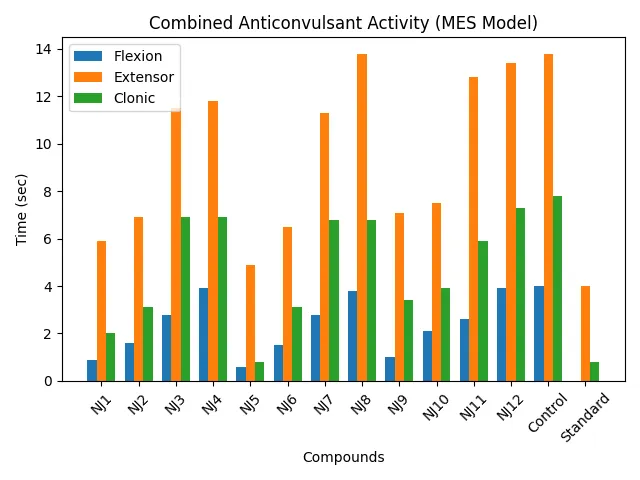
Fig.04 –Invito-Invivo Correlation Graph



Ajay Bagherwal, Dr. Maya Sharma, Synthesis and In-Vivo/In-Vitro Evaluation of Novel Triazole-Based Derivatives, Int. J. of Pharm. Sci., 2026, Vol 4, Issue 5, 6667-6681, https://doi.org/10.5281/zenodo.20391140
 10.5281/zenodo.20391140