View Article

Abstract

Benzofuran, also known as benzo[b]furan, is a 10?-electron heteroaromatic system that is considered a "privileged structure" in medicinal chemistry because of its substantial chemotherapeutic potential and adaptable core. This scaffold functions as an adaptable building block for the synthesis of novel medicinal compounds with a variety of biological profiles, such as antibacterial, anticancer, antitubercular, antioxidant, and anti-inflammatory properties. This review illustrates the creation of new benzofuran analogues as effective therapeutic agents based on thorough literature reviews. By inhibiting anti-apoptotic Bcl2 proteins and targeting vital enzymes like PI3K and VEGFR-2, benzofuran hybrids—such as those conjugated with isatin or pyrazole—exhibit strong antiproliferative effect. In tuberculosis research, the benzofuran ring is essential for attaching to Mycobacterium tuberculosis's InhA pocket and blocking the Pks13 enzyme, which is necessary for the synthesis of mycolic acid. The structure-activity relationship discussed herein provides a robust framework for the future development of next-generation multifunctional drugs designed to treat complex, multifactorial illnesses.

Keywords

Benzofuran, substituted hybrids, anticancer, antitubercular, antioxidant, structure activity relationship

Introduction

× Popup Image

Heterocyclic compounds have become the backbone of modern drug discover, with benzofuran serving as a key example. Chemists and medical researchers have shown a great deal of interest in benzofuran scaffolds because of their dynamic nature, strong chemotherapeutic potential, and adaptable physiological characteristics. These scaffolds serve as flexible building blocks for the synthesis of novel therapeutic compounds with a variety of biological activities, including as antibacterial, anti-inflammatory, analgesic, anti-hyperglycemic, anti-parasitic, and anticancer qualities [1]. Furthermore, these scaffolds enable significant structural alterations in which the location of substituents can be tuned to improve molecular interactions and binding affinity within target proteins' catalytic pockets. These compounds are used in agricultural and other chemical industries as oxidants, brightening agents, antioxidants, and fluorescent sensors in addition to their medical uses [2].                 


CHEMISTRY

Benzofuran, also known as benzo[b]furan, is a 10π-electron, π-excessive heteroaromatic system that is more stable than furan, mainly because of annelation of its benzene ring [3]. Its chemical reactivity is dominated by electrophilic substitution, which happens almost exclusively at the C-2 position; this particular orientation is driven by the high electronegativity of oxygen, which favors an ionic intermediate with a localized negative charge at the 2-position. Benzofuran, which is categorized as a "privileged structure" in medicinal chemistry, functions as a flexible core for a variety of biological activities, such as neuroprotection, anti-inflammatory, and antioxidant properties. By causing apoptosis, benzofuran hybrids (conjugated with moieties like isatin or pyrazole) exhibit strong antiproliferative action against liver, cervix, and colon cancer cell lines in oncology research[4].                                                      


Mechanistically, it has been demonstrated that these conjugates dramatically reduce the expression of the anti-apoptotic Bcl2 protein while raising the amounts of cleaved PARP, which results in programmed cell death[5]. Its biological potency is frequently increased by the deliberate insertion of halogens, nitro, or hydroxyl groups at the 4, 5, and 6 positions of the ring system, and its antimicrobial profile is equally strong [6].

STRUCTURE OF APPROVED DRUGS CONTAINING BENZOFURAN RING


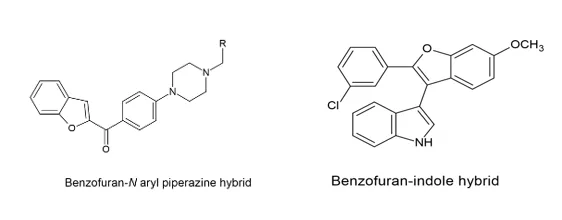
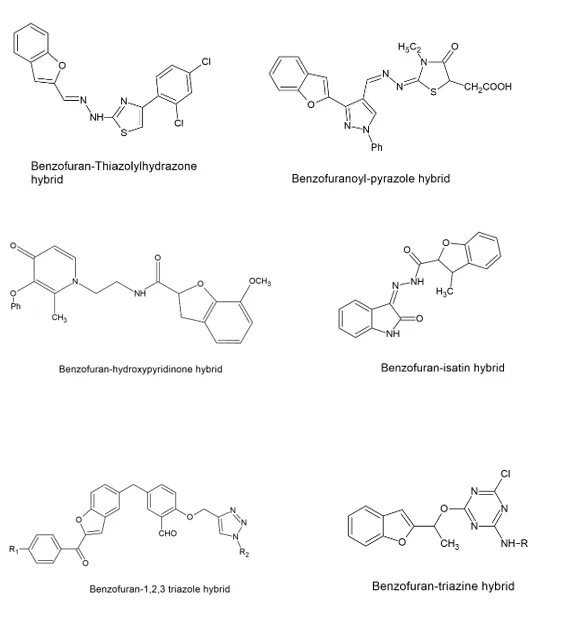
SEVERAL SUBSTITUTED BENZOFURAN HYBRIDS


VARIOUS BIOLOGICAL ACTIVITIES OF BENZOFURAN SCAFFOLD

In nature, benzofuran compounds are a common class of chemicals. The majority of benzofuran compounds have substantial biological activity, including anti-tumor, antibacterial, antioxidative, and antiviral properties, according to numerous studies.


ANTICANCER

According to recent studies, the benzofuran scaffold is a flexible "privileged" core in medicinal chemistry that can be used to create powerful anticancer drugs that target a variety of cancers. In colon cancer (cell lines SW-620 and HT-29), novel benzofuran-isatin conjugates have shown strong antiproliferative action. Lead compounds 5a and 5d cause apoptosis by blocking the anti-apoptotic Bcl2 protein and raising cleaved PARP levels[5].


Benzofuran-based carboxylic acids, particularly compound 9e, selectively block the hypoxia-induced carbonic anhydrase IX and XII isoforms in the therapy of breast cancer, resulting in cell cycle arrest at the G2/M phase[7].

Another study describes the development of benzofuran hybrids intended for dual-target inhibition, such as derivatives of piperazine and thiosemicarbazone. In the study, Compound 8, a benzofuranyl thiosemicarbazone, was shown to be the most effective contender, exhibiting high activity against cervical (Hela) and hepatocellular (HePG2) cancer cell lines.
Anticancer Mechanism included PI3K and VEGFR-2, two enzymes essential for tumor cell survival and angiogenesis (the creation of new blood vessels), are both inhibited by this chemical. It causes late apoptosis and successfully stops the cell cycle at the G1/S phase[8].

 The activity of new benzofuran compounds substituted at the third and fifth positions against liver, lung, and breast cancer is reviewed. Compound BZ-16 had the strongest activity, especially against HepG2 liver cancer.  The study proposes a complex mode of action that includes interference with the VEGFR-2 pathway, suppression of DNA topoisomerase, and production of ROS (reactive oxygen species). The results highlight how adding electron-withdrawing groups (such as fluorine or chlorine) and nitrogen-containing heterocycles (such as pyrrole or piperazine) at key locations on the benzofuran ring greatly increases anticancer activity[9].

ANTITUBERCULAR ACTIVITY

Research demonstrates that the benzofuran ring is a special and adaptable heterocyclic pharmacophore with substantial therapeutic potential against Mycobacterium tuberculosis (Mtb). In order to combat medication resistance, it investigates several benzofuran-based compounds intended to target crucial mycobacterial enzymes as InhA and Pks13[10]. The benzofuran core is essential for binding within the InhA pocket, according to structural analyses of benzofuran pyrrolidine pyrazole derivatives. Usually, it is wedged between residues like Leu207 and Met103 and buried in hydrophobic side chains like Ile215 and Ala157. The benzofuran core is nevertheless essential for preserving strong inhibitory potency (IC50) against the enzyme, even while substituents at other locations affect cellular activity (MIC90) [11].

Benzofuran-1,3,4-oxadiazole hybrids that target the Pks13 enzyme—which is essential for the production of mycolic acid—have been the subject of recent in silico research. Lead compounds exhibit binding affinities (−14.82 kcal/mol) greater than those of typical inhibitors like TAM-16. These scaffolds retain a high degree of stability within the active site of the enzyme, according to molecular dynamics simulations[10]. Benzofuran must be coupled with other nitrogen heterocycles in order to inhibit the H37Rv strain, as demonstrated by the synthesis of benzofuran-quinoline-isatin hybrids. With minimum inhibitory concentrations (MIC) as low as 12.5 µg/ml, these compounds show strong antitubercular efficacy while preserving acceptable pharmacokinetic and safety profiles. When taken as a whole, these articles demonstrate that the benzofuran ring is an essential component of new, direct-acting antitubercular drugs[11].                             


ANTIOXIDANT ACTIVITY

Because of its electron-rich aromatic structure, which uses resonance to stabilize free radicals, the benzofuran ring has strong antioxidant action. In drug design, substituted derivatives—particularly those with hydroxyl or methoxy groups improve their capacity to scavenge radicals. Recent studies revealed that benzo[b]furan derivatives connected to thiazole (compound 10), thiophene (compound 11), or triazole (compound 9) rings have strong activity; in ABTS tests, some of them achieve 87.8% inhibition. Resonance effects across the fused heterocyclic system stabilize the hydrogen donation from amino groups, which is the main cause of its effectiveness[12]. In another study  new thiazole hybrids based on benzofuran were done  and discovered a meta, para-dichloro derivative (compound 2g) as a potent antioxidant with an IC 50 of 30.14μM in DPPH experiments, almost matching the reference standard, gallic acid[6].    


Studies investigated benzofuran and found a direct correlation between the quantity and location of hydroxyl groups on the arylidene moiety and the capacity to scavenge radicals. In DPPH and FRAP tests, their research revealed that 2,3,4-trihydroxybenzylidene derivatives (compound 7) and 2,5-dihydroxybenzylidene derivatives (compound 6) had a strong antioxidant activity[14]. Additionally, researchers synthesized propanehydrazide derivatives with furan and naphthalene moieties and found that certain structures (compounds 36 and 39) could outperform ascorbic acid's antioxidant power by about 1.4 times. All of these sources suggest that although the benzofuran core is a strong scaffold, its antioxidant performance is maximized through polyhydroxylation or the integration of heterocycles rich in nitrogen and sulfur[13].

STRUCTURE ACTIVITY RELATIONSHIP

Substitutions at the C-2 position, such as esters or heterocyclic rings, are crucial for cytotoxic activity because they affect selectivity toward cancer cells over normal ones. The structure-activity relationship (SAR) of benzofuran derivatives shows that their anticancer potency and selectivity are highly dependent on the type and position of substituents appended to the core. A common structural prerequisite that provides a framework for further functionalization is the presence of a 3-methyl group [15].

The main factors influencing activity are electronic effects. Halogenation (Cl, Br, F) greatly increases binding affinity by creating halogen bonds, especially at the 3-methyl position or the para position of connected N-phenyl rings. Success in targeting the HIF-1 pathway required substituting nitrogen-containing alkyl chains for esters and adding a chlorine atom at the para position. On the other hand, neighboring ortho and para substitutions on specific phenyl rings might occasionally be harmful to activity [16]. Linkers play a critical role as well; carbohydrazide, hydrazine, or hydrazide linkers help benzofuran hybridize with other pharmacophores such as isatin. Incorporating an arylsulfone moiety for carbonic anhydrase inhibition increases selectivity for tumor-associated isoforms by promoting binding to the hydrophilic area of the active site. Additionally, the compound's drug-like profile and cytotoxic effect are frequently optimized by the addition of bulky, hydrophobic groups or hydrophilic heteroatoms like piperidine [17].

REVIEW OF LITERATURE

  1. Abd El-Karim et al. synthesized a new series of benzofuran–pyrazole-based analogues as potential antiproliferative agents targeting various protein kinases. The 1H-benzo[d]imidazole derivative 3d demonstrated the highest inhibition against sixty human cancer cell lines and showed multi-targeting PK-suppression activity against B-Raf, c-Met, Pim-1, EGFR, and VEGFR-2[18].                                              
 
  1. Younus et al. performed the synthesis of three novel curcumin-like compounds derived from a benzofuran nucleus and characterized them using spectroscopic techniques. Biological evaluations were done and these synthesized analogues exhibited significantly higher antimicrobial and antifungal activity compared to standard curcumin. Specifically, the 5-bromo-substituted derivative outperformed known heterocyclic analogues by exhibiting exceptional inhibition zones against pathogens like Staphylococcus aureus and Candida albicans[19].


  1. Herrera-Ramírez et al. synthesized a novel series of benzofuran-pterostilbene hybrids using the Mizoroki-Heck cross-coupling reaction as a key synthetic step. Among the library, hybrids 6d and 6e exhibited the greatest biological activity against SW480 colorectal adenocarcinoma cells by triggering programmed cell death and chromatin condensation [20].
       ​​​​
  1. Gritti et al. explained a sustainable, microwave-enhanced process for producing 2-substituted benzofurans from substituted o-alkynylanisoles . The method makes use of an acidic deep eutectic solvent that, in mild circumstances, functions as both the catalyst and the reaction medium. The eutectic mixture was successfully recyclable for up to six cycles thanks to this environmentally friendly synthesis approach, which produced seventeen distinct benzofuran derivatives with great efficiency [21].
  2. Khan et al. created a number of functionalized phenylbenzofuran-2-carboxylate compounds via Suzuki-Miyaura cross-coupling processes. Compounds 4d and 4a have excellent anti-urease and α-glucosidase inhibitory actions that are equivalent to established reference medicines, according to pharmacological screening. Furthermore, the results of the hemolytic assay verified that the produced molecules are not harmful to red blood cells, suggesting their safety and potential as novel therapeutic candidates [22] 
 

CONCLUSION

Benzofuran  is a versatile and privileged nucleus in medicinal chemistry, according to the collective evidence presented in this review. These compounds have a wide range of pharmacological effects, most notably as strong anticancer drugs that target certain biomarkers like PI3K, VEGFR-2, and CDK2. Their strong inhibitory efficacy against enzymes implicated in neurological and metabolic disorders, such as AChE, BChE, BACE-1, MAO, urease, and alpha-amylase, further illustrates their function as multi-target ligands. it can be synthesized using  various methods . SAR studies  show that by incorporating halogens (Cl, F, Br) and nitro groups anticancer and antimicrobial activities can be increased by increasing lipophilicity. Drug resistance can be successfully overcome, target selectivity can be improved, and systemic toxicity can be decreased by combining active pharmacophores into single molecules, as demonstrated by the success of molecular hybridization—coupling the benzofuran ring with isatin, thiazole, or pyrazole. In the end, benzofuran  offer a strong and promising foundation for the development of next-generation multifunctional medications that can treat complicated, multifactorial illnesses.

REFERENCES

  1. Taha M, Rahim F, Ullah H, Wadood A, Farooq RK, Shah SAA, et al. Synthesis, in vitro urease inhibitory potential and molecular docking study of benzofuran-based-thiazoldinone analogues. Sci Rep. 2020;10:10673.
  2. Al-Mohammadi JA, Taha M, Rahim F, Hussain R, Aldossary H, Farooq RK, et al. Synthesis, in vitro evaluation, and molecular docking studies of benzofuran based hydrazone a new inhibitors of urease. Arab J Chem. 2022;15:103954.
  3. Hiremathad A, Patil MR, Chethana KR, Chand K, Santos MA, Keri RS. Benzofuran: an emerging scaffold for antimicrobial agents. RSC Adv. 2015;5(118):96809-96828.
  4. El-Zahar MI, Abd El-Karim SS, Anwar MM. Synthesis and Cytotoxicity Screening of Some Novel Benzofuranoyl-pyrazole Derivatives against Liver and Cervix Carcinoma Cell Lines. S Afr J Chem. 2009;62:189-199.
  5. Eldehna WM, Salem R, Elsayed ZM, Al-Warhi T, Knany HR, Ayyad RR, et al. Development of novel benzofuran-isatin conjugates as potential antiproliferative agents with apoptosis inducing mechanism in Colon cancer. J Enzyme Inhib Med Chem. 2021;36(1):1423-1434.
  6. Kaya B, Maryam Z, Daoud NEH, Bağci ER, Karakaya A, Erçetin T, et al. Synthesis of Novel Benzofuran-Based Thiazole Hybrids and Investigation of Their Antioxidant and Anticholinesterase Activities. FABAD J Pharm Sci. 2025;50(3):531-546.
  7. Eldehna WM, Nocentini A, Elsayed ZM, Al-Warhi T, Aljaeed N, Alotaibi OJ, et al. Benzofuran-based carboxylic acids as carbonic anhydrase inhibitors and antiproliferative agents against breast cancer. ACS Med Chem Lett. 2020;11(6):1022-7.
  8. El-Khouly OA, Henen MA, El-Sayed MAA, El-Messery SM. Design, synthesis and computational study of new benzofuran hybrids as dual PI3K/VEGFR2 inhibitors targeting cancer. Sci Rep. 2022;12(1):17104.
  9. Kumar A, Singh A, Sethi NS. Novel benzofuran derivatives: Synthesis, characterization, and evaluation of anticancer and antibacterial activities. J Indian Intell Tradit. 2025;19(2):234-47.
  10. Irfan A, Faisal S, Zahoor AF, Noreen R, Al-Hussain SA, Tuzun B, et al. In Silico Development of Novel Benzofuran-1,3,4-Oxadiazoles as Lead Inhibitors of M. tuberculosis Polyketide Synthase 13. Pharmaceuticals. 2023;16(6):829.
  11. Santoshkumar S, Satyanarayan ND, Anantacharya R, Sameer P. Synthesis, antimicrobial, antitubercular and cheminformatic studies of 2-(1-benzofuran-2-yl)-N'-[(3Z)-2-oxo-1, 2-dihydro-3H-indol-3-ylidene] quinoline-4-carbohydrazide and its derivatives. Int J Pharm Pharm Sci. 2017;9(5):260-267.
  12. Abdel-motaal M, Kandeel EM, Abou-Elzahab M, Elghareeb F. Synthesis and Evaluation of Antioxidant Activity of Some New Heterocyclic Compounds Bearing the Benzo[B]Furan Moiety. Eur Sci J. 2017;13(30):297-313.
  13. Tumosienė I, Kantminienė K, Klevinskas A, Petrikaitė V, Jonuškienė I, Mickevičius V. Antioxidant and Anticancer Activity of Novel Derivatives of 3-[(4-Methoxyphenyl)amino]propanehydrazide. Molecules. 2020;25(13):2980.
  14. Baldisserotto A, Demurtas M, Lampronti I, Moi D, Balboni G, Vertuani S, et al. Benzofuran hydrazones as potential scaffold in the development of multifunctional drugs: Synthesis and evaluation of antioxidant, photoprotective and antiproliferative activity. Eur J Med Chem. 2018;156:118-125.
  15. Taha M, Shah SAA, Imran S, Afifi M, Chigurpati S, et al. Synthesis and in vitro study of benzofuran hydrazone derivatives as novel alpha-amylase inhibitor. Bioorg Chem. 2017;75:78-85.
  16. Thorat BR, Nazirkar B, Thorat VB, More K, Jagtap R, Yamgar R. Synthesis, SAR, Molecular Docking and Antituberculosis Study of 3-Methyl-1-Benzofuran-2-Carbohydrazide. Asian J Chem. 2016;28(11):2346-2352.
  17. Abdelrahman MA, Eldehna WM, Nocentini A, Ibrahim HS, Almahli H, et al. Novel benzofuran-based sulphonamides as selective carbonic anhydrases IX and XII inhibitors: synthesis and in vitro biological evaluation. J Enzyme Inhib Med Chem. 2020;35(1):298-305.
  18. Abd El-Karim SS, Syam YM, Abdelkader RM, El-Ashrey MK, Anwar MM. Design, synthesis, and in silico studies of new benzofuran–pyrazole hybrids as multi-kinase inhibitors with potential antiproliferative activity. RSC Adv. 2025;15:35003.
  19. Younus AM, Omar AO, Hassin MB. Comparative study of curcumin and novel benzofuran derived analogues through biological activates. Health Biotechnol Biopharma. 2026;10(1):23-38.
  20. Herrera-Ramírez A, Becerra-Quintana R, Yepes AF, Cardona-Galeano W. Novel benzofuran/pterostilbene hybrids trigger programmed cell death and impair migration in CRC cells. PLoS One. 2026;21(4):e0344602.
  21. Gritti A, Sita A, Goudarzi M, Fedeli S, Lepore E, Nava D, et al. Sustainable Microwave-Enhanced Synthesis of 2-Substituted Benzofurans From o-Alkynylanisoles in Acidic Deep Eutectic Solvents. Eur J Org Chem. 2026.
  22. Khan L, Zubair M. Synthesis of functionalized benzofuran esters through Suzuki-Miyaura cross-coupling reactions, their DFT and pharmacological studies. Pak J Pharm Sci. 2025;38(5):1516-1527.
  23. Faheem A, Wadood A, Kanwal T. Hydrazone Containing Synthetic Compounds with Potential Antioxidant, Anti-cancer and Antimicrobial Activities and Their Possible Mechanisms- A critical Review. Innt Med Health Sci. 2021;1(1):69-76.
  24. Sayed AR, Gomha SM, El-lateef HM, Abolibda TZ. L-proline catalyzed green synthesis and anticancer evaluation of novel bioactive benzil bis-hydrazones under grinding technique. Green Chem Lett Rev. 2021;14(2):180-89.
  25. Osmaniye D, Sağlik BN, Levent S, Çevik UA, Ilgin S, Yurttaş L, et al. Design, Synthesis, and Biological Effect Studies of Novel Benzofuran-Thiazolylhydrazone Derivatives as Monoamine Oxidase Inhibitors. ACS Omega. 2024;9(10):11388-97.
  26. Abdulla MH, Vaali-Mohammed MA, Nasri SM, Alhassan NS, Meeramaideen M, Obeed AA, et al. Benzofuran-isatin derivative 5d acts as a dual-action agent in colorectal cancer cells by targeting EMT and mitochondrial apoptosis pathways. Asian Pac J Trop Biomed. 2026;16(5):212-24.
  27. Al-Sanea MM, Al-Ansary GH, Elsayed ZM, Maklad RM, Elkaeed EB, Abdelgawad MA, et al. Development of 3-methyl/3-(morpholinomethyl)benzofuran derivatives as novel antitumor agents towards non-small cell lung cancer cells. J Enzyme Inhib Med Chem. 2021;36(1):987-99.
  28. El-Khouly OA, Henen MA, El-Sayed MAA, Shabaan MI, El-Messery SM. Synthesis, anticancer and antimicrobial evaluation of new benzofuran based derivatives: PI3K inhibition, quorum sensing and molecular modeling study. Bioorg Med Chem. 2021;31:115976.
  29. Farhat J, Alzyoud L, Alwahsh M, Al-Omari B. Structure-Activity Relationship of Benzofuran Derivatives with Potential Anticancer Activity. Cancers. 2022;14(9):2196.
  30. Anwar MM, Abd El-Karim SS, Mahmoud AH, Amr AEG, Al-Omar MA. A Comparative Study of the Anticancer Activity and PARP-1 Inhibiting Effect of Benzofuran Pyrazole Scaffold and Its Nano-Sized Particles in Human Breast Cancer Cells. Molecules. 2019;24(13):2413
  31. Gebeş-Alperen B, Evren AE, Sağlik Özkan BN, Karaburun AC, Gundogdu-Karaburun N. Novel Benzofuran-3-yl-methyl and Aliphatic Azacyclics: Design, Synthesis, and In Vitro and In Silico anti-Alzheimer Disease Activity Studies. ACS Omega. 2025;10(30):32829-43
  32. Biliz Y, Hasdemir B, Küçük HB, Zaim M, Şentürk AM, Kırmızıbekmez AM, et al. Novel N-Acyl Hydrazone Compounds as Promising Anticancer Agents: Synthesis and Molecular Docking Studies. ACS Omega. 2023;8(22):20073-84. doi: 10.1021/acsomega.3c02361.
  33. Fekadu S, Hordofa AK, Belay A, Sherefedin U, Asefa J, Thillainayaga G, et al. DFT- and Multiwfn-driven investigation of 1-benzofuran: Structural, topological, natural bond orbital, Hirshfeld surface, and interaction energy analyses, coupled with molecular docking of pyrazole and chalcone for anti-breast cancer exploration. AIP Adv. 2025;15(8):085220.
  34. Hosny NM, Abdel-Rhman MH. Synthesis, characterization and cytotoxicity of new 2-isonicotinoyl-N-phenylhydrazine-1-carbothioamide and its metal complexes. BMC Chemistry. 2024;18:22.
  35. Prins LHA, Petzer JP, Malan SF. Inhibition of Monoamine Oxidase by Indole and Benzofuran Derivatives. Eur J Med Chem. 2010;45(10):4458-66.
  36. Marak BN, Dowarah J, Khiangte L, Singh VP. A comprehensive insight on the recent development of Cyclic Dependent Kinase inhibitors as anticancer agents. Eur J Med Chem. 2020;203:112571.
  37. Pisani L, Barletta M, Soto-Otero R, et al. Discovery, biological evaluation, and structure-activity and selectivity relationships of 6'-substituted (E)-2-(benzofuran-3(2H)-ylidene)-N-methylacetamides, a novel class of potent and selective monoamine oxidase inhibitors. J Med Chem. 2013;56(6):2651-64.
  38. Xu Z, Zhao S, Lv Z, et al. Benzofuran derivatives and their anti-tubercular, anti-bacterial activities. Eur J Med Chem. 2019;162:266-76.
  39. Zha X, Lamba D, Zhang L, et al. Novel Tacrine-Benzofuran Hybrids as Potent Multitarget-Directed Ligands for the Treatment of Alzheimer's Disease: Design, Synthesis, Biological Evaluation, and X-ray Crystallography. J Med Chem. 2016;59(1):114-31.
  40. Amin KM, Syam YM, Anwar MM, et al. Synthesis and molecular docking study of new benzofuran and furo[3,2-g]chromone-based cytotoxic agents against breast cancer and p38α MAP kinase inhibitors. Bioorg Chem. 2018;76:487-500
  41. Hranjec M, Sović I, Ratkaj I, et al. Antiproliferative potency of novel benzofuran-2-carboxamides on tumour cell lines: Cell death mechanisms and determination of crystal structure. Eur J Med Chem. 2013;59:111-9.
  42. Flynn BL, Gill GS, Grobelny DW, et al. Discovery of 7-hydroxy-6-methoxy-2-methyl-3-(3,4,5-trimethoxybenzoyl)benzo[b]furan (BNC105), a tubulin polymerization inhibitor with potent antiproliferative and tumor vascular disrupting properties. J Med Chem. 2011;54(17):6014-27.
  43. Bruce JY, LoRusso PM, Goncalves PH, et al. A pharmacodynamically guided dose selection of PF-00337210 in a phase I study in patients with advanced solid tumors. Cancer Chemother Pharmacol. 2016;77(3):527-38.
  44. Kamal A, Lakshma Nayak V, Nagesh N, et al. Benzo[b]furan derivatives induces apoptosis by targeting the PI3K/Akt/mTOR signaling pathway in human breast cancer cells. Bioorg Chem. 2016;66:124-31.
  45. Choi MJ, Jung KH, Kim D, et al. Anti-cancer effects of a novel compound HS-113 on cell growth, apoptosis, and angiogenesis in human hepatocellular carcinoma cells. Cancer Lett. 2011;306(2):190-6

Reference

  1. Taha M, Rahim F, Ullah H, Wadood A, Farooq RK, Shah SAA, et al. Synthesis, in vitro urease inhibitory potential and molecular docking study of benzofuran-based-thiazoldinone analogues. Sci Rep. 2020;10:10673.
  2. Al-Mohammadi JA, Taha M, Rahim F, Hussain R, Aldossary H, Farooq RK, et al. Synthesis, in vitro evaluation, and molecular docking studies of benzofuran based hydrazone a new inhibitors of urease. Arab J Chem. 2022;15:103954.
  3. Hiremathad A, Patil MR, Chethana KR, Chand K, Santos MA, Keri RS. Benzofuran: an emerging scaffold for antimicrobial agents. RSC Adv. 2015;5(118):96809-96828.
  4. El-Zahar MI, Abd El-Karim SS, Anwar MM. Synthesis and Cytotoxicity Screening of Some Novel Benzofuranoyl-pyrazole Derivatives against Liver and Cervix Carcinoma Cell Lines. S Afr J Chem. 2009;62:189-199.
  5. Eldehna WM, Salem R, Elsayed ZM, Al-Warhi T, Knany HR, Ayyad RR, et al. Development of novel benzofuran-isatin conjugates as potential antiproliferative agents with apoptosis inducing mechanism in Colon cancer. J Enzyme Inhib Med Chem. 2021;36(1):1423-1434.
  6. Kaya B, Maryam Z, Daoud NEH, Ba?ci ER, Karakaya A, Erçetin T, et al. Synthesis of Novel Benzofuran-Based Thiazole Hybrids and Investigation of Their Antioxidant and Anticholinesterase Activities. FABAD J Pharm Sci. 2025;50(3):531-546.
  7. Eldehna WM, Nocentini A, Elsayed ZM, Al-Warhi T, Aljaeed N, Alotaibi OJ, et al. Benzofuran-based carboxylic acids as carbonic anhydrase inhibitors and antiproliferative agents against breast cancer. ACS Med Chem Lett. 2020;11(6):1022-7.
  8. El-Khouly OA, Henen MA, El-Sayed MAA, El-Messery SM. Design, synthesis and computational study of new benzofuran hybrids as dual PI3K/VEGFR2 inhibitors targeting cancer. Sci Rep. 2022;12(1):17104.
  9. Kumar A, Singh A, Sethi NS. Novel benzofuran derivatives: Synthesis, characterization, and evaluation of anticancer and antibacterial activities. J Indian Intell Tradit. 2025;19(2):234-47.
  10. Irfan A, Faisal S, Zahoor AF, Noreen R, Al-Hussain SA, Tuzun B, et al. In Silico Development of Novel Benzofuran-1,3,4-Oxadiazoles as Lead Inhibitors of M. tuberculosis Polyketide Synthase 13. Pharmaceuticals. 2023;16(6):829.
  11. Santoshkumar S, Satyanarayan ND, Anantacharya R, Sameer P. Synthesis, antimicrobial, antitubercular and cheminformatic studies of 2-(1-benzofuran-2-yl)-N'-[(3Z)-2-oxo-1, 2-dihydro-3H-indol-3-ylidene] quinoline-4-carbohydrazide and its derivatives. Int J Pharm Pharm Sci. 2017;9(5):260-267.
  12. Abdel-motaal M, Kandeel EM, Abou-Elzahab M, Elghareeb F. Synthesis and Evaluation of Antioxidant Activity of Some New Heterocyclic Compounds Bearing the Benzo[B]Furan Moiety. Eur Sci J. 2017;13(30):297-313.
  13. Tumosien? I, Kantminien? K, Klevinskas A, Petrikait? V, Jonuškien? I, Mickevi?ius V. Antioxidant and Anticancer Activity of Novel Derivatives of 3-[(4-Methoxyphenyl)amino]propanehydrazide. Molecules. 2020;25(13):2980.
  14. Baldisserotto A, Demurtas M, Lampronti I, Moi D, Balboni G, Vertuani S, et al. Benzofuran hydrazones as potential scaffold in the development of multifunctional drugs: Synthesis and evaluation of antioxidant, photoprotective and antiproliferative activity. Eur J Med Chem. 2018;156:118-125.
  15. Taha M, Shah SAA, Imran S, Afifi M, Chigurpati S, et al. Synthesis and in vitro study of benzofuran hydrazone derivatives as novel alpha-amylase inhibitor. Bioorg Chem. 2017;75:78-85.
  16. Thorat BR, Nazirkar B, Thorat VB, More K, Jagtap R, Yamgar R. Synthesis, SAR, Molecular Docking and Antituberculosis Study of 3-Methyl-1-Benzofuran-2-Carbohydrazide. Asian J Chem. 2016;28(11):2346-2352.
  17. Abdelrahman MA, Eldehna WM, Nocentini A, Ibrahim HS, Almahli H, et al. Novel benzofuran-based sulphonamides as selective carbonic anhydrases IX and XII inhibitors: synthesis and in vitro biological evaluation. J Enzyme Inhib Med Chem. 2020;35(1):298-305.
  18. Abd El-Karim SS, Syam YM, Abdelkader RM, El-Ashrey MK, Anwar MM. Design, synthesis, and in silico studies of new benzofuran–pyrazole hybrids as multi-kinase inhibitors with potential antiproliferative activity. RSC Adv. 2025;15:35003.
  19. Younus AM, Omar AO, Hassin MB. Comparative study of curcumin and novel benzofuran derived analogues through biological activates. Health Biotechnol Biopharma. 2026;10(1):23-38.
  20. Herrera-Ramírez A, Becerra-Quintana R, Yepes AF, Cardona-Galeano W. Novel benzofuran/pterostilbene hybrids trigger programmed cell death and impair migration in CRC cells. PLoS One. 2026;21(4):e0344602.
  21. Gritti A, Sita A, Goudarzi M, Fedeli S, Lepore E, Nava D, et al. Sustainable Microwave-Enhanced Synthesis of 2-Substituted Benzofurans From o-Alkynylanisoles in Acidic Deep Eutectic Solvents. Eur J Org Chem. 2026.
  22. Khan L, Zubair M. Synthesis of functionalized benzofuran esters through Suzuki-Miyaura cross-coupling reactions, their DFT and pharmacological studies. Pak J Pharm Sci. 2025;38(5):1516-1527.
  23. Faheem A, Wadood A, Kanwal T. Hydrazone Containing Synthetic Compounds with Potential Antioxidant, Anti-cancer and Antimicrobial Activities and Their Possible Mechanisms- A critical Review. Innt Med Health Sci. 2021;1(1):69-76.
  24. Sayed AR, Gomha SM, El-lateef HM, Abolibda TZ. L-proline catalyzed green synthesis and anticancer evaluation of novel bioactive benzil bis-hydrazones under grinding technique. Green Chem Lett Rev. 2021;14(2):180-89.
  25. Osmaniye D, Sa?lik BN, Levent S, Çevik UA, Ilgin S, Yurtta? L, et al. Design, Synthesis, and Biological Effect Studies of Novel Benzofuran-Thiazolylhydrazone Derivatives as Monoamine Oxidase Inhibitors. ACS Omega. 2024;9(10):11388-97.
  26. Abdulla MH, Vaali-Mohammed MA, Nasri SM, Alhassan NS, Meeramaideen M, Obeed AA, et al. Benzofuran-isatin derivative 5d acts as a dual-action agent in colorectal cancer cells by targeting EMT and mitochondrial apoptosis pathways. Asian Pac J Trop Biomed. 2026;16(5):212-24.
  27. Al-Sanea MM, Al-Ansary GH, Elsayed ZM, Maklad RM, Elkaeed EB, Abdelgawad MA, et al. Development of 3-methyl/3-(morpholinomethyl)benzofuran derivatives as novel antitumor agents towards non-small cell lung cancer cells. J Enzyme Inhib Med Chem. 2021;36(1):987-99.
  28. El-Khouly OA, Henen MA, El-Sayed MAA, Shabaan MI, El-Messery SM. Synthesis, anticancer and antimicrobial evaluation of new benzofuran based derivatives: PI3K inhibition, quorum sensing and molecular modeling study. Bioorg Med Chem. 2021;31:115976.
  29. Farhat J, Alzyoud L, Alwahsh M, Al-Omari B. Structure-Activity Relationship of Benzofuran Derivatives with Potential Anticancer Activity. Cancers. 2022;14(9):2196.
  30. Anwar MM, Abd El-Karim SS, Mahmoud AH, Amr AEG, Al-Omar MA. A Comparative Study of the Anticancer Activity and PARP-1 Inhibiting Effect of Benzofuran Pyrazole Scaffold and Its Nano-Sized Particles in Human Breast Cancer Cells. Molecules. 2019;24(13):2413
  31. Gebe?-Alperen B, Evren AE, Sa?lik Özkan BN, Karaburun AC, Gundogdu-Karaburun N. Novel Benzofuran-3-yl-methyl and Aliphatic Azacyclics: Design, Synthesis, and In Vitro and In Silico anti-Alzheimer Disease Activity Studies. ACS Omega. 2025;10(30):32829-43
  32. Biliz Y, Hasdemir B, Küçük HB, Zaim M, ?entürk AM, K?rm?z?bekmez AM, et al. Novel N-Acyl Hydrazone Compounds as Promising Anticancer Agents: Synthesis and Molecular Docking Studies. ACS Omega. 2023;8(22):20073-84. doi: 10.1021/acsomega.3c02361.
  33. Fekadu S, Hordofa AK, Belay A, Sherefedin U, Asefa J, Thillainayaga G, et al. DFT- and Multiwfn-driven investigation of 1-benzofuran: Structural, topological, natural bond orbital, Hirshfeld surface, and interaction energy analyses, coupled with molecular docking of pyrazole and chalcone for anti-breast cancer exploration. AIP Adv. 2025;15(8):085220.
  34. Hosny NM, Abdel-Rhman MH. Synthesis, characterization and cytotoxicity of new 2-isonicotinoyl-N-phenylhydrazine-1-carbothioamide and its metal complexes. BMC Chemistry. 2024;18:22.
  35. Prins LHA, Petzer JP, Malan SF. Inhibition of Monoamine Oxidase by Indole and Benzofuran Derivatives. Eur J Med Chem. 2010;45(10):4458-66.
  36. Marak BN, Dowarah J, Khiangte L, Singh VP. A comprehensive insight on the recent development of Cyclic Dependent Kinase inhibitors as anticancer agents. Eur J Med Chem. 2020;203:112571.
  37. Pisani L, Barletta M, Soto-Otero R, et al. Discovery, biological evaluation, and structure-activity and selectivity relationships of 6'-substituted (E)-2-(benzofuran-3(2H)-ylidene)-N-methylacetamides, a novel class of potent and selective monoamine oxidase inhibitors. J Med Chem. 2013;56(6):2651-64.
  38. Xu Z, Zhao S, Lv Z, et al. Benzofuran derivatives and their anti-tubercular, anti-bacterial activities. Eur J Med Chem. 2019;162:266-76.
  39. Zha X, Lamba D, Zhang L, et al. Novel Tacrine-Benzofuran Hybrids as Potent Multitarget-Directed Ligands for the Treatment of Alzheimer's Disease: Design, Synthesis, Biological Evaluation, and X-ray Crystallography. J Med Chem. 2016;59(1):114-31.
  40. Amin KM, Syam YM, Anwar MM, et al. Synthesis and molecular docking study of new benzofuran and furo[3,2-g]chromone-based cytotoxic agents against breast cancer and p38α MAP kinase inhibitors. Bioorg Chem. 2018;76:487-500
  41. Hranjec M, Sovi? I, Ratkaj I, et al. Antiproliferative potency of novel benzofuran-2-carboxamides on tumour cell lines: Cell death mechanisms and determination of crystal structure. Eur J Med Chem. 2013;59:111-9.
  42. Flynn BL, Gill GS, Grobelny DW, et al. Discovery of 7-hydroxy-6-methoxy-2-methyl-3-(3,4,5-trimethoxybenzoyl)benzo[b]furan (BNC105), a tubulin polymerization inhibitor with potent antiproliferative and tumor vascular disrupting properties. J Med Chem. 2011;54(17):6014-27.
  43. Bruce JY, LoRusso PM, Goncalves PH, et al. A pharmacodynamically guided dose selection of PF-00337210 in a phase I study in patients with advanced solid tumors. Cancer Chemother Pharmacol. 2016;77(3):527-38.
  44. Kamal A, Lakshma Nayak V, Nagesh N, et al. Benzo[b]furan derivatives induces apoptosis by targeting the PI3K/Akt/mTOR signaling pathway in human breast cancer cells. Bioorg Chem. 2016;66:124-31.
  45. Choi MJ, Jung KH, Kim D, et al. Anti-cancer effects of a novel compound HS-113 on cell growth, apoptosis, and angiogenesis in human hepatocellular carcinoma cells. Cancer Lett. 2011;306(2):190-6

Photo
Merin Benny
Corresponding author

Department of Pharmaceutical Chemistry St Joseph’s College of Pharmacy

Photo
Lirin Mary M. K.
Co-author

Department of Pharmaceutical Chemistry St Joseph’s College of Pharmacy

Photo
Ganga L.
Co-author

Department of Pharmaceutical Chemistry St Joseph’s College of Pharmacy

Photo
Merin K. Varghese
Co-author

Department of Pharmaceutical Chemistry St Joseph’s College of Pharmacy

Photo
Sarin Santosh
Co-author

Department of Pharmaceutical Chemistry St Joseph’s College of Pharmacy

Photo
Sneha Suresh
Co-author

Department of Pharmaceutical Chemistry St Joseph’s College of Pharmacy

Merin Benny*, Lirin Mary M. K., Ganga L., Merin K. Varghese, Sarin Santosh, Sneha Suresh, Therapeutic Potential and Medicinal Chemistry of Benzofuran Scaffolds: A Comprehensive Review, Int. J. of Pharm. Sci., 2026, Vol 4, Issue 6, 6341- 6352. https://doi.org/ 10.5281/zenodo.20843182

More related articles
Current Advances in Herbal Management of Obesity, ...
Asifa Yasin Mulani, Ajit Patil, Dr Kiran Patil, Sahil Muneer Sher...
Role Of Artificial Intelligence in Modern Biotechn...
Ankita Pawar, Dr. Mukesh Kumar Meena , Sachin Kumar , Yogita Sury...
Comparative Evaluation of Recent Regulatory Amendm...
Pratima Shinde, Sakshi Swami, Anjali Dudhate, Chaitanya Shinde, D...
Microenvironment-Activated Smart Drug Delivery System: An Integrated Review of p...
Vanitha S, Revathi S, Sri Joshini S, Naveen S, Sarojini. M, Nishi mol. V.N, Balan A...
Therapeutic Potential of Punica Granatum Linn: Phytochemistry and Pharmacologica...
Sunil Hindole, Aarti Kalshetti, Vivek Panchabhai, Shraddha Belkunde...
Related Articles
Evaluation of Anti Urolethiatic Potential of Vitis Vinifera Leaves...
Sumit Shinge, Sushant Patil, Sujit Chavan, Sujit Ukande, Sumayya Shaikh...
Design, Synthesis, And Biological Evaluation of CHIR-090 Analogs as Potential LP...
Taukir Ansari, Sugat Shukla, RaviKant Kushwaha, Rajat Choudhary...
Current Advances in Herbal Management of Obesity, Insulin Resistance and Dyslipi...
Asifa Yasin Mulani, Ajit Patil, Dr Kiran Patil, Sahil Muneer Sherkar...
More related articles
Current Advances in Herbal Management of Obesity, Insulin Resistance and Dyslipi...
Asifa Yasin Mulani, Ajit Patil, Dr Kiran Patil, Sahil Muneer Sherkar...
Role Of Artificial Intelligence in Modern Biotechnology Research and Drug Discov...
Ankita Pawar, Dr. Mukesh Kumar Meena , Sachin Kumar , Yogita Suryavanshi , Konda V V S Krishna, Saur...
Comparative Evaluation of Recent Regulatory Amendments for Medical Devices in In...
Pratima Shinde, Sakshi Swami, Anjali Dudhate, Chaitanya Shinde, Dr. Satpute K. L, N. B Chalmale...
Current Advances in Herbal Management of Obesity, Insulin Resistance and Dyslipi...
Asifa Yasin Mulani, Ajit Patil, Dr Kiran Patil, Sahil Muneer Sherkar...
Role Of Artificial Intelligence in Modern Biotechnology Research and Drug Discov...
Ankita Pawar, Dr. Mukesh Kumar Meena , Sachin Kumar , Yogita Suryavanshi , Konda V V S Krishna, Saur...
Comparative Evaluation of Recent Regulatory Amendments for Medical Devices in In...
Pratima Shinde, Sakshi Swami, Anjali Dudhate, Chaitanya Shinde, Dr. Satpute K. L, N. B Chalmale...