

We use cookies to ensure our website works properly and to personalise your experience. Cookies policy
Department of Pharmaceutics, Deccan School of Pharmacy, Hyderabad, India.
Because transdermal drug delivery systems can increase patient compliance and treatment efficacy, they are becoming increasingly important in modern therapies. Despite being widely utilized, oral and intravenous methods have a number of drawbacks. medication bioavailability is frequently decreased by inadequate solubility, gastrointestinal tract degradation, and hepatic first-pass metabolism in oral medication administration. Despite its effectiveness, intravenous administration might result in side effects such infection, embolism, pain, and injection-related discomfort. Advanced vesicular systems like transferosomes have been created to get around these problems. Phospholipids and edge activators combine to generate transferosomes, which are extremely flexible and ultra-deformable lipid vesicles that effectively enter the skin's tiny pores. Both hydrophilic and lipophilic medications can be encapsulated in their special structure, which consists of a hydrophilic core encased in a lipid bilayer. Enhanced epidermal penetration, prolonged drug release, defense against enzymatic degradation, fewer adverse effects, and avoidance of hepatic first-pass metabolism are just a few benefits that transferosomes offer. They are a promising method for upcoming transdermal, topical, ophthalmic, and systemic drug delivery applications since they can transport proteins, peptides, vaccines, and poorly soluble medications
Hepatic first-pass metabolism, unfavorable side effects, patient noncompliance, and resistance to intrusive treatments are just a few of the obstacles that frequently make effective therapeutic therapy difficult to attain [1]. Over the past few decades, a variety of medication delivery techniques have been created and investigated to solve these problems. Transdermal medication delivery devices have emerged as a possible alternative due to its non-invasiveness and avoidance of the liver's first-pass metabolism [2].Transdermal delivery offers a number of advantages over conventional dosage forms, including avoiding the first-pass effect, providing a longer and more controlled release of the drug, reducing side effects, being appropriate for medications with short half-lives, enhancing the body's reaction to the medication, decreasing differences in medication levels between and across patients, as well as improving patient convenience and treatment compliance [3]. Medical research has looked at a number of methods to enhance medication penetration through undamaged skin. These consist of penetration enhancers, chemical enhancers, iontophoresis, sonophoresis, and vesicular systems. Liposomes, niosomes, virosomes, ethosomes, and transfersomes were classified as "vesicular constructs" by Singh et al. [4]. Transfersomes have drawn a lot of interest among these vesicular systems because of their exceptional flexibility and deformability, which allow them to easily carry medications across the epidermal barrier and pass through the stratum corneum.
TRANSFEROSOMES
The German business IDEA AG trademarked the name "Transfersome" to refer to a proprietary technology used in controlled medication delivery systems. "Transfersome" is derived from the Latin verb *transferre*, which means "to carry across," and the Greek word *soma*, which means "body." Transfersomes are artificial vesicular carriers that mimic the characteristics and actions of natural cell vesicles, which makes them ideal for targeted and regulated drug delivery applications [5].
The commercial use of the NSAID Ketoprofen in a transfersomal formulation under the trade name Diractin was authorized by the Swiss regulatory body in 2007. The efficacy of traditional vesicular systems, such as liposomes and niosomes, for transdermal drug delivery is generally limited by issues such low skin permeability, vesicle rupture, drug leakage, aggregation, and fusion. The new Transfersome carrier technology, which enables effective transdermal administration of both low and large molecular weight medications, was created in order to overcome these problems [6].It is widely accepted that liposomes do not significantly affect cosmetics due to their limited capacity to permeate the stratum corneum. Transfersomes, on the other hand, are thought to travel through the layers of skin as complete vesicles and reach every part of the circulatory system. [7, 8]
Transferosomes are flexible, shape-shifting lipid-based structures that can carry medicinal substances to deeper layers of the skin by passing through the stratum corneum, the skin's outermost layer. This feature is particularly advantageous for medications with large molecular weight or low skin penetration since transferosomes Medication is frequently administered through the skin using transferosomes. By avoiding first-pass metabolism and the digestive system, this technique enables medications to successfully cross epidermal barriers and enter the bloodstream. Longer medication release, fewer side effects, better patient adherence to therapy, and the potential to target particular body parts with localized drug delivery are just a few advantages of this kind of drug administration.[9] Transferosomes can improve the drugs' capacity to penetrate the skin and boost their availability within the body. These vesicles can self-assemble into spherical forms because they are composed of phospholipids and surfactants. A wide range of medication types, including peptides, proteins, genetic material, and fat-soluble and water-soluble substances, can be encapsulated in transferosomes. Several techniques, such as thin-film hydration, reverse-phase evaporation, and ether injection, can be used to manufacture transferosomes. They have been used to administer a number of different therapeutic classes, including antibiotics, antifungals, anti-inflammatory medicines, and anticancer treatments.
ADVANTAGES OF TRANSFEROSOMES [10]
1. Transferosomes promote patient compliance, increase drug absorption, and lessen adverse effects.
2. About 90% of lipophilic medicines can be encapsulated in transferosomes due to their high entrapment efficiency. Adding a surfactant with a low HLB value can increase entrapment efficiency in situations where it is low.
3. They serve as a depot for a prolonged therapeutic impact by releasing the medication gradually and steadily.
4. Transferosomes are biocompatible and biodegradable because, like liposomes, they are made of natural phospholipids.
5. Transferosomes can be used to deliver drugs topically or systemically.
6. Transferosome preparation is straightforward, doesn't require needless pharmaceutical additions, and is simple to scale up.
7. They have a high entrapment efficiency of about 90%, especially for lipophilic medicines.
8. Transferosomes can flex and cross the epidermal barrier without significantly losing medication because of their elastic nature.
9. They can encapsulate a variety of pharmacological compounds with different solubilities since they have both lipophilic and lipophobic components.
10. A variety of substances, such as proteins, peptides, insulin, corticosteroids, NSAIDs, analgesics, anticancer medications, and anesthetics, are delivered via transferosomes.
DISADVANTAGES OF TRANSFEROSOMES
Transferosomes are useful for delivering different kinds of drugs to their intended sites, but there are still a number of issues that researchers must resolve to advance their development.
1. Because the skin's outermost layer is hydrophobic, it is challenging to get hydrophilic medications and high molecular weight chemicals into the skin's deeper layers.
2. One major worry is the stability of transferosomes during storage.[11]
3. Because oxidation can quickly break them down, transferosomes are chemically unstable.
4. Another issue with employing transfersomes for drug administration is the purity of the natural fat molecules they contain.
5. Transfersome manufacture is expensive. [12]
FACTORS INFLUENCING TRANSDERMAL DELIVERY [13]
The two primary categories of parameters that affect a drug's transdermal delivery are physicochemical and biological.
a) Biological Elements
i) Skin Age: Compared to older skin, younger skin is more permeable.Because their skin is more permeable, children are more vulnerable to the absorption of pollutants through their skin.
ii) Skin Condition: A patient's general state of health may have an impact on their skin condition. Furthermore, skin cells can be harmed by exposure to acids, alkalis, and solvents like methanol and chloroform, which also increase the penetration of substances through the skin.
iii) Skin Metabolism: Drugs, hormones, steroids, and some carcinogens can all be metabolized by the skin. The efficacy of medications that penetrate the skin is significantly influenced by this metabolic activity.
iv) Skin Site: The distribution of appendages, the kind of stratum corneum, the thickness of the skin, and the presence of keratins can all differ from one part of the body to another and affect how drugs are delivered.
b) Physicochemical Factors
i) Drug Concentration: The concentration gradient across the barrier is directly correlated with the drug's flow through the skin. Drug delivery is therefore enhanced by a greater concentration gradient.
ii) Skin Hydration: Improving skin permeability is mostly dependent on hydration. Humectants are frequently added to transdermal formulations to enhance medication delivery since skin becomes more porous when it comes into touch with water.
iii) Temperature and pH: Variations in temperature increase a drug's penetration. The diffusion coefficient falls with decreasing temperature. The amount of unionized medication in the formulation has an impact on the drug's skin concentration.
iv) Partition Coefficient: The intercellular route is the main conduit for highly lipophilic compounds with a log K value more than 3 and for molecules with an intermediate partition coefficient (log K between 1 and 3). The transcellular pathway is more likely to be dominant for hydrophilic compounds with a log K < 1.
FACTORS AFFECTING TRANSFERSOMES. [14]
The quality of transfersomes during the creation of an efficient formulation can be influenced by a number of process-related factors. As will be covered below, these factors are mostly related to the creation and manufacture of transfersome formulations.
1. Phospholipids and Edge Activators' Impact
Numerous factors affect the characteristics of vesicles, including drug entrapment effectiveness, surface charge, and vesicle size. These include the concentration of surfactants, the quantity and length of carbon chains in surfactant molecules, the hydrophilic head groups, competition for space in the lipid bilayer, and the surfactant's hydrophilic-lipophilic balance (HLB) value. Smaller vesicles are typically formed when surfactant concentrations are higher, hydrocarbon chains are longer and more frequent, head groups are more hydrophilic, and HLB values are higher.
2. The Impact of Different Solvents
Transfersome compositions frequently employ a variety of solvents, including ethanol and methanol. Solvent appropriateness is mostly determined by how well formulation ingredients work with the solvent and how soluble they are in it. All formulation ingredients, including the medicine and excipients, should fully dissolve in the solvent to create a clear and transparent solution for the best film-forming qualities and enhanced stability following hydration. By boosting medication penetration via biological membranes, the formulation's solvents may also serve as penetration enhancers.
3. The Effects of Various Edge Activators (Surface Active Agents)
Transfersomes are ultra-flexible lipid vesicles with a unique architecture that may quickly bend in response to external stress. Because of their special characteristic, they can fit through skin pores that are smaller than the vesicles themselves. Enhancing membrane deformability is mostly dependent on the kind and concentration of edge activators. The dual role of transfersomes, which serve as both drug carriers and penetration enhancers, is responsible for the increased deformability.
4. Hydration Medium's Effect
To achieve the best formulation, it is essential to choose an appropriate hydration medium, such as water or saline phosphate buffer (pH 6.5–7). By keeping the hydration medium's pH at a suitable level, the drug is kept mostly in its unionized form, which improves drug entrapment inside the transfersomes and makes it easier for the drug to pass across the cell membrane. The structural resemblance between the phospholipid layer of the cell membrane, which facilitates intracellular drug transport, and the lipid bilayer of transfersomes makes this especially significant.
STRUCTURE
Because it imitates the behavior of natural cell vesicles or the process of exocytosis, a transferosome is an artificial vesicle intended for targeted and regulated drug administration. The membrane of these intricate vesicles is extremely flexible and self-regulating, allowing the vesicle to alter shape as needed. Phospholipids like phosphatidylcholine, which naturally form a lipid bilayer in an aqueous environment and serve as the vesicle's structural foundation, make up transferosomes. Transferosomes also have an edge activator made of a single-chain surfactant that breaks the lipid bilayer, increasing the fluidity and flexibility of the membrane. [15] Transferosomes, which are synthetic vesicles similar to biological vesicles, have membranes that are flexible, adaptive, and self-regulating, which makes them ideal for regulated and possibly targeted drug administration. Figure 1 depicts this structure.
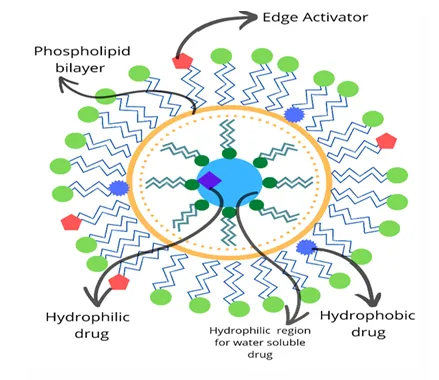
Fig.No.1 Structure of Transferosomes
COMPOSITION
Phospholipids, surfactants (also known as edge activators), and water in a particular ratio make up transferosomes, a type of vesicular drug delivery mechanism.
Phospholipids
Phospholipids such soy phosphatidylcholine, egg phosphatidylcholine, and dipalmitoyl phosphatidylcholine make up the majority of vesicles, with 10–25% surfactant added for flexibility. A hydrating medium, such as saline phosphate buffer (pH 6.5–7), is combined with a variety of solvents, such as methanol and ethanol. The recipe also contains dyes like Rhodamine 123 and Nile red.
Unsaturated fatty acids make up the majority of phosphatidylcholine, which can be obtained from both plant and human sources. Linoleic acid makes up about 70% of all the fatty acids in these unsaturated fatty acids.In water-based systems, the phase-transition temperature of soy phosphatidylcholine is extremely low—below 0°C. The increase in transepidermal water loss (TEWL) following a short application might be used to gauge this. Phospholipids can improve the fluidity of the lipid bilayer mostly because of this characteristic [16].
Edge Activators
Edge activators, sometimes referred to as "bilayer-softening components," are introduced to the lipid bilayer to increase its permeability and flexibility. These could be biocompatible surfactants or amphiphilic medications.Non-ionic single-chain surfactants that damage the lipid bilayer are typically used as edge activators. This disruption improves membrane flexibility by making the bilayer more elastic and fluid. By using the right surfactants in the right amounts, the transferosome membrane's flexibility can be changed.The most popular edge activators in transferosome formulations are biocompatible surfactants that improve bilayer permeability and flexibility. These consist of sodium cholate, sodium deoxycholate, dipotassium glycyrrhizinate, Tweens (Tween 20, Tween 60, and Tween 80), and Spans (Span 60, Span 65, and Span 80) [17].
Table 1: Components used in the formulation of transferosomes
|
Components |
Examples |
Purpose |
|
Edge Activator |
Span 80, Tween 80, Sodium deoxy Cholate, Sodium Cholate |
To impart flexibility to formed vesicles |
|
Phospholipid |
Phosphatidylcholine, Soya Phosphatidylcholine, Dipalmitoyl phosphatidylcholine |
To form self-assembled vesicles |
|
Solvents |
Chloroform, Methanol, Ethanol |
Solvent system to dissolve different components |
|
Hydrating Agent |
Distilled Water or Saline phosphate buffer, Distilled Water |
To hydrate the lipid film formed after evaporation of the solvent |
|
Active Pharmaceutical Ingredient |
Miconazole Nitrate, Itraconazole, Ketoprofen, Diclofenac Sodium |
For providing pharmacological effect |
MECHANISM OF ACTION
Transferosomes' remarkable deformability and self-optimizing properties make them a viable technique for targeted drug delivery across cellular barriers [18].Transfersomes travel through the outermost layers of skin before entering the deeper layer. After then, they are often eliminated into the bloodstream. It should be able to penetrate every tissue in the body if applied properly.
Mechanism of Action: According to the current state of research, transfersomes are drug carriers that can pass through the skin. According to research, the bilayered carriers' increased elasticity (deformability) and the existence of an osmotic gradient across the skin are the two primary elements that determine their ability to penetrate the skin. [19].Under the right circumstances, transferosomes can transfer roughly 0.1 mg of lipid every hour per square centimeter of intact skin. Compared to the value typically generated by the transdermal concentration gradient, this value is substantially higher. The "transdermal osmotic gradient" is actually the cause of this increased flow rate. The skin penetration barrier keeps water from escaping the skin and keeps the epidermis at 75% water content and the stratum corneum near the skin's surface at 15% water content. Due to the interaction between hydrophilic lipid residues and their surrounding water, nearly all polar lipids attract some water.
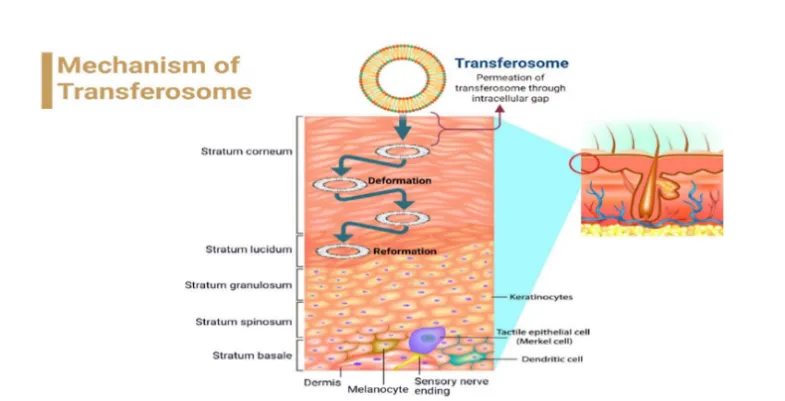
Fig.No.2 Mechanism of Transferosomes
PREPARATION METHODS
Rotary Film Evaporation Method / Modified Hand Shaking Method
Because it effectively and efficiently delivers therapeutic ingredients to the intended location, this approach is widely used. First, a volatile organic solvent is combined with a predetermined quantity of phospholipids and edge activators. The medicine is mixed with the solvent and other ingredients if it is lipophilic. After that, the mixture is sonicated until it turns into a homogenous, transparent solution. The solution is then moved to a flask and put under a rotary evaporator, where it is swirled under vacuum at a constant temperature to produce a thin layer of lipid on the flask walls that contains the active component and edge activators. After that, an aqueous solution is used to hydrate the film, causing it to swell and form bilayer-structured vesicles. [20] The medication can be added to the aqueous solution if it is hydrophilic. The vesicles can be made smaller using methods like extrusion or sonication. Because the vesicles may penetrate the skin's outer layer and reach the bloodstream, this technique is very helpful for delivering medications to particular parts of the body. All things considered, this process of generating transferosomes is a promising approach for drug delivery. The Rotary Film Evaporation Method/Modified Hand Shaking Method for transferosome production is shown in Figure 3.
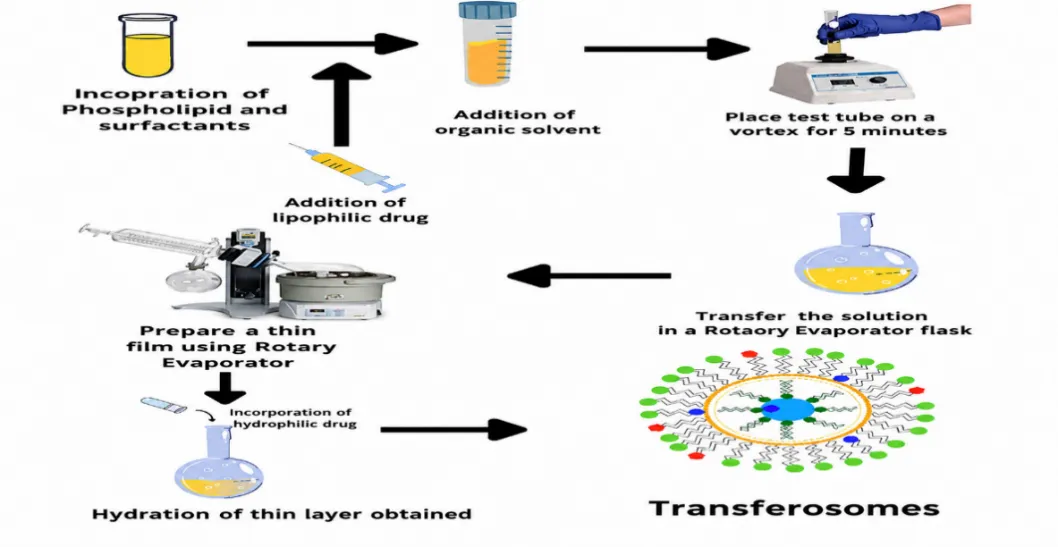
Fig.No.3 Rotary Film Evaporation Method
Reverse Phase Evaporation Method
This method uses lipid-based vesicles called transferosomes in medication delivery systems. Phospholipids are put in a flask after being dissolved in an organic solvent such as ethanol, methanol, or chloroform. [21] The flask is filled with a hydrophilic liquid that contains a surfactant, like an edge activator, and the air is cleared using nitrogen gas. The medicine is either added to the hydrophilic or lipophilic media depending on how soluble it is. After that, the mixture is sonicated to create a uniform, transparent dispersion. To make sure there is no separation, the mixture is left for at least half an hour after sonication. In order to eliminate the organic solvent, the mixture is lastly put under lower pressure.
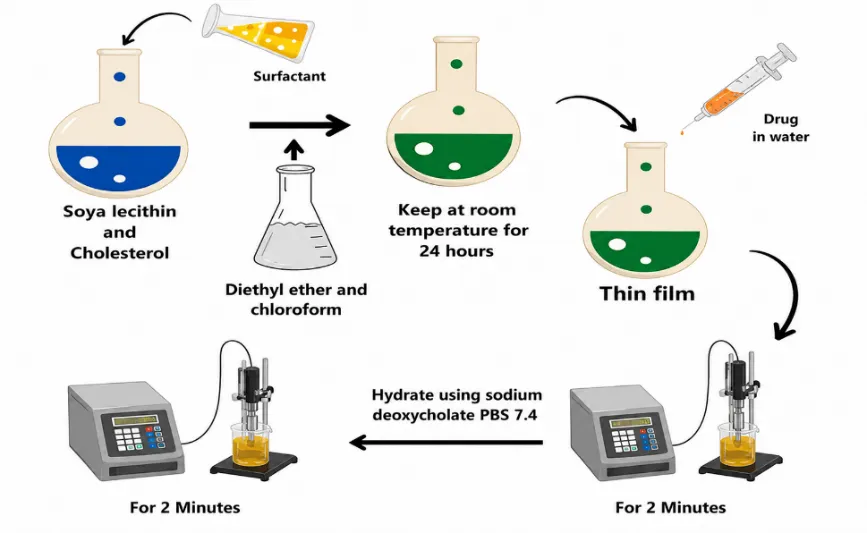
Fig.No.4 Reverse Phase Evaporation Method
Vortex Sonication Method
When creating transferosomes and lipid-based vesicles, sonication and vortexing are crucial processes. These techniques include mechanical stirring and high-frequency sound waves to produce microscopic disruptions that facilitate vesicle production, improve stability during drug transport, and generate flexible transferosomes that can effectively pass through biological barriers such as the stratum corneum of the skin. Phospholipids, the medication, and an edge activator are combined in a phosphate-buffered saline (PBS) solution for the vortexing procedure. A milky white suspension is created by vortexing the mixture. After a brief sonication, the product is filtered through a polycarbonate membrane with 100 nm pores to control the vesicles' size. [22] Figure 5 illustrates the procedure.
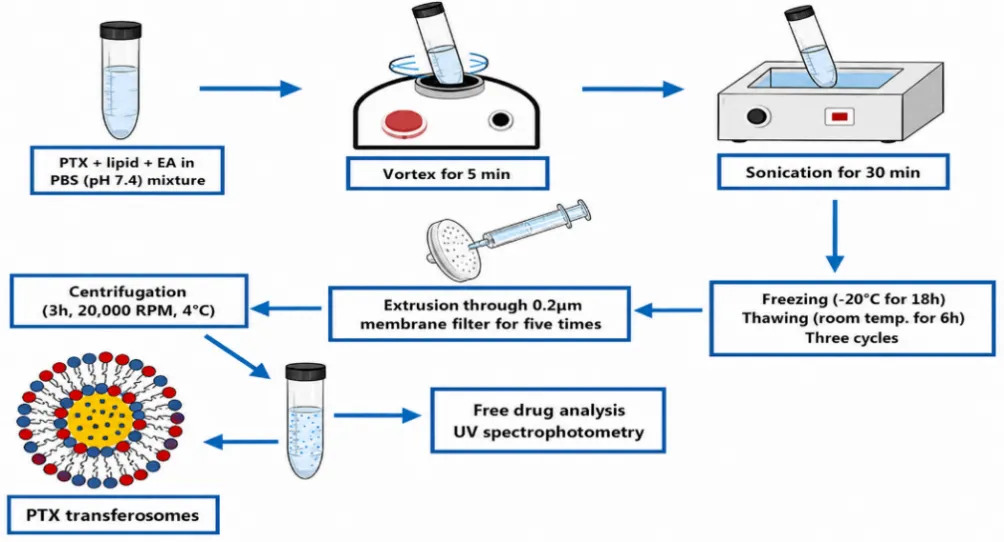
Fig.No.5 Vertex / Sonication Method
Ethanol Injection Method
Phospholipids, an edge activator, and a lipophilic medication are dissolved in ethanol with magnetic stirring until a clear solution forms, creating the organic phase. Water-soluble materials are dissolved in a phosphate buffer to create the aqueous phase. During this stage, hydrophilic medications may be introduced. The temperature of both solutions is raised to about 45 and 50°C. The phospholipid-containing ethanol solution is then gradually added to the aqueous solution while being constantly stirred. Smaller lipid clusters are created when ethanol is added, and these clusters combine to form larger vesicles. After a period of stirring to allow the ethanol to completely evaporate, the mixture is sonicated to minimize the size of the particles. [23, 24]
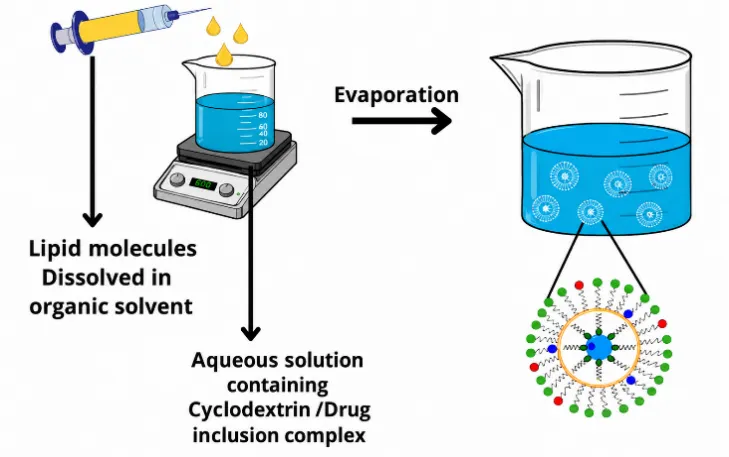
Fig.No.6 Ethanol Injection Method
Freeze Thaw Method
A freezing and thawing cycle is employed to create the transferosomal formulation. First, multilamellar vesicles are submerged in a nitrogen bath at -30°C for 30 seconds to expose them to extremely low temperatures. After that, they are heated in a water bath. To produce the required transferosomes, this procedure is performed multiple times. This method involves first freezing a suspension of multilamellar vesicles at a very low temperature. After that, a hot water bath is used to defrost the tube. To improve the vesicles, this freezing and thawing procedure is carried out eight or nine times.[25]
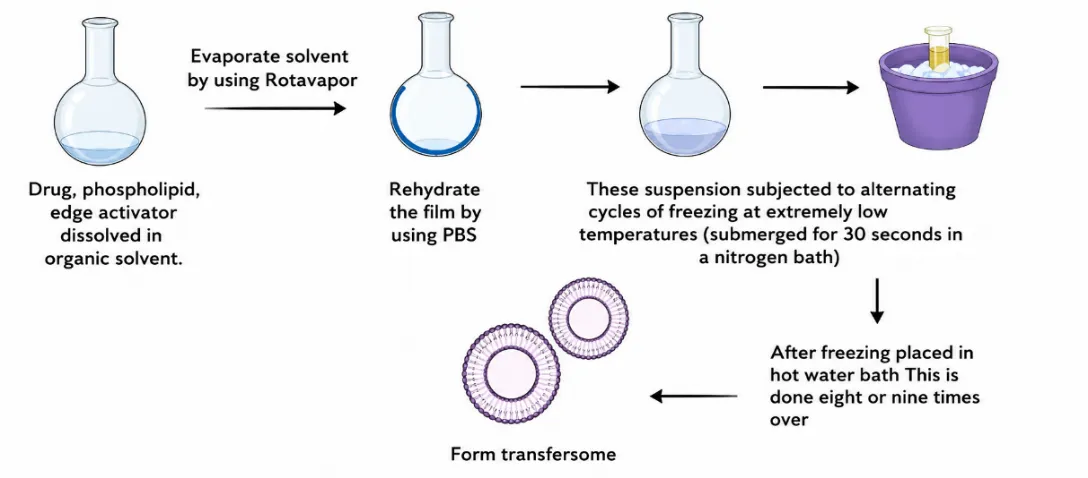
Fig.No.7 Freeze thaw Method
CHARACTERIZATION OF TRANSFEROSOMES
1. Entrapment Efficacy
The percentage entrapment efficiency (%EE) is the quantity of medication that becomes trapped inside the transferosomal structure.
The medicine that is not caught in the vesicles is separated to determine this. Minicolumn centrifugation is used for this. For this, there are two primary approaches: direct and indirect. In the direct approach, the clear liquid (supernatant) is extracted by ultracentrifugation. Next, either n-propanol or 0.1% Triton X-100 are used to break down the vesicles. A syringe filter with a pore size of 0.22 to 0.45 micrometers is then used to filter and dilute the resultant solution. High-Performance Liquid Chromatography (HPLC) or a spectrophotometric technique are then used to determine the drug's concentration.
% Entrapment efficiency = Amount of drug entrapped Total amount of drug added

The indirect method involves filtering the supernatant to get rid of contaminants after diluting it with an appropriate solvent. An analytical approach is then used to determine the amount of free medication in the supernatant.[23, 24] This is calculated as
% Entrapment efficiency = Total amount of drug added-Amount of free DrugTotal amount of drug added

2. Vesicle Size, Morphology and Zeta Potential
The size of the vesicles is ascertained using the Dynamic Light Scattering (DLS) technique. Vesicle size measurements can be made in triplicate when the vesicle solution is combined with an appropriate medium. Alternatively, a 0.2 mm membrane filter can be used to filter the sample once it has been prepared in distilled water. The size and size distribution of the vesicles are measured by diluting the filtered material with saline. A Malvern Zeta Sizer is used for this. Transmission Electron Microscopy (TEM) is utilized to see the vesicles' structure and any shape changes.[23]
(Number of transferosomes counted × dilution factor × 4000) Total number of squares counted

3. Number of Vesicles Per Cubic Millimeter
.9% sodium chloride is used to dilute unsonicated transferosomal formulations five times. The number of transferosomes is counted using an optical microscope and a hemocytometer. Transferosomes larger than 100 nanometers are visible under a microscope. The number of transferosomes is computed after being enumerated in tiny squares. [23]
4. Drug Content
Instrumental techniques, such as a modified high-performance liquid chromatography (HPLC) approach, can be used to determine the drug's concentration. A UV detector, column oven, auto-sampler, pump, and computerized analysis program are used in this process. [24]
5. Measurement of Turbidity
A nephelometer is used to measure a drug's turbidity in an aqueous solution. [24]
6. Degree of Deformability / Permeability Measurement
Pure water is used as a control in the deformability test. The preparation is filtered using a range of microporous filters with pore diameters between 50 and 400 nanometers. DLS is used to measure the size and size distribution of the particles following each filtering stage. A particular formula is then used to compute these outcomes. The equation is:
D = J rvrp

where rv is the vesicle size, rp is the filter's pore size, J is the amount of suspension extruded every five minutes, and D is the degree of deformability. [23, 24]
7. The Occlusion Effect
Occlusion of the skin is thought to aid in drug penetration for topical medications. However, comparable problems also affect elastic vesicles such as transferosomes. Hydrotaxis, the movement of water, is the primary mechanism that allows transferosomes to pass through the skin. Water travels from the skin's comparatively dry surface to its deeper, more water-rich layers during this process. Because occlusion stops water from evaporating from the skin, it affects hydration forces. [24]
8. Penetration Ability, Surface Charge and Charge Density
Transferosome penetration into the skin is evaluated using fluorescence microscopy. A Zetasizer is used to assess the transferosomes' surface charge and charge density. [26, 27]
9. In Vitro Drug Release
A Franz diffusion cell is used to measure in vitro drug release. Adhesive tape is used to secure the donor chamber to the receptor chamber. A magnetic bar is used to continually swirl the fluid in the receptor chamber. To maintain sink conditions, 1 ml of the receptor media is taken out and replaced with an equal volume of new phosphate buffer at predetermined intervals (such as 0, 0.5, 1, 2, 3, 4, and 6 hours). UV or HPLC analysis is then performed on the gathered samples. [23, 24]
10. In Vitro Skin Permeation Studies
The purpose of this study is to ascertain the transport efficiency and pinpoint the variables that raise the transport flux, which is commonly measured in micrograms per square centimeter per hour. Before more costly in vivo tests are carried out, the data collected can be utilized to refine the formulation and forecast in vivo behavior from different transdermal administration systems. Monkey, pig, rat, mouse, guinea pig, and snake skin are substitutes for human skin. A Franz diffusion cell is used for the permeation investigations. The effective permeability area between the donor and receptor compartments is 2.50 square centimeters, and the receptor compartment may hold 50 milliliters. 50 ml of phosphate-buffered saline (pH 7.4) is stirred in the receptor compartment at 100 RPM using a magnetic bar. The formulation, which contains 10 mg of medication, is applied to the skin once the top of the diffusion cell is covered. Aliquots of the receptor media are taken out at certain times and replaced with an equal amount of brand-new phosphate buffer medium (pH 7.4) in order to maintain sink conditions. Spectroscopic techniques or HPLC are used to evaluate the obtained samples. [23, 24]
11. Stability
Transferosomal preparations are kept at various temperatures in airtight amber vials. For long-term storage, the standard storage settings are 25 ± 2°C/60% RH ± 5% RH or 30 ± 2°C/65% RH ± 5% RH for a full year. According to ICH (International Conference on Harmonization) rules, accelerated testing should be conducted at 40 ± 2°C and 75% RH ± 5% for six months. For medications that need to be refrigerated, the recommended storage and testing settings are 5 ± 3°C for 12 months and 25 ± 2°C/60% RH ± 5% RH for 6 months. If these requirements are not met, the drug product is said to have undergone a major alteration. After 30 days, samples from every vial are examined for drug leaks. By comparing it to the initial entrapment efficiency, which is assumed to be 100%, the percentage of drug loss is calculated.[23]
APPLICATIONS
Table 2. Examples of applications of transfersomes as a transdermal delivery system.
|
S.No |
Drug |
Inference |
||
|
1 |
Insulin |
Therapeutically relevant hypoglycemia was successfully induced in both mice and humans, showing effective results and consistent outcomes. |
||
|
2 |
Resveratrol |
The antioxidant activity remained unchanged despite the coating, while the coating helped to enhance the product's stability, improve its bioavailability, increase solubility, and ensure better safety. |
||
|
3 |
Diclofenac sodium |
Maximum deformability was achieved using vesicles composed of Tween 80, which proved to be more effective than bile salts and Span-based vesicles, and significantly enhanced the in vitro delivery of the drug through the skin. |
||
|
4 |
Ketoprofen |
Significantly more effective in reducing pain from knee osteoarthritis during a 6-week treatment period than a placebo, and associated with a lower occurrence of adverse events. |
||
|
5 |
Ibuprofen |
A promising system for extended delivery with acceptable stability properties. |
||
|
6 |
|
The compound demonstrates strong anti-inflammatory effects along with improved permeation and enhanced bioavailability. |
||
|
7 |
Felodipine |
Transfersomes quickly and without causing harm pass through the skin and reach effective levels in the blood at a reduced dosage. |
||
|
8 |
Celecoxib |
Has demonstrated the potential to serve as an alternative to combined oral and topical diclofenac administration in humans. It has been proven to be an effective therapeutic drug delivery system for the treatment of rheumatoid arthritis. |
SAFETY ASPECTS
Even after being applied repeatedly to the skin's surface, phospholipid solutions containing liposomes have been shown to be safe, innocuous, and non-irritating.
In certain instances, they might also offer further advantages for the skin's appearance. The primary component of transferosomes is typically soy phosphatidylcholine with a purity level more than 95%, which is regarded as safe since it is already utilized as an emulsifier in injectable medication formulations and microemulsions for parenteral nutrition. Given the carrier component, it is reasonable to assume that the transferosome product is extremely safe. [28]
FUTURE PERSPECTIVES
These vesicular systems' great tolerability and effectiveness point to a variety of possible therapeutic uses. Advanced local and systemic treatments could be administered by these nanocarriers, particularly for medicines that are difficult to penetrate through the stratum corneum through passive diffusion. SwissMedic, a Swiss regulatory body, has approved the transferosome formulation of the non-steroidal anti-inflammatory medicine (NSAID) ketoprofen. The product will be marketed under the Diractin trademark. Other therapeutic treatments based on transferosome technology are also undergoing clinical development, according to IDEA AG. [29]
Compared to traditional non-specific drug delivery methods, targeted drug delivery has many advantages. By enabling precise site-specific distribution, nanomaterials increase the efficacy of therapy. Potential toxicity to organs and cells is still a significant problem, though. Future studies will concentrate on creating safer methods to reduce toxicity without sacrificing effectiveness. The development of advanced drug delivery systems has the potential to significantly improve targeted and controlled therapy. [30]
CONCLUSION
A very promising and sophisticated vesicular drug delivery method for improving transdermal and targeted medication delivery is transferosomes. Because of their ultra-deformable character, which is brought about by phospholipids and edge activators, they may effectively penetrate the epidermal barrier, improving bioavailability, regulating drug release, and boosting therapeutic efficacy. Several studies have shown that they can deliver a variety of medications, such as corticosteroid, anti-inflammatory, anticancer, and antioxidant medicines, with fewer adverse effects and better patient compliance. Additional benefits of transferosomes include their biocompatibility, flexibility, non-invasive delivery, and capacity to carry both lipophilic and hydrophilic medications. Their pharmaceutical uses are growing as a result of ongoing improvements in formulation strategies and characterisation techniques, despite obstacles pertaining to stability, large-scale manufacture, and cost. Overall, transferosomes are a major advancement in new drug delivery methods and have a great deal of promise for commercial and clinical use in contemporary treatments.
REFERENCES


Syed Zubair Atif, S. M. Shahidulla, Transferosomes: Revolutionizing Ultra-Deformable Vesicles for Advanced Transdermal Drug Delivery, Int. J. of Pharm. Sci., 2026, Vol 4, Issue 6, 7631-7645, https://doi.org/10.5281/zenodo.21066115
 10.5281/zenodo.21066115