

We use cookies to ensure our website works properly and to personalise your experience. Cookies policy
Malineni Perumallu Pharmacy College, Pulladigunta, Guntur, Andhra Pradesh, India 522017
Iron deficiency anaemia (IDA) is the most prevalent single-nutrient disorder worldwide, and pica — the persistent ingestion of substances with little or no nutritive value — is among its most characteristic behavioural manifestations. Ryzophagia, the compulsive consumption of uncooked rice, is reported predominantly in women of South Asian origin and characteristically remits once iron stores are replenished. Fixed-dose combinations of ferrous fumarate with folic acid, marketed in India under the brand name Livogen, are among the most widely dispensed oral haematinics for precisely this population. What has attracted far less attention is the possibility that the pica itself may blunt the therapeutic response to the drug prescribed to abolish it. Raw milled rice delivers a substantial load of ungelatinised starch, phytate, residual pericarp polyphenols, competing divalent minerals and storage proteins into the proximal small intestine — the segment, and the luminal chemistry, that govern the uptake of non-haem and salt-derived iron. Phytate inhibits iron absorption in a strictly dose-dependent manner, reducing absorption by approximately 18% at 2 mg and by more than 80% at 250 mg of phytate phosphorus in single-meal studies. Because patients with ryzophagia often ingest several hundred grams of raw grain daily, grazing across the waking hours rather than at defined mealtimes, the probability that a dose of oral iron coincides with a phytate-rich gastric load is high. This narrative review synthesises evidence on the composition of uncooked rice, duodenal iron transport, the pharmaceutics of ferrous fumarate and the inhibitory behaviour of phytate to build a mechanistic case for a clinically meaningful interaction, and proposes pragmatic counselling measures pending trial data.
Anaemia continues to defy the sustained public-health effort directed against it. The most recent global assessment published by the World Health Organization places the burden at approximately 30% of non-pregnant women aged 15–49 years, 37% of pregnant women and 40% of children aged 6–59 months, with the South-East Asia Region carrying a strikingly disproportionate share of the total — on the order of 244 million affected women and 83 million affected children.[1,18,19] Iron deficiency is the dominant, although by no means the exclusive, driver of this burden. In the paediatric population, iron deficiency anaemia (IDA) is the single commonest haematological disorder, affecting roughly one in five children below four years of age even in high-income settings.[2] The distribution of that burden across the principal population groups is shown in Figure 1.
The geography of the problem is not accidental. Populations in which anaemia is most entrenched are largely those whose energy intake is dominated by cereal staples and whose iron intake is therefore overwhelmingly non-haem. In predominantly plant-based diets, non-haem forms contribute approximately 90–95% of total daily iron, and this fraction is both intrinsically less absorbable and far more sensitive to the chemistry of the meal in which it is presented.[3] Rice occupies a special position within this pattern: it is the staple of more than half the world's population, yet polished rice is comparatively poor in iron, and the iron it does contain is of limited bioavailability, commonly estimated at around 10% for plant foods generally.[8]
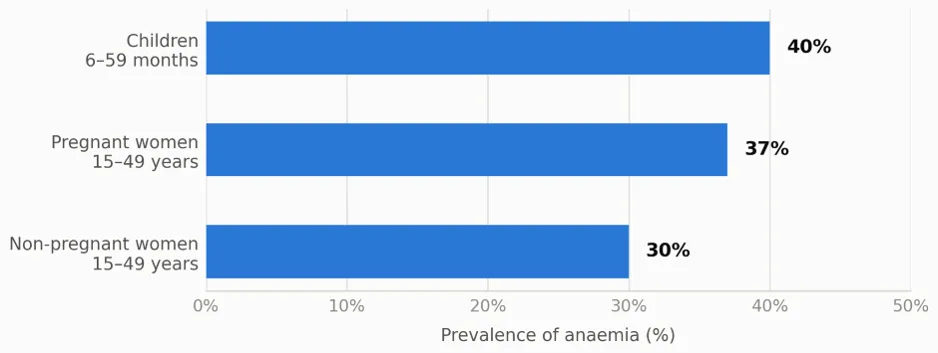
Figure 1. Global prevalence of anaemia by population group. Values are the most recent World Health Organization estimates, referring to 2019.[1]
Against this background, a clinical observation that has long been recorded but rarely interrogated deserves renewed attention. A subset of patients with IDA develops an intense, compulsive craving for uncooked rice. The behaviour is usually treated as a diagnostic curiosity — a sign that points towards the deficiency — and is expected to disappear once iron is replaced. This review asks a different question: not what raw-rice eating tells us about the patient's iron status, but what it may be doing to the iron we give them.
Iron deficiency anaemia and pica
Pica is defined by the persistent ingestion, over a period of at least one month, of substances that are not recognised as food, in a manner that is inappropriate to the individual's developmental level and not sanctioned by cultural practice. Its recognised variants are conventionally named for the substance craved: geophagia for earth and clay, pagophagia for ice, amylophagia for raw starch, and ryzophagia for uncooked rice.[24] Rice sits awkwardly within this taxonomy, because it is unambiguously a food — but it is not a food in the state in which it is being consumed, and the behaviour that surrounds it carries all the hallmarks of compulsion rather than nutrition.
The association with iron deficiency is robust. A meta-analysis of seventy studies estimated the pooled worldwide prevalence of pica during pregnancy and the postpartum period at 27.8% (95% confidence interval 22.8–33.3).[4] A scoping review of twenty reports found that, without exception, identifying the pica led to the detection of iron deficiency and that treatment of the deficiency resolved the associated symptoms.[5] The consistency of that observation is the strongest argument for regarding pica as a manifestation of the deficiency state rather than an unrelated behavioural disorder.[25]
The mechanism remains hypothetical. The most widely discussed explanation holds that depletion of iron-dependent enzymes within the central nervous system perturbs dopaminergic signalling and the regulation of appetite, producing cravings that are highly specific for texture, temperature or odour rather than for nutritional content. Alternative accounts emphasise oral-sensory relief of the glossitis and mucosal discomfort that accompany deficiency, or a conditioned behavioural loop reinforced by transient symptomatic relief. Whichever explanation ultimately prevails, the clinically relevant point is the direction of the arrow: the deficiency appears to generate the craving, and correction of the deficiency extinguishes it. The relationship examined in this review, in which that sequence is proposed to close into a self-reinforcing loop, is summarised in Figure 2.
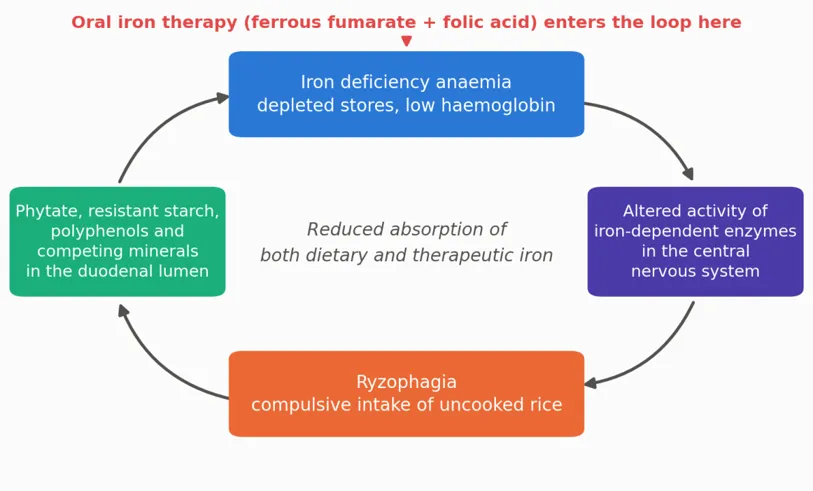
Figure 2. The proposed self-reinforcing cycle linking iron deficiency anaemia, ryzophagia and impaired iron absorption. Oral iron therapy enters the cycle at the point marked in red. The hypothesis advanced in this review is that its therapeutic effect is attenuated at the luminal step, so that the loop is not fully interrupted by treatment alone.
Oral iron therapy
Oral iron remains the first-line treatment for uncomplicated IDA in almost every setting, on grounds of cost, safety and convenience. The conventional armamentarium consists of the ferrous salts — sulphate, fumarate and gluconate — which differ chiefly in their elemental iron content per unit weight and, to a debated extent, in gastrointestinal tolerability.[47,48] Newer preparations, including iron bisglycinate chelate and liposomal formulations, have been shown to achieve comparable efficacy with significantly fewer adverse effects, and third-generation parenteral agents provide a route of escape for patients who cannot absorb or cannot tolerate oral therapy.[2,21,22]
The dosing of oral iron has been substantially revised over the past decade. Work using stable-isotope methodology has demonstrated that single doses of 60 mg or more of elemental iron provoke an acute rise in circulating hepcidin that persists for approximately twenty-four hours and resolves by forty-eight hours, so that consecutive-day and twice-daily regimens are partially self-defeating.[12,46] The practical consequence — that alternate-day, single morning dosing yields greater fractional and total absorption than the traditional thrice-daily schedule — has been reinforced by subsequent analysis.[13]
Where oral therapy fails, the standard differential is well rehearsed: incorrect diagnosis, non-adherence, continuing blood loss, and malabsorption from coeliac disease, atrophic gastritis or Helicobacter pylori infection. The argument developed in this review is that this list is incomplete for one identifiable subgroup, and that a behavioural inhibitor of absorption — the pica itself — belongs on it.[23]
2. RYZOPHAGIA AND UNCOOKED RICE
The term ryzophagia derives from the Greek oryza, rice, and denotes the compulsive consumption of raw, uncooked grain. It is reported chiefly, though not exclusively, in women of South Asian origin, and in Western clinical practice adult cases are typically encountered in patients of non-European descent. The best-characterised description in the English-language literature concerns two non-pregnant women with pica for uncooked basmati rice who presented with fatigue, abdominal discomfort and hair loss. Both were vegetarian, both had iron deficiency attributable to heavy menstrual bleeding and multiparity, and both had sustained dental damage from chewing hard grain. Following parenteral iron therapy, the ryzophagia and every other manifestation apart from the tooth damage resolved.[6]
Two features of the behaviour matter for the argument that follows. The first is quantity. Published descriptions and clinical anecdote alike record intakes ranging from a few handfuls to several hundred grams of dry grain daily — quantities that, in the upper range, approach or exceed the weight of rice the same individual would consume cooked. The second is temporal pattern. Ryzophagia is a grazing behaviour rather than a meal: patients describe reaching repeatedly for small handfuls throughout the day, often concealed from family members. There is, in consequence, rarely a prolonged interval in which the stomach and duodenum are free of raw grain.
The condition is almost certainly under-reported. Patients seldom volunteer it, partly through embarrassment and partly because rice is not perceived as a non-food; clinicians, for the same reason, may fail to classify it as pica even when it is disclosed.[26,27] Beyond its significance as a marker of deficiency, the behaviour carries its own morbidity: irreversible dental attrition and enamel fracture,[6] gastrointestinal discomfort attributed to indigestible plant lectins and to the large load of ungelatinised starch, displacement of nutrient-dense foods from the diet, and a microbiological hazard, since Bacillus cereus spores are widely distributed in raw rice and survive in the absence of cooking.[15,45]
Composition of uncooked rice
Uncooked milled rice is, in compositional terms, a concentrated starch matrix with a modest protein fraction, very little fat, and a mineral profile that is unremarkable except for what it contains in the way of absorption inhibitors. Indicative values are summarised in Table 1. The critical insight is not any single figure but the fact that raw grain represents the pre-processing state of the food: it carries the maximum phytate content, the maximum proportion of ungelatinised type-2 resistant starch, intact lectins, and none of the losses that washing, soaking, fermentation or boiling would otherwise impose.
Rice varieties differ appreciably in their nutritional composition. Comparative work shows that iron concentrations are highest in pigmented varieties, with black rice exceeding white, red and glutinous types, and that milling by-products such as husk and bran retain a substantial share of the grain's iron, leaving polished rice — the form most commonly eaten, and most commonly eaten raw — relatively iron-poor.[8] Preparation method matters at least as much as variety. Brown and black rice supply more fibre, antioxidants and vitamins than white rice, while cooking methods differ systematically in nutrient retention, with steaming and pressure cooking preserving more than boiling, and soaking and fermentation acting specifically to reduce antinutrient content.[9,44]
This last point is the pivot of the present argument. Every traditional processing step applied to rice — rinsing, soaking, fermenting, boiling and discarding the excess water — reduces phytate, either by leaching it into water that is thrown away or by activating endogenous and microbial phytases that hydrolyse it to lower inositol phosphates with far weaker chelating power. Eating rice raw bypasses all of them simultaneously. The ryzophagic patient is therefore not simply eating rice; they are eating the one form of rice in which the inhibitory fraction is maximally preserved.[32,34,35]
Table 1. Indicative composition of 100 g of raw milled white rice and its relevance to oral iron therapy.
|
Component |
Indicative amount per 100 g |
Relevance to iron absorption |
|
Energy |
355–365 kcal |
No direct effect; displaces nutrient-dense foods when intake is large |
|
Total starch |
78–80 g, largely ungelatinised (type-2 resistant starch) |
Increases digesta bulk and viscosity; delivers fermentable substrate to the colon |
|
Protein |
6.5–7.5 g (prolamins, glutelins) |
Storage proteins may bind and sequester divalent cations |
|
Fat |
0.5–1.0 g |
Negligible |
|
Dietary fibre |
0.6–1.4 g |
Higher in under-milled grain; carries associated phytate and polyphenols |
|
Iron |
0.8–1.2 mg; higher in pigmented and unpolished varieties[8] |
Intrinsic contribution small; bioavailability of plant iron approximately 10%[8] |
|
Phytic acid |
Approx. 50–300 mg in well-milled white rice; substantially higher in brown rice |
Principal inhibitor; chelates iron to form insoluble complexes[10,17] |
|
Calcium, zinc, magnesium |
Present in modest amounts |
Compete for DMT1 uptake and for phytate binding sites |
Values are indicative ranges compiled from the cited comparative literature on rice composition and processing [8,9] together with standard food-composition data; exact figures vary with variety, degree of milling and growing conditions.
3. PHYTATE AND IRON BIOAVAILABILITY
Phytic acid, myo-inositol 1,2,3,4,5,6-hexakis dihydrogen phosphate, is the principal phosphorus storage compound of cereal grains and legumes. Its six phosphate groups carry a strong net negative charge across the pH range encountered in the stomach and small intestine, and this makes it an efficient chelator of polyvalent cations. Complexed with ferric or ferrous iron it forms poorly soluble salts that resist dissociation at intestinal pH and are not substrates for any known transporter. In the intact grain the compound is concentrated in the aleurone layer and in globoid crystals of the germ; milling removes a variable proportion of it, so that well-polished white rice contains substantially less than brown rice, but polishing never removes it entirely.[31,41,42]
The quantitative relationship between phytate and iron absorption in humans is unusually well characterised. In the classic dose-ranging study, labelled wheat rolls were fed with seven graded doses of phytate phosphorus from 2 mg to 250 mg. Absorption fell by 18% at the lowest dose, by 64% at 25 mg and by 82% at 250 mg, each difference highly significant, and ascorbic acid significantly counteracted the inhibition at every level tested.[10,33] Two features of that dataset deserve emphasis: the effect appears at doses far smaller than those encountered in an ordinary cereal meal, and the dose–response curve is steep at its lower end (Table 2, Figure 3).
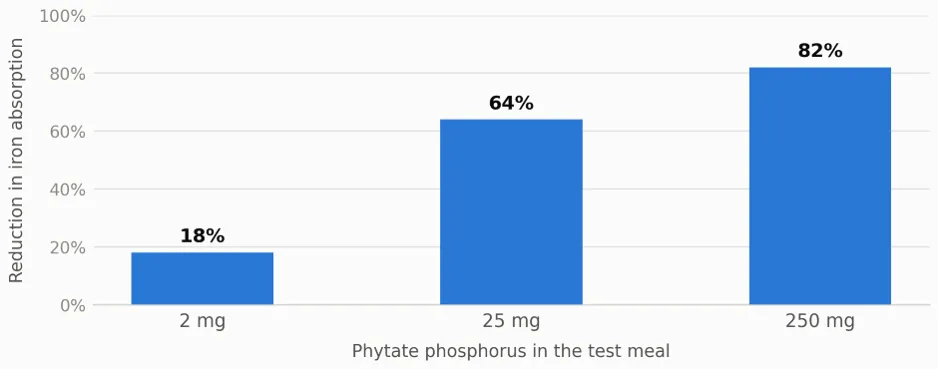
Figure 3. Dose-dependent inhibition of iron absorption by phytate in humans. Drawn from the single-meal data of Hallberg and colleagues, in which labelled wheat rolls were fed with graded doses of phytate phosphorus; every reduction shown reached p < 0.001.[10]
Expressing the relationship as a phytate-to-iron molar ratio gives a practical rule of thumb. Meaningful improvement in absorption generally requires a molar ratio below one, and preferably below 0.4, whereas unrefined cereal-based meals routinely present ratios many times higher.[17] Some adaptation occurs with habitual high-phytate intake, and iron absorption in individuals accustomed to such diets is less severely inhibited than single-meal studies in naive subjects would predict, but adaptation attenuates the effect rather than abolishing it. Phytate also acts additively with other luminal inhibitors — polyphenols from bran and pericarp fragments, and calcium — so that mixed inhibitory loads behave worse than any single component alone.[36,40]
A significant limitation of this literature must be stated plainly, because it defines the gap this review is written to identify. Almost all of the human phytate data derive from studies of food iron or of fortificant iron incorporated into a meal, at doses of a few milligrams. There is a conspicuous absence of data on the interaction between phytate and a pharmacological dose of a therapeutic ferrous salt — the 50 to 60 mg of elemental iron delivered by a single haematinic tablet. Whether such a dose saturates the available chelating capacity, or is simply precipitated in proportion, is not known.
Table 2. Dose-dependent inhibition of iron absorption by phytate in humans, from single-meal studies using labelled wheat rolls.[10]
|
Phytate phosphorus in the meal |
Reduction in iron absorption |
Statistical significance |
|
2 mg |
18% |
p < 0.001 |
|
25 mg |
64% |
p < 0.001 |
|
250 mg |
82% |
p < 0.001 |
Ascorbic acid significantly counteracted the inhibition at every dose tested; meat had only a modest protective effect, and then only at the highest phytate load.[10]
4. MECHANISM OF ORAL IRON ABSORPTION
Iron from an oral ferrous salt must clear a sequence of barriers before it reaches the circulation, and each barrier is a potential site of interference. Gastric acid first solubilises the salt and maintains iron in a low-molecular-weight, absorbable state; any ferric iron present is reduced at the brush border of the proximal duodenum by the ferrireductase DCYTB. Ferrous iron then crosses the apical membrane through the proton-coupled divalent metal transporter DMT1, encoded by SLC11A2.[28,29] Within the enterocyte, iron is either sequestered in ferritin and lost when the cell is shed, or chaperoned to the basolateral membrane, where ferroportin — the only known cellular iron exporter — releases it for oxidation by hephaestin and loading onto transferrin.
The rate-limiting control point of the whole system is hormonal. Hepcidin, a peptide synthesised by hepatocytes, binds ferroportin, occludes its transport channel and triggers its ubiquitination and internalisation, so that iron export is restricted for a period that outlasts the hepcidin signal itself. In iron deficiency, hepcidin falls; the resulting derepression permits continued export from the enterocyte and activates the enterocyte HIF system, in which HIF-2α increases transcription of ferroportin and, in parallel, of the apical transporters DCYTB and DMT1. The absorptive machinery is thus coordinately upregulated at both membranes, matching intestinal uptake to systemic need.[11,30]
Pharmacological dosing interacts with this system in a way that is now well documented. Doses at or above 60 mg of elemental iron acutely raise hepcidin for approximately twenty-four hours, with resolution by forty-eight hours, which is why alternate-day single morning doses of 60 to 120 mg are recommended to maximise fractional absorption while limiting adverse effects; the same body of work confirms that taking supplements with food materially reduces bioavailability, and that a source of ascorbic acid — approximately 60 mg per 10 mg of elemental iron — can substantially offset that loss.[13,39]
For the present argument, the decisive observation is that hepcidin regulation and luminal chemistry are sequential and independent bottlenecks. However favourably the enterocyte is primed by a low hepcidin concentration, only iron that remains soluble and low-molecular-weight in the duodenal lumen is available to DCYTB and DMT1. Iron precipitated as an insoluble phytate complex is removed from the absorbable pool before the transporters are ever engaged, and no degree of physiological upregulation can recover it. These relationships, together with the points at which constituents of uncooked rice are proposed to interfere with them, are summarised in Figure 4.
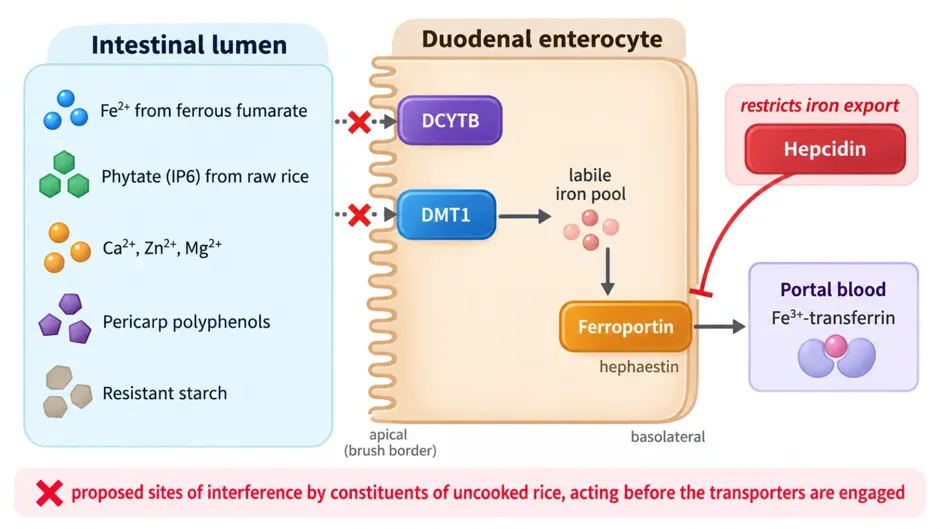
Figure 4. Iron absorption across the duodenal enterocyte, and the sites at which constituents of uncooked rice are proposed to interfere. Iron must remain soluble in the lumen to be reduced by DCYTB and taken up by DMT1; hepcidin acts later and separately, restricting export through ferroportin. Interference by phytate and competing solutes therefore occurs upstream of any physiological compensation.
There is a further downstream consideration. Only about 10% of ingested dietary iron is absorbed, with the remainder passing into the colon, where it influences microbial composition; iron fortification has been shown to reduce beneficial Bifidobacteria while favouring potentially pathogenic organisms, and certain probiotic strains with ferric-reducing activity, together with prebiotics such as inulin and galacto-oligosaccharides, have been proposed as means of improving mineral absorption.[14,49,50] Raw rice is itself a substantial delivery vehicle for fermentable resistant starch to the colon, which makes this axis directly relevant to the interaction under discussion.
5. LIVOGEN AND IRON THERAPY
Livogen is a long-established Indian oral haematinic and one of the most frequently dispensed iron preparations in the subcontinent. The standard captab formulation contains ferrous fumarate IP 152 mg, providing 50 mg of elemental iron, together with folic acid IP 1500 micrograms;[16] variants of the brand add zinc and cyanocobalamin to the same base. Ferrous fumarate contains approximately one-third iron by weight, is only sparingly soluble in water but dissolves readily in gastric acid, and is generally regarded as therapeutically equivalent to ferrous sulphate with a modestly different tolerability profile. The folic acid component supports the DNA synthesis required for accelerated erythropoiesis during repletion and addresses the concurrent folate deficiency that is common in the same populations.
The clinical context in which Livogen and its equivalents are used is worth stating explicitly, because it overlaps almost exactly with the population in which ryzophagia is described. These are women of reproductive age in rice-staple, largely vegetarian communities, frequently multiparous, frequently with heavy menstrual bleeding, and frequently enrolled in antenatal or adolescent anaemia programmes that distribute iron–folic acid tablets on a routine schedule.[20] The prescriber who writes for Livogen in such a setting and the clinician who encounters raw-rice pica are, statistically, looking at the same patient.
Standard counselling for oral iron is similarly well established: take the tablet on an empty stomach, an hour before or two hours after food; take it with a source of ascorbic acid such as citrus juice; avoid tea, coffee, milk, calcium supplements and antacids within two hours; expect dark stools, and accept mild nausea or constipation as common and usually self-limiting; and continue therapy for approximately three months beyond normalisation of haemoglobin in order to refill stores. It is a careful and evidence-based list. It is also a list that enumerates tea, coffee, milk, calcium and antacids — and says nothing whatever about raw rice, because no guideline has yet considered it.
6. POTENTIAL UNCOOKED RICE–LIVOGEN INTERACTION
The question is, in fact, already being asked outside the peer-reviewed literature. Consumer-facing summaries of the raw rice–Livogen relationship circulate widely and assert, without primary evidence, that the phytic acid and complex starches of raw grain bind iron in the gastrointestinal tract and thereby deepen the anaemia they are meant to signal.[7] Claims of this kind reach patients long before they reach journals, and they deserve either substantiation or refutation rather than silence.
The hypothesis advanced here can be stated in a single sentence: in patients whose iron deficiency anaemia is accompanied by ryzophagia, the habitual ingestion of raw rice may substantially reduce the fraction of iron absorbed from ferrous fumarate–folic acid therapy, and may therefore contribute to an apparently poor or slow response to treatment. Three independent lines of reasoning converge on this proposition.
The first is compositional. Raw rice presents the highest phytate burden of any form in which rice is consumed, because none of the phytate-degrading steps of ordinary preparation has been applied. The second is behavioural. Ryzophagia is a grazing habit distributed across the waking day, which makes the phytate-free interval required by conventional dosing advice difficult or impossible to achieve; a patient may faithfully take the tablet an hour before a meal and still take it into a stomach containing raw grain eaten twenty minutes earlier. The third is pharmacological. Absorption of iron from a ferrous salt depends entirely on the metal remaining soluble in the duodenal lumen, and phytate is an efficient precipitant at doses well below those a ryzophagic intake would supply.[10]
An illustrative calculation makes the scale of the concern concrete, with the important caveat that it is modelled rather than measured. A patient consuming 300 grams of well-milled raw white rice daily, at an assumed phytate content in the region of 50 to 100 milligrams per 100 grams, ingests roughly 150 to 300 milligrams of phytic acid, distributed across the day in parallel with the single 50 milligram elemental iron dose. Even allowing generously for dilution, for incomplete co-localisation in time, and for partial adaptation to a habitually high-phytate diet, the phytate-to-iron molar ratio in the duodenum at the moment the tablet dissolves may plausibly exceed the thresholds at which inhibition is known to be marked.[17] If the grain consumed is brown, unpolished or under-milled, the estimated load rises several-fold.
Intellectual honesty requires the converse to be stated with equal clarity. It is entirely possible that the interaction is negligible in practice. Well-polished white rice is comparatively low in phytate; a 50 milligram pharmacological dose of elemental iron is an order of magnitude larger than the food iron used in the classic inhibition studies and may simply overwhelm the available chelating capacity; and habitual consumers of high-phytate diets show measurable adaptation. The point of this review is not that the interaction has been demonstrated, but that it is plausible, that it is currently unmeasured, and that the measurement is straightforward to perform.
Possible mechanism of interaction
Five mechanisms, not mutually exclusive, could contribute to reduced iron bioavailability when raw rice and a ferrous fumarate tablet share the gastrointestinal lumen. They are summarised in Table 3 and set out below.
First, and most important, direct chelation. Phytate liberated from raw grain binds ferrous and ferric iron to form insoluble complexes that are not substrates for DCYTB or DMT1, removing the metal from the absorbable pool before it reaches the transporter.[10]
Second, competitive mineral loading. Raw rice supplies calcium, zinc and magnesium, which compete with iron both for uptake through DMT1 and for occupancy of phytate binding sites; the net effect on free, absorbable iron is difficult to predict a priori but is unlikely to be favourable.[40]
Third, physical and rheological effects. Ungelatinised type-2 resistant starch granules resist amylolysis, increase the bulk and viscosity of duodenal digesta, and may entrap dissolved iron or reduce its contact with the absorptive surface of the proximal duodenum, where uptake capacity is concentrated.[43]
Fourth, polyphenol complexation. Residual pericarp and bran fragments in under-milled or unpolished grain carry phenolic compounds that form stable, poorly absorbable iron complexes and act additively with phytate.[37,38]
Fifth, a downstream consequence with feedback potential. A larger unabsorbed iron fraction passes into the colon, where — delivered alongside a considerable load of fermentable resistant starch — it may shift microbial composition and aggravate the gastrointestinal intolerance that is itself a principal cause of non-adherence to oral iron.[14] The result would be a self-reinforcing loop in which pica reduces absorption, reduced absorption perpetuates deficiency, and persistent deficiency sustains the pica.
Table 3. Proposed mechanisms of the uncooked rice–Livogen interaction, with the evidence supporting each and a corresponding testable prediction.
|
Proposed mechanism |
Presumed site |
Current evidence |
Testable prediction |
|
Chelation of iron by phytate to form insoluble complexes |
Stomach and duodenal lumen |
Strong, but derived from food iron rather than therapeutic doses[10,17] |
Fractional absorption of ferrous fumarate falls when co-administered with raw rice but not with cooked rice |
|
Competition from dietary calcium, zinc and magnesium |
Duodenal brush border (DMT1) |
Indirect; established for mixed meals |
Absorption varies inversely with the divalent-mineral load of the grain consumed |
|
Entrapment in ungelatinised starch and increased digesta viscosity |
Proximal duodenum |
Mechanistically plausible; not measured for iron |
Cooked rice of identical phytate content inhibits less than raw rice |
|
Complexation by residual pericarp and bran polyphenols |
Duodenal lumen |
Established for polyphenol-rich foods generally |
Under-milled and brown raw rice inhibit more than well-polished white rice |
|
Increased colonic iron load with microbiota shift and worsened tolerability |
Colon |
Established for unabsorbed and fortificant iron[14] |
Faecal iron and dysbiosis indices rise, and adherence falls, in ryzophagic patients |
The mechanisms listed are inferences drawn from established physiology and have not been demonstrated directly in patients with ryzophagia.
7. CLINICAL IMPLICATIONS
Even in the absence of confirmatory trial data, several implications follow directly from the plausibility of the interaction, and all of them are low-cost and low-risk.
The first is simply to ask the question. A history of raw-rice consumption should be sought explicitly in every patient presenting with iron deficiency anaemia in a rice-staple population, and particularly in women of reproductive age. Patients rarely volunteer the behaviour, and an open question about diet will usually not elicit it; a specific, non-judgemental enquiry is required. Where the behaviour is disclosed, it should be quantified — approximate grams per day, and, critically, its timing in relation to the iron tablet.
The second is diagnostic. Ryzophagia belongs on the differential for apparently refractory oral iron therapy, alongside non-adherence, continuing blood loss and malabsorptive disease. Before escalating to intravenous iron or embarking on an extensive gastrointestinal investigation, it is reasonable to establish both that the patient is taking the tablet and that they are not simultaneously eating the grain.
The third is therapeutic counselling. Pending better evidence, it is prudent to advise a separation of at least two hours between raw-rice consumption and the iron tablet, to pair the dose with a source of ascorbic acid given its demonstrated capacity to counteract phytate inhibition,[10] and to consider alternate-day single morning dosing, which independently improves fractional absorption.[12,13] Equally important is the framing: pica is a symptom of the deficiency, not a bad habit, and should be addressed without reproach, since shame is a reliable route to concealment and non-adherence.
The fourth is the management of the collateral harms. Dental review is warranted, since enamel attrition from chewing hard grain does not reverse with iron repletion.[6] Food-safety counselling regarding Bacillus cereus and plant lectins in uncooked grain is appropriate.[15] And where an adequate haematological response has not occurred after four weeks of genuinely confirmed adherence, parenteral iron bypasses the luminal problem in its entirety — consistent with the reported resolution of ryzophagia and associated symptoms following iron dextran therapy.[6]
Finally, there is a programmatic implication. In settings where anaemia control programmes already distribute iron–folic acid tablets to large populations at scale, the addition of a single screening question about raw-grain consumption would cost almost nothing and might identify a subgroup for whom the standard regimen is predictably underperforming.
8. RESEARCH GAP AND FUTURE PERSPECTIVES
The literature reviewed here establishes each link in the proposed chain independently, and none of them together. Phytate inhibition of iron absorption is well quantified, but for food iron rather than for therapeutic doses of a ferrous salt.[10,17] The composition of rice by variety and preparation method is documented, but not for the specific raw grains that ryzophagic patients actually consume.[8,9] Ryzophagia is described in case reports and captured within broader pica reviews, but its prevalence among patients attending anaemia clinics in rice-staple regions is unknown.[5,6] And no study of any design has measured iron absorption from a haematinic tablet taken in the presence of raw rice.
Four investigations would close most of this gap, and none is technically demanding. The first is descriptive: a cross-sectional study in antenatal and haematology clinics in South Asia, using a structured enquiry and quantitative food-frequency assessment, to establish how common ryzophagia is among patients with IDA and how much grain is consumed. The second is analytical: phytate, polyphenol and mineral profiling of the raw rice varieties most commonly eaten in this way — basmati, sona masoori and parboiled types — coupled with in-vitro digestion and Caco-2 uptake experiments in which a therapeutic dose of ferrous fumarate is presented with and without raw grain.
The third is the decisive human experiment: a randomised crossover study using stable iron isotopes, comparing fractional absorption of a standard ferrous fumarate–folic acid dose administered alone, with a defined quantity of raw rice, and with an equal dry weight of the same rice cooked. Such a design would isolate the contribution of the uncooked state itself, which is the specific claim made in this review. The fourth is pragmatic: a randomised trial in ryzophagic patients comparing structured timing and behavioural counselling plus standard therapy against standard therapy alone, with haemoglobin and serum ferritin at eight to twelve weeks as endpoints. Mechanistic sub-studies measuring hepcidin and characterising the faecal microbiota would add explanatory value, the latter being of particular interest given the resistant-starch load involved.[14]
Two therapeutic questions follow naturally. The first concerns mitigation: whether co-administered ascorbic acid, or exogenous phytase, can restore absorption in this setting to the degree that single-meal studies would predict.[10] The second concerns formulation: whether chelate-protected and encapsulated preparations such as iron bisglycinate and liposomal iron, which are already known to achieve comparable efficacy with fewer adverse effects,[2] are also less vulnerable to luminal phytate. If they are, the clinical recommendation for this specific subgroup writes itself, and the question is both commercially tractable and directly testable.
A final methodological observation. Reviews of this kind risk assembling a plausible chain of reasoning and mistaking it for evidence. The mechanisms set out in Section 6 are inferences from established physiology, not observations, and they should be labelled as such in any clinical guidance derived from this work until they have been measured directly.
CONCLUSION
Ryzophagia has long been regarded as a diagnostic sign — a behavioural signal that points the clinician towards iron deficiency and that is expected to disappear once the deficiency is treated. This review has argued that the relationship may not be unidirectional. Raw milled rice delivers phytate, ungelatinised resistant starch, competing minerals and residual polyphenols into the same duodenal segment, and during the same hours, in which iron from a ferrous fumarate–folic acid tablet must remain soluble in order to be absorbed. Every element of this chain is independently established; only their combination is untested.
If the interaction proves real, its clinical consequence is that a subgroup of patients are being treated with a regimen whose effective dose is substantially lower than the prescribed dose, for reasons that neither they nor their clinicians have identified, and that are correctable at no cost by a change in timing. If it proves negligible, that result is also worth having, since it would allow clinicians to reassure patients and to redirect attention to other causes of treatment failure. Either way, the question deserves to be asked empirically rather than left to inference.
In the interim, the practical recommendations are modest and carry no material risk: enquire specifically about raw-rice consumption in every patient with iron deficiency anaemia in rice-staple populations, quantify it where present, advise temporal separation from the iron dose together with a source of ascorbic acid, address the pica as a symptom rather than a habit, attend to the dental and microbiological consequences, and consider parenteral therapy where an adequate response fails to materialise despite confirmed adherence.
REFERENCES

Anusha Dasari, Tavitinaidu Mudadla, Manisha Bogolu, Sravani Lakkamraju, Lakshmi Kalyani Bai Banavathu, Siva Reddy Chinakondu, Prasanna Kumar Suddapalli, Uncooked Rice Consumption in Iron Deficiency Anemia: A Review of its Potential Impact on Oral Iron Bioavailability, Int. J. of Pharm. Sci., 2026, Vol 4, Issue 10, 1219-1234. https://doi.org/10.5281/zenodo.23239461
 10.5281/zenodo.23239461