

We use cookies to ensure our website works properly and to personalise your experience. Cookies policy
Department of Pharmacy Practice, Shree Devi College of Pharmacy, Mangaluru, Karnataka, India.
A 36-year-old man was bitten by a snake inside his vehicle around 10 pm. The forensic department identified the snake as a cat snake. At first, he was treated at a nearby hospital. However, the 20-minute whole blood clotting test (20WBCT) was positive, and subsequently, he was referred to a tertiary care center. Upon arrival, approximately two hours later, a fang mark with noticeable irritation was observed on the right biceps. Systemic envenomation with coagulopathy was suggested by laboratory investigations, which showed WBCT >20 minutes and an elevated activated partial thromboplastin time (APTT) of 45.27 seconds. The patient was admitted for thorough monitoring. During hospitalization, a total of 30 vials of anti-snake venom (ASV) were administered in separate doses, based on serial 20WBCT findings. Proton pump inhibitors, analgesics, intravenous antibiotics, and antihistamines were used as supportive treatment. The patient's hemodynamic stability was maintained, and there was no progression of bleeding manifestations, acute kidney injury, neurotoxicity, cellulitis, or other organ dysfunction. Transient hypertension was a mild form of autonomic dysfunction that resolved with supportive management. Following the administration of ASV therapy, WBCT underwent normalization, and APTT experienced a notable improvement, ranging from 45.27 seconds to 29.32 seconds. The patient's clinical stability, coagulopathy, envenomation, organ dysfunction, and autonomic instability were all absent at discharge. Early recognition and timely ASV administration, combined with supportive care, can prevent snakebite envenomation and improve outcomes.
Snakebite is a serious medical emergency, particularly in tropical and rural regions, where delayed access to medical care can increase the risk of complications. ¹ Snake venom can affect different systems of the body and may lead to local tissue damage, swelling, bleeding, abnormalities in blood clotting, neurological manifestations, kidney injury, and, in severe cases, death. ¹, ²
The clinical effects of snakebite depend on the species of snake, the amount of venom injected, and the time between the bite and initiation of treatment. Venomous snakebites may produce different patterns of envenomation, including neurotoxicity, cytotoxicity, hemotoxicity, and coagulopathy. ², ³ Viper envenomation, in particular, can cause venom-induced consumption coagulopathy (VICC), in which venom toxins interfere with the coagulation system and rapidly consume clotting factors, increasing the risk of abnormal bleeding. ³

Figure 1: Cat snake identified as the offending species.
Early recognition of envenomation and prompt treatment are important for preventing serious complications. Snake antivenom is the specific treatment for systemic envenomation and should be administered when there is evidence of significant envenoming. ¹, ² Supportive management and close monitoring of vital signs, coagulation parameters, renal function, and other relevant laboratory investigations are also essential. ³ ³
Therefore, timely diagnosis, appropriate administration of antivenom, continuous monitoring, and supportive care play an important role in improving outcomes in patients with snakebite. The present case study describes the clinical presentation, investigations, treatment, and outcome of a patient with snakebite envenomation, with emphasis on the importance of early diagnosis and appropriate management.
CASE REPORT:
A male patient, 36 years old, from Sullia Taluk, Dakshina Kannada, came to the emergency department of The Indiana Hospital and Heart Institute on 14-06-2026 at approximately 10.00 pm. The patient stated that when he opened the car door, he saw a snake near the door handle and was bitten on the right arm (right biceps region). The forensic department determined that the snake was a cat snake. The patient was first assessed in the emergency room and later admitted for additional treatment.
The patient was initially treated at a local hospital, where the whole blood clotting time was found to exceed 20 minutes, indicating systemic envenomation with coagulopathy, and the patient was promptly transferred to a tertiary care hospital. Upon arrival, the patient was conscious and oriented, with a GCS of 15/15. The pulse rate was 102 bpm, which indicated tachycardia. Blood pressure was 158/110 mmHg, GRBS was 210 mg/dl, and the pupils were observed to be reactive. There was no documentation of any focal sensory or motor neurological deficit. The past medical history was notable for hypertension lasting about one year. Examination of the right arm revealed edema, redness, tenderness, and fang marks. The bite site was cleaned and debrided, and blood samples were collected for CBC, CRP, LFT, RFT, WBCT, and APTT.
The patient was admitted to the ICU for fluid therapy, symptomatic support, and continuous monitoring. Snake antivenom was advised and given without delay, together with symptomatic care and monitoring. Antihistamines and corticosteroids were given before anti-snake venom therapy to prevent anaphylactic reactions caused by ASV. The patient was given an initial dose of 10 vials of ASV. A repeat WBCT revealed that the blood remained incoagulable; therefore, another 10 vials of ASV were given. Later WBCT testing still showed delayed clotting (less than 20 minutes), after which a further 10 vials of ASV were administered. Altogether, 30 vials of ASV were administered during the hospital stay. Once ASV therapy was completed, a repeat WBCT showed clot formation within 20minutes.
Thereafter, WBCT was monitored at 6-hour intervals on 3 occasions, all of which showed normal clotting time (< 20 min; ~15 min). Coagulation parameters were monitored, and the APTT decreased from 45.27 seconds to 29.32 seconds. Full routine laboratory testing was done. CBC showed Hb-10 g/dL, ESR-36 mm/hr, uric acid-6.9 mg/dL, and CRP-21.4 mg/dl
On the fourth day of hospitalization, 17-06-2026, the patient's pulse rate was 82 bpm and regular, and BP was 110/80 mmHg. Swelling and pain in the affected arm had decreased. ESR dropped to 10 mm/hr, CRP-6.9 mg/dl.
Throughout the treatment period, the patient's haemodynamic status stayed stable. No signs were found of worsening cellulitis, neurotoxicity, renal injury, bleeding manifestations, or damage to other organs. During the hospital stay, mild autonomic dysfunction appeared as transient hypertension, which improved with supportive care. Upon discharge, the patient showed no symptoms, and there was no clinical indication of continuing envenomation, coagulopathy, organ dysfunction, or autonomic instability. Blood pressure had returned to normal, and the patient was clinically stable. The patient was discharged on June 17, 2026, and was instructed to repeat APTT and serum creatinine and report to the OPD the next day.
|
PARAMETERS |
BEFORE |
AFTER |
|
Hb |
10g/dl |
14.8g/dl |
|
APTT |
45.27seconds |
29.32seconds |
|
CRP |
21.4mg/l |
6.9mg/l |
|
ESR |
36mm/hr |
10mm//hr |
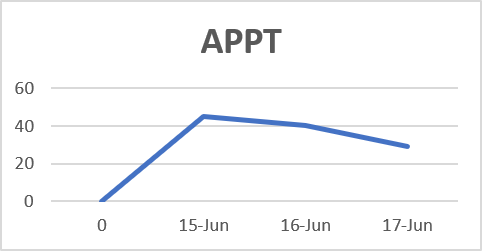
Figure 2: Trend of APTT values during hospitalization following ASV therapy.
DISCUSSION:
Snakebite is a serious medical emergency that can cause both local and systemic complications. In this case, the patient had fang marks, swelling, redness, and tenderness at the bite site. The abnormal 20-minute whole blood clotting test (20WBCT) and prolonged APTT indicated the presence of coagulation abnormalities. The 20WBCT is a simple bedside test that can help identify coagulopathy, particularly where laboratory facilities are limited. 4˒5
Venom-induced consumption coagulopathy (VICC) occurs when snake venom affects the normal clotting process and causes rapid consumption of clotting factors. This can increase the risk of bleeding and, in severe cases, may lead to kidney or other organ complications. 5.6 In the present case, early identification of the abnormal clotting results allowed treatment to be started promptly.
The patient received a total of 30 vials of polyvalent anti-snake venom (ASV) in divided doses because the clotting test remained abnormal. Following treatment, the 20WBCT gradually became normal, and the APTT improved from 45.27 to 29.32 seconds. Similar findings have been reported by Silva et al., who found that Indian polyvalent antivenom helped patients recover from venom-induced consumption coagulopathy more rapidly. 8
The patient was also monitored closely for bleeding, neurological symptoms, kidney injury, and worsening of the local bite-site reaction. He initially had tachycardia and elevated blood pressure, but these improved with supportive treatment. There was no evidence of progressive cellulitis, neurotoxicity, renal injury, or other organ damage. Close monitoring and supportive management therefore played an important role along with ASV therapy [4, 9].
Overall, this case demonstrated the importance of early diagnosis, timely administration of ASV, and regular monitoring of coagulation parameters in snakebite envenomation. The enhancement in 20WBCT and APTT, together with decreased swelling and pain and the lack of major complications, pointed to a favorable reaction to the treatment. Testing APTT and serum creatinine again after discharge was likewise suitable to confirm that no delayed complications arose.
CONCLUSION
This case showed how recognizing the condition early and treating it promptly can lead to a substantial difference in patients suffering from snakebite envenomation. The patient showed a positive response to polyvalent anti-snake venom, with gains in the 20WBCT and APTT, as well as a decrease in swelling and pain at the site of the bite. No serious complications, including bleeding, kidney injury, neurological issues, or other organ damage, appeared during the time in hospital. Careful monitoring and supportive care also contributed to a smooth recovery. In general, this case underscores the value of administering ASV without delay, monitoring regularly, and providing suitable supportive treatment to achieve a good outcome in patients with venom-induced consumption coagulopathy.
REFERENCES


Nireeksha P, Rashika R S, Management of Venom-Induced Consumption Coagulopathy with Polyvalent Anti Snake Venom: Case Study, Int. J. of Pharm. Sci., 2026, Vol 4, Issue 10, 1247-1251. https://doi.org/10.5281/zenodo.23240706
 10.5281/zenodo.23240706