

We use cookies to ensure our website works properly and to personalise your experience. Cookies policy
Department of Research and Development, Lee Pharma Limited, Visakhapatnam, Andhra Pradesh, India
The Formation of nitrosamine impurities in pharmaceutical active ingredients (APIs) has become a significant quality and regulatory concern due to their potential genotoxic and carcinogenic properties. This review systematically examines the chemical pathways leading to nitrosamine formation during API synthesis, particularly on tetrazole ring synthesis involving sodium azide. The role of nitrosating agents, secondary amines, tertiary amines, and quenching conditions is critically evaluated. Pharmaceutically attention for to the use of sodium nitrite for azide destruction in acidic media this favorable conditions may exist for nitrosamine generation in the presence of nitrosatable amines. In addition that Contribution of Amines including DMF, DMAc, NMP, triethylamine, and tetrabutylammonium reagents, as primary sources of nitrosamine. In this paper we give Primary Conclusion that reagent selection, alternative quenching methods, process optimization in Industrial Pharmaceutical scale
Nitrosamines are chemical compounds classified as probable human carcinogens. They can unintentionally form in pharmaceutical drugs during manufacturing, storage, or packaging when certain amines react with Nitrosating agents. While present in low levels in food and water, their presence in medications is tightly. Long-term exposure to nitrosamine impurities (such as NDMA and NDEA) above acceptable levels may increase the risk of cancer. However, regulatory authorities emphasize that the health risk from taking affected medication at standard doses is typically very low. The Approach of their Formation in Active Pharmaceutical ingredients. Use of sodium nitrite or other Nitrosating agents in presence of secondary, or tertiary amines, or quaternary ammonium salts within the API manufacturing process either within the same or at different process steps. Use of sodium nitrite or other Nitrosating agents in combination with reagents, solvents, and catalysts, which are susceptible to degradation to secondary or tertiary amines, within the same or different process steps. Use of contaminated raw materials (e.g. solvents, reagents, catalysts)
Nitrosation is adding a Nitrosonium ion NO+ to an amine –NH2 leading to a nitrosamine, Many primary alkyl N-nitroso compounds, such as CH3N(H)NO, tend to be unstable with respect to hydrolysis to the alcohol. Those derived from secondary amines (e.g., (CH3)2NNO derived from dimethylamine) are more robust. It is these N-nitrosamines that are carcinogens in rodents.
Involvement of Sodium azide is the inorganic compound with the formula NaN3. This colorless salt is the gas-forming component in many car airbag systems. It is used for the preparation of other azide compounds. It is an ionic substance, is highly soluble in water, and is very toxic.
2. LITERATURE REVIEW:
2.1 Approach I:
Risk assessment approach-1 deals with the chemistry how Nitrosamine impurities directly formed.
Chemistry How Nitrosamine formed:
Nitrosation is adding a Nitrosonium ion NO+ to an amine –NH2 leading to a nitrosamine, Many primary alkyl N-nitroso compounds, such as CH3N(H)NO, tend to be unstable with respect to hydrolysis to the alcohol. Those derived from secondary amines (e.g., (CH3)2NNO derived from dimethylamine) are more robust. It is these N-nitrosamines that are carcinogens in rodents.
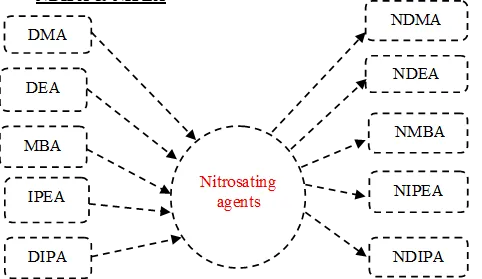
As NDEA, NDMA, NMBA, NDIPA & NIPEA are concern the main precursors for formation of NDEA, NDMA, NMBA, NDIPA & NIPEA are DEA, DMA, MBA, DIPA & IPEA all are secondary amines and they will definitely form NDEA, NDMA, NMBA, NDIPA & NIPEA if they react with Nitrosation agents.
Direct condition for formation of NDEA, NDMA, NMBA, NDIPA & NIPEA
2.2 Approach II
Risk assessment approach-II deals with the chemistry how Nitrosamine impurities are indirectly formed. During the of tetrazole ring formation.
Tetrazole ring formation:
Tetrazole are a class of synthetic organic heterocyclic compound, consisting of a 5-member ring of four nitrogen atoms and one carbon atom. The simplest is Tetrazole itself, CH2N4. They are unknown in nature Tetrazole was first prepared by the reaction of anhydrous hydrazoic acid and hydrogen cyanide under pressure. Treatment of organic nitriles with sodium azide in the presence of iodine or silica-supported sodium bisulfate as a heterogeneous catalyst enables an advantageous synthesis of 5-substituted 1H-tetrazoles.
Sodium azide:

Sodium azide is the inorganic compound with the formula NaN3. This colorless salt is the gas-forming component in many car airbag systems. It is used for the preparation of other azide compounds. It is an ionic substance, is highly soluble in water, and is very toxic.
2.3 Chemical Reactions
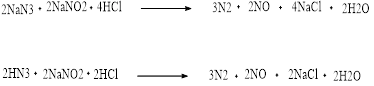
Treatment of sodium azide with strong acids gives hydrazoic acid, which is also extremely toxic:

Sodium azide can be destroyed by treatment with nitrous acid solution to avoid Formation of Hydrazoic acid

Sodium nitrite can also be used in the production of nitrous acid via Hydrochloric acid. This reaction first yields nitrous acid

The nitrous acid then, under normal conditions, decomposes

Carcinogenic nitrosamines are formed when secondary amines that react with sodium nitrite in the presence of acid medium.
R2NH (amines) + NaNO2 (sodium nitrite) → R2N–N=O (nitrosamine)
Indirect condition for formation of NDEA, NDMA, NMBA, NDIPA & NIPEA:
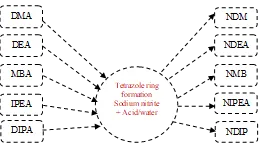
From the above approach II, it is clear that formation of Nitroso amine impurities possible in the presence of Nitrosating agent along with presence of secondary amine compound.
From the above approach II, it is clear that formation of Nitroso amine impurities possible if the tetrazole ring formation involved with sodium azide and excess azide quenching taking place with sodium nitrite in acidic medium in the presence of secondary amine compound.
2.4 Approach III
Risk assessment practical approach deals with the chemistry how Nitrosamine impurities directly formed & how solvents are playing role for formation of secondary amine source.
Mechanism of Formation of NDEA:

Mechanism of Formation of NDMA:
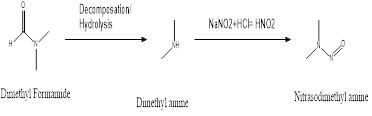
Mechanism of Formation of NDMA:
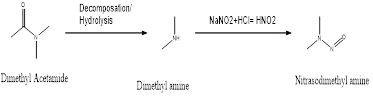
Mechanism of Formation of NMBA:
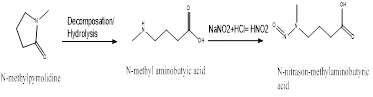
Mechanism of Formation of NDBA:

From the above practical approach, it is clear that formation of nitroso amine impurities possible if we use solvents like DMF, DMAC, NMP & Bases like TEA, TBA (providing secondary amine) while tetrazole ring formation with Azide, as we know excess azide is going to be quench with sodium nitrite (providing Nitrosating agent) leads to formation of Nitrosamine impurities.
DMF-Source Di methylamine
DMAc -Source Di methylamine
NMP - Source N-methyl butyric acid
TEA - Source Di ethylamine
TBA - Source Di butyl amine
3. RESULTS & GRAPHS
3.1 Nitrosating Agents:
|
Sr. No |
Nitrosating agent (NO)* |
Structure |
|
1 |
Nitrite salts |
MNO2 |
|
2 |
Nitrate salts |
MNO3 |
|
3 |
Nitrous acid |
HNO2 |
|
4 |
Nitrous aecidium ion |
H2O+-NO |
|
5 |
Nitric acid (contains N2O4) |
HNO3 |
|
6 |
Alkyl nitrites |
R-ONO |
|
7 |
Peroxynitrite |
ONOO(-) |
|
8 |
Nitrosonium ion |
NO+ |
|
9 |
Nitro compounds |
R-NO2 |
|
10 |
Nitrous anhydride |
N2O3 |
|
11 |
Dinitrogen tetroxide |
N2O4 |
|
12 |
Nitrosyl halides |
Halide-NO |
|
13 |
Nitrosyl thiocyanate |
ONSCN |
|
14 |
Nitroso phenol |
Phenol-NO |
|
15 |
Nitroso thiol |
SH-NO |
|
16 |
Aqua regia |
HCl + HNO3 |
|
17 |
Nitryl chloride |
NO2Cl |
4.2 Nitrosable Substances:
|
Sr. No |
Nitrosatable substance |
Structure |
Byproducts |
|
1 |
Secondary amines (cyclic and acyclic) |
R1-NH-R2 |
|
|
2 |
Tertiary amines (cyclic and acyclic) |
- |
NHR1R2, NHR1R3, or/and NHR2R3 |
|
3 |
Hydrazine derivatives |
NH2-NR1R2 |
NHR1R2 |
|
4 |
N-methyl-2- pyrrolidinone |

|
N-methyl-4-aminobutyric acid |
|
5 |
Tertiary amides |
R1CONR2R3 |
NHR2R3 |
|
6 |
N-Chloroalkyl amines |
R1R2N-Cl |
NHR1R2 |
|
7 |
N-Alkyl carbamates |
R1O-CO-NR2R3 |
NHR2R3 |
4. CONCLUSION
Avoiding reaction conditions that may produce nitrosamines whenever possible; when not possible, demonstrating that the process is adequately controlled and is capable of consistently reducing nitrosamine impurities within the recommended AI limits through appropriate and robust fate and purge studies.
Using bases other than secondary, tertiary, or quaternary amines (when possible) if ROS conditions may form nitrosamines.
If possible, avoiding the use of amide solvents (e.g.-dimethylformamide dimethylacetamide, and N-methylpyrrolidone), and when their use is unavoidable, exercising caution including assessing whether nitrosamines can form.
Replacing nitrites with other quenching agents for azide decomposition processes − Optimizing and consistently controlling the sequences of reactions, processes, and reaction conditions (such as pH, temperature, and reaction time).
Designing a manufacturing process that facilitates the purge of nitrosamine impurities in the subsequent processing steps.
API manufacturers should remove quenching steps (when there is a risk of nitrosamine formation (e.g., using nitrous acid to decompose residual azide)) from the main reaction mixture to reduce the risk of nitrosamine formation. The API, or an intermediate formed through a reaction using an azide salt, can be separated from the mother liquor in the organic phase. The aqueous waste phase separated from the organic phase should then be quenched with nitrous acid without contacting the API, its intermediate, or solvents intended for recovery.
API manufacturers should audit their supply chains and monitor them for any at-risk API raw materials and intermediates. API manufacturers should maintain records including the name(s) of the raw material or intermediate supplier(s) and the raw material or intermediate manufacturer(s) and any repackers and distributors who handle the materials before API manufacture. When appropriate, API manufacturers should establish controls and consider additional specifications for at-risk materials to prevent formation of nitrosamine impurities.
To avoid cross-contamination when recovered materials such as solvents, reagents, and catalysts are used in the manufacturing process, API manufacturers should use recovered material only in the same step or in an earlier step (if there is sufficient purification) of the same process from which it was collected. The recovered materials should meet appropriate standards before reuse. If the recovery of materials is outsourced to third-party contractors, the API manufacturer should audit the contractors’ validation of cleaning procedures and other controls. API manufacturers should follow recommendations in ICH Q7 to prevent cross-contamination with nitrosamines or nitrosamine precursors. API manufacturers should also verify with their suppliers whether the purchased materials used in their processes are recovered.
API manufacturers should be aware that potable water used in API manufacture may contain low levels of nitrites and even nitrosamines from environmental sources. The existence of nitrites in processing water may lead to nitrosamine formation in API manufacture. Therefore, to avoid unacceptable levels of nitrosamine impurities in APIs, API manufacturers should analyse nitrite and nitrosamine levels in water and use water that has been purified to remove unacceptable impurities. If a nitrosamine is introduced to the API through exogenous sources that can be avoided, manufacturers should eliminate the source of nitrosamine impurities.
REFERENCES


Srikanth Reddy Jonnala, Patnala Ranjit Kumar, Understanding Nitrosamine Formation in Tetrazole API Synthesis: Mechanisms, Risk Assessment, and Process Control, Int. J. of Pharm. Sci., 2026, Vol 4, Issue 7, 3960-3965. https://doi.org/10.5281/zenodo.21458319
 10.5281/zenodo.21458319