

We use cookies to ensure our website works properly and to personalise your experience. Cookies policy
Department Of Pharmaceutical Quality Assurance Vidya Bharti College Of Pharmacy, Amravati - 444601 Maharashtra, India
Charge-transfer reactions and ion-pair complexation methods have become important analytical approaches for spectroscopic quantification of pharmaceutical substances. These reactions generate stable, colored complexes that exhibit distinct absorption maxima, allowing sensitive and selective detection of drugs, particularly those that lack strong native chromophores. Charge-transfer interactions occur between electron-donor drugs and electron-acceptor reagents, while ion-pair complexation involves electrostatic interactions between protonated basic drugs and acidic dyes. Both approaches offer operational simplicity, reduced cost, and excellent analytical performance. This review presents an overview of their principles, mechanisms, and applications in pharmaceutical quality assurance, emphasizing their relevance in modern spectroscopic determination.
Spectroscopic analysis remains a cornerstone of pharmaceutical quality assurance because it is rapid, cost-effective, and requires minimal sample preparation. Many pharmaceutical compounds possess weak or insufficient intrinsic absorbance, particularly in the UV region, which limits the applicability of direct spectrophotometric measurement. This challenge has encouraged the development of derivatization and chromogenic reaction techniques that can significantly improve sensitivity and selectivity. Among these, charge-transfer complex formation and ion-pair complexation have emerged as highly versatile and dependable approaches. These reactions convert non-absorbing or weakly absorbing drug molecules into intensely colored complexes with well-defined absorption maxima, allowing accurate quantitative estimation even at low concentrations.
The underlying strength of these methods lies in their chemical specificity. Charge-transfer reactions exploit the electron-donating capability of many pharmaceutical molecules, especially those containing aromatic systems, heteroatoms, or functional groups capable of forming donor–acceptor interactions. When combined with strong electron-acceptor reagents, these drugs yield stable complexes that exhibit characteristic spectral signatures. Similarly, ion-pair complexation takes advantage of the protonation behavior of basic drugs. In acidic media, protonated drug molecules form stable ionic associations with anionic dyes, resulting in highly colored complexes that can be extracted into organic solvents for enhanced measurement accuracy.
As the pharmaceutical industry continues to introduce structurally diverse active ingredients, the limitations of traditional spectrophotometric approaches become more evident, particularly for compounds that lack chromophores or exhibit overlapping absorption spectra. Charge-transfer and ion-pair reactions address these limitations by providing adaptable analytical strategies capable of accommodating a wide range of chemical structures. Their operational simplicity and minimal instrumentation make them particularly suitable for routine quality control laboratories, academic research settings, and resource-constrained environments.
These chromogenic methods not only enhance analytical performance but also reduce dependence on more sophisticated and costly techniques such as HPLC or LC–MS. By offering excellent sensitivity, reproducibility, and selectivity, charge-transfer and ion-pair complexation reactions continue to strengthen the analytical toolkit available for pharmaceutical quality assurance. Their practical advantages, coupled with extensive literature support and validated protocols, ensure their ongoing relevance in modern drug analysis.
2. CHARGE-TRANSFER REACTION:
Principle:
• This complex shows a new absorption band in the UV/Visible region due to electronic transitions within the donor–acceptor system.
• The intensity of this absorption:
is directly proportional to drug concentration,
provides the analytical basis for spectrophotometric determination.
• CT complexes generally absorb in the 350–600 nm range, improving:
sensitivity,
selectivity,
accuracy,
especially for drugs with low UV absorbance or overlapping spectra.
• The method requires minimal sample preparation and works in aqueous or organic media.
• Complexes are stable for a reasonable time, suitable for routine analysis.
Mechanism:
1. Donor Characteristics (Drug):
• Drugs act as electron donors due to:
aromatic rings
heteroatoms (N, O, S)
functional groups with lone-pair electrons
2. Acceptor Reagents:
• Strong electron-withdrawing agents such as:
p-chloranilic acid
DDQ (2,3-dichloro-5,6-dicyano-1,4-benzoquinone)
TCNE (tetracyanoethylene)
TCNQ (tetracyanoquinodimethane)
3. Complex Formation:
• Partial electron transfer occurs from donor → acceptor.
• A donor–acceptor (D–A) complex is formed via weak intermolecular forces.
4. Color Development:
• The complex becomes intensely colored.
• Color intensity depends on strength of donor–acceptor interaction.
5. Measurement:
• The colored complex shows a λmax at 350–600 nm.
• Absorbance is measured and correlated with concentration.
Reaction:
The charge-transfer reaction can be represented as:
D + A ⇌ [D···A] → D⁺ + A⁻ (partial charge transfer) Where:
• D = Electron donor (drug)
• A = Electron acceptor (e.g., DDQ, TCNE, TCNQ, p-chloranilic acid)
• [D···A] = Charge-transfer complex
• Example:
• Drug (D) + DDQ (A) → Colored CT Complex (D···DDQ)
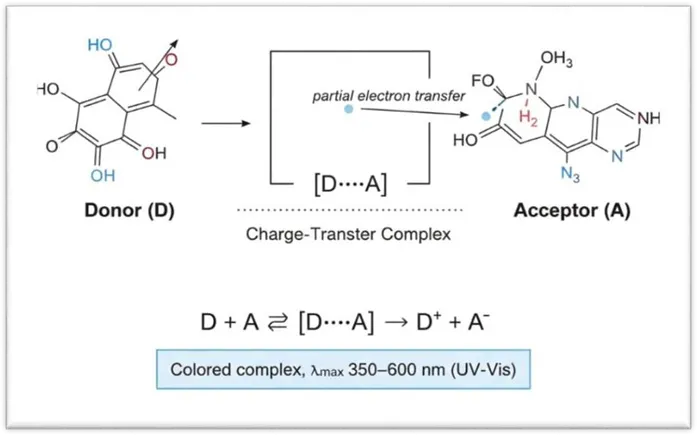
Fig. No.1 (General Charge-Transfer Reaction)
3. ANALYTICALAPPLICATIONS OF CHARGE-TRANSFER COMPLEXES
Charge-transfer reactions have become an essential tool for the quantitative determination of pharmaceutical substances, primarily because they offer an efficient means of converting non-absorbing or weakly absorbing drug molecules into intensely colored analytical species.
The formation of these highly chromogenic complexes enables reliable application of the Beer–Lambert law across a broad concentration range, supporting both low-level detection and routine assay operations with equal precision.
The strong coloration exhibited by charge-transfer complexes is a direct outcome of their high molar absorptivity, which significantly improves method sensitivity and allows the detection of drugs at microgram levels without the need for sophisticated instrumentation.
One of the major advantages of charge-transfer methodology is its intrinsic selectivity. Only compounds capable of donating electrons usually those with aromatic systems, heteroatoms, or lone-pair electrons participate effectively in these reactions.
This chemical specificity ensures that interfering substances lacking electron-donating capacity do not contribute to absorbance, thereby reducing matrix effects and improving analytical accuracy. As a result, a diverse range of therapeutic agents such as antihistamines, antidepressants, cardiovascular medications, analgesics, and several central nervous system drugs have been quantified successfully using charge-transfer spectrophotometry.
These applications demonstrate the broad utility of the technique across multiple pharmacological classes.
Charge-transfer reactions are compatible with both active pharmaceutical ingredients and formulated dosage forms. With appropriate sample preparation such as extraction, dilution, or filtration these methods can accommodate tablets, capsules, syrups, and injectable products.
Their adaptability makes them suitable for routine quality control workflows in manufacturing environments, where time-efficient and reliable methods are essential. Furthermore, the technique requires only basic laboratory equipment such as a UV–Visible spectrophotometer, volumetric glassware, and readily available reagents, making it accessible to laboratories with limited resources.
The robustness and reproducibility of charge-transfer methods contribute significantly to their widespread adoption.
The reactions often proceed rapidly under mild conditions, forming stable complexes that allow multiple measurements without signal drift. Method validation typically demonstrates strong linearity, low limits of detection and quantification, and acceptable precision and accuracy in accordance with pharmacopeial standards. Collectively, these attributes affirm the value of charge-transfer spectrophotometry as a dependable, cost-effective, and versatile analytical strategy for pharmaceutical quality assurance.
4. ION-PAIR COMPLEXATION REACTION:
Principle:
• Ion-pair complexation is based on the interaction between: protonated basic drug molecules and anionic dye reagents.
• In acidic medium, drugs containing basic nitrogen atoms get protonated.
• These protonated drug ions form stable ion-pair complexes with acidic dyes.
• The formed ion-pair complexes are:
Strongly absorbing (colored)
Stable for several hours
• This stability allows:
Repeated measurements
Delayed readings without loss of accuracy
• Ion-pair formation introduces a reliable absorbance signal for drugs that lack strong intrinsic chromophores.
• The method offers:
High accuracy
High precision
Excellent sensitivity
• Suitable for many drug classes such as:
Antihistamines
Antipsychotics
Proton pump inhibitors
Local anesthetics
CNS drugs
Mechanism:
1. Protonation of Drug:
• In acidic medium, the basic drug (D) gains a proton: D + H⁺ → DH⁺
2. Interaction with Anionic Dye:
• The protonated drug ion (DH⁺) electrostatically interacts with a negatively charged dye (A⁻).
3. Ion-Pair Formation:
• A neutral ion-pair complex is formed: [DH⁺ · A⁻]
• This complex is stabilized by:
Electrostatic attraction
Hydrophobic interactions
4. Extraction into Organic Phase:
• The neutral ion-pair is extracted into an organic solvent (e.g., chloroform or dichloromethane).
• This step:
Isolates the complex from aqueous interferences
Enhances clarity and stability of the solution.
5. Measurement:
• The organic layer containing the ion-pair complex shows strong absorbance.
• Absorbance is measured using a UV–Visible spectrophotometer.
Reaction:
Step 1: Protonation D + H⁺ → DH⁺
Step 2: Ion-Pair Formation
DH⁺ + A⁻ ⇌ [DH⁺ · A⁻] (Ion-Pair Complex)
Where:
• D = Basic drug
• DH⁺ = Protonated drug
• A⁻ = Anionic dye (e.g., bromothymol blue, bromocresol green, methyl orange, etc.)
• [DH⁺ · A⁻] = Neutral ion-pair complex
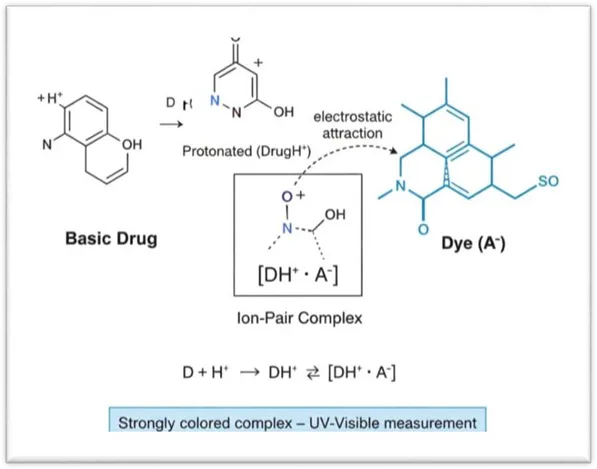
Fig. No.2 General Ion-Pair Reaction Mechanism
5. ANALYTICALAPPLICATIONS OF ION-PAIR COMPLEXATION
Ion-pair complexation methods are widely used for the determination of pharmaceutical substances containing basic nitrogen atoms, and their popularity stems from the high degree of accuracy and precision they consistently deliver.
The stability of the ion-pair complexes formed between protonated drug molecules and anionic dyes plays a central role in ensuring dependable analytical performance.
Once formed, these complexes remain intact for extended periods, often several hours, without undergoing significant decomposition or loss of absorbance intensity.
This stability allows analysts to conduct repeated measurements or delayed readings without compromising result integrity, making the technique particularly suitable for high-throughput laboratory environments.
The versatility of ion-pair spectrophotometry is evident from its successful application across numerous therapeutic classes. Drugs such as antihistamines, antipsychotics, proton pump inhibitors, local anaesthetics, and various central nervous system agents all possess basic functional groups that readily undergo protonation in acidic media.
These protonated forms interact efficiently with acidic dyes to produce strongly absorbing complexes, enabling their determination with excellent sensitivity.
The technique has proven especially valuable for drugs that lack strong intrinsic chromophores, as ion-pair formation introduces a reliable and measurable absorbance signal.
One of the defining advantages of this method is its operational simplicity. The procedure typically requires only a suitable buffer to maintain the desired pH, a dye reagent capable of forming the ion pair, and an organic solvent such as chloroform or dichloromethane for extraction.
The extraction step not only isolates the complex from potentially interfering aqueous components but also enhances the clarity and stability of the final analytical solution.
As a result, the method does not rely on complex instrumentation or advanced sample preparation techniques, making it accessible to laboratories with limited resources while still meeting rigorous analytical standards.
The strong absorbance exhibited by the resulting ion-pair complexes enables sensitive quantification at low concentration levels. High molar absorptivity values contribute to low limits of detection and quantification, which is particularly beneficial for trace analysis and stability studies.
Additionally, because ion-pair formation is highly selective for protonated drugs, interference from common excipients such as binders, fillers, or preservatives is significantly reduced.
This selectivity ensures that the analytical process remains focused on the target drug, improving both accuracy and specificity.
Given these advantages, ion-pair spectrophotometry has become a preferred technique in routine quality control, research laboratories, and academic settings. Its blend of sensitivity, simplicity, specificity, and reliability ensures that it remains a robust and indispensable tool for pharmaceutical analysis.
As drug molecules continue to diversify in structure and complexity, the relevance and applicability of ion-pair based spectrophotometric methods are expected to grow even further, reinforcing their long-standing role in modern analytical chemistry.
Table. No.1 Comparison Between Charge-Transfer Reaction And Ion-Pair Complexation Reaction
|
Feature |
Charge-Transfer Reaction |
Ion-Pair Reaction |
|
Basic Principle |
Electron transfer between drug (donor) and acceptor |
Electrostatic attraction between oppositely charged ions |
|
Drug Type |
Electron-rich drugs |
Basic (protonated) drugs |
|
Reagent Type |
Electron acceptors (DDQ, TCNQ) |
Acidic dyes (BCG, BPB, MO) |
|
Complex Formed |
Donor–acceptor complex |
Ion-pair complex |
|
Color Formation |
Yes (intense) |
Yes |
|
Absorption Range |
350–600 nm |
400–600 nm |
|
Medium |
Organic solvent |
Aqueous + organic extraction |
|
pH Effect |
Not critical |
Critical (pH-dependent) |
|
Sensitivity |
High |
High |
|
Main Use |
UV-Vis estimation |
UV-Vis estimation |
6. COMPARATIVE OVERVIEW
Charge-transfer and ion-pair complexation reactions both provide effective strategies for enhancing the spectroscopic determination of pharmaceutical compounds, yet each operates on fundamentally different chemical principles that influence their analytical behavior and suitability for various drug classes. Charge-transfer reactions depend on the interaction between electron-donor and electron-acceptor species, resulting in the formation of donor–acceptor complexes characterized by distinct absorption bands. These absorption bands arise due to electronic transitions from the highest occupied molecular orbital (HOMO) of the donor to the lowest unoccupied molecular orbital (LUMO) of the acceptor. The intensity and wavelength of these transitions provide measurable spectroscopic signatures, making the method particularly advantageous for drugs with aromatic rings, heteroatoms, or conjugated systems that readily donate electrons. As a result, this approach is highly applicable to a wide range of pharmaceutical molecules that possess inherent electron-rich structural features.
In contrast, ion-pair complexation is rooted in electrostatic interactions between a protonated drug species and an anionic dye molecule. This process begins with the protonation of basic drugs in acidic media, which converts them into positively charged entities capable of forming strong ionic associations with acidic dyes. The resulting ion-pair complexes exhibit intense coloration and can be easily extracted into organic solvents due to their hydrophobic nature. This mechanism makes ion-pair complexation especially suitable for the determination of drugs containing tertiary or secondary amine groups, as these functionalities readily undergo protonation. The method’s selectivity arises from its dependence on drug ionization behavior, allowing it to differentiate effectively between compounds based on their basicity and structural features.Although both techniques deliver high sensitivity and strong analytical response, they differ in their operational requirements. Charge-transfer reactions often proceed in homogeneous solutions and typically do not require extraction steps, making the procedure straightforward and rapid. The complexes formed are usually stable in solution and can be measured directly, which reduces handling time and potential sources of error. Ion-pair complexation, however, frequently involves a solvent extraction step to isolate the ion-pair complex from the aqueous phase. This extraction enhances the purity, stability, and absorbance of the complex, thereby improving analytical accuracy. While this additional step may introduce more procedural complexity, it also offers greater specificity by effectively separating the target analyte from interfering substances.
Together, these techniques offer complementary strengths and provide analysts with versatile tools for pharmaceutical spectroscopic analysis. Charge-transfer reactions excel in situations involving electron-rich compounds that interact readily with strong acceptors, whereas ion-pair complexation is ideally suited for basic drugs that form stable ionic associations with dyes. Their combined applicability ensures that a broad spectrum of pharmaceutical substances can be quantified accurately, even those that lack significant intrinsic absorbance. By enabling the transformation of structurally diverse drugs into measurable chromogenic complexes, both methods play a crucial role in expanding the capabilities of spectrophotometric analysis and supporting reliable quality control across the pharmaceutical industry.
CONCLUSION
Charge-transfer reactions and ion-pair complexation methods continue to play a significant role in spectroscopic determination within pharmaceutical quality assurance. Their ability to enhance sensitivity, improve selectivity, and generate stable colored complexes makes them valuable alternatives to more complex analytical approaches. Charge-transfer complexes are particularly effective for electron-donating drugs, while ion-pair complexes excel in the determination of basic drugs that form stable ionic associations with acidic dyes. Both methods offer operational simplicity, affordability, and strong analytical performance. As the pharmaceutical industry advances, these chromogenic reactions are expected to remain essential tools for routine drug analysis and research applications.
REFERENCES

Mahesh Katkade, Amol Sawale, Use of Charge Transfer Reaction and Ion-Pair Complexation Reaction for Spectroscopic Determination: A Comprehensive Review, Int. J. of Pharm. Sci., 2026, Vol 4, Issue 6, 2382-2389, https://doi.org/10.5281/zenodo.20610492
 10.5281/zenodo.20610492