

We use cookies to ensure our website works properly and to personalise your experience. Cookies policy
1Department of Regulatory Affairs, SNJB’s Shriman Sureshdada Jain college of pharmacy.
2Department of Pharmaceutics, SNJB’s Shriman Sureshdada Jain college of pharmacy.
A crucial component of pharmaceutical product lifecycle management are post-approval changes (PACs), which enable producers to increase production efficiency, adhere to changing legal and quality requirements without sacrificing the efficacy, safety, or quality of their products. Health authorities in major international markets have developed organized, risk-based frameworks for the classification, evaluation, and approval of such changes in order to guarantee proper regulatory monitoring. The PAC regulatory requirements in the US, EU, Canada, and Australia are compared in this review. The US Food and Drug Administration (US FDA), the European Medicines Agency (EMA) and European Commission, Health Canada, and the Therapeutic Goods Administration (TGA) of Australia all published official regulatory guidelines and legislative frameworks that were thoroughly examined. Regulatory authority oversight, legislative frameworks, risk-based change classification systems, submission procedures, documentation requirements, and review schedules are among the key components examined. While all regions use a tiered risk-based approach (e.g., Prior Approval Supplements, Changes Being Affected, and Annual Reports in the US; Type IA, IB, and II variations in the EU; Level I–III Post-Notice of Compliance changes in Canada; and Notifications, Self-Assessable Requests, and Category 3 applications in Australia), procedural requirements, implementation schedules, and regulatory flexibility differ noticeably. There is also discussion of recent regulatory developments, such as new variation laws in the European Union and greater agreement with ICH Q12 lifecycle management concepts. In addition to highlighting regional differences and harmonization in PAC regulatory systems, this comparative analysis offers useful information for regulatory experts and pharmaceutical companies engaged in international product lifecycle management.
At the time of authorization, pharmaceutical items are authorized for commercialization based on extensive data proving their efficacy, safety, and quality. However, producers frequently have to make adjustments during the product life cycle in order to increase manufacturing efficiency, guarantee a steady supply, take into account technical improvements, or adhere to revised quality and regulatory standards. To make sure they don't negatively affect the medicinal product's quality, safety, or efficacy, these changes—also referred to as post-approval changes (PACs) or post-authorization variations—must be thoroughly assessed and controlled.Administrative updates, quality and production adjustments, revisions to formulation, packaging, labeling, or manufacturing locations, as well as updates to clinical or pharmacovigilance data, are examples of post-approval changes. Regulatory bodies all across the world have set up formal frameworks to categorize, evaluate, and authorize such modifications because of their possible effects on public health. Therefore, an essential part of pharmaceutical regulatory affairs and lifecycle management is the efficient handling of PACs.For managing post-approval modifications, major regulatory bodies such as the US Food and Drug Administration (US FDA), Health Canada, the European Medicines Agency (EMA) and the European Commission (EC), and the Therapeutic Goods Administration (TGA) of Australia have created region-specific guidelines and submission pathways. These regulatory systems differ in terms of change classification, reporting criteria, approval dates, and regulatory procedures, but having the same goal of maintaining patient safety and product quality.Depending on the possible risk involved, post-approval modifications in the US are handled under the FDA's framework for supplements and annual reports, such as Prior Approval Supplements (PAS), Changes Being Effected (CBE), and Annual Reports. Health Canada's Post-Notice of Compliance (Post-NOC) Changes guidance uses a tiered system in Canada, classifying changes into Level I (Supplement), Level II (Notifiable Change), and Level III (Annual Notification). Commission Regulation (EC) No 1234/2008 governs the harmonized variant classification system used by the European Union, which includes Type IA, Type IB, and Type II variations. Similar to this, variants are categorized as minor, moderate, or major by Australia's TGA, with certain paths based on the level of regulatory influence.Although each region has its own regulatory system and submission pathways, the overall objective of PAC regulation is consistent across all markets: to ensure that any post-approval modification maintains the product’s safety, efficacy, and quality by using a structured, evidence-based evaluation.
The meaning and categorization of PACs :
Any modifications made to a pharmaceutical product's approved regulatory dossier after it has been given marketing authorization are known as post-approval changes, or PACs. Administrative data, production procedures, quality control systems, labeling, or safety information may all be affected by these modifications.
PACs are categorized by regulatory bodies according to the possible threat to the efficacy, safety, and quality of the product. The degree of regulatory assessment and approval necessary prior to implementation is determined by this classification.
Typical classifications consist of:
• Minor Modifications: Modifications that have little to no effect on the effectiveness, safety, or quality of the product. Usually, these demand for reporting or alerting in recurring updates.
• Moderate Changes: Moderate changes typically need prior notification or regulatory approval before being implemented.
• Major Changes: Modifications that could have a major effect on efficacy, safety, or quality. These necessitate the submission of thorough data and previous regulatory authority permission.
POST-APPROVAL CHANGES IN THE UNITED STATES (1)
Post-approval changes (PACs) in the United States are regulated through a structured, risk-based framework designed to ensure that modifications introduced after approval do not compromise the identity, strength, quality, purity, or potency of drug products, thereby maintaining their safety and effectiveness. The regulatory approach emphasizes scientific risk assessment and lifecycle management of pharmaceutical products throughout their commercial lifespan.
Regulatory Authority and Oversight
The United States Food and Drug Administration (USFDA), primarily through the Center for Drug Evaluation and Research (CDER), oversees post-approval changes for both New Drug Applications (NDAs) and Abbreviated New Drug Applications (ANDAs). CDER is responsible for the evaluation of Chemistry, Manufacturing, and Controls (CMC) changes and determines the appropriate reporting category and regulatory pathway based on the potential risk posed by the change to product quality and performance .
Legal and Regulatory Framework
The legal foundation for post-approval change management in the United States is established under Section 506A of the Federal Food, Drug, and Cosmetic (FD&C) Act and implemented through 21 CFR 314.70 (Supplements and Other Changes to an Approved Application). These provisions require marketing authorization holders to evaluate the impact of proposed changes prior to implementation and to notify the FDA using the appropriate reporting mechanism. Compliance with current Good Manufacturing Practices (cGMP) as outlined in 21 CFR Parts 210 and 211 remains mandatory for all post-approval modifications .
In addition, FDA guidance documents—most notably “Changes to an Approved NDA or ANDA”—provide practical interpretation of regulatory expectations and facilitate consistent implementation across the pharmaceutical industry.
Risk-Based Classification of Post-Approval Changes
USFDA classifies post-approval changes into major, moderate, and minor categories, reflecting their potential impact on product quality and clinical performance.
Major Changes – Prior Approval Supplement (PAS)
Major changes are defined as those with a substantial potential to adversely affect critical quality attributes of the drug product. Such changes require submission of a Prior Approval Supplement (PAS) and explicit FDA approval prior to product distribution.
Moderate Changes – Changes Being Effected (CBE)
Moderate changes are those that may have a limited but non-negligible impact on product quality. These are reported through Changes Being Effected (CBE) supplements, which are further subdivided into:
Minor Changes – Annual Report
Minor changes are those with minimal potential to affect product quality or performance and are documented in the Annual Report without prior FDA approval.
SUPAC Framework and Change Categorization (2)
To further standardize post-approval change evaluation, the FDA introduced the Scale-Up and Post-Approval Changes (SUPAC) guidance series. SUPAC documents provide detailed recommendations for immediate-release (IR), modified-release (MR), and semisolid dosage forms, classifying changes related to composition, manufacturing site, process, batch size, and equipment, along with associated documentation and reporting requirements. SUPAC has significantly contributed to regulatory predictability and harmonization of post-approval submissions in the United States .
Submission Procedures and Documentation Requirements (3)
All post-approval change submissions to the FDA are accompanied by Form FDA 356h, which serves as the standardized administrative form for PAS, CBE supplements, and Annual Reports. Scientifically, each submission is expected to include a comprehensive description of the change, a structured risk assessment, comparative pre- and post-change data, and stability and validation information where applicable. The FDA also allows the use of comparability protocols, enabling applicants to pre-define acceptance criteria and potentially reduce future reporting categories for well-characterized changes .
United States (FDA): Post-Approval Change (PAC) / Variation Classification Chart (1)
|
Variation Category |
FDA Reporting Type |
Regulatory Timeline |
Representative Examples (as per FDA guidance) |
|
Major Change |
Prior Approval Supplement (PAS) |
FDA approval required before implementation |
• Change in qualitative or quantitative formulation (components/composition) |
|
Moderate Change |
CBE-30 (Changes Being Effected in 30 Days) |
Implementation allowed after 30 days if FDA raises no objection |
• Change in manufacturing process parameters (non-critical) |
|
Moderate Change |
CBE (Changes Being Effected) |
May be implemented immediately upon FDA receipt |
• Strengthening of in-process controls |
|
Minor Change |
Annual Report (AR) |
Reported in next Annual Report |
• Change in secondary packaging site |
POST-APPROVAL CHANGES IN EUROPEAN UNION (4)
In the European Union (EU), post-approval changes to authorized medicinal products—referred to as variations—are regulated under a comprehensive legal and procedural framework that ensures continued compliance with established quality, safety, and efficacy standards throughout the product lifecycle. This framework is recognized as one of the most harmonized globally, providing a structured approach for marketing authorization holders (MAHs) to manage changes after initial approval.
Regulatory Authority and Legal Framework (4)
The European Medicines Agency (EMA), in conjunction with the European Commission (EC) and National Competent Authorities, oversees post-authorization variation procedures for centrally authorized products. The core legal instruments governing EU post-approval changes include:
These provisions collectively ensure that any amendments to the terms of an existing marketing authorization do not negatively affect the medicinal product’s benefit-risk profile, and that updates are consistently reviewed across all EU Member States.
EU Risk-Based Variation Classification System: (4) (5)
The EU variation system adopts a risk-based approach, categorizing changes according to their potential impact on the quality, safety, or efficacy of a medicinal product. This classification determines procedural requirements, timelines, and submission modalities.
Grouping:
The marketing authorization holder may decide to submit these modifications as a single application if the same variation affects one or more marketing authorizations from the same holder.
Regardless of content, type IA variations can typically be grouped together.
Grouping for national variances may not be permitted by certain authorized authorities.
Type IA and type IB/type II variations can be grouped in certain situations (for further details, see the permissible and non-acceptable grouping guidance document mentioned below). In certain situations, the procedure type defaults to the highest recorded procedure, and the adjustments are likely to be important.
Worksharing:
The same type IB or type II variation, or the same group of variations affecting multiple marketing authorizations from the same Marketing Authorization Holder, may be submitted in a single application, according to Article 20 of Commission Regulation (EC) No 1234/2008.
One authority may be selected from among the member states' competent authorities to investigate the variation on behalf of the other relevant authorities through a worksharing mechanism. This may also include consequence IA changes if a grouped application is used.
Worksharing does not apply to line extensions.
Recent Revisions and Implementation
In response to advances in regulatory science, manufacturing technologies, and global harmonization initiatives such as ICH Q12 lifecycle management, the European Commission adopted a revised Variations Regulation (EU 2024/1701) that entered into force in July 2024 and became applicable on 1 January 2025. This revised regulatory framework is further supported by updated EC Variations Guidelines, which are expected to apply from 15 January 2026. These changes aim to streamline variation procedures, clarify classification criteria, and align EU practices with international lifecycle management principles. During the transition period, existing guidelines continue to apply to submissions filed before 15 January 2026, while new applications will follow updated guidance and eCTD/eAF requirements thereafter.
New Variations Guidelines (C/2025/5045)
Submission Procedures, Timelines, and Documentation (5) (6)
Post-approval change submissions in the EU must be submitted in electronic Common Technical Document (eCTD) format using the electronic Application Form (eAF) provided by the EMA. Timelines for regulatory assessment are defined by variation type, with Type IA notifications processed within 30 days (post-notification), Type IB within a 30-day assessment period, and Type II reviews ranging from approximately 60–90 days under normal conditions. Pre-submission dialogue with the EMA is strongly encouraged to ensure correct classification and avoid validation delays.
Updated eAF
European Union Post-Approval Change (PAC) / Variation Classification Chart (4)
|
Variation Category |
EMA Assessment Timeline |
Typical Examples |
|
Type IA (Do & Tell) |
Notification within 12 months after implementation |
• Administrative change (MAH address) • Tightening of finished product shelf-life within approved limits• Minor change in manufacturing process with no impact on CQAs |
|
Type IAIN (Immediate Notification) |
Notification immediately (≤30 days) after implementation |
• Addition of a new manufacturing site for batch release• Change in batch size within approved range |
|
Type IB |
30 days (validation + assessment); can extend to 60 days if issues arise |
• Change in manufacturing site for non-critical process step• Minor formulation change without bioavailability impact• Update of specifications within approved limits |
|
Type II |
60 days standard Up to 90 days (complex cases)Up to 120 days (new indication) |
• Addition of a new therapeutic indication• Significant formulation change• Change in manufacturing process affecting critical quality attributes |
|
Extension of Marketing Authorization |
210 days (full MA evaluation timeline) |
• New route of administration (oral → injectable)• New strength outside approved range• New pharmaceutical form (tablet → suspension) |
POST-APPROVAL CHANGES IN CANADA (7)
To help classify quality modifications made to a newly approved medication that has been issued a Notice of Compliance (NOC).
To offer sponsors suggestions based on data that would be deemed adequate to determine how the change would affect the new drug's quality in terms of safety, effectiveness, and/or effective use.
Scope and Application
Background
The first version of Health Canada's Post-Notice of Compliance Changes - Quality Document was completed in 2009. This paper has been updated on a regular basis, with a focus on using a science-based and risk-based approach to evaluate the pharmaceutical quality of these items. As a result, updated guidance materials on information to enable quality adjustments to new medications are still required, as is a modernized, science-based, and risk-based approach to this domain.
Sponsors should examine the related Post-Notice of Compliance (NOC) Changes: Framework Document for further background information, including a list of outdated policies and guidance papers.
Reporting Categories
The criteria listed below are intended to provide guidance for classifying a quality-related change. Specific change examples based on the application of these criteria are presented in Appendices 1 (Human Pharmaceuticals), 2 (Veterinary pharmaceuticals), 3 (Biologics), and 4 (Schedule C drugs), respectively. Sponsors should contact Health Canada for assistance in classifying changes. Contact information is available in Guidance for Industry: Management of Drug Submissions (drugs for human use) and Guidance for Industry: Management of Regulatory Submissions (drugs for veterinary use).Sponsors should use discretion when classifying a series of improvements to the same drug product that are intended to be deployed concurrently or sequentially. Although individual changes may fall within a specific reporting category [for example (e.g.), Notifiable Change], the modifications as a whole may require a higher risk reporting category (e.g., Supplement). Sponsors are recommended to contact Health Canada for specific information on filing requirements in such circumstances.
Level I - Supplements (major quality changes)
Level I: Supplements (Major Quality Changes) are modifications that have a significant potential to negatively impact a drug product's identity, strength, quality, purity, or potency since these aspects may be related to the product's efficacy or safety.
Generally speaking, a modification that is backed by substantial documentation and necessitates a thorough evaluation of the supporting documentation would be classified as Level I. This will give Health Canada the chance to put risk management principles into practice by giving them enough time to properly evaluate the documentation. This evaluation will take into account any possible impact on market availability as well as any negative consequences on the drug product's identification, potency, strength, quality, or purity.The modifications covered by this reporting category must be submitted to Health Canada as a Supplement to a New Drug Submission (SNDS) or a Supplement to an Abbreviated New Drug Submission (SANDS), along with the suggested supporting data. The sponsor cannot make the adjustment until they have received a NOC.
For more information on supporting data pertaining to the change, refer to the Quality (Chemistry and Manufacturing) Guidance: New Drug Submissions (NDSs) and Abbreviated New Drug Submissions (ANDSs) guidance paper for supplements for conventional human pharmaceuticals.
Level II - Notifiable Changes (moderate quality changes)
Changes that have a moderate potential to negatively impact the drug product's identity, strength, quality, purity, or potency are classified as Level II-Notifiable Changes (Moderate Quality Changes) because they may have an impact on the product's efficacy or safety.
Note: Human pharmaceuticals are not covered by any of the Level II-Notifiable Changes
The modifications that fall under this reporting category should be submitted to Health Canada as a Notifiable Change, together with the suggested supporting information. The sponsor should wait to implement any Level II adjustments until they have received a No Objection Letter (NOL).
Level III - Annual Notification (minor quality changes)
Changes that have little chance of negatively affecting the drug product's identity, strength, quality, purity, or potency are classified as Level III-Annual Notification (Minor Quality Changes) since they may have an impact on the product's efficacy or safety.
The sponsor may make the modifications covered by this reporting category without first having Health Canada assess the supporting data. The Post-Notice of Compliance Changes: Notices of Change (Level III) Form must be used for any Level III modifications. Although supporting data for the Level III modifications suggested in this advice document should not be submitted, Health Canada should have access to the data within thirty (30) calendar days upon request.
Level IV Changes - record of changes
Changes to a new drug that are not Level I, Level II, or Level III and are not anticipated to negatively impact the drug product's identity, strength, quality, purity, or potency—all of which may be related to its efficacy or safety—are referred to as Level IV (Quality only) changes. Health Canada may not have to examine the changes contained in this reporting category before the sponsor implements them. The modifications must adhere to Division 2 of the Food and Drug Regulations' Good Manufacturing Practices (GMP) criteria and be kept in the drug product's record by either the manufacturer or the sponsor.
Submission Procedures (8):
Forms Needed in Canada for Post-Approval Modifications
(Health Canada: Modifications to the Notice of Compliance (NOC)) Core Form (Required for All Submissions After Approval) , Application for Drug Submission (DSAF)
Drug Submission Application Form is the official name.
Form Number: HC/SC 3011
Relevance:
Supplements (SANDS/SNDS)
Notifiable Modifications (NC)
Annual Alerts (AN)
Canada Post-Approval Change (PAC) / Variation Classification Chart (7)
|
Variation Category |
Risk Level |
Regulatory Pathway |
When Can the Change Be Implemented? |
Official Timeline / Review Target |
Typical Examples |
|
Level I – Supplement |
High risk (major change with potential impact on safety, efficacy, or quality) |
Supplement to a New Drug Submission (SNDS) or Supplement to an Abbreviated NDS (SANDS) |
Only after Health Canada approval |
Target review timelines aligned with SNDS/SANDS (generally up to 300 days depending on submission type) |
Change in manufacturing process affecting critical quality attributes; major formulation changes; new manufacturing site for sterile products |
|
Level II – Notifiable Change (NC) |
Moderate risk (may have impact but manageable with data) |
Notifiable Change submission |
After receipt of Health Canada “No Objection Letter” |
Health Canada review target: 90 days |
Moderate changes in specifications; replacement of excipients with similar functionality; changes in container closure system |
|
Level III – Annual Notification (AN) |
Low risk (minimal or no potential impact) |
Annual Notification |
Can be implemented immediately; notification submitted within the annual reporting cycle |
No formal review timeline; assessed during routine review if required |
Tightening of specifications; minor changes to analytical methods; editorial updates to quality documentation |
POST-APPROVAL CHANGES IN AUSTRALIA (9) (10)
In Australia, post-approval changes to registered prescription medicines are regulated by the Therapeutic Goods Administration (TGA) under a well-defined, risk-based regulatory framework. These changes—commonly referred to as variations—are managed to ensure that approved medicines continue to meet established standards of quality, safety, and efficacy throughout their lifecycle. The Australian system is internationally recognized for its alignment with ICH principles and its clear differentiation between changes requiring evaluation and those that can be managed administratively.
Regulatory Authority and Legal Framework
The Therapeutic Goods Administration (TGA), operating under the Australian Department of Health, is the national authority responsible for regulating therapeutic goods, including post-approval changes to medicines listed on the Australian Register of Therapeutic Goods (ARTG).
The principal legal and regulatory instruments governing post-approval changes include:
• Therapeutic Goods Act 1989 — provides the legislative basis for the registration, variation, and ongoing regulation of therapeutic goods in Australia.
• Therapeutic Goods Regulations 1990 — outline procedural and administrative requirements for making variations to registered medicines.
• TGA Variation Guidelines for Prescription Medicines — define the classification, documentation, and submission pathways for post-approval changes, including specific appendices for chemical entities, biologicals, and changes excluding clinical or bioequivalence data.These instruments collectively ensure that any post-approval modification does not compromise the medicine’s benefit-risk profile and that regulatory oversight remains proportionate to the level of risk introduced by the change.
Australia Risk-Based Classification System for Post-Approval Changes (9)
Australia adopts a risk-stratified approach to post-approval changes, categorizing variations based on their potential impact on quality, safety, and efficacy. This guidance, describes the kinds of modifications and alterations that can be made to chemically produced (non-biological) prescription medications that are currently listed on the Australian Register of Therapeutic Goods (ARTG):
Corrections, notifications and quality information changes
Modifications that don't need permission beforehand These are:
Modifications to an ARTG entry: a small adjustment to add or rectify data that was unintentionally entered improperly or left out of the ARTG entry, including the product information (PI).
Notifications: under some circumstances, there is relatively little risk. These adjustments are automatically approved by TGA after the application cost is submitted and paid. The applicant must provide supporting documentation using the authorized electronic form and offer legal guarantees that all requirements are fulfilled.
Self-assessable requests (SARs) are lower risk variations for which the sponsor, including the PI, can provide an evaluation of their own data for the TGA to confirm.
Category 3 requests: these are variants that solely call for the assessment of quality-related data. These variation types are meant to serve as representative kinds, and the cover letter includes an explanation of the precise changes that are being asked. includes modifications to the PI's quality aspects.
Evaluation Timelines (10)
|
Part 1 variation type |
Tga review timeline |
Evaluation level |
|
Notification |
Immediate / no statutory timeframe |
None |
|
Self-Assessable Request (SAR) |
45 working days |
Limited |
|
Category 3 Application |
90 working days |
Full quality evaluation |
Submission Pathway (11)
All post-approval changes are submitted electronically via the TGA Business Services (TBS) portal.
Official steps:
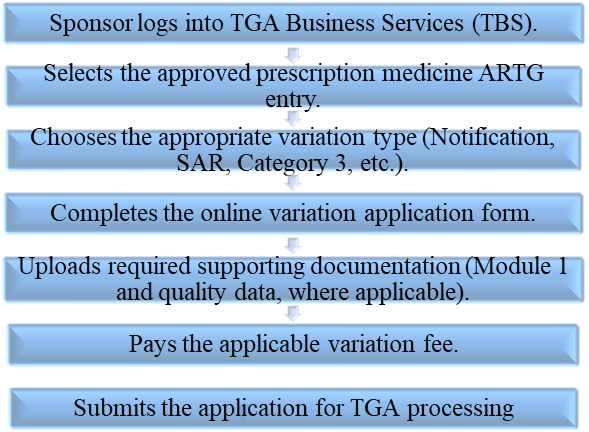
Forms Required for Post-Approval Changes (11)
Online Variation Application Form (Mandatory)
There is no separate PDF form; the TBS online form is the official submission mechanism.
Lifecycle Management and Regulatory Alignment
Australia’s post-approval change framework is aligned with international lifecycle management principles, including:
• ICH Q8–Q11 (pharmaceutical development and quality)
• ICH Q12 (lifecycle management of medicinal products)
Australia Post-Approval Change (PAC) / Variation Classification Chart (9) (10)
|
Variation Category (TGA) |
Variation Type |
Statutory Timeline (TGA) |
Official Examples |
|
Notification |
Notification (N) |
No evaluation timeline (notification only; change may be implemented before or at time of notification) |
• Change to sponsor contact details • Editorial changes to Product Information (PI) or labels with no regulatory impact |
|
Self-Assessable Request (SAR) |
Self-Assessable Request |
45 working days |
• Minor change to finished product specifications within approved limits • Minor change in analytical test methods • Minor manufacturing process changes not affecting product quality |
|
Category 3 Application |
Category 3 (C3) |
90 working days |
• Change in manufacturing site for part of the manufacturing process • Moderate change to manufacturing process with supporting quality data • Change in container closure system with quality justification. |
Comparative Chart: Post-Approval Changes (PACs) / Variations (1) (4) (7) (9) (10)
US vs EU vs Canada vs Australia
|
Region |
Variation Type / Category |
Regulatory Pathway / Name |
Official Review Timeline |
Typical Examples of Variations |
|
United States (FDA) |
Major Change |
Prior Approval Supplement (PAS) |
Approval required before implementation |
Change in formulation composition; change in sterilization method; change in drug substance synthesis route; new manufacturing site without satisfactory CGMP inspection |
|
Moderate Change |
CBE-30 (Changes Being Effected in 30 Days) |
May implement 30 days after FDA receipt if no objection |
Manufacturing process parameter changes (non-critical); batch size change using different equipment; transfer to compliant manufacturing site |
|
|
Moderate Change |
CBE-0 |
May implement immediately upon FDA receipt |
Strengthening in-process controls; changes improving product quality assurance |
|
|
Minor Change |
Annual Report |
Reported in next annual report |
Change in secondary packaging site; labeling site change; equipment replacement of same design |
|
|
European Union (EMA / EC) |
Minor Change |
Type IA (“Do & Tell”) |
Notification within 12 months after implementation |
Administrative MAH changes; tightening shelf-life within approved limits; minor manufacturing process change |
|
Minor Change (Immediate) |
Type IA-IN |
Notification immediately (≤30 days) after implementation |
Addition of batch release site; batch size change within approved range |
|
|
Moderate Change |
Type IB (“Tell, Wait and Do”) |
30 days (extendable to 60 days) |
Manufacturing site change for non-critical steps; minor formulation change; specification updates |
|
|
Major Change |
Type II |
60–90 days (up to 120 days for complex cases) |
New therapeutic indication; significant formulation change; process change affecting CQAs |
|
|
Extension |
Line Extension |
210 days |
New dosage form; new strength outside approved range; new route of administration |
|
|
Canada (Health Canada) |
Major Quality Change |
Level I – Supplement (SNDS / SANDS) |
Up to 300 days (aligned with supplement review targets) |
Major formulation changes; critical manufacturing process change; new sterile manufacturing site |
|
Moderate Quality Change |
Level II – Notifiable Change (NC) |
90 days (No Objection Letter required) |
Moderate specification changes; excipient replacement with similar function; container closure change |
|
|
Minor Quality Change |
Level III – Annual Notification (AN) |
No formal review timeline |
Tightening specifications; minor analytical method changes; editorial CMC updates |
|
|
Record-Only Change |
Level IV |
No review; retained in records |
GMP-compliant changes with no impact on quality, safety, or efficacy |
|
|
Australia (TGA) |
Very Low Risk |
Notification |
No statutory timeline |
Sponsor contact detail change; editorial PI or label updates |
|
Low Risk |
Self-Assessable Request (SAR) |
45 working days |
Minor specification changes; minor analytical method changes; low-risk manufacturing adjustments |
|
|
Moderate Risk (Quality Only) |
Category 3 Application |
90 working days |
Manufacturing site change for part of process; container closure change; moderate process modification |
CONCLUSION:
A vital part of pharmaceutical product lifecycle management, post-approval changes (PACs) allow for ongoing improvement while preserving the efficacy, safety, and quality of pharmaceuticals. The US Food and Drug Administration (FDA), the European Medicines Agency (EMA) and European Commission, Health Canada, and the Therapeutic Goods Administration (TGA) of Australia are among the major regulatory bodies that have developed organized, risk-based frameworks to control post-approval modifications in a variety of regulatory contexts.A unifying regulatory philosophy is apparent despite geographical variations in nomenclature, procedural procedures, paperwork requirements, and review dates. Tiered classification systems are used in all four jurisdictions to balance regulatory control with the possible risk associated with the change. While modest modifications are often handled by notification or periodic reporting methods, major changes consistently require prior regulatory permission backed by extensive evidence. Additionally, the study shows growing regulatory convergence, especially through compliance with International Council for Harmonization (ICH) norms, especially ICH Q12, which encourages improved comprehension of products and processes, regulatory flexibility, and effective lifecycle management.A global trend toward modernization, standardization, and dependence on established pharmaceutical quality systems is highlighted by recent regulatory advancements, such as the updated EU Variations Regulation and developing electronic submission systems. However, pharmaceutical corporations still face difficulties in maintaining worldwide product portfolios due to procedural intricacies and region-specific expectations.
Overall, by methodically contrasting PAC frameworks in the US, EU, Canada, and Australia, this review offers a comprehensive resource for researchers, regulatory experts, and pharmaceutical stakeholders. In an increasingly international pharmaceutical environment, prompt implementation of post-approval modifications, strategic lifecycle planning, and effective compliance all depend on a thorough understanding of these regulatory requirements.
REFERENCES:


Gauri Tilekar1*, Vandna. R. Daga2, A Comparative Study of Post-Approval Changes in Pharmaceuticals: Regulatory Requirements in the US, EU, Canada, and Australia, Int. J. of Pharm. Sci., 2026, Vol 4, Issue 1, 3359-3374. https://doi.org/10.5281/zenodo.18409348
 10.5281/zenodo.18409348