

We use cookies to ensure our website works properly and to personalise your experience. Cookies policy
1,2Research Scholar Department of Pharmacy, Siddhi's Institute of Pharmacy, Nandgaon, Maharashtra, India.
3Assistant Professor, Siddhi's Institute of Pharmacy, Nandgaon, Maharashtra, India.
Clitoria ternatea L., commonly known as butterfly pea or Aparajita, is a perennial climbing plant belonging to the family Fabaceae and is widely used in traditional Ayurvedic medicine. It is traditionally recognized as a Medhya-Rasayana for supporting memory and cognitive function. This review highlights its botanical characteristics, phytochemical constituents, medicinal properties, evaluation parameters, and future prospects in herbal formulation development. The plant contains bioactive compounds, including flavonoids, phenolic compounds, anthocyanins, particularly ternatins, and cyclotides. These constituents have been investigated for their potential antioxidant, antimicrobial, anti-inflammatory, antidiabetic, neuroprotective, and anxiolytic activities. Its flowers are also valuable as natural food colourants because of their distinctive blue pigmentation and pH-responsive properties. Pharmacognostic, physicochemical, phytochemical, and biological evaluations are essential for ensuring the identity, purity, safety, and quality of herbal formulations. Chromatographic techniques, including TLC, HPTLC, and HPLC, can support standardization and quality control. Furthermore, the plant has potential applications in pharmaceutical preparations, nutraceuticals, functional foods, and intelligent food packaging. However, most reported pharmacological effects require further validation through toxicological studies and well-designed clinical trials. In conclusion, C. ternatea is a promising medicinal plant for herbal formulation development, but standardized preparations and evidence-based research are necessary to establish its safety, efficacy, and therapeutic applications.
It is a perennial, twining leguminous plant that originated in tropical Asia and later spread to various regions, including South and Central America, the East and West Indies, China, and India, where it has become naturalised. It is also known by several other names, such as Clitoria, blue pea, Kordofan pea in Sudan, cunha in Brazil, and pokindong in the Philippines. This fast-growing legume thrives during the summer season and is native to the Old World. The genus Clitoria comprises approximately 60 species, which are predominantly distributed throughout tropical regions, although a few species are also found in temperate areas. Among these, Clitoria ternatea is the most commonly reported species. The genus is characterised by woody growth, attractive papilionaceous flowers, a funnel-shaped calyx with persistent bracteoles, stipules, and stalked ovaries. Traditionally, different species of Clitoria have been used in folk medicine for various purposes, including enhancing fertility, regulating menstrual discharge, treating gonorrhoea, and acting as sexual stimulants. [1] Plant extracts play a significant role in influencing the results of various tests. Clitoria ternatea (C. ternatea) has been recognized as a potential natural remedy for several diseases due to its strong antimicrobial properties against bacteria such as Escherichia coli, Staphylococcus aureus, and Vibrio cholerae. Studies have shown that extracts from its leaves and roots exhibit bactericidal activity, meaning they can kill these harmful bacteria.[2]Various extraction techniques are used depending on their purpose and suitability. Modern extraction methods are often employed to improve the extraction yield while reducing costs. However, the recovery of antioxidants depends not only on the extraction technique but also on the solvent used. This is because antioxidants differ in their chemical structures, properties, and polarities, which influence their solubility in different solvents. Common solvents used to extract antioxidants from plant materials include ethanol, methanol, acetone, and ethyl acetate (Wang et al., 2008). The efficiency of each solvent in extracting bioactive compounds may vary depending on the plant species and the characteristics of the compounds being extracted.[3] Therefore, this study aimed to evaluate the antimicrobial activity of methanolic extracts obtained from the leaves and flowers of Clitoria ternatea under controlled laboratory conditions (in vitro).[4]
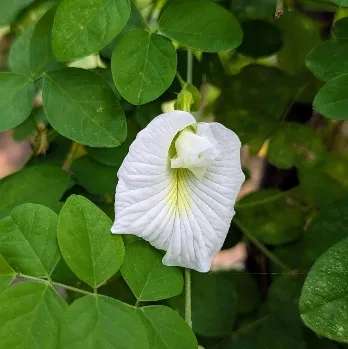
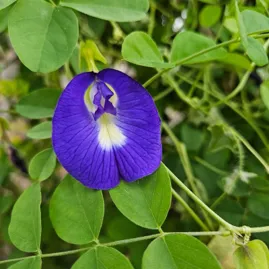
Fig no:1 clitorea ternatea
The root powder is used as one of the components in the formulation of the drug SULAK and its ointment, which are employed in the treatment of leprosy. Its chemical identity and therapeutic activity are compared with those of standard allopathic antileprosy drugs, such as clofazimine, dapsone, and rifampicin, using methods prescribed by the Indian Pharmacopoeia (IP). The use of medicinal plants and chemical substances for treating various diseases and for personal adornment has been practiced since ancient times.[5]
2. History:-
Since ancient times, Shankhpushpi has been widely recognized in Ayurveda for its medicinal properties. It is traditionally used as a brain tonic, nervine tonic, and laxative. In Ayurvedic literature, it is classified as a Medhya-Rasayana, a group of substances believed to support memory, intellect, and mental well-being. The term Shankhpushpi refers to several botanical species, including Convolvulus pluricaulis and Evolvulus alsinoides (family Convolvulaceae), Clitoria ternatea (family Papilionaceae), and Canscora decussata (family Gentianaceae). This herbal drug is traditionally used for its effects on the central nervous system (CNS), particularly for enhancing memory and improving intellectual abilities.The flowers of Clitoria ternatea resemble the shape of a conch shell, which is associated with the Sanskrit name Shankhpushpi. In Ayurveda, this plant is considered a Medhya herb due to its traditional use in promoting cognitive function and supporting mental health. It has also been used in the management of Manasika Roga (mental disorders). Extracts of Clitoria ternatea are incorporated into Medhya-Rasayana formulations, which are traditionally used to rejuvenate the body and support the treatment of neurological conditions.[1]
3. Plant profile:-
3.1 Synonyms :
Clitoria ternatea is also known by several scientific synonyms, including Clitoria albiflora Mattei, Clitoria bracteata Poir., Clitoria mearnsii De Wild., Clitoria tanganicensis Micheli, and Clitoria zanzibarensis Vatke
3.2 Taxonomic Classification:
Clitoria ternatea belongs to the kingdom Plantae and is classified under the subkingdom Viridaeplanta, infrakingdom Streptophyta, division Tracheophyta, subdivision Spermatophytina, infradivision Angiospermae, class Magnoliopsida, superorder Rosanae, and order Fabales. It belongs to the family Fabaceae, genus Clitoria L., and species Clitoria ternatea
3.3 Common Names;
Clitoria ternatea is known by various common names in different languages and regions. In Arabic, it is called Mazerion Hidi and Baslat el-Zuhoor. In Bengali and Hindi, it is known as Aparajita, while its Chinese name is Die Dou. English names include blue-pea, bluebellvine, butterfly-pea, cordofan-pea, and Darwin-pea. In French, it is called honte, and in German, blaue Klitorie. Portuguese names include clitória-azul and clitória, while in Punjabi it is known as Koyal. Its Sanskrit names are Girikarnika and Vishnukranta. In Spanish, it is referred to as conchitas papito, azulejo, zapatico de la reina, and zapotillo. The Swedish name is himmelsärt, while in Tamil it is called Kakkanam and in Telugu, Dintena.[6]
4. Medicinal uses :-
In Ayurveda, Sankhapushpi is a medicinal drug obtained from the roots and seeds of CT. It is traditionally used as a nerve tonic and is believed to have alterative and laxative properties. Its leaves and roots are used to manage various health conditions, including body aches, infections, genitourinary disorders, and intestinal worm infestations. They are also used as an antidote for animal stings. Two varieties of the plant are known: the white-flowered variety is considered more effective medicinally and is therefore preferred, while the blue-flowered variety is commonly used as a substitute. The roots have a bitter and pungent taste and are traditionally valued for their purgative, laxative, and diuretic effects. They are used in Ayurvedic practice to address conditions such as indigestion, constipation, fever, arthritis, and eye disorders. Additionally, the roots are traditionally employed in the treatment of ascites, enlargement of the abdominal organs, sore throat, and various skin diseases.[7]
Table 1: Medicinal Uses of Clitoria Ternatea [7,8,9]
| No. | Medicinal use | Potential activity or traditional application | Evidence level |
|---|---|---|---|
| 1 | Memory enhancement | Traditionally used to support memory, learning, and cognitive function | Mainly preclinical research and traditional use |
| 2 | Anti-anxiety activity | May help reduce anxiety-like behaviour and stress responses | Mainly animal studies |
| 3 | Antidepressant activity | Investigated for potential effects on depression-related behaviours | Mainly preclinical research |
| 4 | Antioxidant activity | Contains anthocyanins and flavonoids that can neutralize free radicals in laboratory tests | Laboratory evidence |
| 5 | Anti-inflammatory activity | Studied for its potential to reduce inflammation | Mainly laboratory and animal studies |
| 6 | Antidiabetic activity | Extracts have shown potential to influence blood glucose regulation | Mainly preclinical research; limited human evidence |
| 7 | Antimicrobial activity | Extracts have shown activity against certain bacteria and fungi in laboratory studies | Laboratory evidence |
| 8 | Analgesic activity | Traditionally investigated for potential pain-relieving effects | Mainly animal studies |
| 9 | Antipyretic activity | Studied for potential fever-reducing effects | Mainly animal studies |
| 10 | Neuroprotective activity | Investigated for possible protection against oxidative stress-related neuronal damage | Mainly preclinical research |
| 11 | Wound healing | Extracts have been studied for their potential to support wound repair | Mainly animal studies |
| 12 | Diuretic activity | Traditionally used and experimentally investigated for increasing urine output | Mainly preclinical research |
| 13 | Antiasthmatic activity | Traditionally used for respiratory complaints; potential effects have been investigated experimentally | Limited preclinical evidence |
| 14 | Lipid-lowering activity | Studied for possible effects on cholesterol and other blood lipids | Mainly animal studies |
| 15 | Gastroprotective activity | Investigated for potential protective effects on the stomach lining | Mainly preclinical research |
5. Evalution parameter:
5.1 Pharmacognostic evaluation
5.1.1 Macroscopy: Examines the external characteristics of the plant, including colour, shape, size, odour, and texture of leaves, flowers, roots, and seeds.
5.1.2 Microscopy: Studies the internal structure of plant tissues to identify diagnostic features and confirm the authenticity of the plant material.
5.1.3 Foreign Matter: Determines the presence of unwanted materials, such as dust, soil, insects, and other plant parts, to ensure purity.
5.1.4 Powder Characteristics: Evaluates the colour, odour, texture, and microscopic features of powdered plant material for identification and quality control.
[10, 11]
5.2 Physicochemical Evaluation of Clitoria ternatea
5.2.1 Moisture / Loss on Drying: Determines the moisture and volatile matter present in the plant material, helping assess its stability and storage quality.
5.2.2 Ash Values: Measure the inorganic residue remaining after incineration, indicating the presence of minerals and possible contamination with soil or sand.
5.2.3 Extractive Values: Determine the amount of constituents extracted using specific solvents, helping estimate the chemical composition of the plant material.
5.2.4 .Extraction Yield: Measures the quantity of extract obtained from the starting plant material, usually expressed as a percentage of the initial weight.
[10, 11, 12]
5.3 Phytochemical Evaluation of Clitoria ternatea
5.3.1 Phenolics and Flavonoids: Detects and estimates phenolic compounds and flavonoids that contribute to the plant’s antioxidant and other potential biological activities.
5.3.2 Anthocyanins / Ternatins: Evaluates the blue pigments present in the flowers, which are responsible for their characteristic colour and antioxidant potential.
5.3.3 TLC, HPTLC or HPLC: Chromatographic techniques used to identify, separate, and quantify phytochemical constituents and support the standardization and quality control of herbal formulations.
[12, 13, 7]
5.4 Biological Evaluation of Clitoria ternatea
5.4.1 Antioxidant Assays: Evaluate the ability of plant extracts to neutralize free radicals using methods such as DPPH and ABTS assays.
5.4.2 Antimicrobial Assays: Assess the inhibitory effects of plant extracts against bacteria and fungi using methods such as agar well diffusion.
5.4.3 Other Activity-Specific Tests: Investigate potential pharmacological activities, including anti-inflammatory, antidiabetic, and neuroprotective effects, using appropriate laboratory or experimental models.
5.4.4 Toxicity and Safety: Evaluate the potential toxic effects and safety of plant extracts through suitable toxicity studies to determine their safe use in herbal formulations.
[12–14]
5.5 Quality Assessment and Standardization of Clitoria ternatea
5.5.1 Reproducibility: Ensures consistent results by maintaining uniform extraction methods, experimental conditions, and formulation procedures.
5.5.2 Chemical Fingerprint: Uses chromatographic techniques such as TLC, HPTLC, or HPLC to identify characteristic phytochemicals and assess the consistency of plant extracts.
5.5.3 Plant-Part-Specific Interpretation: Evaluates leaves, roots, flowers, and seeds separately because their phytochemical composition and biological activities may differ.
5.5.4 Evidence-Based Conclusions: Draws conclusions based on reliable experimental findings and available scientific evidence while considering the limitations of existing studies. [12–14
6. Future prospective :-
6.1 Pharmaceutical and Medicinal Research
Clitoria ternatea contains flavonoids, anthocyanins, phenolic compounds, and cyclotides that may have pharmaceutical applications. Further studies are required to identify active compounds and establish their therapeutic potential .[7,15]
6.2 Neuroprotective and Cognitive Applications
Future research should investigate the potential effects of C. ternatea on memory, learning, and neurological health through experimental studies and clinical trials. [7,15]
6.3 Antioxidant and Anti-inflammatory Applications
Its anthocyanins and flavonoids show antioxidant potential. Further studies are needed to evaluate their effects on oxidative stress and inflammatory pathways. [13,16]
6.4 Diabetes and Metabolic Disorders
Further investigations should assess its effects on blood glucose regulation, dosage, and safety to establish its potential role in managing metabolic disorders [7,15].
6.5 Natural Food Colourants and Functional Foods
The ternatins present in its flowers may be useful as natural blue and purple food colourants. Future research should improve pigment stability and extraction efficiency. [13,16]
6.6 Intelligent Food Packaging
The pH-sensitive pigments of C. ternatea may be used in intelligent packaging to monitor changes in food quality and freshness. [16]
6.7 Cyclotides and Peptide Biotechnology
Cyclotides may offer opportunities for pharmaceutical and agricultural biotechnology. Further research is required to establish their safety and biological activity [15]
6.8 Agricultural Applications
ternatea may contribute to sustainable agriculture as a forage crop, cover crop, and potential source of natural biopesticidal compounds [15]
6.9 Extraction Techniques and Standardization
Optimizing extraction methods and using HPLC and LC–MS techniques may improve the identification, quality control, and reproducibility of herbal formulations.[13,16]
6.10 Toxicity Assessment and Clinical Validation
Further toxicological studies and well-designed clinical trials are necessary to establish the safety, appropriate dosage, and therapeutic efficacy of C. ternatea-based preparations. [7,15]
CONCLUSION
Clitoria ternatea L. is a promising medicinal plant with significant potential in herbal formulation development due to its diverse phytochemical constituents, particularly flavonoids, phenolics, anthocyanins, and cyclotides. Its reported antioxidant, antimicrobial, anti-inflammatory, antidiabetic, neuroprotective, and cognitive-supporting activities highlight its therapeutic importance. Pharmacognostic, physicochemical, phytochemical, and biological evaluations are essential for ensuring the quality, safety, and consistency of C. ternatea-based formulations. Despite its promising traditional and preclinical evidence, further studies on standardization, toxicity, pharmacokinetics, dosage, and well-designed clinical trials are required to establish its therapeutic efficacy and safe clinical application.
REFERENCES

Manjiri Chaudhari, Aakanksha Deshmukh, Girish Kokate, A Comprehensive Review of Herbal Formulations of Clitoria Ternatea: Phytochemistry, Pharmacological Activities, and Therapeutic Potential, Int. J. of Pharm. Sci., 2026, Vol 4, Issue 10, 4875-4881. https://doi.org/10.5281/zenodo.23829745
 10.5281/zenodo.23829745