

We use cookies to ensure our website works properly and to personalise your experience. Cookies policy
Jagdambha institute of pharmacy and research, kalamb.
Nasal drug delivery is an effective and non-invasive route of drug administration that offers rapid drug absorption, improved bioavailability, and avoidance of first-pass metabolism. However, conventional nasal dosage forms such as drops and sprays have certain limitations, including rapid mucociliary clearance, enzymatic degradation, limited residence time, and poor absorption of certain drugs. To overcome these limitations, mucoadhesive in situ gel systems have emerged as a promising approach for nasal drug delivery. In situ gels are administered in the form of a liquid and undergo sol-to-gel transformation after coming into contact with physiological conditions such as temperature, pH, or ions present in the nasal cavity. The incorporation of mucoadhesive polymers helps the formulation adhere to the nasal mucosa, prolonging drug residence time and improving drug absorption. Various natural and synthetic polymers, such as chitosan, carbopol, poloxamer, gellan gum, xanthan gum, and sodium alginate, are used in the development of these systems. This review focuses on the anatomy and physiology of the nasal cavity, barriers to nasal drug delivery, mechanisms of mucoadhesion and in situ gel formation, different approaches, polymers, formulation methods, and evaluation parameters. Mucoadhesive in situ gel systems represent a promising strategy for improving the efficiency of nasal drug delivery through controlled and sustained drug release.
The nasal route has gained attention as an alternative to oral and parenteral administration because the nasal mucosa is vascularized, accessible and suitable for non-invasive dosing. Drugs administered intranasally may be absorbed through the mucosal epithelium and enter the systemic circulation without first passing through the gastrointestinal tract and hepatic first-pass pathway. The route can provide a rapid onset of action and may be useful when swallowing is difficult or when a rapid therapeutic response is desirable. Its usefulness is nevertheless dependent on the physicochemical properties of the drug, formulation characteristics and the physiological condition of the nasal cavity [2,3,7].
Conventional nasal dosage forms, particularly aqueous drops and sprays, may be removed rapidly by mucociliary clearance. The formulation can also be diluted by nasal secretions, deposited in an unintended region or cleared before sufficient drug permeation occurs. Enzymes present in the nasal cavity may degrade susceptible molecules, especially peptides and proteins. In addition, the limited volume that can be administered intranasally restricts the amount of drug delivered in a single dose [3,7,10,12].
In situ gel technology is one strategy proposed to improve nasal residence. An in situ gelling formulation is administered in a fluid state and converts into a gel after encountering a suitable physiological trigger. The transition may be induced by temperature, pH or ions. When mucoadhesive polymers are incorporated, the formed gel can interact with mucin and remain in contact with the nasal epithelium for a longer period. This can create a local drug reservoir and support prolonged release [1,15–17].
The purpose of this review is to summarize the formulation science and therapeutic relevance of mucoadhesive in situ nasal gels. Emphasis is placed on the nasal environment, absorption barriers, gelation mechanisms, polymer selection, preparation techniques, quality evaluation and the challenges that must be addressed before wider clinical translation.
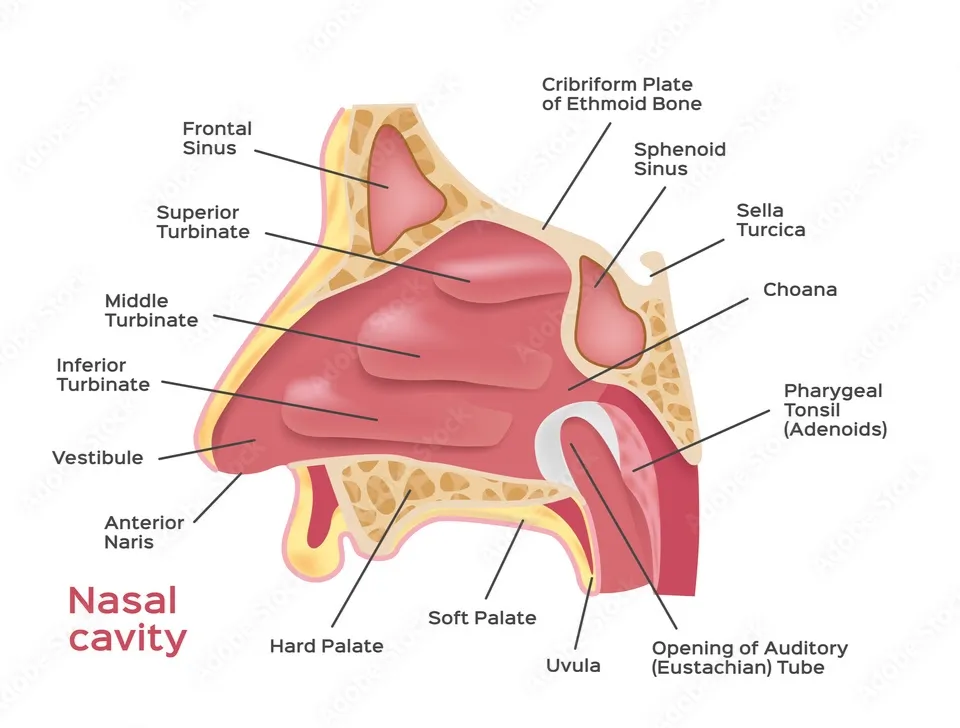
Figure 1: Anatomy of Nasal Cavity
2. ANATOMY AND PHYSIOLOGY OF THE NASAL CAVITY
The nasal cavity extends from the nostrils to the nasopharynx and is divided into right and left passages by the nasal septum. For drug-delivery purposes, it is commonly described in terms of three regions: the vestibular, respiratory and olfactory regions. Each region has a distinct epithelial structure and role in drug deposition and absorption [7,10,12].
2.1 Vestibular region
The vestibule forms the entrance to the nasal cavity and contains hairs that trap larger airborne particles. Its epithelial lining is more similar to skin than to the deeper respiratory mucosa. Because its absorptive surface is relatively limited, it is not generally considered the principal region for systemic drug absorption.
2.2 Respiratory region
The respiratory region occupies the largest portion of the nasal cavity. It is lined by a ciliated epithelium containing goblet cells, which secrete mucus. The region is richly supplied with blood vessels and provides a substantial surface area for absorption. The mucus layer traps particles and helps protect the underlying epithelium, while the cilia move mucus towards the nasopharynx.
2.3 Olfactory region
The olfactory region is located in the upper part of the nasal cavity and contains specialized olfactory epithelium associated with the sense of smell. It is of particular interest in nose-to-brain delivery research because pathways associated with the olfactory and trigeminal nerves may provide routes for transport towards the central nervous system. Achieving reproducible deposition in this region remains a formulation and device challenge [2,8,29].
2.4 Mucus and mucociliary clearance
Nasal mucus is a protective, hydrated layer containing mucins and other components. Ciliated epithelial cells move the mucus towards the nasopharynx, removing inhaled particles, microorganisms and deposited materials. This protective mechanism is essential for respiratory health but can shorten the time available for drug absorption. The supplied source describes mucociliary clearance on the order of approximately 15–20 minutes, while other cited descriptions report a clearance half-life of about 15–30 minutes for non-bioadhesive liquid or powder formulations [7,12].
A nasal in situ gel is designed to increase viscosity after administration and to interact with the mucosal surface. The objective is not to permanently prevent normal clearance, but to provide sufficient residence for drug release and absorption while maintaining mucosal tolerability.
3. ADVANTAGES, DISADVANTAGES AND BARRIERS OF NASAL DELIVERY
3.1 Advantages
3.2 Disadvantages and limitations
The nasal route is therefore not universally suitable for every active pharmaceutical ingredient. Formulation development must balance permeability, residence time, dose volume, viscosity, sprayability and local safety. Penetration enhancers have been investigated, but their use requires careful assessment because some agents may irritate or damage the mucosal barrier [3,7,10,12].
4. BARRIERS TO NASAL DRUG ABSORPTION
4.1 Limited bioavailability and molecular size
Drug absorption depends on molecular size, lipophilicity, ionization, aqueous solubility and the ability to cross the epithelial barrier. Small molecules generally permeate more readily than large hydrophilic molecules. Peptides and proteins may show low nasal bioavailability because of their size, hydrophilicity and susceptibility to enzymatic degradation. Both transcellular and paracellular pathways contribute to transport, but the relative contribution varies with the molecule and formulation [7,12,13].
4.2 Mucociliary clearance
The coordinated beating of cilia transports mucus towards the nasopharynx. This mechanism rapidly removes non-adhesive liquid formulations and can reduce the contact time between the drug and absorptive epithelium. Mucoadhesive polymers are incorporated to interact with mucus and prolong residence. Formulation viscosity and the site of deposition also influence clearance and should be optimized rather than maximized.
4.3 Enzymatic degradation
Nasal secretions and epithelial tissues contain enzymes capable of degrading peptides and proteins. Exopeptidases can act at peptide termini, while endopeptidases can cleave internal peptide bonds. Enzyme inhibitors, cosolvents and prodrug strategies have been discussed as possible approaches, although each requires evaluation for safety and compatibility with nasal tissues [12].
4.4 Mucosal barrier and formulation-related factors
The mucus layer can bind or hinder the diffusion of certain molecules. Tight junctions between epithelial cells restrict paracellular transport, while the lipid character of cell membranes influences transcellular permeation. Formulation pH, osmolality, viscosity, droplet size, excipient concentration and drug release rate may all influence nasal performance. Repeated administration also raises questions about local tolerability and effects on normal mucociliary function [7,10,13,14].
5. MECHANISMS OF DRUG ABSORPTION THROUGH THE NASAL MUCOSA
After administration, a drug must first disperse or dissolve in the nasal fluid and move through the mucus layer. It then encounters the epithelial barrier. The principal pathways described for nasal transport are transcellular and paracellular diffusion; carrier-mediated transport, vesicular transport and efflux mechanisms may also contribute [13].
5.1 Transcellular transport
Transcellular transport involves movement through epithelial cells. Lipophilic molecules may partition into and diffuse across cell membranes more readily than highly hydrophilic compounds. The extent of transport depends on the drug's physicochemical characteristics and the integrity of the epithelial membrane.
5.2 Paracellular transport
Paracellular transport occurs through the spaces between adjacent epithelial cells and is regulated by tight junctions. It is an aqueous pathway but is generally restrictive, particularly for larger molecules. Some mucoadhesive polymers, including chitosan, have been investigated for their ability to transiently influence tight-junction permeability. Such effects must be assessed alongside epithelial safety and reversibility [14].
5.3 Carrier-mediated and vesicular pathways
Carrier-mediated transport uses endogenous transport systems, whereas vesicle-mediated transport involves cellular uptake and movement in vesicles. These pathways may be relevant to selected compounds, but they are not universal mechanisms and should not be assumed to operate equally for all nasal formulations.
6. MUCOADHESIVE IN SITU GEL SYSTEMS
6.1 Definition and principle
In situ gels are liquid or low-viscosity systems that undergo gel formation at the site of administration in response to a physiological or environmental stimulus. In nasal delivery, the formulation is applied as a solution or spray and subsequently forms a more viscous gel after contact with nasal secretions and the local environment. The formed matrix can retain the drug and release it gradually [1,15,16].
6.2 Sol-to-gel transition
The transition may be initiated by a change in temperature, pH or ionic composition. Thermoresponsive formulations are designed to remain sufficiently fluid during handling and administration but gel at or near nasal temperature. pH-responsive polymers alter their ionization and swelling behaviour as the surrounding pH changes. Ion-responsive polymers form networks through interactions with mono- or divalent cations present in the fluid [17–20].
6.3 Mechanism of mucoadhesion
Mucoadhesion is the attachment of a formulation to a mucus-covered biological surface. It may involve wetting and close contact, followed by interpenetration of polymer chains with mucin and the development of intermolecular interactions. Hydrogen bonding, electrostatic attraction and polymer-chain interpenetration are commonly discussed mechanisms. The strength and duration of adhesion depend on polymer molecular characteristics, hydration, charge, concentration and the properties of the mucus layer [3,16–19].
6.4 Functional role of the gel matrix
After gelation, the increased viscosity can reduce rapid runoff and create a drug-containing depot at the mucosal surface. Drug release may occur through diffusion, polymer relaxation, swelling or gradual erosion/dissolution of the matrix. The intended outcome is prolonged contact and controlled release, not complete obstruction of physiological clearance. The final formulation should remain comfortable, non-irritant and capable of reproducible administration.
6.5 Desired formulation characteristics
7. APPROACHES TO IN SITU GEL FORMATION
7.1 Temperature-triggered systems
Thermosensitive systems use polymers whose solubility, hydration or association changes with temperature. An ideal nasal formulation remains manageable at room temperature and forms a gel at the temperature encountered in the nasal cavity. Poloxamer-based systems are widely investigated because their amphiphilic block-copolymer structure can produce temperature-dependent micellization and gelation. Chitosan-containing systems may also show temperature- and pH-dependent behaviour depending on the formulation composition [19,20,22,27].
7.2 pH-triggered systems
pH-sensitive polymers contain acidic or basic functional groups that ionize in response to changes in environmental pH. Changes in ionization can alter polymer-chain repulsion, swelling and viscosity, leading to gel formation. Carbopol/carbomer and related polyacrylic acid materials are examples of polymers used in pH-responsive systems. The pH range must be selected with regard to nasal physiology and local tolerability [19,20].
7.3 Ion-activated systems
Ion-responsive polymers form gels through interactions with ions in the surrounding fluid. Gellan gum and alginate are examples of polysaccharides that can form networks in the presence of suitable cations, particularly divalent ions such as calcium. The concentration and type of ions, polymer composition and availability of cross-linking sites influence gel strength and formation time [20,28].
7.4 Other chemically induced systems
Chemically induced gelation may involve ionic cross-linking, enzymatic cross-linking or photopolymerization. Enzymatic systems can operate under relatively mild physiological conditions, whereas photopolymerization requires a suitable light source and photoinitiator. These approaches are discussed in the broader in situ gel literature; their suitability for routine intranasal administration requires separate evaluation of feasibility and safety [21,22].
8. POLYMERS USED IN NASAL IN SITU GELS
Polymer selection is a critical step because the polymer determines gelation behaviour, viscosity, mucoadhesion, drug-release characteristics and formulation stability. The source document groups polymers according to their principal response mechanism. The properties below are summarized from the supplied review and its cited references [18–28].
8.1 Carbopol/carbomer
Carbopol is a cross-linked polyacrylic acid polymer with substantial water-sorption and swelling capacity. Its carboxylic groups become increasingly ionized as pH rises, causing chain expansion and increased viscosity. It is used as a pH-responsive gelling agent and can provide mucoadhesive interactions through hydrogen bonding and other intermolecular forces. Concentration and neutralization must be optimized because excessive viscosity may interfere with administration.
8.2 Poloxamer
Poloxamers are non-ionic triblock copolymers consisting of a central hydrophobic polypropylene oxide block flanked by hydrophilic polyethylene oxide blocks. They are water-soluble and exhibit temperature-dependent micellization and gelation. A formulation can be prepared to remain fluid at lower temperature and become more viscous or gel-like as temperature increases. Poloxamer concentration and grade influence the gelation temperature and mechanical properties [27].
8.3 Chitosan
Chitosan is obtained by deacetylation of chitin and is a cationic, biodegradable polysaccharide. Its solubility depends on pH and degree of deacetylation. Chitosan is valued for mucoadhesive properties and has been investigated as a permeation-modifying polymer. Formulation design must consider its pH-dependent solubility, compatibility with the drug and potential effects on epithelial integrity [14,18].
8.4 Gellan gum
Gellan gum is an anionic extracellular polysaccharide that can undergo gelation in the presence of mono- and divalent cations. Its network formation involves ordered polymer-chain associations and cation-mediated junction zones. It is used in ion-activated in situ systems and may provide a useful balance between solution handling and gel formation [20,28].
8.5 Sodium alginate
Sodium alginate is a polysaccharide obtained from brown algae and contains mannuronic and guluronic acid residues. Calcium ions interact particularly with guluronic-acid-rich regions to form a gel network. Alginate is biodegradable and can provide mucoadhesive properties through its carboxyl groups. Gel strength and porosity are influenced by polymer composition, concentration and cross-linking conditions [28].
8.6 Xanthan gum and cellulose derivatives
Xanthan gum is an anionic polysaccharide produced by bacterial fermentation. It can modify viscosity and contribute to gel structure. Cellulose derivatives such as hydroxypropyl methylcellulose may be used as viscosity modifiers or formulation-supporting polymers. Polymer blends are sometimes explored to combine gelation with suitable rheological and mucoadhesive properties [18,26,28].
| Polymer | Main response/property | Potential formulation role | Source refs. |
|---|---|---|---|
| Carbopol/carbomer | pH-responsive; anionic | Swelling, gel formation and mucoadhesion | [19,20] |
| Poloxamer | Temperature-responsive; non-ionic | Thermogelling matrix and viscosity increase | [18,27] |
| Chitosan | Cationic; pH/temperature dependent | Mucoadhesion and possible permeability modulation | [14,18] |
| Gellan gum | Ion-responsive; anionic | Cation-triggered gel network | [20,28] |
| Sodium alginate | Ion-responsive polysaccharide | Calcium-mediated gelation and mucoadhesion | [28] |
| Xanthan gum | Anionic polysaccharide | Viscosity modification and gel support | [26,28] |
| HPMC | Cellulose derivative | Viscosity and formulation support | [18,26] |
9. METHODS OF FORMULATION
9.1 Cold method
In the cold method, the required ingredients are dispersed or dissolved in chilled purified water, usually with controlled stirring. The dispersion may be kept under refrigeration to facilitate polymer hydration and to prevent premature gelation. Poloxamer-based systems are commonly prepared by a cold technique because the polymer remains more readily dispersed at low temperature and develops gel-like behaviour as temperature rises. Chitosan-containing formulations may also require controlled low-temperature processing depending on their composition [23,26].
9.2 Hot method
The hot method is selected for polymers that require elevated temperature for dissolution or hydration. Gellan gum and pectin are examples described in the supplied source. The polymer is dispersed or dissolved in heated water, followed by controlled cooling and addition of suitable ions or other formulation components when required. Temperature, mixing order and cooling rate can affect polymer structure and final gel properties [24].
9.3 General formulation considerations
A nasal in situ gel may contain an active pharmaceutical ingredient, one or more gelling polymers, mucoadhesive polymer (s), solvent or vehicle, pH-adjusting agents and suitable stabilizing or preservative components where justified. The formulation process should control polymer hydration, drug dispersion, pH, temperature and mixing. The final preparation must be evaluated for dose uniformity, ease of administration, gelation under simulated nasal conditions and compatibility with the container-closure system.
10. EVALUATION PARAMETERS
Evaluation should establish that the formulation can be administered reproducibly, undergoes gelation under relevant nasal conditions, retains the drug at the intended site and releases it at a suitable rate. The tests summarized below are reported in the supplied source; exact methods and acceptance criteria should be selected and justified for the specific formulation [29–31].
1. Appearance and clarity: Inspect the formulation in sol and gel states for colour, transparency, visible particles, phase separation and other physical changes.
2. pH: Measure formulation pH using a calibrated pH meter. The selected pH should be compatible with nasal administration and should not compromise drug stability.
3. Sol-to-gel transition temperature and gelation time: Determine the temperature or physiological condition at which gelation begins and record the time required to form a stable gel.
4. Gelling capacity: Mix a defined amount of formulation with simulated nasal fluid and observe the speed, extent and persistence of gel formation.
5. Viscosity and rheology: Measure viscosity at relevant temperatures and, where possible, at different shear rates. Rheological behaviour helps predict handling, sprayability and retention.
6. Drug content and content uniformity: Determine drug concentration using a validated analytical method and assess uniformity between samples or containers.
7. Mucoadhesive strength: Measure the force required to detach the gel from a suitable mucosal tissue model under controlled contact conditions.
8. In vitro drug release: Use an appropriate diffusion or release apparatus and a validated membrane/receptor medium. Sample at planned intervals and quantify released drug.
9. Release kinetics: Fit release data to suitable kinetic models and interpret the model only when supported by the quality of fit and experimental design.
10. Sterility or microbial quality: Apply the microbiological quality requirements appropriate to the intended product and route.
11. Stability studies: Evaluate physical appearance, pH, drug content, viscosity, gelation behaviour and microbial quality under justified storage conditions.
A formulation should not be considered successful on the basis of gelation alone. It should also demonstrate acceptable nasal tolerability, reproducible drug delivery, stability and a release profile appropriate to the intended therapeutic use.
11. THERAPEUTIC APPLICATIONS
11.1 Nasal and systemic delivery
The most direct application is local or systemic delivery through the nasal mucosa. Mucoadhesive in situ gels may increase contact time and provide a matrix for sustained drug release. The supplied review describes nasal formulations investigated with drugs including rizatriptan benzoate, sumatriptan, naproxen and montelukast, as well as mometasone furoate in an allergic-rhinitis model. These examples illustrate the range of therapeutic areas explored; they do not establish that every formulation has demonstrated clinical benefit [25,30,31,33].
11.2 Nose-to-brain delivery
Nose-to-brain delivery is an area of interest for selected neurological conditions because pathways associated with the olfactory and trigeminal regions may provide access towards the central nervous system. Formulation design must address deposition in the relevant nasal region, drug stability, mucosal transport and the possibility of systemic absorption. Nanocarriers and ligand-mediated strategies have been discussed as approaches to improve targeting, but their effectiveness and safety require product-specific evidence [2,8,29].
11.3 Other routes of in situ gel application
The supplied source also describes in situ gels for oral, ocular, rectal, vaginal and injectable delivery. These examples demonstrate the broader versatility of stimulus-responsive gel technology. Oral systems may use pH or ionic changes in the gastrointestinal tract; ocular gels can prolong precorneal residence; rectal and vaginal gels may improve local retention; and injectable systems may form depots or tissue-compatible hydrogels. These applications are not nasal formulations and are included here only to place nasal in situ gels within the wider field [15,21,22,32,34].
12. CHALLENGES AND DEVELOPMENT OPPORTUNITIES
Despite their potential, nasal in situ gels face several development challenges. First, gelation must occur rapidly enough to limit runoff but not so early that the product becomes difficult to administer. Second, a high viscosity may improve retention while reducing spray formation and distribution. Third, formulation deposition is affected by the delivery device, patient technique and nasal anatomy. Unintended deposition in the anterior nose may reduce the fraction reaching the intended absorptive region. Unpleasant taste, throat runoff and local discomfort can also reduce patient acceptance [10,35].
A further challenge is balancing mucoadhesion with normal mucociliary function. Excessive or persistent adhesion may not be desirable, and repeated-dose safety must be assessed. The formulation should not cause epithelial injury, persistent inflammation or impairment of ciliary activity. For peptide and protein drugs, enzymatic stability and epithelial permeation remain important obstacles. For nose-to-brain products, demonstrating reproducible targeting and meaningful therapeutic exposure is particularly important [7,8,12,29].
Manufacturing and regulatory considerations include batch-to-batch consistency, control of polymer attributes, scale-up of mixing and cooling processes, container compatibility, microbial quality, stability and validated analytical methods. Clinical translation requires well-designed studies that compare the in situ gel with appropriate conventional formulations and assess both local and systemic safety.
13. FUTURE PERSPECTIVES
Future development is likely to focus on multifunctional polymers that combine mucoadhesion with controlled, stimulus-responsive gelation. Polymer blends may be tailored to achieve a suitable balance of pre-administration flow, gelation temperature, mechanical strength and drug release. More detailed rheological characterization and physiologically relevant nasal models can help predict performance before clinical studies.
Advanced delivery devices may improve dose reproducibility and deposition in selected nasal regions. Nanoparticle-based carriers, ligand-coated systems and receptor-mediated transport are being explored for targeted delivery, including nose-to-brain applications. Computational tools and artificial intelligence may assist in selecting polymer combinations and optimizing formulation variables; however, predictions must be validated experimentally and should not replace safety or clinical evidence.
The most important translational priorities are to establish long-term nasal tolerability, demonstrate consistent drug exposure, define robust manufacturing controls and generate adequate clinical evidence. A successful formulation will need to combine therapeutic performance with patient comfort, ease of use and a reliable product lifecycle.
CONCLUSION
Mucoadhesive in situ gels represent a promising approach for improving the performance of nasal drug delivery systems. By undergoing sol-to-gel transformation after administration and interacting with the nasal mucus layer, these formulations may prolong residence time and support controlled drug release. Poloxamer, chitosan, carbopol, gellan gum, sodium alginate and related polymers provide different mechanisms for temperature-, pH- or ion-triggered gelation. Nevertheless, formulation success depends on appropriate polymer selection, nasal tolerability, reproducible administration, drug stability and a suitable release profile. Further systematic preclinical and clinical studies are required to confirm safety, efficacy, manufacturing consistency and the clinical value of these systems.
DECLARATION
This manuscript is a rewritten academic review draft prepared from the user-supplied 30-page PDF. No new experimental data are presented. The cited bibliography has been transcribed from that source and has not been independently verified item-by-item; bibliographic details, DOI information and journal formatting should be checked against the original publications before submission.
REFERENCES

Sakshi Raut, Aishwarya Deshmukh, Simran Yunus Sheikh, Krutika Bisen, Dr. Rahul Bijwar, Advances in Mucoadhesive in Situ Gel-Based Nasal Drug Delivery Systems: Formulation and Therapeutic Application, Int. J. of Pharm. Sci., 2026, Vol 4, Issue 11, 3955-3963. https://doi.org/10.5281/zenodo.24415347
 10.5281/zenodo.24415347