

We use cookies to ensure our website works properly and to personalise your experience. Cookies policy
Department of Pharmaceutical Chemistry, Shantiniketan College of Pharmacy, Dhotre Bk
Cinitapride is a selective gastroprokinetic agent widely prescribed for the management of gastroesophageal reflux disease (GERD), functional dyspepsia, and other gastrointestinal motility disorders. The development of reliable, accurate, and validated analytical methods is essential to ensure the quality, safety, and efficacy of Cinitapride in bulk drug substances and pharmaceutical dosage forms. A variety of analytical techniques, including UV–Visible spectrophotometry, colorimetric methods, High-Performance Liquid Chromatography (HPLC), Reverse-Phase High-Performance Liquid Chromatography (RP-HPLC), High-Performance Thin-Layer Chromatography (HPTLC), and Liquid Chromatography–Mass Spectrometry (LC–MS/MS), have been reported for its qualitative and quantitative determination. Each analytical technique offers specific advantages depending on the intended application, sensitivity, accuracy, and regulatory requirements. This review comprehensively summarizes the reported analytical methods for the estimation of Cinitapride, with emphasis on their analytical principles, method development, validation parameters in accordance with ICH Q2(R2) guidelines, applications, advantages, limitations, and future perspectives. The review aims to provide researchers, pharmaceutical scientists, and quality control analysts with a comprehensive reference for selecting suitable analytical methods for the routine analysis and quality assessment of Cinitapride.
Analytical chemistry plays a pivotal role in the pharmaceutical industry by ensuring the quality, safety, and efficacy of drug substances and pharmaceutical formulations. The development and validation of reliable analytical methods are essential throughout the drug development process, including raw material testing, formulation development, quality control, stability studies, dissolution testing, and regulatory approval. The selection of an appropriate analytical technique is primarily based on the physicochemical properties of the drug, required sensitivity, specificity, precision, accuracy, and compliance with regulatory guidelines such as the International Council for Harmonisation (ICH) Q2(R2) guideline for analytical method validation (1–6).
Cinitapride Hydrogen Tartrate is a substituted benzamide derivative widely used as a gastroprokinetic agent for the treatment of gastroesophageal reflux disease (GERD), functional dyspepsia, non-ulcer dyspepsia, and delayed gastric emptying. The drug exerts its pharmacological action by acting as an agonist at 5-hydroxytryptamine (5-HT₁ and 5-HT₄) receptors and as an antagonist at 5-HT₂ and dopamine D₂ receptors, thereby enhancing acetylcholine release from enteric neurons and promoting gastrointestinal motility. These pharmacological properties make Cinitapride an effective therapeutic option for various gastrointestinal motility disorders (2,3,7,8).
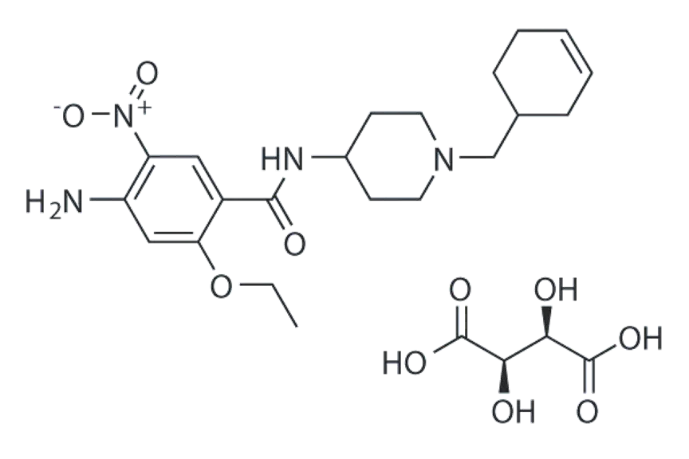
Accurate quantitative determination of Cinitapride is essential to ensure the quality, potency, stability, and safety of pharmaceutical products throughout their shelf life. Several analytical methods have been reported for the determination of Cinitapride in bulk drug substances, pharmaceutical dosage forms, and biological matrices. Conventional techniques such as UV–Visible spectrophotometry and colorimetric methods are widely employed because of their simplicity, rapidity, and cost-effectiveness. In contrast, chromatographic techniques including High-Performance Liquid Chromatography (HPLC), Reverse-Phase High-Performance Liquid Chromatography (RP-HPLC), High-Performance Thin-Layer Chromatography (HPTLC), and Liquid Chromatography–Mass Spectrometry (LC–MS/MS) provide superior sensitivity, selectivity, precision, and accuracy, making them suitable for routine quality control, stability-indicating analysis, impurity profiling, and pharmacokinetic studies (9–12).
Cinitapride Hydrogen Tartrate has the IUPAC name 4-amino-N-[1-(cyclohex-3-en-1-ylmethyl)piperidin-4-yl]-2-ethoxy-5-nitrobenzamide and the molecular formula C₂₅H₃₆N₄O₁₀, with a molecular weight of 552.57 g/mol. It is a yellow-coloured crystalline powder, freely soluble in methanol and sparingly soluble in water. The drug belongs to the benzamide class of gastroprokinetic and antiemetic agents and exhibits an elimination half-life of approximately 3–5 hours. Owing to these physicochemical and pharmacological characteristics, several analytical approaches have been developed for its qualitative and quantitative estimation (7–12).
The present review comprehensively summarizes the analytical methods reported for the determination of Cinitapride, with particular emphasis on UV–Visible spectrophotometry, colorimetric methods, RP-HPLC, HPTLC, LC–MS/MS, and simultaneous estimation techniques. Furthermore, the review discusses method validation parameters according to ICH Q2(R2) guidelines, compares the advantages and limitations of different analytical techniques, and highlights future perspectives for the development of robust, sensitive, and environmentally sustainable analytical methods for Cinitapride (1,9–12).
1. UV–Visible Spectrophotometric Methods
UV–Visible spectrophotometry is one of the most widely employed analytical techniques for the quantitative estimation of Cinitapride because of its simplicity, rapidity, cost-effectiveness, and minimal instrumentation requirements. The technique is particularly suitable for routine quality control analysis of bulk drug substances and pharmaceutical dosage forms. Several UV spectrophotometric methods have been reported for the determination of Cinitapride either alone or in combination with other pharmaceutical agents, demonstrating satisfactory analytical performance in accordance with ICH validation guidelines.
Thangabalan et al. developed a rapid, precise, accurate, and sensitive UV spectrophotometric method for the quantitative estimation of Cinitapride using methanol as the solvent. The drug exhibited maximum absorbance (λmax) at 260 nm and obeyed Beer–Lambert's law over the concentration range of 5–40 μg/mL. The proposed method demonstrated excellent linearity and accuracy, with recovery values greater than 99%, indicating its suitability for routine quality control analysis of pharmaceutical formulations (13).
Teja et al. reported a simple, economical, and reproducible UV spectrophotometric method for the estimation of Cinitapride in bulk drug and tablet dosage forms. The maximum absorbance was observed at 263 nm, and the method exhibited linearity within the concentration range of 0.2–1.0 μg/mL, with a correlation coefficient (r²) of 0.9999. No interference from commonly used pharmaceutical excipients was observed, confirming the specificity and applicability of the method for routine pharmaceutical analysis (14).
A Q-analysis UV spectrophotometric method was developed for the simultaneous estimation of Cinitapride Hydrogen Tartrate and Pantoprazole Sodium in capsule formulations. The absorption maxima of Cinitapride and Pantoprazole were found at 265.5 nm and 268 nm, respectively, while the isoabsorptive point was observed at 236 nm. Both drugs obeyed Beer–Lambert's law within the concentration range of 5–30 μg/mL, and recovery studies confirmed the accuracy and precision of the developed analytical method (15,19).
Karanjia et al. developed chemometric-assisted spectrophotometric methods based on Principal Component Regression (PCR) and Partial Least Squares (PLS) for the simultaneous determination of Cinitapride Hydrogen Tartrate and Pantoprazole Sodium in bulk drug and capsule formulations. The multivariate calibration models demonstrated excellent linearity, specificity, precision, and accuracy and were successfully validated according to ICH guidelines. The proposed chemometric approach effectively resolved overlapping spectra without prior separation, making it suitable for routine quality control analysis of combined pharmaceutical formulations (16).
Hemalatha et al. developed visible spectrophotometric methods for the simultaneous estimation of Cinitapride and Pantoprazole in bulk drug and capsule dosage forms. The method involved diazotization followed by complex formation for Cinitapride and redox-complexation for Pantoprazole. Maximum absorbance was observed at 399 nm for Cinitapride and 477 nm for Pantoprazole. The developed methods exhibited good linearity, precision, sensitivity, and accuracy over the respective concentration ranges and were successfully applied for routine pharmaceutical analysis (17).
Katakam developed a validated simultaneous equation UV spectrophotometric method for the estimation of Rabeprazole Sodium and Cinitapride in tablet dosage forms. The selected analytical wavelengths were 284.5 nm for Rabeprazole and 267 nm for Cinitapride. The method showed excellent linearity over the concentration ranges of 3–8 μg/mL and 2–7 μg/mL, respectively. Precision studies demonstrated percentage relative standard deviation (%RSD) values below 2%, while recovery values ranged between 98% and 102%, confirming the accuracy, precision, and robustness of the method according to ICH validation guidelines (18).
Overall, the reported UV–Visible spectrophotometric methods provide simple, rapid, accurate, precise, and economical analytical procedures for the determination of Cinitapride in bulk drug substances and pharmaceutical formulations. These methods are particularly advantageous for routine quality control laboratories because of their low operational cost, ease of execution, and satisfactory analytical performance. However, compared with chromatographic techniques such as RP-HPLC and LC–MS/MS, UV spectrophotometric methods generally exhibit lower sensitivity and selectivity, particularly when complex pharmaceutical matrices or biological samples are analyzed (13–19).
2. Reverse-Phase High-Performance Liquid Chromatography (RP-HPLC) Methods
Reverse-Phase High-Performance Liquid Chromatography (RP-HPLC) is one of the most reliable and widely used analytical techniques for the quantitative determination of Cinitapride in bulk drug substances and pharmaceutical dosage forms. The method offers excellent sensitivity, specificity, accuracy, precision, and reproducibility, making it highly suitable for routine quality control, stability studies, and pharmaceutical analysis.
Macharla and Bairam developed and validated an RP-HPLC method for the simultaneous estimation of Cinitapride Hydrogen Tartrate and Pantoprazole Sodium in pharmaceutical dosage forms. Chromatographic separation was achieved using a Thermo Scientific BDS Hypersil C18 column (250 × 4.6 mm, 5 μm) with a mobile phase consisting of methanol and 0.1% (v/v) triethylamine (pH 6.0) in the ratio of 85:15 (v/v). The mobile phase was delivered at a flow rate of 1.0 mL/min, and detection was carried out at 264 nm. The retention times for Cinitapride and Pantoprazole were 4.73 min and 2.86 min, respectively. The method exhibited excellent linearity within the concentration range of 0.5–1.3 μg/mL, with correlation coefficients (r²) of 0.9922 for Cinitapride and 0.9974 for Pantoprazole. The limits of detection (LOD) were 0.00164 μg/mL and 0.00042 μg/mL, while the limits of quantification (LOQ) were 0.00496 μg/mL and 0.00126 μg/mL for Cinitapride and Pantoprazole, respectively. Recovery studies and precision analysis demonstrated satisfactory analytical performance, with percentage relative standard deviation (%RSD) values below 2.0%. The developed method was successfully applied to the simultaneous estimation of both drugs in bulk and pharmaceutical formulations, demonstrating good agreement with the labelled claim and compliance with ICH validation guidelines (20).
Basnet et al. developed a rapid, accurate, and stability-indicating RP-HPLC method for the determination of Cinitapride Hydrogen Tartrate in bulk drug and pharmaceutical formulations. Chromatographic separation was performed on a Symmetry C18 column (4.6 × 150 mm) using a mobile phase consisting of acetonitrile and phosphate buffer (pH 2.5) in the ratio of 68:32 (v/v) under gradient elution conditions. The analyte was detected at 264 nm with a flow rate of 1.0 mL/min. The proposed method demonstrated excellent linearity over the concentration range of 10–60 μg/mL and satisfied all validation parameters recommended by ICH guidelines, including accuracy, precision, specificity, robustness, and system suitability. Statistical analysis confirmed that the method is appropriate for routine quality control analysis of Cinitapride in bulk drug substances and pharmaceutical formulations (21).
Overall, RP-HPLC methods provide superior analytical performance compared with conventional spectrophotometric techniques due to their high sensitivity, selectivity, precision, and reproducibility. These methods are extensively employed in pharmaceutical quality control laboratories for assay determination, stability studies, impurity profiling, and routine analysis of Cinitapride-containing formulations. Their excellent compliance with ICH Q2(R2) validation requirements makes RP-HPLC the preferred analytical technique for pharmaceutical quality assurance (20,21).
3. Colorimetric Methods
Colorimetric methods are simple, sensitive, and economical analytical techniques employed for the quantitative estimation of Cinitapride in bulk drug substances and pharmaceutical dosage forms. These methods are based on the formation of coloured complexes through oxidation and diazotization reactions, followed by spectrophotometric measurement in the visible region.
Humaira et al. developed six visible colorimetric methods (Methods A–F) for the estimation of Cinitapride. Methods A and B are based on the oxidation of Cinitapride followed by coupling with 1,10-phenanthroline and 2,2′-bipyridyl in the presence of ferric chloride, producing stable orange-red coloured chromogens. Methods C, D, E, and F involve diazotization of Cinitapride with nitrous acid followed by coupling with N-(1-naphthyl)ethylenediamine dihydrochloride (NEDA), phloroglucinol, diphenylamine, and chromotropic acid, resulting in pinkish-purple, orange, pink, and orange coloured complexes, respectively. All developed methods demonstrated satisfactory linearity, precision, accuracy, and recovery and were statistically validated for routine pharmaceutical analysis (22).
The developed colorimetric methods are simple, rapid, economical, and suitable for laboratories with limited analytical facilities. Although these methods are less selective than chromatographic techniques such as RP-HPLC and LC–MS/MS, they provide acceptable analytical performance for routine quality control analysis of Cinitapride-containing pharmaceutical formulations (22).
4. Simultaneous Estimation Methods
Simultaneous estimation methods have gained significant importance in pharmaceutical analysis because they enable the quantitative determination of two or more active pharmaceutical ingredients (APIs) present in combined dosage forms using a single analytical procedure. These methods reduce analysis time, solvent consumption, and overall analytical cost while improving laboratory efficiency and analytical productivity. Several analytical techniques have been reported for the simultaneous estimation of Cinitapride in combination with proton pump inhibitors such as Pantoprazole, Rabeprazole, and Omeprazole in pharmaceutical formulations (31–33).
Various UV–Visible spectrophotometric methods, including Q-analysis, absorbance correction, and chemometric-assisted spectrophotometric techniques, have been successfully developed for the simultaneous estimation of Cinitapride and Pantoprazole. These methods are simple, rapid, economical, and suitable for routine quality control analysis of combined pharmaceutical dosage forms. The reported methods demonstrated excellent linearity, precision, accuracy, specificity, and recovery, and were successfully validated according to ICH Q2(R2) guidelines (31,34–37).
Reverse-Phase High-Performance Liquid Chromatography (RP-HPLC) has also been extensively employed for the simultaneous estimation of Cinitapride because of its superior sensitivity, selectivity, precision, and reproducibility. Macharla and Bairam developed and validated an RP-HPLC method for the simultaneous estimation of Cinitapride Hydrogen Tartrate and Pantoprazole Sodium using a Thermo Scientific BDS Hypersil C18 column (250 × 4.6 mm, 5 µm). The mobile phase consisted of Methanol:0.1% Triethylamine (85:15, v/v; pH 6.0), delivered at a flow rate of 1.0 mL/min, while detection was performed at 264 nm. The developed method exhibited excellent linearity, precision, accuracy, robustness, and recovery, making it suitable for routine quality control analysis of combined pharmaceutical formulations (38).
Similarly, validated UV spectrophotometric methods have been reported for the simultaneous estimation of Rabeprazole Sodium and Cinitapride in tablet dosage forms. These methods demonstrated satisfactory linearity, precision, accuracy, and recovery and were successfully applied to the quantitative analysis of commercial pharmaceutical formulations without interference from formulation excipients (37).
5. Liquid Chromatography–Mass Spectrometry (LC–MS/MS)
Liquid Chromatography–Mass Spectrometry (LC–MS/MS) is a highly sensitive, selective, and advanced analytical technique widely employed for the quantitative determination of Cinitapride in biological matrices, including human plasma, serum, and urine. The technique combines the high-resolution separation capability of liquid chromatography (LC) with the exceptional detection and identification power of tandem mass spectrometry (MS/MS), making it an indispensable tool for pharmacokinetic, bioavailability, bioequivalence, therapeutic drug monitoring, and bioanalytical studies (24, 27, 29). Compared with conventional UV–Visible spectrophotometric and HPLC methods, LC–MS/MS provides significantly lower limits of detection (LOD) and quantification (LOQ), allowing the accurate determination of Cinitapride even at trace concentration levels (27, 29).
Chromatographic separation is generally performed on a reversed-phase C18 analytical column (50–150 × 2.1 or 4.6 mm, 3–5 μm particle size). The mobile phase typically consists of acetonitrile or methanol combined with 0.1% formic acid or ammonium formate buffer, delivered at a flow rate of 0.2–0.5 mL/min. Sample injection volumes usually range from 5–10 μL, with a total chromatographic run time of approximately 3–6 minutes. Detection is carried out using positive electrospray ionization (ESI⁺) coupled with a triple quadrupole mass spectrometer operating in Multiple Reaction Monitoring (MRM) mode, providing excellent analytical sensitivity, selectivity, and reproducibility (27, 29, 30).
Before chromatographic analysis, biological samples are subjected to appropriate sample preparation techniques such as protein precipitation (PP), liquid–liquid extraction (LLE), or solid-phase extraction (SPE) to remove endogenous matrix components and minimize matrix interference. Following centrifugation and filtration, the processed samples are injected into the LC–MS/MS system. Quantitative analysis is performed using a suitable internal standard, and the concentration of Cinitapride is calculated from the calibration curve generated using validated calibration standards (29, 30).
The developed LC–MS/MS methods are validated in accordance with ICH Q2(R2) and internationally accepted bioanalytical method validation guidelines. The validation process includes the evaluation of specificity, selectivity, linearity, accuracy, precision, recovery, matrix effect, carry-over, dilution integrity, stability, limit of detection (LOD), and limit of quantification (LOQ) to ensure reliable and reproducible analytical performance (24, 29, 30).
LC–MS/MS offers several significant advantages, including exceptionally high sensitivity, excellent selectivity, rapid analysis, low detection limits, and accurate quantification of Cinitapride in complex biological matrices. Consequently, the technique is extensively applied in pharmacokinetic studies, bioavailability and bioequivalence studies, therapeutic drug monitoring, drug metabolism investigations, clinical research, and regulatory bioanalysis. However, despite these advantages, LC–MS/MS has certain limitations, including high instrumentation and maintenance costs, complex method development, potential matrix effects during ionization, and the requirement for highly trained analytical personnel (27, 29).
Overall, LC–MS/MS is considered the gold standard for the bioanalytical determination of Cinitapride because of its outstanding analytical performance, superior sensitivity, specificity, and reproducibility. Although the technique is more expensive than conventional HPLC and UV–Visible spectrophotometric methods, its ability to accurately quantify Cinitapride at very low concentration levels makes it indispensable for pharmaceutical research, clinical investigations, and regulatory bioanalytical applications (24, 27, 29, 30).
CONCLUSION
The development and validation of reliable analytical methods are essential for ensuring the quality, safety, efficacy, and regulatory compliance of pharmaceutical products throughout their lifecycle. Cinitapride, a widely prescribed gastroprokinetic agent, requires accurate, precise, and validated analytical techniques for its qualitative and quantitative determination in bulk drug substances, pharmaceutical dosage forms, and biological matrices. This review comprehensively summarizes the analytical methods reported for the determination of Cinitapride, including UV–Visible spectrophotometry, colorimetric methods, Reverse-Phase High-Performance Liquid Chromatography (RP-HPLC), High-Performance Thin-Layer Chromatography (HPTLC), Liquid Chromatography–Mass Spectrometry (LC–MS/MS), and simultaneous estimation methods.
Among the available techniques, UV–Visible spectrophotometric and colorimetric methods are simple, rapid, economical, and suitable for routine quality control analysis. RP-HPLC remains the most widely preferred analytical technique owing to its excellent accuracy, precision, specificity, robustness, and reproducibility for the estimation of Cinitapride in pharmaceutical formulations. HPTLC offers a rapid and cost-effective alternative with the additional advantage of simultaneous analysis of multiple samples, whereas LC–MS/MS provides exceptional sensitivity and selectivity for bioanalytical applications, including pharmacokinetic, bioavailability, bioequivalence, therapeutic drug monitoring, and drug metabolism studies. Furthermore, simultaneous estimation methods facilitate the efficient analysis of Cinitapride in combination with proton pump inhibitors using a single validated analytical procedure, thereby reducing analysis time and operational cost.
Most of the reported analytical methods comply with the requirements of ICH Q2(R2) analytical method validation guidelines and demonstrate satisfactory linearity, accuracy, precision, specificity, robustness, sensitivity, and reproducibility. The selection of an appropriate analytical method depends on the intended application, analytical objectives, instrumentation availability, regulatory requirements, and the complexity of the sample matrix.
Future research should focus on the development of green analytical chemistry approaches, ultra-high-performance liquid chromatography (UHPLC), hyphenated analytical techniques, and advanced LC–MS/MS methods that minimize solvent consumption, shorten analysis time, improve analytical sensitivity, and support sustainable pharmaceutical analysis. Such advancements will contribute to improved quality assurance, regulatory compliance, and pharmaceutical research involving Cinitapride and its formulations.
In conclusion, this review provides a comprehensive and up-to-date overview of the analytical methods available for the determination of Cinitapride and highlights their applications, advantages, limitations, and validation characteristics. It is expected to serve as a valuable reference for researchers, pharmaceutical scientists, quality control laboratories, and regulatory professionals involved in the development, validation, and routine analysis of Cinitapride-containing pharmaceutical products.
REFERENCES


Aditi Bangar, Prachi Kanawade, A Comprehensive Review on Analytical Methods for the Determination of Cinitapride in Bulk and Pharmaceutical Dosage Forms, Int. J. of Pharm. Sci., 2026, Vol 4, Issue 7, 3612-3621. https://doi.org/10.5281/zenodo.21424743
 10.5281/zenodo.21424743