

We use cookies to ensure our website works properly and to personalise your experience. Cookies policy
1 Assistant Professor, Rasiklal Manikchand Dhariwal Institute of Pharmaceutical Education and Research, Pune.
2Student, Kishoritai Bhoyar College of pharmacy, New Kamptee, Nagpur.
3Assistant Professor, Central India College of pharmacy, lonara, Nagpur
4Assistant Professor, Sushganga College of pharmacy Wani, 445304
5Assistant Professor, Sushganga College of pharmacy Wani, 445304
Liposomes have emerged as one of the most significant and versatile nano carrier systems in modern pharmaceutical sciences due to their remarkable ability to encapsulate both hydrophilic and lipophilic therapeutic agents. These spherical vesicular structures consist of one or more phospholipids bilayers surrounding an aqueous core, enabling them to improve drug solubility, stability, bioavailability, and therapeutic efficacy while minimizing toxicity. Since their discovery by Alec Bangham in the 1960s, liposome’s have undergone extensive research and development, leading to several clinically approved formulations for cancer therapy, fungal infections, vaccines, and targeted drug delivery applications. Liposomal systems offer unique advantages such as controlled release, site-specific targeting, prolonged circulation time, and reduced adverse effects. However, challenges including stability issues, high production costs, and scale-up difficulties remain major concerns in their widespread commercialization. This review comprehensively discusses the structure, classification, methods of preparation, characterization, advantages, limitations, applications, marketed formulations, and future prospects of liposome’s as novel drug delivery systems. Recent advances in stealth liposomes, ligand-targeted liposomes, stimuli-responsive liposome’s, and theranostic applications are also highlighted. Liposome’s continued to represent a promising platform for advanced therapeutic interventions and personalized medicine
Liposome’s, derived from the Greek words 'Lipos' meaning fat and 'Soma' meaning body, are spherical concentric vesicles that enclose a water droplet, particularly artificially used to carry drugs into tissue membranes. These round sac phospholipids molecules, which are Nanoparticles (100nm in size), have potential therapeutic properties and are used in various fields such as drug delivery, cosmetics, and biological membrane structure. Liposomes are a tiny bubble with a membrane composed of a phospholipids bilayer, typically made of phospholipids like phosphatidylet-hanolamine and phosphatidylcholine. These phospholipids are amphiphilic with a hydrophilic polar head and a hydrophobic hydrocarbon tail. Their discovery by Bangham in 1961 led to the development of liposome’s as a potential carrier for various drugs.
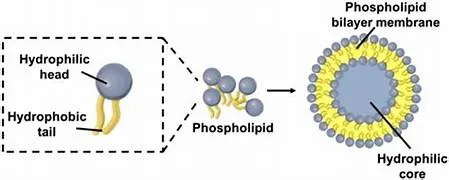
Figure 1: Basic Liposome Structure
Structure of liposomes:
Phospholipids
Cholesterol
Liposomes, derived from the Greek words 'Lipos' meaning fat and 'Soma' meaning body, are spherical concentric vesicles that enclose a water droplet, particularly artificially used to carry drugs into tissue membranes. These round sac phospholipids molecules, which are Nanoparticles (100nm in size), have potential therapeutic properties and are used in various fields such as drug delivery, cosmetics, and biological membrane structure. Liposomes are a tiny bubble with a membrane composed of a phospholipid bilayer, typically made of phospholipids like phosphatidylet-hanolamine and phosphatidylcholine. These phospholipids are amphiphilic with a hydrophilic polar head and a hydrophobic hydrocarbon tail. Their discovery by Bangham in 1961 led to the development of liposomes as a potential carrier for various drugs.
Figure 2: An Illustration of liposome and its structural components
Advantages of Liposome’s:
Liposomes significantly enhance vaccine development by enhancing the stability and delivery of antigens, thus enhancing immune responses.
Liposome’s enable targeted drug delivery to specific tissues or cells, minimizing exposure to healthy tissues and reducing side effects.
Liposome’s can provide sustained therapeutic effects by gradually releasing drugs over time, reducing the need for frequent dosing.
Liposome’s enhance the bioavailability and solubility of water-soluble drugs, a crucial factor in drug effectiveness.
Disadvantages of Liposome’s:
Liposome production can be challenging and costly, potentially limiting their widespread use in large-scale pharmaceutical manufacturing.
Classification of Liposome’s:
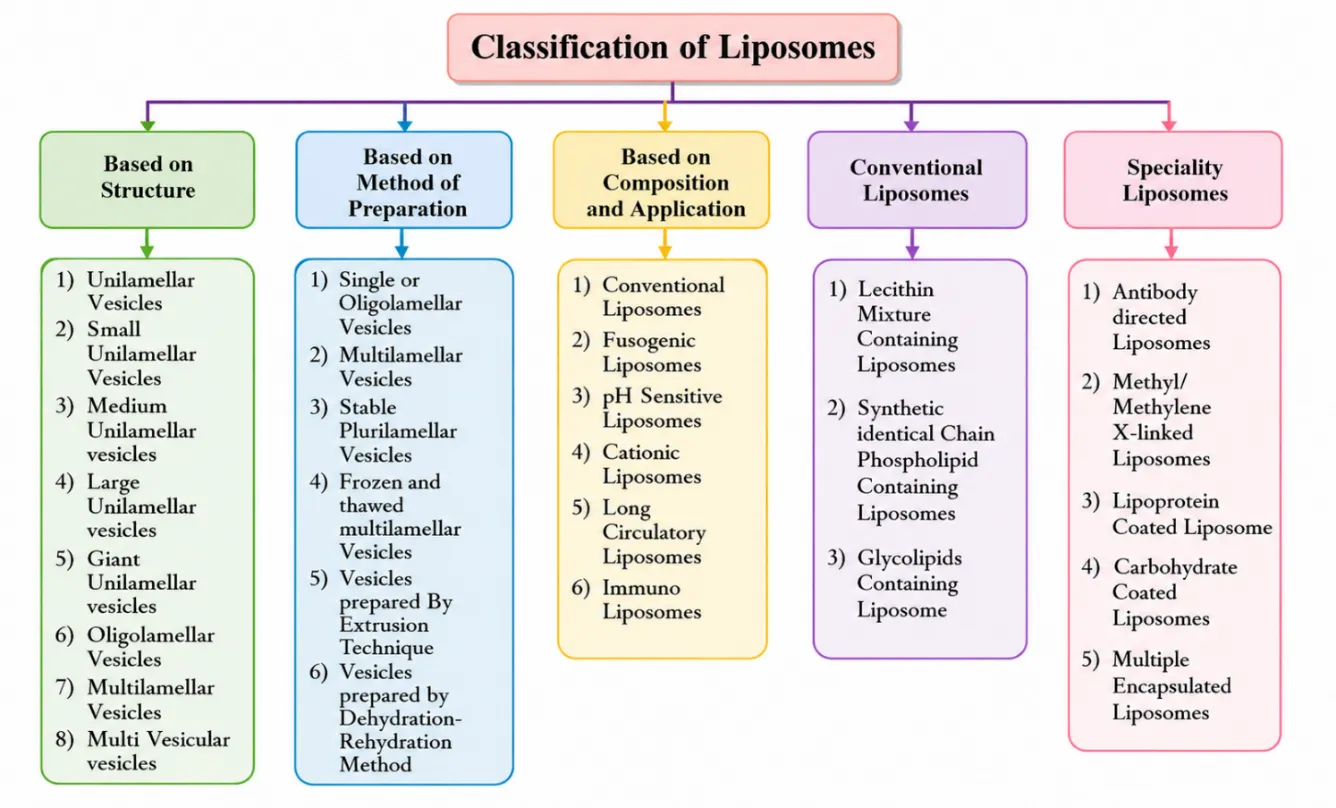
Figure 3.Classification of Liposome’s
Mechanism of formation of Liposome’s:
Liposome performs their motion by four distinct Mechanism-
Method of preparation
The methods can be classified broadly into two categories: mechanical dispersion method sand solvent dispersion methods.
a) Thin-Film Hydration (Bangham Method)
This is the most common and simple method of preparing liposome’s.
Process:
Applications
Widely used for basic research, encapsulation of both hydrophilic and hydrophobic drugs.
b) Sonication
This method reduces the size of liposomes (MLVs) prepared by the thin-film hydration method.
Process:
Applications:
Suitable for forming small liposomes, but sonication can lead to degradation of phospholipids and encapsulated drugs.
c) Extrusion
Extrusion is used to achieve uniform liposome size by forcing them through polycarbonate membranes with specific pore sizes.
-Process:
Applications:
Preferred for producing large, uniform liposomes for drug delivery.
2. Solvent Dispersion Methods
a) Ethanol Injection Method
In this method, lipids dissolved in ethanol are injected rapidly into an aqueous solution.
Process:
1. Dissolve lipids in ethanol.
2. Inject the ethanol solution into an aqueous phase under rapid stirring.
3. The lipid molecules self-assemble into liposomes due to the sudden change in solvent polarity.
Applications:
Simple and quick, but the presence of residual ethanol can be a limitation.
b) Reverse-Phase Evaporation Method (REV)
This method is useful for encapsulating a large volume of aqueous solution into liposome’s.
Process:
Applications:
Useful for encapsulating large aqueous volumes and proteins.
c) Solvent-Spherule Method
This method involves dissolving lipids in an organic solvent, which is then emulsified into an aqueous solution.
Process:
3. Detergent Removal Methods
This method involves the formation of liposomes by the removal of detergents that solubilise lipids.
a) Dialysis
Process:
1. Phospholipids are first dissolved in a detergent solution (e.g., Triton X-100).
2. The detergent-lipid micelle solution is placed in a dialysis bag and dialyzed against a detergent-free buffer.
3. As the detergent is gradually removed, liposomes form spontaneously.
Applications:
Suitable for producing high-quality liposome’s without shear stress.
Marketed formulations of Liposome’s:
Table 1 : Commercially Available Liposomal Drug Formulations and Their Therapeutic Applications
|
Brand Name |
Drug |
Indication |
Type of Liposome |
|
Doxil/Caelyx |
Doxorubicin
|
Breast cancer, Ovarian cancer, AIDS-related Kaposi's sarcoma |
PEGylated Liposome |
|
Doxil/Caelyx |
Amphotericin B |
Fungal infections, Leishmaniasis |
Liposomal Amphotericin B |
|
DepoDur |
Morphine sulfate |
Post-operative pain management |
DepoFoam technology (multi-vesicular) |
|
Marqibo |
Vincristine sulfate |
Acute lymphoblastic leukemia (ALL) |
Sphingomyelin/cholesterol-based liposome |
|
Onivyde |
IRinotecan |
Metastatic pancreatic cancer |
Liposomal formulation |
|
Vyxeos |
Daunorubicin and Cytarabine |
Acute myeloid leukemia (AML) |
Dual-drug liposome formulation |
|
Visudyne |
Verteporfin |
Age-related macular degeneration (AMD), Pathologic myopia |
Liposomal formulation |
|
Myocet |
Doxorubicin |
Metastatic breast cancer |
Non-PEGylated liposomal doxorubicin |
|
DepoCyt |
Cytarabine |
Lymphomatous meningitis |
Sustained-release liposomal formulation |
|
MEPACT |
Mifamurtide |
Non-metastatic osteosarcoma |
Liposomal formulation |
|
Inflexal V |
Influenza vaccine |
influenza prophylaxis
|
Liposomal adjuvant vaccine
|
Evaluation of Liposome’s:
1. Particle Size and Size Distribution
Particle size is crucial as it influences the circulation time, tissue distribution, and cellular uptake of liposomes.
2. Zeta Potential (Surface Charge)
Zeta potential measures the surface charge of liposome’s and is critical for predicting the stability of the formulation.
3. Encapsulation Efficiency (EE %)
Encapsulation efficiency evaluates the percentage of drug that is successfully encapsulated within the liposome.
4. Drug Release Profile
Evaluating the release profile of the drug from liposome’s is crucial to understand the kinetics and ensure controlled delivery.
5. Morphology and Lamellarity
The morphology and number of bilayers (lamellarity) affect encapsulation, release, and the interaction of liposomes with biological membranes.
6. Stability
Stability studies assess the physical and chemical integrity of liposomes over time under various conditions.
7. Pharmacokinetics and Bio distribution
Evaluating the pharmacokinetics and bio distribution of liposome’s is crucial to understand their in vivo behaviour, including circulation time, tissue targeting, and clearance mechanisms.
Application for Liposome’s
Drug Delivery:
Liposome’s are used as adjuvants or carriers for vaccines to enhance immunogenicity.
They can improve antigen delivery to immune cells, leading to a stronger immune response.
Liposomes are utilized in cosmetics and skincare products for controlled release of active ingredients, such as vitamins and antioxidants.
They can enhance the penetration of ingredients into the skin, improving their efficacy.
Liposomes can be used to deliver genetic material, including DNA and RNA, for gene therapy applications.
They protect and facilitate the transport of genetic cargo into target cells.
Liposomes can serve as carriers for contrast agents in medical imaging, such as magnetic resonance imaging (MRI) and ultrasound.
They enable targeted imaging of specific tissues or cells.
Liposomal formulations of chemotherapy drugs, like Doxil (liposomal doxorubicin), are used to treat cancer.
They can improve drug circulation time and reduce damage to healthy tissues.
Liposomes are applied in the food industry for encapsulating and protecting sensitive ingredients, such as vitamins, flavors, and antioxidants.
They can improve the stability and bioavailability of these additives in food products.
Biotechnology
Transdermal Drug Delivery:
Personal Care Products
· Liposomes are employed in personal care products such as sunscreens and moisturizers to enhance the delivery of active ingredients.
Veterinary Medicine
· Liposomes are used in veterinary medicine for drug delivery to animals, similar to their applications in human medicine.
Environmental Remediation:
· Liposomes can be utilized for the controlled release of remediation agents in environmental cleanup efforts.
Intracellular Delivery:
· Liposomes are valuable tools in research for delivering molecules into specific organelles within cells.
Nutraceuticals
· Liposomes are used to enhance the bioavailability of nutraceutical compounds in dietary supplements.
Wound Healing
· Liposomal formulations can be applied to wound dressings to promote the controlled release of wound-healing agents.
Figure 4: Application for Liposomes
Recent Approaches in Liposome Research
Below are some of the prominent approaches:
1. Targeted Liposomal Delivery Systems
2. Stimuli-Responsive Liposomes
Immunoliposomes, which are antibody-conjugated liposomes, are designed for targeted drug delivery to cancer cells or other disease-specific sites. By attaching monoclonal antibodies to the surface, these liposomes can specifically bind to antigens overexpressed in certain diseases, particularly cancers.
Example: Anti-CD19 immunoliposomes for targeted therapy of B-cell malignancies.
4. Liposomal Vaccines
Liposomes are now being explored as carriers for vaccines. They offer protection of the antigen, ensure slow release, and enhance immune responses. Some COVID-19 vaccine candidates have utilized liposomal technology to deliver mRNA effectively.
Example: The development of liposomal mRNA vaccines for infectious diseases such as COVID-19, which leverage lipid nanoparticles for encapsulating mRNA, as seen with the Pfizer-BioNTech and Moderna vaccines.
Liposomes are being utilized to deliver gene-editing tools like CRISPR-Cas9 to target specific genes in diseases. Cationic liposomes, which carry a positive charge, are especially effective in encapsulating and delivering negatively charged nucleic acids (like DNA or RNA) to cells.
CONCLUSION
Liposomes are an innovative drug delivery system with potential applications in pharmaceuticals. Research has shown their ability to overcome challenges from traditional methods, enhancing therapeutic efficacy and safety. Despite challenges, continued innovation in liposomal technologies holds great promise for the future of drug delivery in the pharmaceutical industry. Liposomes offer a versatile approach to drug delivery, improving efficacy, reducing side effects, and enabling precise therapy targeting. Further advancements in liposomal technology are expected to expand their use in various medical applications.
REFERENCE


Prachi Moon, Pranjali Patil, Sabiya Sheikh, Soniya Bhongade, Priyanka Sakhare, A Comprehensive Review on Liposomes: As A Novel Drug Delivery System, Int. J. of Pharm. Sci., 2026, Vol 4, Issue 6, 7015-7028. https://doi.org/10.5281/zenodo.20960696
 10.5281/zenodo.20960696