

We use cookies to ensure our website works properly and to personalise your experience. Cookies policy
Matoshri Radha College of Pharmacy, Virgaon, Akole, Maharashtra, India
A simple rapid, accurate, precise, specific and economical spectrometric method for simultaneous estimation of Gliclazide (GLC) and Metformin hydrochloride (MET) is combined tablet dosage form has been developed. First method is based on an equation of area calculation of curve at two wavelength regions (228.6 to 224nm and 235 to 231 nm). Second method employs simultaneous equation at two wave length corresponding to 226.3 and 233.2 nm. Third method employs derivative spectroscopy at zero crossing points (226 and 232.9) in first order derivative spectra. Both the drugs obey Beer’s law in the concentration ranges employed for these methods.
Analytical chemistry:
Introduction to Pharmaceutical Analysis:
Analytical chemistry termed as science of determining the components of materials in terms of the elements or compound contained., Analytical techniques proved in assuring and maintain the quality of substance and are critical components of QA and QC. The analytical chemistry consists of,
Selection of analytical method:
Classification of Analytical methods:
Analytical methods classified into two categories; Classical methods and instrumental methods: -
Classical methods of analysis is also known as wet chemical analysis. These methods use no mechanical or electronic instruments beyond a balance. They are traditionally used for both qualitative and quantitative analysis.
They are also divided into two sub-type :
B) Instrumental methods
These methods are based upon the measurement of some physical properties as conductivity, electrodes potential, light absorption or emission, mass to change ratio and Fluroscence of substance. There are many techniques available for the analysis of analytes which can be broadly classified as,
Amongst all the techniques mentioned above UV-Visible spectrophotometry and High Performance Liquid Chromatography (HPLC) are the most widely used techniques for quantitative analysis of pharmaceutical substances. HPLC is most widely used of all the analytical techniques HPLC gives high sensitivity high resolution ready adaptability to accurate quantitative determinations and it is non-destructive and may be applied to thermally labile compounds (unlike GC); it is also very sensitive technique since it incorporates a wide choice of detection methods.
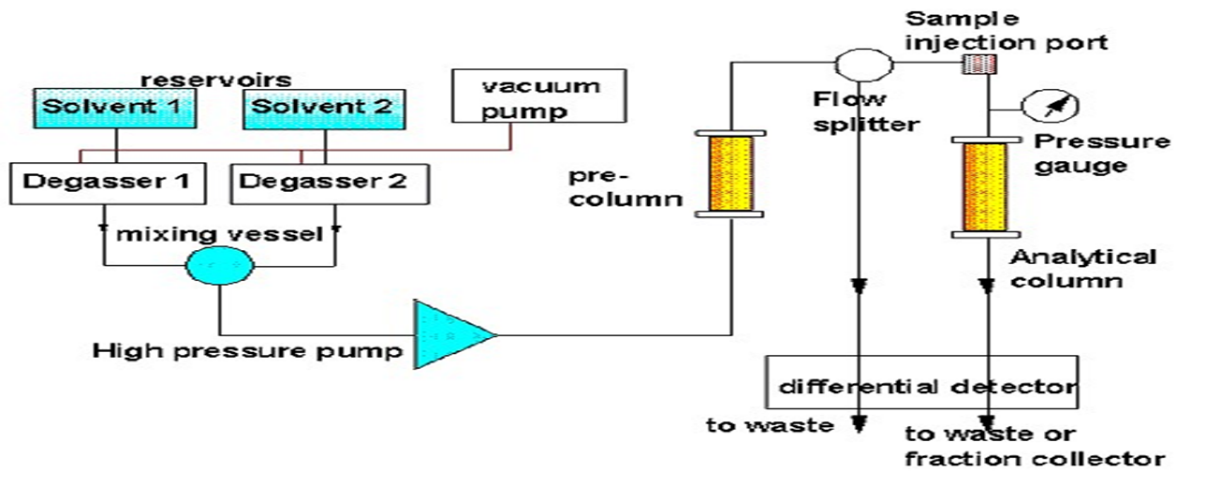
Figure: HPLC system
MATERIALS AND METHODS:
Materials and Reagents:
Procurement of Drug Samples:
Drug sample suppliers and Manufacturer
|
Sr. No. |
Name of Drugs |
Drug supplies & Manufacturer |
|
1 |
Metformin HCL |
INDOCO remedies Ltd, Mumbai, India. |
|
2 |
Gliclazide |
INDOCO remedies Ltd, Mumbai, India. |
Reagents and chemicals:
Following reagents and chemicals were used in whole experimental procedures.
Reagents and chemicals used.
|
Name |
Supplied by |
Grade |
|
Distilled water |
In House |
Double distilled |
|
Methanol |
Merck |
HPLC |
|
O-Phosphoric acid |
Lobachemie |
AR |
|
Potassium dihydrogen phosphate |
Analab Fine Chemicals |
AR |
Instrument Used:
List of apparatus/ instruments used
|
Sr. no. |
Name |
Model |
Manufacturer/Supplier |
|
1. |
Weighing balance |
PGB 100 |
Wenser High Precision Balance |
|
2. |
Digital PH Meter |
PICO+ |
Lab India pvt ltd. |
|
4. |
Sonicator |
WUC-4L Capacity -4 liter |
Wenser Ultra Sonicator |
|
5. |
Magnetic stirrer |
|
Remi Equipment |
|
6. |
HPLC |
HPLC 3000 Series |
Analytical Technologies Ltd. |
HPLC Instrument Information:
|
Parts of Instruments |
Information |
|
System |
HPLC Binary Gradient System |
|
Model no. |
HPLC 3000 Series |
|
Company |
Analytical Technologies Ltd. |
|
Pump |
P-3000-M Reciprocating (40 MPa) |
|
Column |
Grace C18 (250mm×4.6ID, Partical size- 5 micron) |
|
Detector |
UV-3000-M |
|
Software |
HPLC Workstation |
METHODS :
Solubility Studies:
These studied was carried out with a view to find an ideal solvent in which drugs were completely soluble and stable. Various solvents were tried for checking solubility of Metformin HCL and Gliclazide. From solubility studies it was concluded that the drug is soluble in distilled water and methanol so these were selected as solvent for further analysis.
Selection of Analytical Wavelength:
A stock solution of drug was prepared in distilled water and UV spectrum of 100 μg/ml solutions of Metformin HCL and Glicazide was taken. For RP-HPLC analysis, spectra of drug were taken. Wavelength selected for analysis was such, that the drug, exhibited good absorbance.
HPLC Analysis
Optimization of HPLC method:
Initially different mobile phases used such as:
Methanol: water in different proportions with adjustment of pH 6, 5.5 and 4.0 were tried. Then trials with methanol, acetonitrile and buffers were performed. Different concentrations of water with mixture of methanol and acetonitrile were tried in order to determine the best conditions for the effective separation of Metformin HCL and Gliclazide. The mobile phase consisting of Methanol; water pH 3 adjusted with ortho-phosphoric acid (80:20 % v/v) with 0.9 ml/min as flow rate was optimized as it was found to give best system suitability parameters.
Standard solutions:
An Accurately weighed quantity of about 10mg of Metformin HCL and Gliclazide was taken in 100 ml volumetric flask dissolved in sufficient quantity of mobile phase, then sonicated for 15 min and diluted to 100ml with the same solvent so as to get the concentration of 10μg/ml. 1 ml of above solution transferred in 10 ml volumetric flask and the volume was made with diluents. The conc. of Drug is 10μg/ml.
Determination of λmax of Metformin HCL and Gliclazide
Standard stock solution of Metformin HCL and Gliclazide was diluted separately with diluents to obtain final concentration of 10μg/ml. solution was scanned using UV-Visible Spectrophotometer in the spectrum mode between the wavelength ranges of 400 nm to 200nm.
Validation of RP-HPLC:
Specificity studies were conducted to estimate the actual separation of analyte from placebo, and all other related peaks. The placebo solution usually consists of all excipients employed for dosage form manufacturing.
Two replicates of the sample and six replicates of standards were injected to verify the precision and accuracy of the chromatographic system. Different parameters of system suitability which include retention time, resolution, column theoretical plates, and tailing factor
Linearity of the method was studied by injecting six concentrations of the drug prepared in the mobile phase in the range of 10-50 μg/ml for MET and 10-50 μg/ml Gliclazide in triplicate into the RP- HPLC system keeping the injection volume constant. The peak areas were plotted against the corresponding concentrations to obtain the calibration curves.
Precision of the method was verified by repeatability studies. The repeatability of sample application and measurement of peak area for active compound were expressed in terms of RSD (relative standard deviation). Repeatability studies were performed by analyses of concentrations of 20,30,40 ug/ml Metformin and 20,30,40 ug/ml Gliclazide and for RP-HPLC.
The standard deviation of Y-intercept and slope of the calibration curves were used to calculate the LOD and LOQ for both the drugs using the following formulae.
LOD= 3.3(S)/s
LOQ = 10 (S)/ s
Where,
S = Standard Deviation and
S = Slope of the line
To evaluate robustness of HPLC method, few parameters were deliberately varied. The parameters included variation of flow rate, percentage of buffer in the mobile phase and pH of mobile phase.
Accuracy may often be expressed as percent recovery by the assay of a known amount of analyte added. The ICH documents recommend that accuracy should be assessed using a minimum of nine determinations over a minimum of three concentration levels, covering the specified range (i.e. three concentrations and three replicates of each concentration).
DRUG PROFILE
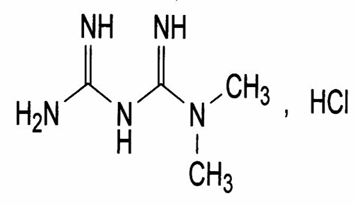
METFORMIN HCL:
|
I. |
Chemical Proprties |
|
Structure |
|
|
CAS Registry No |
1115-70-4 |
|
IUPAC Name |
1-carbamimidamido-N-N-dimethylmethanimidamide |
|
Mole. Formula |
C4H11N5.HCL |
|
Molecular Weight |
165.63 g/mol. |
|
II. Physical Properties: |
|
|
Melting Point |
222-2260C. |
|
Appearance |
White Crystaline Powder |
|
Solubility |
Soluble in water, methanol. Insoluble chloroform, ether, acetone. |
|
Pka |
2.8 and 11.5 at 32 deg. |
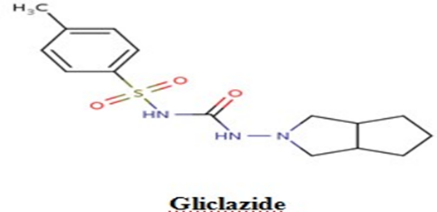
GLICLAZIDE
|
I. Chemical Proprties: |
|
|
Structure |
|
|
CAS Registry No |
21187-98-4 |
|
IUPAC Name |
pyrrol-2-(1H)-ylcarbamoyl)-4-N-(hexahydrocyclopenta(c) methyl) benzenesulphonamide |
|
Mole. Formula |
(C15H21N3O3S) |
|
Molecular Weight |
323.40g/mol |
|
II. Physical Properties: |
|
|
Melting Point |
165-1690C |
|
Appearance |
White powder |
|
Solubility |
Poorly soluble in water, and soluble in methanol, ethanol and Acetonitrile |
|
Pka |
5.8 |
RESULT
The proposed simultaneous estimation method was found to be simple, precise, accurate and rapid for the determination of Metformin HCL and Gliclazide. The mobile phase is simple to prepare and economical. The sample recoveries in all the formulations were in good agreement with their respective label claim and their suggestive not interference of formulation excipients in the estimation. Hence this method can be conveniently adopted for routine analysis of Metformin HCL and Gliclazide in the pharmaceutical dosage form.
1.Metformin HCL
|
Sr. No. |
Parameters |
Acceptance Criteria |
Observation of Metformin HCL Method |
|
1. |
Specificity |
RSD-NMT 2% |
0.35 |
|
2. |
System suitability |
RSD-NMT 2% Retention time Theoretical plate Tailing factor |
3.670 min 5997 1.20 |
|
3. |
Precision Repeatability Intraday precision Interday precision |
RSD-NMT 2% The % variance should NMT 1% ---------- |
0.035 0.07% 0.11%
|
|
4. |
Linearity and Range |
Correlation coefficient- NLT 0.999 Slope |
0.999
82689 |
|
5. |
Detection limit |
Limit of Detection |
0.39 |
|
6. |
Limit of Quantitation |
Limit of Quantitation |
1.18 |
|
7. |
Accuracy |
Mean sample recovered for three sample prepared at different level RSD- NMT 2% |
%Recovery at 50% = 99.98 100%= 99.72 150%= 99.85 |
|
8. |
Robustness |
Critical parameters |
Significant changed is observed at changed in flow rate & wavelength. |
|
9. |
Forced Degradation |
Remarkable degradation more than 20% |
Remarkable degradation observed at alkaline & oxidation. |
2.Gliclazide
|
Sr. No. |
Parameters |
Acceptance Criteria |
Observation of Gliclazide Method |
|
1. |
Specificity |
RSD-NMT 2% |
0.38 |
|
2. |
System suitability |
RSD-NMT 2% Retention time Theoretical plate Tailing factor |
6.541 min 12465 1.10 |
|
3. |
Precision Repeatability Intraday precision Interday precision |
RSD-NMT 2% The % variance should NMT 1% |
0.12 0.37% 0.36% |
|
4. |
Linearity and Range |
Correlation coefficient- NLT 0.999 Slope
|
0.998
34643 |
|
5. |
Detection limit |
Limit of Detection |
0.16 |
|
6. |
Limit of Quantitation |
Limit of Quantitation |
0.49 |
|
7. |
Accuracy |
Mean sample recovered for three sample prepared at different level RSD- NMT 2% |
%Recovery at 50% = 99.81 100%= 99.62 150%= 99.83 |
|
8. |
Robustness |
Critical parameters |
Significant changed is observed at changed in temp. |
|
9. |
Forced Degradation |
Remarkable degradation more than 20% |
Remarkable degradation observed at alkaline & oxidation. |
REFERENCES

Kavita Patole, Suvarna Khedkar, Manasi Deshmukh, Vaibhav Gadhave, Pallavi Phalke, A Comprehensive Review on the Method Development and Analytical Estimation of Metformin and Gliclazide, Int. J. of Pharm. Sci., 2025, Vol 3, Issue 6, 5398-5406. https://doi.org/10.5281/zenodo.15757941
 10.5281/zenodo.15757941