

We use cookies to ensure our website works properly and to personalise your experience. Cookies policy
Department of Pharmaceutical Chemistry, SES Arunamai College of Pharmacy, Mamurabad, Jalgaon, India 425001
Lurasidone is an atypical antipsychotic agent widely used in the management of schizophrenia. In the present study, a simple, precise, rapid and accurate isocratic reversed-phase high- performance liquid chromatography(RP-HPLC)method was developed and validated for the quantitative estimation of Lurasidone in tablet dosage form. Chromatographic separation was achieved on a C18 column (4.6 mm × 100 mm, 2.5 µm) using a mobile phase comprising Methanol and 0.05% Orthophosphoric acid (OPA) in water (50:50,v/v) at a flow rate of 0.7 mL/min, with UV detection at 230 nm. The method exhibited a well-defined peak with a retention time of approximately 4.39 min. The calibration curve demonstrated excellent linearity over the concentration range of 10-50 µg/mL, with a correlation coefficient (r2)of 0.9994. The method was validated as per ICH guidelines and showed satisfactory accuracy, with recovery values within acceptable limits, and high precision, with %RSD less than 2% for both intra-day and inter-day studies. The developed method was found to be specific, sensitive and reproducible, with no interference from excipients. Hence, the method is suitable for routine quality control analysis of Lurasidone in pharmaceutical tablet formulations.
Chemically Lurasidone is1 (1R,2S,6R,7S)-4-{[(1R,2R)-2-{[4-(1,2-benzothiazol-3-yl)piperazin-1-yl]methyl}cyclohexyl]methyl}-4-azatricyclo[5.2.1.0²,⁶]decane-3,5-dione hydrochloride show in fig.1. Lurasidone acts as a complete blocker of dopamine D2 and serotonin 5HT2A receptors, a characteristic it shares with most other second-generation antipsychotic drugs.
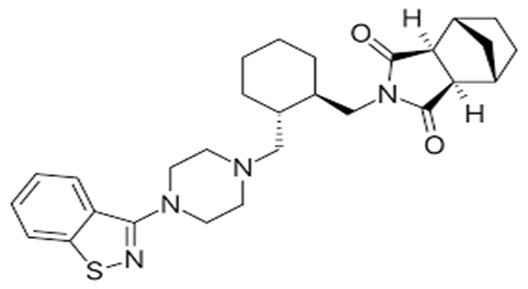
Fig 1. Structure of Lurasidone
Lurasidone hydrochloride contains six chiral centers at positions C1, C2, C11, C12, C15, and C16. The form currently used in clinical practice is a single isomer 2. The therapeutic effect of Lurasidone Hydrochloride in schizophrenia is achieved through its antagonistic action on central dopamine D2 and serotonin 5HT2A receptors, providing antipsychotic activity. Lurasidone is metabolized in the liver by the CYP3A4 enzyme 3, which means its plasma levels can rise when taken with CYP3A4 inhibitors such as ketoconazole or grapefruit juice, potentially increasing side effects. Similar to other atypical antipsychotics, Lurasidone is not recommended for elderly patients due to a higher risk of stroke or transient ischemic attack 3, 4. Lurasidone hydrochloride presents as a white to light yellow crystalline powder with stable properties. It exhibits solubility in chloroform and acetonitrile, limited solubility in ethanol, and slight solubility in water and acetone 5. A comprehensive literature review has identified various techniques for the estimation of Lurasidone, including UV spectroscopy 6, HPLC methods 7-8, UPLC, and LC-MS, applied to bulk drug, pharmaceutical formulations, and biological samples. The aims were to validate the newly developed HPTLC method for Lurasidone in bulk and pharmaceutical dosage forms following ICH guidelines, and to carry out forced degradation studies under various stress conditions such as hydrolytic, oxidative, thermal, and photolytic stress. Two simple and precise methods were developed and validated using solvent mixtures: Method 1 utilized a 70:30 (v/v) ratio of methanol to water, while Method 2 employed a 50:50 (v/v) ratio of acetonitrile to water.
MATERIAL AND METHODS
Chemicals and Reagents
Lurasidone API and Tablet was gifted by Swapnroop Drugs and Pharmaceuticals is a WHO-GMP certified API manufacturer in Sambhajinagar (Aurangabad), India.
All other chemicals and solvents employed were of HPLC grade.
Instrument and Chromatographic Condition
Quantitative HPLC was performed on high pressure liquid chromatography Agilent Tech. Gradient System with Auto injector Equipped with Reverse Phase (Agilent) C18 column (4.6mm x 100mm;2.5µm), a Quaternary Gradient (G130A) S.NO.DE9180834 pump, a 20µl injection loop and UV (DAD) G13148 S.NO. DE71365875 Absorbance detector. The HPLC system was equipped with the software CHEMSTATION 10.1. The optimised mobile phase was consisting of Methanol: 0.05% OPA water (50:50 % v/v), pH 3. It was filtered through a 0.45 µm PVDF filter. The mobile phase was degassed by ultrasonication for 15 min. The mobile phase was pumped from the solvent reservoir to the column at a flow rate of 0.7 mL/min. The run time was set at 15min and the column temperature was maintained at Ambient. The volume of the injection loop was 20 µ L. The eluent was monitored at 230 nm, and data were acquired, stored and analysed with the software CHEMSTATION 10.1.
PREPARATION OF STANDARD SOLUTION
Preparation of a standard stock solution of Lurasidone
Accurately weigh and transfer 10 mg of Lurasidone working standard into a 10 ml volumetric flask. Add methanol as a diluent to dissolve the sample completely, then make up the volume to the mark with the same solvent to obtain a 1000 µg/ml stock solution. Sonicate the solution for 15 minutes to ensure complete dissolution. Then, transfer 0.1 ml of this stock solution into a 10 ml volumetric flask and dilute to the mark with the mobile phase consisting of methanol and 0.05% OPA water, prepared as a 1:1 (v/v) mixture of 5 ml methanol and 5 ml 0.05% OPA water.
Preparation of calibration curve
Standard solutions at concentrations of 10, 20, 30, 40, and 50 µg/mL were prepared and injected into the HPLC system in Agilent Tech. Gradient System with Auto injector, UV Detector. The peak areas corresponding to each concentration were then recorded.
Preparation of mobile phase
Accurately weighed 10 mg of Lurasidone working standard was transferred into a 10 mL volumetric flask. A small volume of methanol was added to dissolve the standard completely, and the volume was adjusted to the mark with the same solvent to prepare a 1000 µg/mL stock solution. The solution was sonicated for 15 minutes to ensure complete dissolution.
From the stock solution, 0.1 mL was pipetted into a 10 mL volumetric flask and diluted to the mark with a mobile phase consisting of methanol and 0.1% OPA water to obtain a 10 µg/mL working standard solution.
The prepared working solution was subjected to chromatographic analysis using different mobile phase compositions under optimised chromatographic conditions.
STABILITY STUDY
Forced degradation studies of Lurasidone were performed individually under various stress conditions, including acidic hydrolysis, alkaline hydrolysis, oxidative degradation using hydrogen peroxide, and Neutral Studies, to evaluate the stability-indicating capability of the developed method.
Acidic hydrolysis
Acidic degradation was carried out using 0.1 N HCl for 1 hour, which showed significant degradation of Lurasidone. The major degradation products were observed after 1 hour, with a percentage degradation of 11.44%. The degradation product appeared at a relative retention time (RRT) corresponding to the 1-hour stress condition, and these impurities were clearly detected in the chromatogram of Lurasidone.
Alkaline degradation
Alkaline degradation was carried out using 0.1 N NaOH at 50°C for 1 hour, which resulted in significant degradation of Lurasidone. The major degradation products were observed after 1 hour, with a percentage degradation of 15.80%.
Oxidative degradation
Under oxidative stress conditions using 3% hydrogen peroxide for 1 hour, Lurasidone showed minimal degradation, and no significant oxidative degradation peaks were observed in the chromatogram. The percentage degradation after 1 hour was found to be 12.59%.
Neutral Studies
Neutral hydrolysis studies were performed to evaluate the stability of Lurasidone under neutral conditions. A Lurasidone working solution (40 µg/mL) was prepared in distilled water and kept at room temperature for 60 minutes.
After the specified time, the solution was diluted with mobile phase and analyzed using the developed RP-HPLC method. The chromatogram showed no significant degradation peaks, indicating that Lurasidone remains stable under neutral hydrolysis conditions.
METHOD VALIDATION
The developed method was validated for linearity, accuracy, precision, specificity, and robustness, and the validation was performed in accordance with ICH guidelines.
Linearity and range
From the Lurasidone standard stock solution, a series of working standard solutions in the concentration range of 10–50 µg/mL were prepared using the mobile phase. A volume of 20 µL of each solution was injected into the chromatographic system using a fixed-volume loop injector, and the chromatograms were recorded. The calibration curve was constructed by plotting peak area versus concentration, and the peak area corresponding to each concentration was measured to evaluate the linearity of the method.
Precision
Repeatability of Measurement
A standard solution of Lurasidone was prepared and injected into the HPLC system. The same solution was injected three times without changing chromatographic conditions. The peak areas obtained from repeated injections were recorded, and the % Relative Standard Deviation (%RSD) of the peak areas was calculated.
Repeatability of Sample Preparation (Method Precision):
Three independent sample solutions of Lurasidone at the same concentration were prepared and analysed using the proposed method. The chromatograms were recorded, and the peak areas were measured. The %RSD of the peak areas was calculated to evaluate the repeatability of the method.
Intra-Day and Inter-Day Precision
Variation in results observed on the same day is termed intra-day precision, whereas variation in results across different days is known as inter-day precision. Sample solutions containing 10 mg of Lurasidone at three different concentrations (20µg/ml, 30µg/ml, 40µg/ml) Lurasidone were analysed three times on the same day and %R.S.D was calculated.
Accuracy
Accuracy was assessed by preparing mixtures of Lurasidone equivalent to 10 mg at 80%, 100%, and 120% of the labeled claim, corresponding to the average weight of the marketed tablets. This powder blend was triturated and analysed chromatographically using the specified method. The analyses were performed in triplicate over three consecutive days, and the percentage recovery of the added drug was used to evaluate accuracy.
Robustness
Robustness refers to a method’s capacity to remain stable despite small, intentional variations in parameters. To assess the robustness of the proposed method, deliberate minor changes were made to the optimized method parameters. The impact of variations in mobile phase composition, flow rate, and wavelength on the retention time and tailing factor of the drug peak was examined. Specifically, the mobile phase composition was adjusted by ±1 ml/min, and the flow rate was varied from the optimized chromatographic conditions.
Limit of detection (LOD) and Limit of Quantitation (LOQ)
The limit of detection (LOD) is defined as the smallest quantity of analyte in a sample that can be detected but not necessarily quantified under specified experimental conditions. In contrast, the limit of quantitation (LOQ) is the lowest amount of analyte that can be quantified with acceptable precision and accuracy. Both LOD and LOQ were determined using the calibration curve and calculated according to the formulas provided in the ICH guideline Q2 (R1).
LOD = (3.3×σ) /S and LOQ = (10×σ) /S
Where, σ = Standard deviation of the Y intercept, S = Slope of the calibration curve equation.
The limit of detection (LOD) may be expressed as:
LOD = 3.3 (SD)/S
= 3.3 X 2.52 / 31.25
= 0.266
The quantitation limit (LOQ) may be expressed as:
LOQ = 10 (SD)/ S
= 10 X 2.52 / 31.25
= 0.8064
RESULT AND DISCUSSION
The present study aimed to develop and validate a rapid, precise, and accurate RP-HPLC method for the analysis of Lurasidone in its Tablet formulation, utilizing a C18 column with UV detection, in accordance with ICH guidelines. In order to achieve a suitable peak shape, retention time, and separation of the Lurasidone peak from excipients, a mobile phase consisting of methanol and 0.05% orthophosphoric acid (OPA) water was employed. The optimized mobile phase ratio was methanol: 0.05% OPA water (50:50 v/v) with a flow rate of 0.7 mL/min. This composition provided a satisfactory peak shape with a tailing factor of 0.67 and theoretical plates exceeding 7000, indicating good column efficiency.
UV Spectroscopy
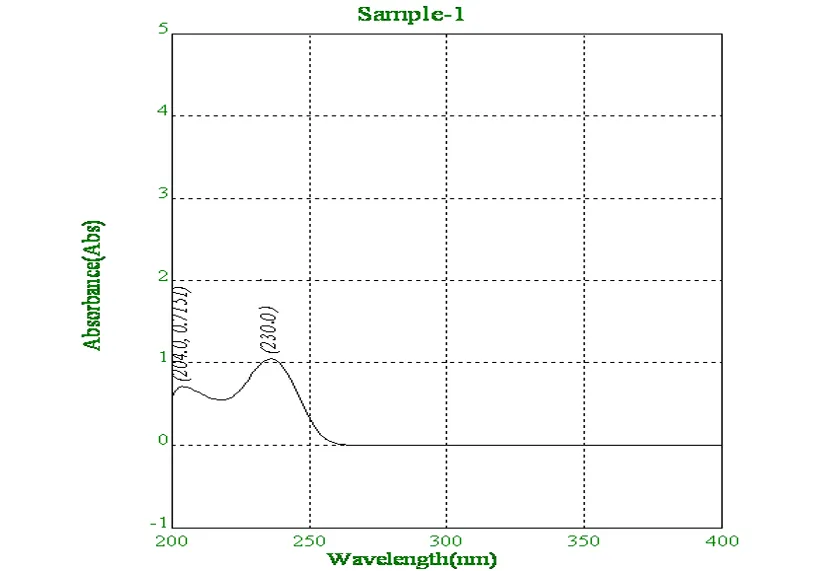
Figure 2:UV Absorption Spectrum of Lurasidone
UV absorption spectrum of a 10 µg/mL solution of Lurasidone in methanol was recorded in the range of 200–400 nm. The maximum absorbance (λmax) was found to be 230 nm, which was selected as the detection wavelength for further analysis.
TABLE NO 1. RESULT OF SYSTEM SUITABILITY TEST
|
Sr. No |
Parameters |
Result |
|
1 |
Retention time(min) |
4.39±0.1 |
|
2 |
Peak area |
349.4133 |
|
3 |
Tailing factor(T) |
0.67 |
|
4 |
SD |
1.55 |
|
5 |
Injection Repeatability (% RSD) |
0.12 |
|
6 |
No. of theoretical plates (N) |
7042 |
Chromatograms of the Lurasidone standard and Lurasidone tablet formulation are presented in Figures 3 and Figure 4, respectively. The Lurasidone peak was observed at a retention time of 4.39 ± 0.1 min and was well resolved from peaks corresponding to excipients. This indicates that the developed method effectively separates the drug from formulation components. The method demonstrated good specificity, as no interfering peaks were observed at the retention time of Lurasidone in the blank chromatogram.
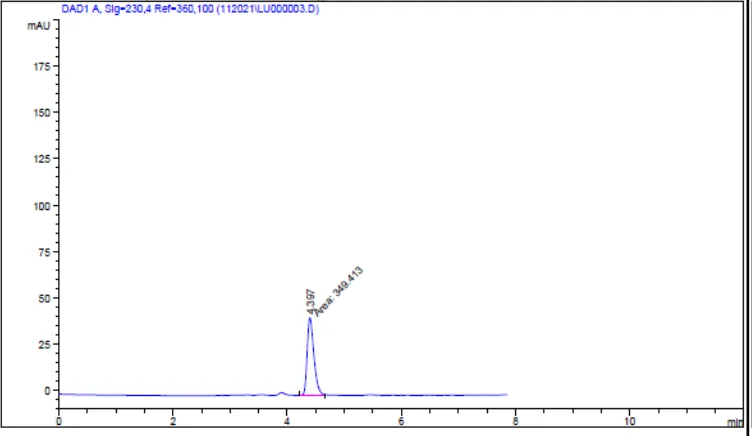
Figure 3: Chromatogram of Standard solution
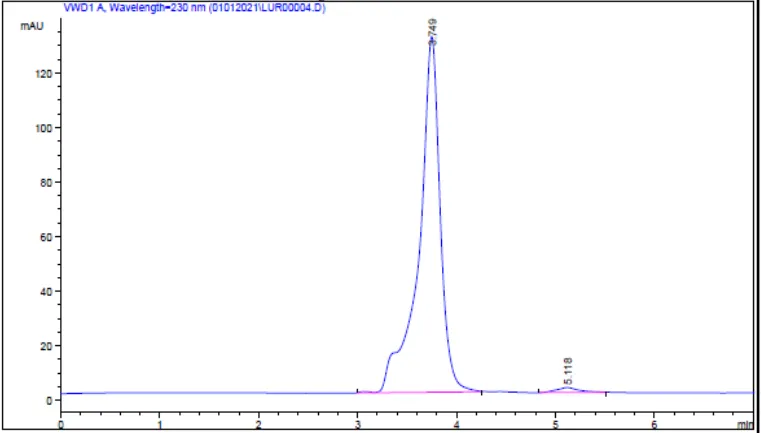
Figure 4: Chromatogram of test solution
The developed analytical method exhibited linearity over the concentration range of 10–50 µg/mL for Lurasidone. The calibration curve, constructed by plotting concentration (X) against the mean peak area (Y) (Figure 5), demonstrated excellent linearity with a correlation coefficient (r²) of 0.9994. The regression equation was determined to be Y = 31.256X + 49.766, where Y represents the peak area and X denotes the concentration in µg/mL. These results indicate a strong correlation between peak area and analyte concentration within the studied range. Furthermore, the limits of detection (LOD) and quantification (LOQ) were found to be 0.266 µg/mL and 0.8064 µg/mL, respectively, confirming the sensitivity of the method.
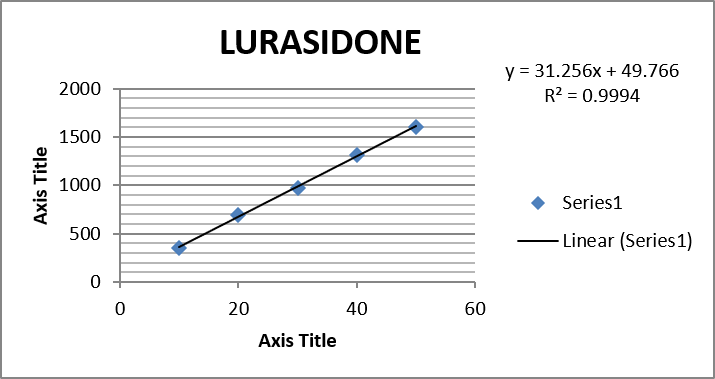
Figure 5: Calibration curve of Lurasidone
The results are presented in Table 2.The mean percentage recovery of 98.38 ± 1.36% demonstrates the accuracy of the developed method.
TABLE NO 2: RESULT OF ACCURACY STUDY
|
Level (%) |
Pre-analyzed sample (µg/mL) |
Amount of Lurasidone added (μg/ML) |
Area. Mean* ± S.D. |
Amt. recovered Mean *± S.D. |
%Recovery Mean *± S.D. |
|
80% |
10 |
8 |
17.8± 0.10 |
7.87± 0.10 |
98.38±1.36 |
|
100% |
10 |
10 |
20.16±0.01 |
20.58±0.01 |
101.6± 0.11 |
|
120% |
10 |
12 |
21.78±0.02 |
20.5±0.02 |
98.17± 0.22 |
The method was validated for both intraday and interday precision at three concentration levels (20, 30, and 40 µg/mL). The intraday precision (%RSD) ranged from 0.028% to 0.23%, while the interday precision (%RSD) ranged from 0.02% to 0.64%, indicating satisfactory precision of the method. The percentage amount found was within acceptable limits for both studies. Repeatability of the method was found to be 0.12%. The detailed results of precision are presented in Table 3.
TABLE NO 3: RESULTS OF INTRADAY AND INTERDAY PRECISION STUDY
|
Concentration (µg/ml) |
Intraday Precision |
Interday Precision |
||||
|
Mean± SD (n=3) |
%Amt Found |
%RSD |
Mean± SD (n=3) |
%Amt Found |
%RSD |
|
|
20 |
691.01±0.96 |
102.60 |
0.023 |
689.78±5.65 |
98.46 |
0.64 |
|
30 |
972.97±0.27 |
98.47 |
0.028 |
969.66±0.69 |
98.12 |
0.02 |
|
40 |
1313.45±0.49 |
101.09 |
0.037 |
1306.91±1.35 |
100.57 |
0.16 |
The proposed method was found to be robust because changes in flow rate (±1 ml/ min-1) and column oven temperature did not change system suitability criteria, and assay deviate not more than 2.0%. In order to demonstrate the stability of both standard and sample solutions during analysis, both solutions were analyzed over a period of 60 h.
The results showed that the retention time and peak area of Lurasidone remained almost unchanged, and no significant degradation was observed for 24 h. The proposed RP-HPLC method was successfully applied to the analysis of the marketed tablet formulation of Lurasidone (Luramax, 30 mg/tablet) and the results obtained are presented in Table No.4. The average drug content was found to be 98.61%.
TABLE NO 4: ESTIMATION OF LURASIDONE IN BULK AND PHARMACEUTICAL DOSAGE FORMS BY RP-HPLC METHOD
|
Sample |
Label claimed (mg/capsule) |
%Label claimed ± SD |
%RSD |
|
Luramax |
Lurasidone =30mg |
98.61± 0.21 |
0.14 |
CONCLUSION
The results of the study demonstrated that the proposed RP-HPLC method for the estimation of Lurasidone in bulk and pharmaceutical dosage form was successfully developed and validated as per ICH guidelines. The method was found to be accurate, precise, specific, and sensitive, with no interference from formulation excipients. Hence, it is suitable for routine analysis and quality control of Lurasidone in bulk and pharmaceutical dosage forms. Under these conditions, Lurasidone showed a retention time of 4.397 min with good peak shape and theoretical plates of 7042, indicating satisfactory system performance.
REFERENCES


Snehal Valvi, Dr. Khushbu Patil, Harshwardhan Deshmukh, Paresh Chaudhari, Mahesh Wagh, Tejas Yeole, Ritesh Chavhan, Dr. Shashikant Barhate, A Rapid and Stability-Indicating RP-HPLC Method for Quantification of Lurasidone in Pharmaceutical Dosage Forms, Int. J. of Pharm. Sci., 2026, Vol 4, Issue 7, 1256-1264. https://doi.org/10.5281/zenodo.21233446
 10.5281/zenodo.21233446