

We use cookies to ensure our website works properly and to personalise your experience. Cookies policy
Kokan Gyanpeeth Rahul Dharkar College of Pharmacy and Research Institute, Mumbai University, Karjat
Dispersible tablets have emerged as an important dosage form designed to disintegrate quickly in a small volume of water, offering improved patient compliance, rapid onset of action, and enhanced therapeutic effectiveness.[1] This review focuses on the scientific principles, formulation strategies, and evaluation parameters involved in developing dispersible tablets for immediate release. Special emphasis is placed on the selection and functional role of superdisintegrants, excipients, and manufacturing techniques such as direct compression, wet granulation, and dry granulation, which significantly influence tablet integrity, disintegration behavior, and drug dissolution profile[6,7]. The abstract also highlights critical formulation considerations including particle size, flow properties, compressibility, and the impact of hydrophilic polymers on wetting and dispersion time. Various evaluation tests such as hardness, friability, wetting time, in-vitro disintegration, dispersion uniformity, and dissolution studies are reviewed to ensure product quality and regulatory compliance. Additionally, recent research trends, challenges in taste masking, suitability for pediatric and geriatric populations, and advancements in superdisintegrant technology are discussed. Overall, this review provides a comprehensive and updated understanding of the formulation design and performance assessment of dispersible tablets for immediate release, offering valuable insights for researchers, formulators, and pharmaceutical technologists.
Dispersible tablets are an advanced oral solid dosage form designed to break down and disperse quickly in a small volume of water, making them highly suitable for patients who have difficulty swallowing standard tablets or capsules. In recent years, the focus of pharmaceutical development has shifted strongly toward patient-friendly dosage forms to improve compliance, especially among pediatric, geriatric, bedridden, and dysphagic populations. By eliminating the need to swallow intact tablets and providing faster onset of therapeutic action, dispersible tablets offer a practical and efficient alternative to conventional oral formulations.[6,7,8]The idea of creating tablets that rapidly disperse in water stemmed from the need for dosage forms that offer immediate drug release and are easy to administer without causing discomfort. Many therapeutic categories such as analgesics, antipyretics, antibiotics, antacids, and antihistamines often demand rapid relief [9].Dispersible tablets meet this requirement by breaking down quickly into fine particles, thereby increasing the effective surface area for dissolution and improving drug absorption. Their rapid performance largely depends on the incorporation of superdisintegrants, which enable swift water penetration and tablet breakup through mechanisms like capillary action, swelling, or deformation [9,10,11].Developing an effective dispersible tablet requires careful selection and optimization of excipients to achieve both mechanical strength and rapid disintegration. Unlike conventional tablets where hardness is prioritized, dispersible tablets must be strong enough to withstand handling yet fragile enough to disperse immediately when in contact with water. Excipients such as diluents, binders, lubricants, sweeteners, flavors, and superdisintegrants play essential roles in achieving this balance. Taste masking is also crucial, as many APIs have an unpleasant or bitter taste. Approaches like microencapsulation, coating, and the use of sweetening or flavoring agents help enhance the palatability of the final product [1].Manufacturing methods—including direct compression, wet granulation, and dry granulation—significantly influence the quality of dispersible tablets. Direct compression is commonly preferred for its simplicity, cost-effectiveness, and suitability for moisture-sensitive drugs, though it requires excipients with excellent compressibility. Wet granulation provides superior content uniformity and mechanical strength, making it advantageous for formulations requiring taste masking or controlled granule size. Dry granulation is appropriate for heat- or moisture-sensitive APIs. Each method demands specific formulation adjustments to ensure desirable disintegration and dissolution characteristics [10,11].Evaluation of dispersible tablets is another critical aspect of formulation development. Regulatory standards require comprehensive quality testing to confirm safety, efficacy, and consistency. Key evaluation parameters include hardness, friability, wetting time, water absorption ratio, dispersion time, uniformity of dispersion, and dissolution profile [11].These tests help determine how the tablet behaves during handling, administration, and dissolution. Rapid disintegration and efficient dissolution remain essential indicators of immediate-release performance, supported by advances in excipient technology such as newer and more effective superdisintegrants like crospovidone, croscarmellose sodium, and sodium starch glycolate [1o,11].
Definitions and Regulatory Expectations
Dispersible tablets intended for immediate release must meet pharmacopeial limits for disintegration and dissolution applicable to immediate-release oral solid dosage forms [4,5]. Regulatory guidances emphasize establishing appropriate dissolution testing and, where applicable, correlating disintegration with dissolution performance [31].
Ideal Characteristics of Dispersible Tablets
Selection of Excipients
Superdisintegrants
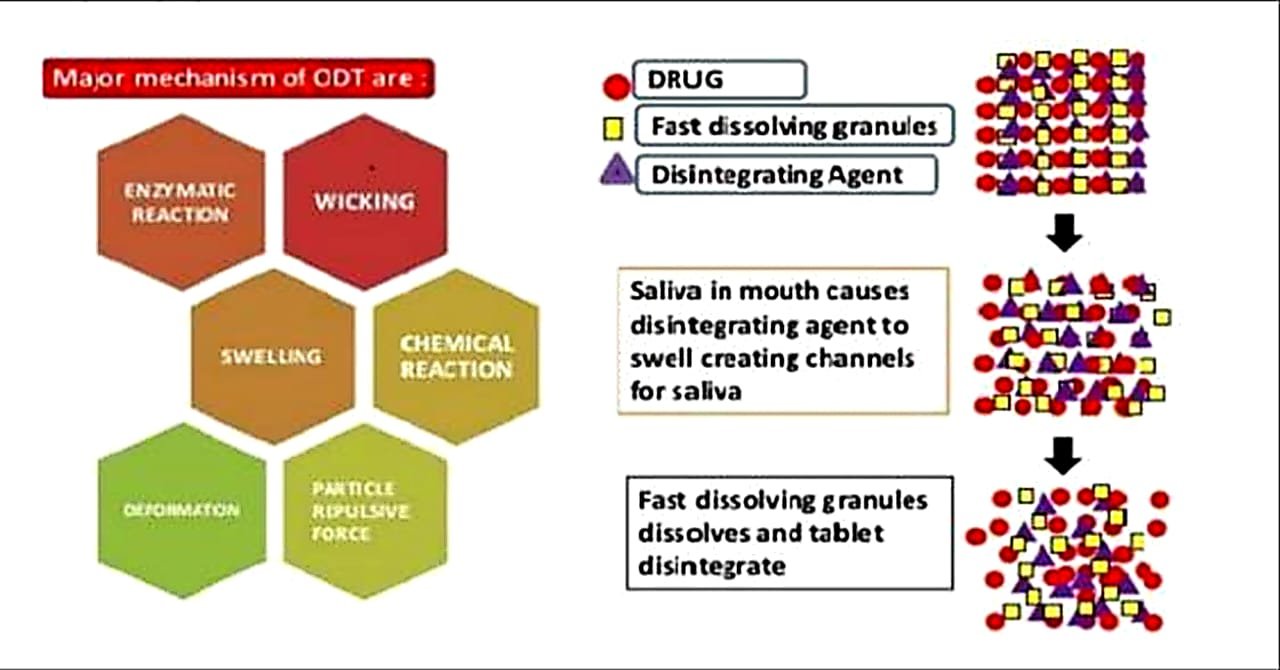
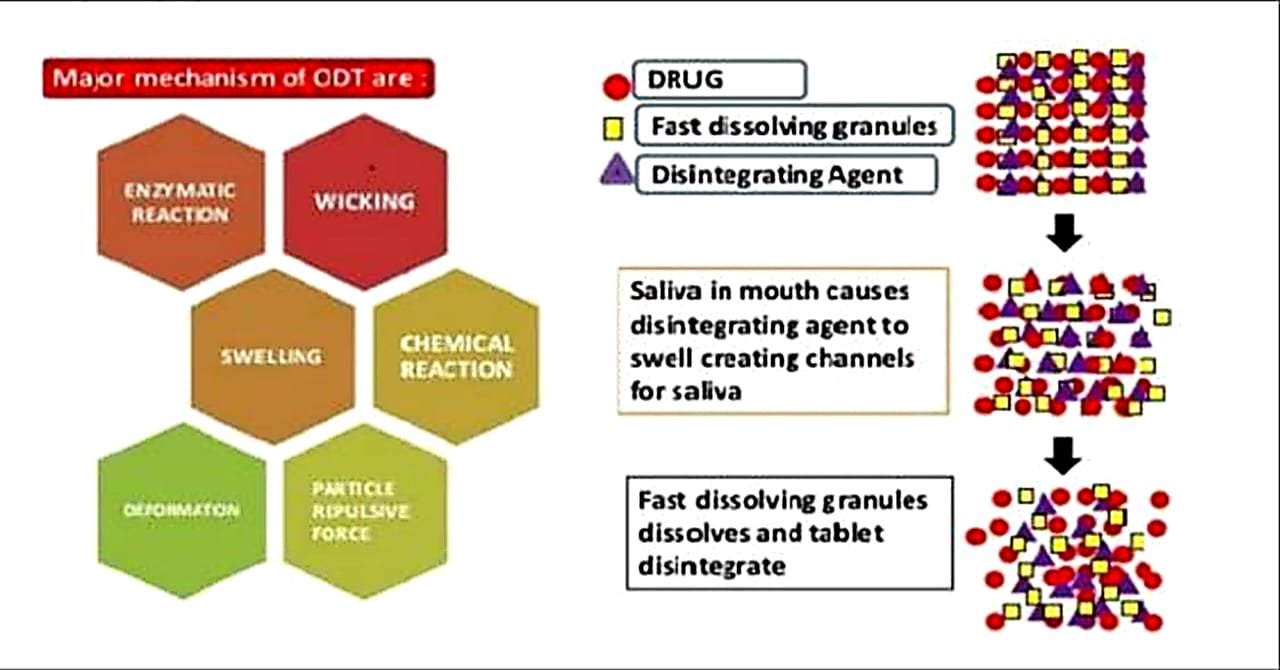
Superdisintegrants are critical to rapid tablet breakup. Common choices include crospovidone, croscarmellose sodium, and sodium starch glycolate. Selection depends on mechanism (swelling, wicking, or deformation recovery), compatibility with API, compressibility, and required disintegration time [10,11,27].
Fillers, Sweeteners and Flavouring Agents
Mannitol, lactose, and microcrystalline cellulose are typical fillers. Mannitol is preferred for its pleasant mouthfeel and cooling sensation [13,14].Sweeteners (e.g., sucralose, aspartame) and flavors (fruit flavors) improve palatability [29].
Binders and Lubricants
If granulation is used, water-soluble binders that do not adversely affect disintegration are chosen. Lubricants (magnesium stearate) must be optimized since excess lubricant can retard wetting and disintegration [2,25].
Cosolvents, Effervescents and Taste-masking Polymers
Effervescent blends (citric acid + sodium bicarbonate) may be used to promote rapid dispersion. Taste-masking can be achieved via complexation, coating, or inclusion in solid dispersions.
Formulation Aspects of Dispersible Tablets
The design of dispersible tablets involves careful consideration of the active pharmaceutical ingredient (API) and excipients to achieve rapid disintegration, uniform dispersion, and mechanical stability.
Drug Properties
Solubility: Highly soluble or easily dispersible drugs enhance rapid dispersion and absorption.
Stability: APIs must remain chemically and physically stable in the presence of excipients and during storage.
Taste: Bitter drugs require taste-masking strategies.
Flow and compressibility: Good flow and compressibility ensure uniform tablet weight and mechanical strength.
Excipients:
The Main Categories Include:
EXCIPIENT TYPE EXAMPLES FUNCTION IN TABLET
Superdisintegrants Crospovidone, crocscarmellose sodium, sodium starch glycolatePromote rapid disintegration
|
EXCIPIENT TYPE |
EXCIPIENT TYPE |
FUNCTION IN TABLET |
|
Superdisintegrants |
Crospovidone, crocscarmellose sodium, sodium starch glycolate |
Promote rapid disintegration |
|
Binder |
Polyvinyl pyrrolidone (PVP),Hydropropy methylcelluiose (HPMC), Starch paste. |
Provide mechanical strength |
|
Fillers/Diluents |
Mannitol, Lactose, MCC |
Enhance bulk, mouthfeel, compression. |
|
Lubricants |
Magnesium stearate, Talc |
Reduce friction during compression |
|
Sweeteners And Flavors |
Aspartame, Sucralose, Orange \Strawberry Flavor |
Improve palatability |
Mechanism of Disintegration
Theories supported by modern pharmaceutical science include:
Water penetrates through pores, weakening intermolecular forces.
Superdisintegrants expand upon hydration, creating disruptive stress.
Electrostatic repulsion between particles helps disintegrate the matrix.
Particles compressed during tableting recover their shape on hydration.
Effervescent agents can accelerate breakup
The selection of a suitable manufacturing method plays a crucial role in determining the physical strength, disintegration behavior, and overall performance of dispersible tablets [1,14,26]. Each technique offers specific advantages and limitations, depending on the properties of the drug and excipients [1]
Direct Compression (DC)
Direct compression is one of the most widely used methods for preparing dispersible tablets due to its simplicity and low production cost. In this technique, the active drug and excipients are blended uniformly and compressed directly into tablets without any granulation step [1].
Key features
Advantages: Fast, economical, fewer processing steps, minimal equipment requirement.
Limitation:Not suitable when powders have poor flow or do not compress well [14,26].
Wet Granulation
Wet granulation is used when the powder blend lacks adequate flow or compressibility. A granulating liquid (such as water or hydroalcoholic solution) is added to the powder to form moist granules, which are then dried and compressed into tablets [2,3,26].
Key features
Advantages: Provides strong, uniform granules; suitable for problematic APIs.
Limitations: More time-consuming; not ideal for moisture-sensitive or heat-sensitive drugs.
Lyophilization (Freeze-Drying)
Lyophilization is a specialized technique used for producing fast-dispersing tablets with extremely rapid disintegration. The formulation is first frozen and then subjected to vacuum drying, where ice is removed by sublimation.
Key features:
Advantages: Ultra-fast disintegration and excellent mouthfeel.
Limitations: Very expensive, requires specialized equipment, tablets are fragile and require special packaging to prevent breakage [16,19].
Sublimation and Spray-Drying
A. Sublimation Method
In sublimation, volatile substances such as camphor, menthol, or urea are incorporated into the tablet formulation. After compression, these volatile components are removed by heating or drying, leaving behind pores
Key features:
Advantages: Simple technique to achieve fast dispersion without specialized equipment.
Limitations:May weaken tablet strength due to high porosity [20,21].
B. Spray-Drying Method
Spray drying involves atomizing the drug and excipient solution or suspension into a hot air chamber. Rapid drying results in porous, low-density granules.
Key features:
Advantages: Suitable for preparing directly compressible, free-flowing powders.
Limitations: Costly and requires specialized spray-drying equipment [7,19].
Solid Dispersion Techniques
Solid dispersion involves dispersing the active drug in a hydrophilic carrier (such as PEG, PVP, or HPMC) in a solid state. The drug is molecularly dispersed or converted to an amorphous form, improving its solubility.
Key features:
Advantages: Improved bioavailability, faster drug release, ideal for BCS Class II drugs.
Limitations: Some carriers may absorb moisture; stability issues may arise if the drug converts back to its crystalline form [24,26].
Dry Granulation
Dry granulation is a manufacturing technique used when the active pharmaceutical ingredient (API) or excipients are sensitive to moisture or heat. Unlike wet granulation, this method does not involve any granulating liquid. Instead, powder particles are aggregated into granules by applying high pressure [1,2].
Key Concept
Dry granulation improves the flow and compressibility of powders without exposing them to moisture, making it ideal for materials that degrade or dissolve when wet.
Process Steps:
Dry granulation can be performed by two main approaches:
A. Slugging
B. Roller Compaction
Key Features
Advantages
Limitations
Dry granulation is especially useful when:
Evaluation Tests
1.Pre-Compression Evaluation Tests
Pre-compression studies assess the flow properties and compressibility of powder blends to ensure uniform die filling and tablet quality [1,2,26].
Angle of Repose: Determines powder flow characteristics; values below 30° indicate good flow.
Bulk Density: Ratio of powder mass to untapped volume.
Tapped Density: Ratio of powder mass to tapped volume.
Carr’s Index: Values between 5–15% indicate good compressibility.
Hausner’s Ratio: Values ≤ 1.25 suggest acceptable flow properties.
2. Post-Compression Evaluation Tests
Post-compression tests evaluate the physical integrity, uniformity, and performance of tablets [25].
Weight Variation: Ensures dose uniformity as per pharmacopoeial limits.
Hardness: Maintained between 3–5 kg/cm² for rapid dispersion.
Friability: Should be ≤ 1%, indicating adequate mechanical strength.
Thickness and Diameter: Ensures dimensional consistency.
3. Specialized Tests for Dispersible Tablets
Wetting Time: Time required for tablet surface to become completely wet.
Water Absorption Ratio: Indicates the extent of water uptake by the tablet.
Dispersion Time: Critical parameter; tablets should disperse completely within 3 minutes as per EP and BP requirements.
Disintegration Test: Conducted using USP apparatus; dispersible tablets typically disintegrate within 5 minutes [6,9,25].
4. Drug Content and Assay
Content uniformity testing ensures even distribution of the drug substance. Acceptable limits are generally 85–115% of the labeled claim [31].
5. In-Vitro Dissolution Study
Performed using USP Apparatus II (paddle method). Immediate-release dispersible tablets should release not less than 80% of the drug within 30 minutes [4,31].
6. Stability Studies
Accelerated stability studies are conducted according to ICH guidelines (40°C ± 2°C / 75% RH ±5%). Parameters such as dispersion time, drug content, and dissolution profile are evaluated [33].
CONCLUSION
Immediate-release dispersible tablets are an effective patient-centric oral dosage form that overcomes swallowing difficulties and ensures rapid onset of therapeutic action. Their successful development relies on rational excipient selection, particularly superdisintegrants, optimized formulation design, and appropriate manufacturing techniques to achieve rapid dispersion and adequate mechanical strength [27,30]. Recent advancements in co-processed excipients, advanced manufacturing technologies, and Quality-by-Design (QbD) approaches have significantly improved formulation robustness and regulatory compliance. Comprehensive evaluation in accordance with pharmacopoeial standards remains essential to ensure quality, safety, and performance [34]. Overall, immediate-release dispersible tablets continue to offer substantial potential for modern pharmaceutical development and patient-friendly drug delivery.
REFERENCES

Aparna Waghchaude, Gokul Jadhav, Swaraj Deshmukh, Saurabh Bhusal, Sanghadeep Gajbhiye, Swapnil Phalak, A Review on Formulation and evaluation of dispersible tablet for immediate release, Int. J. of Pharm. Sci., 2026, Vol 4, Issue 3, 1298-1306. https://doi.org/10.5281/zenodo.18981592
 10.5281/zenodo.18981592