

We use cookies to ensure our website works properly and to personalise your experience. Cookies policy
Department of Pharmacutics, M.A.B.D Institute of Pharmacutical Education and Research, Babhulgaon, Yeola.
Quercetin, a flavonoid with antioxidant and anti-inflammatory properties, is examined in the context of sustained-release drug delivery systems. This review highlights the formulation and evaluation of quercetin sustained-release matrix tablets, utilizing the direct compression method to enhance patient compliance by minimizing the frequency of drug administration. For tablet formulation, a variety of excipients are taken into consideration, including talc, magnesium stearate, tamarind seed polysaccharide, xanthan gum, and microcrystalline cellulose (MCC). MCC aids in tablet compression, while xanthan gum and tamarind seed polymer function as release-controlling agents. Parameters like weight variation, hardness, friability, drug content, and in-vitro dissolution studies can be used to assess the manufactured formulation. This review emphasises the value of sustained-release matrix tablets in enhancing medication delivery as well as the potential of natural polymers in regulating drug release.
The oral route is the most popular route used for administration of drugs, which is due in part to the ease of administration and to the fact that gastrointestinal physiology offers more flexibility in dosage form design than most other routes.1Introduction of matrix tablet as sustained release (SR) has given a new breakthrough for novel drug delivery system (NDDS) in the field of Pharmaceutical technology.2The terms Sustained release, prolonged release, modified release, extended release or depot formulations are used to identify drug delivery systems that are designed to achieve or extend therapeutic effect by continuously releasing medication over an extended period of time after administration of a single dose To ensure that the therapeutic concentration of the drug in the body remains constant, two conditions must be fulfilled, namely 1) The zero order rate of drug release must determine the absorption rate of the drug, 2) The rate at which the drug is released from maintenance dose (and subsequently the absorption rate) should be equal to the rate of drug elimination at the required steady-state concentration a list of important terms that describe different modified release dosage forms are defined below.3
Sustain release: Sustained-release pharmaceuticals have become a very valuable tool in medical practice, providing patients with a wide variety of real and perceived benefits.4
Advantages of sustained release dosage forms:
1. Control of drug therapy is achieved.
2. Rate and extent of drug absorption can be is modified.
3. Frequency of drug administration is reduced.
4. Patient compliance can be improved.
5. Drug administration can be made convenient.
Disadvantages of sustained release dosage forms:
1. It not permits prompt termination of therapy.
2. Less flexibility in dose adjustment.
3. These dosage forms are designed on the basis of average biological half life.
4. They are costly.
Key design principles include:
Ideal properties of drug suitable for SRDDS:
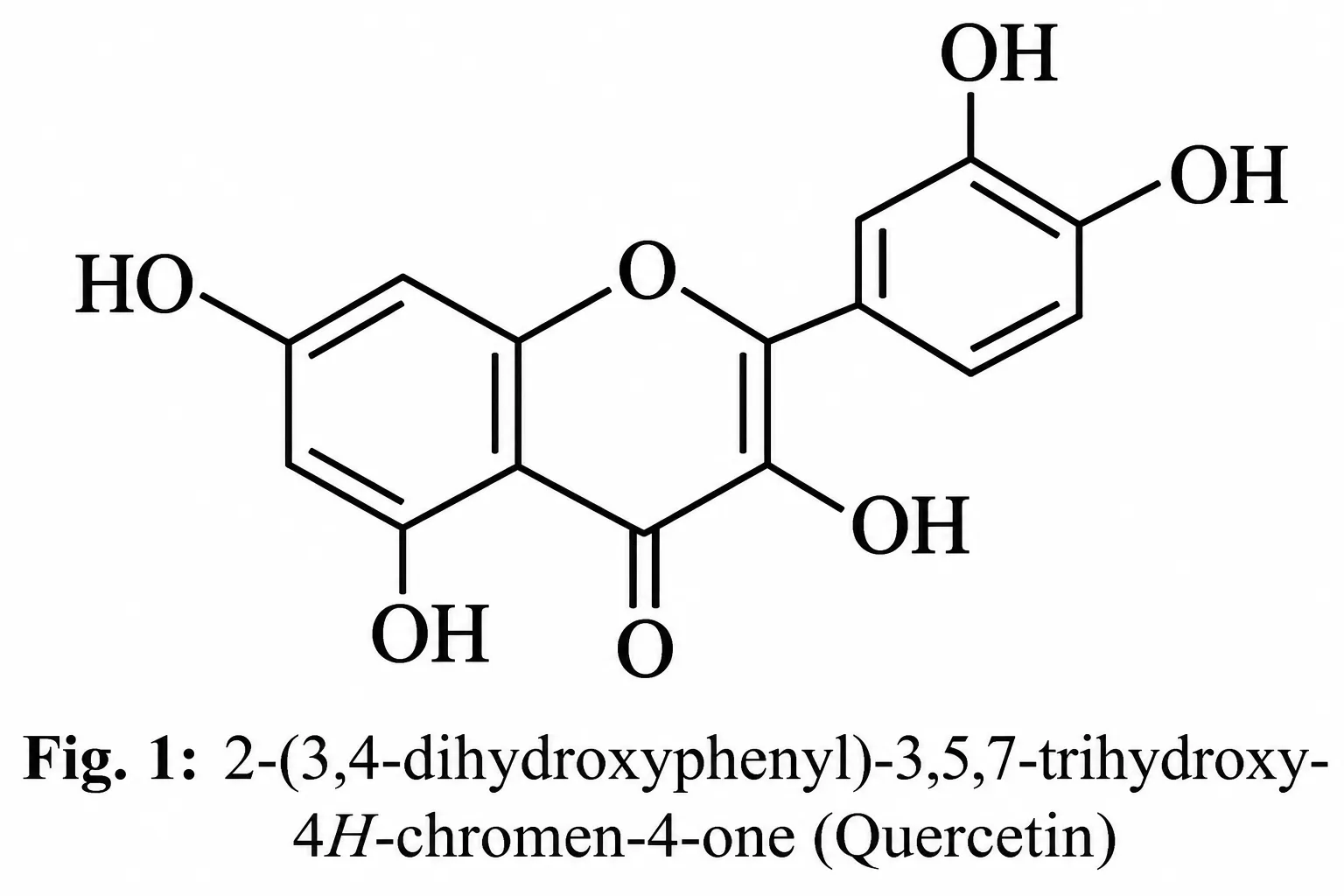
• Quercetin (3,3’,4’,5,7-pentahydroxyflavone)
Quercetin (3,3’,4’,5,7-pentahydroxyflavone) belongs to a wide class of polyphenolic flavonoid chemicals essentially ubiquitous in plants and plant food sources. Quercetin is commonly found in the form of glycosides (sugar derivatives); for example, rutin, which has the hydrogen of the R-4 hydroxyl group replaced by a disaccharide. Quercetin is termed the aglycone, or sugarless version of rutin. Two extensive volumes, the proceedings of major meetings on plantflavonoids, presented much of the biological and medical data about quercetin in 1985 and 1987 satyendra 2012.7
• Drug Profile of Querecetin:
| Sr. No. | Parameters | Description |
|---|---|---|
| 1 | Drug Name | Quercetin |
| 2 | Chemical Name | 2-(3,4-dihydroxyphenyl)-3,5,7-trihydroxy-4H-chromen-4-one |
| 3 | Molecular Formula | C₁₅H₁₀O₇ |
| 4 | Molecular Weight | 302.24 g/mol |
| 5 | Category | Flavonoid (Flavonol) |
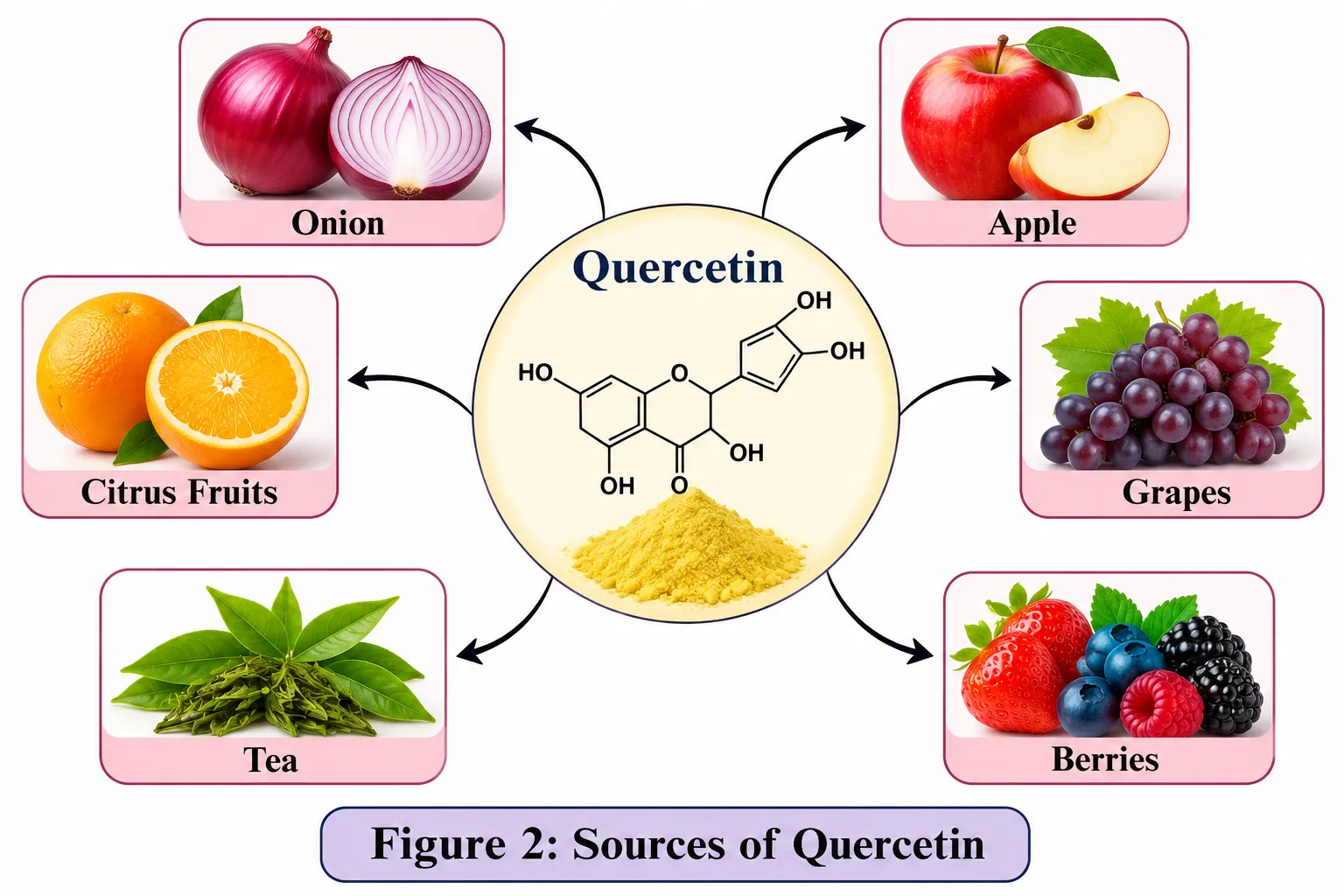
| 6 | Biological Source | Onion, Apple, Tea and Berries |
| 7 | Physical Appearance | Yellow crystalline powder |
| 8 | Melting Point | 313–314°C |
| 9 | Solubility | Practically insoluble in water; soluble in alcohol |
| 10 | Nature | Polyphenolic compound |
| 11 | Pharmacological Activity | Antioxidant, Anti-inflammatory, Antimicrobial |
| 12 | Stability | Sensitive to alkaline pH, oxygen and light |
Quercetin and Autoimmune Diseases: Rheumatoid Arthritis Rheumatoid arthritis (RA) is a systemic chronic autoinflammatory disease. The main clinical symptoms are synovitis and progressive destruction of multiple joints, which can lead to joint deformity and dysfunction. It can also cause multi-system damage, and in severe cases premature death. In a randomized, double-blind, placebo-controlled clinical study, quercetin significantly alleviated morning stiffness and pain in RA patients . In that study, DAS 28 and HAQ scores of RA patients in a quercetin group where lowerthanthose in aplacebo group. Ininvivo studies, quercetin has reduced arthritic scores and improved symptoms significantly in RA mice via inhibiting neutrophil infiltration and reducing levels of pro-inflammatory cytokines such as interferon g, TNF-a, monocyte chemotactic protein 1, IL-6, and IL-17. It also inhibited neutrophil extracellular trap formation by suppressing autophagy .8
• Medicinal Uses of Quercetin:
Quercetin is a natural flavonoid compound that shows various pharmacological activities.
1. Antioxidant Activity: Protects cells from oxidative stress.
2. Anti-inflammatory Activity: Helps reduce inflammation.
3. Antifungal Activity: Shows potential antifungal effects.
4. Antibacterial Activity: Helps inhibit the growth of certain bacteria.
5. Anticancer Activity: Shows potential anticancer properties.9
Anti-Inflammatory Activity Quercetin:not only inhibited neutrophil infltration but alsopromoted the apoptosis of activated neutrophils and reducedthe plasma levels of infammatory cytokines. Terefore, itmay be an alternative agent for the treatment of rheumatoidarthritis by inhibiting neutrophil activities. In terms of theprotective efects of macrophage apoptosis, quercetin inhibitsthe expression of NLRP3 and lysate cysteine protease 1 ina concentration-dependent manner, as well as the expressionof IL-1β and N-GSDMD, thereby preventing THP-1 mac-rophage apoptosis. Quercetin can inhibit the activation ofNLRP3 infammasomes.In addition, quercetin inhibits theelevation of TLR2/MyD88 and p-AMPK induced by lipo-polysaccharide/adenosine triphosphate, and quercetin exertsan anti-infammatory efect by inhibiting TLR2/MyD88/NF-κB and ROS/AMPK pathways.Te combined use ofquercetin and dasatinib can relieve intestinal aging and in-fammation in older mice.10
Side Effects of Quercetin:
Quercetin is generally well tolerated, but high doses may cause some side effects.
1. Nausea.
2. Vomiting.
3. Diarrhea.
4. Headache.
5. Stomach discomfort.11
• Literature review :
1.H.D.Zalte et.al.(2013)
Sustained release matrix tablet is formulated mainly by wet granulation or direct compression method or by dispersion of solid particle within solid particle within a porous matrix formed
HPMC etc. The matrix controls the release rate of drug. Release retardants like HPMC can aid in sustained release and thus they form core excipient of the formulation. The method involves the direct compression of blend of drug, retardant material and additives to formulate a tablet in which the drug is embedded in a matrix core of the retardant, alternatively granulation can be carried out prior to compression. The matrices used may be of hydrophilic, hydrophobic, mineral, or biodegradable types. The drug release rate can be studied by in-vitro dissolution studies. Some drugs that have been formulated as sustained release matrix tablets are Ambroxol HCl, Nateglinide etc. Thus, sustained release matrix tablets can assure better patient compliance through reduction in total dose and dosage regimen, which can be of great help to treat chronic diseases.
2.N. G. Raghavendra Rao et.al (2013)
Recently, sustained release pharmaceutical products became a very useful tool in medical practice, offering a wide range of actual and perceived advantages to the patients. Sustained release is also providing promising way to decrease the side effect of drug by preventing the fluctuation of the therapeutic concentration of the drug in the body. Now a days as very few drugs are coming out of research and development and already existing drugs are suffering the problem of resistance due to their irrational use specifically in case of drugs like antibiotics. Hence, change in the operation is a suitable and optimized way to make the some drug more effective by slight alteration in the drug delivery. Sustained Release is also providing promising way to decrease the side effect of drug by preventing the fluctuation of the therapeutic concentration of the drug in the body. The release of the drug through such system includes both dissolution controlled as well as diffusion controlled mechanisms, Most of drugs, if not formulated properly, may readily release the drug at a faster rate, and are likely to produce toxic concentration of the drug on oral administration. This article contains the basic information regarding sustained release formulation and also the different types of the same.
3.Timmins et.al (2016)
Sustained release matrix type drug delivery systems offer a controlled drug release mechanism that enhances patient compliance and therapeutic efficacy. By utilizing various hydrophilic and hydrophobic polymers, these systems allow for the precise modulation of drug release based on polymer composition. Significant advancements have been made to address the limitations of conventional dosage forms, improving drug bioavailability and reducing the frequency of dosing.
4.Mandev Mehta et.al (2021)
Sustained Release is also a promising method for reducing medication side effects by preventing the therapeutic concentration of the drug from fluctuating in the body. The basic rationale of a sustained drug delivery system is to optimise a drug's biopharmaceutical, pharmacokinetic, and pharmacodynamic properties in order to maximise utility, minimise side effects, and cure the disease. The drug release rate is regulated by the matrix. HPMC and other release retardants can help with sustained release, so they are used as a key excipient in the formulation. The method entails compressing a mixture of medication, retardant material, and additives directly to shape a tablet with the drug embedded in a retardant matrix core; instead, granulation may be done prior to compression. Hydrophilic, hydrophobic, mineral, and biodegradable matrices may be used. To assess the drug release rate, in-vitro dissolution tests may be used. The primary goal of continuous release types is to improve drug therapy, which is determined by the relationship between the advantages and disadvantages of using one.
5.Shraddha p.p et.al (2019)
For internal route of administration, oral drug delivery remains best and the most preferred for administration for various drugs. Sustained Release is also suitable for overcome the side effect of drug and also increase therapeutic efficacy of drug. The basic concepts of sustained drug delivery system optimizes of the various parameters like biopharmaceutical, pharmacokinetic and pharmacodynamics properties of a drug in such a way that therapeutic efficacy is maximized, side-effects are reduced and cure of the disease is achieved easily. In pharmaceutical field, several dosage form having several advantage so that they used, in case of the Sustained release drug delivery is betterment of patient compliance, this due to reduce dose frequency, reduction of fluctuation in steady-state drug levels, maximum utilization of the drug, increased safety margin of potent drug, reduction in healthcare cost through improved therapy and shorter treatment period. The main object of this review give the complete knowledge for the sustained release dosage and its advantage, also describe the various criteria for selection of drug for the drug delivery system.
MATERIALS AND METHOD:
MATERIALS:
| Sr.no | Material | Function |
|---|---|---|
| MCC (microcrystalline cellulose) | Diluent and Compression Aid | |
| Talc | Glidant and Anti Adherent | |
| Magnesium stearate | Lubricant | |
| Xanthan gum | Sustained Release Polymer | |
| Tamarind seed | Natural Release controlling polymer | |
| Quercetin | Antioxidantactivity,Anti-inflammatoryactivity, |
METHOD:
Direct compression:
1. Weighing: Accurately weigh the drug, MCC, xanthan gum, and tamarind seed polysaccharide according to the selected formulation.
2. Sieving: Pass the ingredients through a suitable sieve to remove lumps.
3. Mixing: Mix the drug with xanthan gum, tamarind seed polysaccharide, and MCC until uniform.
4. Lubrication: Add talc and magnesium stearate and mix gently.
5. Compression: Compress the final blend into tablets using a tablet-compression machine.12
6. Evaluation: Evaluate the tablets for weight variation, hardness, friability, drug content, and in-vitro dissolution.13
RESULTS AND DISCUSSION:
Quercetin is a naturally occurring flavonoid chemical having anti-inflammatory and antioxidant qualities. Long-term quercetin release control may be possible with sustained-release drug delivery methods. Important evaluation criteria include weight fluctuation, hardness, friability, drug content, and in-vitro dissolution investigations. The direct compression method is an easy and practical way to prepare tablets. Quercetin is a naturally occurring flavonoid with antioxidant and anti-inflammatory properties; sustained-release drug delivery techniques may be able to manage quercetin release over an extended period of time. The performance of sustained-release tablets may be enhanced by the use of appropriate polymers, according to the reviewed literature. Quercetin's antioxidant qualities shield cells from oxidative harm. Xanthan gum: Aids in regulating the rate of medication release. The natural release-controlling agent is tamarind seed polymer. Direct compression is a quick, easy, and cost-effective technique. Benefits of Sustained Release: Increases patient compliance and prolongs drug release.
• Future scope:
1. The antioxidant properties of quercetin protect cells from oxidative damage.
2. Xanthan gum: Helps control how quickly drugs are released.
3. Tamarind seed polymer is the natural release-controlling agent.
4. Direct compression is a fast, simple, and economical method.
5. Extends drug release and improves patient complianc.
CONCLUSION:
Quercetin is a naturally occurring flavonoid that has anti-inflammatory and antioxidant qualities. According to the literature review, sustained-release matrix tablets could be able to regulate quercetin release over a longer time frame. Release-controlling substances include tamarind seed polymer and xanthan gum. For tablet preparation, the direct compression method is an easy and affordable approach. To optimise the formulation and verify its drug-release efficacy, more investigation and assessment studies are needed.
Acknowledgment:
I would like to express my sincere gratitude to everyone who supported and guided me throughout the completion of my B. Pharmacy Review Project entitled “A Review on Formulation and Evaluation of Quercetin Sustained-Release Matrix Tablets”
First and foremost, I express my heartfelt gratitude to our respected Principal, Dr. Vivekanand Ankush Kashid, for providing the necessary facilities, encouragement, and institutional support to complete this review work successfully.
I am deeply thankful to my respected Guide, Dr. Rushikesh Kailash Salve, for his valuable guidance, continuous support, encouragement, and suggestions throughout the preparation of this review paper.
I also extend my sincere thanks to my Co-Guide, Mr. Rahul Rajendra More, for his valuable assistance, cooperation, and support.
I am also thankful to my parents and friends for their constant encouragement and support throughout this work.
Name of Student: Priyanka Bhausaheb Bhagwat.
REFERENCES


Priyanka Bhagwat, Shweta Satalkar, Dipali Bidgar, Dr. Rushikesh Salve, Dr. Vivekananda Kashid, Rahul More, Aditya Jawarkar, Aryan Bhaiya, A Review on Formulation and Evaluation of Quercetin Sustained-Release Matrix Tablets, Int. J. of Pharm. Sci., 2026, Vol 4, Issue 11, 4247-4254. https://doi.org/10.5281/zenodo.24458390
 10.5281/zenodo.24458390