

We use cookies to ensure our website works properly and to personalise your experience. Cookies policy
1Department of pharmacology, Associate Professor at Dr. Bapuji Salunkhe Institute of Pharmacy, Miraj.
2,3,4,5,6Student At department of pharmacology. Dr. Bapuji Salunkhe Institute of Pharmacy, Miraj.
High Risk Medications (or High Alert Medications) have a high potential to cause significant harm if administered incorrectly. These include: Insulin, Heparin, Warfarin, Morphine, Fentanyl, Methotrexate, Concentrated Potassium Chloride, Concentrated Sodium Chloride and Chemotherapeutic agents. Although medication errors may occur at the same frequency as other drugs, the adverse effects of these errors on patients are far greater and may result in permanent disability, long inpatient admission or death. Extra care must be taken throughout prescribing, dispensing and administration of these drugs to reduce the likelihood of an error occurring. Patients in Intensive Care Units (ICU) are particularly at high risk of medication errors. An average of 1.7 errors occur per patient per day in ICU. This is due to the large number of medications given to patients (polypharmacy), severity of illness, complex and urgent treatments, increased workloads for nursing and medical staff and long processes of administering medication. This process involves 80-200 steps in total between prescription and administration. Common causes of error include incorrect dosages, incorrect patient, incorrect route, incorrect timing, incorrect choice of medication, poor legibility, poor communication, not obtaining complete allergy information, interruptions, no standard protocols and poor monitoring post-administration. In India there is a particular issue with under reporting of ADRs due to fear of punishment, lack of time, knowledge and training meaning very few reports are submitted. To improve this issue, a Pharmacovigilance Programme in India (PvPI) was established in 2010. It is managed from the National Coordination Centre at the Indian Pharmacopoeia Commission, Ghaziabad. Pharmacists play a key role within this program. They not only dispense medications but ensure patient safety by checking prescriptions, performing independent verification checks, educating patients, monitoring for adverse effects and having antidotes readily available.
Up to 80% of the harm is thought to be avoidable, and up to four out of ten patients worldwide suffer harm while receiving medical care in primary healthcare settings. (1) Since medication use is the most prevalent therapeutic intervention in contemporary healthcare, it is also one of the most frequent causes of preventable patient harm.
The Institute of Medicine's (IOM) 1999 report "To Err Is Human," which estimated that medication errors (MEs) could result in up to 98,000 patient deaths annually, marked the beginning of the modern patient safety movement. It was the third leading cause of death at the time due to the high number of deaths that exceeded the amount attributed, which caused the medical community to refocus on the importance of patient safety.
While all drugs carry some risk if taken incorrectly, a small number of them are more likely to seriously harm a patient. These drugs are known as HAMs. High-alert medications have a low therapeutic index, which is the ratio of the lowest curative or effective dose to the maximum tolerated dose. A list created by the American Society of Health-System Pharmacists (ASHP) and the Institute for Safe Medication Practices (ISMP) can be added to hospital formularies to improve patient safety when using these high-risk medications and lower the possibility of mistakes. The consequences could be disastrous for patients, even though errors may or may not be more common with these drugs. (2)
Heparin and insulin administration error made up 8.9% and 11%, respectively, of all major MEs, according to a 1998 ISMP report on MEs (1.8). Insulin, morphine, heparin, intravenous concentrated potassium chloride, warfarin, hydromorphone, and fentanyl are the top seven medications linked to adverse events, according to the summary data from the 2002 MedMarx report on medication events. High-risk medications (HRMs) increase the risk of harming patients, with 0.24 to 89.6 errors per 100 prescriptions, according to the 2018 ISMP report.
Due to their exceptional potential for delivering therapeutic efficacy, high-alert medications are essential in intensive care units (ICUs). Polypharmacy is common among critically ill patients because of their multiple ailments and complexity, which raises the risk of iatrogenic harm. According to reports, MEs are responsible for 78% of severe outcomes, and patients admitted to intensive care typically encounter 1.7 errors per day (4).
Additionally, administering a single dose to a critically ill patient can involve 80–200 steps, including various processes such as prescribing, indenting, dispensing, procurement, administering, recording, monitoring, and documenting. This creates a large enough window for MEs to occur in the first place. Medication safety problems continue to exist despite the medication's cautious use, endangering patient safety. Furthermore, the trend of underreporting continues in developing nations despite the establishment of reporting programs. Complex issues like a lack of time, fear of medico-legal ramifications, embarrassment in front of peers and the public, sanctions, loss of credibility, retraining, and ignorance of the importance of reporting could be the cause of this.
1. Why medication safety is important in India
India has a vast and varied healthcare system where government hospitals, educational institutions, private hospitals, and small clinics coexist. Medication errors are made more likely by a high patient load, a lack of qualified personnel, the widespread availability of medications with similar names and packaging, and the practice of writing prescriptions by hand. Concurrently, a lot of patients purchase over-the-counter medications and take multiple medications at once, which raises the risk of drug interactions and avoidable side effects. Given the current state of the world and Indian medical practices, more evaluation of MEs in the healthcare system is therefore required. The purpose of this study is to evaluate the prevalence, trends, results, and underlying causes of medication incidents linked to HAMs, particularly in the intensive care units of a tertiary care teaching hospital (5).
2.Aim and objectives
This study examined adverse drug reactions (ADR) and medication errors (ME) data from a university hospital in order to identify organizational high-alert medications (6).
Describe how a comprehensive clinical set was developed and implemented.
1. Describe the creation and implementation of a comprehensive suite of clinical pharmacy services centered on high-alert medications. Pharmacy services centered on high-alert medications. Monitor and track all patients starting lithium, clozapine, and warfarin therapy.
2. Identify and monitor all patients starting lithium, clozapine, or warfarin therapy. Conducted concurrent point-of-care consultations with predefined protocols.
3. Implement concurrent, point-of-care consultation using predefined medication-therapy management guidelines developed by clinical pharmacists in collaboration with the treatment team. Treatment Team
4. To reduce preventable adverse drug events, improve medication use, and Goals include reducing preventable adverse drug events, improving medication adherence, and improving clinical outcomes.
3. classification
This classification is based on the ISMP list of high-alert drugs in acute care settings, which is displayed below. Medication classes and categories are listed in the right panel, while specific high-alert medications are listed in the left panel.
There isn't just one pharmacological category of high-alert medications. They are grouped together due to the seriousness of the harm that an error can cause. The ISMP list of high-alert drugs for acute care settings classifies them into general categories and identifies specific drugs that require extra care. A hospital should adopt this list only after considering its own patient population and prescribing practices (8).
• ISMP LIST OF HIGH-ALERT MEDICATION:
SPECIFIC MEDICATION (LEFT) / CATEGORIES OF MEDICATION (RIGHT)
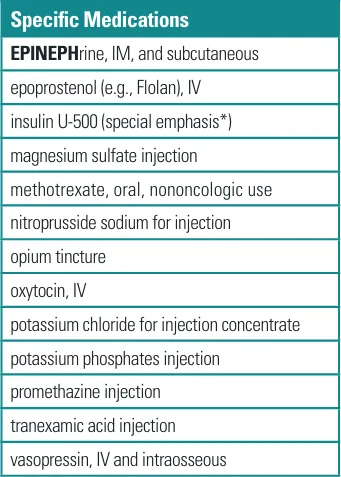
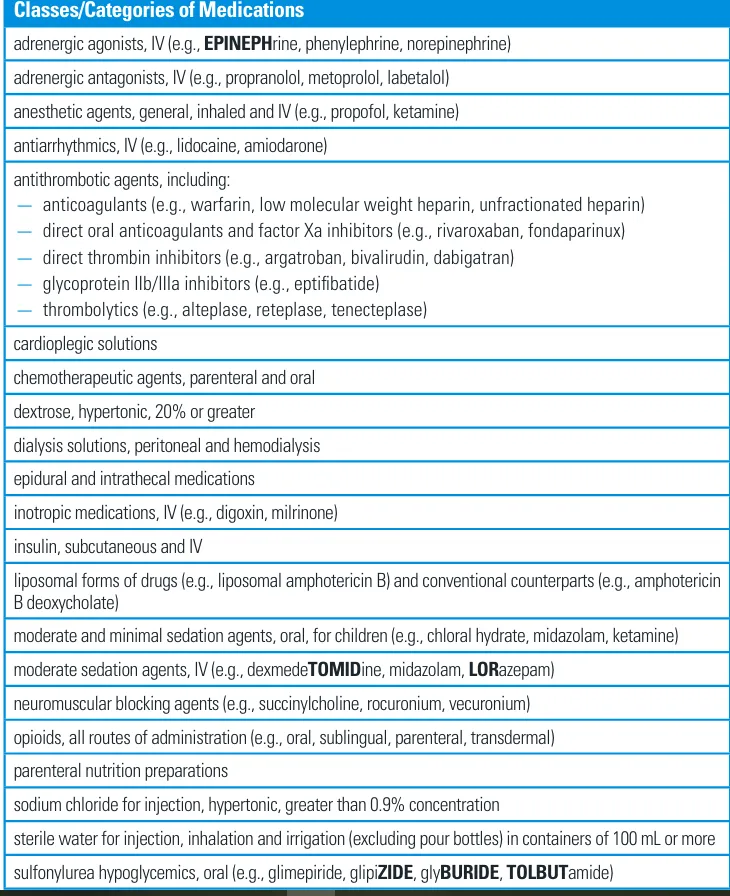
4.Common preventable ADRS
If a medication error occurs, monitoring guidelines are not followed, or a medication is administered to a patient for whom it is contraindicated, the adverse drug reaction is deemed preventable. The following are typical avoidable side effects of high-alert medications:
5.Common causes of medication errors
PREVENTION STRATEGIES:
Some medication-related harm can be avoided by better managing medicines, adjusting how they’re prescribed, adding supportive treatments to reduce side effects, and catching problems early enough to limit the damage.
Human factors experts and reliability science point to three practical ways to make medication use safer:
1. Design systems that stop errors and harm from happening in the first place Build systems that reflect the real complexity of healthcare—the team, the task, and what the patient actually needs. Useful approaches include:
2 .Catch errors before they reach the patient Create checks that flag problems early, and systems that spot harm while there’s still time to act. Examples include:
3.Act fast when something does go wrong Minimise the impact of an error or harm as quickly as possible. This can mean:
Table 1: Three-Level Approach to Medication Safety
| Level | Aim | Examples |
|---|---|---|
| Prevent | Stop the error from happening | Standard order sets, fewer concentrations, barcode checks, restricted storage, LASA separation |
| Detect | Catch the error before it reaches the patient | Pharmacist order review, independent double-check, laboratory alerts, patient monitoring |
| Mitigate | Reduce the harm if the error reaches the patient | Antidotes at point of care, nurse-led reversal protocols, rapid response team |
ROLE OF PHARMACIST:
Role of the Pharmacist A big part of what pharmacists and clinical pharmacists do in medication safety is spotting patients who are already experiencing adverse drug events or other medicine-related problems, those who are at risk of them, and those who could benefit from help that maximises the benefits of their medicines, lowers the risks, and makes treatment more cost-effective. Clinical pharmacy services focus on individual patients rather than the system as a whole. They form a key part of current and future approaches to personalised care, especially for people at higher risk.High-risk patients are usually prioritised for thorough medication reviews by a clinical pharmacist. A full review looks at everything relevant: lab results, clinical assessments, physiological measurements, input from doctors, nurses and other caregivers, plus what the patient themselves reports—both objective findings and how they feel.
Many studies have shown that when pharmacists manage medication therapy, patients experience better outcomes and fewer medicine-related problems.
High-risk groups often include people taking five or more medicines (polypharmacy), those with reduced ability to clear drugs from their body, patients on medicines with a narrow safety margin or potentially inappropriate drugs, frail or malnourished individuals, and older adults. These patients need extra attention to medication safety, careful individual adjustments to their regimens, close follow-up, and good continuity of their personalised treatment.
The main goal of clinical pharmacy services—whether in hospital or in the community—is not only to sort out existing adverse reactions and drug-related problems, but also to stop them happening again and to fine-tune therapy so that medicines work as safely and effectively as possible. For this reason, clinical pharmacy approaches need to be built into wider medication safety strategies and processes (13).
PHARMACOVIGILANCE AND ADR REPORTING IN INDIA:
Pharmacovigilance (as defined by WHO) is the science and activities relating to the detection, assessment, understanding and prevention of adverse effects of drugs and other issues related with pharmaceutical products. The aim of pharmacovigilance is to better patient care and improve drug safety.
1.History and development In pharmacovigilance in india:
Pharmacovigilance in India started quite late. Although PV is still growing in India, the concept has not been entirely new. In 1986, a group of doctors, mainly from academic institutions, drew attention to the need of paying more attention to possible adverse effects of prescribed drugs and to encourage rational use of medication. This led to the establishment of initial ADR monitoring centres. There were 12 regional centres set up, with each centre covering a population of approximately 50 million. Unfortunately, this system was not successful.
However, in 1997, India joined the World Health Organisation (WHO) International Drug Monitoring Program in Uppsala, Sweden. Three ADR monitoring centres were therefore established, mostly in teaching hospitals. These were the National Pharmacovigilance Centre of Department of Pharmacology, All India Institute of Medical Sciences (AIIMS), New Delhi; and two WHO special centres in KEM Hospital, Mumbai and JLN Hospital, Aligarh. The aim of these centres was to monitor ADRs due to drugs on the market in India and relay information to drug regulatory authorities within India. However, due to lack of knowledge amongst health care professionals on the importance of ADR reporting and what the centres were responsible for, these centres did not work efficiently. Additionally, financial support from the Government was not sufficient to allow efficient running of these centres.
In January 2005, the National Pharmacovigilance Programme (NPVP) was established in India, with funding from the World Bank and support from WHO. The NPVP is overseen by the National Pharmacovigilance Advisory Committee, which was set up by the Central Drugs Standard Control Organisation (CDSCO). There were 2 zonal centres set up in order to co-ordinate ADR activity around the country. The South West (SW) Zonal Centre was established in the Department of Clinical Pharmacology at Seth GS Medical College & KEM Hospital, Mumbai. The North East (NE) Zonal Centre was established in the Department of Pharmacology, AIIMS, New Delhi. ADR reports from across the country are collected at these centres and then sent to both the National Pharmacovigilance Advisory Committee and Uppsala Monitoring Centre (UMC) in Sweden.
Three regional centres were connected to the SW Zonal Centre in Mumbai, and 2 regional centres were connected to the NE Zonal Centre in New Delhi. Under each centre there are many peripheral monitoring centres. In total there are 24 peripheral monitoring centres across the country.
Main aims of the National Pharmacovigilance Programme
Immediate aim: Encourage spontaneous reporting of ADRs by health care professionals
Intermediate aim: Increase the involvement of health care professionals in Pharmacovigilance activities and increase communication of drug safety information
Long term aim: Establish a strong pharmacovigilance system within India that can contribute to global drug safety monitoring standards.
Despite these aims, the National Pharmacovigilance Programme encountered problems, and could not reach its desired aims. There are many levels within the system – National, Zonal, Regional and Peripheral centres. This is shown below.
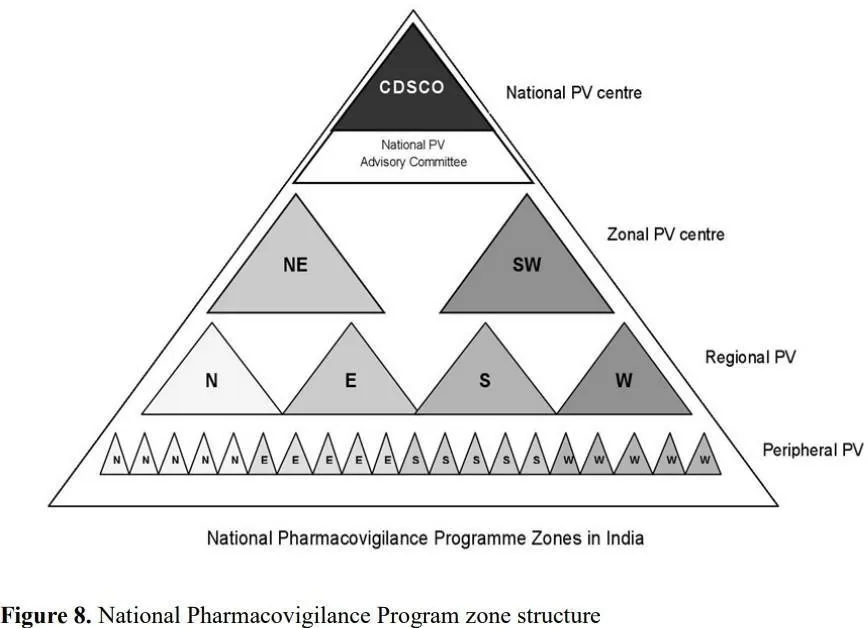
Figure None: National Pharmacovigilance Program Zone Structure
2.CURRENT PV PROGRAMME IN INDIA:
A brain storming session for revitalization of NPVP was jointly organized by Department of Pharmacology, AIIMS and CDSCO in late 2009. Under this, restructured pharmacovigilance programme was planned. The Pharmacovigilance Programme of India (PvPI) was then launched by the Government of India on 14 th July 2010. The All India Institute of Medical Sciences (AIIMS), New Delhi was constituted as National Coordination Centre (NCC). The initiative aims at monitoring Adverse Drug Reactions (ADRs) in the country in order to protect public health and enhance patient safety. Initially, 22 ADR Monitoring Centre (AMC) were established out of which AIIMS, New Delhi was one of them (in 2010).
In order to enhance implementation of PvPI, the National Coordination Centre was shifted from AIIMS, New Delhi to Indian Pharmacopoeia Commission (IPC), Ghaziabad, Uttar Pradesh on 15th April 2011. At IPC, NCC has been assigned with the responsibility to independently provide information on safety of drugs to ensure that drug safety monitoring in the country is in line with international standards.
3.ADR REPORTING IN INDIA :
Adverse Drug Reactions (ADR) may occur in practice from medicines not fully demonstrated in clinical trials. An Adverse Drug Reaction (ADR) is defined as any unintended and harmful effect associated with the use of a medicinal product in humans, which occurs at normal therapeutic doses for the prevention, diagnosis, treatment or modification of a disease, or for the improvement of physiological functions (17).
ADR surveillance is very important for patients and for health professionals. It allows unexpected issues with medicines to be recognised, suitable precautions to be taken and medicine safety improved. Drugs are generally released to the public before extremely rare, but potentially severe adverse reactions, have been identified and appropriately assessed (18).
Suspected ADRs can be reported using Spontaneous Reporting Systems (SRS). This information can be analysed to identify any potential safety concerns for medicines, and therefore produce safety signals. If serious or significant adverse reactions are encountered, they should be appropriately recorded and reported within the relevant pharmacovigilance systems.
.What to report?
You should report any suspected adverse drug reaction to the nearest official pharmacovigilance centre or authority. This should include adverse reactions which:
All suspected reactions to medicines or vaccines, regardless of whether the reaction is previously known reaction, new reaction; serious or non-serious; frequent or infrequent should be reported
3.Timing of ADR Reporting
All suspected ADRs should be reported as soon as possible to allow effective evaluation. It is recommended that:
4 .Who can report?
5. How to report?
6. Where to report?
India has a network of peripheral, regional and zonal pharmacovigilance centres.
Peripheral PV centres act as the primary level for collecting ADR information. These include small medical centres, private hospitals, dispensaries, nursing homes and pharmacies. ADRs reported here are recognised and coordinated by the Regional or Zonal centres. Every state, Union Territory and several leading medical colleges have peripheral centres.
Regional PV centres function as secondary centres. They are usually located in medical colleges with relatively larger facilities and are coordinated by the zonal centres. There are five regional centres in India.
CDSCO zonal and sub-zonal offices are located at:
7.How to report ?
CASE STUDY:
Inpatient Insulin Safety
Study title: Reduction of Insulin-Related Preventable Severe Hypoglycemic Events in Hospitalized Children
Authors: Amy Poppy et al. (Children’s Hospital Colorado)
Source: Pediatrics, Volume 138, Issue 1
Background and clinical problem
Insulin is classified as a high-alert medication. In hospital settings for children, inconsistent or poorly standardised ways of giving insulin often lead to preventable episodes of severe low blood sugar. These events add significantly to patient harm, longer hospital stays, and higher overall risk for children with diabetes.
Quality improvement (QI) strategy and interventions
The hospital set up a dedicated, multi-departmental Insulin Safety Committee (ISC). The goal was to move away from separate, isolated protocols towards a more joined-up, systems-based approach. The team focused on three main areas of change:
- Clinical Care Guideline – They developed clear, standardised clinical guidelines and algorithms specifically for the care of children with diabetes in hospital.
- Electronic Medical Record (EMR) Integration – They updated the electronic records system to include compulsory electronic order sets and standardised communication note templates. This helped reduce confusion, especially during shift handovers.
- Targeted Medical Education – They provided thorough, ongoing training and competency checks for both nurses and doctors on the new high-risk dosing pathways.
Key metrics and outcomes
The study collected clinical data over a period of more than two and a half years (August 2011 to March 2014) and analysed the results using Statistical Process Control (SPC) charts.
RESULT:
The insulin safety improvement project reported a reduction in preventable severe hypoglycaemic events from 1.4 to 0.4 events per 100 insulin days. This represents approximately a 71% reduction after the interventions. The findings show that proper guidelines, staff education and regular monitoring can make a significant difference in medication safety.
The study also highlights the importance of pharmacists in preventing medication errors. Prescription checking, independent double-checking, patient counselling and ADR monitoring are important responsibilities of pharmacists. In India, the Pharmacovigilance Programme of India (PvPI) provides a system for reporting suspected adverse drug reactions. However, lack of awareness and fear of reporting still contribute to under-reporting.
Overall, the findings suggest that proper teamwork, continuous monitoring and a strong medication safety system can reduce preventable harm and improve patient care. Pharmacovigilance and the active involvement of pharmacists are therefore essential for the safe use of high-risk medications
DISCUSSION :
The insulin safety improvement project reported a reduction in preventable severe hypoglycaemic events from 1.4 to 0.4 events per 100 insulin days. This represents approximately a 71% reduction after the interventions. The findings show that proper guidelines, staff education and regular monitoring can make a significant difference in medication safety.
The study also highlights the importance of pharmacists in preventing medication errors. Prescription checking, independent double-checking, patient counselling and ADR monitoring are important responsibilities of pharmacists. In India, the Pharmacovigilance Programme of India (PvPI) provides a system for reporting suspected adverse drug reactions. However, lack of awareness and fear of reporting still contribute to under-reporting.
Overall, the findings suggest that proper teamwork, continuous monitoring and a strong medication safety system can reduce preventable harm and improve patient care. Pharmacovigilance and the active involvement of pharmacists are therefore essential for the safe use of high-risk medications
CONCLUSION:
High-risk medications are an important part of medical treatment, especially for patients who need critical care. Medicines such as insulin, heparin, warfarin and morphine can be very useful when given correctly, but even a small mistake during their use may cause serious health problems. Therefore, proper care is needed at every step, from prescribing the medicine to monitoring the patient.
From this study, it can be understood that most medication errors can be reduced by following simple safety practices. Proper guidelines, regular staff training, prescription checking and double-checking before drug administration can help prevent many errors. The insulin safety case study also showed that introducing proper safety measures helped reduce severe hypoglycaemic events by about 71%.
Pharmacists also have an important role in this process. They help by checking prescriptions, identifying possible drug-related problems, educating patients and reporting adverse drug reactions. The Pharmacovigilance Programme of India (PvPI) further supports the safe use of medicines through ADR reporting and monitoring.
In conclusion, preventing medication errors is a shared responsibility of doctors, nurses and pharmacists. Better communication, teamwork and regular monitoring can make medicine use safer and improve the overall quality of patient care.
ACKNOWLEDGMENT :
The authors would like to express their sincere gratitude to their respected guide and faculty members for their valuable guidance, continuous support, and encouragement throughout the preparation of this review article. The authors are also thankful to their institution for providing the necessary facilities and academic support. Finally, the authors extend their heartfelt thanks to everyone who directly or indirectly contributed to the successful completion of this review article.
REFERENCES

Shraddha Naik, Krushna Harge, Sakshi Mothedesai, Suhani Chougule, Rohit Tone, Aayush Narute, High Risk Medication Under Pharmacovigilance, Int. J. of Pharm. Sci., 2026, Vol 4, Issue 11, 4235-4246. https://doi.org/10.5281/zenodo.24458283
 10.5281/zenodo.24458283