

We use cookies to ensure our website works properly and to personalise your experience. Cookies policy
Student, Matoshri Miratai Aher College of Pharmacy, Karjule Harya, Ahilyanagar, 414304, India.
Clitoria ternatea is a type of plant that keeps growing year after year, and it twins as it grows. This plant is originally from tropical parts of Asia. It boats an extensive historical legacy as both a cognitive enhancer and an agent for anxiety relief. Various portions of the plant have various components. The plant is said to include tannins, resins, starch, taraxerol, taraxenone, alkaloids, flavonoids, saponins, proteins, anthocynins, carbohydrates, and other active compounds. The plant is emplyoyed therapeutically to address a diversw array of medical conditions. Traditional medicine is used to treat various conditions like jaundice, migraine, thorot infections and eye problems. Infections dermatological conditions, asthma, arthritic, inflammation, otalgia. Cutaneous eruptions, and febrile states. Urinary tract infections, constipation, snakebites, headaches, indigestion. leprosy and disorders of the central nervous system. Clitoria ternatea is a plant that has been used in the past for treating gonorrhea, strss and infertility, food colouring. Ayurveda has relied extensively upon the utilizat of this botanical resource. Pharmacologically, it has anti-inflammatory, analgesic, antimicrobial, and anxiolytic properties.
Clitoria ternatea, also called butterfly pea, is a type of plant that grows year after year.It has stems that are round and covered with fine hairs.This plant is part of the Leguminoceae family, which was previously known as Papillioneceae.Its leaves are arranged in a certain way, with leaf stalks that are 2 to 2.5 centimeters long and small sharp leaf tips. The leaves are subcoriaceous, elliptic-oblong in shape, measuring 2.5 to 5 centimeters in length and 2 to 3.2 centimeters in width, with an obtuse or acute tip. Each leaf has 5 to 7 leaflets and filiform stipules. Flowers grow in the leaf axils, are single, and are usually bright or blue, sometimes white, with an orange center; the seeds are 6 to 10 in number, smooth, and have a golden brown color. In Bangladesh, two distinct cultivars are widely grown for ornamental purposes: a white-flowered variant and a blue-flowered variety. A common plant found in gardens is the butterfly pea, also called blue pea (Clitoria ternatea). It has flowers that are 1 to 2 inches long, with bright blue petals that have wavy edges and a white center. Clitoria ternatea, also called butterfly pea, is a type of plant that grows year after year.It has stems that are round and covered with fine hairs. This plant is part of the leguminoceae family, which was previously known as Papillioneceae. Its leaves are arranged in a certain way, with leaf stalks that are 2 to 2.5 centimeters long and small.
Numerous documented Ayurvedic formulations designed to enhance "medha" incorporate Centella asiatica alongside a variety of other botanicals. Scientific inquiry has extensively examined this plant's diverse pharmacological properties, including its antihistaminic, antidepressant, and hypoglycemic effects. For an eternity, nature has served exclusively as the origin of medicinal flora. These medicinal plants are a gift from God, capable of curing a wide range of diseases in humans and other living creatures. They have been the main source of drugs in all systems of medicine and eBooks.
A Review on Clitoria ternatea (Linn.): Chemistry and Pharmacology by Niraj Kumar Singh, Jeetendra Kumar Gupta, Kamal Shah, Pradeep Mishra, Atul Tripathi, Nagendra Singh Chauhan, and Neeraj, Upmanyu from the Institute of Pharmaceutical Research at GLA University, Mathura, Uttar Pradesh-281406, India. Institute of Pharmacy, Pt. Ravi Shankar Shukla University, Raipur, Chhattisgarh, India. Drugs Testing Laboratory Avam. Some valuable ingredients that are used to treat many difficult diseases come from plants. In different kinds of medicine, many plants and herbs are used to help cure different health problems. In all the old Ayurveda texts, Aparajita is talked about as one of the key herbs.
It is a good looking twing herb. Aparajita's scientific name is Clitoria ternatea, and it is part of the Fabaceae, or Pipilionaceae, family. It is likely native to tropical Asia. It can be found in many areas across the humid, lowland tropical regions of Africa, Asia, and Central America. It is found in low and medium altitude regions of settled areas. C.ternatea is a plant that stays around for a long time, has very little hair on its surface, and belongs to the legume family. It is a perennial climber with a slender, hairy stem, found throughout the tropical areas of the country. It is commonly grown in gardens and is often seen growing over hedges. Sai Koteswar Sarma and colleagues present their findings alongside observations concerning thickets. Observations indicate that while Aparajita has been successfully acclimatized to clay soils and evaluated for its utility as a forage or cover crop, it has never been cultivated specifically as a pasture variety.
Furthermore, distinct parts of this plant serve as active constituents in diverse Ayurvedic formulations, where they are employed to address a wide spectrum of medical disorders.
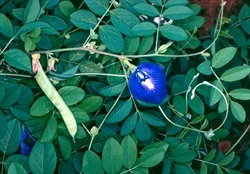
CLITORIA TERNATEA PLANT
TAXANOMIC HERARCHY:-
The complete plant of Clitoria ternatea has a taxonomic hierarchy as follows:
Kingdom:- Plantae
Phylum:- Angiosperms
Order:- Fabales
Family:- Fabaceae
Genus:- Clitoria
Species:- C.ternatea
VERNACULAR NAMES:-
The shape of the flowers on the Clitoria plant shows what its genus name means. The flowers of this plant look like a human female clitoris in shape, which is why the genus name "Clitoria" comes from the word "clitoris." The species name "Ternatea" is taken from Ternate, an island in eastern Indonesia. In many different languages, the names given to flowers often relate to a woman's genital area.
Sanskrit: Ashphota, Aparajita, Saukarnika, Ardrakarni, Girikarnika, Supuspi, Mohanasini Vishadoshaghni, Shwetanama, Vishnu-Kranta, Ashwakhura.
Hindi, Bengali, and Oriya: Aparajita or Aparajit.
Gujarath: Bismar, Garani, Koyala
Kannada: Billisaiuga, Satugadagida. Telugu: Dintana, Gilarnika, Neela-ghentana, Sankhupuvvu.
Tamil: Kakkanam, Kakatan, Kavachi, Kuruvilai.
Punjab: Dhanattar, Rajasthan, Koyalri, Titlimatar
English: Butterfly pea, Blue pea vine, Mussel-shell climber, Pigeon wings.
CULTIVATION:
Clitoria ternatea is a plant that grows with deep roots, is tall and thin, and climbs as it grows. It has leaves that split into five parts and produces flowers that are a deep blue in color. It grows well in many types of soil, including those that are limestone-based, and can handle a pH range from 5.5 to 8.9.
It can live in areas with lots of rain and also in times when there is very little water for a long time. Propagation is done through seed. This plant grows back quickly after being cut or grazed and gives good amounts of yield. It is also called Clitoria ternatea L and is well-suited to grow in heavy cracking clay soils found in northern Australia. It is also used as a cover crop and green manure. The seeds are usually planted at the start and continue until the middle of the wet season. It works best when it's lightly grazed during the wet season.
BOTANICAL DESCRIPTION:
Habits: The plant is a climbing vine.
Roots: It has a root system that branches out from a main root and includes small knots called nodules.
Stem: Aerial, weak stem and a twiner.
Leaf: It has a compound structure with leaves arranged alternately, has stipules, and the veins form a network pattern. Leaflets are stipellate. Petiolate and stipels are pulvinated.
Inflorescence: Solitary and axillary.
Flower: It has bracts and bracteoles that are usually large, flowers are on stalks, have different sepals and petals, are fully developed, have both male and female parts, have five parts, are asymmetrical in shape, and the ovary is positioned below the petals.
Calyx: It has five sepals that are joined together, they are green in color, and they are arranged in a valvate aestivation. Odd sepal is anterior in position.
Corolla: It has five petals, which are either white or blue. The petals are apopetalous, meaning they are not fused together. The corolla shape is papilionaceous, which means it looks like a butterfly. The petals are arranged in a way that they overlap in a descending pattern, known as imbricate aestivation.
Androecium: There are 10 stamens, with 9 of them joined together in a group and the tenth one is separate. Anthers are two-lobed, attached at the base, turn inward, and open by splitting along their length.
GEOGRAPHICAL DESCRIPTION:
The Clitoria genus is a type of plant that is not very significant, it is a native climbing plant and a common flower found in gardens around the world in tropical and subtropical areas. Now the genus is uncommon in the wet and semi-wet areas of Asia, America, and Africa, as well as in the semi-arid tropical regions of Australia. It grows from sea level up to 1800 meters and is also grown as an ornamental plant in warmer parts of the world. Its range spreads from around 20° North latitude to the Salta district in Argentina, which is near 24° South latitude. In Africa, it grows in grasslands, usually on wet black clay soils that get waterlogged seasonally, and in old farmland. In Sudan, it's used as animal feed or for grazing. In Kenya, it's grown together with Chloris gayana.
In America, this plant can be found from Florida up to Texas, and from New Jersey all the way to Kentucky and Arkansas. It is often seen in places like Jamaica, Puerto Rico, Turks and Caicos Islands, and other similar areas. It is found throughout India, especially in the southern parts up to an altitude of 1,500 meters, and also in the Andaman Islands.
PHYTOCHEMICAL COMPONENTS FOUND IN CLITORIA TERNATA; Leaves: Which contain various substances such as alkaloids, reducing sugars, flavonoids, steroids, and glycosides.
Uses:
Flower: Phytochemical constituents include saponin, tannin, alkaloids, glycosides, phytosterols, and carbohydrates.
Uses:
Root: Phytochemical constituents such as 1,1-diphenyl-2-picrylhydrazyl (DPPH).
Uses:
Seeds: The seeds are characterized by a complex array of phytochemical constituents, including nucleoprotein exhibiting an amino-acid sequence analogous to insulin, delphinidin 3,3',5-triglucoside, essential amino acids, pentosan, and water-soluble mucilage. Further analysis reveals the presence of adenosine, an anthoxanthin glucoside, a greenish-yellow fixed oil, a phenol glycoside, 3,5,7,4-tetrahydroxyflavone-3-rhamnoglycoside, and an unspecified alkaloid .The composition also encompasses ethyl D-galactopyranoside, p-hydroxy cinnamic acid polypeptide, a highly basic protein designated as finotin, a bitter acid resin, tannic acid, and 6% ash, alongside a toxic alkaloid.
Uses:
CHEMICAL CONSTITUENTS:
MICROSCOPIC CHARACTERS:
The root has 10 to 20 or more layers of rectangular, thin-walled, tangentially stretched cork cells that peel off easily. The secondary cortex has 10 to 12 rows of large, polygonal, thin-walled cells that contain starch grains, with some cells having crystals of calcium oxalate. There are single fibers or groups of 2 to 10 lignified cortical fibers located in the lower part of the cortex. The secondary phloem has normal elements, with phloem fibers appearing some in groups of 2 to 8 and individual fibers also present. These fibers are long, thin-walled, with narrow centers and pointed ends. The secondary xylem also has normal elements. Vessels have pitted walls with oblong, bordered pits and a short, cone-shaped end, usually found in groups of 2 or 3.Xylem fibers are similar to phloem fibers, and some show slit-like pits. The medullary rays are 1 to 5 cells wide, shaped like ovals, and have pits. Xylem parenchyma cells have irregular shapes and pitted walls. Starch grains are both simple and compound, with compound ones having 2 to 6 parts. Single grains range from 3 to 13 micrometers in diameter and are found in the secondary cortex, phloem, and xylem parenchyma. Powder is yellowish brown in color. It contains simple and compound starch grains, which are between 3 to 13 micrometers in diameter. There are also vessels with oblong bordered pits and pieces of fibers present.
PHARMACOGNOSTICAL DESCRIPTION:
Different growing conditions can affect how the plant looks. Butterfly pea, scientifically known as C.ternatea, is widely grown in gardens mainly for its beautiful flowers, which make it an ornamental plant. Botanically, it belongs to the subfamily Papilionaceae and the family Fabaceae, also called Leguminoseae.It has several other names, such as C. purpurea and C. ternatea. Some of these varieties may be useful for foraging, while others are only partly domesticated. The plant is a long-lived herb that grows as a tall, upright plant, reaching heights between 90 and 162 centimeters. It comes in two kinds, one with white flowers and the other with blue flowers. Clitoria plants have two types of flowers: some are closed and pollinate by themselves, while others are open and get pollinated by insects. The physical features of flowers, such as their color, shape, and where they grow, differ between species. Some flowers can be 60 to 120 millimeters long, similar to beans or blue scabbards, and they are usually flat and long in shape. The flowers of this plant are shaped like a pea flower, grow in the leaf axils, are single flowers, and have a stem that is 0.8 to 1.3 centimeters long .The petals are bright blue or white, with a yellow or orange center. Calyx is 13 to 20 millimeters long. The corolla is 38 to 50 millimeters, shaped like an oval. Each pod has 8 to 11 seeds. The pods are 50 to 100 millimeters long and 0.8 to 1.3 centimeters wide. They are almost straight, slightly flat, and have a sharp tip.
The pods are covered with a few hairs, are about 0.3 to 0.4 centimeters wide, shiny, often have a mottled look, and are very slightly pitted. The color ranges from olive brown to nearly black. Pinnate leaves with 5 or 7 leaflets; stipules persistent, narrowly triangular, 1 to 6 mm long, subulate, prominently 3-nerved; rachis 10 to 70 mm long; petioles are 15 to 30 mm long; stipels are filiform, leaflets are elliptic, oblong, ovate or nearly orbicular, 20 to 50 mm long, 3to 30 mm wide, with apex acute or rounded, often notched, and base cuneate or rounded, both surfaces sparsely appressed pubescent. Flattened pods measure 40 to 130 millimeters in length, are shaped like a line or slightly rounded shape, and are 8 to 12 millimeters wide. They have a persistent style, are pale brown in color, open up when dry, and are lightly covered with fine hairs when they are mature.
The bracteoles stay attached and are 0.4 to 1.2 cm long, shaped like a broad egg or rounde. The calyx is 17 to 22 mm long and has some fine hairs; its lobes are triangle-shaped or long and narrow. The tube is bell-shaped, 8 to 12 mm long, and has a sharp tip or a pointed end. The roots have a buffy brown color, a typical smell, and a bitter taste. Clitoria ternatea has two types of roots. The primary roots are thick, hard, and have a smooth surface. The secondary roots are thinner and have a fibrous texture. This plant can pull nitrogen from the air, which is why it has been used to make the soil better. The thick horizontal roots can grow and produce one to several purple, bluish-gray, slender stems that are longer than 2 meters.
AYURVEDIC PROPERTIES AND USES:
Clitoria has a pungent taste after digestion, is cooling in nature, has a bitter flavor, and is light, dry, and sharp in its qualities. In Ayurveda, "Sankhapushpi" is a formulation that includes the seeds and roots of C.ternatea .It is used as a nerve tonic, an alternative remedy, and also acts as a laxative. It has been used to treat different neurological conditions as an active component in "Medhya Rasayana". It is considered by different groups of people as a medicine that helps with skin diseases, eye and throat infections, urinary problems, ulcers, and also acts as an antidote.
Root:
The roots have a sharp, bitter, or sour taste and are known for their cooling, laxative, diuretic, worm-expelling, and anti-inflammatory effects. Research shows that extracts from C.ternatea can increase the levels of acetyl choline and the activity of acetyl choline esterase in the brains of rats, much like the drug pyritinol, which is commonly used for brain-related conditions. In other uses, C.ternatea is also applied for treating different health issues such as infections, as a deworming agent, to counteract animal stings, for urinary and genital problems, and for muscle and body pain. The roots of C.ternatea are especially helpful for treating severe asthma, remittent fever, and bronchitis. These are given with ghee and honey as a tonic for children to improve their mental abilities, muscle strength, complexion, treat whooping cough, goiter, and epilepsy. The root is used in the form of a decoction or powder to treat rheumatism and ear problems. Root and leaves have emetic and antiperiodic effect.
Seeds:
The seeds from the Clitoria ternatea plant are used for medicinal purposes, both when applied on the outside and taken inside the body. Fried seeds are suggested for ascites when taken by mouth mixed with hot water as a powder along with ghee and fennel. Seeds are also used for digestive issues because they can help clean the inside of the body and make things move more easily when mixed with ginger powder. Seeds are also used to treat cough, liver problems, spleen issues, and rheumatic infections. The seeds are safe to use for problems like abdominal pain, colic, swelling in the body, and arthritis.
Leaves:
Leaves are used to make you throw up, help pass urine, treat fevers, and ease constipation. The leaves can also help reduce inflammation in the mastoid lymph nodes when mixed with salt to make a paste. The juice can help reduce the harmful substances. When used with ginger juice, the fresh leaves help with hepatic fever and heavy sweating. They are also helpful for inflammation around the ear and nearby glands when made into a juice and mixed with common salt.
Flower:
Flowers are recommended and used to treat scorpion stings and snake bites. In Cuba, people use a drink made from flowers and roots to help with menstrual issues.
A mix of flowers is used to help start a period and cause some tightening. Flowers are also used to help with chlorosis and problems in the intestines. In mice subjected to experimentally induced diabetes, an ethanolic extract derived from the flowers was found to markedly reduce serum glucose concentrations.
Stem:
Stem is suggested for treating snake bites and scorpion stings. The plant's stem has chemicals that are mostly seen as good for the brain and can also help with infections in the eyes and throat, skin issues, and problems with the urinary system.
PHARMACOLOGICAL PROPERTIES:
Anthelmintic activity:-
The leaves of C.ternatea demonstrated anthelmintic efficacy when administered as both ethanolic and aqueous extracts at a dosage of 100 mg/ml. The test was carried out at three different concentrations—100, 50, and 25 mg/ml—for both the ethanolic and aqueous extracts, using Eisenia foetida. The study looked at how well the water and alcohol extracts from the leaves of C.ternatea work as anthelmintic, comparing them in a lab setting. So, the study was about figuring out when the worms stopped moving (called the time of paralysis, P) and when they actually died (called the time of death, D). For both extracts, the time of paralysis and the time of death were observed.
For the aqueous extract, these times were 18 ± 1.57 and 53.33 ± 0.33 respectively. For the ethanolic extract, they were 12.33 ± 0.80 and 32.33 ± 0.71 respectively. Finally, the ethanolic extract of C.ternatea showed stronger anthelmintic effects compared to the aqueous extract of C. ternatea.
Antihistaminic activity :-
The study showed that the ethanolic extract from the roots of C.ternatea has antihistaminic effects, and the strength of this effect increases with higher doses. The antihistaminic effect of the ethanol extract of C.ternatea root was tested in mice using clonidine and haloperidol induced catalepsy at doses of 100, 125, and 150 mg/kg given intraperitoneally. In mice, catalepsy that depends on the dose was caused by Clonidine, which is a drug that activates α2 adrenoreceptors. This effect was stopped by drugs that block histamine H1 receptors, but it was not affected by drugs that block histamine H2 receptors. Clonidine causes mast cells to release histamine, which can lead to various asthma-related problems. A nonselective D2 dopamine antagonist like Haloperidol causes catalepsy mainly because it blocks dopamine receptors in the striatum. The people involved in boosting dopamine levels prevent the catatonic state caused by haloperidol. The results showed that the ethanol extract from the roots of C.ternatea (ECTR) and Chlorpheniramine Maleate (CPM) significantly reduced clonidine-induced catalepsy, with a p-value less than 0.001 compared to the control group. However, both ECTR and CPM did not effectively block haloperidol-induced catalepsy. So the conclusion is that agents that increase dopamine transmission help reduce haloperidol-induced catalepsy, and this study shows that ECTR has antihistaminic effects.
Antimicrobial Activity:-
The test to check for antimicrobial effects was done on bacteria that produce Extended Spectrum Beta Lactamase (ESBL), including Salmonella enteritidis, Salmonella typhimurium, Klesiella pneumonia, Enteropathogenic E.coli, Uro-pathogenic E.coli, and Pseudomonas aureginosa. These bacteria were taken from patients who had urinary tract infections and acute gastroenteritis. The disc diffusion method was used to check the activity of the mentioned extracts. Water, methanol, and chloroform extracts from the flowers of C.ternatea showed activity against uropathogenic E.coli, Enteropathogenic E.coli, Enterotoxigenic E.coli, Salmonella typhimurium, Klebsiella pneumoniae, and Pseudomonas aeruginosa. The methanol extract from C.ternatea shows much stronger activity than the chloroform and aqueous extracts. The inhibitory zone made by water, methanol, and chloroform extracts at a concentration of 4 mg per disc was 12 mm, 16 to 26 mm, and 14 to 18 mm respectively. However, the petroleum ether and hexane extracts did not show any activity.
Cytotoxic activity:-
The crude methanol extract from the stem-bark, leaves, and seeds of C.ternatea showed strong cytotoxic effects in a brine shrimp lethality test. The LC50 values for the crude methanol extract from stem-bark, leaves, and seeds were 179.89, 25.82, and 110.92 micrograms per milliliter, respectively. Among them, the crude methanol extract from the leaves had a cytotoxic activity of 25.82 µgm/ml, and the methanol fraction from the leaves showed 22.28 µgm/ml, which is very promising.
Proteolytic activity:-
Activities were tested in extracts from the cotyledons and axis of both resting and germinating seeds of C.ternatea L. The tests measured the activity of endopeptidases, which work best at a pH of 3.5 for hemoglobin and 6.0 for azocasein. They also checked carboxypeptidase, which works best at a pH of 5.2 for CBZ-Phe-Ala, and arylamidases, which work best at a pH of 7.0 for LPA and 7.6 for BAPA. All the activities were low in resting seeds, but the endopeptidases at pH 3.5 and the arylamidase at pH 7.0 were high in the cotyledons. The activity of endopeptidases went up on day 3 and then came down, while the activity of carboxypeptidase and arylamidases in the cotyledons increased and reached their highest level on day 9. In the axial tissue, the endopeptidases and carboxypeptidase activities went up until day 9, then started to go down, while the arylamidases remained at a low level. The rise in acidic endopeptidase and carboxypeptidase activities in germinating cotyledons suggests that these enzymes are involved in breaking down the stored proteins.
Antipyretic activity:-
Testing how well the methanolic extract from C.ternatea L.can reduce fever. Study on the effect of root extract from a blue flowered plant (Family: Fabaceae) on normal body temperature and fever caused by yeast in albino rats. The body's rectal temperature went up after 19 hours following the subcutaneous injection of yeast suspension. The extract caused a big drop in normal body temperature when given in doses of 200, 300, and 400 mg per kilogram of body weight by mouth, and it also lowered the higher body temperature caused by yeast in a way that depended on the dose. The effect lasted for up to 5 hours after taking the drug. The extract had a fever-reducing effect that was similar to paracetamol, which is a commonly used fever medicine.
Antioxidant Activity:- The flowers of C.ternatea have a chemical makeup that suggests they might have antioxidant properties. Evidence from traditional medicine shows that extracts from C.ternatea flowers, also known as butterfly pea, are used in Thailand as part of cosmetic products. The water and alcohol extracts from C.ternatea showed the ability to fight oxidative damage. Water-based extracts had better antioxidant power compared to alcohol-based extracts .The IC50 values were 2 mg/mL for the water extracts and 5 mg/mL for the alcohol extracts. This was checked by doing a DPPH scavenging activity test. The total amount of phenolic compounds in the extract was 2.0 mg per gram, which is equivalent to gallic acid. The results from this study show that extracts from C.ternatea can be used as antioxidants in cosmetic products.
In-Vitro Cytotoxic activity:-
This study checks how harmful petroleum ether and ethanolic flower extracts from C.ternatea Linn are to cells in a lab setting. They used the trypan blue dye exclusion method to measure the cytotoxic effects. Both extracts exhibit significant cell cytotoxic activity. As the concentration of the extract increases, there is a decrease in the number of cells. The higher the concentration, the more cytotoxic activity was observed in all the tested concentrations.
CONCLUSION:
Clitoria ternatea is not just a wild herb; it is also used for its medicinal benefits. It has a lot of traditional uses as well as several medicinal uses. Even though it is helpful in treating some serious and difficult-to-cure conditions like cancer, disorders affecting the nervous system, kidney problems, high blood sugar, urinary issues, enlarged thyroid, and breathing problems, among others. The article provides accumulated information that will guide the investigation into the active part of this plant and how it works to produce its medicinal effects. The main effort of the entire pharmaceutical industry is focused on creating and developing new drugs made from plants by studying ideas from traditional medicine systems. A study looked at the effects of Clitoria ternatea extracts made from its roots, leaves, and flowers. These extracts have various health benefits, such as helping with leprosy, reducing inflammation, fighting worms, supporting the immune system, easing asthma, improving mood, preventing seizures, relieving pain, reducing fever, fighting fungal infections, breaking down proteins, and lowering high levels of lipids in the blood. Many key plant ingredients that are responsible for the activity were separated out. Studies on Clitoria ternatea show that this plant has a lot of possible benefits for biology. Although the reported evidence shows that CT is safe and effective, the quality of the evidence is limited when it comes to understanding its bioactive secondary metabolites, how well they are absorbed by the body, how they move through the body, and their importance in treatment, especially when it comes to clinical trials, which are not well detailed. It is widely thought that the information given in this review could offer clear evidence about how this plant is used in various medicines. At the same time, the organic and water-based extracts from Clitoria ternatea might be used more in the future as a source of helpful plant chemicals for the pharmaceutical industry.
REFERENCES





Omkar Date, Rutuja Bhand, Snehal Dethe, Jayesh Gavhane, Dipak Gite, Review on Clitoria Ternatea, Int. J. of Pharm. Sci., 2026, Vol 4, Issue 11, 4255-4265. https://doi.org/10.5281/zenodo.24458480
 10.5281/zenodo.24458480