

We use cookies to ensure our website works properly and to personalise your experience. Cookies policy
Sigma Institute of Pharmacy, Sigma University, Bakrol, Vadodara 390019, Gujarat
Imeglimin is an emerging therapeutic agent for type 2 diabetes that demonstrates a promising risk–benefit profile. Phase I randomized controlled trials indicate that its adverse effects are generally mild and comparable to placebo, supporting its safety as both an initial treatment and as an adjunct to other antidiabetic therapies, including metformin, sitagliptin, and insulin. Importantly, imeglimin appears to address certain limitations of existing treatments. Unlike metformin, which carries a significant risk of lactic acidosis—particularly in patients with renal impairment or those undergoing major surgery—imeglimin has shown a reduced potential for this complication. Iimeglimin is well tolerated in individuals with moderate hepatic or renal dysfunction. This effect, combined with its selective targeting of mitochondrial pathways, distinguishes imeglimin from other antidiabetic medications. Nevertheless, further research is required to establish its long-term safety and efficacy, especially in patients with cardiovascular comorbidities. Future studies should also explore its potential additive or synergistic effects when used in combination with other novel antidiabetic agents. Addressing these aspects could solidify imeglimin’s role as a versatile and valuable option in the management of type 2 diabetes across diverse patient populations.
Diabetes mellitus is a long-standing metabolic disease that represents a growing threat to global public health. The global burden of diabetes rose sharply between 1990 and 2022, reaching approximately 630 million affected individuals, with the highest impact observed in low- and middle-income regions. Projections from the International Diabetes Federation’s Diabetes Atlas (2021) indicate that the number of adults living with diabetes is expected to increase to 643 million by 2030, representing nearly one in nine adults worldwide, and further escalate to 784 million by 2045, or roughly one in eight adults. In 2021, diabetes was linked to an estimated 6.7 million deaths globally, equating to one death every five seconds. The escalating prevalence of diabetes, coupled with its largely preventable complications, substantial rates of disability and premature mortality, and significant financial burden on healthcare systems, underscores the urgent need to address this condition as a critical public health priority.
Introduction to Drug – Imeglimin[2] :
Imeglimin is a recently introduced oral antihyperglycemic medication that has received regulatory approval in Japan and India. It exerts its therapeutic effects in individuals with type 2 diabetes (T2D) by enhancing both insulin release from pancreatic β-cells and peripheral insulin responsiveness. Clinical evidence indicates that imeglimin produces clinically meaningful reductions in glycated hemoglobin (HbA1c), with glucose-lowering efficacy comparable to that of widely prescribed oral antidiabetic agents. Chemically formulated as a hydrochloride salt, imeglimin represents the first orally active tetrahydrotriazine compound within the novel “glimin” class of drugs. It has been extensively evaluated in Phase 2 clinical trials involving both Japanese and Caucasian populations with T2D. Furthermore, multiple Phase 3 studies conducted in Japanese patients have demonstrated that imeglimin is effective when administered alone or in combination with other antidiabetic therapies, while maintaining an acceptable safety and tolerability profile. Based on the favorable outcomes of these trials, imeglimin at a dose of 1000 mg twice daily was approved for the management of T2D by the Japanese Pharmaceuticals and Medical Devices Agency (PMDA) in June 2021, followed by approval from the Drug Controller General of India (DCGI) in September 2022. Mechanistically, imeglimin functions as a modulator of mitochondrial oxidative phosphorylation, and its glucose-lowering activity is believed to arise primarily from its ability to improve mitochondrial bioenergetics and cellular energy metabolism.
Imeglimin improves impaired mitochondrial function by regulating the activity of respiratory chain complexes, specifically through competitive inhibition of Complex I while simultaneously restoring the function of Complex III. Owing to this distinctive mechanism, imeglimin represents an innovative therapeutic option for type 2 diabetes (T2D), as it uniquely combines insulin-secretion–enhancing effects with improved insulin sensitivity.
Drug profile of imeglimin[3]
Table.1 : Drug profile of imeglimin
|
Sr.No |
Name |
Imeglimin |
|
1) |
IUPAC Name |
(4R)-6-N,6-N,4-trimethyl-1,4-dihydro-1,3,5-triazine-2,6-diamine |
|
2) |
Structural Formula |
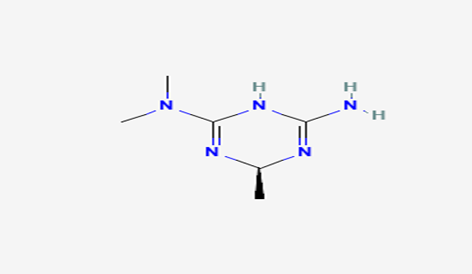
|
|
3) |
Class |
First?in?class “glimin” (tetrahydrotriazine) oral antidiabetic agent; “glimin” group. |
|
4) |
Molecular Formula |
C6H13N5 |
|
5) |
Molecular weight |
155.20 |
|
6) |
Appearance |
White to off-white crystalline powder |
|
7) |
physical state |
Solid |
|
8) |
Mechanism of action |
Mitochondrial function modulation Beta?cell effects Improvement of insulin action & reduction of hepatic glucose output |
|
9) |
Uses |
Treat Type 2 Diabetes Mallitus |
|
10) |
Side effects |
Nausea, abdominal pain, vomiting, diarrhea |
|
11) |
Half Life |
9– 20 Hours. |
Mechanism of action[4] :
Imeglimin acts through a distinctive therapeutic pathway by addressing the three core defects underlying type 2 diabetes: reduced glucose utilization in skeletal muscle, overproduction of glucose by the liver, and accelerated loss of pancreatic β-cell mass due to apoptosis. Clinical evidence demonstrates that imeglimin effectively lowers fasting plasma glucose (FPG) and glycated hemoglobin (HbA1c) levels when used alone or alongside other glucose-lowering medications, providing metabolic benefits across all stages of type 2 diabetes progression. Owing to these multifaceted effects, imeglimin represents a promising therapeutic option. In the interest of conciseness, the present review concentrates specifically on its impact on HbA1c and FPG.
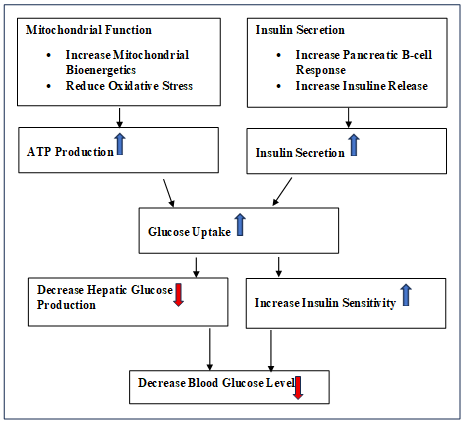
Figure 1 : Drug profile of imeglimin
Imeglimin belongs to the tetrahydrotriazine class of compounds and is chemically designated as (6R)-(+)-4-dimethylamino-2-imino-6-methyl-1,2,5,6-tetrahydro-1,3,5-triazine hydrochloride. Its principal site of action is the mitochondria of aerobic cells, where it modulates oxidative phosphorylation and also acts as a substrate for organic cation transporters. Experimental evidence suggests that imeglimin enhances insulin-dependent phosphorylation of protein kinase B (Akt) in both hepatic and skeletal muscle tissues.
Within the liver, imeglimin modifies mitochondrial substrate utilization and restores metabolic balance by preferentially supporting complex II activity, competitively inhibiting complex I, and re-establishing normal function of complex III. These mitochondrial effects contribute to reductions in hepatic fat accumulation and mitochondrial generation of reactive oxygen species (ROS). Pharmacokinetic investigations indicate that imeglimin is absorbed primarily in the stomach, followed by rapid systemic distribution and minimal binding to plasma proteins. Additionally, imeglimin does not appear to inhibit or induce cytochrome P450 enzymes. The drug is eliminated mainly via renal excretion, with the majority being excreted in its unchanged form.
Clinical studies[6-7] :
Evidence from multiple Phase II and Phase III clinical trials supports imeglimin as a potential alternative therapeutic option. In a four-week Phase IIa, randomized, three-arm parallel study involving 59 individuals with type 2 diabetes, Pirags and colleagues evaluated imeglimin against metformin and placebo, focusing on both safety and efficacy in lowering the area under the curve of plasma glucose concentrations (AUCPG

). Participants with baseline HbA1c values ranging from 6.5% to 8.5% were either treatment-naïve or previously managed with sulfonylurea or metformin monotherapy before enrollment. Subjects were randomly assigned to receive imeglimin at a dose of 2,000 mg once daily or 1,000 mg administered twice daily (BID). Participants in the comparator group received metformin at a dose of 850 mg twice daily or placebo, with mean baseline HbA1c values of 7.41%, 7.07%, and 7.27%, respectively. Among the treatment arms, twice-daily administration of imeglimin resulted in the largest reduction in the area under the plasma glucose curve (AUCPG) from baseline, followed by metformin and once-daily imeglimin dosing, with reductions of approximately 33%, 30%, and 10%, respectively. These findings suggested that the glucose-lowering effectiveness of imeglimin was comparable to that of metformin. In a separate multicenter, randomized controlled trial, 156 individuals with HbA1c levels exceeding 7.5% were assigned in a 1:1 ratio to receive either imeglimin 1,500 mg twice daily or placebo in addition to a stable metformin regimen (1,500–2,000 mg per day). Another multicenter, randomized, placebo-controlled study conducted by Fouqueray and colleagues enrolled 170 patients with HbA1c values greater than 7.5% who were receiving sitagliptin monotherapy. These participants were randomized to receive either sitagliptin plus placebo or sitagliptin combined with imeglimin 1,500 mg twice daily for a duration of 12 weeks.
Adverse events reported in the imeglimin treatment groups were comparable to those observed with placebo. Furthermore, no clinically meaningful differences were detected between treatment arms in changes from baseline to week 12 in triglyceride concentrations, C-reactive protein levels, or systolic blood pressure. Collectively, these findings indicate that twice-daily dosing of imeglimin provides greater efficacy than once-daily administration and can be safely combined with metformin or sitagliptin without increasing adverse effects relative to placebo.
A more recent, larger-scale study evaluated imeglimin as monotherapy in 299 Japanese adults with type 2 diabetes who were either treatment-naïve or previously managed with a single oral antidiabetic agent. This 24-week, randomized, double-blind, parallel-group, dose-ranging Phase IIb trial assigned participants in a 1:1:1:1 ratio to receive imeglimin at doses of 500 mg, 1,000 mg, or 1,500 mg twice daily, or placebo. The most frequently reported adverse events were infections and infestations, with a modestly higher incidence observed in the imeglimin groups compared with placebo.
DISCUSSION :
The precise mechanisms through which imeglimin enhances insulin sensitivity and supports β-cell function remain incompletely defined. Investigating its effects on inflammatory pathways, glucagon regulation, and mitochondrial activity may uncover additional pharmacological properties, further highlighting the therapeutic potential of this novel compound.
Imeglimin has generally demonstrated a favorable safety profile across recent clinical trials, with gastrointestinal adverse events occurring less frequently than with metformin. This review provides a broad overview of imeglimin, covering its mechanism of action and summarizing key studies from its clinical development program. Unlike a systematic review, the goal of this paper is to offer the medical community a comprehensive, narrative introduction to this emerging therapeutic agent.
REFERENCES


Patel Sarthikkumar, Dalwadi Mitali, Limbachiya Harsh, A Review on Imeglimin in Type 2 Diabetes as Potential Long Term Glycemic Control, Int. J. of Pharm. Sci., 2026, Vol 4, Issue 1, 2119-2123. https://doi.org/10.5281/zenodo.18327211
 10.5281/zenodo.18327211