

We use cookies to ensure our website works properly and to personalise your experience. Cookies policy
Department of Pharmacognosy, Centre for Pharmaceutical Sciences, University College of Engineering, Science and Technology, Jawaharlal Nehru Technological University Kukatpally, Hyderabad– 500085, Telangana state, India.
Satureja hortensis L., commonly known as summer savory, is a widely used aromatic and medicinal plant belonging to the Lamiaceae family. Traditionally utilized in folk medicine and culinary applications, it has drawn increasing scientific interest due to its broad spectrum of pharmacological activities. The plant is rich in bioactive constituents such as carvacrol, thymol, flavonoids, and essential oils, which contribute to its antimicrobial, antioxidant, anti-inflammatory, antispasmodic, and antidiabetic properties. This review provides a comprehensive summary of the phytochemical profile, ethnobotanical relevance, and therapeutic potential of Satureja hortensis. Various in vitro and in vivo studies highlight its effectiveness against bacterial and fungal pathogens, oxidative stress, gastrointestinal disorders, and metabolic syndromes. The article also discusses the safety profile and potential applications in pharmaceutical, cosmetic, and food industries. By consolidating current research findings, this review aims to facilitate further exploration and rational utilization of Satureja hortensis in modern medicine.
Summer Savoury, or Satureja hortensis, is an annual herb that is prized for its culinary, therapeutic, and decorative applications. This plant, which has a mildly peppery flavour, is a cooking need as well as a garden favourite. It is frequently used to improve the flavours of meats, drinks, soups, and other foods. Summer Savoury is an annual herb that grows swiftly, develops quickly, and is harvested in the summer, in contrast to its perennial cousin Winter Savoury. A member of the Lamiaceae family of mints, which also includes beebalm, thyme, and rosemary, summer savoury is an annual. It is indigenous to the Mediterranean area and southern Europe. The bushy, extremely fragrant plant has a pleasant perfume and a well-branched root structure. From the petiole-less stem, they grow in pairs. Flowers are two-lipped and either white or light pink. They grow in clusters of three to six on the top leaf axils from midsummer till frost and are about ¼ inch long. Since ancient times, people have planted summer savoury because of its peppery thyme/mint flavour, which can be used in a variety of recipes and is a great addition to a herb garden. Because the herb belonged to the legendary animals, the ancient Roman writer Pliny said that the Latin name for the plant, Satureja, was a derivation of the word for satyr. The Latin word hortus, which means garden, is the source of the specific epithet hortensis, which describes the practice of growing the plant in a garden. Since ancient times, summer savoury has been utilised, especially in Europe and the Mediterranean region. The Greeks and Romans prized it for its culinary and therapeutic qualities. It was once thought to possess aphrodisiac properties and was frequently utilised in herbal cures for respiratory and digestive disorders. The plant's antioxidant, antibacterial, anti-inflammatory, analgesic, hepatoprotective, and anticancer qualities are attributed to its essential oils, which are rich in phenolic compounds, flavonoids, and tannins. A wasp or bee bite might be less painful if the leaves of summer savoury are rubbed. Additionally, it lessens skin irritation. Additionally, the plant helps heal wounds, skin infections, and sore throats. A wasp or bee bite might be less painful if the leaves of summer savoury are rubbed. Additionally, it lessens skin irritation. A wasp or bee bite might be less painful if the leaves of summer savoury are rubbed. Additionally, the plant helps heal wounds, skin infections, and sore throats.
Culinary Uses: Its fragrant leaves are used to meats, soups, and stews as a spice in a variety of culinary traditions. The essential oil's great potential for antibacterial activity against food, plants, and human diseases is indicated by the presence of monoterpenes such carvacrol, cymene, and thymol.
Industrial Applications: Summer savoury is being investigated for use in natural food preservatives and medicinal formulations because of its bioactive components.(1)
Its importance in herbal medicinal system.
Summer savoury, or Satureja hortensis, is a fragrant plant recognised for its culinary use and possible therapeutic advantages. Although it is most known for adding flavour to a variety of foods, it has also been used traditionally as medicine. The therapeutic health advantages of summer savoury, its botanical description, and its historical use in traditional medicine will all be covered in this article. A wasp or bee bite might be less painful if the leaves of summer savoury are rubbed. Additionally, it lessens skin irritation.
Ancient Greek and Roman civilisations made extensive use of summer savoury. It was prized for its digestive qualities and frequently used to relieve bloating and indigestion. A wasp or bee bite might be less painful if the leaves of summer savoury are rubbed. Additionally, it lessens skin irritation. Additionally, the plant helps heal wounds, skin infections, and sore throats.
Summer savoury was a mainstay of ancient herbal therapy throughout Europe. It was used to treat a variety of illnesses, such as gastrointestinal distress, sore throats, and respiratory disorders.
The essential oil's great potential for antibacterial activity against food, plants, and human diseases is indicated by the presence of monoterpenes such carvacrol, cymene, and thymol. The analysis of SHEO derived from Iranian plants showed that it has strong antibacterial properties against a variety of bacteria, with least lethal concentrations and minimum inhibitory concentrations (MIC) that range from 0.06 L/mL for Candida glabrata to 8 L/mL for Pseudomonas aeruginosa.Summer savory's culinary and therapeutic uses have been linked throughout history. It was thought that eating foods with savoury spices may improve digestion and general health. Summer savoury has been used as a natural cure for colds, coughs, and as a general tonic in many folk medicine systems. The possible health advantages of summer savoury are still being investigated in contemporary herbal medicine. Although its historic applications are still recognised, its usage is not as widespread.Summer savoury is mostly used as a culinary herb, it also has significant therapeutic effects, particularly for the digestive tract as a whole. Compared to the closely related winter savoury, S. montana, the plant's effect is milder. The entire plant has antibacterial, fragrant, carminative, digestive, expectorant, and stomachic properties, but the flowering branches are particularly potent. When used internally, it is used to treat nausea, diarrhoea, bronchial congestion, sore throats, menstrual disturbances, and is considered a powerful medicine for colic and flatulence. Pregnant ladies shouldn't be prescribed it. When applied to bee or wasp stings, a sprig of the plant provides immediate relief. The plant may be used fresh or dried, and it is gathered in the summer when it is in blossom. In situations of early baldness, the essential oil is a component of scalp creams. The herb is used to make an external ointment that relieves arthritic joints.
Health benefits of summer Savory
Chemical components like thymol and carvacrol are found in the leaves of the plants. Carvacrol, an antibacterial phenolic chemical, combats a variety of bacterial species, including Bacillus cereus and E. coli. However, thymol has antifungal and antiseptic qualities that shield our bodies against a variety of fungal illnesses. Carvacrol's antibacterial qualities have led to its application as a preservative and addition in a variety of food products. In addition, it provides the meal a sour flavour. High-quality chemical components found in summer savoury leaves and young shoots have been demonstrated to have strong antioxidant properties, which lessen oxidative damage in the body. These also aid in raising the level of HDL, the good cholesterol, and removing excess LDL, the bad cholesterol, from the body. A wasp or bee bite might be less painful if the leaves of summer savoury are rubbed. Additionally, it lessens skin irritation. Additionally, the plant helps heal wounds, skin infections, and sore throats.
The summer savoury essential oil contains strong anti-inflammatory properties that help arthritis sufferers with their joint discomfort by lowering joint inflammation. Additionally, it lessens muscular soreness and oedema. Tannins, linalool, 1-borneol, cymol, and carvacrol are abundant in summer savoury. The herb helps cure digestive disorders such bloating, gas, cramping, diarrhoea, nausea, and lack of appetite because of these active chemical ingredients. The tea and juice of summer savoury leaves are excellent for digestive problems. A wasp or bee bite might be less painful if the leaves of summer savoury are rubbed. Additionally, it lessens skin irritation. Additionally, the plant helps heal wounds, skin infections, and sore throats.
The plant is used as a tonic to boost libido because of its aphrodisiac properties. The substances that treat erectile dysfunction and reproductive problems are not the same as the aphrodisiacs. Minerals and vitamins, including vitamin A, vitamin C, vitamin B1, vitamin B3, potassium, calcium, magnesium, manganese, zinc, and selenium, are abundant in the plant. One essential element that aids in regulating irregular pulse and blood pressure is potassium. Red blood cell production requires iron, and antioxidant enzymes require manganese as a co-factor.
Summer savoury leaves contain vitamin A, which is helpful for healthy skin and mucosa and also helps with eyesight. A wasp or bee bite might be less painful if the leaves of summer savoury are rubbed. Additionally, it lessens skin irritation. Additionally, the plant helps heal wounds, skin infections, and sore throats.
Summer savoury leaf tea can be used to prevent colic, urinary retention, and uterine contractions as well as to treat internal health issues. The herb's antibacterial qualities aid in improved liver and kidney function. A wasp or bee bite might be less painful if the leaves of summer savoury are rubbed. Additionally, it lessens skin irritation. Additionally, the plant helps heal wounds, skin infections, and sore throats.
Description
Aromatic, annual, 10–25 (-35) cm tall, with sessile glands and short, simple appressed hairs covering every part of the plant. Stems are upright, coated in short, white, spreading glandular and eglandular hairs, and measuring 15 to 35 mm for lower internodes and 20 to 40 mm for inflorescence internodes. Similar in form to the cauline leaves, the floral leaves are obtuse, conduplicate, linear or linearlanceolate, and 10 to 30 (-40) mm long by l to 4 (-5) mm broad. Peduncle up to 4 mm (if present), pedicel up to 2.5 mm (if present), flowers frequently sessile, verticillasters distant, crowded to lax, and 2 to 20 flowered. Green, campanulate, 3–5 mm calyx with somewhat uneven, linear to subulate teeth up to 3 mm. Pink or white, 5–10 mm, corolla lavender tube that is part of or slightly protruded from the calyx. Nutlets are broadly elliptic, 1.2–1.3 mm length, c. 1 mm wide, and brown to dark brown.(2)
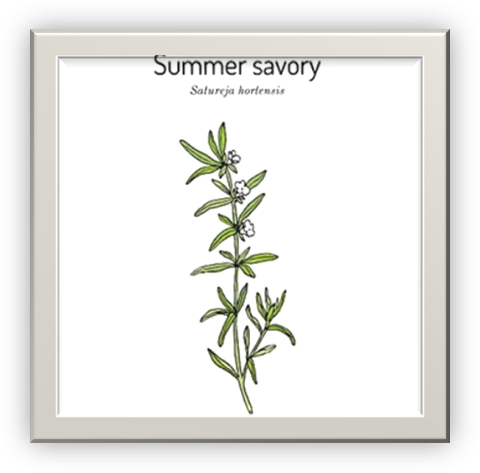
Figure.1. Plant
Geographical distribution of Satureja hortensis:
Satureja hortensis is home to an area that originated in Asia and is now known as Euri-Mediterranea. It is a species with varied dispersion that is found in Sicily in subspace forms as well as in the North and Centre of Italy. Its occurrence in the Alps is irregular. This species is found outside of Italy, always in the Alps, in Austria (Länder of North Tyrol, Eastern Tyrol, Salzburg, and Carinthia), and France (Alpes-de-Haute-Provence, Hautes-Alpes, Alpes-Maritimes, Drôme, Isère, and Haute-Savoie). The Central Massif and the Pyrenees are home to the other European reliefs associated with the Alps. It is found throughout Anatolia and the Mediterranean region of the rest of Europe. Above all, Satureja hortensis thrives in dry, arid environments, such as walls, sandy or gravelly areas, and Mediterranean xerofile breeds. The ideal substrate is siliceous and calcareous, has a neutral pH, and has excellent nutritional qualities. The soil also has to be somewhat wet.
Phytochemical Constituents:
Numerous investigations into the volatile oils and, less often, extracts of S. hortensis have provided insight on the chemical makeup of summer savoury. In terms of overall composition, the fresh leaves include 72% moisture, 4.2% protein, 1.65% fat, 4.45% sugar, 8.60% fibre, and 2.11% ash(3). When examining the composition on a dry weight basis, the primary sources of bioactive chemicals include triterpenic acids, mucilage, resins, sugars, mineral salts, volatile oil (up to 5%), and tannins (up to 8%) (4). Carvacrol, thymol, phenols, and flavonoids are the main constituents of the volatile oil that was extracted from summer savoury(5). Several investigations have identified the primary components of volatile oils as p-cymene (3.5–19.6%), carvacrol (11–67%), terpinene (15.30–39%), and thymol (0.3–28.2%) (3,6 ,7-10). Even if the findings of each study varies noticeably, they all typically show the same composition of volatile oils (apart from the main components that indicate the existence of phellandrene, and-pinene, and-sabinene). terpineol, α-thujene, sabinene, phellandrene, α- and β-pinene, etc.). Seasonal fluctuation, climatic conditions, agronomic practices, genetic structure, etc. are the reasons for the writers' disparate findings (11). Therefore, while talking about the possible uses of essential oils or extracts made from . To give a clear picture of the assessed outcomes, summer savoury should at least include the harvesting area and overall composition. Comparing the extracts from S. hortensis aerial parts to the essential oils, the former have been the focus of somewhat less investigations. It was shown that rosmarinic acid (24.9 mg/g), caffeic acid (1.3 mg/g), naringenin, isoferulic acid, apigenin, and other flavones luteolin dominated the methanolic extract that was produced by maceration and their coumarin derivatives (aesculetin and aesculetin), flavonol (quercetin), flavonol glycosides (isoquercitrin, astragalin, and quercitrin), and their glycosides (apigetrin and vitexin) were found(12). The total phenolic content varied between 119 and 151 mggallic acid equivalents, according to a comparative analysis of the effects of several extraction techniques (Soxhlet extraction, maceration, ultrasound-assisted extraction, microwave-assisted extraction, and subcritical water extraction) on the composition of the summer savoury extracts.
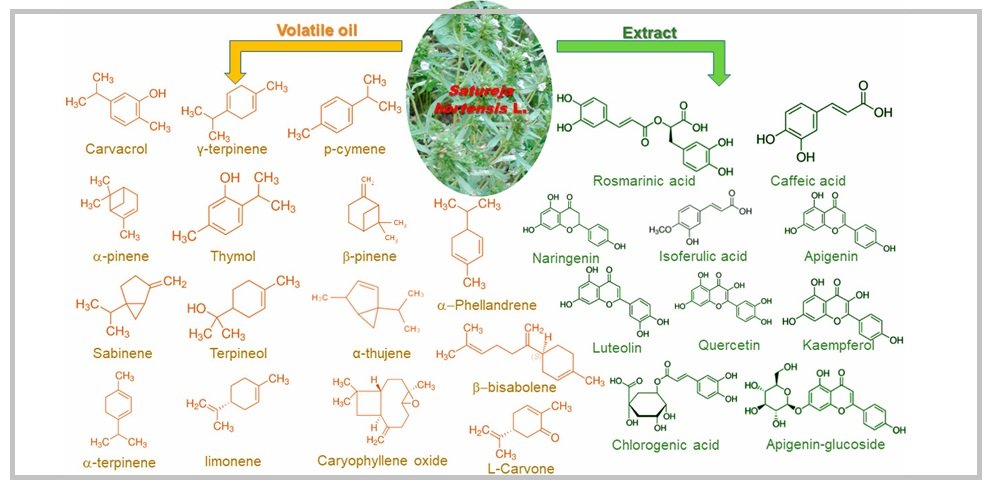
Figure.2. The chief components of Satureja hortensis Aerial parts Responsible for the biological activity.
The Biological Activity of satureja hortensis
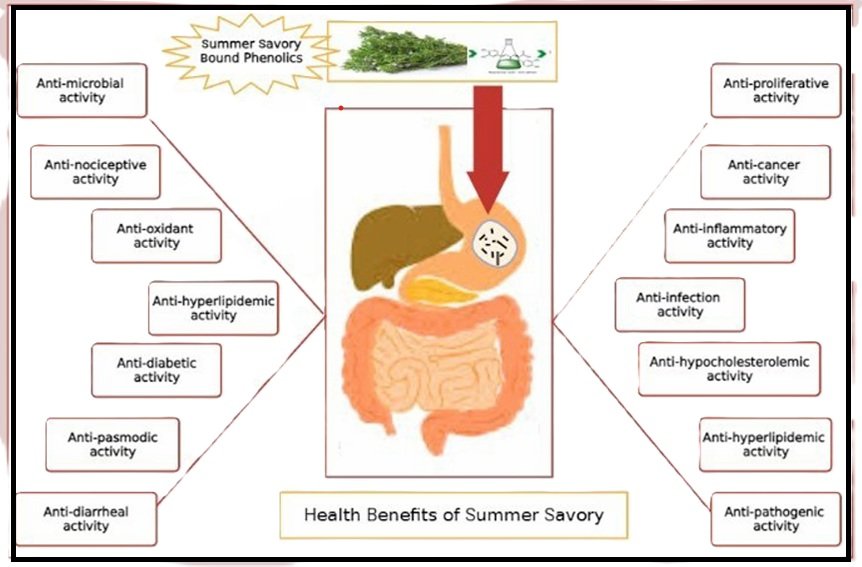
Figure.3. Health Benefits
Anti-Oxidant Activity
Studies conducted in vitro have shown that S. hortensis essential oil has antioxidant action because of the presence of polyphenolic components(5). Several tests have demonstrated that commercial essential oil (from Iran) has a significant antioxidant impact.Such as ferric thiocyanate, carotene bleaching, 2,2-azinobis (3-ethylbenzothiazoline-6-sulfonate) diammonium salt (ABTS), and 2,2-diphenyl-1-picrylhydrazyl (DPPH) (13).Chitosan nanoparticles' antioxidant qualities (ranging from 43.66% to 56.99%, as measured by the DPPH assay) were directly correlated with the EO content when Satureja hortensis essential oil (SHEO), which was obtained by hydro-distillation from Turkish vegetal material, was added. Given the primary constituents found in summer savoury essential oil and the literature review, the high concentration of carvacrol, terpinene, p-cymene, and thymol molecules with established antioxidant activity may be responsible for the SHEO antioxidant activity (14,15). At the same time,Rosmarinic acid, caffeic acid, naringenin, quercetin, apigenin, kaempferol, luteolin, chlorogenic acid, rutin, and apigenin-glycoside—components of S. hortensis extracts—are also well-known for their capacity to serve as antioxidants(16,17). Natural extracts from S. hortensis are now being evaluated for application in the meat industry (the water leaf extract extended the shelf life of ground beef)(18) or as an antioxidant in mayonnaise formulations(19) because of the demonstrated antioxidant activity.
Antimicrobial Activity
The essential oil's great potential for antibacterial activity against food, plants, and human diseases is indicated by the presence of monoterpenes such carvacrol, cymene, and thymol(20). The analysis of SHAP derived from Iranian plants showed that it has strong antibacterial properties against a variety of bacteria, with least lethal concentrations and minimum inhibitory concentrations (MIC) that range from 0.06 L/mL for Candida glabrata to 8 L/mL for Pseudomonas aeruginosa.
Anti Inflamatory Activity
Albino rats (weighing 150–180g) were used to test the essential oil's anti-inflammatory properties by inducing ear edema with xylene. Each rat was given xylene to produce edema.
(0.03mL) to the right ear's anterior and posterior surfaces. Thirty minutes before to the start of inflammation, the rats received intraperitoneal injections of 20, 50, and 100 mg/kg essential oil. The animals in the control group received no treatment. The reduction of mass discrepancies between the right and left ears was used to measure the anti-inflammatory activity.(21,22).
Antinociceptive activity
Essential oils are utilized in antinociceptive experiments to measure the "tail-flick" test for pain inhibitory efficacy using the ANALGESY-METER LE 7106 (Panlab) device (Germany).
After injecting the rat with radiant heat for 30, 60, 90, and 120 minutes, the latency of the rat to withdraw its tail from the heat is measured. In order to prevent tissue injury, the maximum duration of heat exposure was 20 seconds. Ten mice per group received a pretreatment consisting of saline with 1% dimethyl sulfoxide (DMSO) and intraperitoneal injections of essential oil (EO 20, 50, and 100 mg/kg)(23).
Wound healing effect
Planimetry, pH measurement, and antimicrobial analysis were used to assess the progress of injured tissue regeneration. The 10% ointment from Satureja h. essential's capacity for regeneration Studies have been conducted on oil under thermal burn conditions. A short ether anesthesia was administered to white male albino rats weighing 180–200g. The hair was removed in order to prepare the dorsal skin. The animal's back was covered with hot, 4x3 centimeter stainless steel plates that were 200 °C. Vehicle or test ointments were used to cure burns. The percentage of wound healing was computed for each 3-day period after the wound area was assessed(24).
Summer savory and reproduction stimulatory effects
S.H essential oil significantly increased the fertility index, fecundity, litter index, and potency in a research on male rat fertility. It also decreased the loss following implant Additionally, the weights of the testes, testosterone, and FSH were concentrated, and the weights of the ventral prostate, these minalvesicles, and the testes themselves were significantly enhanced. These changes may be related to the essential oils' antioxidant capacity. The main antioxidants found in Satureja species include flavonoids, carvacrol, and pcymene. The findings show that this genus has stimulatory effects on reproduction(25).
Cardiovascular Effects
Various studies have demonstrated the anticoagulant blood effects of S. hortensis. Carvacrol, monoterpene hydrocarbons, flavonoids, and phenolic acids
and apigenin (labiatic acid), which may all contribute to the anti-platelet action of S. hortensis (26) Its traditional use may be explained by the fact that S. hortensis methanol extract has been demonstrated to decrease secretion, aggregation, and blood platelet adhesion.
in the management of heart problems and blood clots(27).
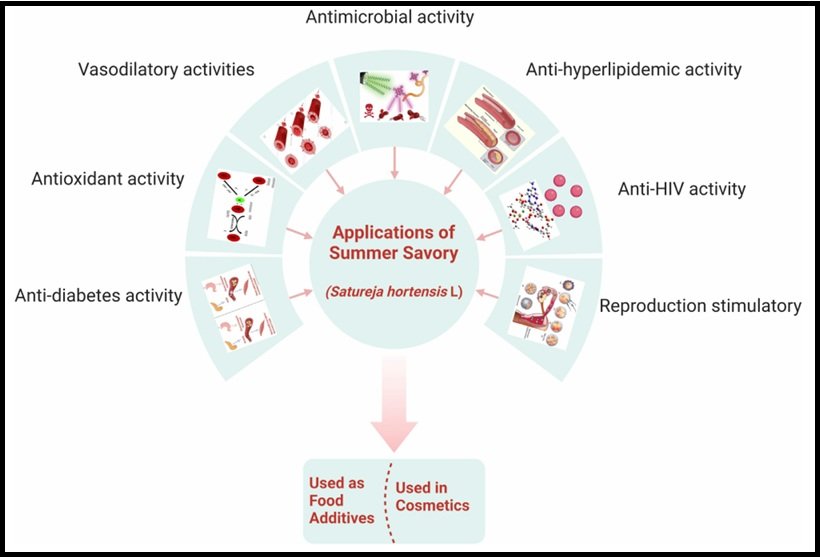
Figure.4. Applications
Genotoxic effect
Zani et al. (1991) used the Salmonella/microsome reversion test and the Bacillus subtilis rec-assay to investigate the genotoxic qualities of the essential oils of S. hortensis and S.montana. Both oils showed modest action in Salmonella and rec-assay assays. The benefits of using these two short-term microbiological tests in tandem for genotoxic investigations were also covered in this paper.
Karpouhtsis et al. (1998) also examined the genotoxic effects of S. thymbra's essential oil and its primary components, carvacrol and thymol, in Drosophila. This paper states that only thymol showed genotoxic action out of the five chemicals examined in the somatic mutation and recombination test on Drosophila(28,29).
Applications of summer savory
Because of its preeminent medicinal action and food and pharmaceutical uses, S.hortensis is utilized globally as a food ingredient, seasoning, and spice as well as in herbal drinks. Additionally, summer savory oil has been utilized in fragrances and cosmetics, both by itself and in conjunction with essential oils. Savory species are mostly used to treat digestive conditions like indigestion, cramps, nausea, and diarrhea as well as muscular soreness and flatus. S. hortensis also has antifungal, antibacterial, antioxidant, anti-hyperlipidemic, anti-HIV, anti-diabetic, expectorant, reproduction-stimulatory, and vasodilatory effects. Ancient medical texts have shown that Saturejaspp. has a therapeutic effect on respiratory conditions including asthma and coughing(30,31,32,33).
Summer savory and its toxicity
When a chemical substance or a portion of a chemical combination is toxic, it can harm an organ. Many people use antioxidants as dietary supplements and nutraceuticals, which can prolong ideal state of health. Although it is often known that "excess of everything is bad," it is less well understood that consuming a lot of antioxidants can also have negative consequences. Conversely, several antioxidants are utilized to highlight broad points regarding antioxidant toxicity. Some guidelines for assessing the toxicity of antioxidants include understanding the effectiveness mechanism, bio-kinetic/bio-efficacy modeling, traditional safety criteria, and antioxidant. It is suggested that the methanolic extract of the summer savory aerial component guards against oxidative damage caused by cisplatin, which is how supplements transforms into treatment.Intraperitoneal injection of cisplatin was used to cause toxicity. The findings support the idea that summer savory may be a good source of phenolic chemicals for both medicinal and nutritional purposes.Summer savory can help maintain normal health parameters or even treat certain oxidative damage disorders. Additionally, S. hortensis has fewer known adverse effects; nonetheless, its usage is advised to be avoided by those on chronic illness medications(34,35).
Usage and applications in food science
The spoiling and destruction of food, vegetables, and fresh fruits are often caused by a variety of microbial contaminations. When these meals are exposed to a humid atmosphere with a high moisture content and high temperature, the rate of deterioration accelerates quickly. This is a serious problem for the food business and the environment. Food, particularly stored food products containing oils and fats, may deteriorate due to chemical spoiling, which is mostly brought on by oxidation that generates ROS during lipid peroxidation. The primary cause of the loss of food's taste, color, and nutritional value is this degradation. The presence of ROS can harm cells and cause major issues for theconsumers of these food items. The use of preservatives in the food business is required to avoid food contamination and degradation due to the risk of food components oxidizing and the issue of microorganisms contaminating food items during storage. Oxidation of molecules should be prevented by employing antioxidant substances in order to prevent initiating the oxidation reaction and to postpone its advancement. Synthetic preservatives are typically employed to stop these oxidation processes. Using synthetic antioxidants like tert-butylhydroquinone, butylated hydroxyanisole, and butylated hydroxytoluene (BHT) is not safe, and prolonged use of these substances can cause health issues including cancer and other toxicity.
Summary points of SHAP
CONCLUSION
Satureja hortensis emerges as a valuable medicinal herb with a wide array of therapeutic benefits supported by traditional knowledge and modern pharmacological studies. The plant's rich content of essential oils—particularly carvacrol and thymol—underpins its strong antimicrobial and antioxidant activities. Additionally, its roles in anti-inflammatory, antispasmodic, antidiabetic, and gastroprotective mechanisms make it a promising candidate for complementary and alternative medicine. Despite the considerable data supporting its biological activities, more in-depth clinical research is necessary to substantiate these claims and ensure safe therapeutic application. Furthermore, the growing demand for natural remedies positions Satureja hortensis as a sustainable and multipurpose herbal resource that holds promise in pharmacological and nutraceutical development.
Future Prospects
To fully realize the therapeutic and commercial potential of Satureja hortensis, future research should focus on the following areas:
By addressing these areas, Satureja hortensis may find a well-established place in evidence-based herbal medicine and natural product industries.
REFERENCES


Poloju Pravalika*, Dr. M. Sandhya Rani, A Review on Satureja Hortensis, Pharmacognostical Overview Forgotten Herb with Emerging Applications, Int. J. of Pharm. Sci., 2025, Vol 3, Issue 8, 177-189. https://doi.org/10.5281/zenodo.16723871
 10.5281/zenodo.16723871