

We use cookies to ensure our website works properly and to personalise your experience. Cookies policy
1,2,3, Department Of Pharmaceutics, Karmayogi Tatyasaheb Bondre Institute Of Pharmacy, Chikhli dist. 4 4Buldhana, Maharashtra (India) – 443201
Anuradha Collage Of Pharmacy, Chikhli Dist. Buldhana, Maharashtra (India) – 443201.
One of the key factors in achieving the required drug concentration in the systemic circulation for pharmacological response is solubility, which is the phenomenon of a solid dissolving in a liquid phase to produce a homogenous system. A drug's bioavailability and pharmaceutical development are hampered by poor water solubility. More than 40% of novel chemical entities have inadequate bioavailability and poor solubility. These medications fall within BCS class II, which is characterized by high permeability and poor solubility. The biggest problem facing formulation scientists is the behavior of medication solubility. Since their bioavailability is mostly dependent on the dissolution process in the GIT, poorly water-soluble medications have been demonstrated to be slowly and unexpectedly absorbed when taken orally. Therefore, hydrotropy, co-crystallization, co-solvency, salt creation, complexation, and solid dispersion are some of the methods utilized to improve the solubility of poorly soluble drugs in water. Several methods for improving the solubility of medications that are poorly soluble in water are highlighted in this review article
The therapeutic efficacy of a medicine depends not only on its bioavailability but also on the solubility of its molecules. Medication solubility is the highest concentration of the medication dissolved in the solvent under certain condition of
temperature, pH and pressure. As solubility is a significant determinant in drug liberation consequently it plays a major function in its bioavailability. For absorption of any medicine it must be present in the form of an aqueous solution at the site of absorption. About 40% of all novel chemical entities have low bioavailability. The bioavailability can be raised by modifications in disintegration and dissolution. Aqueous solubility smaller than 1 μg/ml will undoubtedly produce a bioavailability problem and will influences the efficacy of the medicine. There are number of methods through which aqueous solubility of the drug can be increased. Especially for class II substances according to the Bio pharmaceutics Classification System (BCS), the bioavailability may be improved by raising the solubility and dissolution rate of the drug in the gastro-intestinal fluids [1].
TABLE NO: 1 Solubility Expression
|
Definition |
Parts of solvent required for one part of solute |
|
Very soluble |
Less than 1 |
|
Freely soluble |
From 1 -10 |
|
Soluble |
From 10 -30 |
|
Sparingly soluble |
From 30-100 |
|
Slightly soluble |
From 100-1000 |
|
Very slightly soluble |
From 1000 -10,000 |
|
Insoluble |
Greater than 10,000 |
Biopharmaceutics classification system (BCS)
The system was created by the US Food and Drug Administration (FDA) and classifies medications into four groups based on their solubility and permeability. Due to low solubility, dissolution is the rate-limiting step for drug absorption in Class II and Class IV systems.
TABLE NO: 2 BCS Classification of Drug [2].
|
Class |
Permeability |
Solubility |
|
I |
High |
High |
|
II |
High |
Low |
|
III |
Low |
High |
|
IV |
Low |
Low |
Process of solubilisation
The process of solubilization involves the solute's inter-ionic or intermolecular bonds being broken, the solvent's molecules being separated to make room for the solute, and interactions between the solvent and the solute molecule or ion. As illustrated in Figure 1, holes appear when the solute binding breaks down during the solubilization process. As seen in Figure 2, solid molecules disintegrate during the solubilization process due to the disruption of intermolecular bonds. The solvent seen in Figure 3 incorporates the liberated solid molecule. [3].
Fig. 1: Holes opens in the solvent
Fig. 2: Molecules of the solid breaks away from the bulk
Fig. 3: The freed solid molecule is integrated into the hole in the solvent
Factor affecting
Factor affecting solubility
Chemical Structure, including molecular size, shape and functional groups influences the solubility factor of drugs.
Most of the substances dissolves easily in hot liquids as compared to cold liquids.
Pressure affects the solubility of gases in liquids, as the pressure is increased solubility is increased.
Solubility of substance sometimes increases or decreases depending upon the pH of the medium.
Increase in the concentration of substance leads to an increase in solubility.
Polar substances dissolve easily in polar solvents and non-polar dissolves easily in non-polar solvents, "like dissolves like".
It can affect the solubility as they can compete for solute-solvent interactions or can form complex with the solute.
Increase in surface area leads to an increase in solubility [4].
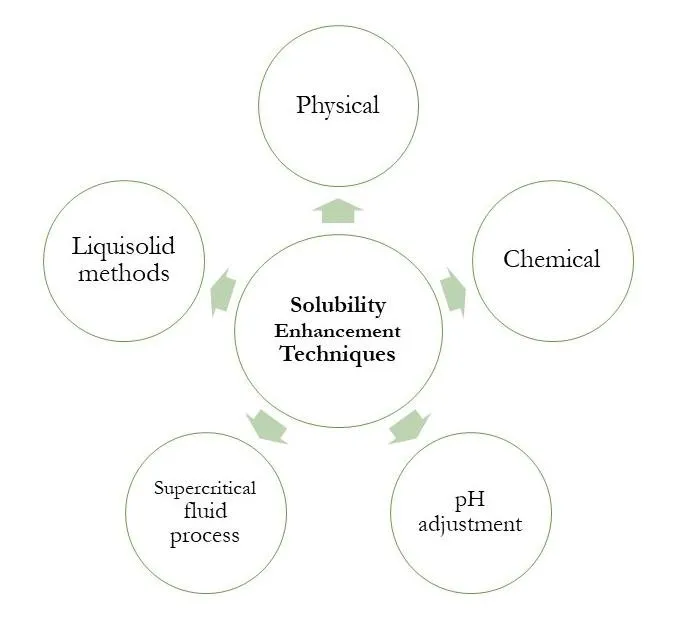
Fig. 4: Broad classification of solubility enhancement techniques [5]
TABLE NO: 3 TECHNIQUES TO OVERCOME POOR SOLUBILITY [6]
|
Category |
Technique |
Sub-techniques / Examples |
|
I. Chemical Modification Techniques |
Salt formation |
Conversion of drug into more soluble salt form |
|
Co-crystallization |
Drug–co-former co-crystals |
|
|
Co-solvency |
Use of water-miscible organic solvents |
|
|
Hydrotropy |
Use of hydrotropic agents |
|
|
Novel solubilizers |
Cyclodextrins, polymeric solubilizers |
|
|
Nanotechnology-based modification |
Drug nanoparticles, nanocarriers |
|
|
II. Physical Modification Techniques |
Particle size reduction |
Conventional milling, Micronization |
|
Crystal habit modification |
Polymorphs, Pseudopolymorphs |
|
|
Nanosuspensions |
Drug nanocrystals stabilized by surfactants |
|
|
III. Complexation Techniques |
Physical mixture |
Simple blending with complexing agents |
|
Kneading method |
Wet massing and drying |
|
|
Co-precipitation method |
Simultaneous precipitation of drug and carrier |
|
|
IV. Inclusion Complexation Techniques |
Kneading method |
Cyclodextrin-based complexes |
|
Lyophilization / Freeze drying |
Molecular level dispersion |
|
|
Microwave irradiation |
Rapid complex formation |
|
|
V. Surfactant-Based Solubilization |
Microemulsions |
Thermodynamically stable systems |
|
SMEDDS |
Self-microemulsifying drug delivery systems |
|
|
VI. Drug Dispersion in Carriers |
Solid solutions |
Molecular dispersion in solid carrier |
|
Solid dispersions |
Fusion method |
|
|
Solvent evaporation method |
||
|
Fusion-solvent method |
||
|
Spray drying |
||
|
Lyophilization / Spray freeze drying |
||
|
Hot-melt extrusion |
||
|
Dropping method |
||
|
VII. pH Modification Techniques |
pH adjustment |
Ionization-based solubility enhancement |
|
VIII. Supercritical Fluid Technology |
SCF processing |
Supercritical CO₂ based particle engineering |
|
IX. Liquisolid Technique |
Liquisolid systems |
Drug dissolved in non-volatile solvent and converted to solid |
|
X. Polymeric Alteration Techniques |
Polymeric modification |
Use of hydrophilic polymers and polymeric carriers |
Co-solvency
Drugs that are poorly soluble in water can be made more soluble by combining them with a water-miscible solvent in which they dissolve easily. The solvent employed in combination is referred to as a co-solvent, and this process is called co-solvency. The co-solvent system functions by lowering the interfacial tension between the hydrophobic solute and aqueous solution. The addition of an organic co-solvent to water causes a significant shift in the solubility of medications; this process is also known as solvent blending. The hydrogen acceptor or donor groups in the co-solvents have a little hydrocarbon area. The hydrophobic hydrocarbon region usually interferes with the hydrogen bonding network of water which. Consequently reduces the intermolecular attraction of water while the hydrophilic hydrogen bonds ensures water solubility [7].
Nanotechnology Approaches:
Drugs with low solubility will be improved by the application of nanotechnology. The study and application of materials and structures at the nanoscale level of roughly 100 nanometers (nm) or less are collectively referred to as nanotechnology. Because micronized products have very little effective surface area for dispersion, oral bioavailability improvement via micronization is insufficient for many new chemical entities with very low solubility. Nanonization is the next phase [8].
Co-crystallization
The use of co-crystals, also known as molecular complexes, is an innovative approach to enhance medication solubility. A solvent may be referred to as a co-crystal if it forms at least two component crystals and is an essential component of the network structure. The solvent is referred to as clathrate (inclusion complex) if it does not actively participate in the network itself, as in open framework structures. A crystalline material made up of two or more molecular (and electrically neutral) species bound together by non-covalent forces is known as a co-crystal. Because the co-crystallizing agents are solids at room temperature, co-crystals are more stable [9].
Salt Formation
Salts have improved solubility and dissolution characteristics in comparison to original drug. The minimum three unit difference between pKa value of the group and that of its counter ions required to form stable salt. Alkali metals salt of acidic drug like penicillin and strong acid salt of basic drug like atropine are more stable than parent drug [10].
Particle size reduction
Particle size reduction can be achieved by micronisation and Nano suspension. Each technique utilizes different equipments for reduction of the particle size.
Nano suspension
Nano suspensions are sub-micron colloidal dispersion of pure particles of drug, which are stabilized by surfactants. The advantages offered by Nano suspension increased dissolution rate is due to larger surface area exposed, while absence of Ostwald ripening is due to the uniform and narrow particle size range obtained, which eliminates the concentration gradient facts.
Micronization
The solubility of drug is often intrinsically related to drug particle size. By reducing the particle size, the increased surface area improves the dissolution properties of the drug. Conventional methods of particle size reduction, such as comminution and spray drying, rely upon mechanical stress to disaggregate the active compound. The micronization is used to increased surface area for dissolution". Micronization does not improve equilibrium solubility; instead, it enhances the rate at which pharmaceuticals dissolve by increasing their surface area. Drug micronization is accomplished through the use of jet mills and rotor stator colloid mills. Eat, because micronization does not alter the drug's saturation solubility, it is not appropriate for medications with high dosage numbers [11].
Techniques for Micronization
Modification of the crystal habit
The ability of an element or compound to crystallize in multiple crystalline forms is known as polymorphism. Unique. Despite having the same chemical makeup, drug polymorphs differ in their solubility, melting point, density, texture, and stability, among other physical characteristics. Similarly, a drug's amorphous form is always preferable to its crystalline form because of its increased surface area and higher associated energy. Order for drug dissolution in various solid forms Metastable polymorph > Amorphous Stable polymorphism [12].
Complexation is the association between two or more molecules to form a non-bonded entity with a well-defined stoichiometry. It relies on relatively weak forces such as London. Forces, hydrogen bonding and hydrophobic interactions. There are many types of complexing agents
TABLE NO: 4 LIST OF COMPLEXING AGENT
|
TYPE |
EXAMPLES |
|
Inorganic |
Ib |
|
Coordination |
Hexamine Cobalt (III) Chloride |
|
Chelates |
EDTA, EGTA |
|
Metal-Olefin |
Ferrocene |
|
Inclusion |
Cyclodextrins, Choleic acid |
|
Molecular Complexes |
Polymers |
Staching Complexation:
These are formed by the overlap of the planar regions of aromatic molecules. Non polar moieties tend to be squeezed out of water by the strong hydrogen bonding interactions of water. This cause some molecules to minimize the contact with water by aggregation of their hydrocarbon moieties. This aggregation is favoured by large planar non polar regions in the molecule stached complexes can be homogenous (self-association) or mixed (complexation) eg., Nicotinamide, Anthracene, Pyrene, Methylene Blue [13].
This is most widely used method to enhance water solubility and increase stability of hydrophobic drugs by using cyclodextrins. Solid inclusion complexes can be prepared by using following methods.
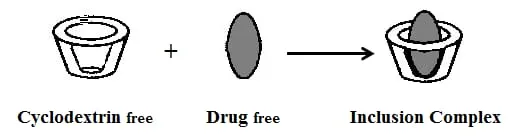
Fig. 5: CD-Drug complex
This method is based on impregnating the CDs with little amount of water or hydro alcoholic solutions to converted into a paste. The drug is then added to the above paste and kneaded for a specified time. The kneaded mixture is then dried and passed through sieve if required [14].
This procedure, which can also be called a substitute for solvent evaporation, involves the molecular mixing of medication and solvent in a shared solvent. Water's special ability to function as a solvent, gas, diluent, plasticizer, and stabilizer is essential to lyophilization. Using this technique, the drug and cyclodextrin-containing solution is first frozen and then dried at low pressure to remove the solvent system.
This technique uses a microwave oven to create a microwave irradiation reaction between the complicated agent and the medication. In R.B.F., the medication and cyclodextrin are combined in a solution of organic solvent and water in a predetermined molar ratio. Next, the reaction is started in a microwave at 60°C for one to two minutes. After the reaction is finished, enough solution is added to eliminate the remaining, uncomplexed free medication and cyclodextrin. The precipitate is then filtered using Whatman filter paper and dried for 48 hours at 40°C in a vacuum oven [15].
Micro emulsion is known as a system of water oil which thermodynamically stable liquid solution. A micro emulsion can be divided of four component system such as internal phase, external phase, surfactant and Co-surfactant, Non-sonic surfactant like labrafil and tweens with high hydrophile-lipophlie balances which are used to formation of oil-in water droplets during the production In micro emulsion technique, many equipment are used such bath, stirring rod, volumetric flask and homogenizer Micro emulsion is known as the isotropic, clear pre concentrate, thermodynamically stable translucent system which is containing a mixture of oil, hydrophilic solvent and hydrophilic surfactant dissolved in a poorly water soluble drug [16].
Uses the concept of in-situ development of emulsion in the gastrointestinal tract. The mixture of oil, co-surfactant, surfactant one or more hydrophilic solvents and co- solvent forms a transparent isotropic solution that is known as the self-emulsifying drug delivery system (SEDDS). Self-emulsifying drug delivery systems (SEDDS) and self microemulsifying drug delivery systems (SMEDDS) are isotropic solutions of oil and surfactant which form oil-in-water microemulsions on minor agitation in the presence of water. These new colloidal preparations on oral administration act like oil-in-water microemulsions [17].
Solid dispersion
In the early 1960s, Sekiguchi and Obi developed the idea of solid dispersions by examining the production and dissolution capabilities of eutectic melts of a sulphonamide medication and a water-soluble carrier. One practical pharmaceutical method for improving the dissolution, absorption, and therapeutic efficacy of medications in dose forms is the use of solid dispersions. A collection of solid goods made up of at least two distinct components—typically a hydrophilic matrix and a hydrophobic drug—are referred to as solid dispersions. Solid dispersions of polyvinylpyrrolidone (Povidone, PVP), polyethylene glycols (PEGs), and Plasdone $630 are the most used hydrophilic carriers. Solid dispersion formulations also include surfactants such as Tween-80, docusate sodium, Myrj-52, Pluronic-F68, and sodium lauryl sulphate (SLS) and ritonavir can be enhanced by solid dispersion with appropriate hydrophilic carriers, such as ritonavir with gelucire and celecoxib with povidone (PVP) [18].
Manufacturing methods of solid dispersion
Solvent evaporation method: In the solvent evaporation method, the medication and carrier are dissolved in a common solvent, which is then evaporated under vacuum to create a solid solution. The medicine (B-carotene) and its carrier (PVP) were initially dissolved in a common solvent by Tachibechi and Nakumara. To create a solid dispersion, evaporate the solvent under vacuum. Solvents like ethanol, chloroform, or a combination of ethanol and dichloromethane are frequently used. In certain situations, cosolvant may be used since it may be necessary to employ a lot of solvents and heat in order to completely dissolve the medicine and carrier. The primary benefit of the solvent approach is that, due to the comparatively low temperatures needed for the evaporation of organic solvents, thermal breakdown of medications or carriers can be avoided. The disadvantages of the solvent approach include the following: it is costly, environmentally harmful, and challenging to locate common and removable solvents; it is difficult to fully remove liquid solvent; and it is challenging to replicate crystal form.
If the pH varies, a medication that is poorly soluble in water might dissolve. When obtaining solubility using this method, the buffer capacity and tolerance of the selected pH must be taken into account. 1961 Drug solubility is increased by excipients that raise the pH of the environment in the dosage form to a level higher than the pKa of weekly acidic medications; weekly basic medications may be made more soluble by excipients that act as alkalizing agents. It can also be applied to lipophilic and crystalline weakly soluble materials [21].
This technology has been introduced in late 1980s and early 1990s. Since the first experience of Hannay et al., in 1879, a number of techniques has been developed and patented in the field of SCF process. SCF technique can be applied to the preparation of solvent-free solid dispersion dosage form to enhance the solubility of poorly soluble compounds. A solid dispersion of Carbamazepine in polyethylene glycol (PEG) 4000 increased the rate and extended the dissolution of Carbamazepine. In this method, a precipitation vessel was loaded with solution of Carbamazepine and PEG-4000 in acetone, which was expanded with supercritical CO₂ from the bottom of the vessel to obtain solvent-free particles. SCFs either as solvent: Rapid expansion from supercritical solution (RESS) or as antisolvent: Gas antisolvent (GAS) and supercritical antisolvent (SAS) [22].
This system is refers to the Formulations which is formed because of the liquid drugs, drug solution or drug suspension in a nonvolatile solvent into a Dry, Free flowing, Non adherent and a Compressible powder as well as stable Mixture by blending the suspension or solution, using the suitable carriers and coating materials. There are various grades of starch, Lactose and cellulose available and that can be used as a Carrier. Also Silica powder may be used as a good coating material by using a very fine grade. The process of emulsification which increases surface area of particles and that can leads to increase in the drug release profile from the suitable vehicle. In this the surfactant play an Imp. Role which can mimic the formation of micelles in a bile salts and because of this solubility characteristics of poorly water soluble drug is increases. The Rate and Extent of absorption of drug is affected if the dissolution as well as solubilization characteristics of hydrophobic drug are changed [23].
REFERENCES


Vaishnavi Ramavat, Mangesh Gadekar, R. Pagore, K. Biyani, A Review on Techniques to Enhance Solubility of Poorly Aqueous Soluble Drug, Int. J. of Pharm. Sci., 2026, Vol 4, Issue 7, 1468-1477, https://doi.org/10.5281/zenodo.21242564
 10.5281/zenodo.21242564